Retinol vs Retinal vs Granactive Retinoid: What Is the Difference?
Understand how retinol, retinal and granactive-retinoid labels differ, what percentages do and do not mean, and how to introduce a night product carefully.
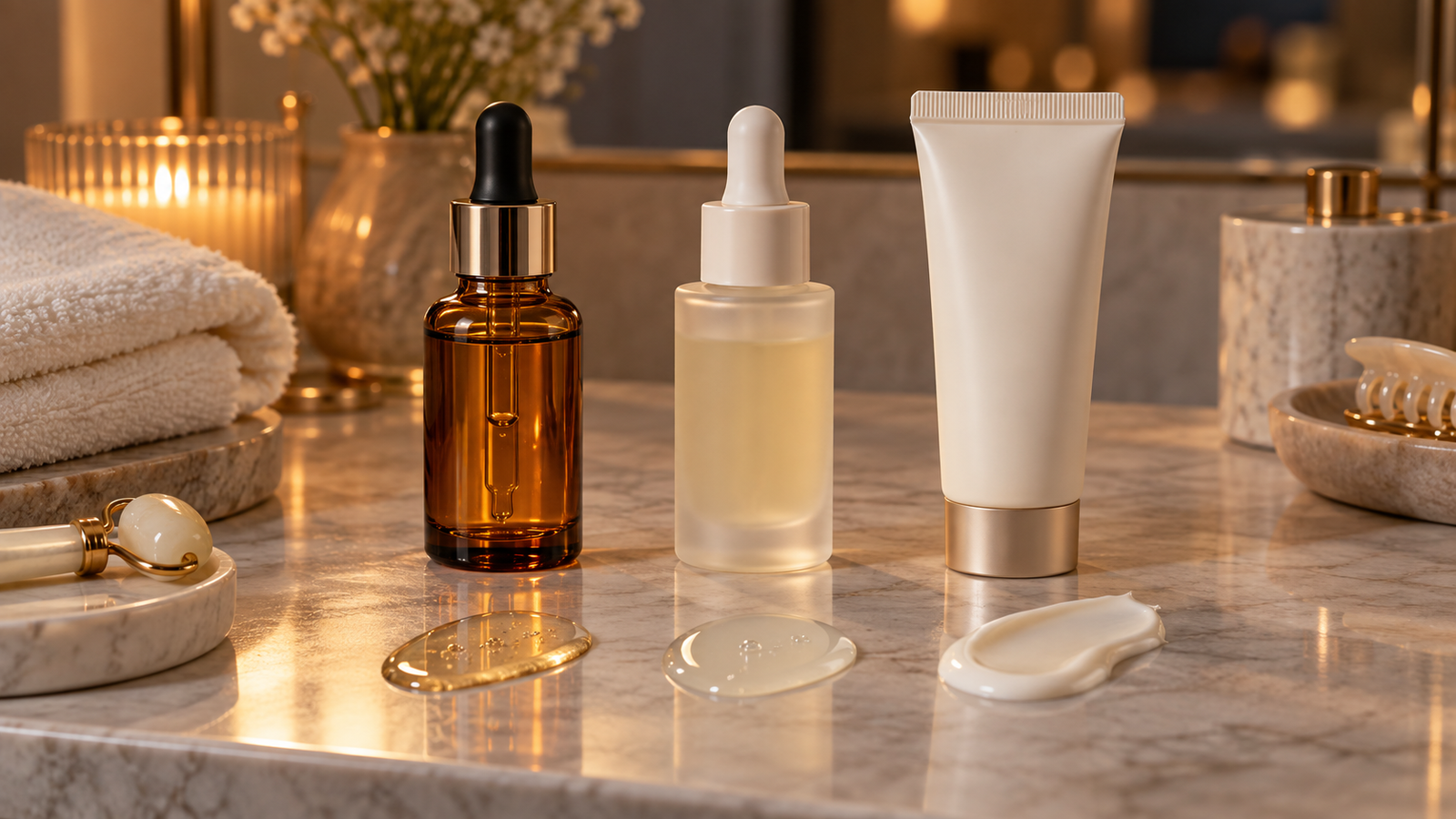
Retinol, retinal and granactive retinoid are often presented as different ways to address fine lines, uneven-looking skin tone and rough texture. They belong to the broader retinoid family, but they are not interchangeable ingredients.
The main difference is their chemical form. Yet that is only part of the buying decision: a product’s concentration, formulation, packaging and instructions can matter just as much as the ingredient name on the front.
This guide explains what each ingredient is, how to interpret common percentage claims and how to choose a product that fits your existing skincare routine.
What are retinoids?
Retinoids are a family of compounds related to vitamin A. Different members of the family are used in cosmetic skincare and in medicines for conditions such as acne.
Retinoic acid is the biologically active form that interacts with retinoid receptors in skin cells. Some cosmetic retinoids undergo conversion within the skin before reaching this form. The number of conversion steps helps explain their chemistry, but it does not establish a reliable strength ranking between finished skincare products.
PubMed
+1
For a practical skincare purchase, you need to consider both the ingredient and the product containing it.
Retinol: the familiar cosmetic retinoid
Retinol is a vitamin A derivative found in facial serums, creams and lotions. Within the skin, retinol can be converted to retinal and then to retinoic acid.
It is commonly used in cosmetic products intended to improve the appearance of fine lines, uneven tone and skin texture. How noticeable the results are will depend on the formulation, the skin concern being addressed, consistent use and individual response.
aad.org
+1
What does the percentage on a retinol product tell you?
A label such as 0.3% retinol or 0.6% retinol identifies a stated concentration of retinol. It is useful when comparing products that disclose the same ingredient in a comparable way, but it does not tell you everything about the formula.
A higher percentage is not automatically a more suitable purchase. Supporting ingredients, delivery system, packaging and your skin’s tolerance all affect the experience of using the product.
When comparing two retinol products, check:
- The stated retinol concentration, if disclosed.
- Whether the formula is a serum, cream or lotion.
- The presence of moisturising ingredients.
- The manufacturer’s application and storage instructions.
- Whether the product fits the other active ingredients you already use.
Retinal: how is it different from retinol?
Retinal, also called retinaldehyde, is another vitamin A derivative. It sits one conversion step away from retinoic acid, whereas retinol undergoes conversion to retinal first. Research has shown that skin cells can convert retinaldehyde into retinoic acid.
PubMed
You may see retinal in facial serums, night creams and targeted eye-area products.
Does fewer conversion steps mean a retinal product is always stronger?
No. The conversion pathway describes the ingredient’s chemistry; it cannot, by itself, predict the results or irritation potential of two different finished products.
For example, a retinal serum and a retinol cream may differ in concentration, supporting ingredients, packaging and intended use. Comparing only their ingredient names would leave out much of the information relevant to choosing between them.
The same caution applies when comparing their percentages. A retinal product labelled 0.1% should not automatically be treated as equivalent to, stronger than or weaker than a retinol product labelled 0.1%.
What is granactive retinoid?
“Granactive retinoid” is a commercial ingredient name commonly associated with a blend containing hydroxypinacolone retinoate, usually abbreviated as HPR.
It appears in some cosmetic night serums and creams. However, its labelling can be confusing, particularly when the product advertises a percentage of the granactive-retinoid complex.
Does “2% granactive retinoid” mean 2% pure HPR?
Not necessarily. The stated percentage may refer to the concentration of the supplied ingredient blend, rather than the concentration of HPR alone.
Before using that number to compare products, look for the manufacturer’s explanation of what the percentage represents. Do not assume that 2% granactive retinoid is directly comparable to 2% retinol or 2% retinal.
The evidence available for one retinoid form should also not automatically be applied to another. Claims about superior results or lower irritation need support from studies of the relevant ingredient and formulation.
Retinol vs retinal vs granactive retinoid: comparison at a glance
| What to compare | Retinol | Retinal | Granactive retinoid |
|---|---|---|---|
| Ingredient identity | A vitamin A derivative | A vitamin A derivative also called retinaldehyde | A commercial ingredient name commonly associated with an HPR-containing blend |
| Relationship to retinoic acid | Can convert to retinal, then retinoic acid | Can convert to retinoic acid | Has a different chemical structure and should not be placed on the same simple conversion scale |
| Common cosmetic formats | Serums, creams and lotions | Serums, creams and targeted treatments | Serums and creams |
| What a percentage may describe | The stated retinol concentration | The stated retinal concentration | Potentially the concentration of an ingredient blend |
| Main buying consideration | Formula, concentration and tolerance | Formula, target area and tolerance | Exact ingredient disclosure, meaning of the percentage and product-specific evidence |
The useful distinction is not that one of these ingredient names wins in every situation. It is that their labels require different interpretation, and the full product should determine your decision.
How to choose a retinoid product for your skin
1. Start with the concern you want to address
Are you looking for a general night-skincare product, or do you have a specific concern such as persistent acne, significant irritation or pronounced pigmentation?
Cosmetic skincare may be suitable for some appearance-related concerns, but it is not a substitute for diagnosis or treatment when a skin condition requires medical care. If you have persistent acne, considerable redness or an existing inflammatory skin condition, ask a dermatologist which ingredients and treatments are appropriate.
aad.org
2. Choose a format that works with your routine
A serum may be convenient if you already use a separate moisturiser. A cream may be preferable if you want a simpler night routine or a richer-feeling product.
Neither format guarantees better performance. Look at the complete ingredient list and the directions rather than assuming that serums are more concentrated or creams are always gentler.
3. Read concentration labels carefully
For retinol and retinal, check whether the manufacturer states the concentration of the ingredient itself. For granactive-retinoid products, check whether the stated percentage refers to the blend.
Avoid creating a personal “strength ladder” using percentages from different ingredient types. The numbers do not provide a common measure of finished-product effectiveness.
4. Consider your existing active ingredients
If you already use exfoliating acids or other potentially irritating treatments, adding a retinoid can make your routine harder to tolerate.
Introduce changes gradually and avoid starting several new active products together. That makes it easier to identify which product is responsible if dryness or irritation develops.
5. Look at packaging and storage instructions
Retinoid formulations can have stability requirements. Check whether the product has protective packaging and follow its stated storage instructions.
Also check the expiry date or period-after-opening symbol. An unfamiliar product kept open beyond its recommended period should not be judged only by how much remains in the bottle.
How to introduce a retinoid into your night routine
The manufacturer’s instructions for the exact product should take priority. For someone new to cosmetic retinoids, a cautious approach is to begin with less frequent use and assess how the skin responds before increasing frequency.
A straightforward evening routine can include gentle cleansing, the retinoid as directed and a moisturiser if needed. Avoid applying extra product to accelerate results.
If the product leaves your skin persistently dry, uncomfortable or inflamed, reduce unnecessary active ingredients and reassess the routine. Pronounced burning, swelling or a persistent reaction warrants stopping the product and seeking professional advice.
Dermatologists also emphasise daytime sun protection while using retinoids. Use an appropriate broad-spectrum sunscreen, along with shade and protective clothing where practical.
aad.org
+1
An important pregnancy precaution
Do not use retinoids during pregnancy. If you are pregnant, planning pregnancy or breastfeeding, ask your clinician to review your skincare products rather than assuming that a cosmetic retinoid is safe because it is available without a prescription.
aad.org
Common mistakes when comparing retinoid products
Buying by the largest percentage alone. Different ingredient forms and formulation systems cannot be compared through a single number.
Assuming fewer conversion steps guarantee better results. Conversion pathways explain chemistry, not the performance of every finished product.
Using multiple retinoid products at once. Layering a retinol serum with a retinal cream, for example, may add irritation without providing a clear practical benefit.
Skipping moisturiser when your skin feels dry. A suitable moisturiser can help make a routine more comfortable, although it does not make every irritating product appropriate for continued use.
Expecting an immediate visible change. Retinoid skincare calls for consistent use and realistic expectations. Do not increase the application amount or frequency simply because you cannot see a difference after a few nights.
Frequently asked questions
Is retinal the same as retinol?
No. Both are vitamin A derivatives, but they are different chemical forms. Retinol can convert to retinal, which can then convert to retinoic acid. The distinction does not mean every retinal product will outperform every retinol product.
Is 2% granactive retinoid stronger than 0.3% retinol?
Those percentages cannot be directly compared. The granactive-retinoid figure may describe an ingredient blend, while the retinol figure may describe the concentration of retinol itself. Check the individual product disclosures before drawing conclusions.
Can I use retinol and retinal together?
There is generally no need to add two cosmetic retinoid products to a basic night routine. Doing so can complicate your routine and increase the potential for irritation. If you are following a dermatologist-directed treatment plan, use the products according to that clinician’s instructions.
Should I choose a retinoid serum or cream?
Choose according to your skin’s comfort, your existing moisturiser and the finished product’s instructions. A serum can fit a layered routine, while a cream may simplify it. Format alone does not establish effectiveness.
Can I apply a facial retinoid around my eyes?
Do not assume that a full-face product is suitable for the eye area. Follow the manufacturer’s directions and avoid applying a product to areas it instructs you to avoid. A product specifically formulated for the eye area should still be introduced cautiously.
What to compare before buying
After identifying the ingredient type, narrow your options by checking the exact concentration disclosure, product format, moisturising ingredients, packaging and directions. A product that fits your routine and that you can use comfortably is more practical than one chosen solely for a prominent percentage claim.
For examples of different night-skincare formats, continue to Physical Glow’s Top 5 Retinol and Retinoid Night Products in India comparison. Use that guide to examine the shortlisted products, then confirm the current ingredient list and instructions for the exact variant you intend to buy.