Ab Roller Range of Motion: Short Reps and Neutral Back Basics
An ab roller need not start with a full rollout. Learn why controlled range, non-slip flooring and pain-free technique matter more than distance.
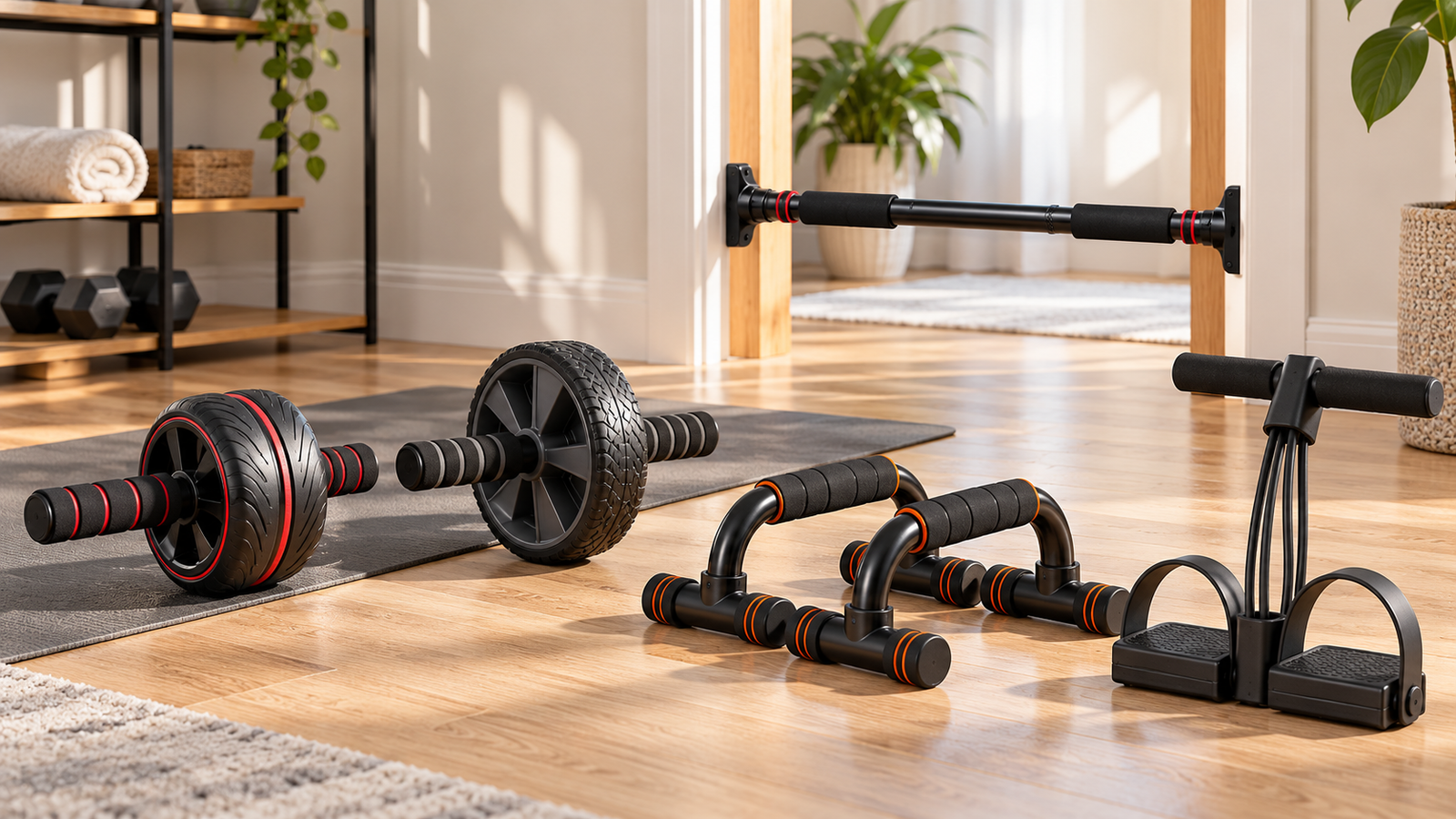
An ab roller looks like one of the simplest pieces of fitness equipment you can buy. Most designs consist of a wheel, a central axle, and two handles. There are no complicated settings, heavy weight stacks, or electronic displays.
Yet performing an ab wheel rollout correctly can be surprisingly challenging.
The exercise requires more than pushing a wheel forward and pulling it back. Your abdominal muscles, shoulders, hips, and other supporting muscles must work together to control your body as the wheel moves away from your knees.
A common mistake is attempting to roll too far before developing sufficient control.
When the wheel travels beyond a manageable distance, the hips may drop, the lower back may arch excessively, and the return movement can become difficult.
This is why short, controlled repetitions are often a more sensible starting point than attempting a full rollout immediately.
A shorter rollout is not necessarily an ineffective repetition. When performed with appropriate technique, it can provide a meaningful challenge while helping you learn how to maintain a stable trunk.
This guide explains how ab roller range of motion works, why lower-back position matters, how to perform short kneeling rollouts, and when to increase the distance safely.
It also covers common technique errors, equipment checks, beginner progressions, and practical ways to include an ab roller in a home workout routine.
1. What Is an Ab Roller?
An ab roller, also called an ab wheel, is a compact exercise tool used for rollout movements.
A basic design includes a rotating wheel with handles on either side.
During a conventional kneeling rollout, you hold the handles, position your knees on the floor, and slowly roll the wheel forward.
As the wheel travels away from your body, your trunk must resist the tendency to sag toward the floor.
You then reverse the movement and return to the starting position.
Common ab roller designs
Single-wheel ab rollers
These feature one central wheel.
They are compact and commonly used for controlled rollout exercises.
Double-wheel ab rollers
These use two closely spaced wheels or a wider wheel assembly.
The wider contact surface may influence side-to-side stability, but it does not remove the need for proper technique.
Wide-wheel ab rollers
Some products have broader wheel surfaces intended to provide a different contact feel.
Actual stability depends on the complete design, floor surface, and movement.
Ab rollers with resistance mechanisms
Certain products include internal resistance or return-assistance features.
These mechanisms vary considerably.
Do not assume that every product advertised as assisted makes the exercise suitable for beginners.
Ab rollers with elbow supports
Some models include forearm or elbow-support platforms.
These are different from conventional handle-only wheels and may require their own technique.
Why design matters
An exercise demonstrated with one type of ab roller may not feel identical on another.
Wheel diameter, handle spacing, grip texture, bearing resistance, and contact width can influence the movement.
Always follow the manufacturer’s instructions for your particular equipment.
2. What Muscles Does an Ab Roller Work?
The ab roller is primarily a core-strengthening exercise, but several muscle groups contribute to the movement.
The exact demands change with technique, range of motion, and exercise variation.
Rectus abdominis
The rectus abdominis is the prominent abdominal muscle running along the front of the trunk.
During a rollout, it contributes to controlling spinal position and resisting excessive extension.
This is an important distinction.
The exercise is not simply about repeatedly bending the spine forward.
A substantial part of the challenge involves preventing the trunk from losing its intended position as the arms move away.
Transversus abdominis
The transversus abdominis is a deeper abdominal muscle associated with abdominal wall function and trunk control.
It contributes alongside other muscles during bracing activities.
Obliques
The internal and external oblique muscles help control movement of the trunk.
They contribute to resisting unwanted rotation and maintaining stability during the rollout.
Shoulder muscles
The shoulders help support the arms and control movement as the wheel travels forward.
Shoulder mobility and strength can influence how far a person can comfortably roll.
Latissimus dorsi
The latissimus dorsi muscles contribute to shoulder movement and help control the return phase.
Gluteal muscles
The gluteal muscles can contribute to pelvic and hip control.
Appropriate glute engagement may help maintain a stable relationship between the trunk and pelvis.
Other supporting muscles
Additional muscles around the shoulders, back, hips, and arms participate depending on the movement.
The ab roller is best understood as a coordinated trunk-control exercise rather than an isolated abdominal movement.
3. Understanding Ab Roller Range of Motion
Range of motion describes how far a movement travels between its starting and ending positions.
For an ab roller, the distance the wheel travels away from your body is one important part of that range.
However, distance alone does not determine the quality of a repetition.
Short range of motion
A short rollout involves moving the wheel forward only a limited distance before returning.
This can reduce the difficulty compared with a longer rollout, provided the movement is performed correctly.
For someone learning the exercise, a short range can make it easier to maintain trunk control.
Moderate range of motion
As control improves, the wheel may travel farther forward.
The increased distance generally places greater demands on the muscles responsible for maintaining position.
However, the exact difficulty depends on body proportions, technique, and equipment.
Full rollout
A full kneeling rollout typically involves extending the body substantially farther forward while maintaining the intended alignment.
Some people can perform this movement with good control.
Others may need additional strength, mobility, or practice.
A full rollout is not an appropriate starting requirement for everyone.
Why farther is not always better
As the wheel moves farther away, maintaining a stable trunk becomes more challenging.
If the lower back begins to arch excessively or the hips sag, the person may have exceeded the range they can currently control.
In that situation, shortening the rollout is a sensible adjustment.
The appropriate range ends before you lose the ability to maintain controlled positioning and return safely.
4. Why Short Repetitions Are Useful for Beginners
A short rollout may look less impressive than a full extension, but visual difficulty is not the same as exercise quality.
Short repetitions allow beginners to concentrate on the mechanics of the movement.
Better position awareness
When the wheel travels only a short distance, it can be easier to notice what happens to the pelvis, lower back, and shoulders.
You can learn to recognize changes in posture before they become excessive.
Easier control during the return
Rolling forward is only half the movement.
You must also be able to bring the wheel back without collapsing or relying on momentum.
A shorter distance can make this return more manageable.
Less temptation to rush
Beginners sometimes push the wheel forward too quickly because the initial part of the movement feels easy.
Short repetitions encourage deliberate movement.
Gradual progression
A short rollout provides a starting point that can be adjusted over time.
Instead of increasing difficulty suddenly, you can progress through small changes in distance or control.
More consistent technique
A smaller number of well-controlled repetitions may provide a better learning experience than repeatedly attempting a distance that causes poor form.
Short does not mean effortless
Even a small rollout can be demanding when performed with appropriate bracing and control.
The objective is to challenge the muscles without exceeding your current ability.
5. What Does a Neutral Back Mean During an Ab Roller Exercise?
Maintaining a controlled trunk position is one of the most important aspects of ab roller technique.
You may hear trainers use phrases such as:
- Keep your back neutral.
- Brace your core.
- Keep your ribs and pelvis controlled.
- Avoid letting your hips sag.
- Do not overarch your lower back.
These instructions all relate to maintaining appropriate trunk control.
Understanding neutral spinal alignment
The spine naturally has curves.
A neutral position generally refers to maintaining an appropriate alignment rather than forcing every part of the spine into a completely flat shape.
During a rollout, the objective is to avoid an uncontrolled increase in lower-back extension as your arms reach forward.
Why the lower back may arch
As the wheel moves away from your knees, the distance between your support points increases.
The body must resist the forces that would otherwise cause the trunk to move into greater extension.
If the movement becomes too demanding, the pelvis and lower back may lose their intended position.
What does excessive arching look like?
Common signs include:
- The lower abdomen dropping toward the floor.
- The hips sagging as the wheel moves forward.
- The lower back becoming increasingly hollow.
- The ribs flaring upward.
- A noticeable loss of control before the return phase.
Not every small change in spinal curvature is automatically dangerous.
However, progressive uncontrolled arching is a useful sign that the rollout may be too difficult.
Should you flatten your back completely?
No.
Trying to force an exaggerated spinal position can create unnecessary tension.
Instead, aim for controlled alignment appropriate to your body and the exercise.
If you are unsure about your technique, a qualified fitness professional can help assess your movement.
Neutral-back training is about maintaining control, not rigidly forcing the spine into an unnatural shape.
6. How to Brace Your Core Before Rolling Forward
Core bracing helps create trunk stiffness during exercises that challenge stability.
For an ab rollout, bracing should begin before the wheel moves.
Start in a stable position
Kneel on an appropriate surface with the wheel positioned in front of you.
Hold both handles securely.
Establish comfortable alignment
Position your shoulders, trunk, and pelvis according to the movement instructions.
Avoid beginning with an exaggerated lower-back arch.
Create abdominal tension
Gently but firmly engage the abdominal wall as though preparing to resist a light push to your midsection.
The goal is coordinated trunk tension.
It should not require extreme straining.
Maintain pelvic control
The pelvis should not drop uncontrollably as you move forward.
Some coaching methods use a slight posterior pelvic tilt to help people control excessive lower-back extension.
However, an exaggerated tilt is not required for every person.
Keep breathing
Bracing does not mean holding your breath throughout the entire exercise.
Use controlled breathing while maintaining the trunk position.
Avoid prolonged breath-holding, particularly if you have a health condition that makes straining inadvisable.
Check before moving
If you cannot maintain a controlled starting position, do not rush into the rollout.
Practice simpler core exercises or obtain appropriate coaching first.
7. How to Perform a Short Kneeling Ab Roller Rollout
The kneeling rollout is a common starting variation.
However, it is still a demanding exercise, and some beginners may need easier movements before attempting it.
Follow your equipment instructions and choose a suitable range.
Step 1: Prepare the workout area
Select a level, dry, non-slippery floor that is appropriate for the wheel.
Remove loose objects and ensure sufficient space in front of you.
Check that the wheel rolls smoothly.
Step 2: Protect your knees
Use a suitable knee pad or supportive exercise surface.
The pad should remain stable and must not slide during the movement.
Avoid placing the rolling wheel on an unsuitable soft surface.
Step 3: Position the wheel
Kneel with the ab roller in front of you.
Grip both handles firmly.
Position the wheel beneath or slightly in front of your shoulders, according to the exercise variation.
Step 4: Prepare your trunk
Establish a controlled back and pelvis position.
Brace the abdominal muscles.
Keep your neck comfortably aligned with the rest of your spine.
Step 5: Roll forward slowly
Move the wheel forward a short distance.
Allow your shoulders and hips to participate in the movement rather than leaving your hips behind while only your arms move.
Maintain controlled trunk positioning.
Step 6: Stop before technique changes
Do not continue simply to reach a particular floor marker.
Stop when you approach the farthest position you can control.
If your lower back begins to sag or your return becomes uncertain, the range is too long for your current ability.
Step 7: Return under control
Draw the wheel back toward the starting position using a controlled movement.
Avoid jerking, bouncing, or snapping your hips backward.
Step 8: Reset before repeating
Pause briefly in the starting position.
Re-establish your grip, breathing, and trunk control.
Begin another repetition only when ready.
One short rollout that you can control from beginning to end is more useful than a longer rollout that ends in a loss of position.
8. How Far Should a Beginner Roll the Wheel?
There is no universal distance that every beginner should achieve.
The appropriate range depends on:
- Existing trunk strength
- Shoulder mobility
- Body proportions
- Exercise experience
- Equipment design
- Floor conditions
- Ability to control the return
- Individual physical limitations
Begin with a manageable distance
A beginner may initially move the wheel only a short distance beyond the starting position.
That can be an appropriate way to learn the exercise.
Focus on the turning point
The turning point is the farthest position before you begin returning.
This should occur while you still have enough control to reverse the movement smoothly.
Avoid using someone else’s range as a target
A person with extensive strength-training experience may perform a much longer rollout.
Their range does not establish what is appropriate for your body.
Increase distance gradually
Once a shorter range becomes consistently manageable, a modest increase may be appropriate.
The improvement should be demonstrated through maintained control rather than simply the ability to push the wheel farther.
Do not measure progress only in centimetres
Greater range can be one form of progression.
However, smoother movement, better trunk stability, and consistent return control are also meaningful improvements.
9. Using a Wall to Limit Ab Roller Range of Motion
A wall can sometimes serve as a physical stopping point during short rollout practice.
This is a common technique for limiting how far the wheel travels.
However, it must be used carefully.
How the wall-stop method works
You position yourself facing a wall at a suitable distance.
The wheel rolls forward until it reaches the wall, preventing further travel.
This can provide a predictable endpoint.
Potential advantage
A planned stopping point may help prevent accidentally rolling farther than intended.
It can also make the range easier to repeat.
Important limitation
A wall should not be used as something to crash into or bounce against.
Approach the stopping point slowly.
The wall does not replace abdominal control.
Check the surroundings
Ensure the floor and wall area are suitable.
Avoid damaging the wall or equipment.
Keep your hands and fingers away from positions where they could become trapped.
Start conservatively
Use a distance that allows you to maintain technique before the wheel reaches the stopping point.
Do not position yourself so far away that you lose control before reaching the wall.
Progress gradually
If the current range becomes consistently manageable, the distance may be increased modestly.
However, the objective remains a controlled movement.
The wall is a range-limiting aid, not a substitute for strength or a guarantee of safety.
10. Why the Return Phase Matters
Many people concentrate on how far they can push the wheel forward.
However, bringing the wheel back is equally important.
The outward phase
As you roll forward, the body must resist increasing extension demands.
The trunk and shoulder muscles help control the movement.
The return phase
During the return, the body must reverse the movement while maintaining stability.
The abdominal muscles and other supporting muscles continue working.
Why beginners sometimes struggle
A person may successfully roll forward but then discover they cannot return without changing technique.
This indicates that the outward range exceeded their current return capacity.
Do not collapse to finish the repetition
Allowing your stomach or chest to drop toward the floor is not an appropriate substitute for a controlled return.
Avoid using momentum
Jerking the wheel backward or sharply lifting the hips can change the intended movement.
How to improve return control
Shorten the range.
Use a slower, more manageable repetition.
Practice returning smoothly before increasing the distance.
If you cannot reverse a short rollout safely, choose an easier core exercise.
11. Ab Roller Breathing Basics
Breathing helps you maintain a controlled rhythm during demanding exercises.
However, breathing instructions can vary according to the movement and coaching approach.
Avoid prolonged breath-holding
Some people hold their breath when an exercise becomes difficult.
Excessive straining and prolonged breath-holding can produce substantial changes in blood pressure.
This may be particularly relevant for people with cardiovascular concerns.
Use steady breathing
A common coaching approach is to inhale during the controlled outward movement and exhale during the return.
Other approaches may coordinate breathing differently.
The essential principle is to maintain controlled breathing without losing trunk stability.
Exhale through the difficult portion
A deliberate exhalation during the return may help some people avoid unnecessary straining.
Do not sacrifice technique for a breathing pattern
If you cannot maintain movement control while breathing normally, the exercise may be too demanding.
Shorten the range or stop the set.
Seek guidance when appropriate
People with cardiovascular, respiratory, or other relevant medical conditions should seek individualized exercise guidance.
12. Common Ab Roller Mistakes
The ab roller is mechanically simple, but several technique errors can make it difficult to use effectively.
Mistake 1: Rolling too far too soon
Attempting maximum distance immediately can cause loss of trunk control.
Better approach: Begin with short rollouts and progress gradually.
Mistake 2: Letting the lower back sag
Excessive uncontrolled lumbar extension can indicate that the movement is too difficult.
Better approach: Maintain trunk control and stop before the back begins to sag.
Mistake 3: Leaving the hips behind
Moving only the arms forward while the hips remain in a sharply bent position changes the exercise.
Better approach: Learn the intended coordinated shoulder, trunk, and hip movement.
Mistake 4: Pulling back with momentum
A rushed return may hide a lack of control.
Better approach: Choose a range from which you can return smoothly.
Mistake 5: Looking excessively upward
Throwing the head back can disturb comfortable neck alignment.
Better approach: Keep the neck aligned naturally and avoid forcing the gaze.
Mistake 6: Holding the breath throughout
Prolonged breath-holding may increase unnecessary strain.
Better approach: Maintain controlled breathing.
Mistake 7: Performing too many repetitions
As fatigue increases, technique may deteriorate.
Better approach: End the set when you can no longer maintain consistent control.
Mistake 8: Training on a slippery floor
An unexpectedly moving wheel can make the exercise harder to control.
Better approach: Use a suitable surface and inspect the equipment.
Mistake 9: Using the wrong ab roller variation
Not every exercise is appropriate for every product design.
Better approach: Follow model-specific instructions.
Mistake 10: Ignoring pain
Sharp pain or persistent discomfort should not be treated as a normal requirement of progress.
Better approach: Stop and seek appropriate professional advice when necessary.
13. How to Tell Whether Your Rollout Range Is Too Long
Your body position provides useful feedback.
A range may be excessive when you notice:
- Your lower back arches increasingly as you roll forward.
- Your abdomen drops toward the floor.
- Your hips lose control.
- Your shoulders can no longer support the movement comfortably.
- You must jerk the wheel backward to return.
- You cannot breathe normally during the repetition.
- Your technique changes substantially between repetitions.
- You experience pain rather than ordinary muscular effort.
What should you do?
Do not try to force the next repetition farther.
Shorten the range.
If the problem continues even with a very short rollout, choose an easier exercise.
Use video carefully
Recording yourself from the side can sometimes help you observe body position.
However, a video does not replace qualified technique assessment.
Camera angles can also make spinal positioning difficult to judge accurately.
Focus on consistency
A controlled range that can be repeated reliably is a more practical training reference than a maximum distance achieved once with poor control.
14. Short Reps vs Full Reps: Which Is Better?
Neither variation is universally better in every situation.
Their usefulness depends on the person’s current strength and ability.
| Feature | Short rollout | Longer rollout |
|---|---|---|
| Wheel travel | Limited | Greater distance |
| Typical difficulty | Generally lower | Generally higher |
| Trunk-control demands | Easier to manage | More demanding |
| Return phase | Usually more manageable | Requires greater control |
| Beginner suitability | May be an appropriate progression | Often too difficult initially |
| Technique priority | Maintain alignment | Maintain alignment |
| Main purpose | Learn and strengthen controlled movement | Progress the exercise when ready |
A short rollout is not a completely different exercise.
It is a variation of the same movement using a reduced range.
As the distance increases, the challenge generally becomes greater.
However, increasing distance should not come at the expense of technique.
For someone who already performs controlled longer rollouts, short repetitions may still be useful during warm-ups, technique practice, or lower-intensity sessions.
15. Ab Roller Progressions for Beginners
Not everyone should begin directly with an ab wheel rollout.
Some people may benefit from developing trunk control using simpler exercises first.
Stage 1: Basic trunk bracing
Learn to engage the abdominal wall while maintaining comfortable breathing.
This can help establish awareness of trunk positioning.
Stage 2: Dead bug variations
A dead bug involves controlled movements of the arms and legs while maintaining trunk stability.
Appropriate variations can help develop control without requiring an ab roller.
Stage 3: Plank variations
Planks challenge the body to maintain a stable position.
Choose a variation appropriate for your ability.
A full plank is not mandatory if a shorter-lever or modified version is more suitable.
Stage 4: Very short kneeling rollouts
Begin using the ab roller through a limited range.
Concentrate on a controlled outward movement and return.
Stage 5: Consistent short repetitions
Develop the ability to repeat the same range without losing technique.
Stage 6: Gradually longer kneeling rollouts
Increase the distance modestly when you can maintain control.
Stage 7: More demanding variations
Advanced variations may involve longer ranges or different starting positions.
These are not necessary for everyone.
Standing rollouts, in particular, require substantially greater control and should be treated as an advanced exercise rather than an inevitable next step.
Progression should be based on demonstrated control, not pressure to reach the most difficult variation.
16. How Many Ab Roller Repetitions Should Beginners Perform?
There is no universal repetition target that applies to everyone.
The appropriate workload depends on fitness level, technique, experience, and the rest of the workout programme.
Prioritize technique over numbers
An ab rollout is relatively demanding.
Performing many poor-quality repetitions is not automatically more useful than performing fewer controlled ones.
An illustrative starting approach
For someone who can already perform short kneeling rollouts safely, an initial practice might involve a small number of controlled repetitions, such as three to five per set, with adequate recovery.
This is an example for technique practice, not a prescribed programme for every beginner.
Some people may need easier exercises instead of attempting even a few rollouts.
Stop when technique deteriorates
If your back position changes significantly, you begin rushing, or you can no longer return smoothly, end the set.
Do not continue solely to reach a planned number.
Allow adequate recovery
Core muscles also need recovery between demanding sessions.
Avoid assuming that daily maximal ab roller training is necessary.
Combine with other training
An ab roller can be one part of a balanced fitness routine.
It should not replace all other strength, mobility, or cardiovascular exercise.
17. Can You Use an Ab Roller Every Day?
Daily use is not automatically necessary or appropriate.
The answer depends on intensity, total workload, recovery, and individual circumstances.
Muscle recovery matters
Demanding strength exercises create fatigue.
The amount of recovery required depends on the training session and the person.
More frequent does not always mean more effective
Performing rollouts every day does not guarantee faster improvement.
Training quality and gradual progression matter.
Watch for persistent soreness
Some muscular soreness may occur after unfamiliar exercise.
However, persistent or worsening pain, especially in the back, shoulders, or other joints, should not be ignored.
Plan your overall training
If you already perform other demanding core exercises, consider the combined workload.
An ab roller session adds to your existing training demands.
When in doubt
Use a conservative approach and seek guidance from a qualified trainer when developing a structured programme.
18. How to Choose a Suitable Ab Roller for Home Use
Ab rollers vary in design and quality.
Before buying or using one, evaluate whether it is appropriate for your intended exercises.
Wheel construction
Check the wheel material and overall build.
The wheel should rotate smoothly without visible damage.
Handle grip
Handles should provide a secure hold.
Loose, cracked, or excessively slippery grips can interfere with control.
Axle condition
Inspect whether the handles and wheel assembly are securely connected.
Avoid using a roller with loose or damaged components.
Wheel width
Wider and narrower designs may feel different during use.
However, width alone does not establish overall safety or exercise effectiveness.
Weight and load rating
Check the manufacturer’s stated user-load limit where provided.
Do not exceed the equipment’s specified capacity.
Floor compatibility
Some wheel materials may behave differently on tiles, wood, mats, or other surfaces.
Use only surfaces permitted by the manufacturer.
Knee support
A suitable knee pad may improve comfort during kneeling variations.
However, a knee pad should not slide or interfere with the rolling surface.
Avoid relying on appearance alone
Bright colours, extra accessories, or premium-looking packaging do not guarantee that an ab roller is more suitable.
Construction quality, intended use, and manufacturer guidance matter more.
19. The Importance of Floor Grip
An ab roller needs a predictable rolling surface.
The wheel should move smoothly in the intended direction without suddenly slipping or becoming obstructed.
Tile floors
Smooth tiles are common in Indian homes.
Check for water, dust, and cleaning residue.
Avoid performing rollouts on wet or unusually slippery tiles.
Wooden floors
A level wooden surface may be appropriate for some rollers, but the wheel material and floor condition matter.
Check for damage, loose boards, or slippery surface treatments.
Exercise mats
Some mats can compress, wrinkle, or move when a wheel rolls across them.
Only use a mat when it is suitable for the particular equipment and movement.
Carpet
Thick carpeting may interfere with smooth wheel travel.
The wheel could sink into the surface or encounter greater rolling resistance.
Follow the equipment instructions.
Check for obstacles
Even a small object can interfere with the wheel.
Before each session, remove loose items from the intended path.
20. Knee Support and Comfort
Kneeling rollouts place pressure on the knees.
A suitable support surface can improve comfort, but it should not create instability.
Use appropriate padding
A dedicated knee pad or other stable support may help reduce pressure on the knees.
Avoid excessive softness
Very thick or unstable padding may make it difficult to maintain a secure kneeling position.
Keep the pad stationary
The pad should not slide forward as the wheel moves.
Do not ignore knee pain
If kneeling causes pain, do not assume that discomfort is a necessary part of training.
You may need a different exercise or professional assessment.
Consider alternatives
People who cannot kneel comfortably may benefit from other core-training movements.
There is no requirement to use an ab roller to develop abdominal strength.
21. Ab Roller vs Plank: Understanding the Difference
Both ab rollouts and planks can challenge trunk stability.
However, they do so through different movement demands.
Plank
A conventional plank involves maintaining a relatively stationary body position.
The trunk works to resist unwanted movement.
Ab rollout
A rollout adds substantial movement through the shoulders and changes the distance between the wheel and the supporting knees or feet.
This can increase the challenge to trunk control.
Which is more difficult?
A conventional ab wheel rollout is often more demanding than a basic plank variation.
However, exercise difficulty depends on the exact variation and the person performing it.
Which should beginners choose?
A suitable plank or another simpler core exercise may be a useful starting point for someone who cannot control a rollout.
Do you need both?
Not necessarily.
A balanced programme can include different exercises according to individual goals and abilities.
The ab roller is one option rather than a compulsory component of core training.
22. Can an Ab Roller Reduce Belly Fat?
Ab rollers are frequently marketed using claims about abdominal definition, flat stomachs, or belly-fat reduction.
These claims should be examined carefully.
Core strength and fat loss are different goals
An ab roller can challenge abdominal and supporting muscles.
However, strengthening muscles in one area does not establish that body fat will be reduced specifically from that area.
Spot reduction is not a reliable expectation
Performing abdominal exercises alone is not a guaranteed way to remove fat from the stomach.
Changes in body fat involve broader physiological factors and energy balance.
Why abdominal definition varies
Visible muscle definition depends on factors such as muscle development, body-fat distribution, genetics, and individual anatomy.
Is the ab roller still useful?
Yes, it can be a useful exercise tool for appropriately selected core-strengthening movements.
However, it should be evaluated according to those purposes rather than promises of targeted fat loss.
The primary reason to use an ab roller is controlled strength training, not the expectation that it will selectively burn belly fat.
23. Who Should Be Cautious with Ab Roller Exercises?
Ab rollouts place demands on the trunk, shoulders, arms, and other supporting structures.
They may not be suitable for everyone.
People with existing lower-back pain
If you have active or recurrent back pain, especially when extending the trunk, do not assume that rollouts are appropriate.
Seek individualized guidance from a qualified healthcare professional or physiotherapist.
People with shoulder problems
Rollouts require shoulder control and an appropriate range of movement.
Existing shoulder pain, instability, or restricted mobility may make the exercise unsuitable.
People with wrist discomfort
Gripping the handles transfers force through the hands and wrists.
If the movement causes wrist pain, stop and consider alternatives.
People recovering from surgery
Abdominal, spinal, or other relevant surgery may affect exercise selection.
Do not begin demanding core exercises without appropriate clearance and guidance.
Pregnant or postpartum individuals
Changes in abdominal wall function, physical comfort, and other factors can influence exercise suitability.
Ab roller rollouts should not be assumed appropriate during pregnancy or postpartum recovery.
Seek individualized guidance.
People with certain cardiovascular conditions
Breath-holding and strenuous exercise may be unsuitable for some people.
Medical guidance may be needed before performing demanding core movements.
Absolute beginners
Someone with little strength-training experience may be better served by simpler trunk-control exercises before progressing to an ab roller.
Pain, dizziness, unexpected weakness, or loss of control are reasons to stop rather than continue through the movement.
24. How to Track Ab Roller Progress
Progress is not limited to performing longer rollouts.
Several indicators can show improved control.
Consistent range
Can you repeat the same short distance without your technique changing?
Consistency is a useful starting goal.
Better return control
Can you bring the wheel back smoothly without jerking or sharply lifting your hips?
Improved breathing
Can you maintain controlled breathing throughout the repetition?
Stable trunk positioning
Can you keep the lower back and pelvis under control as the wheel moves?
Reduced reliance on momentum
Are you performing the movement deliberately rather than using a quick push-and-pull action?
Gradual range increases
Once shorter repetitions become consistently manageable, a slightly longer range may provide an appropriate progression.
Training notes
You can record:
- Exercise variation
- Number of controlled repetitions
- Approximate range or stopping point
- Perceived difficulty
- Whether technique remained consistent
- Any discomfort that occurred
Avoid comparing your performance only with the distance achieved by someone else.
25. A Practical Ab Roller Safety Checklist
Before your next session, review the following:
- Inspect the equipment: Check wheel rotation, axle, handles, and visible damage.
- Choose the right floor: Use a suitable, level, dry surface.
- Clear the rolling path: Remove objects that could obstruct the wheel.
- Protect your knees: Use stable padding when appropriate.
- Check your grip: Hold the handles securely.
- Brace before moving: Establish controlled abdominal tension.
- Maintain trunk alignment: Avoid uncontrolled lower-back arching.
- Start with short repetitions: Do not chase maximum distance.
- Control both directions: The return should be as deliberate as the outward movement.
- Keep breathing: Avoid unnecessary prolonged breath-holding.
- Stop when form changes: Do not force additional repetitions.
- Progress gradually: Increase difficulty only when the current range is consistently manageable.
- Respect pain signals: Stop if the movement produces sharp or concerning discomfort.
- Follow the product instructions: Use only permitted surfaces and exercise variations.
A short preparation routine can help make ab roller training more predictable.
Frequently Asked Questions
1. Is an ab roller suitable for beginners?
Some beginners may be able to perform short kneeling rollouts with appropriate control.
However, ab rollouts are demanding and may be too difficult for someone new to strength training.
Simpler core exercises can provide a more appropriate starting point.
2. Do short ab roller repetitions work?
Short rollouts can challenge the muscles responsible for trunk control when performed correctly.
A full range is not required for every individual or training stage.
3. How far should I roll an ab wheel?
Roll only as far as you can maintain controlled alignment and return safely.
There is no universal distance that everyone should achieve.
4. Why does my lower back arch during rollouts?
Excessive arching may occur when the movement exceeds your current ability to control trunk extension.
Shortening the rollout and improving bracing may help.
Persistent difficulty may indicate that a simpler exercise is more appropriate.
5. Should my back be completely straight?
The goal is controlled alignment, not forcing the spine into an unnaturally flat position.
Maintain an appropriate trunk position without uncontrolled sagging or excessive arching.
6. Can I use a wall to stop the ab roller?
A wall can sometimes provide a stopping point for a short rollout.
Approach it slowly and avoid striking it forcefully.
The setup must still allow you to control the movement.
7. How many ab roller repetitions should beginners do?
There is no fixed number for everyone.
For a person who can perform the movement safely, a small number of controlled repetitions may be appropriate.
End the set when technique deteriorates.
8. Should I perform ab wheel rollouts every day?
Daily training is not universally necessary.
Frequency should reflect exercise difficulty, overall workload, recovery, and individual ability.
9. Does an ab roller work the upper and lower abs?
The rectus abdominis functions as a muscle during trunk control.
Although people often describe upper and lower abdominal regions separately, an ab roller should not be marketed as guaranteeing isolated fat loss or completely independent training of those areas.
10. Can ab rollouts hurt your lower back?
Poor control, excessive range, or inappropriate exercise selection can increase the risk of discomfort or injury.
Stop if the movement causes pain and seek professional advice when appropriate.
11. Is a double-wheel ab roller easier than a single-wheel model?
A wider wheel assembly may influence side-to-side stability.
However, actual difficulty depends on the overall design and exercise technique.
Two wheels do not automatically make rollouts easy or suitable for everyone.
12. Can I do ab rollouts on a yoga mat?
Only if the mat is suitable for the wheel and remains stable.
Some soft mats can wrinkle or interfere with rolling.
Check the manufacturer’s surface recommendations.
13. Should I inhale or exhale while rolling forward?
Breathing instructions vary.
A common approach involves controlled inhalation during the outward movement and exhalation during the return.
Avoid prolonged breath-holding and prioritize controlled movement.
14. What should I do if I cannot pull the wheel back?
The range may be too difficult.
Do not deliberately collapse or jerk the wheel.
Use a shorter range, appropriate assistance, or a simpler core exercise.
15. Is an ab roller better than a plank?
Neither exercise is universally better.
They create different demands, and suitability depends on individual ability and training goals.
16. Can ab roller exercises burn belly fat?
Ab rollouts can strengthen supporting muscles but do not guarantee targeted abdominal fat loss.
Spot reduction should not be treated as an expected result.
17. When should I increase my rollout distance?
Consider increasing the range when you can repeatedly perform the current distance with stable trunk positioning, controlled breathing, and a smooth return.
Progress gradually.
18. Is a full standing rollout necessary for strong abs?
No.
Standing rollouts are advanced and not required for everyone.
Core strength can be developed through many different exercises and progressions.
Final Thoughts
The ab roller is a compact exercise tool that can provide a demanding challenge to abdominal and supporting muscles.
However, effective use depends on much more than how far the wheel travels.
For beginners, the most important priorities are controlled range of motion, appropriate trunk alignment, steady breathing, and the ability to return safely to the starting position.
Short kneeling rollouts can help develop these skills without immediately requiring a full extension.
As strength and coordination improve, the rollout distance may be increased gradually.
However, longer repetitions should never come at the expense of control.
If your lower back begins to arch excessively, your hips sag, or you cannot reverse the movement smoothly, shorten the range or choose an easier variation.
Remember that an ab roller is not essential for core strength, nor is it a guaranteed method for reducing belly fat.
It is one training option that can be useful when matched to a person’s ability and performed correctly.
The goal is not to roll as far as possible. The goal is to control the wheel through a range your body can manage safely and consistently.
A short, controlled rollout is a sensible foundation for progress—and a far better starting point than forcing a full repetition before you are ready.
Editorial note: This article provides general fitness education and is not a substitute for individualized exercise instruction or medical advice. Ab roller movements can be demanding on the trunk, shoulders, and wrists. Follow the equipment manufacturer’s directions and consult a qualified professional when injury, pain, pregnancy, postoperative recovery, or other relevant health considerations affect exercise suitability.