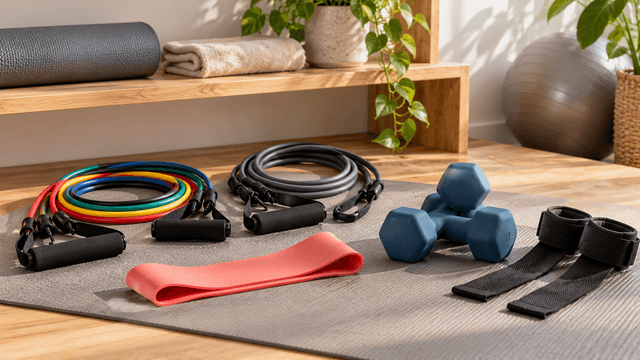
Resistance Bands for Beginners: Choose the Right Shape and Resistance
A beginner-friendly explanation of flat bands, tubes and mini loops, with resistance selection, safe anchoring and a practical home-workout checklist.

Resistance bands are among the most practical tools for exercising at home. They are lightweight, portable, relatively affordable and can be used for a wide range of strength, mobility and warm-up exercises.
But choosing the right resistance band is not always straightforward.
Should beginners buy a loop band or a resistance tube? What does a 3–7 kg resistance rating mean? Are thicker bands always better? And can resistance bands replace dumbbells?
The answers depend on your fitness level, exercise goals and the movements you plan to perform.
The best resistance band for beginners is not necessarily the strongest one. It is the band that allows you to exercise with controlled technique and appropriate resistance.
This guide explains different resistance band types, how resistance levels work, common buying mistakes and how to build a simple home workout.
What Are Resistance Bands and How Do They Work?
Resistance bands are elastic exercise tools that create tension when stretched.
Unlike a traditional dumbbell, which provides resistance primarily through gravity, an elastic band produces tension as it lengthens.
Generally, the further a band is stretched, the greater the force required to continue stretching it.
However, the exact resistance depends on several factors:
- Band material
- Thickness and width
- Original length
- Stretch distance
- Manufacturing specifications
- Attachment and exercise setup
This means two bands with the same advertised resistance may feel different during exercise.
Resistance bands can be used for strength training, mobility exercises, warm-ups and certain rehabilitation movements when appropriately selected.
Their versatility makes them particularly useful for people building a compact home workout setup.
Understanding the Different Types of Resistance Bands
Not all resistance bands have the same shape or intended purpose.
Choosing the correct type can make your exercises more comfortable and easier to perform safely.
1. Flat Resistance Bands
Flat resistance bands are long strips of elastic material without handles.
They are commonly available in different lengths, widths and resistance levels.
Their flexible design makes them suitable for controlled exercises, stretching and certain mobility movements.
Best suited for:
- Beginners learning resistance exercises
- Gentle upper-body movements
- Controlled mobility work
- Warm-up routines
- Lightweight home workouts
One advantage is that flat bands can often be held at different points to adjust the working length.
However, gripping a flat band may become uncomfortable during exercises requiring considerable tension.
2. Resistance Tubes
Resistance tubes are generally cylindrical elastic bands.
Some have handles, while others are sold as simple tubes or as part of sets with interchangeable attachments.
Handle-equipped tubes may provide a more familiar grip for exercises resembling dumbbell movements.
Best suited for:
- Standing rows
- Biceps curls
- Shoulder exercises
- Certain chest exercises
- General home strength training
Resistance tubes can be convenient for users who want a compact alternative to some traditional gym equipment.
However, exercises requiring door anchors or other attachments need particular care.
An incorrectly secured attachment can cause the band to release unexpectedly.
3. Mini Loop Resistance Bands
Mini loop bands are short, continuous elastic loops.
They are commonly used around the thighs, knees or ankles, depending on the exercise.
These bands are particularly convenient for movements involving the hips and lower body.
Best suited for:
- Lateral band walks
- Glute bridges
- Controlled hip movements
- Lower-body warm-ups
- Beginner activation exercises
Mini loops are usually compact enough to fit in a small workout bag.
However, their short length makes them less suitable for some upper-body pulling movements.
4. Long Loop Resistance Bands
Long loop bands are continuous elastic loops with considerably more working length than mini loops.
They are commonly used for full-body resistance exercises.
Depending on their size and strength, they may also be used for assisted pull-ups.
Best suited for:
- Full-body strength routines
- Rows and presses
- Certain lower-body exercises
- Assisted pull-up training
- Warm-up movements
Long loops can provide considerable versatility, but beginners should avoid choosing an excessively strong band simply because it appears more durable.
5. Fabric Resistance Bands
Fabric resistance bands are often made with woven materials and elastic fibres.
They are particularly common in short-loop formats intended for lower-body exercises.
Some users prefer their feel because certain fabric designs may roll or slide less than thin latex bands.
However, comfort and durability depend on the actual construction.
Fabric bands are not automatically superior to latex bands for every exercise.
Flat Band vs Tube vs Mini Loop: Which Should Beginners Choose?
The correct format depends on your intended workout.
| Band type | Common uses | Main consideration |
|---|---|---|
| Flat band | Mobility, light resistance and warm-ups | Grip and available length |
| Resistance tube | Rows, curls and general strength | Handles and anchor safety |
| Mini loop | Glute and hip exercises | Limited stretch length |
| Long loop | Full-body strength and assisted movements | Correct resistance selection |
| Fabric loop | Lower-body training | Fit and stretch range |
For beginners who want general full-body exercise, a light-to-medium long band or a suitable resistance tube may offer greater variety.
For someone focused mainly on lower-body movements, a mini-loop set can be practical.
There is no need to purchase every type immediately.
How Do Resistance Band Levels Work?
Resistance bands are frequently sold using colours or advertised resistance ranges.
You may encounter bands marked:
- Light
- Medium
- Heavy
- Extra heavy
Some brands also display resistance values in kilograms or pounds.
For example, a resistance band may be labelled 3–7 kg.
This does not necessarily mean it behaves exactly like lifting a dumbbell weighing between 3 and 7 kg.
The resistance generally changes as the band stretches.
Why the Advertised Kilogram Rating Can Be Confusing
Manufacturers may measure resistance at different stretch lengths.
One brand might report tension at a particular percentage of elongation, while another may use a different method.
Consequently, a 5 kg rating from one manufacturer cannot automatically be compared directly with a 5 kg rating from another.
Colour coding is also not universal.
A red band may be labelled light by one manufacturer and medium by another.
Always check the manufacturer’s resistance information rather than relying on colour alone.
What Resistance Level Should a Beginner Start With?
Beginners should generally start with a band that allows controlled movement throughout the intended exercise.
The correct resistance depends on both the person and the exercise.
A band suitable for squats may be too strong for shoulder exercises.
Likewise, a band comfortable for rowing may provide insufficient resistance for some lower-body movements.
A practical starting approach is to choose a lighter band and test it using slow, controlled repetitions.
The final repetitions should feel challenging without forcing you to lose proper technique.
If you cannot complete the movement through a comfortable range, the resistance may be excessive.
If the movement is extremely easy and technique remains stable, a modest increase may be appropriate.
Can Resistance Bands Build Muscle?
Resistance bands can provide a useful form of strength training.
Muscles respond to appropriately challenging resistance, whether it comes from weights, elastic bands or other equipment.
Resistance-band exercises can contribute to strength and muscle development when the training programme provides sufficient challenge and is progressed over time.
However, results depend on several factors:
- Exercise selection
- Training consistency
- Resistance intensity
- Number of sets and repetitions
- Recovery
- Nutrition
- Individual training experience
Resistance bands are not inherently more effective than dumbbells or gym machines.
They are simply another way to provide muscular resistance.
For some users, especially beginners, they offer a convenient starting point.
More advanced users may eventually benefit from additional equipment to achieve their training goals.
Five Beginner-Friendly Resistance Band Exercises
The following movements illustrate how bands can fit into a basic home workout.
Use a resistance level appropriate to your ability, and stop if you experience pain, dizziness or loss of control.
1. Resistance Band Row
Primary focus: Upper back and pulling muscles.
A row can be performed with a suitable resistance band attached to a secure anchor or using another manufacturer-approved setup.
Pull the band toward your torso while keeping the movement controlled.
Avoid excessive shrugging or jerking.
Do not use an unstable piece of furniture as an anchor.
2. Resistance Band Biceps Curl
Primary focus: Biceps.
Stand on a band only when its design and manufacturer’s guidance support that setup.
Hold the band securely and bend your elbows to perform the curl.
Keep your upper arms relatively stable.
Avoid using body momentum to move the band.
3. Mini-Band Lateral Walk
Primary focus: Hip muscles.
Place an appropriate mini loop around the legs according to the exercise instructions.
Maintain a stable stance and step sideways with control.
Avoid allowing the band to pull your knees inward.
A lighter band may be easier for beginners to manage.
4. Resistance Band Glute Bridge
Primary focus: Glutes and hip extension.
A suitable mini loop may be positioned above the knees.
Lie on your back with your knees bent and feet supported.
Raise your hips in a controlled manner while maintaining comfortable alignment.
Lower slowly without excessive arching of the lower back.
5. Resistance Band Pull-Apart
Primary focus: Upper-back and shoulder muscles.
Hold a suitably light band in front of your body.
Move your hands apart gradually while keeping the motion controlled.
Avoid forcing the shoulders into an uncomfortable position.
This exercise should use a band light enough to maintain proper technique.
A Simple Resistance Band Workout for Beginners
You do not need a complicated programme to begin resistance training.
A short routine can help you become familiar with the equipment.
| Exercise | Suggested starting volume |
|---|---|
| Band row | 1–2 sets of 8–12 repetitions |
| Band biceps curl | 1–2 sets of 8–12 repetitions |
| Mini-band lateral walk | 1–2 sets of 8–10 steps per direction |
| Glute bridge | 1–2 sets of 8–12 repetitions |
| Band pull-apart | 1–2 sets of 8–12 repetitions |
These are illustrative starting ranges, not a personalised exercise prescription.
Begin with fewer repetitions if necessary, and prioritise controlled movement.
Rest between sets as needed.
People with injuries, recent surgery or medical restrictions should seek individual guidance before starting unfamiliar exercises.
How to Make Resistance Band Exercises More Challenging
As your strength and confidence improve, you may need to progress your workouts.
Progression does not always require buying a stronger band.
Possible methods include:
Increasing Repetitions
Once an exercise becomes easier, you may gradually perform additional repetitions while maintaining good technique.
Adding Sets
Increasing the total number of controlled sets can raise training volume.
Changing the Band
Moving to a stronger band may increase resistance when the current band no longer provides sufficient challenge.
Adjusting the Exercise
A different movement variation can change how demanding the exercise feels.
However, avoid shortening a band excessively or stretching it beyond the manufacturer’s recommended limits to create more tension.
How to Choose Resistance Bands for Home Workouts
When comparing resistance bands, consider practical specifications instead of relying entirely on advertising claims.
1. Choose the Right Shape
A mini loop and a resistance tube are not interchangeable for every exercise.
Start with your training goals and select the appropriate format.
2. Check the Resistance Range
Look for clearly stated resistance information.
Prefer products that explain how resistance is measured.
Do not assume colour labels are standardised across brands.
3. Examine the Material
Resistance bands may use natural latex, synthetic rubber, thermoplastic materials or fabric constructions.
Some users need to avoid natural latex because of allergies.
Check material details before purchasing.
4. Consider Band Length
A short loop may suit lower-body training, while a longer band can accommodate different pulling and pressing movements.
Compare the manufacturer’s specified dimensions.
5. Inspect Handles and Attachments
If choosing a tube set, examine whether handles, clips and anchor accessories are included.
Accessories should be appropriate for the band’s intended resistance and setup.
6. Consider Storage and Portability
One advantage of resistance bands is their compact size.
A simple storage pouch may be useful if you frequently travel or exercise outside the home.
Comparing Popular Resistance Band Formats in India
Physical Glow readers may encounter products such as:
Boldfit Resistance Band 3–7 kg Yellow: A light-resistance option that can be considered for controlled exercises where the band dimensions and stretching range are appropriate.
Boldfit Light Flat Resistance Band: A flat elastic format that may suit certain warm-up and mobility movements.
Slovic Resistance Tube: A tube-style format useful for shoppers specifically looking for a different gripping and exercise setup.
Slovic Latex Resistance Band: A latex-based option whose dimensions and labelled resistance should be checked against the intended exercise.
Slovic Mini Loop Resistance Bands Set of Five: A set-based format offering several loop bands for lower-body or other compatible exercises.
These examples represent different product categories rather than an independently tested performance ranking.
Before buying, verify current product specifications, availability, package contents and seller information.
Common Resistance Band Mistakes to Avoid
Choosing the Strongest Band Immediately
A stronger band is not always better.
Excessive resistance may interfere with technique and reduce your ability to complete the intended movement.
Ignoring Band Condition
Elastic materials can deteriorate over time.
Inspect bands before each workout for cracks, tears, thinning, damage or worn attachments.
Replace damaged equipment.
Using Unsafe Anchors
Never attach a band to an unstable object or an unsuitable door fixture.
Use the manufacturer’s recommended anchoring method and check that the anchor is secure before applying tension.
Stretching Beyond Recommended Limits
Excessive stretching can damage the band or cause it to fail.
Follow the manufacturer’s maximum elongation guidance.
Allowing the Band to Snap Back
Release tension gradually.
Never let go of a stretched band unexpectedly.
Keep your face and eyes away from the potential recoil path.
Training Through Pain
Muscular effort and pain are not the same.
Stop an exercise if it causes sharp pain or unexpected discomfort.
How to Clean and Store Resistance Bands
Proper care may help preserve usability and reduce avoidable wear.
Clean bands according to the manufacturer’s instructions.
For many basic elastic bands, wiping with a soft, slightly damp cloth may be suitable, but cleaning methods vary by material.
Avoid harsh chemicals unless approved by the manufacturer.
Allow equipment to dry as directed before storage.
Store bands away from excessive heat, sharp surfaces and prolonged direct sunlight when recommended.
Do not leave elastic bands stretched around furniture between workouts.
Inspect stored bands again before using them.
Resistance Bands vs Dumbbells: Which Is Better for Beginners?
Both resistance bands and dumbbells can support beginner strength training.
They differ mainly in how resistance is produced and how easily that resistance can be measured.
| Feature | Resistance bands | Dumbbells |
|---|---|---|
| Resistance | Generally changes with stretch | Fixed mass |
| Portability | Usually very portable | Depends on weight |
| Storage | Compact | Requires more space |
| Load comparison | Can be difficult across brands | Weight is directly specified |
| Exercise variety | Broad, depending on setup | Broad, depending on available weights |
| Accessories | Some exercises require anchors | Usually fewer attachments |
If your main concern is portability and limited storage, resistance bands may be more convenient.
If you prefer clearly measurable external loads, dumbbells may be easier to track.
Many home workouts can use both.
Frequently Asked Questions
1. Are resistance bands good for complete beginners?
Yes. They can be suitable for beginners when the resistance, exercise and setup are appropriate. Start with controlled movements and manageable tension.
2. Which resistance band should I buy first?
For general home exercise, a light-to-medium long band or suitable resistance tube may be useful. For lower-body movements, a mini-loop set may be more appropriate.
3. Does a 5 kg resistance band equal a 5 kg dumbbell?
Not necessarily. Band tension changes with stretch and depends on how the manufacturer measures resistance. A dumbbell has a fixed mass.
4. Can resistance bands replace gym equipment?
They can replace or supplement some exercises, but they are not direct substitutes for every machine or free-weight movement.
5. How many days per week should beginners use resistance bands?
A beginner may start with resistance training on two or three nonconsecutive days per week, depending on fitness level and recovery. Training frequency should be adjusted to individual needs.
6. Are fabric bands better than latex bands?
Not automatically. Fabric and latex bands have different characteristics. The better choice depends on exercise type, comfort, construction and material preferences.
7. Can resistance bands break?
Yes. Damaged, over-stretched or incorrectly used bands can fail. Regular inspection and correct anchoring are essential.
8. Do I need several resistance levels?
Not necessarily at first. However, having more than one resistance level may become useful because different muscle groups and exercises require different amounts of tension.
Final Thoughts
Resistance bands can make home exercise more accessible without requiring a large collection of equipment.
The key is choosing a band that suits your training goals rather than buying the strongest or most expensive option.
Flat bands, resistance tubes, mini loops and long loops all have practical uses, but their shapes and resistance characteristics are different.
Start with manageable tension, learn controlled movement patterns and increase the challenge gradually.
For beginners, consistency, safe technique and suitable resistance matter more than the colour or advertised strength of the band.
A well-chosen resistance band can be a useful part of a balanced fitness routine, whether you exercise at home, travel frequently or want a compact addition to your existing equipment.
Physical Glow Editorial Note: This article provides general fitness education and product-selection guidance. Physical Glow has not independently tested the resistance bands mentioned. Exercise suitability varies by individual health, training experience and equipment setup. Some related product pages and buying guides may include affiliate links through which Physical Glow may earn a commission at no additional cost to readers.