Treadmill vs Exercise Bike: Which Is Better for Home Cardio?
Compare treadmills and exercise bikes for home cardio by impact, workout style, floor space, stability, noise, comfort and long-term training goals.
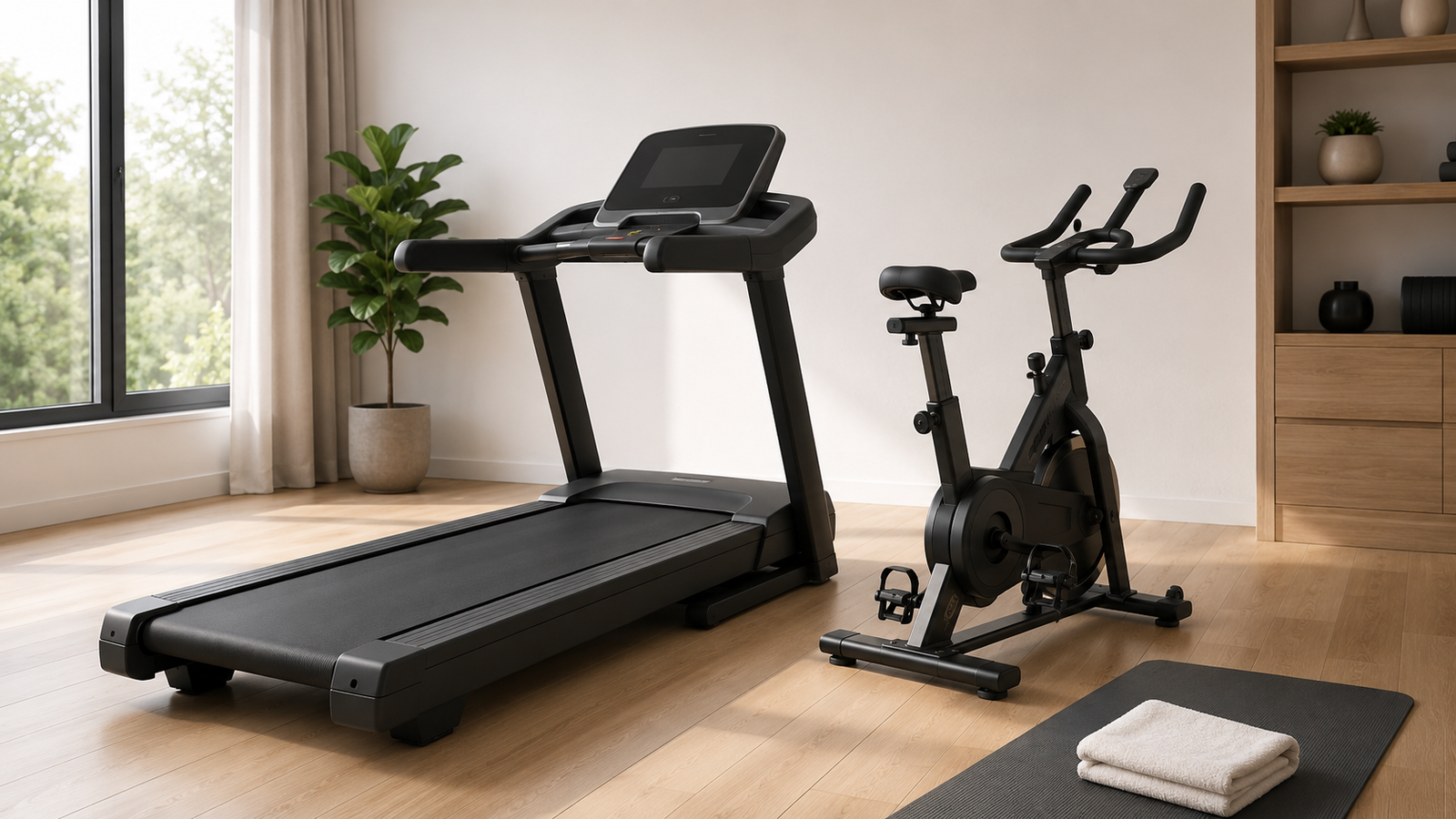
If you have room for only one cardio machine, the choice between a treadmill and an exercise bike can shape how often you actually train. Both can support effective home cardio, but they feel very different, use different movement patterns and place different demands on joints, balance and space.
A treadmill is the more natural choice if you want to walk, jog or run indoors. An exercise bike can be a better fit if you prefer seated cardio, lower-impact movement or a smaller training footprint.
Treadmill vs Exercise Bike at a Glance
| Factor | Treadmill | Exercise Bike |
|---|---|---|
| Movement | Walking, jogging, running | Seated cycling |
| Impact | Higher, especially when running | Usually lower impact |
| Balance demand | Higher | Usually lower once seated |
| Space | Usually larger | Often more compact |
| Workout variety | Speed and often incline | Resistance, cadence and bike type |
| Noise | Motor plus foot strike | Depends on resistance system |
Choose a Treadmill If Walking or Running Is Your Main Goal
A treadmill lets you train the movement you already use outdoors. That makes it especially relevant for people who want indoor walking mileage, jogging or structured running workouts when weather, traffic or scheduling makes outdoor exercise inconvenient.
Speed and incline can be adjusted without changing machines. This makes a treadmill useful for easy walking, brisk incline sessions and harder running intervals, provided the model is designed for the level of use you expect.
Choose an Exercise Bike If You Prefer Lower-Impact Cardio
Cycling is usually easier on the joints than running because the body is supported by the saddle and there is no repeated foot strike. That can make an exercise bike appealing to people who dislike impact or who simply enjoy cycling more than walking on a belt.
An indoor bike can still provide very challenging cardio. Increasing resistance and cadence can create hard sessions without requiring the larger running deck of a treadmill.
Comfort Is Not the Same as Effectiveness
A machine that feels easier on the joints can still produce a demanding cardiovascular workout. Likewise, a treadmill is not automatically more effective just because running can feel harder.
The better machine is the one that allows you to train at an appropriate intensity consistently. Enjoyment matters because the machine that repeatedly gets used has more value than the technically superior machine that becomes a clothes rack.
Floor Space and Room Layout
Treadmills generally require more floor length. Folding designs can reduce storage footprint, but they remain substantial pieces of equipment. Exercise bikes are often shorter and can fit more easily into smaller home-gym corners.
Measure the actual setup area, including space to mount and dismount safely. For a treadmill, also leave enough room behind the deck. For a bike, make sure there is enough clearance to adjust the seat and handlebars.
Noise and Shared Living
A treadmill produces motor noise, belt movement and repeated foot-strike vibration. An exercise bike removes the foot-strike component, although fan-resistance bikes can still be intentionally noisy.
Magnetic resistance bikes are often chosen by people who value smoother, quieter indoor cycling. If noise is a major concern, compare resistance system and build rather than assuming every bike is silent.
Which Is Easier for Beginners?
Both can be beginner-friendly. Walking on a treadmill is familiar, while an exercise bike can feel more stable because you are seated. The important issue is setup.
On a treadmill, start at a comfortable speed and use the safety features correctly. On a bike, adjust saddle height so pedalling is comfortable and avoid using a setup that forces the knees or hips into an awkward position.
Which Offers Better Progression?
Treadmills progress through speed, incline, duration and interval structure. Bikes progress through resistance, cadence, duration and interval structure. Both can support gradual training progression.
If you want to become a better runner, treadmill training is more specific. If you want indoor cycling or lower-impact conditioning, the bike is more specific.
Which Is Better for Multiple Users?
A treadmill is straightforward for users of different heights because there is less adjustment. An exercise bike needs seat and sometimes handlebar adjustment when different people use it.
On the other hand, a bike may be more comfortable for household members who do not want to run or who prefer seated exercise. Check user-weight capacity and adjustment range for either machine.
Common Buying Mistakes
- Buying for calorie-burn marketing rather than for the movement you enjoy.
- Ignoring the full footprint of a treadmill.
- Choosing an exercise bike without checking saddle and handlebar adjustment.
- Assuming lower impact means low intensity.
- Ignoring maintenance and service availability.
- Buying a machine with features you will not use consistently.
Final Verdict
Choose a treadmill if walking or running is the activity you want to train and you have enough space for a stable machine. Choose an exercise bike if you prefer seated, lower-impact cardio or need a more compact home setup.
The best purchase is not the machine with the biggest specification list. It is the machine whose movement style you can repeat week after week.