Air Purifier Odours on First Use: Unpacking and Ventilation Checks
A new air purifier may have packaging smells or exposed protective film. Learn basic unpacking and installation checks before drawing conclusions about filtration.
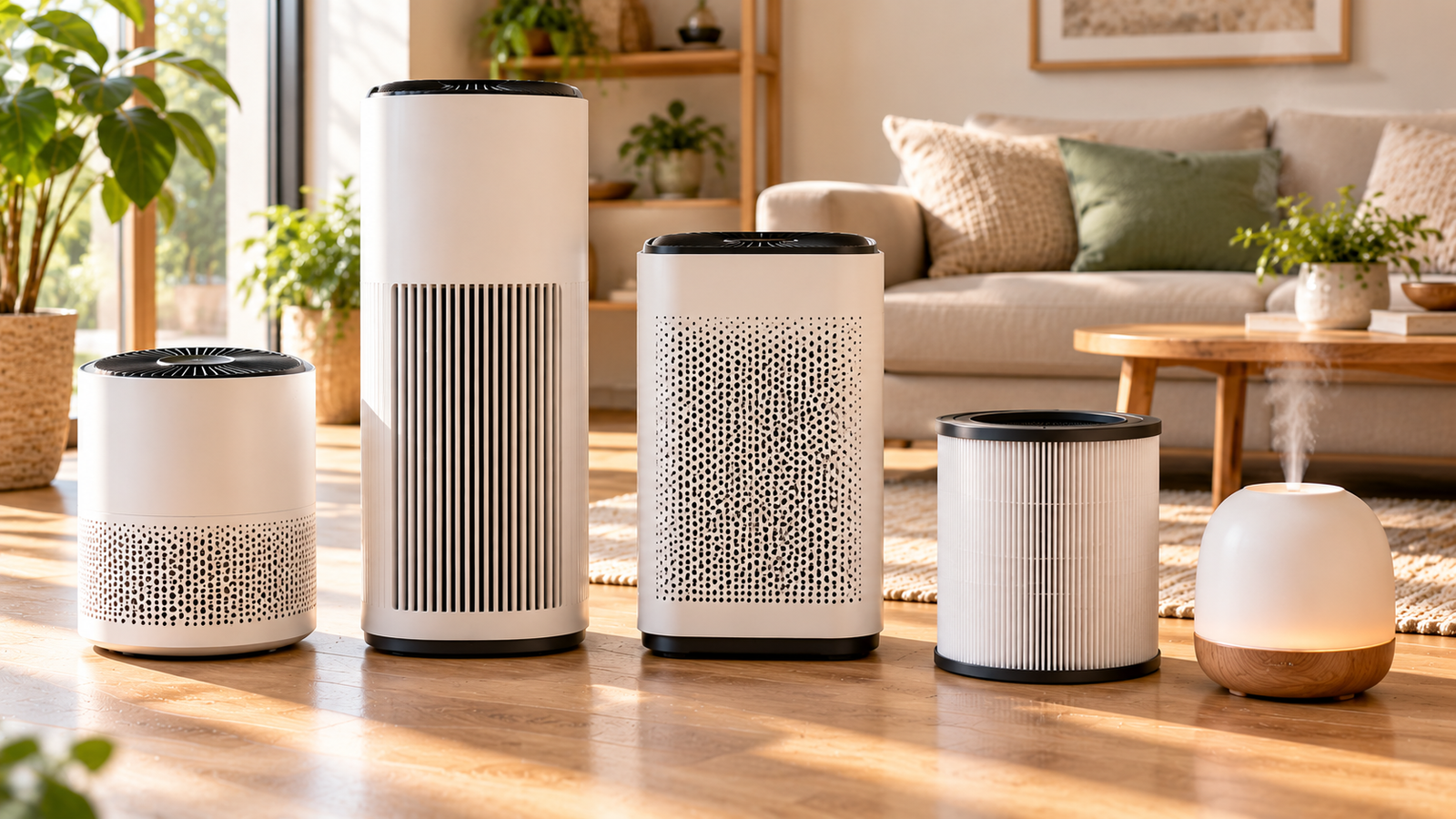
A new air purifier is supposed to help improve indoor air quality, so noticing an unfamiliar smell when switching it on for the first time can be confusing.
You may notice a mild plastic-like smell, an unfamiliar filter-material odour, or a scent resembling new packaging.
Sometimes the smell is present immediately after opening the box. In other cases, it becomes noticeable only after the fan begins circulating air.
A mild, temporary new-product odour can occur with some air purifiers.
Philips, Blueair, LG, and Coway all acknowledge that certain new appliances or replacement filters may release a characteristic smell during initial use.
However, the presence of a new-product smell does not automatically mean every odour is harmless.
A burning or electrical smell requires a different response from a mild packaging-related scent.
Likewise, a musty smell may indicate excess moisture or another indoor-air problem rather than normal manufacturing residue.
Incorrect installation can create additional issues.
Some air purifier filters arrive enclosed in protective plastic bags that must be removed before operation. Leaving this packaging around the filter can obstruct airflow, reduce filtration performance, and potentially create an overheating hazard.
Poor placement, blocked air openings, saturated filters, and inadequate room ventilation can also affect the experience.
The most useful first-use routine is to inspect the purifier, remove all shipping materials, install the filters correctly, choose a suitable location, and assess any odour without ignoring electrical or health-related warning signs.
Ventilation can help disperse ordinary new-material odours when outdoor air conditions are suitable.
However, opening windows is not always appropriate during severe outdoor air pollution.
The correct approach depends on the product, the smell, and the surrounding environment.
This guide explains why some new air purifiers smell, which odours may be temporary, how to unpack and inspect the filters, and when to discontinue use.
It also covers activated carbon filters, HEPA filters, airflow, ventilation, humidity, maintenance, and practical troubleshooting for first-time users.
1. Why Can a New Air Purifier Smell?
An air purifier contains several materials that may have characteristic odours when new.
Plastic housing
The outer body may contain moulded plastic components.
Filter materials
Filters can contain synthetic fibres, activated carbon, adhesives, frames, and other materials.
Packaging
Filters may remain sealed inside plastic bags or cardboard packaging during storage and transport.
Stored odours
A smell associated with the materials can accumulate inside closed packaging.
Initial airflow
When the fan begins operating, air may carry some of these odours into the room.
Manufacturer guidance
Blueair explains that new filters sometimes have an inherent material smell that becomes noticeable when their packaging is opened.
Coway provides similar guidance for newly purchased air purifiers.
Is the smell always dangerous?
No.
Some mild new-material smells are temporary.
However, the exact cause cannot be established from smell alone.
Practical takeaway
A mild scent from a newly unpacked filter should be distinguished from persistent, irritating, burning, or otherwise abnormal odours.
2. Normal New-Product Odour vs a Warning Smell
Different odours require different responses.
| Odour or observation | Possible explanation | Recommended approach |
|---|---|---|
| Mild plastic-like smell on first use | New housing or manufacturing materials | Check instructions and ventilate when appropriate |
| Light filter-material smell | Newly unpacked filter | Follow manufacturer first-use guidance |
| Cardboard or packaging scent | Stored packaging odours | Remove shipping materials and check filters |
| Strong burning smell | Possible overheating or electrical fault | Stop using and seek service |
| Smoke or visible scorching | Serious equipment or electrical problem | Stop use, prioritize safety, seek urgent assistance if needed |
| Musty smell | Moisture, contaminated filter, or room problem | Inspect the environment and device |
| Dusty smell after prolonged use | Dirty or saturated filter | Review cleaning and replacement needs |
| Cooking or smoke smell | Indoor pollutant source | Address source and ventilation |
| Strong chemical odour with irritation | Unknown source or unsuitable materials | Stop use, leave the affected area, investigate safely |
| Repeated odour after filter replacement | Filter material, installation, or environmental issue | Check compatibility and contact manufacturer if persistent |
Why this table matters
The word smell covers many different situations.
A faint new-filter scent should not be treated in the same way as smoke coming from an appliance.
Burning, sparking, or visible smoke should never be dismissed as normal new-product odour.
3. What Manufacturers Say About First-Use Smells
Official support guidance provides useful examples.
Philips
Philips states that some air purifiers produce a plastic smell during the first few uses.
It says this may disappear within a few days.
However, Philips recommends contacting after-sales service when the appliance produces a burnt smell.
Blueair
Blueair explains that filter materials can have an inherent odour, especially after being stored in sealed packaging.
It recommends running the purifier and ventilating the room when appropriate to help disperse the smell.
Coway
Coway acknowledges that certain new products may emit a slight odour during the initial period.
It recommends contacting customer support when the smell persists.
LG
LG also describes an initial plastic-like smell associated with new appliance materials.
What these statements do not establish
They do not mean that every chemical, smoky, or irritating smell should be ignored.
Practical interpretation
Manufacturer guidance supports the possibility of temporary mild material odours, but abnormal or persistent smells still require investigation.
4. How Long Should a New Air Purifier Smell?
There is no universal first-use odour period.
Philips example
Philips states that an initial plastic smell may disappear within a few days for affected models.
Coway example
Coway indicates that certain new-product odours typically disappear within about a week.
Blueair example
Blueair recommends ventilation and allowing time for the initial filter smell to fade.
Why timing varies
Potential factors include:
- Filter material
- Packaging duration
- Product design
- Room ventilation
- Temperature
- Individual odour sensitivity
- Manufacturing differences
Does a smell become safe after a certain number of days?
No.
Elapsed time does not establish safety.
What if the smell becomes stronger?
Discontinue use and consult the manufacturer.
What if it causes symptoms?
Do not continue using the appliance merely because the manual mentions temporary odours.
Practical recommendation
A faint, diminishing new-material smell may be handled according to manufacturer instructions. A persistent, worsening, or irritating odour deserves attention sooner.
5. Why Unpacking Matters Before First Use
Air purifiers often contain protective materials inside the main housing.
External packaging
This may include cardboard, foam, plastic films, and protective covers.
Internal filter packaging
Filters may arrive inside individual plastic bags.
Protective seals
Some accessories may contain shipping tabs or other removable materials.
Why internal packaging is easy to miss
A filter may already be positioned inside the purifier when delivered.
The user might assume the unit is ready to operate.
Manufacturer guidance
Philips identifies unremoved filter packaging as a possible cause of weak airflow and poor air-cleaning performance.
Levoit also warns against operating certain models while the filter remains wrapped.
Important safety concern
Some manuals warn that retained plastic packaging can obstruct airflow and create an overheating or fire hazard.
Essential principle
A preinstalled filter is not necessarily an unpacked filter. Always inspect the filter compartment before first use.
6. The Complete Air Purifier Unboxing Checklist
Step 1: Inspect the shipping box
Look for major damage or signs of mishandling.
Step 2: Remove the purifier carefully
Follow the handling instructions.
Step 3: Check the power cord
Look for visible damage.
Step 4: Identify the model
Confirm that the device matches the purchase information.
Step 5: Read the quick-start guide
Look for filter-unpacking requirements.
Step 6: Keep the unit disconnected
Do not connect power while opening internal compartments.
Step 7: Locate the filter cover
Use the manual to identify the access method.
Step 8: Remove the filter assembly
Only if the instructions require it.
Step 9: Inspect for plastic wrapping
Check all sides of the filter.
Step 10: Remove shipping materials
Remove only materials identified as removable packaging.
Step 11: Check filter orientation
Follow the arrows, tabs, or other model-specific instructions.
Step 12: Reinstall correctly
Ensure the filter sits in its intended position.
Step 13: Close the compartment
Secure the cover according to the manual.
Step 14: Choose a suitable location
Allow the required airflow clearance.
Step 15: Connect power safely
Use the specified electrical supply.
Step 16: Start the device
Observe normal operation and investigate anything unusual.
7. How to Identify Removable Filter Packaging
Not every plastic-looking surface is packaging.
Some filters include permanent frames, mesh surfaces, and protective structures.
Loose plastic bag
A sealed bag around the entire filter is commonly intended to be removed.
Shipping film
A temporary film may cover a component during transport.
Permanent filter frame
Rigid structural material should not be removed unless directed.
Integrated mesh
Some pre-filter surfaces are part of the filtration assembly.
Adhesive seals
Only remove seals specified in the manual.
Why guessing can cause problems
Removing the wrong material may damage the filter.
Leaving the actual packaging in place may obstruct airflow.
Best approach
Compare the filter with the diagram supplied for the exact model.
When uncertain
Contact the manufacturer before operating the unit.
8. What Happens If Filter Plastic Is Not Removed?
A filter enclosed in shipping plastic cannot function as intended.
Blocked airflow
The wrapping can prevent air from passing through the filter media.
Reduced filtration
Air may not be cleaned through the intended filter path.
Unusual noise
The fan may behave abnormally when airflow is obstructed.
Heating concerns
Certain manuals identify overheating as a potential risk when wrapping is left in place.
Philips guidance
Philips lists retained packaging as a cause of poor performance or weak airflow.
Levoit guidance
Levoit explicitly warns against operating particular models without removing the filter’s plastic wrapping.
Does a running fan prove the filter is installed correctly?
No.
The appliance may power on even when the filter has not been prepared properly.
Practical rule
Turn the device off and disconnect power before investigating a suspected packaging problem.
9. Checking Filter Orientation
Filters must be installed according to the manufacturer’s design.
Cylindrical filters
Some models use a single round replacement cartridge.
Flat panel filters
Others use multiple flat filter elements.
Layered systems
A purifier may contain separate pre-filters, particle filters, and carbon components.
Why orientation matters
The product may be designed to route air through the filters in a particular order.
Philips guidance
Philips recommends checking that filters are fitted in the correct order and direction.
Direction arrows
Some filters display orientation marks.
Pull tabs
Certain filters include tabs intended to face a specific direction.
What should you avoid?
Do not force a filter that does not fit correctly.
Important reminder
A replacement filter can look similar to the original while having different dimensions or installation requirements.
10. HEPA Filters and Activated Carbon Filters Are Different
Understanding filter functions helps explain odour performance.
Particle filtration
HEPA and other mechanical particle filters are designed to capture airborne particles.
These may include dust, pollen, and certain smoke particles.
Gas and odour filtration
Activated carbon and certain other sorbent materials may capture some gases and odorous substances.
Why the difference matters
Many odours involve gaseous compounds.
A particle filter alone is not necessarily designed to remove those gases.
US EPA guidance
The EPA explains that gas-phase filters can remove certain gases and odours when designed for those pollutants.
Does every carbon filter remove every smell?
No.
Performance depends on the pollutant, the sorbent, its quantity, operating conditions, and filter condition.
Important distinction
A purifier marketed as a HEPA air purifier may have excellent particle filtration without comprehensive odour removal capability.
11. Why New Activated Carbon Filters Can Smell
Activated carbon is commonly used in filters intended to adsorb certain gaseous substances.
New material odour
Some replacement filters may have a characteristic smell when unpacked.
Packaging
Sealed packaging can retain odours associated with filter components.
Material differences
Carbon filters vary in construction and manufacturing.
Does a carbon smell prove contamination?
No.
Does it prove the filter is safe?
Also no.
The source should be assessed according to the manufacturer’s guidance.
Manufacturer examples
Blueair and Coway acknowledge temporary odours from newly unpacked filter materials.
What may help?
For a mild manufacturer-recognized smell, appropriate ventilation may help.
What if it persists?
Contact support and review filter compatibility.
12. Can a New HEPA Filter Have an Odour?
Some new particle filters have a characteristic material smell.
Filter fibres
Filters may contain synthetic or glass-fibre-based media depending on design.
Frames and seals
Adhesives and supporting components may have their own material characteristics.
Packaging
A sealed bag can concentrate odours before opening.
Manufacturer statements
Coway and Blueair describe mild new-filter odours as possible during first use.
What about the word HEPA?
HEPA describes a filtration performance category, not a guarantee that the entire filter assembly has no smell.
Should you wash a new HEPA filter?
No, unless its manufacturer specifically permits washing.
Why not?
Water can damage many particle-filter media and reduce filtration performance.
Practical recommendation
Follow the replacement filter’s preparation instructions instead of attempting an improvised wash to remove odour.
13. Is Every Air Purifier Filter Washable?
No.
This is one of the most important maintenance distinctions.
Washable pre-filter
Some models include a coarse pre-filter that can be rinsed.
Vacuum-cleanable pre-filter
Other models permit dry cleaning.
Non-washable particle filter
Many HEPA and similar filters require replacement rather than washing.
Carbon filter
Some carbon components must also be replaced rather than immersed.
Philips example
Philips provides model-specific guidance that permits washing certain pre-filters while requiring replacement of other filter elements.
Why care methods differ
Different materials perform different functions.
What should you avoid?
Do not submerge the complete filter cartridge without confirming that it is designed for washing.
Essential rule
Cleaning instructions apply to the exact filter layer or component—not automatically to the entire filter assembly.
14. Why Ventilation Helps with New-Product Odours
Ventilation introduces or circulates outside air to help dilute indoor contaminants when conditions are appropriate.
Initial material odours
Certain manufacturing-related smells may dissipate over time.
Air exchange
Ventilation can help reduce the concentration of some indoor gaseous pollutants.
Blueair guidance
Blueair recommends running a newly unpacked purifier while ventilating the room to help reduce temporary filter odours.
Coway guidance
Coway provides similar advice.
EPA guidance
The EPA identifies source control and ventilation as fundamental strategies for improving indoor air quality.
Is ventilation a replacement for filtration?
No.
They address different aspects of indoor air quality.
Important qualification
Ventilation should be used when outdoor air conditions are suitable and safe.
15. Should You Open Windows When Starting a New Purifier?
Not automatically.
The appropriate choice depends on outdoor air conditions.
When outdoor air is reasonably clean
Opening windows may help disperse temporary indoor new-material odours.
When outdoor pollution is high
Opening windows may introduce additional pollutants.
Dust storms
Windblown dust may increase the indoor particle burden.
Wildfire smoke
Outdoor smoke can make unrestricted ventilation undesirable.
Traffic pollution
Homes near busy roads may experience periods of elevated outdoor pollution.
EPA guidance
The EPA recommends considering outdoor air conditions when deciding how to ventilate and use indoor air cleaning.
Practical recommendation
If outdoor pollution is severe, prioritize avoiding pollutant entry and use safer ventilation arrangements when conditions improve.
Key point
Ventilation is beneficial when it improves the actual air conditions—not merely because an appliance is new.
16. Ventilation in Indian Homes
Indoor air conditions vary significantly across India.
Urban traffic
Traffic-related emissions may affect outdoor air near busy roads.
Seasonal pollution
Some locations experience periods of elevated particulate pollution.
Dust
Construction, dry weather, and wind can introduce dust.
Monsoon humidity
High moisture levels may complicate indoor comfort and drying.
Kitchen activities
Cooking can produce both particles and gaseous pollutants.
Why this matters
Opening windows can sometimes improve ventilation and sometimes introduce additional pollution.
Jaipur and other urban areas
Outdoor conditions may differ by neighbourhood, time of day, and season.
Better approach
Consider actual outdoor air conditions, indoor pollutant sources, and suitable ventilation opportunities.
Practical principle
A first-use ventilation recommendation should be adapted to the surrounding environment rather than applied without context.
17. Should the Purifier Run at Maximum Fan Speed?
Fan speed affects how much air moves through the purifier.
Low speed
Generally moves less air through the filtration system.
Higher speed
Generally moves more air.
EPA guidance
The EPA explains that, all else equal, higher fan speeds and longer operating times increase the amount of air filtered.
Does high speed remove a new-product smell immediately?
No.
Why not?
The smell may originate from the filter or other material inside the appliance.
Manufacturer guidance
Some brands recommend operating the device while ventilating to help temporary material odours dissipate.
What should you follow?
Use the manufacturer’s first-use recommendations.
Warning
Do not keep running a device that produces smoke, burning odours, or other signs of an electrical problem.
18. Does a Higher CADR Remove Odours Faster?
CADR stands for Clean Air Delivery Rate.
It is commonly used to describe particle-removal performance.
What CADR measures
A certified CADR typically relates to the device’s ability to supply air cleaned of specified particles.
What it does not directly measure
It is not a universal measure of gas or odour removal.
EPA guidance
The EPA states that CADR ratings are used for particles.
Gas and odour filtration requires separate consideration.
Why this matters
A purifier with a high particle CADR may still have limited capability against particular household odours.
Activated carbon
The amount and type of carbon can matter.
Does maximum fan speed guarantee superior gas capture?
Not in every design or condition.
Practical takeaway
Do not judge first-use odour handling solely by the purifier’s CADR specification.
19. Choosing the Right Room for Initial Operation
The manufacturer’s instructions should guide initial placement.
Living room
May provide ample space and suitable ventilation.
Bedroom
Can be appropriate for some models, but a strong unfamiliar smell may be uncomfortable in a sleeping area.
Spare room
May be useful for initial operation when the manufacturer recommends allowing a temporary material scent to fade.
Kitchen
Some manufacturers advise against placing ordinary air purifiers close to heat, grease, or steam sources.
Bathroom
High humidity and water exposure may make certain bathrooms unsuitable.
Balcony
Do not place an indoor-only purifier outdoors merely to air it out.
Blueair guidance
For mild new-filter odours, Blueair suggests temporarily airing the filter by an open window or running the purifier in a less frequently occupied room.
Important condition
Follow the device’s indoor-use, temperature, and moisture restrictions.
20. Why Airflow Clearance Matters
An air purifier needs unobstructed air pathways.
Air intake
The intake allows room air to enter the unit.
Air outlet
The outlet returns filtered air to the room.
Blocked intake
Curtains, furniture, or other objects may restrict airflow.
Blocked outlet
A shelf or wall may interfere with the intended airflow pattern.
Manufacturer guidance
Philips and Levoit identify obstructed air openings as possible causes of weak performance.
Should every purifier be placed in the centre of the room?
No.
Placement requirements vary.
How much clearance is necessary?
Use the distance specified in the manual.
Avoid arbitrary clearance rules
A distance suitable for one appliance may be inadequate for another.
Practical recommendation
Place the purifier where it can draw in and discharge air as designed.
21. How to Check That Air Is Flowing Properly
Airflow can be assessed without disassembling the running appliance.
First check
Ensure the packaging has been removed.
Second check
Confirm the filter is installed correctly.
Third check
Look for blocked openings.
Fourth check
Verify the fan is running.
Levoit guidance
Levoit describes using a light piece of tissue or paper near the air intake or outlet to observe airflow.
Important precaution
Do not allow paper, cloth, or other material to enter the unit.
Weak airflow
If output is unusually low, stop and follow the manufacturer’s troubleshooting instructions.
Avoid inserting objects
Never place fingers or tools into a running fan.
Key point
A fan noise does not necessarily prove normal airflow through the filter system.
22. What If the Purifier Smells Only When the Fan Runs?
This pattern can provide a useful clue.
Filter-material odour
Moving air may carry a mild scent from a new filter into the room.
Contaminated filter
A used filter may release previously captured odorous substances.
Room odour
The fan may redistribute an existing smell.
Internal appliance problem
An abnormal smell could also originate from the motor or electronics.
How to distinguish
Consider when the smell began and whether it resembles a mild material scent or something burning.
Never rely on smell alone
The exact source may not be obvious.
Safe response
For an unfamiliar strong or irritating odour, stop the appliance and seek manufacturer guidance.
Practical takeaway
The fact that a smell appears only when the fan is on does not establish that it is harmless.
23. What If the New Purifier Smells Burnt?
A burning smell deserves immediate attention.
Possible concern
Electrical or mechanical components may be overheating or malfunctioning.
Philips guidance
Philips distinguishes a temporary plastic smell from a burnt smell and recommends contacting after-sales service for the latter.
What should you do?
Switch the unit off if safe.
Disconnect power when it is safe to do so.
Do not keep testing
Repeatedly restarting a device with a burning smell is not appropriate.
Look for warning signs
These may include:
- Smoke
- Sparks
- Unusual heat
- Melting or deformation
- Crackling
- Electrical failure
When smoke or fire is present
Move away from danger and contact emergency services as appropriate.
Do not attempt unauthorized repairs
Use qualified or manufacturer-approved service.
24. Strong Chemical Odours and Physical Symptoms
Some smells may be accompanied by eye, nose, or throat irritation.
Possible symptoms
These can include:
- Eye irritation
- Throat irritation
- Coughing
- Headache
- Nausea
- Breathing discomfort
What does this mean?
The symptoms may have several explanations.
Can smell identify the chemical?
No.
Odour is not a reliable way to identify every airborne substance or determine exposure risk.
What should you do?
Stop using the suspected device.
Move to a safer area.
Seek appropriate medical advice if symptoms occur or persist.
Severe symptoms
Significant breathing difficulty or other serious symptoms require urgent assessment.
Product follow-up
Contact the manufacturer before using the purifier again.
Important principle
Do not continue prolonged exposure to an unknown irritating smell simply because the appliance is new.
25. Why a Used Filter May Smell Different from a New Filter
A new filter and a saturated filter can produce similar complaints for different reasons.
New filter
Its odour may be associated with unused materials or packaging.
Used filter
It may have accumulated particles and adsorbed gaseous compounds.
Activated carbon saturation
A filter can become less effective when its useful capacity for certain substances is depleted.
Environmental exposure
Cooking, smoke, pets, and other sources can influence filter conditions.
Manufacturer guidance
Blueair, Coway, and Philips all identify dirty or saturated filters as possible sources of unpleasant odours.
What should you do?
Check filter condition and replacement requirements.
Avoid washing non-washable filters
Replacement may be necessary.
Practical distinction
A new-filter smell and an old-filter smell should not automatically receive the same troubleshooting response.
26. Why Activated Carbon Cannot Remove Every Odour
Activated carbon works by adsorbing certain substances onto its surface.
Not all gases behave identically
Different gaseous compounds have different capture characteristics.
Carbon quantity matters
A small amount of carbon may have different capacity from a substantial sorbent bed.
Airflow matters
The interaction between moving air and the sorbent affects performance.
Saturation matters
Adsorption capacity is finite.
EPA guidance
The EPA explains that gas-phase filters are generally designed for particular pollutants and cannot be expected to remove all gases from indoor air.
What about persistent household smells?
A purifier may reduce some odours but may not remove their source.
Better approach
Address the cause of the smell wherever possible.
Practical lesson
Do not interpret a persistent odour as automatic proof that the air purifier is defective.
The pollutant may fall outside the filter’s intended capabilities.
27. Source Control: The First Step in Managing Indoor Odours
Source control means reducing or removing the source of a pollutant.
Cooking odours
Use appropriate kitchen exhaust ventilation.
Tobacco smoke
Prevent indoor smoking exposure.
Garbage
Remove waste and clean contaminated surfaces.
Cleaning chemicals
Follow product instructions and ensure appropriate ventilation.
Moisture
Repair leaks and address damp areas.
Fragrances
Avoid unnecessary sources if occupants experience irritation.
EPA guidance
The EPA identifies source control as the most effective general strategy for reducing many indoor pollutants.
Why this matters
A purifier may remove some airborne material while the source continues releasing more.
Practical recommendation
An air purifier should supplement—not replace—appropriate source control and ventilation.
28. Air Purifiers and Musty Smells
A musty odour can be associated with moisture problems.
Damp walls
Water intrusion can create conditions that support microbial growth.
Wet furnishings
Carpets, curtains, and other materials can retain moisture.
Leaks
Plumbing or structural leaks may remain hidden.
Humid rooms
High humidity can contribute to damp conditions.
EPA guidance
The EPA states that portable air cleaners cannot solve mould problems because they do not remove the underlying moisture source.
Can a purifier reduce some particles?
Certain filters may capture some airborne particles associated with mould.
Does that eliminate the mould?
No.
What should you do?
Investigate moisture sources and arrange appropriate remediation when needed.
Important conclusion
A musty room cannot be made safe simply by operating an air purifier continuously.
29. Can a New Filter Become Damp During Storage?
It is possible for equipment or packaging to experience unwanted moisture exposure during storage or transport.
Damaged packaging
A compromised box may allow water to reach the contents.
Humid conditions
Certain storage environments can introduce moisture concerns.
Condensation
Temperature changes may lead to condensation under some conditions.
What should you inspect?
Look for:
- Wet packaging
- Water stains
- Unusual dampness
- Visible deterioration
- Musty smell
- Damaged filter material
Should you install a wet filter?
Not unless the manufacturer explicitly permits and provides the required procedure.
Why?
Moisture can affect certain filter materials and electrical components.
Best approach
Contact the seller or manufacturer about a filter that arrives visibly wet or damaged.
30. Humidity and Air Purifier Placement
An ordinary air purifier is not necessarily a dehumidifier.
Particle removal
The purifier may remove certain airborne particles.
Humidity
Relative humidity describes water vapour in the air compared with the amount the air could hold at that temperature.
Does HEPA filtration remove humidity?
No.
What about combined products?
Some appliances include separate humidifying or dehumidifying functions.
Why placement matters
Excessive humidity can affect the room and certain filter materials.
EPA guidance
The EPA recommends managing moisture and keeping indoor humidity controlled to discourage mould growth.
What should you avoid?
Do not place an ordinary indoor purifier directly beside a humidifier outlet unless the manufacturers approve the arrangement.
Practical recommendation
Follow the air purifier’s operating-humidity requirements and manage indoor moisture separately.
31. Can an Air Purifier Remove Cooking Odours?
Some models may reduce certain cooking-related pollutants.
Particles
Cooking can generate airborne particles.
Gases
Cooking can also release odorous gaseous compounds.
Particle filter
A suitable filter can capture some particles.
Carbon filter
A suitable gas-phase filter may remove some gaseous substances.
Why source control matters
Removing pollution close to the cooking source is important.
Kitchen exhaust
Appropriate exhaust ventilation can help remove cooking-related emissions.
Can an air purifier replace a range hood?
No.
Practical recommendation
Use suitable kitchen ventilation and other source-control methods rather than relying exclusively on a portable purifier.
32. What About Smoke Odours?
Smoke contains a mixture of particles and gases.
HEPA or other mechanical filters
These can help remove certain airborne smoke particles.
Activated carbon
May capture some associated gases depending on its design and capacity.
Limitations
No ordinary residential purifier removes every harmful smoke constituent.
Carbon monoxide
The EPA warns that current residential gas-phase filters should not be relied upon to remove carbon monoxide.
Fire-related smoke
Significant smoke exposure may require broader safety action.
Important distinction
A purifier that reduces visible or noticeable smoke is not necessarily making the environment safe.
Practical reminder
Do not use an air purifier as a substitute for functioning carbon monoxide alarms, source control, or appropriate emergency response.
33. Do Ionizers or Ozone Features Remove Odours?
Some air-cleaning products use electronic technologies in addition to mechanical filtration.
Ionizers
These devices charge particles.
Ozone generators
These intentionally produce ozone.
What is ozone?
Ozone is a reactive gas that can irritate the lungs.
EPA warning
The EPA advises against using ozone generators in occupied spaces.
Does ozone reliably remove indoor odours?
At concentrations that comply with public-health standards, ozone is generally ineffective for removing many indoor pollutants.
Additional concern
Ozone can react with other substances and produce unwanted byproducts.
What about a purifier with an optional ionizer?
Review the manufacturer’s details and independent emissions information.
Safer purchasing consideration
Choose a device that does not intentionally generate ozone.
Practical rule
Do not attempt to remove a new air purifier smell by activating an ozone-generating feature.
34. Can You Add Essential Oils or Fragrance to the Filter?
Do not assume so.
Filter media
HEPA and carbon filters are designed for specific filtration functions.
Essential oils
Oil can affect certain materials.
Fragrance liquids
These may introduce additional volatile compounds into the room.
Electrical components
Liquids near the fan or motor may create problems.
Diffuser-equipped products
Some appliances have a separate, purpose-designed aroma feature.
Why this matters
A diffuser function is different from applying fragrance directly to a filter.
What should you do?
Use only the designated compartment and approved substances if the product explicitly includes an aroma feature.
Avoid improvised deodorizing
Do not spray perfume into air intakes.
Practical recommendation
Identify and address the source of the odour instead of masking it with added fragrance.
35. Is It Safe to Spray Air Freshener Near a Purifier?
Air fresheners release additional substances into indoor air.
Masking
They may conceal an odour without removing its source.
Indoor chemical load
Some fragrance products release volatile compounds.
Sensor response
Certain air-quality sensors may respond to changes in the surrounding air.
Manufacturer restrictions
Some air purifier manuals advise keeping aerosol sprays and similar products away from the appliance.
Does a pleasant smell prove clean air?
No.
Does a purifier need fragrance to work?
No.
Better approach
Use appropriate ventilation, cleaning, and source control.
Practical principle
Fresh-smelling air and low pollutant levels are not always the same thing.
36. First-Use Air Quality Indicator Problems
Some purifiers include colour-coded air-quality indicators.
What the light represents
It reflects the specific measurements and thresholds used by the device.
What sensors measure
Some detect particles.
Others may estimate certain gas-related conditions.
Does the light identify every odour?
No.
Can the indicator stay unchanged?
Yes.
The detected pollutant may not correspond to the sensor’s measurement capability.
Packaging issue
Philips identifies unremoved filter wrapping as one possible reason for poor purification performance.
Sensor contamination
Certain devices require periodic sensor cleaning.
What should you do?
Follow the model-specific troubleshooting instructions.
Important limitation
A blue, green, or otherwise favourable indicator should not be treated as proof that all indoor pollutants are absent.
37. Air Purifier Filter Replacement Indicators
Many purifiers use a filter-life indicator.
Time-based indicators
Some estimate replacement based on elapsed use.
Algorithm-based indicators
Certain models use additional operating information.
Does an indicator measure every pollutant captured?
Not necessarily.
Why actual conditions matter
Dust, smoke, cooking emissions, and other sources can influence the rate at which a filter becomes loaded.
Manufacturer guidance
Blueair and Coway explain that filter life depends on the environment and may be shorter in heavily polluted conditions.
Resetting the indicator
Follow the manufacturer’s procedure after the required replacement or maintenance.
Do not reset to hide a problem
A reset does not physically restore a saturated filter.
Practical recommendation
Combine the manufacturer’s replacement guidance with inspection and any abnormal performance symptoms.
38. Cleaning the Pre-Filter Without Damaging Other Filters
Many air purifiers contain a pre-filter.
What it does
A pre-filter commonly captures larger particles before they reach other filter layers.
Possible cleaning methods
Depending on the model:
- Vacuuming
- Dry brushing
- Gentle wiping
- Washing with water
Philips example
Some Philips models permit washing the pre-filter while requiring complete drying before reinstalling it.
Why complete drying matters
A damp component may create problems when enclosed in the purifier.
What about the HEPA filter?
Do not wash it unless the manufacturer explicitly states that it is washable.
What about carbon filters?
Follow the separate instructions.
Important reminder
The presence of a washable pre-filter does not mean the entire filtration cartridge can be placed in water.
39. When to Replace a Smelly Filter
A filter may require replacement if it becomes saturated, damaged, or unsuitable for use.
Persistent used-filter odour
May indicate accumulated odorous substances.
Dirty filter
Visible loading may suggest maintenance is needed.
Reduced airflow
A clogged filter can affect performance.
Damage
Torn or deformed media may no longer perform as intended.
Moisture
Wet or contaminated filters may require replacement depending on their construction.
Manufacturer guidance
Philips, Blueair, and Coway identify saturated or dirty filters as possible causes of persistent odour.
What should you avoid?
Do not spray fragrance or household chemicals onto the filter to extend its service life.
Compatibility
Use a replacement designed for the specific purifier.
Practical recommendation
Replace the filter when the manufacturer requires it or when its condition makes continued use inappropriate.
40. A Safe First-Use Procedure for a New Air Purifier
The following routine combines unpacking, setup, and odour checks.
Step 1: Read the manual
Identify the filter preparation and operating requirements.
Step 2: Inspect the device
Look for shipping damage.
Step 3: Disconnect from power
Keep the appliance unplugged while opening filter compartments.
Step 4: Remove packaging
Take off all specified plastic wrapping and shipping materials.
Step 5: Inspect the filter
Look for moisture or damage.
Step 6: Confirm orientation
Install in the correct direction and order.
Step 7: Secure the cover
Close all required access panels.
Step 8: Select a location
Use a stable, dry indoor surface.
Step 9: Check airflow clearance
Keep the openings unobstructed.
Step 10: Consider ventilation
Use outdoor ventilation when conditions are suitable.
Step 11: Connect power
Use the approved supply and cable.
Step 12: Start the purifier
Follow the recommended initial settings.
Step 13: Observe airflow
Ensure the fan operates normally.
Step 14: Assess any smell
Distinguish a mild temporary material scent from an abnormal burning or irritating odour.
Step 15: Stop for warning signs
Do not continue if smoke, overheating, sparking, or strong irritation develops.
Step 16: Monitor the first-use period
A mild odour should generally diminish according to the relevant manufacturer guidance.
Step 17: Contact support when needed
Seek assistance for persistent or worsening odours.
41. Common First-Use Air Purifier Mistakes
Mistake 1: Leaving the filter inside its plastic bag
This prevents normal filtration and may create safety concerns.
Mistake 2: Assuming a preinstalled filter is ready to use
Shipping packaging may still be present.
Mistake 3: Removing structural filter material
Not every plastic-looking component is disposable.
Mistake 4: Installing filters backward
Follow the direction and order instructions.
Mistake 5: Running with blocked air openings
The purifier needs its intended airflow path.
Mistake 6: Assuming every new-product smell is safe
Strong burning or irritating odours require attention.
Mistake 7: Opening windows during severe outdoor pollution
Ventilation should consider actual outdoor conditions.
Mistake 8: Washing non-washable HEPA filters
Water may damage the filter media.
Mistake 9: Installing a damp pre-filter
Wait until it has dried according to instructions.
Mistake 10: Adding essential oils directly to a filter
Only use approved aroma features.
Mistake 11: Spraying fragrance into the intake
This can introduce additional substances and may damage components.
Mistake 12: Relying on a particle sensor to identify every odour
A favourable indicator does not guarantee the absence of gases.
Mistake 13: Assuming a HEPA filter removes all gases
Gas removal requires appropriate filtration technology.
Mistake 14: Ignoring a damp or musty room
Moisture problems require source control.
Mistake 15: Using ozone to eliminate the smell
Ozone is a lung irritant.
Mistake 16: Operating a unit with damaged electrical components
Stop use and seek service.
Mistake 17: Ignoring filter replacement instructions
A saturated filter may lose performance.
Mistake 18: Assuming high CADR means perfect odour control
CADR primarily measures particle-cleaning performance.
Mistake 19: Placing an indoor purifier outdoors to air it out
Follow product-specific environmental restrictions.
Mistake 20: Continuing use despite symptoms
Stop exposure and seek appropriate advice when irritation or other concerning symptoms occur.
42. Troubleshooting Air Purifier Odours
| Problem | Possible explanation | Practical response |
|---|---|---|
| Mild plastic smell immediately after unpacking | New appliance materials | Follow manufacturer first-use instructions |
| Filter smells when removed from packaging | Material or stored packaging odour | Air out according to manufacturer guidance |
| Burning smell develops | Possible electrical or mechanical fault | Stop use and seek service |
| Smoke appears | Serious malfunction or fire | Prioritize safety and emergency response |
| Airflow is weak | Filter packaging, incorrect installation, or blockage | Switch off and inspect |
| Fan makes unusual noise | Obstruction, packaging, or mechanical issue | Stop and troubleshoot according to manual |
| Smell persists beyond expected initial period | Filter or appliance issue | Contact manufacturer |
| Musty smell comes from room | Moisture or possible mould source | Investigate and address moisture |
| Used filter smells dusty | Dirt or saturation | Clean or replace as directed |
| Smell becomes noticeable at high speed | Increased airflow carrying odour | Identify source; stop if abnormal |
| Odour returns after filter replacement | New filter or environmental source | Check compatibility and room conditions |
| Carbon filter does not remove cooking smell | Limited gas-filtration capability or continuing source | Improve source control and ventilation |
| Air-quality light stays favourable despite smell | Sensor does not measure that pollutant | Do not rely on indicator alone |
| Room becomes uncomfortable | Unknown irritant or other indoor-air issue | Stop use, leave affected area, investigate safely |
| Filter arrived wet | Shipping or storage problem | Do not install; contact seller or manufacturer |
| Smell starts months after purchase | Dirty or saturated filter, moisture, or device fault | Inspect and follow service guidance |
An odour complaint may involve more than one cause.
Avoid modifying several parts of the purifier at once without knowing what the actual problem is.
43. The Complete Unpacking and Ventilation Checklist
Before connecting power
- Packaging: Remove shipping materials.
- Filter: Inspect all required filter layers.
- Plastic wrapping: Remove every specified protective bag or film.
- Condition: Check for damage or moisture.
- Orientation: Follow the filter arrows or tabs.
- Cover: Secure the housing.
- Cable: Inspect for damage.
- Surface: Choose a stable indoor location.
Placement
- Keep the air intake unobstructed.
- Keep the outlet unobstructed.
- Maintain manufacturer-required clearance.
- Avoid standing water.
- Avoid unsuitable heat sources.
- Avoid excessive humidity.
- Do not place the purifier where it may tip.
- Follow indoor-use restrictions.
Initial operation
- Review the manual.
- Use the approved power supply.
- Start at the recommended setting.
- Check for normal airflow.
- Observe abnormal noise.
- Assess any new odour.
- Ventilate when outdoor conditions are suitable.
- Monitor whether a mild smell diminishes.
- Stop immediately for serious warning signs.
If an odour appears
- Identify whether it resembles material, dust, mustiness, or burning.
- Check when the smell began.
- Consider whether a new filter was installed.
- Review filter packaging.
- Review installation.
- Consider indoor sources.
- Check for moisture.
- Do not use ozone to mask the smell.
- Avoid adding fragrances directly to the filter.
- Contact the manufacturer if the cause remains unclear.
Routine maintenance
- Inspect the pre-filter.
- Clean washable components as instructed.
- Keep non-washable filters dry.
- Replace saturated filters.
- Check for dust buildup.
- Monitor airflow.
- Keep vents unobstructed.
- Address room moisture.
- Follow replacement indicators.
- Inspect the power cord.
- Keep the user manual accessible.
Frequently Asked Questions
1. Is it normal for a new air purifier to smell?
A mild temporary new-material smell can occur with certain products.
Philips, Blueair, LG, and Coway acknowledge this possibility.
However, burning, severe, or irritating odours require a different response.
2. Why does my new purifier smell like plastic?
The smell may come from new appliance materials or packaging.
Check the manufacturer’s guidance and ensure all filter wrapping has been removed.
3. How long does a new air purifier smell last?
Some manufacturers report that mild first-use odours disappear within several days or approximately a week.
There is no universal guarantee.
4. Should I run my new purifier continuously to remove the smell?
Follow the manufacturer’s first-use directions.
Do not continue operating a device producing abnormal heat, smoke, burning smells, or irritating emissions.
5. Should I open windows when using a new purifier?
Ventilation may help disperse mild material odours when outdoor air is suitable.
Avoid introducing heavily polluted outdoor air unnecessarily.
6. Can I operate an air purifier with the filter still wrapped?
No.
Filters must be unpacked according to the manufacturer’s instructions.
7. What happens if the plastic film stays on the filter?
Airflow and filtration may be obstructed.
Certain manuals also identify overheating risks.
8. Are all filters washable?
No.
Some pre-filters can be washed, while many HEPA and carbon filters should be replaced rather than washed.
9. Can a HEPA filter smell when new?
Some new filter assemblies have material-related odours.
Follow the manufacturer’s instructions and investigate persistent or abnormal smells.
10. Why does an activated carbon filter smell?
New material and packaging can contribute to an initial smell.
A used filter may also release odours after becoming saturated.
11. Does activated carbon remove all smells?
No.
Gas adsorption depends on the pollutant, carbon material, amount, and filter condition.
12. Can I spray perfume on an air purifier filter?
Do not do so unless the manufacturer explicitly allows the application.
13. Can I add essential oils to a HEPA filter?
No, unless the product has a specifically approved method.
Ordinary particle filters are not aroma diffusers.
14. Why does my purifier smell burnt?
A burning smell may indicate an electrical or mechanical problem.
Stop use and seek manufacturer-approved assessment.
15. Can I use the purifier again after a burning smell disappears?
Do not assume it is safe.
Obtain appropriate service advice before restarting.
16. Does a new-filter odour mean the filter is defective?
Not automatically.
Some manufacturers identify a mild temporary smell as a normal material characteristic.
17. What if the smell does not disappear?
Check installation, filter compatibility, room conditions, and manufacturer guidance.
Contact support if it persists or worsens.
18. Can an air purifier remove mould smells?
It may reduce some particles or odours, but it cannot resolve the moisture problem responsible for mould growth.
19. Does a HEPA filter remove cooking gases?
HEPA filters primarily remove particles.
Gas removal generally requires an appropriate gas-phase filter.
20. Does high CADR mean excellent odour removal?
No.
CADR is primarily a particle-cleaning performance metric.
21. Why is the air quality indicator green when the room smells?
The sensor may not measure the particular gaseous substance causing the smell.
22. Should I wash a new carbon filter before use?
No, unless the manufacturer specifically requires or permits it.
23. Can I leave a new filter by an open window?
Blueair recommends this for certain mild new-filter odours.
However, protect the filter from moisture, pollution, and other conditions prohibited by the manufacturer.
24. Why does my purifier smell after filter replacement?
The new filter may have a material-related odour, or another environmental or device issue may be present.
25. Can a filter become smelly because of humidity?
Yes.
Moisture exposure can affect filter condition and contribute to odour problems.
26. Can an air purifier lower humidity?
An ordinary particle-filtering air purifier does not function as a dehumidifier.
Only combination appliances with a designated dehumidification feature can perform that additional function.
27. Should I use ozone to remove new-plastic smells?
No.
The EPA advises against using ozone generators in occupied spaces.
28. Should I place the purifier in the kitchen?
Only where permitted by the manufacturer’s placement requirements.
Avoid unsuitable heat, steam, grease, and blocked airflow.
29. Can I put an indoor purifier on a balcony to remove its smell?
Do not place an indoor-only unit outdoors unless the manufacturer explicitly permits the location and conditions.
30. When should I contact the manufacturer?
Contact support for a persistent or worsening smell, abnormal noise, damaged filters, weak airflow that remains unresolved, or any suspected mechanical or electrical fault.
31. What if the smell causes a headache or throat irritation?
Stop using the device and move to a safer area.
Seek medical advice when symptoms occur or persist, and urgent attention for serious symptoms.
32. Can a purifier completely eliminate household odours?
No ordinary residential purifier should be expected to remove every odorous substance.
Source control and appropriate ventilation remain important.
Final Thoughts
A mild smell during the first few uses of an air purifier is not necessarily unusual.
Some manufacturers acknowledge that new plastic components, filter materials, and sealed packaging can produce temporary odours.
However, the cause should not be assumed without checking the equipment.
The first priority is correct unpacking.
Many filters are delivered in protective plastic bags that must be removed before operation.
Leaving the wrapping in place can obstruct airflow and may create safety concerns.
Next, confirm that every filter is installed in the correct direction and that the intake and outlet are unobstructed.
Choose a stable location that meets the manufacturer’s requirements.
If the unit has a mild material odour recognized by the manufacturer, appropriate ventilation may help.
But outdoor conditions matter.
Opening windows during severe pollution can introduce unwanted contaminants, so ventilation should be considered in the context of actual air quality.
A burning smell is different.
If the purifier produces smoke, sparks, excessive heat, or a strong electrical odour, stop using it and obtain appropriate assistance.
Similarly, persistent mustiness may indicate a moisture problem requiring attention beyond filtration.
Remember that HEPA filters are primarily designed to capture particles, while activated carbon and other suitable media may reduce certain gases and odours.
No single filter can be expected to eliminate every household pollutant.
A dependable first-use routine combines correct unpacking, proper filter installation, unobstructed airflow, appropriate ventilation, and immediate attention to abnormal smells.
Do not spray fragrance into the filter, wash components that are not designed for washing, or use ozone to conceal an odour.
With correct setup and maintenance, an air purifier can support indoor air-cleaning efforts without unnecessary troubleshooting or avoidable misuse.
References and Further Reading
- Philips India — My Philips Air Purifier Produces a Bad or Unpleasant Smell: https://www.philips.co.in/c-t/XC000012264/my-philips-air-purifier-produces-a-bad-or-unpleasant-smell
- Philips India — My Philips Air Purifier Does Not Improve Air Quality: https://www.philips.co.in/c-t/XC000006305/my-philips-air-purifier-does-not-improve-the-air-quality
- Philips India — My Philips Air Purifier Makes an Unusual Noise: https://www.philips.co.in/c-t/XC000006271/my-philips-air-purifier-makes-an-unusual-noise
- Blueair — Filter Smell: https://blueairsupport.zendesk.com/hc/en-us/articles/41981863268372-Filter-smell
- Blueair — I Notice a Smell from My 2-in-1 Device: https://blueairsupport.zendesk.com/hc/en-us/articles/41990711610260-I-notice-a-smell-from-my-2-in-1-device
- Coway — My Airmega Has a Smell or Odour: https://cowaymega.zendesk.com/hc/en-us/articles/360004560773-My-Airmega-has-a-smell-odor
- LG — Air Purifier: The New Product Has a Smell: https://www.lg.com/us/support/help-library/lg-air-purifier-the-new-product-has-a-smell-CT32001601-20154712689154
- Levoit — How to Clean Your Air Purifier: https://levoit.com/blogs/levoit-blog/how-to-clean-your-air-purifier
- US Environmental Protection Agency — Guide to Air Cleaners in the Home: https://www.epa.gov/indoor-air-quality-iaq/guide-air-cleaners-home
- US Environmental Protection Agency — What Are Ionizers and Other Ozone-Generating Air Cleaners?: https://www.epa.gov/indoor-air-quality-iaq/what-are-ionizers-and-other-ozone-generating-air-cleaners
- US Environmental Protection Agency — Ozone Generators That Are Sold as Air Cleaners: https://www.epa.gov/indoor-air-quality-iaq/ozone-generators-are-sold-air-cleaners
- US Environmental Protection Agency — How Can I Tell If I Have a Mold Problem?: https://www.epa.gov/mold/how-can-i-tell-if-i-have-mold-problem
- US Environmental Protection Agency — Indoor Air Filtration: https://www.epa.gov/wildfires/indoor-air-filtration
Editorial note: This article provides general consumer guidance on air purifier setup, maintenance, and indoor air quality. First-use odours, filter construction, electrical requirements, and operating restrictions differ across manufacturers and models. A temporary material odour recognized by a manufacturer does not establish that every smell is harmless. Follow product-specific instructions, stop using equipment with abnormal electrical symptoms, and seek appropriate assistance when health symptoms or persistent indoor-air problems occur. Air purifiers supplement source control and ventilation and should not be treated as guarantees of pollutant removal or medical treatment.