Ear Thermometer Probe Covers: Hygiene Between Family Members
Ear thermometers often use disposable probe covers or manufacturer cleaning instructions. Learn how to prevent cross-contact and protect the sensor.
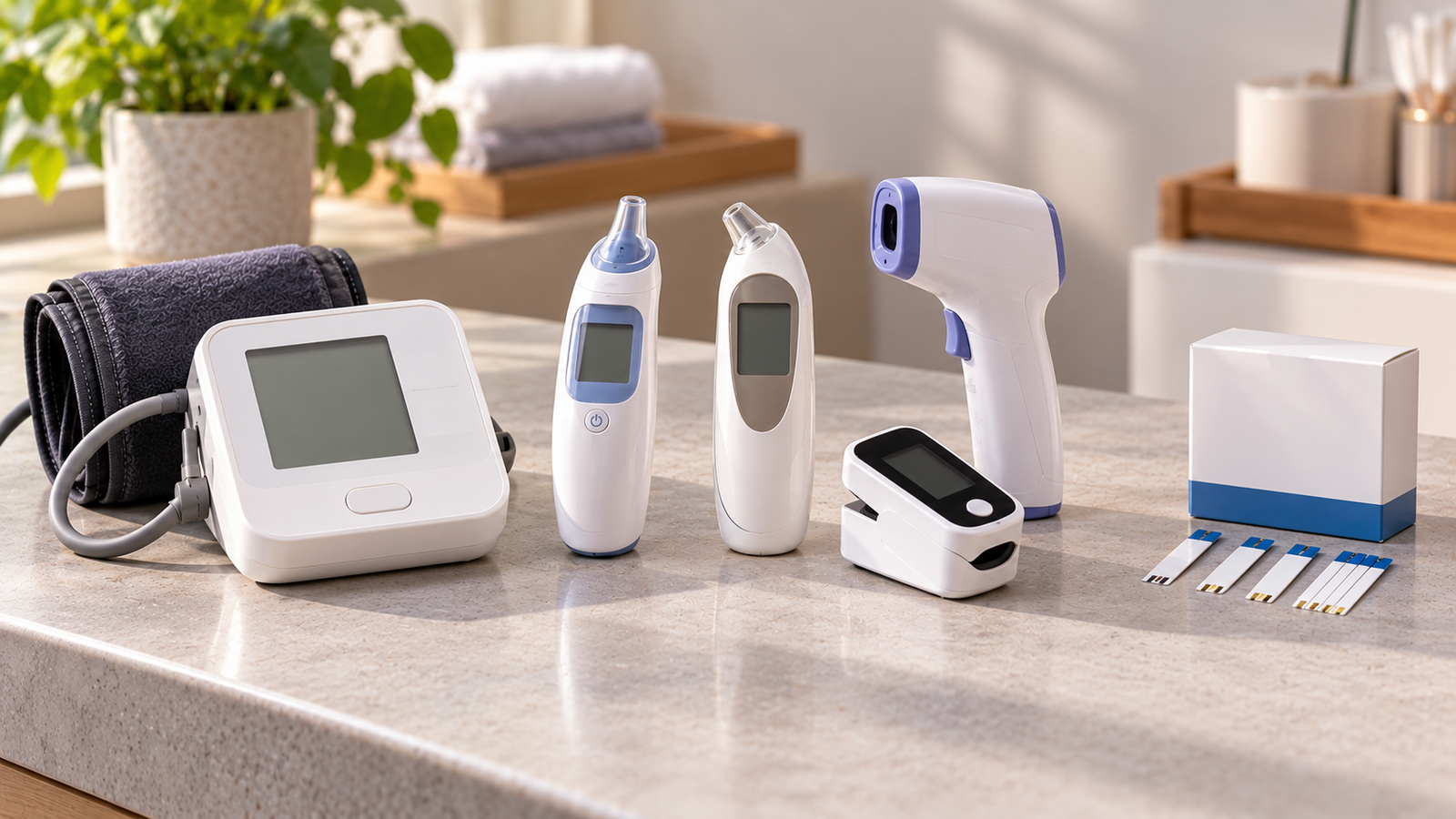
An ear thermometer is a convenient device for checking body temperature at home.
It can be particularly useful in households where several family members need temperature monitoring during a period of illness.
Unlike some traditional digital thermometers, an infrared ear thermometer can provide a reading in just a few seconds.
However, taking a temperature is not simply a matter of inserting the probe and pressing a button.
Ear thermometers require correct positioning, appropriate maintenance, and careful attention to hygiene.
Many popular models use disposable probe covers, also called lens filters, hygiene caps, or protective probe sleeves.
These covers fit over the thermometer’s measuring tip and are designed to help protect the sensor from earwax and other contamination.
They also reduce the opportunity for material collected during one measurement to be transferred to another person.
A common mistake is assuming that a probe cover only needs to be changed when moving between different family members.
For many models, this is incorrect.
Braun ThermoScan, OMRON Gentle Temp, and Beurer FT 58 instructions specify using a fresh disposable probe cover for every measurement.
That includes repeat measurements on the same person.
Other thermometers, such as the Kinsa Smart Ear, do not require disposable probe covers and instead rely on a manufacturer-specified cleaning procedure.
The safest approach is to identify the thermometer’s exact design, use its approved protective accessories, and follow the required cleaning or cover-replacement procedure before each reading.
Probe hygiene matters for two reasons.
First, reusable equipment can become contaminated when it contacts different people.
Second, earwax, dirt, or an incorrectly attached cover can affect the infrared sensor and produce unreliable temperature readings.
This guide explains how ear thermometer probe covers work, when they should be changed, how to handle them hygienically, and what to do when the sensor becomes dirty.
It also covers family temperature monitoring, thermometer positioning, children’s age limitations, ear infections, storage, cleaning, and a practical pre-measurement checklist.
1. What Is an Infrared Ear Thermometer?
An infrared ear thermometer is a device designed to estimate body temperature by measuring infrared radiation from the ear canal and tympanic region.
It is sometimes called a tympanic thermometer.
Infrared measurement
The sensor detects thermal radiation rather than measuring temperature through a conventional contact metal probe.
Fast readings
Many ear thermometers provide results within seconds.
Home use
Certain models are intended for household temperature monitoring.
Clinical models
Other products are designed for healthcare settings.
Why the distinction matters
Home and professional devices may have different accessories, maintenance procedures, and infection-control requirements.
Main components
A typical infrared ear thermometer may include:
- Measuring probe
- Infrared sensor
- Display
- Measurement button
- Battery compartment
- Probe-cover attachment
- Cover-ejection mechanism
- Protective storage cap or case
Not every model is identical
The sensor configuration and required accessories differ between manufacturers.
2. What Is an Ear Thermometer Probe Cover?
A probe cover is a protective accessory fitted over a thermometer’s measuring tip.
It is also described as a lens filter, hygiene cap, or probe sleeve.
Main purpose
For devices designed to use disposable covers, it helps maintain hygienic use.
Sensor protection
It reduces direct contact between the measuring tip and earwax or other residue.
Accuracy
A properly fitted manufacturer-approved cover is part of the device’s intended measurement system.
Single-use design
Many covers are intended for one measurement only.
Does every thermometer need a cover?
No.
Some models are explicitly designed for operation without disposable covers.
Manufacturer examples
Braun ThermoScan, OMRON Gentle Temp 520, and Beurer FT 58 use disposable probe covers.
Kinsa Smart Ear is designed for coverless operation with cleaning of the probe.
Practical principle
A probe cover is not a universal accessory. Whether one is required depends on the exact thermometer.
3. Probe Cover, Lens Filter and Storage Cap: What Is the Difference?
These terms can be confusing.
Disposable probe cover
A protective component fitted over the measuring tip for taking a reading.
Lens filter
Braun commonly uses this term for its disposable covers.
Hygiene cap
Another term used for disposable protective covers.
Protective storage cap
A separate accessory intended to protect the probe while the thermometer is stored.
Connection ring
Some OMRON models use a ring to help install the disposable probe cover.
Why the distinction matters
A storage cap is not necessarily designed to remain attached during temperature measurement.
Likewise, a connection ring is not the disposable cover itself.
What should you do?
Identify the components using the manufacturer’s diagram.
Never assume that every protective-looking part has the same function.
4. Why Probe Covers Matter for Family Hygiene
A shared thermometer comes into contact with different users.
Earwax
Small amounts of earwax may contact the probe-cover surface.
Skin contact
The protective tip may touch the outer ear.
Other residue
Moisture or other material may remain on a used cover.
Shared equipment
Using the same contaminated accessory on another person can create an avoidable route for transferring material between users.
OMRON warning
The Gentle Temp 520 manual specifically warns against using a cover after someone else has used it because of potential cross-infection, including otitis externa.
Does a new cover guarantee zero infection risk?
No.
The thermometer body, hands, storage case, and other contact surfaces may also become contaminated.
What does CDC guidance support?
The CDC recommends appropriate cleaning and reprocessing of reusable healthcare equipment between patients.
Practical takeaway
Use fresh disposable covers when required, and do not neglect the cleanliness of the reusable thermometer itself.
5. How Often Should You Change a Disposable Probe Cover?
For many ear thermometers, the answer is straightforward.
Replace the disposable cover after every measurement.
Braun ThermoScan
Braun specifies a new lens filter for each temperature reading.
OMRON Gentle Temp 520
OMRON requires a new, undamaged probe cover for each measurement.
Beurer FT 58
Beurer specifies replacement after each use.
What about measuring the same person twice?
The disposable cover should still be replaced when the model requires a fresh cover for each reading.
What about checking the opposite ear?
Use a new cover for the next measurement.
What about another family member?
Always use a new cover and follow the appropriate hygiene procedure.
Why replace after every measurement?
A used cover may contain earwax or other residue even when it appears clean.
Important qualification
These instructions apply to the cover-requiring models described above.
A coverless thermometer follows a different cleaning procedure.
6. Can You Reuse a Disposable Probe Cover?
A disposable probe cover should not be reused.
Why not?
It is designed for a limited, specified use.
Earwax contamination
Residue may remain on its surface.
Handling
Removing and refitting a used cover can introduce further contamination.
Fit
The cover may become distorted or damaged.
Measurement performance
Manufacturers evaluate their devices with the intended accessory arrangement.
Can you wipe the cover with a tissue?
Wiping does not convert a single-use cover into an approved reusable accessory.
Can you wash it?
No, unless the manufacturer explicitly describes a reusable-cover design and cleaning procedure.
Can you disinfect it with alcohol?
Do not attempt to reprocess disposable covers against their instructions.
Practical rule
Discard used single-use covers and fit a fresh one before another measurement.
7. Does a Cover Need Replacing Even If It Looks Clean?
Yes, when the manufacturer specifies single use.
Visible appearance
A cover may appear perfectly clean after measuring temperature.
Microscopic residue
Small amounts of earwax or other material may remain.
Braun explanation
Braun states that even a microscopic layer of earwax or dirt can interfere with the infrared measurement.
Hygiene
Visible cleanliness does not establish that a cover is suitable for reuse.
Measurement consistency
A fresh approved cover helps maintain the intended optical conditions.
What should you avoid?
Do not judge reusability by colour, smell, or the absence of visible dirt.
Key point
A disposable lens filter is replaced because of its intended use—not only when it becomes visibly dirty.
8. Disposable Covers vs Coverless Thermometers
These two designs require different handling.
| Feature | Disposable-cover thermometer | Coverless thermometer |
|---|---|---|
| Probe protection | Disposable filter or cap | Integrated probe design |
| Between-reading procedure | Replace cover as directed | Clean probe as directed |
| Consumables | Replacement covers required | Generally no disposable covers |
| Contact with earwax | Cover helps protect sensor | Probe surface may need direct cleaning |
| Maintenance | Cover changes plus device cleaning | Probe cleaning plus device maintenance |
| Example | Braun ThermoScan | Kinsa Smart Ear |
| Main concern | Reused, damaged, or incompatible cover | Inadequately cleaned measuring tip |
Which is more hygienic?
Neither design should be considered automatically superior in all circumstances.
What matters?
Correct use, cleaning, accessory compatibility, and adherence to the manufacturer’s instructions.
Coverless example
Kinsa states that its Smart Ear thermometer does not require disposable probe covers and provides a method for cleaning the sensor.
Practical recommendation
Choose a thermometer whose hygiene procedure you can maintain consistently.
9. How to Attach a New Braun ThermoScan Lens Filter
Braun provides a specific fitting procedure for its ThermoScan lens filters.
Step 1: Identify the correct filter
Use the compatible genuine Braun accessory.
Step 2: Keep the filters clean
Do not handle the measuring surface unnecessarily.
Step 3: Position the thermometer
Align the probe with a fresh filter in the dispenser.
Step 4: Attach the filter
Push the probe straight into the filter as instructed.
Step 5: Lift the thermometer
Remove the thermometer with the new filter attached.
Step 6: Check the fit
Confirm that the filter is secure.
Step 7: Take the reading
Follow the thermometer’s normal measurement procedure.
Step 8: Eject or remove
After use, remove the filter using the model’s designated method.
Step 9: Discard
Place the used filter in an appropriate waste bin.
Step 10: Fit a fresh filter
Use another cover if a new measurement is required.
Important note
Braun models differ in their physical ejection mechanisms, so follow the instructions for your model.
10. How OMRON Gentle Temp Probe Covers Are Attached
OMRON Gentle Temp 520 uses a different arrangement.
Compatible accessory
The model uses an approved MC-EP2 series probe cover.
Connection ring
A separate ring assists with attachment.
Manufacturer procedure
OMRON instructs the user to place a new cover onto the connection ring in the specified orientation.
The thermometer probe is then positioned and pushed into the cover until it clicks.
Why orientation matters
An incorrectly installed cover may interfere with normal operation.
Cover detection
OMRON describes an indicator that can flash when the cover is not attached correctly.
What should you avoid?
Do not force a damaged cover onto the probe.
Important distinction
The connection ring is an installation accessory.
It is not intended to replace the disposable measuring cover.
Practical rule
Use the complete installation method from the exact OMRON manual.
11. Why Cover Compatibility Matters
Probe covers are not universally interchangeable.
Shape
Different thermometers may use different tip geometries.
Optical material
The cover material must be compatible with the infrared measurement system.
Thickness
Differences may affect the intended measuring conditions.
Attachment
A cover must fit securely.
Sensor detection
Some models recognize whether the expected cover is attached.
Braun guidance
Braun recommends genuine ThermoScan lens filters for its ear thermometers.
Beurer guidance
Beurer specifies compatible covers for its FT 58 model and warns that other covers can affect measurements.
Practical recommendation
Check the model number before purchasing replacement covers.
Do not assume that similar-looking packaging indicates compatibility.
12. What Happens If a Probe Cover Is Loose?
An improperly attached cover can affect the measurement.
Poor fit
The cover may not sit in its intended position.
Wrinkles
A distorted cover may interfere with the optical path.
Movement
The cover could shift during placement.
Device error
Some models may refuse to take a reading.
What should you do?
Remove and discard the unsuitable disposable cover.
Use a fresh cover
Install it according to the instructions.
Do not use force
The thermometer probe is a sensitive component.
If the problem continues
Check whether the replacement covers are compatible and undamaged.
Practical principle
A loose or improperly installed cover should not be treated as acceptable simply because the thermometer powers on.
13. Why Earwax Can Affect Temperature Readings
Earwax is a normal substance produced within the ear canal.
It helps protect the ear.
However, excessive earwax can interfere with some ear thermometer measurements.
Infrared path
The thermometer detects heat radiation from the intended area.
Obstruction
Earwax can interfere with the sensor’s view.
Cover contamination
Wax on a used lens filter may also affect the reading.
Braun guidance
Braun identifies excessive earwax and dirty lens filters as possible causes of inaccurate measurements.
Mayo Clinic guidance
Mayo Clinic also lists earwax among factors that can reduce ear thermometer accuracy.
What should you do?
Use a clean, approved probe cover.
Do not insert cotton swabs deeply
Trying to remove earwax with objects inside the canal can cause injury or push wax farther inward.
When earwax is a concern
Seek advice from a qualified healthcare professional.
14. Why You Should Not Clean Earwax with the Thermometer
An ear thermometer is a measuring device, not an ear-cleaning tool.
Probe design
The tip is intended for temperature measurement.
Sensitive tissue
The ear canal can be injured by forceful insertion.
Wax movement
Pushing objects into the ear can move wax inward.
Sensor damage
Using the thermometer to scrape or clear material may damage the lens.
Infection concerns
Improper handling may introduce additional contamination.
OMRON warning
OMRON instructs users not to force the probe into the ear.
Practical recommendation
If visible earwax or discomfort prevents accurate measurement, use a suitable alternative thermometer and seek professional guidance where necessary.
15. Cleaning the Thermometer Body Between Family Members
Replacing a disposable cover does not eliminate the need to maintain the reusable device.
Handle contact
Hands touch the thermometer during each use.
Buttons
Frequently touched controls may collect residue.
Display
The screen can be touched during operation.
Outer housing
The thermometer may contact skin or nearby surfaces.
Manufacturer instructions
Use the approved cleaning or disinfection procedure.
CDC guidance
In healthcare settings, reusable patient-care equipment must be cleaned and reprocessed appropriately between patients.
What about home use?
Maintain the device according to its instructions and clean it when contaminated.
Do not immerse the thermometer
Most electronic ear thermometers are not designed for submersion.
Practical rule
A new cover protects the measuring tip, but the rest of the thermometer still needs appropriate care.
16. How to Clean the Infrared Sensor
The infrared measuring lens is one of the most sensitive parts of an ear thermometer.
Why care matters
Scratches, dirt, and cleaning residue may affect its performance.
Braun example
For certain Braun ThermoScan models, the manufacturer recommends gently wiping the probe lens with a cotton swab or soft cloth moistened with 70% isopropyl alcohol when cleaning is necessary.
OMRON example
OMRON Gentle Temp 520 provides a procedure for cleaning the lens if the thermometer is accidentally used without a cover.
Kinsa example
Kinsa Smart Ear recommends cleaning the sensor with a cotton swab and alcohol.
Are these methods interchangeable?
No.
Why not?
Materials, sensor assemblies, and drying requirements differ.
What should you do?
Use the exact model’s cleaning instructions.
Important warning
Never scrape the infrared lens or use abrasive paper towels when the manufacturer warns against them.
17. Why Cleaning and Drying Time Matter
A sensor may need time to dry after cleaning.
Residual moisture
Cleaning fluid may remain temporarily on the measuring surface.
Measurement performance
A wet or contaminated sensor may not operate as intended.
OMRON guidance
For the Gentle Temp 520, OMRON specifies allowing the cleaned probe lens approximately 45 minutes to dry completely before fitting a new cover in the relevant cleaning procedure.
Does Braun require the same waiting time?
Not necessarily.
Does every thermometer require 45 minutes?
No.
Why this matters
Applying one brand’s cleaning interval to another can be misleading.
Practical recommendation
Follow the model-specific drying time.
Do not take a reading immediately after cleaning if the instructions require a waiting period.
18. Can You Use Alcohol Wipes on an Ear Thermometer?
Possibly, but only when suitable for the device.
Alcohol concentration
Some manufacturers specify 70% isopropyl alcohol.
Device components
The probe, display, and housing may have different material requirements.
Excess liquid
Cleaning fluid should not enter openings or electrical components.
Manufacturer guidance
Braun and Kinsa provide alcohol-based probe-cleaning instructions for certain models.
Is household disinfectant safe?
Not automatically.
Why caution matters
Certain cleaning chemicals can affect optical surfaces, plastics, seals, or displays.
Do not spray directly
Unless explicitly permitted, avoid applying cleaning liquid directly to the electronic device.
Practical rule
Use manufacturer-approved wipes, swabs, or cloths rather than improvising a stronger cleaning solution.
19. Can You Wash the Entire Thermometer?
Do not immerse an electronic ear thermometer unless its manufacturer specifically approves that procedure.
Water exposure
Many household thermometers are not designed for full immersion.
Battery compartment
Water may damage electrical components.
Sensor assembly
Moisture can interfere with measurement.
Kinsa guidance
Kinsa advises against submerging its Smart Ear thermometer or putting it in boiling water or a dishwasher.
OMRON guidance
OMRON provides specific surface-cleaning procedures rather than general immersion instructions.
What about a waterproof rating?
Check exactly what the rating covers.
Practical conclusion
Cleaning a thermometer does not usually mean rinsing the entire electronic device under a tap.
20. Can a Disposable Probe Cover Be Cleaned Instead of Replaced?
For single-use covers, no.
Wiping
May leave contamination behind or damage the cover.
Alcohol
May alter the intended surface or introduce residue.
Water
May affect fit or material characteristics.
Reattachment
The cover may no longer fit as intended.
Manufacturer instructions
Braun, OMRON, and Beurer specify new disposable covers for each measurement.
What if replacement covers are unavailable?
Use another suitable thermometer rather than reusing a single-use cover against the instructions.
Important principle
A lack of spare covers is a supply problem, not a reason to bypass the thermometer’s intended hygiene procedure.
21. What If You Accidentally Use the Thermometer Without a Cover?
This situation requires attention when the model is designed for disposable covers.
Stop before further readings
Do not continue using the device without the required accessory.
Inspect the probe
Avoid touching the sensor.
Follow cleaning instructions
Use the manufacturer’s specific procedure for accidental uncovered use.
OMRON example
OMRON provides a cleaning procedure using 70% alcohol and a specified drying period.
Braun example
Braun provides model-specific lens-cleaning instructions when the probe becomes dirty.
Replace the cover
Fit a new, compatible disposable filter once the device is ready.
Do not improvise
Do not insert tissue, plastic film, or another household material over the sensor.
Practical takeaway
An uncovered reading may be unreliable, and the probe may require proper cleaning before reuse.
22. Handling Used Covers Without Touching the Tip
Many thermometers are designed to make cover removal convenient.
Ejection buttons
Some Braun and Beurer models have a mechanism that releases the disposable cover.
Why this helps
It can reduce the need to handle the used tip directly.
No ejection button
Other models require manual removal.
What should you do?
Follow the model-specific removal method.
Avoid unnecessary contact
Handle used covers carefully.
Disposal
Place the used cover in an appropriate waste container.
Wash hands
Follow good hand hygiene, particularly when caring for an ill person.
Practical reminder
Do not place a used cover back into the clean-cover dispenser.
23. Keeping Clean and Used Covers Separate
A simple organizational system can help prevent accidental reuse.
Clean covers
Keep them in their original protective packaging where practical.
Used covers
Discard immediately after measurement.
Do not create a reuse pile
A used cover should not be set aside for later.
Keep dispensers clean
Avoid touching the unused filter surfaces.
Family measurement routine
Prepare a fresh cover before measuring each person.
Children
Keep small accessories away from children.
Why this matters
Probe covers are small items and may present a choking hazard if misused.
Best approach
Keep unused covers protected, handle them only as necessary, and discard used ones promptly.
24. Storing Replacement Probe Covers
Proper storage supports hygiene and material integrity.
Dry location
Avoid damp storage.
Dust protection
Keep the accessories in suitable packaging.
Direct sunlight
Avoid prolonged sunlight when prohibited.
Temperature extremes
Follow manufacturer limits.
Braun guidance
Braun recommends storing lens filters in a dry location free from dust and contamination.
Open packaging
Keep unused filters protected after opening the box.
Do not store loose in a bag
Unprotected filters may become dirty or damaged.
Before use
Inspect the replacement cover.
Practical rule
A cover should be fresh, clean, undamaged, and compatible when fitted.
25. Can Different Family Members Share One Ear Thermometer?
Yes, many household ear thermometers are designed for shared use when appropriate hygiene procedures are followed.
Disposable-cover models
Use a fresh cover for each measurement.
Coverless models
Clean the measuring probe according to the manufacturer before use on another person.
Shared handle
Keep the housing and buttons appropriately clean.
Illness
Use good hand hygiene when handling equipment.
Additional caution
People with certain ear infections or conditions may not be suitable candidates for ear measurement.
Clinical settings
Healthcare providers follow formal equipment-reprocessing protocols that may be stricter than ordinary household care.
Practical recommendation
The same thermometer can be shared, but a used disposable cover should not be shared.
26. A Family Temperature-Monitoring Routine
This routine helps maintain consistent measurements and hygiene.
Step 1: Identify the person
Know whose temperature is being measured.
Step 2: Check the thermometer
Confirm that it is clean and functioning.
Step 3: Prepare a fresh cover
Use one if required by the model.
Step 4: Select any required user setting
Some thermometers have age-specific modes.
Step 5: Position the person comfortably
Minimize unnecessary movement.
Step 6: Follow the ear-positioning instructions
Use the method appropriate for the person’s age and the device.
Step 7: Take the reading
Avoid forceful insertion.
Step 8: Record the result if needed
Include the time and measurement site.
Step 9: Remove the used cover
Discard it appropriately.
Step 10: Clean the device as directed
Pay attention to contamination and shared handling.
Step 11: Prepare for the next person
Use a new cover or complete the coverless-probe cleaning procedure.
Step 12: Store safely
Keep the thermometer and accessories away from small children.
27. Correct Ear Thermometer Positioning
Proper positioning influences measurement accuracy.
Ear canal shape
The canal is not a perfectly straight tube.
Probe direction
The thermometer must be aimed according to the manufacturer’s method.
American Academy of Pediatrics guidance
For children older than one year, the AAP describes gently pulling the ear back and upward before inserting the ear thermometer.
Younger children
Positioning requirements may differ.
OMRON guidance
OMRON recommends positioning the probe in the direction of the eardrum without forcing insertion.
Why correct positioning matters
A poorly positioned sensor may not measure the intended area accurately.
Important warning
Do not push the probe deeply or continue if the person experiences pain.
Best approach
Follow the exact thermometer instructions, with particular attention to age-specific ear positioning.
28. Why Ear Thermometers May Not Suit Very Young Infants
Age matters when selecting a temperature-measurement method.
Narrow ear canals
Young infants have relatively small ear canals.
Measurement difficulty
This can make reliable positioning difficult.
AAP guidance
The American Academy of Pediatrics recommends avoiding ear thermometers in infants younger than six months.
Mayo Clinic guidance
Mayo Clinic similarly advises that ear thermometers are not recommended for very young infants, using a somewhat different age cutoff.
Why recommendations may differ
Different clinical resources and product manufacturers may describe different age ranges.
Practical recommendation
For infants under six months, use a temperature-measurement method recommended by a healthcare professional.
Important caution
An age-selection feature on a thermometer does not override medical guidance about which measurement method is most reliable for a young infant.
29. Fever in Babies Under Three Months
Fever in very young infants requires prompt medical attention.
AAP guidance
The AAP states that a baby aged three months or younger with a rectal temperature of 38°C (100.4°F) or higher requires immediate contact with a pediatrician.
Why this matters
Serious infections may initially present with fever.
Do not rely only on a questionable ear reading
Ear thermometers may be inaccurate in very young infants.
What if the baby feels unwell?
Seek medical advice promptly.
Do not delay care
Do not spend time repeatedly testing the same disposable cover or searching for a more reassuring number when urgent assessment is indicated.
Important reminder
Probe hygiene supports reliable monitoring, but it cannot replace age-appropriate fever assessment or medical care.
30. Using Ear Thermometers with Older Children
Ear thermometers may be appropriate for children old enough for the device and clinical guidance.
Correct age
Follow pediatric recommendations and model instructions.
Gentle positioning
Never force the probe into the ear.
Movement
A moving child may make correct placement difficult.
Probe covers
Use a new disposable cover for every reading when required.
Earwax
Excessive wax can affect results.
Ear infection
An ear condition may make measurement uncomfortable or unsuitable.
What if the child resists?
Use an appropriate alternative measurement method rather than forcing the procedure.
Practical recommendation
Comfort, gentle technique, and appropriate measurement choice matter more than obtaining an ear reading at any cost.
31. Ear Infections and Temperature Measurement
An ear infection can complicate ear thermometer use.
Pain
Insertion may be uncomfortable.
Canal inflammation
The ear canal may be tender or swollen.
Ear discharge
Discharge may indicate a condition requiring medical attention.
OMRON warning
The Gentle Temp 520 instructions advise against use in people with certain ear diseases, including otitis externa and otitis media.
Mayo Clinic guidance
Ear infections can affect the accuracy of some ear thermometer measurements.
What should you do?
Use a suitable alternative temperature-measurement method and seek medical advice as appropriate.
Do not force the probe
Pain is a reason to stop.
Practical rule
A person with ear pain or discharge should not be subjected to repeated ear temperature checks merely to obtain a number.
32. Ear Drops, Hearing Aids and Recent Swimming
Several everyday conditions can influence ear temperature readings.
Ear drops
Medication or fluid in the ear may interfere with the measurement.
Hearing aids
A hearing aid may change local conditions.
Earphones
Some devices may affect ear temperature before measurement.
Swimming
Water remaining in the ear can create problems.
Bathing
Recent bathing may affect the measurement.
Braun guidance
Braun recommends waiting approximately 20 minutes after certain factors, including hearing-aid use or exposure to unusually hot or cold conditions.
OMRON guidance
OMRON warns against using its Gentle Temp 520 when the ear canal is wet.
What should you do?
Follow the exact thermometer instructions and choose an alternative method when necessary.
33. Should You Measure the Same Ear Every Time?
For following temperature changes over time, consistency matters.
Left and right ears
Measurements may differ between ears.
Braun guidance
Braun recommends taking sequential measurements in the same ear when comparing results.
Why consistency helps
It reduces one source of variation.
Does the same ear always provide the most accurate result?
Not necessarily.
Ear-specific problems
An infection, obstruction, or other condition may make one ear unsuitable.
Practical approach
Use the same suitable ear for serial readings, provided the model instructions and the person’s condition permit it.
Record keeping
Note the ear used when tracking temperature over time.
34. Why Readings Sometimes Differ
Several factors can produce variation.
Probe placement
The tip may be positioned differently.
Earwax
Obstruction can interfere with the infrared measurement.
Used cover
Residue may affect the sensor’s optical path.
Ambient temperature
Recent exposure to cold or heat can influence results.
Ear selection
The left and right ears may differ.
Device acclimation
A thermometer moved between different environments may require time to adjust.
Battery condition
Some devices display errors or function abnormally when batteries are depleted.
What should you do?
Review the device instructions and repeat a measurement correctly with a fresh cover when required.
Important limitation
Repeated measurements should not be used to dismiss concerning symptoms or delay medical assessment.
35. What If You Get an Unusually Low Reading?
A low ear temperature reading may reflect technique or device issues.
Poor positioning
The sensor may not be aimed correctly.
Earwax
Obstruction can affect the measurement.
Recently cold ear
Outdoor conditions may lower the measured temperature.
Used or damaged cover
An unsuitable filter may interfere with the reading.
What should you do?
Check the instructions.
Use a new cover if required.
Ensure appropriate environmental acclimation.
Confirm when necessary
Use another clinically appropriate temperature-measurement method.
Seek help for concerning symptoms
An unexpectedly low temperature accompanied by severe illness, confusion, or other alarming symptoms requires medical assessment.
36. What If You Get an Unusually High Reading?
An elevated reading may indicate fever, but device technique should still be checked.
Measurement site
Ear temperatures may differ from oral or underarm measurements.
Recent heat exposure
Environmental conditions may affect readings.
Ear condition
Inflammation or other factors may influence measurement.
Cover quality
An improperly attached cover may affect results.
How should you respond?
Consider the person’s age, symptoms, and clinical condition.
Do not rely on colour codes alone
Age-based fever indicators are device-specific aids, not medical diagnoses.
When concerned
Use a suitable measurement method and seek healthcare advice.
Urgent symptoms
Difficulty breathing, confusion, seizures, severe lethargy, or other serious symptoms require urgent medical attention.
37. Cover-Detection Indicators and Error Messages
Some thermometers detect whether a disposable cover is attached.
Missing-cover indicator
The display may show a symbol or warning.
Measurement lockout
Certain devices will not take a reading without a cover.
Braun guidance
Some ThermoScan models require a fitted lens filter before operation.
OMRON guidance
The Gentle Temp 520 can display a flashing probe-cover indicator when the cover is not attached correctly.
What should you do?
Stop and check the cover.
Use a fresh compatible accessory
Do not attempt to bypass the mechanism.
Persistent error
Consult the manual or manufacturer support.
Important principle
A cover-detection error is not permission to disable the safety or measurement feature.
38. Storage Hygiene Between Illnesses
A thermometer may remain unused for weeks or months.
Storage case
Use the protective case or cradle supplied with the device.
Clean equipment
Store the thermometer after completing any required cleaning.
Dry environment
Avoid excess humidity.
Dust
Protect the probe and unused covers.
Direct sunlight
Follow the manufacturer’s storage limits.
Braun guidance
Braun recommends dry storage away from dust, contamination, and direct sunlight.
Before reuse
Inspect the sensor, batteries, housing, and accessories.
Do not store with a used measuring cover
Discard disposable filters after measurement.
Practical recommendation
Keep the thermometer and clean cover supply together, but maintain separation from discarded materials.
39. How Many Spare Covers Should a Family Keep?
There is no universal number of replacement covers required for every household.
Household size
More users may require more measurements.
Illness
Temperature checks may become more frequent when several family members are unwell.
Repeat readings
A fresh disposable cover may be required every time.
Product packaging
Replacement filters are sold in different quantities.
Braun example
Its LF40 lens filters are commonly supplied in packs of 40.
Beurer example
The FT 58 has replacement packs containing 20 disposable covers.
What should you do?
Keep a reasonable supply compatible with your thermometer.
Do not overbuy without checking compatibility
Confirm the model before purchasing large quantities.
Practical lesson
A spare-cover supply should support proper single use rather than encourage reuse when covers run out.
40. Disposal of Used Probe Covers
Used probe covers should be handled according to product instructions and local waste rules.
Household use
Discard used disposable filters promptly in an appropriate waste container.
Do not return to the dispenser
Keep used and unused covers separate.
Avoid direct tip contact
Use the ejection mechanism where supplied.
Hand hygiene
Wash or sanitize hands when appropriate after handling used equipment.
Clinical settings
Healthcare facilities may have specific waste-management and infection-control requirements.
Do not assume all used covers require identical disposal
Requirements can vary by healthcare setting, contamination, and local regulation.
Children and pets
Keep small discarded parts inaccessible.
Practical principle
Use, discard, and replace each disposable filter without mixing it back into clean supplies.
41. Common Ear Thermometer Hygiene Mistakes
Mistake 1: Reusing a cover for another family member
Disposable covers must be replaced according to the instructions.
Mistake 2: Reusing a cover on the same person
Many models require a fresh cover for every reading.
Mistake 3: Wiping a used disposable cover
Cleaning does not make it reusable.
Mistake 4: Using an incompatible replacement cover
Fit and optical characteristics may differ.
Mistake 5: Taking measurements without a required cover
This may contaminate the sensor or interfere with accuracy.
Mistake 6: Touching the sensor lens
Fingerprints may affect performance.
Mistake 7: Cleaning with abrasive tissue
Some manufacturers warn that paper fibres can scratch delicate sensor surfaces.
Mistake 8: Using the same cleaning method for every brand
Cleaning agents and drying times differ.
Mistake 9: Immersing electronic thermometers in water
Most are not intended for immersion.
Mistake 10: Sharing a coverless thermometer without cleaning it
Follow the manufacturer’s between-use cleaning procedure.
Mistake 11: Ignoring earwax buildup
Excessive wax can affect measurement accuracy.
Mistake 12: Forcing the probe into the ear
This may cause pain or injury.
Mistake 13: Using an ear thermometer despite ear pain
Use another suitable method and seek medical advice when needed.
Mistake 14: Using ear readings in a very young infant without considering limitations
Pediatric guidance recommends avoiding tympanic measurement in infants younger than six months.
Mistake 15: Comparing different ears without noting the difference
Serial measurements are more consistent when taken in the same suitable ear.
Mistake 16: Ignoring temperature changes from the environment
Recent exposure to heat or cold may affect readings.
Mistake 17: Storing clean covers loosely
Dust and contamination can affect unused supplies.
Mistake 18: Leaving a used cover on the thermometer
Discard single-use covers after measurement.
Mistake 19: Treating a normal number as proof that a sick person is well
Temperature is only one part of clinical assessment.
Mistake 20: Delaying medical care to obtain repeated readings
Age, symptoms, and illness severity must guide the response.
42. Troubleshooting Probe-Cover Problems
| Problem | Possible explanation | Recommended response |
|---|---|---|
| Thermometer will not take a reading | Required cover missing | Fit a fresh approved cover |
| Cover indicator flashes | Improper installation or wrong cover | Reattach correctly using a new cover |
| Cover slips off | Incorrect fit or damaged accessory | Discard and replace |
| Temperature varies unexpectedly | Positioning, ear condition, or cover problem | Review technique and replace cover |
| Sensor appears dirty | Uncovered use or residue | Follow model-specific cleaning |
| Cover contains earwax | Normal contamination during use | Discard after measurement |
| Unused covers look dusty | Poor storage | Use clean, protected replacements |
| No covers remain | Supply exhausted | Obtain compatible covers or use another suitable thermometer |
| Child experiences ear pain | Ear condition or insertion problem | Stop and seek advice |
| Thermometer gives very low reading | Technique, temperature exposure, or obstruction | Recheck appropriately |
| Probe is visibly scratched | Sensor damage | Contact manufacturer |
| Thermometer was submerged | Possible electronic damage | Stop use and seek service guidance |
| Coverless thermometer becomes dirty | Direct sensor contamination | Clean according to its instructions |
| Display shows repeated error | Cover, battery, or device problem | Consult model-specific troubleshooting |
| Different ears give different results | Anatomical or positioning differences | Use the same suitable ear for monitoring |
| Cleaning fluid remains on probe | Insufficient drying | Wait as instructed before use |
A single problem can have several explanations.
Do not continue measuring with damaged or improperly attached components.
43. The Complete Ear Thermometer Hygiene Checklist
Before checking temperature
- Thermometer: Confirm the correct device.
- Age: Make sure ear measurement is appropriate.
- Sensor: Inspect for dirt and damage.
- Cover: Identify whether the model requires one.
- Compatibility: Use approved replacement filters.
- Condition: Select a clean, undamaged cover.
- Hands: Maintain appropriate hand hygiene.
- Environment: Consider recent heat, cold, or bathing.
- Ear condition: Avoid use when ear pain or other contraindications are present.
Installing a disposable cover
- Use a fresh cover.
- Avoid touching the measuring surface.
- Follow the correct orientation.
- Attach using the approved mechanism.
- Check the fit.
- Do not force incompatible accessories.
- Do not stack covers.
- Confirm the device is ready.
Taking a reading
- Position the person comfortably.
- Follow age-appropriate ear positioning.
- Insert gently.
- Aim according to instructions.
- Avoid forcing the probe.
- Keep the person reasonably still.
- Take the measurement.
- Record the reading if needed.
- Note the ear used for serial monitoring.
After each measurement
- Remove the used disposable cover.
- Discard it promptly.
- Keep used covers away from clean supplies.
- Clean reusable surfaces as directed.
- Wash hands as appropriate.
- Use a fresh cover before another measurement.
Coverless thermometers
- Identify the model’s cleaning requirements.
- Clean the sensor after use as directed.
- Observe specified drying times.
- Avoid immersion.
- Inspect the probe.
- Store with the appropriate protective cap.
Storage
- Keep the thermometer clean.
- Use its protective case.
- Store unused covers in clean packaging.
- Avoid dust.
- Avoid high humidity.
- Avoid temperature extremes.
- Keep small components away from children.
- Check supplies before the next illness.
When medical advice is needed
- Fever in a very young infant
- Persistent or unusually high fever
- Ear pain or discharge
- Severe lethargy
- Difficulty breathing
- Confusion
- Seizures
- Dehydration concerns
- Any symptoms suggesting serious illness
Frequently Asked Questions
1. What is an ear thermometer probe cover?
It is a protective accessory fitted over the measuring tip of certain infrared ear thermometers.
It helps support hygiene and protects the sensor from contamination.
2. Do all ear thermometers need probe covers?
No.
Braun ThermoScan and OMRON Gentle Temp 520 require disposable covers, while Kinsa Smart Ear is designed for use without them.
3. Should I change the cover between family members?
Yes, when using a disposable-cover model.
Fit a fresh cover for each measurement.
4. Can I reuse the cover on the same person?
Not when the manufacturer specifies a new cover for every reading.
Braun, OMRON, and Beurer provide this instruction.
5. Can I wash disposable lens filters?
Do not wash and reuse single-use covers.
Discard them after the intended measurement.
6. Can I disinfect a disposable cover with alcohol?
Do not attempt to reprocess a single-use cover contrary to manufacturer instructions.
7. Why does a clean-looking cover still need replacement?
Invisible residue may remain, and the cover is designed for single use.
8. Can dirty covers affect accuracy?
Yes.
Braun and OMRON identify dirt and earwax on covers as factors that can interfere with readings.
9. Can I use any brand of ear thermometer cover?
No.
Choose an accessory approved for the specific thermometer.
10. Are Braun ThermoScan covers interchangeable between models?
Braun states that its LF40 lens filters are compatible with its ThermoScan ear thermometer range.
Confirm compatibility for your exact product and market.
11. What probe covers does OMRON Gentle Temp 520 use?
OMRON specifies compatible MC-EP2 series probe covers.
Follow the correct installation instructions.
12. Why does my thermometer show a probe-cover warning?
The cover may be missing, incorrectly attached, or incompatible.
Check the manual.
13. Can I measure temperature without the cover?
Not when the thermometer requires one.
Some models will not operate without the filter.
14. What if I accidentally took a reading without a cover?
Follow the manufacturer’s cleaning procedure for the exposed sensor before using the thermometer again.
15. Can I clean the sensor using rubbing alcohol?
Certain models permit a specific alcohol-based cleaning procedure.
Use only the method and drying interval recommended for your thermometer.
16. Can I wash the whole thermometer under water?
Do not assume so.
Many electronic ear thermometers are not designed for immersion.
17. Why does earwax affect readings?
Earwax may obstruct the infrared measurement or contaminate the probe cover.
18. Should I use a cotton bud to remove earwax before measuring?
Do not insert cotton buds deeply into the ear canal.
Seek professional help when earwax buildup interferes with measurement.
19. Can I use an ear thermometer when someone has an ear infection?
Certain manufacturers advise against it, and ear conditions can affect accuracy or comfort.
Use another appropriate method and seek medical advice.
20. Can I use an ear thermometer for a newborn?
Pediatric guidance recommends avoiding ear thermometers in infants younger than six months because narrow ear canals can make readings unreliable.
21. What temperature is concerning in a baby under three months?
The American Academy of Pediatrics advises immediate contact with a pediatrician for a baby three months or younger with a rectal temperature of 38°C (100.4°F) or higher.
22. Why are my left and right ear readings different?
Differences in positioning, anatomy, earwax, and other factors may affect the readings.
23. Should I always measure the same ear?
For consistent serial monitoring, Braun recommends using the same suitable ear.
24. Can hearing aids affect ear thermometer readings?
Yes.
Some manufacturers recommend waiting after hearing-aid removal before measuring.
25. Should I take a reading immediately after swimming?
Some manufacturers advise waiting because water and recent swimming may affect readings.
26. Why is the thermometer reading unusually low?
Poor positioning, earwax, temperature exposure, or an accessory problem may be involved.
Check the instructions and use a suitable alternative method when necessary.
27. How should unused probe covers be stored?
Keep them clean, dry, protected from dust, and within manufacturer-specified storage conditions.
28. Can I store used covers for later cleaning?
No, not when they are designed as disposable accessories.
Discard after use.
29. Can an ear thermometer spread infection?
Improperly shared equipment can create contamination concerns.
Use fresh disposable covers or model-specific cleaning procedures.
30. Are probe covers enough to keep the device hygienic?
No.
The handle and other reusable surfaces also require appropriate care.
31. Can I use the same ear thermometer in a family with several children?
Yes, when the device is suitable for each child’s age and used with the required hygiene procedure.
32. What if my thermometer has no disposable covers available?
Use another appropriate thermometer rather than reusing disposable accessories against their instructions.
33. How do I know if the infrared lens is damaged?
Visible scratching, contamination, or repeated measurement problems may indicate an issue.
Seek manufacturer support.
34. Should I repeatedly measure until I get a normal temperature?
No.
Repeat only as appropriate using correct technique, and do not delay medical assessment when symptoms or age indicate concern.
35. When should I contact a doctor?
Seek advice for concerning fever, persistent illness, ear pain, or other significant symptoms.
Very young infants and people with serious symptoms require prompt assessment.
Final Thoughts
Ear thermometers can make temperature monitoring more convenient, but their accuracy and hygiene depend on correct use.
For models designed with disposable lens filters, replacing the cover is a routine part of every measurement.
That means changing it even when the next reading is being taken from the same person.
A cover that looks clean may still contain earwax or other residue.
Reusing it can interfere with the intended measurement conditions and creates avoidable hygiene concerns.
For coverless thermometers, the procedure is different.
These models rely on cleaning the measuring probe according to their specific instructions.
The reusable body of any shared thermometer also needs appropriate maintenance.
Correct positioning is equally important.
Earwax, incorrect insertion angle, recent temperature exposure, and certain ear conditions may affect readings.
For young infants, an ear thermometer may not be the most suitable method.
In particular, pediatric guidance recommends avoiding tympanic readings for babies younger than six months.
Finally, temperature monitoring should support medical decisions rather than replace them.
A thermometer reading is only one part of assessing someone’s condition.
Use a fresh approved cover for each measurement when required, keep the sensor clean, follow correct positioning instructions, and take concerning symptoms seriously.
A simple family routine—clean hands, the correct accessory, a careful reading, immediate disposal, and proper storage—can make temperature monitoring more hygienic and dependable.
References and Further Reading
- Braun Healthcare — ThermoScan Disposable Lens Filters: https://www.braunhealthcare.com/us_en/filters_accessories/thermoscan-lens-filters/
- Braun Healthcare — ThermoScan 7+ Connect: FAQs and Measurement Guidance: https://www.braunhealthcare.com/us_en/thermoscan-7-connect-irt6575-faqs/
- Braun Healthcare — ThermoScan 6: Care and Cleaning: https://www.braunhealthcare.com/us_en/thermoscan-6-irt6515/
- OMRON Healthcare — Gentle Temp 520: Probe Cover and Lens Care: https://www.omron-healthcare.co.uk/products/gentle-temp-520
- Beurer — FT 58 Ear Thermometer: https://www.beurer.com/global/p/79533/
- Beurer — FT 58 Disposable Protective Caps: https://www.beurer.com/global/p/79534/
- Kinsa — Smart Ear Thermometer: Product and Cleaning Information: https://www.kinsahealth.com/products/kinsa-smart-ear-smart-thermometer
- Kinsa Help Center — How to Clean Your Smart Ear Thermometer: https://kinsa.zendesk.com/hc/en-us/articles/208250876–Smart-Ear-How-to-clean-to-your-thermometer-to-ensure-accuracy
- American Academy of Pediatrics — How to Take Your Child’s Temperature: https://www.healthychildren.org/English/health-issues/conditions/fever/pages/How-to-Take-a-Childs-Temperature.aspx
- American Academy of Pediatrics — Fever and Your Baby: https://www.healthychildren.org/English/health-issues/conditions/fever/Pages/Fever-and-Your-Baby.aspx
- Mayo Clinic — Thermometers: Understand the Options: https://www.mayoclinic.org/diseases-conditions/fever/in-depth/thermometers/art-20046737
- CDC — Core Infection Prevention and Control Practices: https://www.cdc.gov/infection-control/hcp/core-practices/
- CDC — Recommendations for Disinfection and Sterilization in Healthcare Facilities: https://www.cdc.gov/infection-control/hcp/disinfection-sterilization/summary-recommendations.html
Editorial note: This article provides general thermometer-use, hygiene, and home-health education. Probe-cover requirements, cleaning methods, drying times, age suitability, and measurement procedures vary by model. Always follow the instructions for the exact thermometer. Infrared ear readings can be affected by earwax, positioning, ear conditions, and environmental factors. Ear thermometers may be unsuitable for very young infants or people with certain ear problems. Temperature measurements should not replace clinical assessment, particularly for infants, persistent fever, or serious symptoms. Seek guidance from a qualified healthcare professional when appropriate.