Hair Finishing Oils on Fine Hair: Avoiding Greasy Roots and Heavy Ends
Understand how to apply finishing products sparingly, distribute them through lengths and avoid greasy-looking roots.
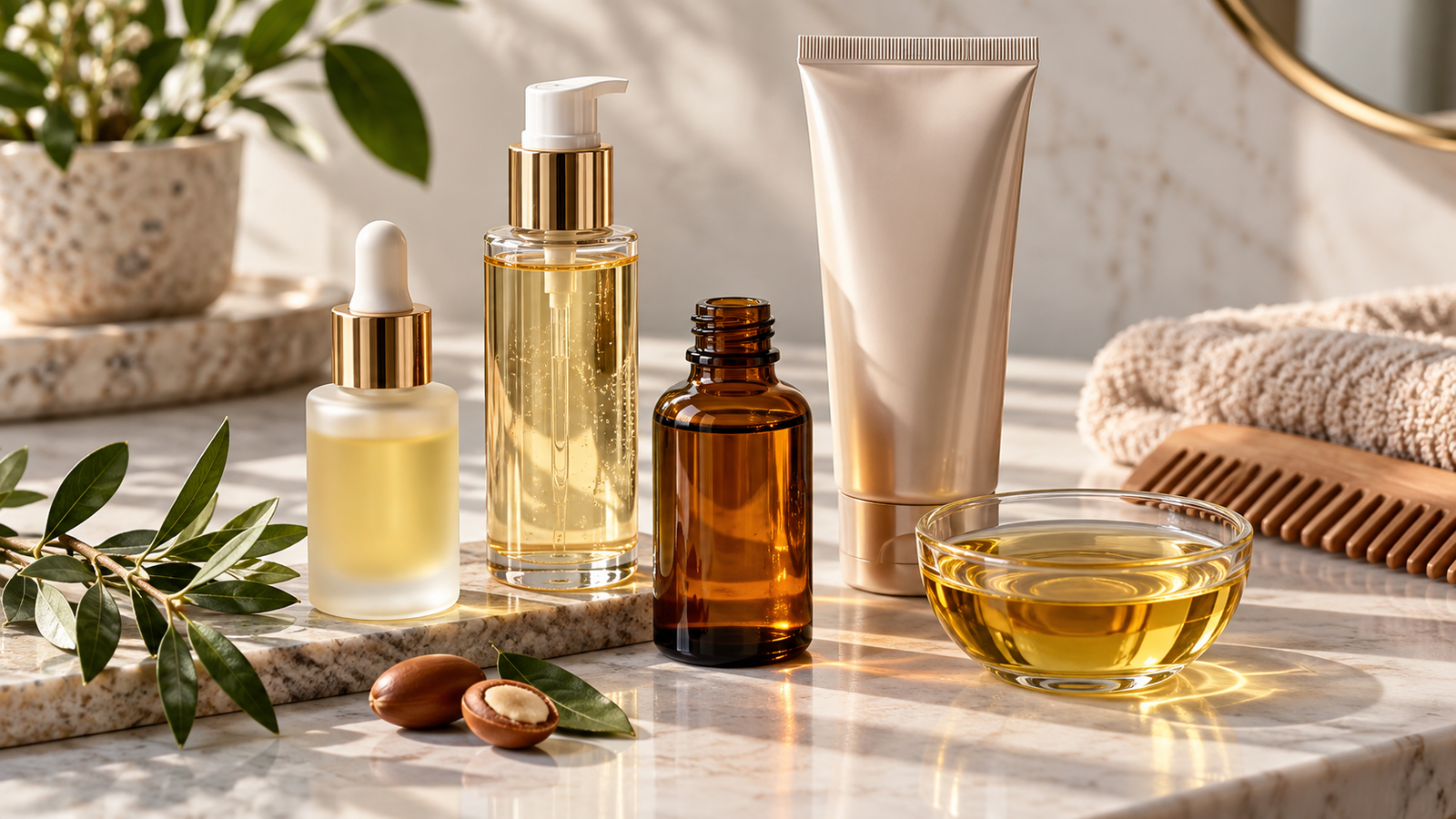
Hair oils and finishing serums can make hair look smoother, shinier and more manageable. But for people with fine hair, finding the right product and application method can be difficult.
A few drops of oil may transform dry-looking ends into glossy, polished hair. Add slightly too much, however, and the same hair can appear flat, greasy and weighed down.
This creates a common dilemma: how do you get the benefits of a hair oil without losing volume?
The answer depends on more than choosing a lightweight product.
For fine hair, the amount of finishing oil, where it is applied, the formula and the condition of the hair can matter as much as the product itself.
Fine hair does not necessarily need to avoid oils altogether. Instead, it often benefits from a more controlled application technique.
This Physical Glow guide explains how finishing oils work, why fine hair becomes weighed down easily, how to select suitable formulations and how to apply the right amount without creating greasy roots or heavy ends.
1. What Is a Hair Finishing Oil?
A hair finishing oil is a product applied primarily to the hair shaft to improve its cosmetic appearance and feel.
Depending on its formulation, it may help:
- Add shine.
- Smooth visible frizz.
- Reduce friction.
- Improve manageability.
- Make dry-looking ends appear more polished.
- Reduce the appearance of flyaways.
- Improve softness and slip.
Finishing oils are generally applied after washing, conditioning or styling.
Some products can be used on damp hair, while others are designed for dry hair.
They are different from scalp treatments intended to address particular scalp concerns.
Hair Finishing Oil vs Traditional Hair Oil
Traditional hair oils may contain ingredients such as coconut oil, sesame oil, almond oil or other plant-derived oils.
These are sometimes used before shampooing or as part of longer hair-oiling routines.
Finishing oils are often designed to provide immediate cosmetic benefits using smaller quantities.
They may contain:
- Plant-derived oils.
- Silicone-based conditioning ingredients.
- Esters.
- Emollients.
- Fragrance.
- Other formulation ingredients.
A finishing product marketed as an argan oil serum does not necessarily consist primarily of pure argan oil.
The complete ingredient list is important.
2. What Makes Fine Hair Different?
Fine hair refers to the diameter of individual hair strands.
It does not necessarily mean someone has very little hair.
A person may have fine strands but high hair density.
Another person may have thick individual strands but relatively low density.
These characteristics affect how hair behaves.
Fine Hair vs Thin Hair
| Characteristic | Fine hair | Thin hair |
|---|---|---|
| Main meaning | Small diameter of individual strands | Lower hair density |
| Main cosmetic concern | Strands may become weighed down | Scalp may be more visible |
| Response to heavy products | May lose movement and volume | Depends on strand diameter |
| Styling approach | Often benefits from lightweight products | Depends on density and texture |
Fine hair can be straight, wavy, curly or coily.
It can also be naturally oily or dry.
Therefore, fine hair should not automatically be treated as oily hair.
Why Fine Hair Can Look Greasy Quickly
When individual strands are small in diameter, a relatively small amount of coating product may noticeably change their appearance and movement.
Oil and other conditioning ingredients can cause adjacent strands to group together.
This may reduce visible volume and make the hair look less airy.
The result is particularly noticeable near the roots.
3. Why Do Hair Oils Weigh Fine Hair Down?
Hair oils and conditioning serums work partly by coating the hair shaft.
This coating can reduce friction and improve the appearance of the cuticle.
However, the amount of product deposited matters.
Excess Product Can Reduce Movement
Fine strands may become grouped together when too much oil or serum is applied.
Instead of flowing separately, the hair can look heavy and flat.
Product Buildup Can Increase the Effect
Repeatedly applying finishing oil without sufficient cleansing may leave the hair feeling coated.
This is more likely when multiple leave-in products are used together.
Natural Scalp Oil Contributes
Sebum from the scalp can also move onto the hair.
If finishing oil is applied near already oily roots, the combined effect may make hair look greasy quickly.
The Formula Matters
Two products labelled hair serum may have different textures and leave different amounts of residue.
Some spread readily and feel lightweight.
Others provide a richer coating.
A product that works beautifully on thick, coarse hair may feel excessive on fine hair when applied in the same quantity.
4. Can Fine Hair Benefit From Finishing Oils?
Yes.
Fine hair may benefit from a suitable finishing product when it experiences frizz, tangling, dryness or a lack of shine.
The benefits are primarily cosmetic and related to hair-fibre conditioning.
Smoother Appearance
A suitable oil or serum can help smooth the hair surface and reduce the appearance of flyaways.
Better Detangling
Some finishing products improve slip, which may reduce friction during brushing.
Improved Shine
A smoother hair surface can reflect light more evenly.
This may make hair appear shinier.
Reduced Frizz
Some conditioning ingredients help limit unwanted friction and changes in hair appearance associated with humidity.
However, not every oil provides the same humidity resistance.
More Comfortable Ends
Hair ends are older portions of the hair shaft and have experienced more washing, brushing and environmental exposure.
A small amount of finishing product may improve their feel.
These benefits do not mean that an oil can permanently repair all forms of hair-shaft damage.
Split ends, for example, cannot be permanently fused back into healthy hair by applying a cosmetic serum.
5. Where Should You Apply Hair Oil on Fine Hair?
For many people with fine hair, placement is the most important technique.
The safest cosmetic starting point is usually the mid-lengths and ends rather than the roots.
Illustrative placement guide for fine hair. Start with the ends and use only the remaining product on the mid-lengths if needed.
The Root Area
Avoid applying an ordinary finishing oil heavily around the scalp unless the product is specifically designed for that purpose.
Root application can make fine hair appear flat.
The Mid-Lengths
Apply lightly if the hair needs additional smoothing.
Do not assume the entire length needs equal coverage.
The Ends
The ends are often the best starting point for fine hair.
They may benefit from a small amount of product without substantially affecting volume near the scalp.
6. How Much Finishing Oil Should Fine Hair Use?
There is no universal number of drops suitable for every product.
One drop of a rich oil may behave differently from one pump of a lightweight serum.
Hair length, density and condition also influence the appropriate amount.
Start With Less Than You Think You Need
For a concentrated oil dispensed in drops, one small drop may be a reasonable initial trial for certain fine-hair types.
This is an illustrative starting point, not a fixed recommendation.
For pump dispensers, follow the product instructions and use the smallest practical quantity initially.
The Application Method
- Dispense a small amount into your palms.
- Rub your hands together to distribute it.
- Touch the ends of the hair first.
- Lightly smooth any remaining product through the mid-lengths.
- Wait and assess the result.
- Add more only if necessary.
Why Applying More Is Difficult to Reverse
Once too much oil is distributed through fine hair, it may be difficult to remove without washing.
Starting with less gives you more control.
Signs You Have Used Too Much
- Strands stick together.
- Hair loses volume.
- Ends appear wet or stringy.
- The hair feels coated.
- The roots flatten quickly.
- The product transfers noticeably to your hands.
If these signs appear consistently, reduce the amount or consider a different formula.
7. Should You Apply Hair Oil to Wet or Dry Hair?
Both methods can work, depending on the product.
However, they serve somewhat different styling purposes.
Applying to Damp Hair
Some finishing oils and serums are designed for use after towel-drying.
Potential benefits include easier distribution and improved manageability before styling.
For fine hair, avoid leaving the hair dripping wet and applying a large amount of product without being able to assess coverage.
Applying to Dry Hair
Dry-hair application is useful for targeted finishing.
It allows you to identify the specific areas that need more shine or frizz control.
A tiny amount may be enough for the ends or surface flyaways.
Which Is Better for Fine Hair?
If your main goal is detangling or preparing hair for styling, a suitable damp-hair application may be helpful.
If your goal is controlling a few flyaways after styling, dry-hair application may offer better precision.
Follow the manufacturer’s instructions because not all formulas are intended for both methods.
8. Hair Oil vs Hair Serum: Which Is Better for Fine Hair?
The terms hair oil and hair serum are often used inconsistently.
Some products labelled serum contain plant oils.
Others rely heavily on silicone-based conditioning systems.
Neither category is automatically superior.
| Feature | Hair finishing oil | Hair finishing serum |
|---|---|---|
| Typical composition | May emphasize plant oils or blends | May contain silicones, emollients, oils or polymers |
| Main purpose | Shine, softness, conditioning | Smoothing, slip, shine or frizz control |
| Texture | Can range from light to rich | Can range from watery to rich |
| Fine-hair suitability | Depends on formulation and dose | Depends on formulation and dose |
| Common mistake | Applying too much near roots | Assuming all serums are lightweight |
Are Silicones Bad for Fine Hair?
Not inherently.
Silicones are widely used in haircare because they can improve slip, reduce friction and enhance shine.
Some silicone-containing products feel lightweight, while others leave a richer coating.
The complete formulation and application amount determine how the product behaves.
Are Natural Oils Always Better?
No.
Natural origin does not guarantee that an ingredient will be lighter, safer or more effective.
A pure plant oil may feel heavier on fine hair than a carefully formulated finishing serum.
The appropriate choice depends on the result you want.
9. Comparing Common Hair Oil Ingredients
Different oils have different physical properties, but their performance depends heavily on how they are formulated.
| Ingredient | Common cosmetic role | Fine-hair consideration |
|---|---|---|
| Argan oil | Emollience, shine and conditioning | Use sparingly; product texture varies |
| Coconut oil | Hair lubrication and pre-wash treatment | May feel heavy as a finishing product |
| Jojoba oil | Emollient conditioning | Suitability depends on amount and formula |
| Almond oil | Softening and lubrication | Rich application may reduce volume |
| Squalane | Lightweight-feeling emollience in some formulas | Can suit certain minimalist products |
| Dimethicone | Slip, conditioning and smoothing | Can be useful when appropriately formulated |
| Cyclopentasiloxane | Volatile silicone used in some cosmetic formulations | May contribute to a lighter application feel |
An ingredient list alone cannot predict exactly how a product will perform.
For example, an argan oil serum might contain several other ingredients that determine its spreadability, texture and residue.
Should You Buy Pure Argan Oil?
Pure argan oil may be suitable for some people.
However, a blended formula designed for finishing may be easier to control on fine hair.
There is no need to assume that the purest product is necessarily the best one for styling.
10. How to Avoid Greasy Roots
Greasy roots are one of the most common complaints among fine-haired users.
The solution is not always switching to a more expensive product.
Often, the technique needs adjustment.
Avoid Direct Scalp Application
Unless specifically directed, keep finishing oil away from the scalp.
Start Lower on the Hair
Begin with the ends.
Only spread the remaining product higher if necessary.
Avoid Adding Oil Before Every Styling Step
Repeated application can gradually build up residue.
Consider Existing Leave-In Products
If you already use a conditioning cream, leave-in spray and heat protectant, another substantial layer of serum may be unnecessary.
Assess Your Natural Oil Production
Someone with an oily scalp may need particularly restrained finishing-product use.
Adding oil to the roots can make natural sebum more visible.
Keep Application Tools Clean
Product residue can accumulate on brushes and combs.
Regularly clean tools according to their material and manufacturer’s recommendations.
11. Why Fine Hair Ends Can Look Heavy Instead of Smooth
Hair ends may appear dry and rough before applying oil.
After applying too much, they may become stringy.
This happens because product deposits can change how the strands separate and move.
Signs of a Balanced Finish
Hair generally remains:
- Soft.
- Flexible.
- Separated rather than clumped.
- Comfortable to touch.
- Shiny without looking wet.
- Naturally movable.
Signs of Excessive Product
The ends may look:
- Darker than the rest of the hair.
- Greasy.
- Clumped.
- Flat.
- Sticky or overly coated.
What Should You Do?
Reduce the quantity before abandoning the product.
If a tiny amount still creates a heavy finish, the formula may not suit your hair.
A lightweight leave-in conditioner or serum may be a more practical alternative.
12. Fine Straight Hair vs Fine Wavy Hair
Hair diameter and hair texture are separate characteristics.
This matters because fine straight hair and fine wavy hair may respond differently to the same finishing oil.
Fine Straight Hair
Oil may become visually noticeable quickly.
A small amount at the ends may provide enough shine without flattening the roots.
Products intended to add significant richness may feel excessive.
Fine Wavy Hair
Fine waves can benefit from products that reduce frizz and improve definition.
However, too much oil may stretch out the appearance of the waves and reduce bounce.
Fine Curly Hair
Fine curls may benefit from conditioning but can lose definition if weighed down.
A lightweight product applied in small amounts may be preferable.
The Key Principle
Choose according to both strand diameter and styling needs.
Do not assume that all fine hair requires the same oil or application technique.
13. Does Hair Porosity Affect Finishing Oil Performance?
Hair porosity describes aspects of how the hair fibre interacts with water and other substances.
It is influenced by the condition of the cuticle and other hair characteristics.
However, popular at-home porosity tests, such as dropping a hair strand into a glass of water, are not reliable standalone diagnostic methods.
More Useful Questions
Instead of relying on an online porosity label, consider:
- Does your hair become rough after washing?
- Does it tangle easily?
- Has it been bleached or chemically treated?
- Does the product leave residue?
- Does your hair become limp quickly?
These observations can help guide product selection.
Chemically Treated Fine Hair
Bleached or chemically treated fine hair may need additional conditioning.
However, it can still become weighed down by excessive finishing oil.
The appropriate formula must balance conditioning and lightweight styling.
14. Can Finishing Oil Protect Hair From Heat Damage?
Some finishing products are marketed as offering heat protection.
However, not every hair oil is a tested heat protectant.
Applying ordinary plant oil before using a hot styling tool does not automatically provide sufficient protection.
What Should You Check?
Review whether the manufacturer explicitly claims heat protection and provides suitable directions.
For frequent blow-drying, straightening or curling, consider a product formulated and tested for the intended heat-styling use.
Avoid Excessive Heat
Even with a heat-protection product, high temperatures can damage the hair shaft.
Use the lowest effective temperature and minimize repeated passes.
What About Applying Oil After Styling?
A small quantity can help improve shine or control flyaways.
However, avoid applying excessive product to freshly styled fine hair.
The goal is to polish the finish without eliminating volume.
15. How to Layer Finishing Oil With Other Hair Products
Layering can improve styling results, but using too many products may be counterproductive for fine hair.
Consider this example routine:
Simple wash-day styling order
- ShampooCleanse the scalp according to its needs.
- ConditionerApply appropriately, focusing on the lengths where needed.
- Leave-in or heat protectant, if neededChoose a product suited to your styling method.
- Style gentlyAvoid excessive heat, pulling and friction.
- Finishing oilApply a minimal amount to the ends or targeted flyaways if the hair needs additional polish.
Product order varies by formulation. Some finishing serums are designed for use before styling rather than afterward; follow the label.
Do You Need All These Products?
No.
Fine hair may look and feel better with fewer layers.
If conditioner and one leave-in product provide sufficient smoothness, a separate finishing oil may not be necessary.
16. How to Fix Hair After Applying Too Much Oil
Accidentally overapplying a hair serum is common.
Fortunately, you do not always need to immediately wash your hair.
Step 1: Stop Adding More Product
Do not attempt to correct an oily appearance by applying additional serum.
Step 2: Reassess After a Few Minutes
Some formulations distribute or settle differently over time.
However, excessive product generally does not disappear completely.
Step 3: Gently Redistribute
A clean brush or comb may help distribute product more evenly.
Avoid aggressive brushing, especially on fragile hair.
Step 4: Consider a Suitable Absorbing Product
Dry shampoo may temporarily reduce the appearance of greasy roots.
However, it should be used as directed and is not a substitute for washing.
It may also leave residue.
Step 5: Wash When Necessary
If the hair remains heavily coated, shampooing may be the most reliable solution.
Use an appropriate cleanser rather than repeatedly adding products to disguise buildup.
Prevent the Same Problem Next Time
Reduce the initial quantity significantly.
For fine hair, a tiny adjustment in amount can produce a noticeable difference.
17. How to Choose the Right Finishing Product for Fine Hair
Product selection should begin with the problem you want to solve.
| Your priority | What to consider | What to avoid |
|---|---|---|
| Shine without greasiness | Lightweight, easily spreadable finish | Excessively rich application |
| Frizz control | Smoothing serum or suitable finishing oil | Multiple heavy layers |
| Dry-looking ends | Targeted emollient conditioning | Coating the entire scalp |
| Flyaway control | Small amount of finishing product | Applying oil across all roots |
| Heat styling | Product with explicit heat-protection directions | Assuming any oil protects against heat |
| Fine waves | Lightweight definition and frizz control | Excessively heavy formulas |
Look Beyond the Front Label
Words such as lightweight, professional, premium and salon finish are marketing descriptions.
They do not guarantee suitability.
Review the actual directions, ingredients and product texture.
Consider Cost Per Use
A concentrated serum may last a long time when used in very small quantities.
However, an expensive product that consistently weighs down your hair is poor value regardless of how long the bottle lasts.
Compare Existing Products
Physical Glow’s Best Hair Serums and Finishing Oils in India: Top 5 Options guide covers products including Streax Professional Vitariche Gloss Hair Serum, TRESemmé Keratin Smooth Anti-Frizz Hair Serum, Moroccanoil Treatment Original and Wella Professionals Oil Reflections.
These products represent different finishing and conditioning approaches.
The commercial guide helps compare individual options. This article focuses specifically on how to use finishing products without weighing down fine hair.
18. A Practical Finishing Oil Routine for Fine Hair
Use this routine when your goal is smoothness and shine without sacrificing volume.
On Wash Day
After shampooing and conditioning, gently remove excess water.
Apply any necessary leave-in or heat-protection product according to its instructions.
Once the hair is ready for finishing, assess whether it actually needs oil.
If it already feels smooth and manageable, skip the additional step.
On Non-Wash Days
Check which areas need attention.
If the ends look dry, apply a minimal amount only there.
Avoid automatically reapplying oil to the entire head.
Before Going Out
Use a very small amount to smooth visible flyaways if needed.
Do not repeatedly layer product until every strand appears perfectly flat.
Fine hair often looks better when it retains some natural movement.
Before Bed
An additional finishing-oil application is not automatically necessary.
If your hair is comfortable, leave it alone.
Use gentle handling and avoid tight hairstyles that create unnecessary tension.
19. Common Mistakes When Using Hair Oil on Fine Hair
Mistake 1: Applying Oil Directly to the Roots
This can make fine hair appear flat and greasy.
Mistake 2: Using the Same Quantity as Someone With Thick Hair
Product quantity should reflect your own hair characteristics.
Mistake 3: Assuming Natural Oil Is Always Lightweight
Pure oils can feel heavy depending on the ingredient and amount.
Mistake 4: Applying Several Leave-In Products Together
Overlapping products may create unnecessary buildup.
Mistake 5: Using a Rich Hair Mask as a Leave-In Finisher
Rinse-out treatments should not be left in the hair unless specifically formulated for that use.
Mistake 6: Assuming Finishing Oil Repairs Split Ends
It can temporarily improve appearance and feel but does not permanently repair split hair fibres.
Mistake 7: Applying More Oil Whenever Hair Looks Dull
Dullness can result from product buildup, damage or other factors.
Adding oil is not always the solution.
Mistake 8: Using Ordinary Oil as Heat Protection
Choose a product explicitly intended for heat styling when needed.
Mistake 9: Neglecting Cleansing
Repeated leave-in product application without appropriate washing can contribute to buildup.
Mistake 10: Judging the Product Before Adjusting the Amount
A product that feels too heavy at three pumps may work better with a much smaller quantity.
20. Frequently Asked Questions
Can fine hair use hair oil?
Yes. Fine hair can benefit from suitable finishing oils, particularly when applied sparingly to the mid-lengths and ends.
Which is better for fine hair: oil or serum?
Neither is universally better. The full formula, texture and amount matter more than the label.
Does argan oil make fine hair greasy?
It can if too much is used or if the formulation is rich. Some blended argan oil products may feel lighter than pure oil.
Should I put hair oil on my roots?
For ordinary finishing purposes, fine hair often looks better when oil is applied primarily to the ends rather than the roots.
How many drops should I use?
There is no fixed number. Start with a very small amount consistent with the product instructions and add more only if necessary.
Can I use hair oil every day?
Some people can use a small amount daily, but repeated applications may cause buildup or a heavy appearance.
Is hair oil better on wet or dry hair?
It depends on the formula. Some products work well on damp hair, while others are intended for dry-hair finishing.
Will hair oil make my hair grow faster?
Ordinary finishing oils are not established treatments for increasing hair growth. Cosmetic shine and conditioning benefits should not be confused with hair-growth claims.
Can I use coconut oil as a finishing oil?
You can, but it may feel heavy on some fine-hair types. It may be more suitable as a pre-wash treatment for certain users.
Are silicone serums bad for fine hair?
Not inherently. Some silicone-based formulas provide useful smoothing and slip without excessive heaviness when applied correctly.
Can finishing oil reduce frizz?
Some formulations can improve the appearance of frizz, although performance depends on the formula, environment and hair characteristics.
Does hair oil protect against straightener heat?
Not every oil provides adequate heat protection. Use a product specifically designed for your heat-styling needs.
Why do my ends look stringy after serum?
You may be applying too much product, or the formula may be too heavy for your hair.
Can I use hair oil with a leave-in conditioner?
Yes, if both products are compatible and the combination does not weigh down your hair.
Should fine hair avoid hair masks?
Not necessarily. Fine hair may benefit from conditioning masks, but overly rich formulas or excessive application can reduce volume.
What if my hair gets greasy after using too much oil?
Reduce the amount next time. If the hair remains heavily coated, appropriate shampooing may be necessary.
Is expensive hair oil better?
Not automatically. Suitability, formulation and application technique are more important than price alone.
Can hair oil permanently repair damaged hair?
No. Conditioning ingredients may improve appearance, feel and manageability, but they cannot permanently restore severely damaged hair fibres.
21. Final Verdict: Fine Hair Needs Precision, Not More Product
Hair finishing oils can be useful for fine hair, but the application technique is especially important.
The main challenge is balancing shine and smoothness against the risk of a heavy, greasy appearance.
For most fine-haired users, the best starting approach is simple:
Apply a minimal amount, begin with the ends and avoid unnecessarily coating the roots.
Choose a formula that spreads easily and produces the finish you want.
Consider how it interacts with your conditioner, leave-in products and styling routine.
Remember that fine hair does not automatically mean oily hair, and a person with fine strands may still need adequate conditioning.
If an oil repeatedly makes the hair look flat, try reducing the amount before purchasing a replacement.
If the formula continues to feel heavy even in very small quantities, a different lightweight serum or leave-in conditioner may be a better choice.
The goal is not maximum shine at any cost. It is softer, smoother and more manageable hair that still retains its natural volume and movement.
Editorial References and Further Reading
- American Academy of Dermatology — Tips for Healthy Hair
- American Academy of Dermatology — Hair and Scalp Care
- Rele and Mohile — Effect of Mineral Oil, Sunflower Oil and Coconut Oil on Prevention of Hair Damage
- DermNet — Hair Shaft Disorders
Physical Glow Editorial Note: This article provides general haircare information. Product performance varies according to hair type, formulation and application technique. Persistent scalp irritation, unusual hair shedding or significant hair breakage may require professional evaluation. Product recommendations are editorial and should not be interpreted as proof of clinical effectiveness.