How to Choose Styling Products for Your Hair
Learn how to choose styling products for your hair, with practical guidance on hair type, hold, texture, finish, frizz control and styling method. This beginner-friendly guide helps you make a clear, informed choice without unnecessary complexity.
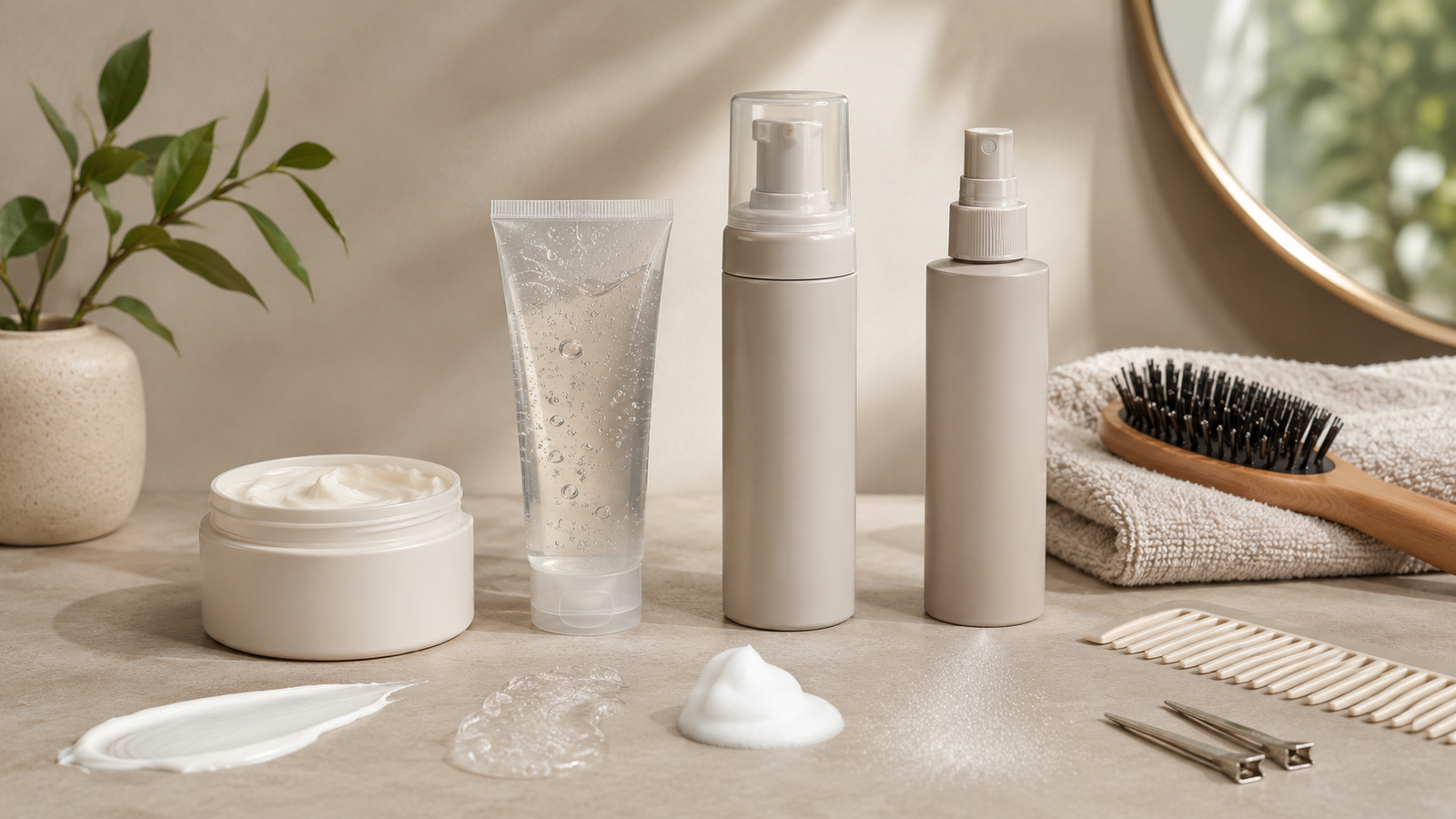
Hair styling products can completely change the way hair behaves.
They can help create:
- hold;
- volume;
- texture;
- curl definition;
- smoothness;
- shine;
- separation;
- frizz control.
But styling products are also one of the easiest parts of a haircare routine to overcomplicate.
You may see routines containing:
leave-in conditioner → mousse → curl cream → gel → serum → hair spray → wax
when the hair may only need one or two styling products.
The better approach is:
decide what result you want → understand your hair type → choose the right level of hold → select the appropriate texture → start with a small amount → add another product only if it solves a different problem
The best styling product is not the strongest one.
It is the one that helps your hair look and behave the way you want without making it unnecessarily:
- stiff;
- greasy;
- sticky;
- dry;
- coated.
What Is a Hair Styling Product?
A styling product is designed primarily to change or maintain the appearance and behaviour of the hair.
Depending on the formula, it may help with:
- shaping;
- holding;
- defining;
- smoothing;
- volumizing;
- texturizing.
Common styling products include:
- mousse;
- foam;
- gel;
- cream;
- wax;
- paste;
- pomade;
- clay;
- hair spray;
- texturizing spray;
- sea-salt spray;
- curl cream.
Hair oils, serums and leave-in conditioners can also influence styling, but their primary job is often more focused on conditioning or smoothing.
Start With the Result You Want
Do not begin with:
Which product is best?
Start with:
What do I want my hair to do?
For example:
More Volume
You may need:
- mousse;
- root-lifting spray;
- lightweight texturizing product.
Strong Hold
Consider:
- gel;
- strong hair spray;
- styling paste.
Curl Definition
Consider:
- curl cream;
- gel;
- mousse.
Smoothness
Consider:
- styling cream;
- serum;
- smoothing product.
Texture
Consider:
- clay;
- paste;
- texture spray.
Shine
Consider:
- serum;
- lightweight pomade;
- finishing oil.
Once the goal is clear, the product category becomes much easier to choose.
Understand Hold Levels
Styling products are often described as:
- light hold;
- medium hold;
- strong hold;
- extra strong hold.
This refers to how strongly the product helps maintain the hairstyle.
Light Hold
Best when you want:
- natural movement;
- soft waves;
- flexible styling.
Common products include:
- light mousse;
- styling cream;
- flexible hair spray.
Hair usually remains:
- touchable;
- movable.
Medium Hold
Useful when you want:
- more structure;
- better curl definition;
- style that lasts longer.
Examples include:
- medium gel;
- mousse;
- styling paste.
This is often a useful balance for everyday styling.
Strong Hold
Designed for styles that need to remain firmly in place.
Examples:
- strong gel;
- firm hair spray;
- some waxes and pomades.
Useful for:
- slick styles;
- defined curls;
- structured hairstyles.
But strong hold can sometimes feel:
- stiff;
- crunchy.
That may or may not be desirable.
More Hold Is Not Automatically Better
A very strong product can make soft hairstyles feel unnatural.
For example, if your goal is:
loose movement
a strong-hold gel may make the hair feel too rigid.
Choose the lowest amount of hold that reliably maintains the style you want.
Finish Matters Too
Styling products can also create different finishes.
Common finishes include:
- matte;
- natural;
- satin;
- glossy;
- wet-look.
Matte Finish
Provides little visible shine.
Common in:
- clays;
- pastes;
- some texture products.
Popular for shorter hairstyles where you want:
- definition;
- texture;
- low shine.
Natural Finish
Designed to leave hair looking relatively untreated.
Useful for:
- everyday styling;
- soft volume;
- flexible hairstyles.
Glossy Finish
Adds visible shine.
Common in:
- pomades;
- serums;
- oils.
Can work well for:
- sleek styles;
- polished looks.
Too much shine can make fine hair appear greasy.
Wet-Look Finish
Creates a deliberately glossy, freshly styled appearance.
Usually created using:
- gel;
- glossy pomade;
- wet-look styling products.
This is a stylistic choice rather than a sign of healthy hair.
Mousse
Mousse is a lightweight foam styling product.
It is particularly useful for:
- volume;
- waves;
- curls;
- light-to-medium hold.
It tends to spread easily through the hair.
Who May Like Mousse?
Mousse can be particularly useful for:
- fine hair;
- wavy hair;
- curly hair;
- people who want volume without heavy creams.
Because mousse contains a lot of air, it can provide styling effect without adding much weight.
How to Use Mousse
A common method:
- Start with damp hair.
- Shake the container if required.
- Dispense a small amount.
- Distribute through the hair.
- Scrunch curls or work into roots for volume.
- Blow-dry or air-dry.
Follow the product directions because different mousses behave differently.
Mousse for Fine Hair
Fine hair often responds very well to mousse.
Apply mainly:
- at roots for volume;
- lightly through lengths for hold.
Avoid combining it with several heavy creams.
This can cancel the volume you are trying to create.
Mousse for Curly Hair
Mousse can provide:
- curl definition;
- volume;
- lighter hold.
It is useful for people who find gel too heavy.
You can use:
leave-in → mousse
or:
mousse alone
depending on how much conditioning your hair needs.
Hair Foam vs Mousse
These terms are often used interchangeably.
Some modern styling foams are:
- lighter;
- less stiff;
than traditional mousse.
But there is no strict universal distinction.
Judge the product by:
- hold;
- texture;
- finish.
Hair Gel
Gel provides stronger structure.
It is commonly used for:
- curl definition;
- slicked styles;
- strong hold;
- controlling flyaways.
It creates a film around the hair as it dries.
Gel for Curly Hair
Gel is one of the most effective products for maintaining curl definition.
A common routine:
- Apply leave-in if needed.
- Apply gel to wet or damp hair.
- Scrunch.
- Allow hair to dry.
- Avoid touching while drying.
Once dry, the curls may feel hard.
This is called a gel cast.
What Is a Gel Cast?
As gel dries, it may form a firm coating around curls.
This helps maintain:
- shape;
- definition.
Once the hair is fully dry, you can gently scrunch the curls.
This softens the cast while retaining definition.
Some people use:
- clean hands;
- one drop of serum or oil.
Is Crunchy Hair Bad?
Not necessarily.
If the crunch disappears after gently breaking the cast, it simply means the gel created strong temporary hold.
If the hair remains:
- stiff;
- sticky;
- uncomfortable;
you may be using:
- too much gel;
- a formula that is too strong.
Gel for Straight Hair
Gel can also be used for:
- slick backs;
- structured short styles;
- flyaway control.
Use a small amount.
Too much can make straight hair:
- visibly coated;
- stiff.
Hair Cream
Styling cream is generally softer than gel.
It can provide:
- light hold;
- smoothness;
- frizz control;
- definition.
It is particularly useful when you want the hair to remain:
- soft;
- touchable.
Who Should Consider Styling Cream?
Often useful for:
- thick hair;
- coarse hair;
- wavy hair;
- curly hair;
- dry hair.
Fine hair should use creams carefully because they can reduce volume.
Curl Cream
Curl creams are designed specifically to improve:
- curl definition;
- softness;
- frizz control.
They often combine:
- conditioning agents;
- light hold.
A curl cream may be enough on its own if you prefer:
- soft curls;
- natural movement.
If you need stronger hold, combine:
curl cream → gel
Do You Need Leave-In and Curl Cream?
Not always.
Many curl creams already provide significant conditioning.
Try different combinations:
Option 1
Leave-in + gel
Option 2
Curl cream + gel
Option 3
Curl cream alone
Use the simplest combination that gives you the result you want.
Hair Wax
Wax is generally thicker and more concentrated.
It can provide:
- texture;
- separation;
- flexible hold.
Often used for:
- short hairstyles;
- piecey looks;
- controlling specific sections.
Who Is Wax Best For?
Wax often works well for:
- short;
- medium-length;
- thicker hair.
Fine hair may become greasy if too much is used.
How to Use Hair Wax
Start with a tiny amount.
Rub it between your fingertips or palms until evenly distributed.
Apply mostly to:
- ends;
- specific sections.
Avoid scooping large amounts directly into the hair.
Hair Paste
Hair paste usually provides:
- medium hold;
- texture;
- relatively natural finish.
It is more flexible than many gels.
Useful for:
- short hair;
- textured styles;
- casual separation.
Depending on the formula, it may work for both fine and thick hair.
Hair Clay
Hair clay generally provides:
- matte finish;
- texture;
- stronger grip.
Often used for:
- short hairstyles;
- messy textured looks;
- hairstyles requiring volume without shine.
Clay for Fine Hair
Clay can add:
- body;
- texture.
But too much can make fine hair:
- dry;
- sticky;
- difficult to restyle.
Use a small amount.
Pomade
Pomade usually provides:
- smoothness;
- definition;
- shine.
There are two major categories:
- water-based;
- oil-based.
Water-Based Pomade
Usually:
- easier to wash out;
- provides strong hold;
- can create polished styles.
Often useful for:
- slick backs;
- side parts;
- structured hairstyles.
Oil-Based Pomade
Usually provides:
- strong shine;
- flexible restyling.
But it can be harder to remove.
Repeated use may create:
- buildup;
- greasy hair.
It is most useful when that classic glossy look is intentional.
Hair Spray
Hair spray is mainly a finishing product.
It helps keep the finished hairstyle in place.
Hold may range from:
- flexible;
- medium;
- firm.
Flexible Hair Spray
Useful for:
- soft waves;
- blowouts;
- natural movement.
Hair remains easier to brush and restyle.
Strong Hair Spray
Useful for:
- formal hairstyles;
- updos;
- styles that need to last for hours.
It may make hair feel stiffer.
How to Apply Hair Spray
Do not spray extremely close to the hair unless instructions say otherwise.
Hold the product at the recommended distance.
Apply:
- lightly;
- evenly.
For targeted flyaways, you can spray onto:
- a styling brush;
- clean toothbrush-style tool;
and gently smooth the area.
Root-Lifting Spray
Root-lifting products are designed specifically to increase volume near the scalp.
They are usually applied to:
- damp roots.
Then activated during:
- blow-drying.
These products are useful for:
- fine;
- flat hair.
Avoid applying heavy oils or creams at the roots afterward.
Volumizing Spray
Volumizing sprays can increase:
- body;
- texture.
They may contain polymers that create more space and grip between strands.
They work best when the rest of the routine is not excessively heavy.
Texturizing Spray
Texture spray is designed to create:
- grip;
- separation;
- volume;
- undone texture.
It can be useful for:
- fine hair;
- waves;
- updos;
- styles that need grip.
It is not the same as hair spray.
Hair spray focuses more on hold.
Texture spray focuses more on grip and separation.
Sea-Salt Spray
Sea-salt sprays are designed to mimic some of the texture created by ocean water.
They can add:
- roughness;
- volume;
- wave definition.
But salt-based products can make some hair feel:
- dry;
- stiff.
They may be best suited to:
- fine;
- oily;
- wavy hair.
Dry or damaged hair may prefer gentler texture products.
Sugar Spray
Sugar-based texture sprays are an alternative.
They may provide:
- texture;
- light hold;
with a different feel from salt.
Some people find them less drying.
Again, the formula matters more than the marketing name.
Dry Texture Spray
Dry texture sprays are often aerosol products.
They can create:
- immediate volume;
- grip.
Useful for:
- fine hair;
- styling curls;
- updos.
They can also absorb some oil.
But they are not a replacement for shampoo.
Dry Shampoo
Dry shampoo is mainly designed to absorb:
- excess scalp oil.
It can also provide:
- texture;
- volume.
Common absorbent ingredients include:
- starches;
- powders.
Is Dry Shampoo a Styling Product?
It can be both:
- oil-control product;
- styling aid.
It is often useful for creating grip in freshly washed fine hair.
But it should not replace regular cleansing indefinitely.
How Often Can You Use Dry Shampoo?
Use when needed.
Avoid repeatedly applying layer after layer without cleansing.
Excess dry shampoo can cause:
- buildup;
- scalp discomfort;
- visible residue.
Wash the scalp properly after repeated use.
Styling Powder
Hair powders are designed to add:
- grip;
- volume;
- matte texture.
A tiny amount can dramatically change fine hair.
But powders can become difficult to distribute evenly.
Use very little.
Edge Control
Edge-control products are concentrated styling products designed to smooth:
- hairline;
- short hairs.
They usually provide:
- strong hold;
- smoothness.
Avoid excessive tension when styling edges.
Repeated pulling can contribute to hair breakage and traction-related hair loss.
Styling Balm
Balm is a broad marketing term.
It often refers to a richer cream designed for:
- smoothing;
- flyaway control;
- light hold.
Check the actual texture and directions rather than relying on the word balm.
Hair Butter
Hair butters are generally very rich.
They may combine:
- shea butter;
- oils;
- conditioning agents.
They can work well for:
- coarse;
- coily;
- very dry hair.
Fine hair is usually easily overwhelmed.
Hair Styling for Fine Hair
The main goal for fine hair is usually:
style without weight
Useful products include:
- mousse;
- volumizing spray;
- root lifter;
- texture spray.
Be cautious with:
- heavy creams;
- waxes;
- thick oils;
- rich pomades.
Apply most styling products sparingly.
Hair Styling for Thick Hair
Thick hair may require:
- more product;
- stronger hold.
Useful options include:
- cream;
- gel;
- paste;
- serum.
Sectioning during application can improve distribution.
Hair Styling for Straight Hair
Straight hair can show:
- grease;
- product buildup;
quickly.
For volume:
- mousse;
- root spray.
For smoothness:
- lightweight serum.
For shorter styles:
- paste;
- clay;
- pomade.
Hair Styling for Wavy Hair
Wavy hair generally responds well to:
- mousse;
- light curl cream;
- gel.
A simple routine:
light leave-in → mousse or gel → scrunch → dry
Too much cream can stretch the waves.
Hair Styling for Curly Hair
Curly hair usually benefits from products that provide both:
- conditioning;
- hold.
A common routine:
leave-in → curl cream → gel
But simplify if possible.
You may only need:
leave-in → gel
Hair Styling for Coily Hair
Coily hair may benefit from richer products such as:
- leave-in cream;
- curl butter;
- gel.
For twist-outs and braid-outs, creams may provide:
- softness;
- definition.
Strong gel may provide longer-lasting hold.
Styling Products for Dry Hair
Prioritize products that combine styling with:
- conditioning;
- lubrication.
Good options include:
- styling cream;
- curl cream;
- serum.
Use drying texture products more carefully.
Styling Products for Oily Hair
Choose lightweight products.
Useful options:
- mousse;
- texture spray;
- dry shampoo when needed.
Keep:
- oils;
- heavy creams;
away from the roots.
Styling Products for Damaged Hair
Damaged hair should prioritize protection over aggressive styling.
Look for:
- smoothing creams;
- heat-protective stylers;
- lightweight serum.
Avoid products that require:
- repeated brushing;
- extreme tension;
- high heat.
Styling Products for Bleached Hair
Bleached hair can be fragile.
A practical sequence:
- Leave-in conditioner
- Heat protectant
- Lightweight styling cream or mousse
- Minimal heat
- Serum if needed
Be cautious with:
- drying salt sprays;
- excessive teasing.
Styling Products for Frizzy Hair
Frizz control usually requires:
- smoothing;
- hold.
Useful combinations include:
Straight/Wavy Hair
Smoothing cream → serum
Curly Hair
Leave-in → gel
Coily Hair
Leave-in → cream → gel if needed
Anti-humidity products can also help.
Styling Products for Humid Weather
Humidity can cause hair fibres to absorb moisture and change shape.
Anti-humidity products often use:
- silicones;
- film-forming polymers.
These can help maintain styles.
No product can completely prevent humidity from affecting hair, but some formulations can reduce the effect.
Styling Products for Dry Weather
Dry environments may increase:
- static;
- flyaways.
Use:
- conditioning creams;
- light serum;
- anti-static products.
Avoid excessive drying powders.
Styling Products and Heat Protection
A styling product is not automatically a heat protectant.
Look specifically for:
- thermal protection;
- heat-protection claim.
If you use:
- blow dryer;
- straightener;
- curling iron;
thermal protection should be deliberate.
Should Heat Protectant Go Before Styling Products?
Usually, heat protection should be applied before heat exposure.
A typical damp-hair sequence:
- Leave-in conditioner
- Heat protectant
- Mousse or styling cream
- Blow-dry
Some products combine these functions.
Follow the manufacturer’s directions.
Styling Product Order
There is no single universal sequence, but a practical rule is:
conditioning → heat protection → hold → finishing
For example:
Straight Hair
Leave-in → heat protectant → mousse → blow-dry → serum → hair spray
Curly Hair
Leave-in → curl cream → gel → dry → serum
Short Hair
Dry or damp hair → paste/clay/pomade
Use only the steps you actually need.
Can You Layer Mousse and Gel?
Yes.
This is popular for curly and wavy hair.
For example:
mousse → gel
may provide:
- volume;
- stronger hold.
But two products are not automatically better.
Try each product separately first.
Can You Layer Cream and Gel?
Yes.
A common curly-hair combination is:
curl cream → gel
Cream provides:
- softness;
- definition.
Gel provides:
- hold.
If hair becomes:
- greasy;
- weighed down;
use less cream or remove it.
Can You Use Serum With Gel?
Yes.
Usually serum works best:
after the gel has dried
Use it to:
- soften the cast;
- add shine;
- reduce friction.
Can You Use Oil With Styling Products?
Yes, but sparingly.
Oil can reduce:
- frizz;
- dryness.
However, applying oil before certain styling products may reduce their grip.
For example, a strong layer of oil before gel can sometimes interfere with hold.
What Is Product Pilling?
Sometimes styling products form:
- flakes;
- white residue;
- small balls.
This can happen when formulas are incompatible or too much product is layered.
A simple test:
- Put a small amount of each product in your palm.
- Rub them together.
If they immediately:
- clump;
- form white residue;
they may not layer well.
This test is not perfect, but it can provide a clue.
Styling Product Flaking
Gel can sometimes flake after drying.
Possible causes include:
- too much product;
- incompatible layering;
- touching hair excessively while drying.
Try:
- less gel;
- fewer products underneath.
Styling Product Buildup
Styling products can accumulate on the hair.
Common contributors:
- wax;
- pomade;
- silicone serum;
- dry shampoo;
- hair spray;
- styling cream.
Signs include:
- dullness;
- heaviness;
- difficulty styling;
- greasy feel.
Wash appropriately.
Occasional clarifying shampoo may help.
Clarifying Shampoo
Clarifying shampoo is designed to remove more buildup than a gentle everyday cleanser.
It can be useful if you regularly use:
- waxes;
- heavy oils;
- dry shampoo;
- strong styling products.
Follow with conditioner.
Do not necessarily use it every wash.
Styling Products and Scalp Health
Most styling products are designed for the hair, not the scalp.
Heavy buildup on the scalp may contribute to:
- itching;
- discomfort;
- greasiness.
Wash the scalp regularly.
Avoid applying thick styling creams directly to the scalp unless designed for that purpose.
Hair Spray and Scalp
Hair spray may land on the scalp during application.
Occasional exposure is usually unavoidable.
If you notice:
- irritation;
- itching;
adjust application and product choice.
Styling Products and Acne
Hair products can transfer onto:
- forehead;
- temples;
- neck.
This can contribute to breakouts in susceptible individuals.
If you notice acne along the hairline:
- reduce heavy products near the face;
- keep hair off the skin when possible;
- wash pillowcases regularly.
Fragrance in Styling Products
Styling products often contain fragrance.
Because they remain on the hair, the scent may last for hours.
That is fine if you tolerate it.
People with fragrance sensitivity may prefer:
- fragrance-free;
- low-fragrance products.
Alcohol in Styling Products
Alcohol is common in:
- hair spray;
- gels;
- some mousses.
Volatile alcohols help formulas:
- dry quickly;
- feel lighter.
They are not automatically harmful.
However, heavily alcohol-based products can feel drying on some hair.
Balance depends on the complete formula.
Fatty Alcohols
Ingredients such as:
- cetyl alcohol;
- cetearyl alcohol;
are completely different.
These are conditioning ingredients used in creams.
Do not avoid them because the word alcohol appears.
Silicones in Styling Products
Silicones can help provide:
- smoothness;
- shine;
- frizz protection.
They are often useful in:
- smoothing creams;
- heat protectants;
- serums.
They are not inherently bad.
If buildup develops, wash appropriately.
Polymers in Styling Products
Hold products often rely on film-forming polymers.
These create a flexible or firm film around the hair.
That is how products such as:
- gel;
- mousse;
- hair spray;
maintain the hairstyle.
Strong-hold polymers may feel stiffer.
Do Natural Styling Products Work Better?
Not automatically.
Natural waxes, oils and gums can provide styling effects.
But synthetic polymers are often excellent at providing:
- predictable hold;
- humidity resistance.
Choose based on performance and tolerance.
Styling Product for Short Hair
Short hairstyles often benefit from:
- wax;
- paste;
- clay;
- pomade.
Choose based on finish.
Want Matte Texture?
Clay or paste.
Want Shine?
Pomade.
Want Flexible Movement?
Light paste.
Styling Product for Medium Hair
Medium-length hair may use:
- cream;
- mousse;
- paste;
- gel.
Your goal matters more than length alone.
Styling Product for Long Hair
Long hair often needs:
- anti-frizz control;
- heat protection;
- hold for waves/curls.
Useful products include:
- mousse;
- smoothing cream;
- serum;
- hair spray.
Avoid loading the roots with heavy product.
Styling Products for Updos
Updos often need:
- grip;
- hold.
Useful tools include:
- texture spray;
- dry shampoo;
- hair spray.
A small amount of wax can control flyaways.
Styling Products for Braids
A lightweight cream or gel can improve:
- smoothness;
- section control.
Avoid pulling braids excessively tight.
Constant tension can contribute to:
- breakage;
- traction-related hair loss.
Styling Products for Sleek Hairstyles
Sleek styles may use:
- gel;
- pomade;
- strong hair spray.
But avoid repeatedly applying high tension around the hairline.
The style should not feel painful.
Styling Products for Men’s Hair
The same principles apply regardless of gender.
For short hairstyles:
- clay;
- paste;
- wax;
- pomade;
are common.
Choose according to:
- hold;
- finish;
- hair thickness.
Styling Products for Children’s Hair
Keep routines simple.
If needed, use:
- light detangler;
- gentle styling cream.
Avoid:
- very strong hold;
- excessive fragrance;
- pulling hair tightly.
How Much Styling Product Should You Use?
Usually less than you think.
Mousse
Start with a small palm-sized amount depending on hair length.
Gel
Begin with a small amount and distribute evenly.
Cream
Fine hair may need only a pea-sized amount.
Wax/Paste
Start with an amount around the size of:
- a grain of rice;
- small pea;
depending on hair length.
Serum
Start with:
- one drop;
- half pump;
- one pump.
Add gradually.
Why Product Distribution Matters
Applying too much product to one section can create:
- greasy patches;
- stiffness.
Rub products between your hands first.
For long or curly hair, work in sections.
This provides better coverage with less total product.
Applying Styling Products to Wet Hair
Wet application works well for products designed for:
- curls;
- gels;
- mousses.
Water helps distribute product evenly.
Curl products often create better definition when applied to very wet hair.
Applying Styling Products to Damp Hair
This is useful for:
- mousse;
- creams;
- heat protectants.
Damp hair provides good distribution without excessive dilution.
Applying Styling Products to Dry Hair
Dry application is best for:
- wax;
- paste;
- clay;
- pomade;
- finishing serum;
- texture spray;
- hair spray.
These products are often used to refine the finished style.
Should You Brush After Styling Product?
Depends on the product.
For straight blowouts:
- brushing during styling is normal.
For curly hair after gel:
- avoid brushing after definition has formed.
That can break apart curls and increase frizz.
Air-Drying With Styling Products
For waves or curls:
- Apply product.
- Shape/scrunch.
- Leave hair relatively undisturbed.
- Allow it to dry fully.
Touching hair repeatedly while drying can increase frizz.
Diffusing Hair
A diffuser attaches to a hair dryer.
It distributes airflow more gently.
Useful for:
- waves;
- curls.
Apply styling product first.
Then diffuse using:
- moderate heat;
- controlled airflow.
Avoid excessively high heat.
Blow-Drying for Volume
For fine hair:
- Apply root lifter/mousse.
- Use heat protection.
- Lift roots while drying.
- Finish with light hair spray.
Avoid heavy oil beforehand.
Styling Straight Hair Smoothly
A basic routine:
- Leave-in if needed.
- Heat protectant.
- Smoothing cream.
- Blow-dry.
- Small amount of serum.
- Optional flexible hair spray.
Styling Fine Wavy Hair
Try:
- Lightweight conditioner.
- Minimal leave-in.
- Mousse.
- Scrunch.
- Air-dry or diffuse.
If hold is insufficient, add a light gel.
Styling Curly Hair
Simple routine:
- Conditioner.
- Leave-in if needed.
- Gel or curl cream + gel.
- Scrunch.
- Air-dry/diffuse.
- Break cast after fully dry.
Styling Coily Hair
Depending on the style:
- Leave-in conditioner.
- Styling cream.
- Gel if additional hold is needed.
- Twist/braid/style.
Avoid excessive product layering.
Signs You Are Using Too Much Styling Product
Hair may become:
- sticky;
- greasy;
- crunchy;
- dull;
- heavy.
You may also notice:
- flakes;
- difficult washing.
Reduce the amount before changing brands.
Signs Your Product Has Too Little Hold
Your style may:
- collapse quickly;
- curls lose definition;
- flyaways return.
Try:
- slightly more product;
- stronger-hold category.
Signs Your Product Has Too Much Hold
Hair may:
- feel hard;
- lack movement;
- look unnatural.
Move toward:
- flexible hold;
- cream;
- mousse.
How to Choose Products by Hold and Finish
Light Hold + Natural Finish
Choose:
- cream;
- lightweight mousse.
Medium Hold + Volume
Choose:
- mousse;
- foam.
Strong Hold + Defined Curls
Choose:
- gel.
Matte Texture
Choose:
- clay;
- paste.
Glossy Structured Style
Choose:
- pomade.
Final Hold
Choose:
- hair spray.
This makes product selection much easier than shopping by brand.
Do You Need Separate Products for Every Hairstyle?
Not necessarily.
One versatile product may handle several looks.
For example, a medium-hold mousse can work for:
- blowouts;
- waves;
- curls.
A medium gel can work for:
- curls;
- slick backs;
- flyaway control.
Start with versatile products.
Does Expensive Styling Product Work Better?
Not necessarily.
A higher price may reflect:
- branding;
- fragrance;
- packaging;
- salon distribution.
Affordable styling products can use excellent:
- polymers;
- silicones;
- conditioning ingredients.
Judge by:
- hold;
- finish;
- feel;
- washability.
When Is Premium Styling Product Worth It?
Possibly if it offers:
- better texture;
- lighter feel;
- more reliable humidity resistance;
- better fragrance experience;
- less buildup.
But only pay more if you actually notice those benefits.
Common Styling Product Mistakes
Buying by Trend
A viral product may not suit your hair.
Using Too Much
The most common mistake.
Using Strong Hold When You Want Movement
Match hold to style.
Layering Too Many Products
Can cause buildup and flaking.
Applying Heavy Products at the Roots
Can reduce volume.
Ignoring Heat Protection
Styling product is not always thermal protection.
Using Wax or Pomade Without Proper Cleansing
Can cause buildup.
Applying Gel and Touching Hair Constantly While It Dries
Can increase frizz.
Using Salt Spray on Already Very Dry Hair
May make it feel rougher.
Pulling Sleek Hairstyles Too Tightly
Can damage the hairline.
Styling Product Buying Checklist
Before buying, ask:
1. What style am I trying to create?
Volume, curls, sleekness, texture?
2. How much hold do I need?
Light, medium or strong?
3. What finish do I want?
Matte, natural or glossy?
4. Is my hair fine or coarse?
Fine hair generally needs lighter products.
5. Is my hair dry or damaged?
Avoid unnecessarily drying formulas.
6. Do I use heat?
Check for thermal protection.
7. Do I already own a product that does the same job?
Avoid duplication.
8. Will the product wash out easily?
Especially important for wax and pomade.
9. Does my scalp become oily quickly?
Keep heavy products off the roots.
10. Does the product make styling easier?
That is the most important question.
A Minimal Styling Kit
Most people do not need ten styling products.
A practical kit might contain:
Fine/Straight Hair
- mousse;
- heat protectant;
- lightweight serum.
Wavy Hair
- mousse or light curl cream;
- gel.
Curly Hair
- leave-in;
- gel;
- optional curl cream.
Coily Hair
- leave-in;
- styling cream;
- gel when stronger hold is required.
Short/Textured Hair
- paste or clay;
- optional hair spray.
Build from there only if needed.
When Should You Simplify?
Simplify if:
- styling takes too long;
- hair feels constantly coated;
- you use several products with identical functions;
- you cannot tell which product is helping;
- washing requires repeated aggressive shampooing.
Remove one product at a time.
The goal is not a complicated routine.
It is predictable results.
When Should You Seek Professional Advice?
Styling products mainly affect the hair fibre and appearance.
Seek appropriate professional advice if you notice:
- sudden significant shedding;
- visible thinning;
- bald patches;
- persistent scalp inflammation;
- severe itching;
- painful scalp;
- progressive breakage without an obvious cause.
Also reconsider styling habits if you regularly use:
- tight ponytails;
- tight braids;
- extensions;
- repeated high heat.
These can contribute to mechanical damage.
The Physical Glow Takeaway
Choosing styling products becomes much easier when you focus on the result you want, rather than collecting products.
A simple guide:
- volume → mousse or root-lifting spray;
- curl definition → gel, mousse or curl cream;
- strong hold → gel or firm hair spray;
- soft control → styling cream;
- matte texture → clay or paste;
- shine and sleek styles → pomade or serum;
- final hold → hair spray.
Then match the product to your hair:
- fine hair → lightweight formulas;
- thick/coarse hair → richer products may work well;
- wavy hair → prioritize light hold without excess weight;
- curly hair → combine conditioning with appropriate hold;
- dry or damaged hair → prioritize protective, smoothing products;
- oily roots → keep heavy products away from the scalp.
Start with one styling product.
Use a small amount.
Add another only when it performs a clearly different job.
A good styling routine should give you:
the shape, hold and finish you want
without leaving your hair:
greasy → sticky → stiff → overloaded.
That is the difference between using styling products strategically and simply using more of them.