How to Read Hair-Growth Serum Labels: Ingredients, Concentrations and Expectations
Learn to compare leave-on scalp-serum formats, ingredient declarations, percentage claims and realistic expectations without treating cosmetic marketing as a medical guarantee.
Hair-growth and scalp serums are often sold with prominent ingredient percentages, clinical-sounding complexes and claims about stronger, thicker or denser-looking hair.
The challenge is that the front of the bottle rarely tells you enough to judge the product properly.
A serum may highlight ingredients such as Redensyl, AnaGain, Baicapil, peptides, caffeine or botanical extracts, but the usefulness of those claims depends on the actual concentration, the complete formula, how the product is meant to be used and the quality of evidence behind the ingredient.
This guide explains how to read a hair-growth serum label without assuming that the biggest percentage or longest ingredient list automatically makes a product better.
Start by identifying what type of product it actually is
Not every product marketed as a “hair serum” is designed for the scalp.
Some hair serums are primarily cosmetic products used on the hair lengths to:
- Reduce frizz.
- Add shine.
- Improve slip.
- Smooth the hair surface.
- Reduce tangling.
A scalp serum is different.
It is generally designed to be applied directly to the scalp and left on for an extended period.
Before comparing ingredients, check whether the product is:
- A leave-on scalp serum.
- A hair-length smoothing serum.
- A scalp tonic.
- A spray treatment.
- An oil-based scalp treatment.
- A medicated hair-loss treatment.
Products from these categories should not be treated as interchangeable.
What does “hair-growth serum” actually mean?
“Hair-growth serum” is largely a marketing category.
It does not automatically mean that the product has been proven to regrow hair.
Depending on the formula, the product may instead be intended to:
- Support the appearance of fuller hair.
- Improve scalp condition.
- Reduce hair breakage.
- Improve hair anchoring.
- Support the appearance of hair density.
- Provide conditioning around the scalp.
These outcomes are different from medically treating hair loss.
When you see the words “hair growth,” look for the exact claim being made.
There is an important difference between:
“Helps hair look fuller”
and
“Regrows lost hair.”
The second is a much stronger medical-style claim and requires much stronger evidence.
Look beyond the front label
The front label is designed to attract attention.
Important information is often found elsewhere on the packaging.
Check:
- Full ingredient list.
- Stated concentrations.
- Directions for use.
- Frequency of application.
- Whether the product is leave-on or rinse-off.
- Recommended application area.
- Warnings.
- Bottle size.
- Manufacturer information.
- Expiry or period-after-opening information.
If a product makes a strong claim but provides little information about how it should be used, that should make you more cautious about interpreting the marketing.
Why ingredient concentration matters
An ingredient can appear in a formula without being present at the same concentration used in supporting research.
For example, a product may advertise a known cosmetic active prominently but disclose only that it is “powered by” the ingredient rather than state how much is included.
That does not automatically mean the ingredient is ineffective.
But it does make it harder to compare the product with published studies or another serum that provides a clear concentration.
When comparing products, distinguish between:
- Concentration of the individual active.
- Concentration of a branded ingredient complex.
- Total concentration of several ingredients combined.
These are not the same thing.
What is a branded active complex?
Many hair serums use trademarked or branded ingredient blends.
Examples commonly seen in the market include names such as:
- Redensyl.
- AnaGain.
- Baicapil.
- Procapil.
- Capixyl.
These are not single generic ingredients in the same sense as caffeine or niacinamide.
They are usually commercial ingredient systems containing multiple components.
The manufacturer of the ingredient may have studies supporting use at a particular concentration, but that does not mean every finished serum containing the trademarked ingredient has been tested independently.
What does “3% Redensyl” mean?
When a product says it contains 3% Redensyl, the percentage generally refers to the amount of the commercial Redensyl ingredient blend used in the finished formula.
It does not necessarily mean that 3% of the bottle consists of one single active molecule.
This distinction matters when comparing percentages.
A 3% branded complex cannot simply be compared numerically with:
- 3% caffeine.
- 3% niacinamide.
- 3% of another commercial blend.
The ingredient systems are different.
What is Redensyl?
Redensyl is a commercial cosmetic ingredient complex marketed for use in scalp and hair-care products.
It is commonly promoted around hair density and hair-follicle-related cosmetic claims.
When evaluating a serum containing Redensyl, check:
- Whether the concentration is disclosed.
- Whether the finished product has its own testing.
- Whether claims refer to the ingredient supplier’s study or the actual retail serum.
- How long the manufacturer recommends using the product.
Do not automatically assume that an ingredient-supplier study proves the exact serum you are buying will produce the same result.
What is AnaGain?
AnaGain is another branded cosmetic ingredient used in some scalp serums.
It is derived from pea sprout extract and is marketed around supporting the hair-growth cycle and fuller-looking hair.
Again, the important questions are:
- What concentration is used?
- Is the evidence for the raw ingredient or the finished serum?
- How was the outcome measured?
- How long was the study?
- How many participants were involved?
A dramatic percentage in marketing material can sound impressive without telling you how meaningful the real-world change was.
What is Baicapil?
Baicapil is a commercial ingredient blend commonly associated with botanical components.
It is used in cosmetic hair-density and scalp-care formulations.
If a serum lists Baicapil prominently, treat it as one part of the formula rather than proof that the product will reverse hair loss.
Look for transparent information about concentration and finished-product testing.
What about Procapil and Capixyl?
Procapil and Capixyl are other commercial ingredient systems found in scalp products.
Marketing often describes them using terms related to:
- Hair anchoring.
- Follicle support.
- Density.
- Hair-strength appearance.
The same evaluation rules apply.
A recognisable trademarked ingredient can be useful information, but it should not replace an assessment of the actual finished product.
Why several branded actives do not automatically make a serum better
Some products advertise combinations such as:
Redensyl + AnaGain + Baicapil + Procapil
A longer list can look more advanced, but more actives do not automatically mean better results.
Important questions include:
- Are meaningful concentrations disclosed?
- Is the finished product stable?
- Are the ingredients compatible?
- Has the complete formula been tested?
- Can you use the product consistently without irritation?
A simpler formula with transparent concentrations can sometimes be easier to evaluate than a product containing many proprietary blends with unclear amounts.
Caffeine in scalp serums
Caffeine is commonly used in scalp products.
It is often marketed around stimulating or energising the scalp and supporting the appearance of thicker hair.
Laboratory research and cosmetic studies have explored caffeine in hair-related applications, but a caffeine cosmetic serum should not automatically be treated as an established treatment for significant hair loss.
Check:
- Concentration, when disclosed.
- Whether it is a leave-on product.
- How frequently it is meant to be applied.
- Whether the serum causes dryness or irritation.
Peptides in hair serums
Peptides are small chains of amino acids.
Different peptides are used in cosmetic products for very different purposes.
If a product simply says “contains peptides,” that information is incomplete.
Check the ingredient list to see which peptide or peptide complex is included.
Peptides may be incorporated into formulations aimed at:
- Hair-fibre conditioning.
- Scalp support.
- Hair-density appearance.
- Barrier support.
The evidence should be assessed for the specific peptide rather than for the word “peptide” as a category.
Botanical extracts
Hair serums may contain ingredients such as:
- Rosemary extract.
- Green tea extract.
- Ginseng.
- Pea sprout extract.
- Saw palmetto-derived ingredients.
- Aloe.
- Plant antioxidants.
Botanical ingredients can contribute to the overall formulation, but “natural” does not automatically mean more effective or less irritating.
A botanical extract can still cause sensitivity in some users.
What about rosemary oil?
Rosemary oil receives significant attention in hair-care discussions.
However, an essential oil and a formulated leave-on serum containing rosemary-derived ingredients are not necessarily equivalent.
Pure essential oils can be irritating when used incorrectly.
Do not assume that applying concentrated rosemary essential oil directly to the scalp is preferable to using a properly formulated cosmetic product.
Niacinamide in scalp serums
Niacinamide may be included to support scalp barrier function or improve the general feel of the scalp.
It is better known as a skincare ingredient than as a proven hair-regrowth treatment.
If a serum contains niacinamide alongside other ingredients, consider it part of the supporting formula rather than evidence that the product will reverse hair thinning.
Panthenol and conditioning ingredients
Panthenol and similar ingredients may improve hair feel, moisture retention and manageability.
This can make the hair appear smoother or fuller.
But improved hair appearance is not the same as increasing the number of hairs growing from the scalp.
Distinguishing cosmetic improvement from biological hair growth is one of the most important skills when reading serum claims.
Hair growth vs reduced breakage
A product can make hair appear fuller without increasing follicle growth.
For example, a serum or conditioning treatment may:
- Reduce breakage.
- Improve strand flexibility.
- Reduce roughness.
- Improve shine.
- Reduce friction.
If fewer hairs break along the lengths, the hair may look denser over time.
That is useful, but it should not be described as follicular regrowth.
Hair shedding vs hair breakage
These are also different problems.
Hair shedding
The strand is released from the follicle.
You may notice full-length hairs, often with a small bulb at one end.
Hair breakage
The strand breaks somewhere along its length.
You may notice shorter pieces and uneven lengths.
A scalp serum aimed at shedding may not solve breakage caused by heat styling or chemical damage.
Likewise, a conditioning serum may improve breakage without changing shedding.
Why application instructions matter
A well-formulated serum can still be disappointing if used incorrectly.
Check whether the product says to:
- Apply once or twice daily.
- Apply only at night.
- Use a certain number of drops.
- Apply directly to the scalp.
- Massage gently.
- Leave it on.
- Avoid washing for a certain period.
Do not automatically double the amount because you want faster results.
More product can increase:
- Greasiness.
- Residue.
- Irritation.
- Product waste.
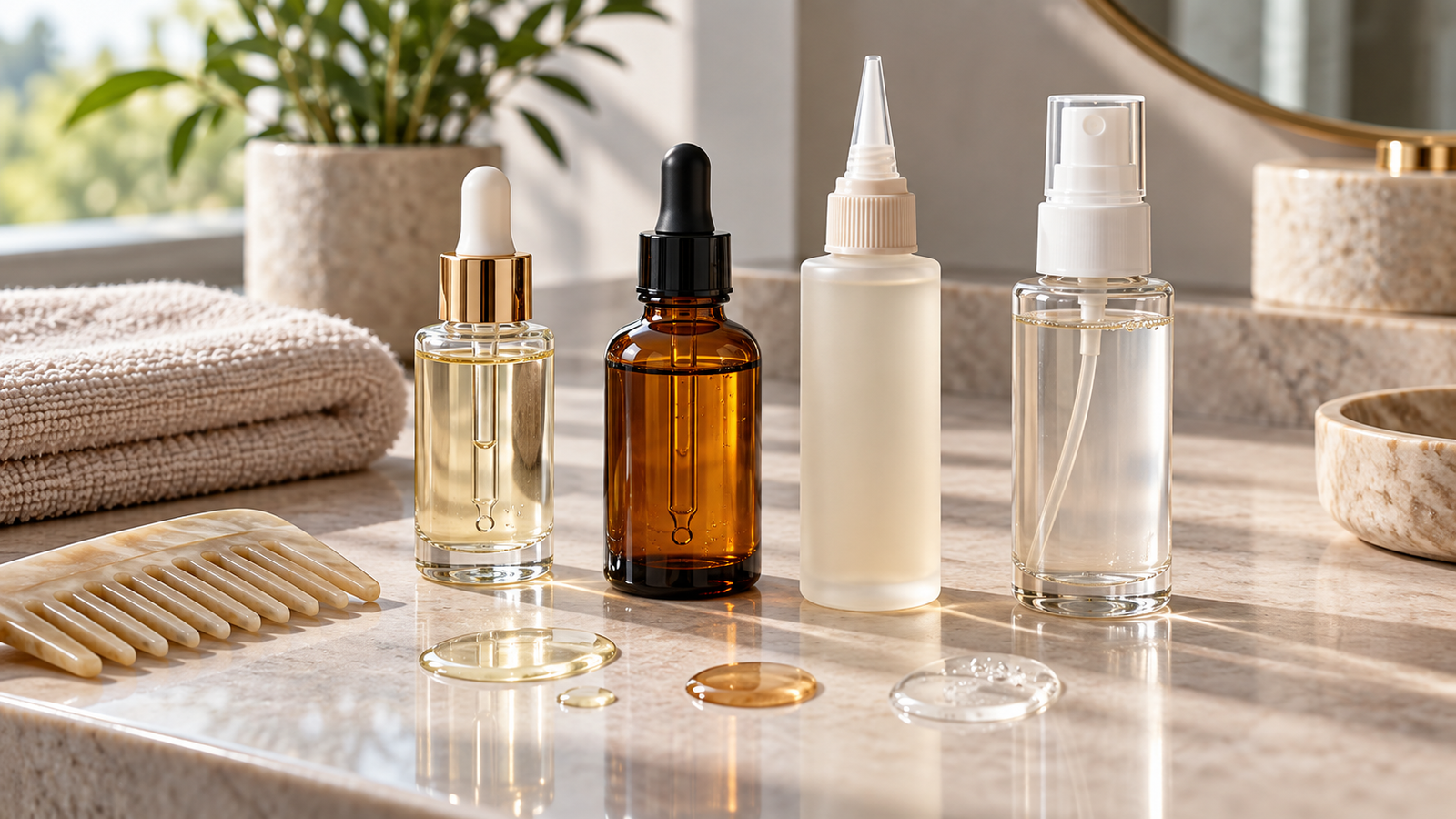
Dropper vs precision nozzle vs spray
Packaging can affect how practical the product is.
Dropper bottle
Useful for applying small amounts to selected scalp areas.
Possible drawback: the dropper can become messy if it repeatedly touches the scalp.
Precision nozzle
Useful for creating lines through the hair and depositing serum directly onto the scalp.
This can be particularly practical for thicker hair.
Spray bottle
Useful for distributing a lightweight formula across a larger area.
However, some product may land on the hair rather than the scalp.
The best format depends on how much scalp area you need to cover.
Water-based vs oil-based scalp serum
Water-based serum
Usually feels lighter and may be easier to use daily without making the hair greasy.
Oil-based serum
May provide more emollience but can make the roots look oily, particularly on fine hair.
Neither format is inherently better for hair growth.
Consider scalp comfort, wash frequency and how the product fits your routine.
How to calculate value properly
Do not compare scalp serums only by bottle price.
Consider:
- Bottle size.
- Recommended amount per application.
- Applications per day.
- Estimated duration of one bottle.
For example, a 30 ml serum used once daily may last very differently from a 30 ml serum intended for twice-daily application.
A cheaper bottle is not always cheaper over several months of use.
Why duration matters
Hair changes occur slowly.
A product that claims visibly thicker hair in a few days deserves scrutiny.
Even when an ingredient is useful, hair growth cycles operate over weeks and months rather than overnight.
When a manufacturer cites results, check:
- Study length.
- Number of participants.
- Whether measurements were objective.
- Whether there was a control group.
- Whether results refer to the final serum.
How to read “clinically tested”
“Clinically tested” sounds reassuring, but the phrase alone tells you very little.
Ask:
What was tested?
It could mean:
- The finished retail product.
- One ingredient in the product.
- A similar formula.
- A small consumer perception study.
What was measured?
Possibilities include:
- Hair count.
- Hair density.
- Hair diameter.
- Shedding.
- User satisfaction.
- Self-reported appearance.
A consumer questionnaire is not the same as an objective measurement of new hair growth.
“Up to” claims
Be cautious with statements such as:
“Up to 90% reduction in hair fall.”
“Up to” usually refers to the highest result observed under specific study conditions.
It does not mean every user achieved that result.
Look for the average result, sample size and study design when these are available.
Before-and-after photographs
Before-and-after images can be useful, but they can also be misleading.
Appearance can change because of:
- Lighting.
- Hair styling.
- Camera angle.
- Parting position.
- Hair washing.
- Hair fibres or styling products.
- Image exposure.
Photographs are stronger evidence when conditions are standardised and accompanied by objective measurements.
What does dermatologist-tested mean?
“Dermatologist-tested” does not automatically mean dermatologist-recommended or clinically proven to regrow hair.
It usually indicates that dermatological testing was involved in some way.
You still need to understand:
- What was tested.
- What outcome was assessed.
- Whether irritation or efficacy was being measured.
Fragrance in scalp serums
Fragrance can make a product more pleasant to use but does not contribute to hair growth.
If your scalp is sensitive, fragrance may be worth considering when comparing formulations.
Stop using a product if it repeatedly causes:
- Burning.
- Itching.
- Significant redness.
- Rash.
- Persistent flaking.
Alcohol in scalp serum
The word “alcohol” on an ingredient list does not automatically mean the product is harsh.
Different alcohols serve different purposes.
Some volatile alcohols help create a fast-drying texture.
Fatty alcohols such as cetyl alcohol and stearyl alcohol are commonly used as emollient or structural ingredients.
Judge the complete formula and how your scalp responds rather than avoiding every ingredient containing the word alcohol.
Silicones in hair serums
Silicones are often used in serums intended for the hair lengths because they can improve smoothness, slip and shine.
Their presence does not mean the product is bad.
But a silicone-rich hair serum may be primarily a cosmetic styling product rather than a scalp treatment.
Again, identify the product’s intended role before comparing it with growth-focused leave-on scalp serums.
How to compare two hair-growth serums
Use a consistent checklist.
| Factor | What to check |
|---|---|
| Product type | Is it actually a leave-on scalp serum? |
| Key actives | Which ingredients are highlighted? |
| Concentrations | Are meaningful percentages disclosed? |
| Evidence | Ingredient study or finished-product testing? |
| Directions | How often and how much should you apply? |
| Texture | Water-based, gel, spray or oil-based? |
| Packaging | Dropper, nozzle or spray? |
| Bottle size | How many millilitres are included? |
| Routine cost | How long is one bottle likely to last? |
| Tolerability | Fragrance, irritation potential and scalp comfort |
Red flags to watch for
Be cautious when a product:
- Promises permanent regrowth for everyone.
- Guarantees results within a few days.
- Uses dramatic percentages without explaining what they measure.
- Treats an ingredient-supplier study as proof of the finished product.
- Provides no clear application instructions.
- Suggests that shedding always has one simple cause.
- Claims to replace medical evaluation for significant hair loss.
Transparent information is more useful than exaggerated promises.
When cosmetic serum may not be enough
Hair shedding and thinning can occur for many reasons, including:
- Genetics.
- Stress.
- Nutritional deficiencies.
- Hormonal changes.
- Thyroid disorders.
- Recent illness.
- Certain medications.
- Scalp conditions.
- Pattern hair loss.
- Postpartum changes.
A cosmetic serum cannot diagnose the reason.
Consider professional evaluation if you notice:
- Sudden significant shedding.
- Patchy hair loss.
- Rapidly widening parting.
- Visible scalp inflammation.
- Pain or severe itching.
- Scarring.
- Eyebrow or eyelash loss.
- Hair loss accompanied by other unexplained symptoms.
Earlier assessment can be useful when true hair loss is progressing.
Hair serum vs proven medical treatment
Cosmetic scalp serums and medicines should not be treated as equivalent categories.
Some medical treatments have stronger evidence for specific types of hair loss.
Whether those treatments are appropriate depends on the cause of the hair loss, medical history and individual circumstances.
Do not stop a prescribed treatment or substitute a cosmetic serum without discussing the change with the clinician managing your condition.
How to introduce a scalp serum
When trying a new cosmetic serum:
- Read the directions.
- Start with the recommended amount.
- Apply to the scalp rather than saturating the hair lengths unless directed.
- Wash your hands afterward if necessary.
- Monitor for irritation.
- Avoid starting several new scalp products simultaneously.
- Take consistent photographs if you want to track appearance over time.
Use the same lighting, hair parting and camera distance for progress photos.
Do you need to massage the serum into the scalp?
Gentle spreading can help distribute the product.
Aggressive massage is unnecessary.
Hard rubbing does not force ingredients deeper into the scalp and may irritate sensitive skin or pull on fragile hair.
Use the application technique recommended by the manufacturer.
Can several hair serums be layered together?
Usually there is little reason to layer multiple leave-on growth serums.
Doing so can:
- Increase irritation.
- Create residue.
- Make the hair greasy.
- Increase cost.
- Make it difficult to know which product is helping or causing a reaction.
Choose one product and evaluate it consistently unless a clinician recommends a specific combination.
Frequently asked questions
Is a higher percentage hair serum always better?
No.
Percentages may refer to different ingredients or branded complexes and are not directly comparable.
The complete formulation and evidence matter.
Is Redensyl better than AnaGain?
There is not enough basis to declare one universally better for every user.
They are different commercial ingredient systems with different supporting evidence.
Compare the finished products rather than only the trademarked ingredient names.
Can hair serum regrow a receding hairline?
A cosmetic serum should not be assumed to reverse a receding hairline.
Hairline recession can be associated with pattern hair loss and may require medical assessment.
How long should I use a serum before deciding whether it works?
Follow the timeframe provided by the product, but be sceptical of extremely rapid claims.
Changes in hair density generally require consistent observation over months rather than days.
Can I apply hair-growth serum every day?
Many products are designed for daily use, but follow the instructions for the specific serum.
More frequent application than recommended does not guarantee better results.
Should serum be applied before or after hair oil?
If the serum is water-based and intended for direct scalp contact, heavy oil may interfere with its application.
Follow the product directions. In many routines, it is simpler to avoid layering several scalp treatments at the same time.
Do I need to wash my hair every day when using scalp serum?
Not necessarily.
Wash frequency depends on scalp type, product buildup and the serum’s directions.
A lightweight leave-on product may not require daily washing.
What to check before buying
Before purchasing a hair-growth or scalp serum, answer these questions:
- Is this genuinely a scalp treatment rather than a smoothing hair serum?
- Which active ingredients are included?
- Are their concentrations disclosed?
- Do the percentages refer to individual ingredients or commercial blends?
- Has the finished serum been tested?
- How often must it be used?
- How long will one bottle last?
- Does the formula suit your scalp and hair routine?
- Are the claims realistic?
- Is your hair concern something that may need medical assessment?
These questions make product comparisons far more useful than simply choosing the serum with the longest ingredient list.
Physical Glow’s Top 5 Scalp and Hair-Growth Serums in India comparison looks at several leave-on serum formats, ingredient combinations and application systems. Use that comparison alongside this guide, then verify the current ingredient concentrations, bottle size, usage directions and claims for the exact serum you are considering.