Salicylic Acid Face Wash vs Gentle Cleanser: How to Choose a Routine
Learn how an active-ingredient face wash differs from a gentle cleanser, how to avoid over-cleansing and when a cleansing oil may be used first.
Salicylic-acid face washes and gentle cleansers can both remove oil, sunscreen, sweat and daily buildup, but they are designed with different priorities.
A salicylic-acid cleanser combines basic cleansing with an exfoliating ingredient that can be useful for oily, congested or blemish-prone skin. A gentle cleanser focuses more on removing impurities while minimising dryness and irritation.
The better choice depends on your skin type, how frequently you cleanse, what other active ingredients you already use and whether clogged pores or sensitivity are the bigger concern.
For many people, the answer is not necessarily choosing one permanently. A gentle cleanser may form the foundation of the routine, while a salicylic-acid face wash is used when additional pore-focused cleansing is useful.
What is a salicylic-acid face wash?
A salicylic-acid face wash is a rinse-off cleanser containing salicylic acid.
Salicylic acid belongs to a group of exfoliating ingredients commonly described as beta hydroxy acids, or BHAs.
It is widely used in products aimed at oily and blemish-prone skin because it can help loosen accumulated dead skin cells and material around pores.
Unlike a leave-on salicylic-acid serum or exfoliant, a face wash remains on the skin for a relatively short period before being rinsed away.
That difference matters when comparing products.
What is a gentle cleanser?
A gentle cleanser is designed to clean without leaving the skin excessively tight, dry or irritated.
It may come in several textures, including cream, lotion, gel or low-foam liquid.
A gentle cleanser usually prioritises:
- Mild cleansing agents.
- Comfortable after-feel.
- Barrier support.
- Reduced fragrance or other potential irritants.
- Compatibility with frequent use.
The term “gentle” is not a regulated guarantee, however. The complete ingredient list and how your skin responds still matter.
Salicylic-acid face wash vs gentle cleanser at a glance
| Factor | Salicylic-acid face wash | Gentle cleanser |
|---|---|---|
| Main purpose | Cleansing plus pore-focused exfoliation | Everyday cleansing with minimal irritation |
| Common skin type | Oily, combination or blemish-prone | Dry, sensitive, normal or treatment-stressed skin |
| Exfoliating ingredient | Usually salicylic acid | Usually none |
| Use frequency | Depends on concentration and tolerance | Often suitable for regular use |
| Dryness potential | Higher | Usually lower |
| Pore congestion focus | Higher | Lower |
| Best role | Targeted cleansing step | Basic routine cleanser |
| Suitable with strong actives | Requires more care | Often easier to combine |
How does salicylic acid work?
Salicylic acid is oil-soluble.
That property allows it to interact with the oily environment around pores differently from many water-soluble exfoliating acids.
In skincare, it is commonly used to help reduce the buildup of dead skin cells and oil that can contribute to clogged-looking pores.
This is why it often appears in products marketed for blackheads, whiteheads and oily skin.
However, a cleanser containing salicylic acid is still a rinse-off product.
The final result depends on more than the ingredient name alone.
Why rinse-off salicylic acid is different from a leave-on exfoliant
A face wash may remain on the skin for less than a minute before being rinsed away.
A leave-on product can remain for several hours.
That means a cleanser may provide a gentler way to introduce salicylic acid, but it may also provide less intensive exfoliation than a well-formulated leave-on product.
This can actually be an advantage for someone who wants some pore-focused support without adding another leave-on active.
What does a gentle cleanser actually do?
A gentle cleanser still needs to remove unwanted material from the skin.
That can include:
- Sweat.
- Excess sebum.
- Dirt.
- Some sunscreen.
- Light makeup.
- Environmental residue.
The difference is that it aims to do this without removing so much oil that the skin feels stripped.
After cleansing, skin should ideally feel clean but comfortable rather than squeaky or unusually tight.
Does “foaming” mean harsh?
No.
A foaming cleanser can still be mild.
Modern cleansing formulas can produce foam while using relatively gentle surfactants.
Likewise, a non-foaming cream cleanser is not automatically better.
Judge the finished formula by how your skin feels after use.
Why oily skin may benefit from salicylic-acid cleansers
Oily skin produces more sebum, which can contribute to a shiny appearance and clogged pores in some people.
A salicylic-acid cleanser may be useful when oiliness is accompanied by concerns such as:
- Blackheads.
- Whiteheads.
- Congested pores.
- Frequent small blemishes.
It can provide cleansing and mild exfoliation in one step.
However, oily skin can still become dehydrated or irritated.
Using the strongest possible cleanser is not necessarily helpful.
Can dry skin use salicylic acid?
Yes, but more caution is usually required.
Dry skin already has less surface oil and may feel uncomfortable after repeated exfoliation.
If you have dry skin but occasional clogged pores, you might use a salicylic-acid cleanser less frequently and keep a gentle cleanser for most washes.
Another option is to use a targeted leave-on product only where needed rather than exposing the whole face to an exfoliating cleanser every time.
Which is better for sensitive skin?
A gentle cleanser is usually the safer starting point.
Sensitive skin may react to:
- Exfoliating acids.
- Fragrance.
- Strong surfactants.
- Multiple actives.
- Frequent cleansing.
That does not mean everyone with sensitive skin must avoid salicylic acid.
Some people tolerate it well at lower frequency.
Introduce it gradually and stop if you develop persistent burning, redness or excessive dryness.
What about combination skin?
Combination skin can involve an oily T-zone with drier cheeks.
In this situation, a salicylic-acid cleanser may be useful on oily areas, while a gentle cleanser may be preferable for the whole face on other days.
You do not necessarily need to treat every area of the face identically.
Salicylic acid and blackheads
Blackheads form when material inside a pore remains open to the air and oxidises.
Salicylic acid is commonly used in blackhead-focused skincare because it can help reduce the buildup of material inside pores.
A cleanser may improve the appearance of congestion gradually, but blackheads are unlikely to disappear after one wash.
Consistent use matters more than aggressive scrubbing.
Salicylic acid and whiteheads
Whiteheads are closed clogged pores.
Salicylic acid may also be useful here because of its exfoliating and pore-focused properties.
Again, a rinse-off cleanser is usually a relatively gentle treatment format.
Persistent acne may need a broader skincare or medical approach.
Does salicylic-acid face wash treat acne?
Salicylic acid is a well-established ingredient used in acne-focused skincare, but the effect of a particular cleanser depends on concentration, formulation and use.
A cosmetic face wash should not be assumed to treat every type of acne.
Mild clogged pores may respond differently from inflammatory or cystic acne.
If acne is painful, scarring or persistent, professional assessment is more useful than repeatedly switching cleansers.
Can a gentle cleanser help acne-prone skin?
Yes.
Acne-prone skin does not always need an active cleanser.
A gentle cleanser may be particularly useful when you already use leave-on treatments such as:
- Salicylic acid.
- Retinoids.
- Benzoyl peroxide.
- Prescription acne products.
In that type of routine, another active cleanser may increase irritation without providing much additional benefit.
Why more exfoliation is not always better
Combining several exfoliating products can lead to overuse.
For example, someone may use:
- Salicylic-acid cleanser.
- Exfoliating toner.
- AHA serum.
- Retinoid.
This can quickly become too much for some skin.
Signs of over-exfoliation can include persistent stinging, tightness, peeling and increased sensitivity.
When several active products are already present, a basic gentle cleanser is often the better foundation.
Salicylic acid percentage
Face washes may advertise different salicylic-acid concentrations.
A higher percentage is not automatically better.
The useful concentration depends on the entire formula and your tolerance.
Because cleanser contact time is short, formulation also affects how much the ingredient can interact with the skin before rinsing.
Do not choose solely by the largest number on the label.
Should you leave salicylic-acid cleanser on your face?
Follow the manufacturer’s instructions.
Some products may recommend massaging for a short period before rinsing.
There is usually no reason to leave a rinse-off cleanser on for several minutes unless the directions specifically say to do so.
Extending contact time can increase irritation without guaranteeing better results.
How often should you use it?
Frequency depends on your skin.
Some people tolerate a salicylic-acid face wash daily.
Others may do better using it:
- Every other day.
- A few times per week.
- Only during periods of increased congestion.
Start more conservatively if your skin is dry or sensitive.
Can you use salicylic-acid cleanser twice a day?
It is possible, but not everyone needs that much exfoliating cleansing.
If your skin starts feeling:
- Tight.
- Rough.
- Stingy.
- Unusually shiny but dehydrated.
reduce the frequency.
A common approach is to use a gentle cleanser for one wash and the salicylic-acid cleanser for the other.
Morning or evening?
Either can work.
Morning
Using it in the morning can fit well if your evening routine contains stronger actives and you want to separate them.
Evening
Using it in the evening can help remove oil and buildup accumulated through the day.
There is no universal best time.
The overall routine matters more.
Can you alternate cleansers?
Yes.
This is one of the easiest ways to balance active cleansing and gentleness.
For example, you might use a gentle cleanser most of the time and introduce a salicylic-acid face wash only a few times per week.
This gives you more control than forcing one cleanser to handle every situation.
What ingredients make a cleanser gentle?
There is no single ingredient that guarantees gentleness.
Useful supporting components may include:
- Glycerin.
- Ceramides.
- Panthenol.
- Hyaluronic acid.
- Mild emollients.
But the surfactant system remains important.
A cleanser with several moisturising ingredients can still feel drying if the cleansing system is too aggressive for your skin.
What are surfactants?
Surfactants are ingredients that help water mix with oil and debris so they can be rinsed away.
They are essential to most cleansers.
Different surfactants vary in strength and skin feel.
You do not need to avoid surfactants; without them, many cleansers would not clean effectively.
The goal is an appropriate surfactant system rather than no surfactants at all.
Why “soap-free” can matter
Traditional soap can have a higher pH than facial skin.
Some modern cleansers are marketed as soap-free because they rely on synthetic cleansing agents instead.
This can be useful information for people who find traditional soap drying.
But “soap-free” does not automatically make every formula gentle.
Fragrance in face washes
Fragrance does not improve cleansing performance.
Many users tolerate fragranced cleansers without problems.
However, if you have sensitive or reactive skin, a fragrance-free cleanser may be easier to manage.
Because a cleanser is rinsed off, fragrance exposure may be shorter than with leave-on products, but sensitivity is individual.
Physical scrub particles with salicylic acid
Some face washes combine salicylic acid with physical exfoliating particles.
For many users, this is unnecessary.
Using both chemical exfoliation and abrasive scrubbing can increase irritation.
If your main goal is unclogging pores, you generally do not need to scrub aggressively.
Cleansing brushes and active cleansers
Similarly, pairing a salicylic-acid cleanser with a powered cleansing brush can increase mechanical irritation.
If you use an exfoliating cleanser, your fingertips are usually enough.
More friction does not mean deeper pore cleansing.
How much cleanser should you use?
Use enough to spread comfortably over the face.
A large amount does not automatically clean better.
Excess product can:
- Waste cleanser.
- Increase dryness.
- Be harder to rinse.
Follow the manufacturer’s recommendation where available.
How long should cleansing take?
A short, thorough massage is usually enough.
Focus on areas where buildup commonly occurs, such as:
- Around the nose.
- Forehead.
- Chin.
- Hairline.
Avoid prolonged rubbing.
The goal is effective cleansing, not friction.
Water temperature
Use comfortable lukewarm water.
Very hot water can make some skin feel dry and irritated.
Extremely cold water does not “close pores.”
Pores do not open and close like doors in response to water temperature.
Should the skin feel squeaky clean?
No.
“Squeaky” skin often indicates that significant surface oils have been removed.
A cleanser can work effectively without leaving the face tight.
After rinsing, skin should ideally feel comfortable.
Moisturiser after cleansing
Both salicylic-acid cleansers and gentle cleansers can be followed by moisturiser.
This is particularly helpful if you experience dryness.
A simple moisturiser can support skin comfort after cleansing.
You do not need to skip moisturiser because your skin is oily.
Sunscreen still matters
A salicylic-acid cleanser does not replace sunscreen.
If you are managing blemishes or post-acne marks, daily sun protection is especially useful because sun exposure can make pigmentation more noticeable.
Apply a suitable broad-spectrum sunscreen as the final step of the morning skincare routine.
Salicylic cleanser with retinol
Some people can use both, but irritation risk increases depending on frequency and skin sensitivity.
If you already use a retinoid at night, you may prefer a gentle cleanser at that time.
The salicylic cleanser could be used on alternate nights or in the morning.
There is no requirement to combine them.
Salicylic cleanser with vitamin C
These ingredients can exist in the same routine.
However, if the combination causes stinging or dryness, simplify.
Skincare routines do not become more effective simply because more actives are used simultaneously.
Salicylic cleanser with benzoyl peroxide
Both can be useful in acne-prone routines, but the combination can be drying.
If you use a benzoyl-peroxide treatment, a gentle cleanser may provide better balance.
People using prescription acne treatments should follow their clinician’s advice.
Can you use salicylic acid around the eyes?
Avoid the immediate eye area unless the product specifically states otherwise.
The eyelids and surrounding skin are sensitive.
If cleanser enters the eyes, rinse thoroughly with water.
Persistent irritation requires appropriate assessment.
Salicylic acid on damaged skin
Avoid applying exfoliating cleansers over:
- Open cuts.
- Raw irritated areas.
- Freshly picked blemishes.
- Significant sunburn.
Allow the skin to recover first.
An active cleanser can sting damaged skin considerably.
What does purging mean?
The term “purging” is commonly used to describe a temporary increase in blemishes after starting ingredients that affect skin-cell turnover.
However, not every breakout after introducing a product is purging.
A new cleanser may also cause:
- Irritation.
- Dryness.
- An unrelated breakout.
Do not continue indefinitely with a product that clearly makes your skin uncomfortable under the assumption that everything is “purging.”
How long does a cleanser need to work?
Cleansers remove surface buildup immediately, but changes in congestion or blemishes take longer to judge.
Do not expect blackheads or acne to disappear after several washes.
Use the product consistently while monitoring:
- Oiliness.
- Dryness.
- New irritation.
- Changes in congestion.
If the routine is making the skin steadily worse, reconsider it.
Gentle cleanser for a damaged skin barrier
When skin becomes unusually irritated, a simplified routine can be useful.
A gentle cleanser can reduce additional stress while you temporarily reduce strong actives.
Signs that your routine may be too aggressive include persistent burning, peeling and tightness.
If irritation is significant, professional advice may be appropriate.
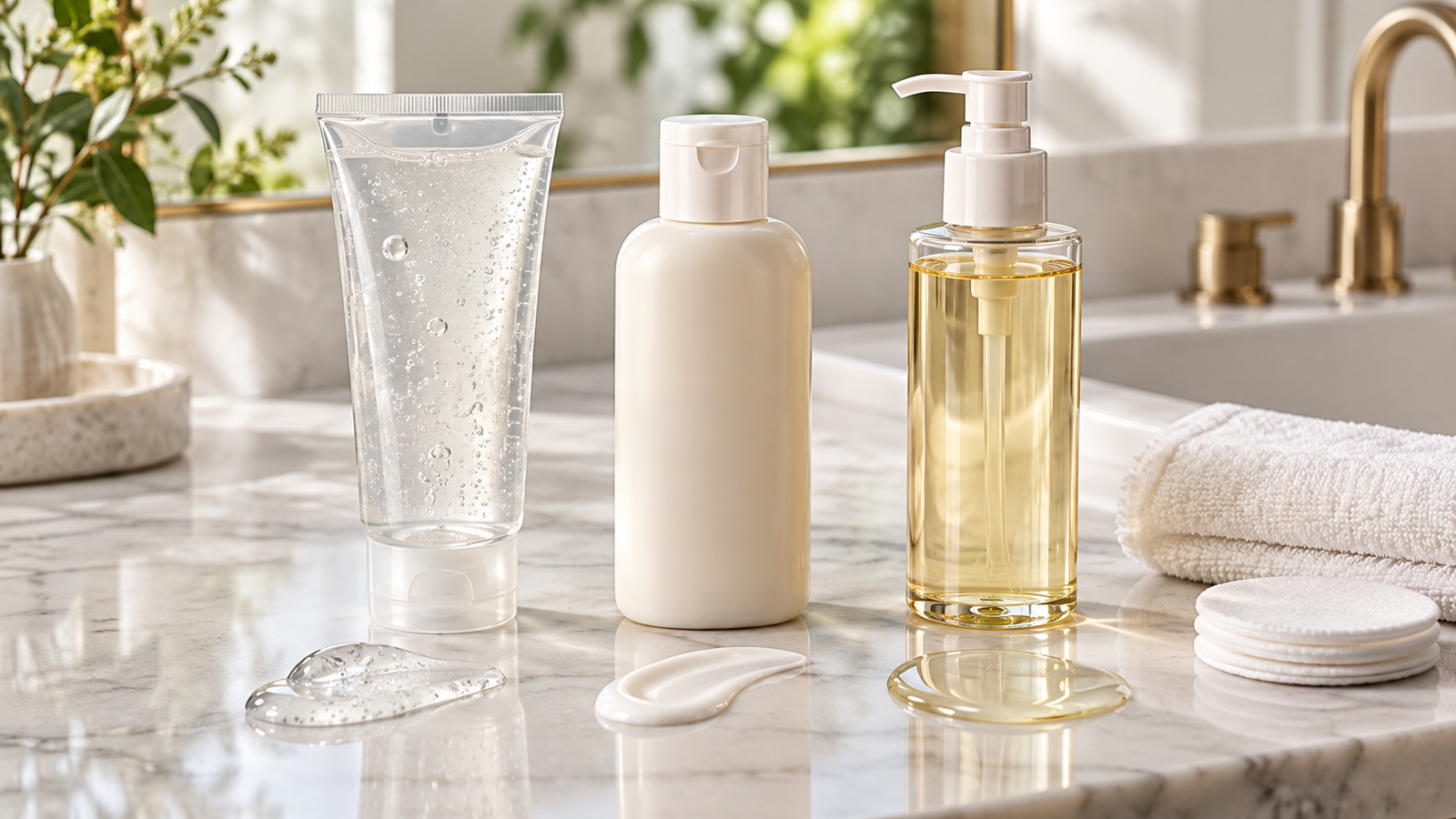
Gel cleanser vs cream cleanser
Texture can provide clues about how a cleanser feels, but it does not determine performance.
Gel cleanser
Often feels fresh and lightweight.
Frequently marketed to oily or combination skin.
Cream cleanser
Usually feels richer.
Often marketed to dry or sensitive skin.
A well-formulated gel can still be gentle, and a cream cleanser can still clean effectively.
Low-foam cleanser
Low-foam products use less visible lather.
They can feel comfortable for dry skin.
Foam itself is not harmful, but some users associate heavy lather with a stronger cleansing sensation.
Choose based on actual skin feel rather than foam level alone.
Salicylic cleanser for body acne
Some salicylic-acid cleansers can also be used on areas such as the chest or back if the product directions permit.
These areas may experience clogged pores and blemishes.
A body wash format can be more practical than using a small facial cleanser over large areas.
Persistent or severe body acne may need professional treatment.
Can men and women use the same cleanser?
Yes.
Facial cleansers do not need to be gender-specific.
Choose based on:
- Skin type.
- Concerns.
- Formula.
- Tolerance.
Packaging marketed to a particular gender does not determine cleansing performance.
Does age determine which cleanser you need?
Not by itself.
Teenagers can have dry or sensitive skin.
Adults can have oily, acne-prone skin.
Choose according to how your skin behaves now rather than an age label.
Common mistakes with salicylic-acid face wash
The main mistakes are using it too frequently, combining it with too many other exfoliants, scrubbing aggressively, choosing the highest concentration automatically and continuing despite persistent irritation.
Salicylic acid works better as a consistent part of a balanced routine than as an aggressive quick fix.
Common mistakes with gentle cleansers
A gentle cleanser can still be used incorrectly.
Common problems include using too little to remove heavy sunscreen, assuming “gentle” means it can remove every type of waterproof makeup, cleansing repeatedly because the skin does not feel squeaky, or choosing a formula that leaves an uncomfortable residue for your skin type.
The right gentle cleanser should clean effectively while leaving the skin comfortable.
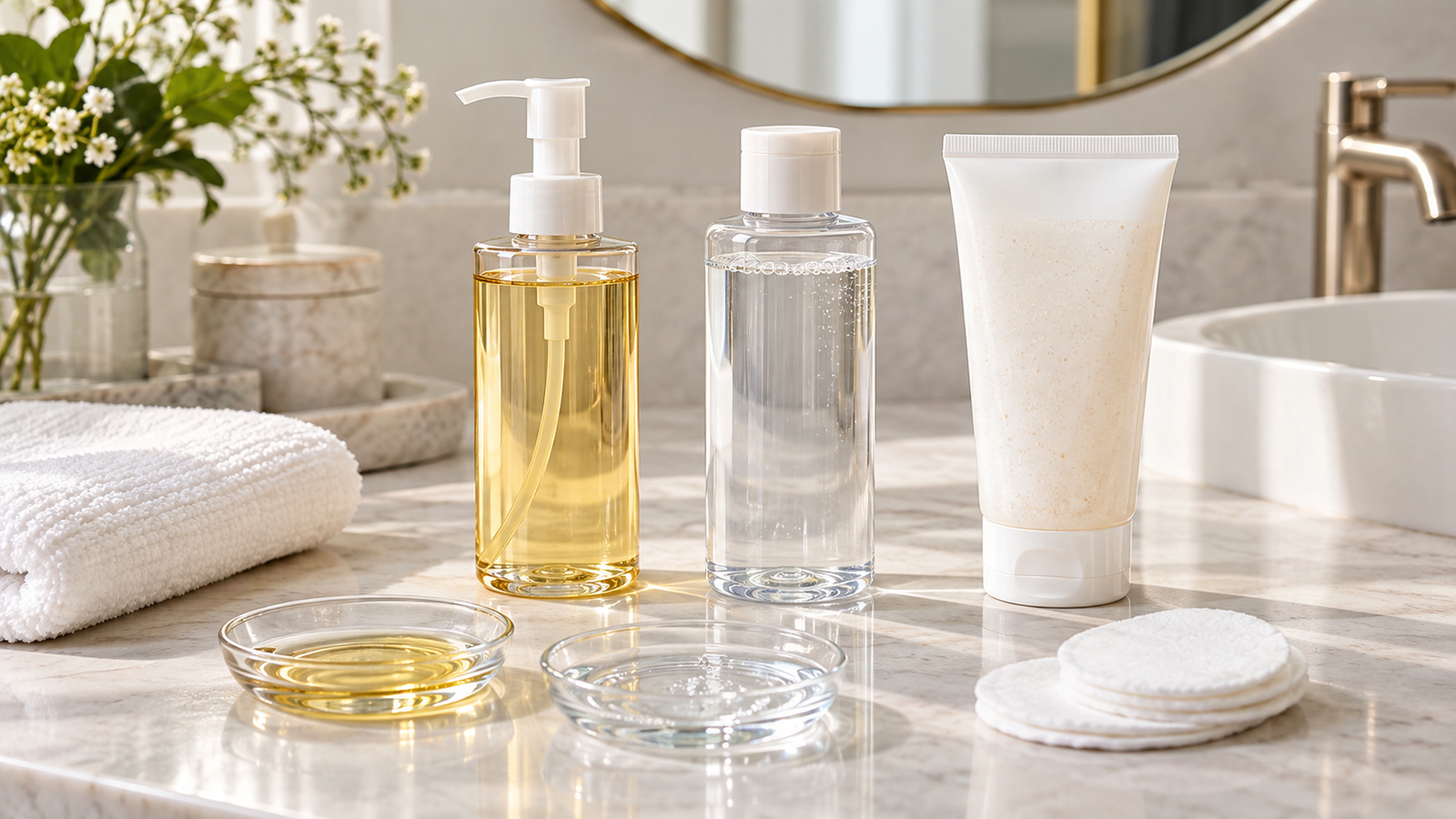
What about double cleansing?
Double cleansing typically means using an oil-based first cleanser followed by a water-based cleanser.
It can be useful when removing:
- Heavy sunscreen.
- Waterproof makeup.
- Long-wear foundation.
If you double cleanse, the second cleanser does not need to be extremely strong.
A gentle cleanser is often sufficient.
If you use a salicylic-acid cleanser as the second step, watch for dryness.
How to compare face washes before buying
| Factor | What to check |
|---|---|
| Main function | Basic cleansing or exfoliating cleansing |
| Salicylic acid | Present, absent and concentration if disclosed |
| Skin type | Oily, dry, sensitive or combination |
| Texture | Gel, cream, foam or lotion |
| Fragrance | Important for sensitive users |
| Supporting ingredients | Humectants, ceramides or soothing ingredients |
| Frequency | Suitable for daily or occasional use |
| Other actives | Consider your full skincare routine |
| After-feel | Comfortable rather than excessively tight |
| Size and price | Cost per use for regular cleansing |
Which should you choose for oily skin?
A salicylic-acid cleanser can be useful if oiliness is accompanied by frequent congestion.
If your skin is oily but already uses several acne treatments, a gentle cleanser may be the better choice.
Oiliness alone does not mean you need exfoliation every time you wash.
Which should you choose for dry skin?
Start with a gentle cleanser.
If you also experience occasional clogged pores, introduce salicylic acid cautiously rather than replacing every wash.
Which should you choose for sensitive skin?
A simple gentle cleanser is usually the most practical starting point.
Choose fragrance-free options if fragrance tends to bother your skin.
Add active cleansers only if needed.
Which should you choose for acne-prone skin?
It depends on the rest of the routine.
A salicylic-acid cleanser can be a useful active step.
But if you already use effective leave-on acne products, a gentle cleanser may help reduce irritation.
More acne ingredients do not automatically produce faster improvement.
Frequently asked questions
Is salicylic-acid face wash better than a normal cleanser?
Not universally.
It is more targeted toward oiliness and clogged pores, while a gentle cleanser is better suited to basic everyday cleansing.
Can I use salicylic-acid face wash every day?
Many people can, but frequency should depend on concentration and tolerance.
Reduce use if the skin becomes dry or irritated.
Can I use a gentle cleanser if I have acne?
Yes.
A gentle cleanser can be especially useful when acne is treated with other active products.
Does salicylic-acid face wash remove blackheads?
It may gradually improve clogged pores, but it is unlikely to eliminate every blackhead by itself.
Is salicylic-acid cleanser good for oily skin?
It can be useful, particularly when oily skin is also congested or blemish-prone.
Can salicylic acid make skin dry?
Yes.
Overuse may cause dryness, irritation or peeling.
Should I use moisturiser after salicylic-acid face wash?
Yes, if your skin needs it. Oily skin can also benefit from an appropriate moisturiser.
Can I alternate a salicylic cleanser with a gentle cleanser?
Yes. This is often a practical way to control exfoliation frequency.
Is a cleanser enough to treat severe acne?
Usually not. Severe, painful, persistent or scarring acne should be professionally assessed.
Can a gentle cleanser remove sunscreen?
Many can remove ordinary sunscreen, but water-resistant or heavy sunscreen may require more thorough cleansing or a first-step oil cleanser.
Choosing between a salicylic-acid face wash and a gentle cleanser
Start with your main concern.
If your skin is oily, congested and prone to clogged pores, a salicylic-acid face wash can be a useful targeted cleanser.
If your skin is dry, sensitive or already exposed to several active treatments, a gentle cleanser is usually the stronger foundation.
You do not have to commit to only one.
For many routines, the most balanced approach is a gentle cleanser for regular cleansing and a salicylic-acid cleanser used only as often as the skin comfortably tolerates.
The goal is not to make the skin feel stripped. It is to remove what needs to be removed while keeping the skin comfortable enough to maintain the routine consistently.
Physical Glow’s Top 5 Gel, Gentle and Double-Cleansing Face Washes in India comparison looks at several cleanser formats for different skincare routines. Use that comparison alongside this guide, then verify the current salicylic-acid concentration, cleanser type, fragrance, bottle size and usage directions for the exact product you are considering.