Ab Roller Wheel Guide: Single, Double and Rebound Designs Explained
Learn how single-wheel, dual-wheel and rebound-style ab rollers differ in stability, grip design, movement control and practical home use.
Ab rollers look simple, but wheel design can noticeably change how stable, demanding and beginner-friendly the exercise feels.
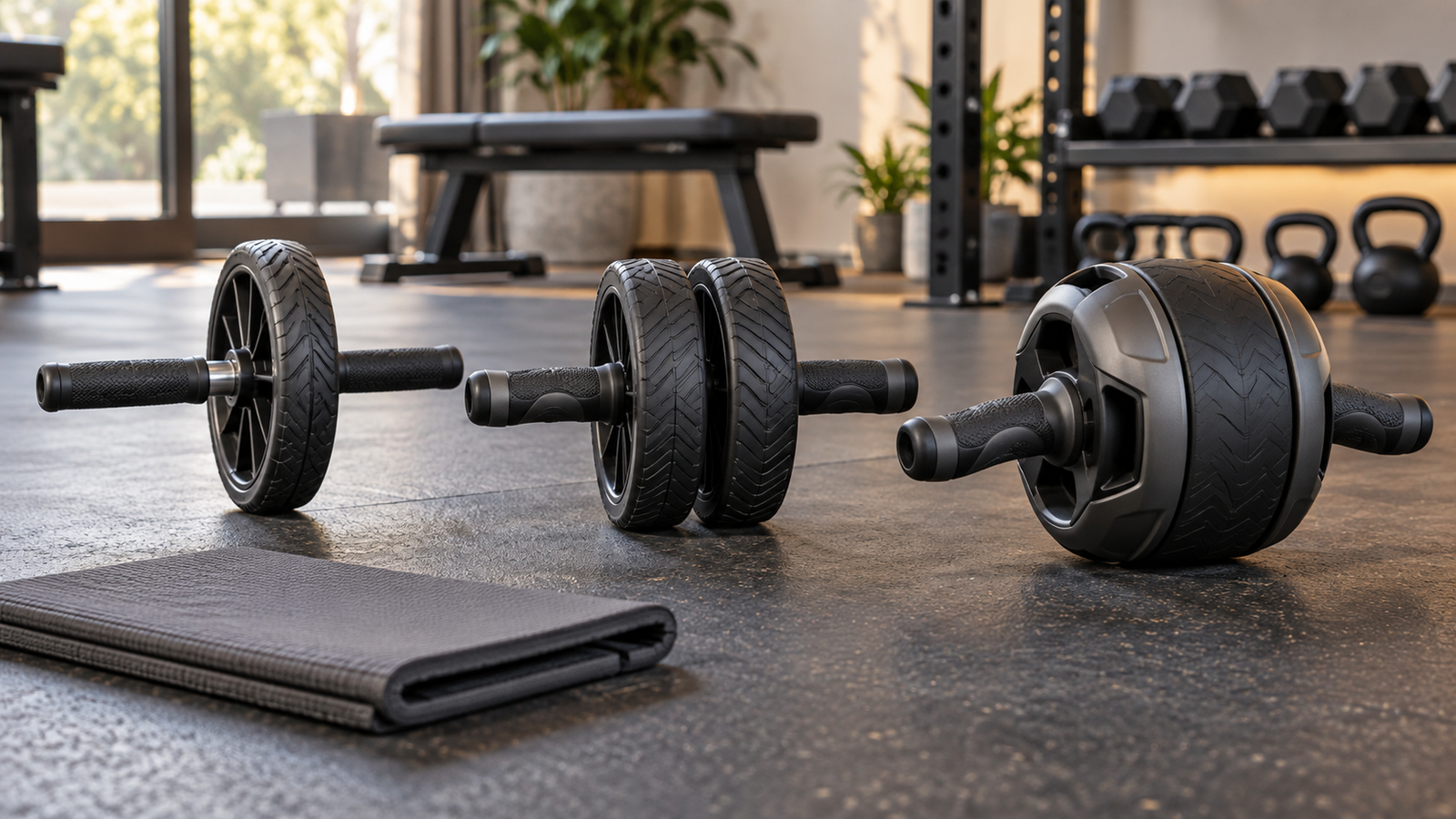
A narrow single-wheel roller usually requires more balance and control. A dual-wheel model offers a wider base and can feel more stable. Rebound-style rollers add a wider housing or assisted return mechanism that can make the movement feel more controlled for some users.
The right choice depends on your current core strength, shoulder comfort, available floor space and whether you want maximum instability or a more supportive learning curve.
What is an ab roller?
An ab roller is a compact exercise tool built around one or more wheels with handles extending from either side.
During a rollout, you typically begin from a kneeling position, roll the wheel forward while keeping the trunk controlled, then return to the starting position.
The movement challenges more than the abdominal muscles alone.
It can involve:
- Rectus abdominis.
- Obliques.
- Deep trunk muscles.
- Shoulders.
- Lats.
- Chest.
- Hip stabilisers.
- Forearms and grip.
The key challenge is resisting excessive extension through the lower back while the arms move away from the body.
Why wheel design matters
The width, number of wheels and internal mechanism affect how the roller behaves.
A very narrow wheel can move more freely from side to side, increasing the demand for balance.
A wider wheel base can reduce some of that instability.
A rebound roller may add spring-assisted return or a wider housing that changes both the feel and difficulty of the movement.
This is why two ab rollers can look similar but feel very different in use.
Single-wheel vs dual-wheel vs rebound ab roller at a glance
| Factor | Single-wheel roller | Dual-wheel roller | Rebound-style roller |
|---|---|---|---|
| Stability | Lower | Moderate to high | Usually higher |
| Balance demand | High | Moderate | Usually lower |
| Beginner friendliness | Lower to moderate | Moderate to high | Often high |
| Core control demand | High | High | Moderate to high |
| Side-to-side movement | Greater | Reduced | Usually reduced |
| Typical construction | One narrow wheel | Two parallel wheels | Broad wheel or spring-assisted housing |
| Portability | Excellent | Excellent | Good |
| Mechanical complexity | Low | Low | Higher |
| Best for | Users wanting a simple challenging tool | General home training | Users wanting added control or assisted return |
What is a single-wheel ab roller?
A single-wheel ab roller usually uses one central wheel with handles extending out on both sides.
The narrower base means the roller can tilt slightly from side to side.
That instability can increase the challenge because you need to control:
- Forward movement.
- Backward movement.
- Side-to-side wobble.
- Shoulder position.
- Trunk alignment.
For experienced users, that can be useful.
For beginners, it can make the movement feel less predictable.
Advantages of a single-wheel roller
A single-wheel design offers several practical advantages.
Simple construction
There are fewer moving parts.
This usually means:
- Lower weight.
- Easy storage.
- Simple maintenance.
- Fewer mechanical parts to fail.
Greater stability challenge
Because the wheel is narrow, you need more control to keep the roller tracking straight.
This can make the exercise feel more demanding without adding external weight.
Compact size
Single-wheel rollers fit easily into:
- Small home gyms.
- Cupboards.
- Gym bags.
- Travel luggage.
They are among the most compact core-training tools available.
Drawbacks of a single-wheel roller
The same instability that makes the exercise challenging can also make it less accessible.
Potential drawbacks include:
- More side-to-side wobble.
- Greater coordination demand.
- Less confidence for beginners.
- Higher chance of losing alignment if technique is weak.
If you cannot yet maintain a controlled short-range rollout, a very narrow wheel may not be the easiest starting point.
What is a dual-wheel ab roller?
A dual-wheel roller uses two parallel wheels mounted closely together.
The extra width creates a broader contact area with the floor.
This generally reduces side-to-side movement.
The roller still requires substantial trunk control, but the path may feel more predictable.
Advantages of a dual-wheel roller
More lateral stability
Two wheels can make it easier to keep the roller moving in a straight line.
This can help users focus on:
- Core control.
- Shoulder position.
- Range of motion.
- Breathing.
Rather than spending as much attention on preventing the wheel from tipping sideways.
Beginner-friendly feel
For many users, a dual-wheel model offers a practical balance between challenge and stability.
It is still demanding, but often less intimidating than a narrow single-wheel design.
Simple construction
Like a single-wheel roller, most dual-wheel designs remain mechanically simple.
That means they can still be:
- Lightweight.
- Portable.
- Easy to clean.
- Easy to store.
Drawbacks of a dual-wheel roller
The additional stability may reduce some of the balance demand.
For users specifically looking for maximum instability, this can make the exercise feel slightly less challenging.
The difference is not necessarily large, however.
Your rollout depth, tempo and body position usually affect difficulty more than the difference between one and two wheels.
What is a rebound-style ab roller?
A rebound ab roller usually has a wider wheel housing and may include an internal spring or return-assistance mechanism.
The exact design varies.
Some models use:
- Automatic rebound.
- Spring-assisted return.
- Broad dual-wheel construction.
- Integrated elbow supports.
- Large central wheel housings.
The main idea is to make the forward and return motion feel more controlled.
What does “automatic rebound” mean?
An automatic rebound mechanism stores some mechanical energy as the wheel rolls forward.
As you return, the mechanism can provide assistance.
This does not mean the machine performs the exercise for you.
You still need to control the movement.
However, the return phase may feel easier than with a completely free-rolling wheel.
The amount of assistance varies by product.
Advantages of a rebound roller
More controlled return
The assistance can make the movement feel less abrupt.
This may be useful for users learning rollout mechanics.
Wider base
Many rebound rollers have broader wheel housings.
That can reduce side-to-side wobble.
Confidence for beginners
The combination of a wide base and return assistance can make the exercise feel more manageable.
This may encourage users to practise short controlled repetitions rather than immediately attempting an excessive rollout.
Drawbacks of a rebound roller
More mechanical complexity
A spring-assisted device contains more parts.
That can mean:
- More weight.
- Larger size.
- More components that may wear.
- Greater importance of product quality.
Less portable
Many rebound rollers are bulkier than traditional models.
They may be less convenient for travel or very small storage spaces.
Assistance can be over-relied upon
If the return mechanism does too much of the work, some users may focus less on controlling the movement themselves.
Use the rebound feature as support rather than as a reason to extend beyond your current safe range.
Does a more stable roller make the exercise less effective?
Not necessarily.
Exercise difficulty depends on several factors, including:
- Rollout distance.
- Body position.
- Tempo.
- Control.
- Starting position.
- Repetition quality.
A dual-wheel roller used with excellent control and longer range can be more demanding than a single-wheel roller used for short, unstable repetitions.
Do not choose equipment solely because it looks harder.
Which type is best for beginners?
For many beginners, a dual-wheel or wide rebound-style roller is easier to learn with.
The extra stability can help you focus on:
- Keeping the trunk braced.
- Moving slowly.
- Avoiding excessive lower-back arching.
- Learning how far forward you can control.
A beginner does not need to roll very far.
Short, controlled repetitions are a better starting point than trying to reach full extension immediately.
Which type is better for experienced users?
Experienced users may prefer a single-wheel roller because the narrow base adds instability.
However, progression does not require switching to a narrower wheel.
You can also progress by:
- Increasing rollout distance.
- Slowing the movement.
- Pausing near the extended position.
- Increasing repetitions.
- Progressing from kneeling toward more advanced variations.
Technique quality remains more important than wheel count.
How to perform a basic kneeling ab rollout
A simple starting technique is:
- Kneel on a padded surface.
- Place the roller directly in front of you.
- Grip the handles firmly.
- Brace your abdomen.
- Keep the ribs and pelvis controlled.
- Roll forward slowly.
- Stop before the lower back begins to sag.
- Pull the roller back toward you under control.
The goal is not to roll as far as possible.
The goal is to maintain control.
What should your back position look like?
During a rollout, avoid letting the lower back collapse into excessive extension.
Think about maintaining a controlled trunk position.
A slight natural spinal curve is normal.
The warning sign is when the pelvis drops and the lower back visibly arches because you have moved beyond the range you can control.
Reduce the distance if this happens.
How far should you roll?
Only as far as you can maintain control.
For a beginner, that may be a short distance.
As strength improves, you can gradually increase the rollout.
You do not need to reach full body extension for the exercise to be useful.
Why beginners often roll too far
The roller moves easily, so it can travel farther than the user’s trunk strength can control.
Common signs that you have gone too far include:
- Lower back dropping.
- Losing abdominal tension.
- Shoulders collapsing.
- Difficulty returning without jerking.
- Falling forward.
Stop before this point.
Knee position and comfort
Most ab roller training begins from the knees.
Use a mat or knee pad if the floor is hard.
Some rollers include a small knee mat.
That accessory can be useful, but the mat size and thickness matter more than simply having one included.
Handle design matters
Handles affect comfort and grip.
Look at:
- Handle diameter.
- Foam thickness.
- Rubber texture.
- Width between hands.
- Grip length.
Very thin handles may feel uncomfortable for larger hands.
Very thick foam can also reduce grip security if it compresses excessively.
Foam grips vs textured rubber
Foam grips
Advantages:
- Soft.
- Comfortable.
- Lightweight.
Potential drawbacks:
- Can absorb sweat.
- May tear over time.
- Can rotate on cheaper models.
Rubber or textured grips
Advantages:
- Durable.
- Easy to clean.
- Often provide better friction.
Potential drawbacks:
- Can feel firmer on the hands.
Grip preference is personal.
Wheel width and stability
A wider wheel generally gives a larger contact patch.
This tends to make the roller more stable laterally.
However, an extremely wide wheel can change the feel of the movement.
For most home users, moderate width provides a useful balance between stability and challenge.
Wheel material matters
Common materials include:
- Rubber.
- Hard plastic.
- Thermoplastic compounds.
A softer rubberised surface may:
- Provide better floor grip.
- Reduce noise.
- Protect flooring.
A hard plastic wheel may roll smoothly but can be noisier.
Check floor compatibility if you train on:
- Tiles.
- Wood.
- Laminate.
- Vinyl.
Can ab rollers damage floors?
They can, depending on wheel material and flooring.
Potential issues include:
- Scuff marks.
- Scratches.
- Dirt transfer.
- Pressure marks.
Use a clean exercise mat if you are concerned about the surface.
However, very soft mats can make rolling uneven.
Choose a mat firm enough to let the wheel travel smoothly.
What surface is best?
A firm, flat surface is usually easiest.
Good options can include:
- Rubber gym flooring.
- Firm exercise mats.
- Smooth indoor flooring with suitable wheel material.
Avoid:
- Uneven surfaces.
- Thick soft carpets.
- Slippery floors.
- Wet surfaces.
The roller should move predictably.
Is a rebound roller safer?
Not automatically.
A rebound mechanism can make the movement easier to control, but the exercise still requires proper technique.
You can still overextend.
You can still lose alignment.
Equipment design does not replace movement control.
Are elbow-supported rollers easier?
Some large rebound models include forearm or elbow supports.
These change the exercise mechanics.
They may reduce some grip demand and make the setup feel more stable.
However, they are not exactly the same exercise as a traditional hand-held ab wheel.
If you want the classic rollout movement, a standard handle design is more direct.
Can ab rollers train the lower abs?
The abdominal muscles work together during rollouts.
It is more useful to think of the exercise as a whole-core stability movement rather than a way to isolate one small section of the abs.
Claims that one roller specifically “targets lower abs” should be treated cautiously.
Your body position and movement matter more than marketing labels.
Does an ab roller burn belly fat?
No exercise tool can selectively remove fat from the abdomen.
Ab rollers can strengthen the trunk muscles, but visible abdominal definition also depends on overall body composition.
Fat loss occurs through broader energy balance rather than spot reduction.
Avoid products promising that a roller will specifically burn stomach fat.
Can ab rollers build a six-pack?
They can help strengthen the abdominal muscles.
Whether those muscles become visibly defined depends on factors including:
- Body fat level.
- Genetics.
- Overall training.
- Nutrition.
- Muscle development.
An ab roller is a training tool, not a guarantee of visible abs.
Shoulder demand during rollouts
The shoulders work significantly during the movement.
As the arms move farther forward, shoulder demand increases.
If you have:
- Shoulder pain.
- Previous instability.
- Limited overhead mobility.
Start cautiously.
If the movement causes sharp pain, stop.
Do not force the rollout simply because the abdominal muscles can continue.
Wrist comfort
The neutral handle position of an ab roller can feel more comfortable than floor exercises that require the palms to remain flat.
However, grip and wrist position still matter.
Keep the wrists controlled rather than letting them collapse excessively.
If gripping the handles causes persistent wrist pain, another core exercise may be more suitable.
Lower-back discomfort
Lower-back discomfort often occurs when the rollout goes beyond the range the user can control.
Common causes include:
- Excessive rollout distance.
- Weak trunk bracing.
- Fatigue.
- Moving too quickly.
- Poor starting position.
Reduce the range and focus on control.
Sharp or persistent back pain is a reason to stop and seek appropriate professional advice.
How to progress safely
Progress gradually.
A simple sequence can be:
Stage 1: Static plank
Build basic trunk control.
Stage 2: Short kneeling rollouts
Move only a small distance.
Stage 3: Longer kneeling rollouts
Increase range gradually.
Stage 4: Paused rollouts
Pause briefly before returning.
Stage 5: Advanced variations
Only after you can perform controlled kneeling repetitions consistently.
There is no need to rush toward standing rollouts.
Repetition quality vs repetition count
Five controlled repetitions can be more useful than twenty unstable ones.
Stop a set when:
- Your lower back begins to sag.
- The return becomes jerky.
- Your shoulders collapse.
- You can no longer keep the wheel tracking correctly.
Fatigue can change technique quickly.
How many repetitions should beginners do?
There is no universal number.
A beginner might start with a small number of controlled repetitions and gradually build capacity.
Choose a repetition range that allows you to maintain form.
Do not chase high numbers at the expense of trunk control.
Can you use an ab roller every day?
Daily use is not necessary for most people.
The abdominal and supporting muscles need recovery like other trained muscle groups.
Frequency depends on:
- Training intensity.
- Volume.
- Experience.
- Other exercises in your programme.
If the muscles remain sore or technique deteriorates, allow more recovery time.
How to combine ab rollers with other core exercises
An ab roller can be one part of a balanced programme.
Other useful core patterns can include:
- Planks.
- Side planks.
- Dead bugs.
- Bird dogs.
- Pallof presses.
- Loaded carries.
Different exercises challenge trunk control in different directions.
You do not need to rely on one tool.
Ab roller vs plank
A plank is mostly static.
An ab rollout adds movement and generally increases the lever arm as the roller travels forward.
This often makes the rollout more demanding.
For beginners, planks can be a useful foundation before progressing to rollouts.
Ab roller vs sit-ups
Sit-ups involve repeated trunk flexion and significant hip-flexor contribution.
Rollouts focus more heavily on resisting extension while the arms move forward.
They are different exercises rather than direct replacements.
A training programme can include either or both depending on goals and comfort.
Ab roller vs crunches
Crunches involve spinal flexion over a smaller range.
Rollouts involve whole-body stabilisation and shoulder movement.
The ab roller usually requires more coordination and upper-body involvement.
Common ab roller mistakes
Rolling too far
This is the most common problem.
Stop before losing spinal control.
Moving too quickly
Slow movement makes it easier to maintain tension.
Letting the hips lead backward
Returning by simply pushing the hips back reduces the intended challenge.
Focus on drawing the roller back while maintaining trunk control.
Shrugging the shoulders
Keep the shoulders controlled and avoid collapsing toward the ears.
Holding the breath
Use controlled breathing rather than staying breathless throughout the set.
Chasing standing rollouts too early
Advanced variations require substantial strength.
There is no need to perform them for the exercise to be effective.
How to compare ab rollers before buying
| Factor | What to check |
|---|---|
| Wheel design | Single, dual or rebound |
| Wheel width | Narrow or wide |
| Stability | How much side-to-side movement occurs |
| Handle material | Foam, rubber or textured plastic |
| Wheel surface | Rubberised or hard plastic |
| Return assistance | None or spring-assisted |
| Size | Compact or large housing |
| Knee mat | Included and adequately padded |
| Portability | Easy to store or travel with |
| Mechanical complexity | Simple axle or rebound mechanism |
| Floor compatibility | Grip and risk of marking flooring |
Which type should you choose?
Choose a single-wheel roller if:
- You already have good core control.
- You want more instability.
- Compact storage matters.
- You prefer a simple design.
Choose a dual-wheel roller if:
- You want more lateral stability.
- You are newer to rollouts.
- You want a conventional roller without mechanical assistance.
- You want a balance between control and challenge.
Choose a rebound roller if:
- You want a wider, more stable platform.
- You prefer some assistance during the return phase.
- Portability is less important.
- You want a more guided feel.
Frequently asked questions
Is a dual-wheel ab roller easier than a single-wheel roller?
Usually, it feels more stable because the contact base is wider.
The core exercise is still demanding.
Does an automatic rebound roller reduce effectiveness?
Not necessarily.
It changes the resistance profile and may assist the return.
You can still create a challenging workout by controlling range and tempo.
Which ab roller is best for beginners?
A stable dual-wheel or broad rebound-style design is often easier to learn with.
Technique matters more than the exact model.
Is a wider wheel always better?
No.
A wider wheel provides more stability, while a narrow wheel creates more balance demand.
Choose according to your training level.
Can beginners use an ab roller?
Yes, but start with a short range and controlled kneeling repetitions.
If you cannot maintain trunk position, first build basic core strength with simpler exercises.
Why does my lower back hurt during rollouts?
You may be extending farther than you can control or losing trunk position.
Reduce the range.
Stop if the pain is sharp or persistent.
Can an ab roller replace all other ab exercises?
It can be a useful core exercise, but a varied programme can train trunk stability in several directions.
There is no need to rely on one movement.
Do rebound rollers work automatically?
They may assist the return, but you still need to control the movement.
They are not motorised exercise machines.
Choosing the right ab roller for home training
The best design depends on how much stability you need.
A single-wheel roller provides a simple, compact setup with greater side-to-side challenge.
A dual-wheel roller offers more stability while preserving the traditional rollout movement.
A rebound-style roller can provide the most guided experience through a wider base and, on some models, return assistance.
For most beginners, stability and controllable range are more valuable than choosing the hardest-looking design.
Whichever style you choose, progress by improving technique and gradually extending the rollout rather than allowing the lower back to compensate.
Physical Glow’s Top 5 Ab Roller Wheels in India comparison looks at traditional, dual-wheel and rebound-style models for home training. Use that comparison alongside this guide, then verify the current wheel design, dimensions, handle construction, rebound mechanism and included accessories for the exact roller you intend to buy.