Yoga Wheel vs Balance Dome vs Exercise Ball: Choosing a Mobility Prop
Compare yoga wheels, balance domes and inflatable exercise balls by shape, stability demands, storage needs and suitable beginner progressions.
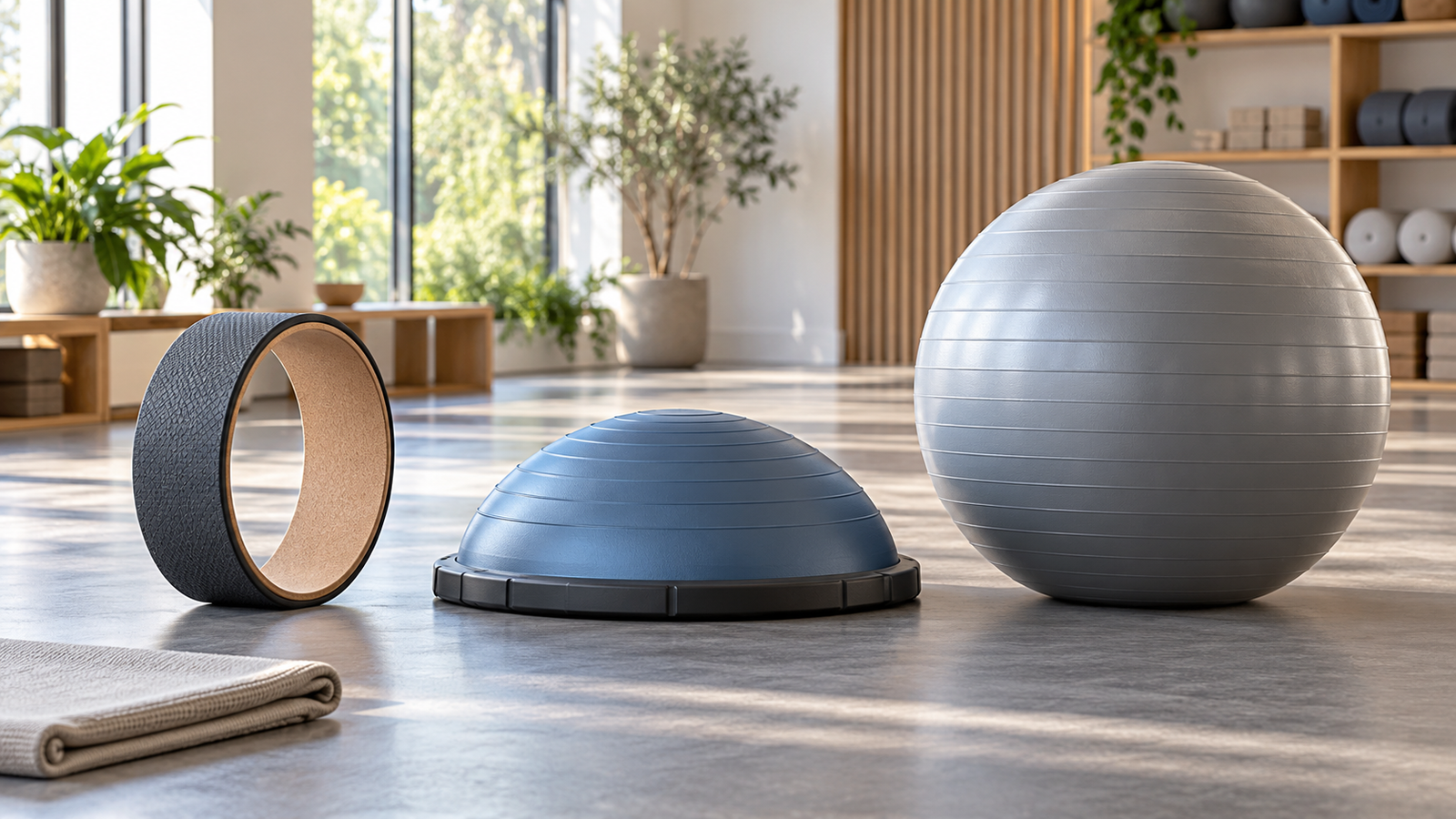
Yoga wheels, balance domes and exercise balls are all used to add variety to mobility, balance and core training, but they are designed for very different types of movement.
A yoga wheel is mainly used for supported stretching, backbends and mobility drills. A balance dome creates an unstable platform for balance and strength work. An exercise ball is a larger inflatable tool that can support core exercises, seated movement, mobility drills and some strength-training variations.
The right choice depends on what you actually want to train.
What is a yoga wheel?
A yoga wheel is a circular mobility tool, usually made from a rigid inner ring with a padded outer surface.
It is commonly used for:
- Supported backbends.
- Chest-opening stretches.
- Shoulder mobility.
- Thoracic spine mobility.
- Balance drills.
- Some yoga poses.
The wheel is designed to support the body while allowing movement around its curved surface.
It is not primarily a strength machine.
What is a balance dome?
A balance dome is a half-sphere inflatable trainer attached to a rigid flat base.
It creates an unstable surface.
You may also see it described as a:
- Half balance ball.
- Balance trainer.
- Stability dome.
It is commonly used for:
- Balance training.
- Single-leg stability work.
- Squats.
- Lunges.
- Push-up variations.
- Core exercises.
- Rehabilitation-style exercises.
The instability forces the body to make constant small adjustments.
What is an exercise ball?
An exercise ball is a large inflatable ball used for fitness, mobility and seated exercises.
It is also commonly called a:
- Stability ball.
- Swiss ball.
- Gym ball.
- Fitness ball.
Exercise balls are used for:
- Core training.
- Hamstring curls.
- Bridges.
- Wall squats.
- Mobility.
- Seated balance.
- Some stretching exercises.
Because of its size, an exercise ball creates a very different training experience from a yoga wheel or balance dome.
Yoga wheel vs balance dome vs exercise ball at a glance
| Factor | Yoga wheel | Balance dome | Exercise ball |
|---|---|---|---|
| Main purpose | Mobility and supported stretching | Balance and instability training | Core, mobility and general fitness |
| Shape | Rigid circular wheel | Half inflatable dome | Full inflatable ball |
| Stability | Moderate | Intentionally unstable | Unstable |
| Best for beginners | Yes, with controlled use | Yes, with easier exercises | Yes, with appropriate sizing |
| Portability | Good | Moderate | Lower |
| Space needed | Low | Moderate | High |
| Common use | Backbends and mobility | Balance, squats, lunges | Core, bridges, seated work |
| Inflation required | Usually no | Yes | Yes |
What does a yoga wheel actually do?
A yoga wheel acts as a curved support.
It can help you explore positions that may otherwise feel difficult to hold.
For example, when used behind the upper back, the wheel can support a gradual backbend.
This can make it easier to focus on:
- Chest opening.
- Shoulder position.
- Upper-back mobility.
- Controlled spinal extension.
The wheel should not be used to force range of motion.
Yoga wheel for backbends
Backbends are one of the most common uses.
A simple supported version involves:
- Sitting in front of the wheel.
- Positioning it behind the upper back.
- Leaning back slowly.
- Allowing the wheel to support the movement.
- Keeping the motion controlled.
Do not roll rapidly or force the lower back into an extreme arch.
The movement should feel supported, not painful.
Yoga wheel for thoracic mobility
The thoracic spine is the upper and mid-back region.
Some users place the wheel behind the upper back and gently roll over it to encourage extension.
This may feel useful if your routine involves:
- Long periods of sitting.
- Desk work.
- Forward-leaning posture.
However, mobility tools should not be treated as a cure for back pain or postural problems.
Yoga wheel for shoulder mobility
The wheel can also be used as a support during stretches involving the shoulders and chest.
The main advantage is the curved shape, which allows gradual movement.
If you already have shoulder pain or instability, avoid forcing overhead positions.
Yoga wheel size
Yoga wheels are available in different diameters and widths.
Common differences include:
- Smaller travel-style wheels.
- Standard wheels.
- Wider or thicker padded models.
A larger wheel may create a gentler curve.
A smaller wheel may create a deeper bend.
Beginners often find a standard or slightly larger wheel easier to control.
Yoga wheel padding
Padding affects comfort.
A thicker outer layer can reduce pressure on:
- Spine.
- Hands.
- Feet.
Look for padding that is:
- Firm enough to stay stable.
- Soft enough for comfort.
- Non-slip.
Very soft foam can compress and make the wheel less stable.
Yoga wheel weight capacity
Manufacturers often publish a maximum load.
Check this before buying.
But remember that the capacity assumes:
- Correct use.
- An undamaged product.
- Proper body positioning.
- A flat surface.
Do not use a cracked or deformed wheel.
What does a balance dome do?
A balance dome creates controlled instability.
Because the surface moves slightly under you, your muscles have to make constant small corrections.
This can challenge:
- Ankles.
- Knees.
- Hips.
- Core.
- Postural control.
The goal is not to wobble as much as possible.
The goal is to maintain control despite the unstable surface.
Dome side up vs platform side up
Many balance domes can be used in two orientations.
Dome side up
The inflatable surface faces upward.
This is commonly used for:
- Standing balance.
- Squats.
- Lunges.
- Step-ups.
Platform side up
The flat base faces upward.
This can create a more unstable setup.
Exercises may include:
- Push-ups.
- Planks.
- Advanced balance work.
Check whether the manufacturer actually approves both orientations.
Balance dome for beginners
Beginners should start with simple exercises.
Examples include:
- Two-foot standing balance.
- Supported mini squats.
- Gentle weight shifts.
- Step-on and step-off drills.
Stand near a stable support if necessary.
Do not begin with advanced single-leg exercises if you cannot comfortably balance on the floor.
Balance dome for squats
Squatting on a dome increases instability.
This usually reduces the amount of external load you can safely use.
For general strength development, a stable floor is often better for heavy squats.
A balance dome is more useful for:
- Coordination.
- Stability.
- Low-load balance challenges.
Do not assume unstable training is automatically superior to stable strength training.
Balance dome for rehabilitation
Balance domes are sometimes used in rehabilitation settings.
But rehabilitation exercises should be matched to the injury.
Do not self-prescribe unstable exercises after:
- Ankle injury.
- Knee surgery.
- Ligament injury.
- Significant balance problems.
Professional guidance may be appropriate.
What does an exercise ball do?
An exercise ball provides a large movable surface.
Because it rolls in multiple directions, your body needs to control its position.
This makes it useful for:
- Core stability.
- Lower-body exercises.
- Mobility.
- Seated balance.
Unlike a balance dome, an exercise ball is not fixed to a rigid base.
That makes it more mobile and potentially more challenging in some exercises.
Exercise ball for core training
Common core exercises include:
- Ball crunches.
- Stir-the-pot variations.
- Planks with forearms on the ball.
- Feet-on-ball planks.
- Rollouts.
- Dead-bug-style ball presses.
The ball can increase instability, but technique still matters.
Exercise ball bridges
A common lower-body exercise is the ball bridge.
You place the heels on the ball, lift the hips and maintain control.
This can challenge:
- Glutes.
- Hamstrings.
- Core.
A harder variation adds hamstring curls by bending the knees while keeping the hips elevated.
Wall squats with an exercise ball
The ball can be positioned between the back and a wall.
As you squat, it rolls with you.
This can make the movement feel guided.
However, it is not automatically safer than a normal squat.
Use a comfortable range and maintain foot control.
Exercise ball for sitting
Some people use exercise balls as chairs.
Short periods of active sitting may feel engaging, but replacing a supportive office chair for the entire workday is not necessarily more ergonomic.
Long-duration comfort and posture still matter.
Use the ball as an exercise tool rather than assuming it is a superior full-time office chair.
How to choose the right exercise ball size
Ball size matters more than many buyers realise.
Common sizes include:
- 55 cm.
- 65 cm.
- 75 cm.
The right size depends mainly on your height and the exercises you plan to perform.
When sitting on the ball, your hips and knees should generally feel comfortably positioned rather than excessively compressed or elevated.
Manufacturer size charts should be your main guide.
Under-inflated vs over-inflated exercise ball
Inflation changes the feel.
Under-inflated
A softer ball:
- Feels more stable.
- Compresses more.
- Can be easier for beginners.
More fully inflated
A firmer ball:
- Rolls more easily.
- Creates more instability.
- Feels more responsive.
Do not exceed the manufacturer’s recommended inflation.
Anti-burst exercise balls
Some exercise balls are marketed as anti-burst.
This usually means the material is designed to deflate more slowly if punctured rather than suddenly exploding.
It does not mean the ball cannot fail.
Check:
- Maximum user weight.
- Surface condition.
- Inflation level.
- Product age.
Replace a ball that develops damage.
Which tool is best for flexibility?
The yoga wheel is usually the most directly focused on mobility and supported stretching.
It can be useful for:
- Back extension.
- Chest opening.
- Shoulder mobility.
An exercise ball can also support stretching, but its larger size makes it less targeted.
A balance dome is mainly a balance and stability tool.
Which tool is best for balance?
The balance dome is the most purpose-specific choice for balance training.
It lets you practise:
- Double-leg balance.
- Single-leg balance.
- Dynamic weight shifts.
- Controlled unstable squats.
The exercise ball can also challenge balance, but it is usually less practical for standing work.
Which tool is best for core training?
The exercise ball offers the widest range of core exercises.
You can use it for:
- Planks.
- Crunches.
- Rollouts.
- Bridges.
- Hamstring curls.
The balance dome also supports many core exercises.
The yoga wheel can challenge the core during certain poses, but that is not its primary role.
Which tool takes up the least space?
A yoga wheel is usually the easiest to store.
A balance dome is larger but relatively compact.
An exercise ball requires the most room unless you deflate it.
If your workout space is small, storage should be part of the buying decision.
Portability
Yoga wheel
Easy to move and store.
Balance dome
Moderately portable but bulkier.
Exercise ball
Bulky when inflated.
If you plan to travel with your equipment, the yoga wheel is the simplest.
Floor requirements
Use all three tools on a stable, clean surface.
Avoid:
- Wet floors.
- Sharp objects.
- Loose rugs.
- Uneven flooring.
Inflatable equipment should be kept away from sharp edges and heat sources.
Footwear or barefoot?
This depends on the exercise.
For yoga wheel stretching, barefoot use is common.
For balance dome training, footwear may provide more grip during some fitness exercises.
For exercise ball training, either can work.
The important factor is secure contact with the floor and equipment.
Is instability training better than normal exercise?
Not automatically.
Unstable tools can increase balance demand, but they often reduce the amount of force or weight you can use.
For example, heavy strength exercises are usually better performed on stable ground.
Instability tools are useful for:
- Balance.
- Coordination.
- Variety.
- Low-load control.
They should complement, not automatically replace, stable strength training.
Can these tools improve posture?
They can help train mobility, core control and body awareness.
But they should not be presented as guaranteed posture-correction devices.
Posture varies naturally and is influenced by:
- Habit.
- Movement.
- Strength.
- Mobility.
- Work environment.
- Comfort.
If you have persistent pain, do not rely on a mobility tool as the only solution.
Can a yoga wheel help back pain?
Some people enjoy the stretching sensation from a yoga wheel.
However, back pain has many possible causes.
Do not use aggressive spinal extension if you have:
- Acute pain.
- Numbness.
- Weakness.
- Recent injury.
- Diagnosed spinal conditions.
Seek appropriate medical guidance if symptoms are significant.
Can an exercise ball replace a bench?
For some light exercises, an exercise ball can act as a support.
But it does not provide the same stability as a weight bench.
For heavy dumbbell or barbell work, a proper bench is usually the more suitable choice.
Avoid using an exercise ball for loads beyond what you can control safely.
Can a balance dome replace a step platform?
Not really.
A step platform provides a stable elevated surface.
A balance dome intentionally creates instability.
They serve different purposes.
If your goal is cardio stepping, a stable step platform is generally more appropriate.
Common yoga wheel mistakes
Forcing backbends
The wheel should support movement, not push you beyond your comfortable range.
Rolling too quickly
Move slowly.
Using the wrong size
An overly small wheel can create a deeper curve than you expect.
Ignoring surface grip
The wheel should not slide during use.
Treating discomfort as progress
Sharp pain is not a sign of effective stretching.
Common balance dome mistakes
Starting with advanced single-leg drills
Master basic balance first.
Using heavy weights on an unstable surface
Instability reduces strength output and can increase fall risk.
Standing too close to the edge
Keep your weight centred until you understand how the dome responds.
Using a damaged dome
Stop if the base cracks or the inflatable section loses integrity.
Common exercise ball mistakes
Choosing the wrong size
Ball diameter affects exercise position.
Over-inflating
Follow manufacturer guidance.
Using it near sharp furniture
Keep a clear training area.
Performing advanced exercises too soon
Start with simple movements.
Assuming anti-burst means indestructible
Inspect the ball regularly.
How to compare yoga wheels before buying
Look at:
- Diameter.
- Width.
- Padding thickness.
- Outer grip texture.
- Inner frame material.
- Maximum supported load.
- Product weight.
A rigid, well-padded wheel usually feels more predictable.
How to compare balance domes
Look at:
- Dome diameter.
- Platform width.
- Surface texture.
- Inflation system.
- Base grip.
- Included handles or resistance bands.
- Weight limit.
Accessories are useful only if they fit your training goals.
How to compare exercise balls
Look at:
- Ball diameter.
- User-height guidance.
- Maximum load.
- Anti-burst claim.
- Surface texture.
- Inflation pump.
- Material thickness.
Do not buy purely on colour or the largest diameter.
Which tool is best for beginners?
This depends on your goal.
Choose a yoga wheel if:
- Your main focus is mobility.
- You want supported stretches.
- You have limited storage space.
Choose a balance dome if:
- You want balance and coordination work.
- You enjoy standing instability exercises.
- You have enough floor space.
Choose an exercise ball if:
- You want the widest range of core exercises.
- You have space to keep it inflated.
- You want a versatile general fitness tool.
Frequently asked questions
Is a yoga wheel better than an exercise ball for stretching?
For supported backbends and targeted upper-back mobility, a yoga wheel is usually more convenient.
An exercise ball supports broader, gentler stretching.
Is a balance dome the same as an exercise ball?
No.
A balance dome is a half-sphere attached to a rigid base.
An exercise ball is a complete inflatable sphere.
Which is better for abs?
An exercise ball generally supports more core exercise variations.
A balance dome also works well for unstable planks and similar movements.
Can beginners use a balance dome?
Yes, but start with two-foot balance and supported movements.
Can I use a yoga wheel every day?
Gentle mobility work can be frequent if it feels comfortable.
Avoid repeatedly forcing deep ranges.
Does sitting on an exercise ball strengthen the core?
Sitting on an unstable surface requires some postural control, but it should not replace purposeful core training.
Can an exercise ball burst?
Any inflatable ball can fail if damaged or overloaded.
Anti-burst designs are intended to reduce sudden failure, not eliminate the risk.
Which tool is easiest to store?
A yoga wheel.
Choosing the right mobility and balance tool
Start with your main goal.
If you want supported stretching and backbend work, a yoga wheel is the most specialised option.
If you want balance and instability training, choose a balance dome.
If you want versatile core, mobility and general fitness exercises, an exercise ball offers the broadest range of uses.
You do not need all three unless your training includes all three types of movement.
Choose one tool that solves a clear need in your routine rather than buying several overlapping accessories.
Physical Glow’s Top 5 Yoga Wheels and Balance Props for Home Mobility comparison looks at different wheel, dome and exercise-ball formats. Use that comparison alongside this guide, then verify the current dimensions, weight capacity, materials and inflation requirements for the exact product you intend to buy.