Dumbbell Buying Guide: Fixed vs Adjustable Dumbbells for Home Training
A practical dumbbell buying guide comparing fixed and adjustable designs, weight range, grip, shape, storage and progression for home strength training.
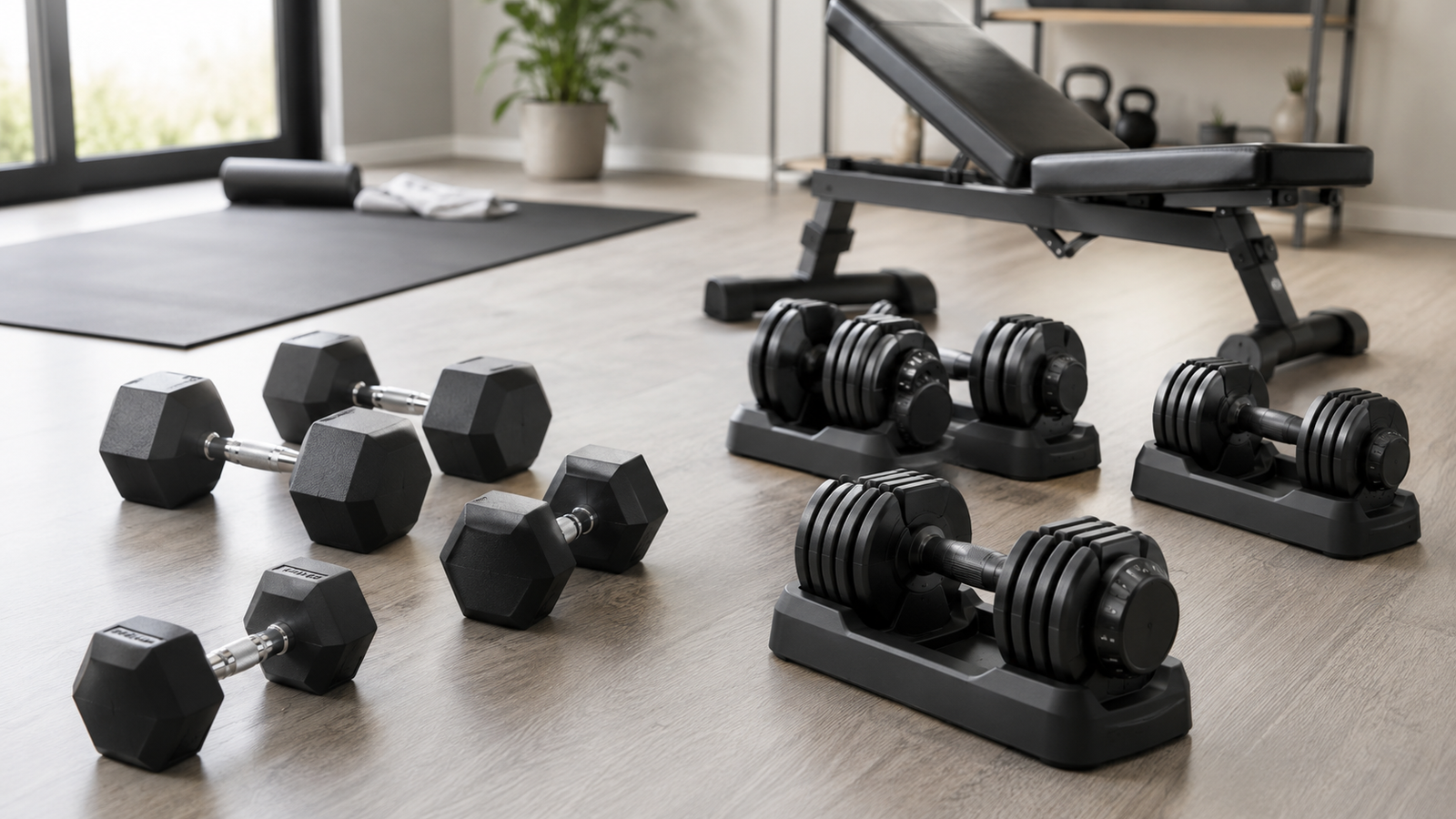
Dumbbells are among the most useful pieces of strength-training equipment you can own.
With a pair of dumbbells, you can train:
- chest;
- shoulders;
- back;
- arms;
- legs;
- glutes;
- core.
They can also fit into training plans ranging from:
- beginner home workouts;
- general fitness;
- muscle building;
- strength training;
- circuit training.
But choosing dumbbells becomes more complicated once you start comparing:
- fixed dumbbells;
- adjustable dumbbells;
- hex shapes;
- round heads;
- rubber coating;
- neoprene coating;
- selector systems;
- spin-lock designs;
- weight ranges;
- handle sizes;
- storage requirements.
The best choice is not simply the heaviest dumbbell you can afford.
The more useful question is:
“Which dumbbell setup gives me enough weight range to progress while fitting my space, exercises and budget?”
For most buyers, the priorities are:
training goals → weight range → fixed vs adjustable → grip → shape → durability → adjustment speed → storage → value.
This guide explains each factor so you can choose dumbbells that remain useful as your strength improves.
Start With Your Training Goal
Before choosing a dumbbell type, identify how you intend to use it.
General Fitness
If your goal is:
- basic strength;
- home workouts;
- maintaining activity;
you may not need a very large weight range.
A few moderate weights may be enough.
Muscle Building
Muscle-building programs usually require more progression.
You may eventually need different loads for:
- shoulder raises;
- curls;
- rows;
- presses;
- squats;
- Romanian deadlifts.
A broader weight range becomes much more useful.
Strength Training
Strength-focused users may require substantially heavier dumbbells.
In this case, consider:
- maximum available weight;
- handle strength;
- adjustment mechanism;
- durability.
Circuit Training
If you frequently move quickly between exercises, adjustment speed matters.
Fixed dumbbells can be particularly convenient because there is no need to change weight between movements.
Small-Space Home Gym
If storage space is limited, adjustable dumbbells can replace several pairs of fixed weights.
This is one of their strongest advantages.
Fixed vs Adjustable Dumbbells
This is the most important decision.
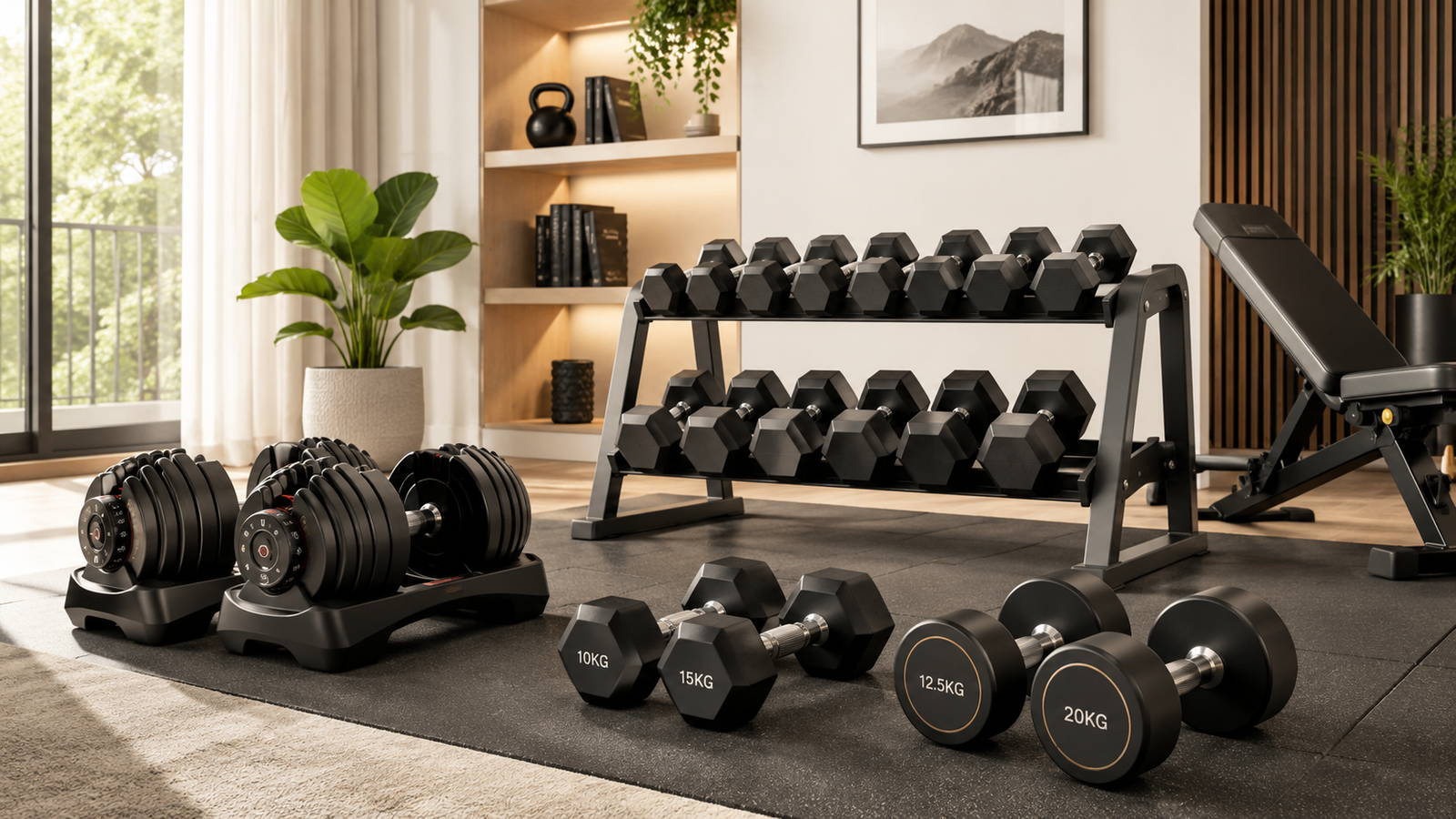
Fixed Dumbbells
A fixed dumbbell has one permanent weight.
Examples include:
- 2 kg;
- 5 kg;
- 10 kg;
- 15 kg.
To change resistance, you pick up another dumbbell.
Adjustable Dumbbells
An adjustable dumbbell allows you to change the resistance of one unit.
Different systems may use:
- removable plates;
- spin-lock collars;
- selector dials;
- sliding pins;
- mechanical selectors.
One adjustable dumbbell can potentially replace many fixed dumbbells.
Fixed Dumbbells: Advantages
Fixed dumbbells offer several practical benefits.
Immediate Weight Changes
If you want to move from:
5 kg curls
to:
10 kg rows
you simply pick up another pair.
There is no adjustment process.
This is useful for:
- supersets;
- circuits;
- drop sets;
- fast-paced workouts.
Simple Construction
There are few moving parts.
That generally means:
- less mechanical complexity;
- fewer adjustment mechanisms to fail.
Familiar Shape
Traditional fixed dumbbells usually feel balanced and predictable.
Easy to Share
In a household gym, multiple people can use different weights simultaneously.
Fixed Dumbbells: Limitations
The main disadvantages are:
- cost;
- storage;
- number of dumbbells required.
If you want:
2 kg
5 kg
7.5 kg
10 kg
12.5 kg
15 kg
you may quickly accumulate many pairs.
That requires:
- floor space;
- rack space;
- greater total spending.
Adjustable Dumbbells: Advantages
Adjustable dumbbells are designed to solve the space problem.
Large Weight Range in a Small Footprint
One pair may replace:
- five;
- ten;
- or more;
fixed pairs.
This can be extremely useful in:
- apartments;
- bedrooms;
- small home gyms.
Easier Progressive Overload
You can gradually increase resistance without buying another pair each time.
Potentially Better Long-Term Value
Although adjustable dumbbells may cost more initially, they can be cheaper than purchasing an equivalent collection of fixed dumbbells.
Adjustable Dumbbells: Limitations
They are not perfect.
Potential disadvantages include:
- slower weight changes;
- bulkier heads;
- moving parts;
- higher replacement cost if a mechanism fails.
Some adjustable models also become physically longer even at lighter settings.
That can affect exercises such as:
- curls;
- presses;
- lateral raises.
Which Is Better for a Home Gym?
For many home users:
adjustable dumbbells provide the strongest space efficiency.
But fixed dumbbells may still be better if you:
- have adequate storage;
- train frequently;
- perform fast circuits;
- prefer simple equipment.
A mixed setup can also work.
For example:
- one adjustable pair for heavier lifting;
- a few light fixed dumbbells for warm-ups and smaller exercises.
Different Adjustable Dumbbell Systems
Not all adjustable dumbbells work the same way.
The three major formats are:
- Plate-loaded spin-lock dumbbells
- Selectorized dumbbells
- Modular locking systems
1. Spin-Lock Dumbbells
These use:
- a metal handle;
- removable plates;
- threaded collars.
To change weight:
- unscrew the collar;
- add or remove plates;
- tighten the collar again.
Advantages
They are usually:
- affordable;
- simple;
- durable;
- capable of relatively heavy loading.
Disadvantages
Weight changes can be slow.
This is less convenient for:
- circuits;
- drop sets.
The protruding handle ends may also feel uncomfortable during some exercises.
2. Selectorized Adjustable Dumbbells
These use a:
- dial;
- pin;
- slider;
to select weight while the dumbbell sits in a base.
When lifted, only the selected plates remain attached.
Advantages
Weight changes can take only a few seconds.
This is convenient for:
- traditional strength workouts;
- changing loads between exercises.
Disadvantages
They usually contain more:
- plastic;
- mechanical parts.
They may also require more careful handling.
Dropping them can damage the selector mechanism.
3. Modular Locking Systems
Some adjustable dumbbells use:
- detachable plates;
- quick-lock mechanisms.
They may offer a balance between:
- durability;
- faster adjustment.
The details vary considerably between manufacturers.
Weight Range Is Critical
The dumbbell must be:
light enough for smaller exercises
and:
heavy enough for larger movements.
A dumbbell that only reaches 5 kg may quickly become limiting for:
- squats;
- rows;
- Romanian deadlifts.
A dumbbell that starts at 10 kg may be too heavy for:
- lateral raises;
- rehabilitation-style work;
- beginners.
Different Exercises Need Different Weights
You should not expect one resistance level to work for every exercise.
For example, someone may use:
Lateral raise
5 kg
Biceps curl
8 kg
Shoulder press
12 kg
Row
20 kg
Goblet squat
24 kg
The exact numbers vary enormously between individuals, but the principle matters.
Your lower body and back can usually handle more resistance than smaller shoulder muscles.
Choosing a Starting Weight
There is no universal beginner weight.
The appropriate load depends on:
- exercise;
- training experience;
- body size;
- strength;
- technique.
Instead of asking:
“What dumbbell weight should a beginner buy?”
ask:
“What range will let me perform several exercises now while still giving me room to progress?”
Why a Weight Range Matters More Than One Weight
Suppose you buy only:
5 kg dumbbells.
They may work well initially for:
- curls;
- shoulder exercises.
But soon they may feel too light for:
- rows;
- squats.
A broader range gives the equipment a longer useful life.
Adjustable Dumbbell Maximum Weight
Pay particular attention to the maximum.
Common adjustable models may reach:
- 10 kg;
- 15 kg;
- 20 kg;
- 24 kg;
- 32 kg;
- 40 kg or more per dumbbell.
For general home fitness, moderate ranges may be sufficient.
For serious strength training, higher maximum weight becomes important.
Weight Increments
The difference between settings matters.
An adjustable dumbbell might progress in:
- 1 kg;
- 2 kg;
- 2.5 kg;
- 5 kg;
steps.
Smaller increments allow smoother progression.
This can be especially useful for:
- shoulder exercises;
- arm exercises.
Moving directly from:
5 kg to 10 kg
may be too large a jump for some movements.
Micro-Progression
Strength does not always improve in large steps.
Smaller increments help you progress gradually.
For example:
8 kg
9 kg
10 kg
may be more useful than:
5 kg
10 kg
15 kg
for certain exercises.
Pair vs Single Dumbbell
Always check whether the listing includes:
- one dumbbell;
- a pair.
This is especially important with adjustable dumbbells.
Some expensive listings show two dumbbells in marketing photographs but sell:
one unit only.
Read the package contents carefully.
When One Dumbbell Is Enough
A single dumbbell can still be useful for exercises such as:
- goblet squats;
- one-arm rows;
- single-arm presses;
- suitcase carries.
But for many traditional exercises, a pair is more convenient.
Dumbbell Shape
Fixed dumbbells commonly have:
- hexagonal heads;
- round heads.
Shape affects:
- stability;
- storage;
- exercise use.
Hex Dumbbells
Hexagonal dumbbell heads have flat sides.
Advantages
They do not roll easily.
This is useful on:
- home floors;
- racks.
They are also convenient for exercises such as:
- renegade rows;
- dumbbell push-ups.
The flat surface creates better stability.
Round Dumbbells
Round dumbbells are common in:
- commercial gyms;
- traditional iron sets.
They can be perfectly effective for lifting.
However, they may roll if placed on an uneven floor.
Adjustable Dumbbell Shape
Adjustable dumbbells often have:
- rectangular;
- rounded;
- elongated;
heads.
The shape can affect comfort.
Some systems feel much larger than conventional fixed dumbbells.
Dumbbell Length
Length matters more than many buyers realize.
Some adjustable dumbbells remain the same full length regardless of selected weight.
For example, even at:
5 kg
the dumbbell may have the physical dimensions of its:
24 kg
setting.
That can make certain exercises feel awkward.
Exercises Affected by Long Dumbbells
Large adjustable dumbbells may interfere during:
- curls;
- overhead presses;
- chest presses;
- close-grip movements.
If compact handling matters to you, compare actual dimensions.
Handle Diameter
Handle thickness affects comfort.
A very thick handle may be:
- challenging;
- beneficial for grip training;
but uncomfortable for smaller hands.
A very thin handle may feel less secure under heavier loads.
Knurling
Metal handles often include textured grooves called:
knurling.
This improves grip.
Knurling can range from:
- mild;
- moderate;
- aggressive.
For home training, moderate texture usually provides sufficient grip without feeling excessively rough.
Rubber or Neoprene Handles
Some lighter dumbbells use:
- neoprene;
- vinyl;
- rubber;
coatings.
These may feel comfortable but provide a different grip experience than metal.
Neoprene Dumbbells
Neoprene-coated dumbbells are popular for lighter weights.
They are often used for:
- beginner workouts;
- aerobics;
- light resistance exercises.
Advantages
They can provide:
- comfortable grip;
- floor protection;
- easy colour coding.
Limitation
They are generally not used for very heavy dumbbells.
Rubber-Coated Hex Dumbbells
Rubber-coated dumbbells are common in home and commercial gyms.
The rubber protects:
- the dumbbell;
- floor surfaces;
to some extent.
It can also reduce noise.
Rubber Smell
New rubber dumbbells sometimes have a noticeable odour.
This may decrease after:
- airing;
- time.
If you train in a small enclosed room, this may matter.
Urethane Dumbbells
Premium dumbbells may use urethane instead of rubber.
They can offer:
- durability;
- lower odour;
- resistance to wear.
But they are typically more expensive.
For a normal home gym, urethane is not essential.
Cast-Iron Dumbbells
Traditional iron dumbbells can be:
- durable;
- compact.
However, uncoated iron can:
- chip;
- rust;
- damage floors more easily.
Floor Protection
Even rubber-coated dumbbells can damage:
- tile;
- wood;
- laminate;
if dropped.
Consider using:
- rubber gym flooring;
- equipment mats.
A yoga mat is generally not ideal protection for heavy dumbbells because the dumbbell can compress or tear it.
Do Not Drop Adjustable Dumbbells
Many selectorized adjustable dumbbells are not designed to be dropped.
Their internal mechanisms can become damaged.
Lower them under control.
This is especially important after:
- heavy presses;
- rows.
Maximum Drop Tolerance
Some products specify limited drop resistance.
Treat this as:
emergency durability
rather than permission to throw the dumbbells after every set.
Adjustment Speed
If you choose adjustable dumbbells, consider how long it takes to change weight.
Selector Dial
Often very fast.
Pin System
Usually fast.
Spin Lock
Slower.
Plate Loading
Varies.
Adjustment Speed and Workout Style
Fast adjustment matters more if you do:
- circuits;
- supersets;
- drop sets.
For traditional strength training with:
1–3 minutes rest
between sets, a slower adjustment system may not be a major problem.
Can You Adjust Both Dumbbells at Once?
With fixed dumbbells, no adjustment is needed.
With selectorized dumbbells, you typically adjust each dumbbell separately.
This adds a small amount of time.
For most home workouts, that is manageable.
Adjustment Mechanism Reliability
Before buying a selectorized dumbbell, inspect how the locking system works.
You want plates to remain securely attached during:
- curls;
- presses;
- rows.
A loose plate system is unacceptable.
Audible or Visual Lock Confirmation
Some systems provide:
- clicks;
- indicator windows;
- visible selectors.
These can help confirm that the chosen weight is locked.
Always make sure the adjustment is fully engaged before lifting.
Base Tray
Selectorized dumbbells usually sit inside a tray or cradle.
The tray:
- aligns plates;
- supports weight selection.
Do not throw it away.
Without the base, adjustment may not work correctly.
Storage Requirements
Fixed dumbbells require more space as your collection expands.
Adjustable dumbbells require much less.
Dumbbell Rack
A rack can help organize fixed dumbbells.
Advantages:
- easier access;
- reduced floor clutter.
But a rack adds:
- cost;
- footprint.
Adjustable Dumbbell Stand
Some adjustable systems offer optional stands.
A stand raises the dumbbells to around:
- knee;
- waist;
height.
This can make adjustment more comfortable.
But it is optional.
Storing Dumbbells on the Floor
This works if you have:
- adequate space;
- durable flooring.
Avoid placing them where someone may:
- trip;
- stub a foot.
Home Gym Space
Measure your available area before buying.
Consider:
- dumbbells;
- bench;
- exercise area;
- storage.
A compact adjustable pair can be particularly useful when the room serves multiple purposes.
Dumbbells and Benches
A bench expands the exercises you can perform.
Examples include:
- chest press;
- incline press;
- supported rows;
- seated shoulder press.
But you do not need a bench immediately.
Many effective dumbbell exercises can be done:
- standing;
- on the floor.
Dumbbells for Full-Body Training
A well-chosen dumbbell range can cover major movement patterns.
Squat
- goblet squat;
- dumbbell front squat.
Hinge
- Romanian deadlift;
- dumbbell deadlift.
Push
- chest press;
- overhead press.
Pull
- rows.
Carry
- farmer carry;
- suitcase carry.
This makes dumbbells particularly efficient for home gyms.
Fixed Dumbbells for Circuit Training
Fixed dumbbells work very well if your workouts include:
- rapid exercise transitions.
For example:
5 kg lateral raises
10 kg curls
15 kg rows
You can switch instantly.
With adjustable dumbbells, each change requires adjustment.
Adjustable Dumbbells for Traditional Strength Training
Adjustable dumbbells are particularly suitable for:
- sets;
- rest periods;
- progressive strength work.
The adjustment time usually fits naturally between exercises.
Progressive Overload
To continue gaining strength, resistance usually needs to increase over time.
Dumbbells make this easy to understand.
For example:
Week 1:
10 kg
Later:
12 kg
Later:
14 kg
This measurable progression is one advantage dumbbells have over some elastic resistance systems.
Do Not Increase Weight Too Quickly
Progression should remain compatible with:
- control;
- technique;
- range of motion.
A heavier dumbbell is not useful if the movement becomes:
- shortened;
- uncontrolled.
Double Progression
One simple progression strategy is:
- choose a repetition range;
- increase repetitions within that range;
- increase weight once the upper end becomes manageable.
For example:
8–12 repetitions.
You might progress from:
10 kg × 8
to
10 kg × 12
before increasing weight.
This is only one training strategy, but it shows why smaller weight increments can be valuable.
Dumbbell Accuracy
Low-cost dumbbells may vary slightly from the stated weight.
For general fitness, small variation is unlikely to matter significantly.
Serious strength users may care more about:
- consistency;
- calibration.
Weight Labels
Make sure the weight is easy to identify.
Fixed dumbbells generally display:
- kg;
- lb.
Adjustable systems should make the selected load obvious.
This reduces setup mistakes.
Kilograms vs Pounds
Some imported dumbbells use pounds.
Useful approximate conversions:
1 kg ≈ 2.2 lb
10 kg ≈ 22 lb
20 kg ≈ 44 lb
Always check the unit before purchasing.
Maximum User Strength and Future Progression
Try to think beyond your first month.
A beginner may currently use:
5 kg
but may eventually need significantly more for:
- squats;
- rows;
- deadlift variations.
Buying slightly more range than you currently need can improve long-term value.
But Do Not Overbuy
The opposite mistake is buying:
40 kg adjustable dumbbells
when your actual routine consists mainly of:
- light rehabilitation;
- mobility;
- beginner circuits.
Large systems are:
- heavier;
- more expensive;
- bulkier.
Choose based on realistic training goals.
Dumbbells for Beginners
A beginner usually benefits from:
- multiple resistance options;
- manageable increments.
A small fixed set or adjustable pair can both work.
Light Dumbbells
Light dumbbells are useful for:
- shoulder raises;
- warm-ups;
- beginner exercises.
But they may quickly become too light for large compound movements.
Heavy Dumbbells
Heavier dumbbells expand options for:
- rows;
- squats;
- Romanian deadlifts;
- presses.
But heavier equipment requires:
- greater control;
- appropriate technique.
Dumbbells for Older Adults
Dumbbells can be useful for strength training across many age groups.
The appropriate resistance depends on:
- current ability;
- balance;
- mobility;
- health.
Someone with substantial balance or medical concerns may benefit from professional exercise guidance.
Dumbbells and Joint Pain
Changing dumbbell type will not necessarily solve joint pain.
Pain during lifting may relate to:
- technique;
- range of motion;
- load;
- previous injury.
If pain persists, appropriate professional assessment may be necessary.
Wrist Position
Some adjustable dumbbells have:
- bulky handles;
- unusual centre balance.
Make sure you can maintain a comfortable wrist position during:
- presses;
- curls.
Balance of the Dumbbell
Traditional fixed dumbbells usually distribute weight evenly.
Adjustable systems should also feel reasonably balanced.
If plates move or shift during use, that can be distracting or unsafe.
Noise
Fixed rubber dumbbells are generally fairly quiet when handled carefully.
Plate-loaded adjustable dumbbells may create more:
- metal contact;
- rattling.
This can matter in:
- apartments;
- early-morning workouts.
Dumbbells for Apartments
A good apartment setup prioritizes:
- controlled lifting;
- rubber coating;
- floor protection.
Do not drop weights.
Even a relatively light dumbbell can create substantial impact noise for neighbours below.
Maintenance
Dumbbells require relatively little maintenance.
For fixed dumbbells:
- wipe sweat;
- inspect rubber;
- check handles.
For adjustable systems:
- inspect selectors;
- keep plates aligned;
- clean adjustment mechanisms.
Do Not Lubricate Without Instructions
If an adjustable mechanism becomes stiff, do not automatically apply:
- oil;
- spray lubricant.
Some products require specific maintenance.
Follow manufacturer guidance.
Rust Prevention
Metal handles may develop rust if repeatedly exposed to:
- sweat;
- moisture.
Wipe them after use.
Store in a dry environment.
Cleaning Neoprene Dumbbells
Wipe them using a mild cleaning method appropriate for the coating.
Avoid harsh chemicals that could:
- degrade;
- discolor;
the surface.
Fixed Dumbbells vs Adjustable Dumbbells: Quick Comparison
| Factor | Fixed Dumbbells | Adjustable Dumbbells |
|---|---|---|
| Space efficiency | Lower | Excellent |
| Weight changes | Instant | Requires adjustment |
| Mechanical complexity | Low | Higher |
| Best for circuits | Excellent | Moderate |
| Best for small homes | Moderate | Excellent |
| Long-term range | Requires more pairs | Built into system |
| Initial cost | Lower per pair | Higher |
| Full-set cost | Can become high | Often lower |
| Durability | Usually excellent | Depends on mechanism |
| Dropping tolerance | Generally better | Often limited |
| Storage | Requires rack/floor area | Compact |
Adjustable Dumbbell vs Traditional Plate Set
Traditional plate-loaded dumbbells can be an excellent budget alternative.
Plate-Loaded
Advantages:
- inexpensive;
- simple;
- expandable.
Disadvantages:
- slow adjustments;
- loose plates require careful locking.
Selectorized
Advantages:
- rapid changes;
- compact storage.
Disadvantages:
- higher cost;
- mechanical complexity.
Choose according to how much convenience matters.
Dumbbells vs Resistance Bands
Both are useful but behave differently.
Dumbbells
Provide resistance through:
- gravity.
Advantages include:
- predictable load;
- easy progression tracking.
Resistance Bands
Provide resistance that increases as they stretch.
Advantages include:
- portability;
- low storage requirements.
Many home gyms benefit from having both rather than treating them as competitors.
Dumbbells vs Kettlebells
Kettlebells place the weight farther from the handle.
They are especially useful for:
- swings;
- ballistic exercises;
- carries.
Dumbbells are often easier for:
- pressing;
- curls;
- traditional bodybuilding movements.
Neither universally replaces the other.
Dumbbells vs Barbells
Barbells allow substantially heavier loading for many exercises.
Dumbbells provide:
- independent arm movement;
- more home-friendly storage;
- exercise variety.
For a compact home gym, dumbbells may be the more practical starting point.
How Many Dumbbells Do You Need?
For fixed dumbbells, many users eventually want:
3–6 pairs
covering different resistance levels.
For adjustable dumbbells:
one pair
may be enough.
A Practical Fixed-Dumbbell Setup
A beginner home gym might eventually include something like:
- light pair;
- medium pair;
- heavier pair.
The exact weights depend on the individual.
Do not copy someone else’s numbers blindly.
A Practical Adjustable Setup
For many people, one pair covering approximately:
light to moderately heavy resistance
can handle most home exercises.
Serious strength users may need a higher maximum.
Common Dumbbell Buying Mistakes
Buying Only One Weight
Different exercises require different loads.
Choosing the Heaviest Set You Can Afford
Maximum weight is useless if lower settings are impractical.
Ignoring Weight Increments
Large jumps can limit progression.
Not Checking Whether the Listing Is a Pair
Some adjustable dumbbells are sold individually.
Ignoring Dumbbell Dimensions
Some adjustable models are very large.
Buying a Huge Fixed Set Without Storage
Measure your space first.
Dropping Adjustable Dumbbells
Mechanical selectors can be damaged.
Ignoring Floor Protection
Rubber coating does not make floors indestructible.
Buying Based Only on Price Per Kilogram
Usability matters too.
Expecting One Dumbbell Weight to Fit Every Exercise
Your strength varies dramatically by movement.
How to Compare Two Adjustable Dumbbells
If two models have similar prices, compare them in this order.
1. Weight Range
Does it cover your current and future training needs?
2. Increments
Are the jumps manageable?
3. Adjustment Mechanism
Is it:
- fast;
- secure;
- easy to understand?
4. Dimensions
How long and bulky is the dumbbell?
5. Grip
Is the handle comfortable?
6. Durability
How much of the mechanism relies on:
- plastic;
- exposed moving parts?
7. Warranty
What happens if the selector mechanism fails?
How to Compare Two Fixed Dumbbells
Focus on:
- exact weight;
- handle grip;
- head shape;
- coating;
- dimensions;
- build quality.
For rubber hex dumbbells, inspect whether:
- handles are securely bonded to heads;
- rubber finish is consistent.
Warranty Matters More for Adjustable Dumbbells
Fixed dumbbells have little that can mechanically fail.
Adjustable dumbbells may contain:
- selectors;
- locking mechanisms;
- removable plates.
A meaningful warranty becomes more valuable.
Replacement Parts
For adjustable systems, check whether you can obtain:
- trays;
- handles;
- plates;
- selector parts.
A proprietary system with no replacement support can become expensive if one component fails.
Budget Fixed Dumbbells
Budget fixed weights can offer excellent value.
What matters most is:
- secure construction;
- accurate enough weight;
- comfortable grip.
Cosmetic finish is secondary.
Budget Adjustable Dumbbells
Affordable plate-loaded adjustable dumbbells can be very practical.
Very cheap selectorized systems deserve more caution because mechanical reliability matters.
Premium Adjustable Dumbbells
Premium systems may offer:
- faster adjustment;
- stronger materials;
- more compact dimensions;
- smaller increments;
- better warranties.
These improvements can matter to frequent users.
But occasional exercisers may not need them.
Cost Per Weight Setting
Adjustable dumbbells can look expensive until you compare them with the fixed weights they replace.
Suppose one adjustable pair replaces:
- 5 kg;
- 7.5 kg;
- 10 kg;
- 12.5 kg;
- 15 kg;
- 17.5 kg;
- 20 kg.
Buying seven fixed pairs may cost more and require significantly more storage.
But Convenience Has Value Too
Do not compare price only.
If you constantly avoid using an adjustable system because changing weights is frustrating, its theoretical savings are irrelevant.
Your equipment should fit how you actually train.
Try Before Buying When Possible
If you can test an adjustable dumbbell:
- change the weight several times;
- perform a curl;
- press it overhead;
- perform a row;
- place it back into the cradle.
Notice:
- grip;
- balance;
- dimensions;
- adjustment ease.
Buying Online
When shopping online, pay particular attention to:
- whether price is for one or two dumbbells;
- maximum weight;
- minimum weight;
- increment size;
- product dimensions;
- warranty.
Do not rely only on product photographs.
Product Photos Can Be Misleading
Wide-angle photography can make:
- adjustable dumbbells;
- storage systems;
appear more compact than they are.
Check actual measurements.
Reviews: What Is Worth Reading?
User reviews can be particularly useful for identifying:
- selector failures;
- loose plates;
- strong odour;
- coating damage;
- inaccurate package contents;
- warranty problems.
Focus on repeated patterns rather than one isolated complaint.
Safety Basics
Before every workout:
- check adjustable locks;
- inspect plates;
- make sure the floor is clear;
- use controlled movements.
Do not lift an adjustable dumbbell if a plate appears:
- partially attached;
- misaligned.
Children and Home Dumbbells
Dumbbells should be stored so children cannot easily:
- lift;
- roll;
- drop;
them.
Adjustable dumbbells may also contain:
- moving selectors;
- removable plates.
Treat them as exercise equipment, not toys.
Training Around Pets
Keep pets away from the immediate workout area.
A moving dumbbell can cause serious injury if an animal unexpectedly enters your lifting space.
A Quick Dumbbell Selection Guide
| Priority | What to prioritize |
|---|---|
| Small apartment | Adjustable dumbbells |
| Fast circuits | Fixed dumbbells |
| Beginner strength | Broad moderate weight range |
| Muscle building | Good maximum weight + small increments |
| Heavy training | High maximum load + durable construction |
| Budget setup | Plate-loaded adjustable dumbbells |
| Easy weight changes | Selectorized adjustable dumbbells |
| Minimal maintenance | Fixed dumbbells |
| Floor exercises | Hex-shaped heads |
| Light fitness | Neoprene/light fixed dumbbells |
| Long-term home gym | Adjustable pair or multiple fixed pairs |
| Shared household gym | Fixed range or two adjustable units |
Dumbbell Buying Checklist
Before purchasing, ask:
Training
- What exercises will I perform?
- How heavy do I realistically expect to train?
Weight range
- Is the minimum light enough?
- Is the maximum heavy enough?
Progression
- Are the weight increments manageable?
Quantity
- Is the listing for one dumbbell or a pair?
Type
- Fixed or adjustable?
Adjustment
- If adjustable, how fast is the system?
- Does it lock securely?
Grip
- Is the handle suitable for my hands?
Dimensions
- Will the dumbbells feel too long or bulky?
Shape
- Do I need hex heads for floor stability?
Space
- Do I have room for several fixed pairs?
Durability
- Can the dumbbells tolerate my training style?
Warranty
- Is support available if an adjustable mechanism fails?
Value
- Am I paying for usable weight range or unnecessary features?
A Simple Decision Process
If you are still unsure, use this sequence.
Step 1 — Determine Your Space
Very limited space?
Start with adjustable dumbbells.
Step 2 — Determine Your Workout Style
Fast circuits?
Fixed dumbbells become more attractive.
Traditional sets with rest periods?
Adjustable dumbbells work very well.
Step 3 — Determine Your Weight Range
Choose enough range for:
- smaller upper-body exercises;
- larger lower-body movements.
Step 4 — Check Weight Increments
Smaller jumps generally make progression easier.
Step 5 — Compare Ergonomics
Check:
- handle;
- length;
- head shape.
Step 6 — Compare Durability and Warranty
Especially for selectorized models.
Step 7 — Compare Price
Only after the equipment meets the first six requirements.
Frequently Asked Questions
Are adjustable dumbbells worth it?
They can be excellent value for home gyms because one pair can replace many fixed weights while using much less space.
Are fixed dumbbells better than adjustable dumbbells?
Not universally. Fixed dumbbells are simpler and faster to switch between, while adjustable dumbbells save space and can provide a broader weight range.
What dumbbell weight should beginners start with?
There is no universal starting weight. Different exercises require different loads, so a range of weights is more useful than one fixed number.
Should I buy one dumbbell or a pair?
A pair is more versatile, but one dumbbell can still be used for unilateral exercises, goblet squats and carries.
Are 5 kg dumbbells enough?
They may be enough for some exercises and beginners, but can become too light for larger movements as strength improves.
Are 10 kg dumbbells good for beginners?
For some movements they may be appropriate; for others they may be too heavy. Training resistance should be exercise-specific.
What is the best adjustable dumbbell weight range?
It depends on your goals. General fitness requires less maximum weight than long-term strength or muscle-building training.
Are 24 kg adjustable dumbbells enough?
For many home users they provide a substantial training range. Stronger users may eventually require more for lower-body and pulling movements.
Are hex dumbbells better?
Hex heads prevent rolling and provide stable contact with the floor, making them particularly practical for home gyms.
Are rubber dumbbells better than iron?
Rubber coating can reduce noise and provide some floor protection. Iron dumbbells can be more compact and durable but may be harsher on flooring.
Are neoprene dumbbells good?
They are practical for lighter weights, beginner exercise and aerobic-style routines.
Do adjustable dumbbells break easily?
Quality varies. Mechanical selector systems require more careful handling than traditional fixed dumbbells.
Can adjustable dumbbells be dropped?
Many should not be dropped. Check manufacturer guidance and lower them under control.
How many dumbbells do I need for a home gym?
An adjustable pair may be enough. With fixed dumbbells, several pairs are usually required to cover different exercises.
Are dumbbells enough for a full-body workout?
Yes. Dumbbells can train major movement patterns including squats, hinges, presses, rows and carries.
Can dumbbells build muscle?
Yes, when resistance, training volume, progression, nutrition and recovery are appropriate.
Can dumbbells replace a gym?
For many general strength and muscle-building goals, a well-selected dumbbell setup can provide substantial training options at home.
Are dumbbells better than resistance bands?
They provide different resistance characteristics. Dumbbells offer predictable load, while bands offer portability and variable resistance.
Should I buy dumbbells in kg or pounds?
Either works. Just make sure you understand the units and track progression consistently.
Do I need a dumbbell rack?
Not necessarily. A rack becomes useful when you own multiple fixed pairs.
Do adjustable dumbbells need a stand?
No. A stand is primarily a convenience feature.
What should I check before buying adjustable dumbbells online?
Verify:
- single vs pair;
- minimum weight;
- maximum weight;
- increments;
- dimensions;
- adjustment system;
- warranty.
The Physical Glow Takeaway
The best dumbbell setup is not simply the one with the highest maximum weight.
It is the one that gives you enough resistance range to train different movements today and enough progression to remain useful as you become stronger.
For small home gyms, adjustable dumbbells are often the most practical solution because one pair can replace many fixed weights while occupying far less space.
Fixed dumbbells remain an excellent choice when you value:
- simplicity;
- durability;
- instant weight changes;
- circuit-style workouts.
Whichever format you choose, prioritize:
useful weight range → manageable increments → comfortable grip → practical dimensions → secure construction → storage → long-term value.
Pay particular attention to the difference between:
maximum weight
and:
usable weight range.
A 24 kg adjustable dumbbell may sound impressive, but it is much more useful when it also provides appropriate lighter settings and sensible progression increments.
Likewise, a cheap fixed pair can be excellent equipment—but only if the weight remains useful for your actual exercises.
For most people building a home strength setup, the strongest purchase is therefore not the biggest collection of weights. It is a compact, dependable system that lets you perform your main exercises with good control, increase resistance gradually and continue progressing without needing to replace your entire setup every few months.