Exercise Bike Buying Guide: Air, Upright and Spin Bikes Explained
A practical exercise bike buying guide comparing air, upright and spin bikes by resistance, flywheel, riding position, adjustability, comfort and space.
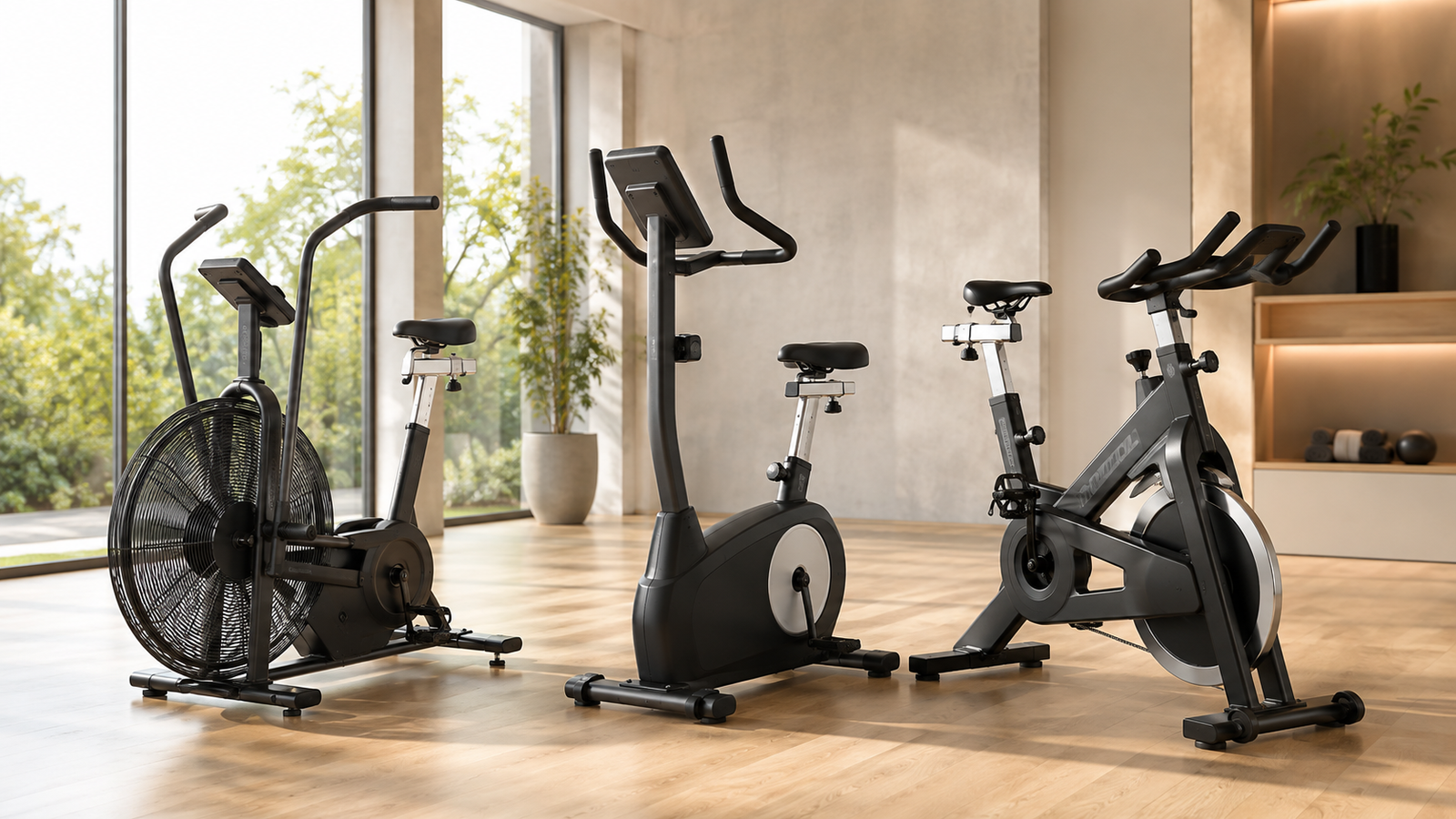
Exercise bikes are among the most practical cardio machines for home use.
They can provide:
- indoor cycling;
- low-impact cardiovascular training;
- interval workouts;
- steady-state cardio;
- warm-ups;
- general fitness;
- convenient exercise when outdoor conditions are poor.
But the category is much broader than it first appears.
A search for an “exercise bike” may show:
- upright bikes;
- air bikes;
- spin bikes;
- magnetic indoor cycles;
- belt-drive bikes;
- chain-drive bikes;
- bikes with fixed handles;
- bikes with moving handles;
- compact folding bikes;
- commercial-style indoor cycling machines.
These machines can feel completely different to use.
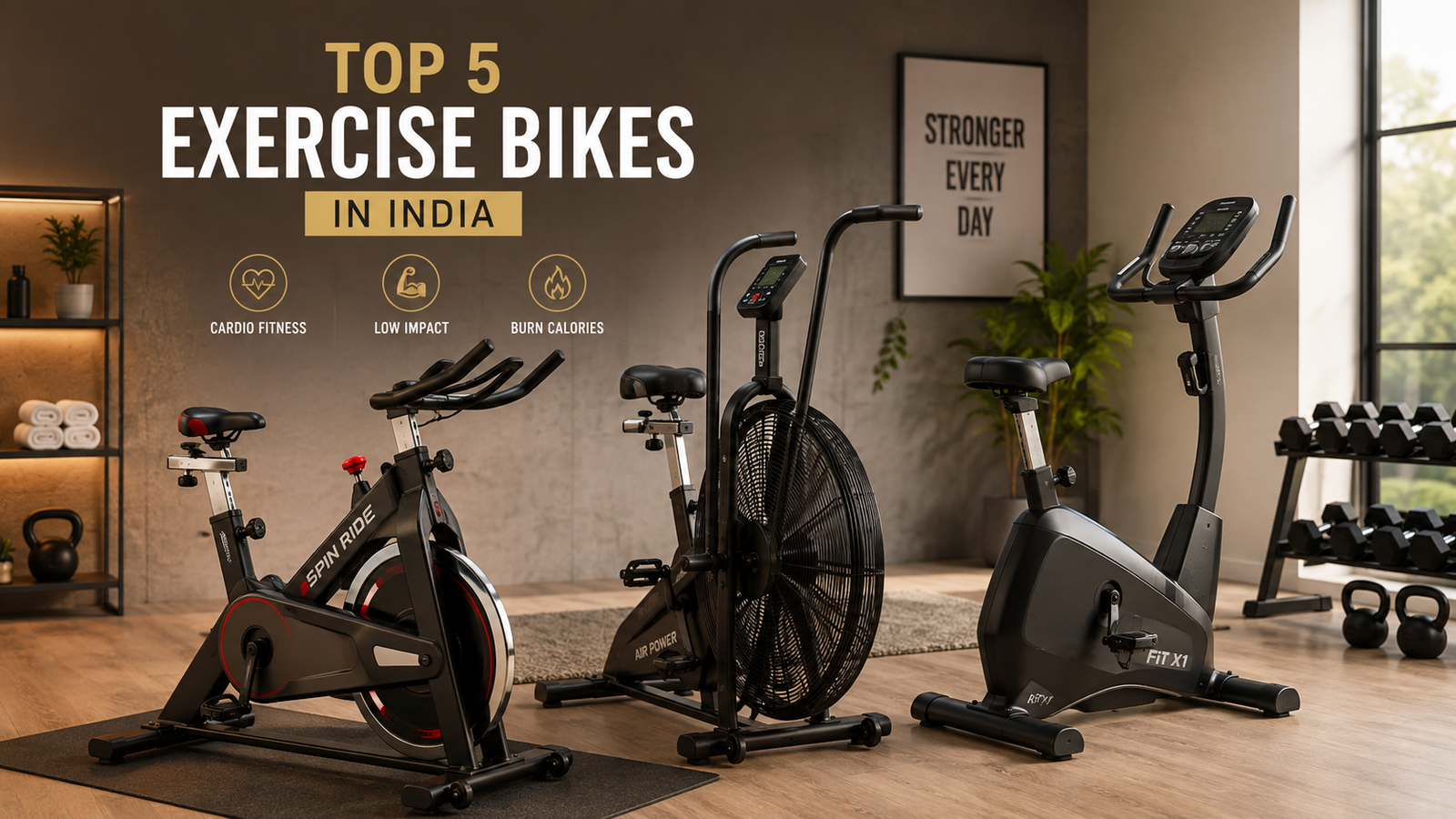
An air bike built around full-body intervals is not the same product as a quiet magnetic spin bike intended for longer cycling sessions. An upright exercise bike prioritizes a more relaxed, general-fitness position, while a performance-focused spin bike places greater emphasis on:
- flywheel feel;
- resistance;
- saddle adjustment;
- riding position.
The useful question is therefore not:
“Which exercise bike is best?”
It is:
“Which type of exercise bike matches the way I want to train, the space I have available and the level of adjustability and resistance I actually need?”
For most buyers, the important factors are:
bike type → resistance system → riding position → flywheel → adjustability → user capacity → stability → noise → size → console → maintenance → service and warranty.
This guide explains each factor so you can choose an exercise bike based on practical use rather than marketing specifications.
Start With Your Main Training Goal
Before comparing models, decide what type of exercise you expect to do most often.
General Cardio and Everyday Fitness
If your goal is primarily:
- increasing daily activity;
- moderate cardio;
- improving fitness;
- comfortable indoor cycling;
an upright exercise bike may be enough.
You may prioritize:
- easy entry;
- comfortable saddle;
- simple resistance;
- compact footprint;
- clear controls.
Indoor Cycling and Longer Workouts
If you enjoy cycling-style workouts and expect to spend:
- 30;
- 45;
- 60 minutes;
riding regularly, a spin-style bike may be more appropriate.
Important factors become:
- riding position;
- flywheel feel;
- resistance smoothness;
- seat adjustment;
- handlebar adjustment;
- pedal quality.
High-Intensity Intervals
If your primary goal is:
- short hard intervals;
- full-body conditioning;
- high-intensity workouts;
an air bike may be particularly suitable.
Air bikes use fan resistance, and many have moving handlebars that allow you to train:
- arms;
- legs;
together.
They feel significantly different from traditional indoor cycles.
Low-Impact Cardio
Cycling is generally considered lower impact than activities such as running because your feet remain supported by the pedals.
However, comfort still depends on:
- bike fit;
- saddle position;
- resistance;
- previous joint issues.
A poorly adjusted exercise bike can still create discomfort.
The Three Main Exercise Bike Types
For most home buyers, the useful comparison is between:
- Upright exercise bikes
- Spin bikes / indoor cycles
- Air bikes
1. Upright Exercise Bikes
Upright exercise bikes usually have:
- larger padded saddles;
- relatively high handlebars;
- enclosed or semi-enclosed resistance systems;
- electronic displays.
Your torso generally remains more upright than on a performance-focused spin bike.
Best suited to
- general fitness;
- moderate cardio;
- beginners;
- users who prioritize comfort;
- straightforward home workouts.
Upright Bike Advantages
They are often:
- easy to use;
- reasonably compact;
- quieter than air bikes;
- comfortable for moderate sessions.
Many also offer:
- preset resistance levels;
- workout programs;
- heart-rate sensors.
Upright Bike Limitations
They may offer less:
- aggressive resistance;
- cycling realism;
- riding-position adjustment;
than higher-quality spin bikes.
If you want intense studio-style cycling, a basic upright bike may feel limiting.
2. Spin Bikes / Indoor Cycling Bikes
Spin bikes are designed to more closely resemble the position and feel of road cycling.
Typical features include:
- heavier flywheel;
- narrow saddle;
- adjustable handlebars;
- adjustable resistance;
- forward riding position.
They are often used for:
- indoor cycling classes;
- interval sessions;
- endurance rides.
Spin Bike Advantages
They generally offer:
- strong resistance range;
- smooth pedalling;
- better standing-cycling capability;
- more performance-oriented adjustment.
A good spin bike can accommodate both:
- steady cycling;
- demanding intervals.
Spin Bike Limitations
Potential drawbacks include:
- firmer saddle;
- more aggressive riding position;
- larger footprint than compact upright models.
Beginners may need time to become comfortable with the saddle and setup.
3. Air Bikes
Air bikes use a large fan wheel.
As you pedal or move the handles, the fan pushes air.
The harder you work:
the greater the resistance becomes.
This creates a self-regulating resistance system.
Air Bike Advantages
Air bikes are excellent for:
- intervals;
- conditioning;
- full-body workouts.
Many allow you to use:
- legs only;
- arms only;
- arms and legs together.
There is no need to select a resistance level before every effort.
Work harder and resistance automatically increases.
Air Bike Limitations
Air bikes can be:
- noisy;
- physically demanding;
- less suitable for quiet apartment workouts.
They also provide a different cycling experience from traditional indoor cycling.
If you want smooth, quiet, long-duration cycling, a magnetic spin bike may suit you better.
Air Bike vs Spin Bike vs Upright Bike
| Feature | Air Bike | Spin Bike | Upright Bike |
|---|---|---|---|
| Primary use | Intervals / conditioning | Indoor cycling / endurance | General cardio |
| Resistance | Fan / effort-based | Friction or magnetic | Usually magnetic |
| Noise | Higher | Low to moderate | Usually low |
| Upper-body involvement | Often yes | No | Usually no |
| Riding position | Upright/athletic | Forward/athletic | Upright |
| Long steady rides | Possible | Excellent | Good |
| Intense intervals | Excellent | Excellent | Moderate |
| Beginner simplicity | Good | Moderate | Excellent |
| Apartment friendliness | Lower | High if magnetic | High |
Resistance System
Resistance determines how difficult pedalling feels.
Common systems include:
- magnetic resistance;
- friction resistance;
- air resistance.
Magnetic Resistance
Magnetic exercise bikes use magnets to create resistance against the flywheel without requiring direct physical contact.
Advantages
They are often:
- quiet;
- smooth;
- low maintenance.
This makes magnetic bikes particularly attractive for:
- apartments;
- shared homes;
- early-morning workouts.
Magnetic Resistance Levels
Some bikes use numbered settings such as:
1–8
or:
1–32.
A larger number of resistance levels does not automatically mean a better bike.
What matters is:
- usable resistance range;
- smooth progression.
Eight meaningful resistance levels may be more useful than 32 poorly differentiated levels.
Friction Resistance
Friction bikes use a pad that presses against the flywheel.
Turning a resistance knob increases contact and makes pedalling harder.
Advantages
- simple;
- potentially wide resistance range;
- commonly used in traditional spin bikes.
Disadvantages
The friction pad can:
- wear;
- require replacement;
- generate some noise.
Emergency Stop on Spin Bikes
Some resistance knobs also function as:
- emergency brakes.
Pressing the knob stops the flywheel more quickly.
This can be useful because a heavy flywheel can continue rotating after you stop applying force.
Air Resistance
Air bikes create resistance through a fan.
The harder you pedal:
- the faster the fan moves;
- the greater the resistance.
There are no fixed resistance limits in the same sense as many magnetic bikes.
Which Resistance System Is Best?
There is no universal winner.
Choose:
Magnetic
if you prioritize:
- quiet operation;
- smooth riding;
- low maintenance.
Friction
if you prioritize:
- traditional spin-bike feel;
- simple resistance adjustment.
Air
if you prioritize:
- intense intervals;
- self-regulating resistance;
- full-body conditioning.
Flywheel Weight
Flywheel weight is often heavily marketed on spin bikes.
You may see:
- 4 kg;
- 8 kg;
- 12 kg;
- 18 kg;
- 20 kg;
flywheels.
A heavier flywheel can contribute to a smoother feeling by maintaining more rotational momentum.
But flywheel weight alone does not determine ride quality.
Do You Need a Heavy Flywheel?
Not necessarily.
Overall ride quality depends on:
- bearings;
- drive system;
- resistance design;
- frame;
- flywheel distribution.
A well-engineered lighter flywheel can feel better than a poorly built heavy one.
Flywheel Location
Some spin bikes position the flywheel:
- front;
- rear.
This changes:
- weight distribution;
- styling;
- sweat exposure.
Rear flywheels may be less exposed to sweat dripping from the rider.
But placement alone is not a reason to choose a bike.
Drive System: Belt vs Chain
Spin bikes typically use:
- belt drive;
- chain drive.
Belt Drive
A belt connects the pedals to the flywheel.
Advantages
Usually:
- quieter;
- smoother;
- lower maintenance.
This is often the better option for home users.
Chain Drive
Chain-driven bikes operate more like traditional bicycles.
Advantages
Some riders prefer the mechanical feel.
Disadvantages
They may require more:
- maintenance;
- lubrication;
and produce more noise.
Belt Drive Is Usually More Practical at Home
For most household users, belt drive provides the better combination of:
- quiet operation;
- cleanliness;
- low maintenance.
Serious cyclists may have personal preferences, but most general buyers do not need a chain system.
Riding Position
Bike geometry has a major effect on comfort.
You should be able to maintain a position that feels:
- stable;
- controlled;
- appropriate for your mobility.
Upright Riding Position
Upright bikes place the torso more vertically.
This may feel comfortable for:
- beginners;
- casual cardio users.
Spin-Bike Position
Spin bikes generally encourage more:
- forward lean;
- hip flexion.
This can feel familiar to road cyclists.
But incorrect setup may create discomfort in:
- knees;
- lower back;
- wrists.
Adjustability Is Critical
A bike that cannot fit your body properly may remain uncomfortable regardless of price.
Pay particular attention to:
- seat height;
- seat fore/aft position;
- handlebar height;
- handlebar fore/aft position.
Seat Height
Seat height affects:
- knee angle;
- pedalling mechanics.
A simple starting point is to set the saddle so your knee retains a slight bend when the pedal is near the bottom of the stroke.
The leg should not be:
- completely locked;
- excessively bent.
Signs the Seat May Be Too Low
Possible signs include:
- excessive knee bend;
- cramped pedalling;
- discomfort at the front of the knee.
Signs the Seat May Be Too High
Possible signs include:
- hips rocking side to side;
- difficulty reaching the bottom of the pedal stroke;
- toes excessively pointing downward.
Fore/Aft Saddle Adjustment
Moving the seat:
- forward;
- backward;
helps position your knees and hips relative to the pedals.
Many basic upright bikes offer only:
vertical adjustment.
More advanced spin bikes often provide both:
- vertical;
- horizontal;
adjustment.
Handlebar Adjustment
Handlebar adjustability can improve comfort for users with different:
- heights;
- torso lengths;
- mobility.
Beginners may prefer higher handlebars.
Experienced riders may prefer a lower, more performance-oriented position.
Four-Way Adjustment
When manufacturers say:
four-way adjustable seat
they usually mean:
- up;
- down;
- forward;
- backward.
This provides significantly more fitting flexibility than height adjustment alone.
User Height Range
Some manufacturers list a recommended rider-height range.
Check this if you are:
- particularly short;
- particularly tall.
A bike designed around average proportions may not fit every user comfortably.
User Weight Capacity
Exercise bikes specify a maximum user weight.
Common capacities might include:
- 100 kg;
- 110 kg;
- 120 kg;
- 130 kg;
- 150 kg.
Leave some practical margin rather than operating exactly at the limit.
Why Weight Margin Matters
Higher user weight affects:
- frame;
- pedals;
- bearings;
- saddle support;
- stability.
If you weigh:
118 kg
a bike rated for:
120 kg
may technically meet the specification, but a higher-capacity model may provide better confidence and durability.
Stability
A bike should not:
- rock;
- shift;
- wobble;
significantly during normal riding.
Stability becomes particularly important during:
- standing climbs;
- high-intensity intervals.
Wider Base
Wide front and rear stabilizer bars can improve stability.
Many include adjustable levelling feet to compensate for uneven flooring.
Machine Weight
Heavier exercise bikes often feel more stable.
However, they are also harder to:
- move;
- store.
This trade-off matters if you frequently reposition the machine.
Transport Wheels
Front-mounted transport wheels make it easier to tilt and roll the bike.
They are useful for home spaces where the bike needs to move between workouts.
But they do not make a large spin bike truly portable.
Pedals
Pedal quality can significantly affect comfort.
Common options include:
- flat pedals;
- toe cages;
- straps;
- dual-sided pedals;
- clip-in systems.
Basic Flat Pedals
Suitable for:
- casual workouts;
- athletic shoes.
Look for:
- textured surface;
- secure straps.
Toe Cages
Toe cages help keep the foot positioned on the pedal.
This can provide greater stability during:
- faster cycling;
- standing efforts.
Adjustable Straps
A pedal strap should accommodate different shoe sizes without:
- excessive looseness;
- uncomfortable pressure.
Clip-In Pedals
Some performance bikes support cycling shoes using systems such as:
- SPD.
This can appeal to experienced cyclists.
Most general home users do not need clip-in pedals.
Dual-Sided Pedals
Some bikes provide:
- standard platform on one side;
- clip-in mechanism on the other.
This allows both:
- regular training shoes;
- cycling shoes.
Pedal Thread Compatibility
Advanced users who may replace pedals should check standard compatibility.
However, most buyers can simply use the original pedals.
Saddle Comfort
Exercise-bike saddles often receive complaints.
This is partly because cycling places body weight on a relatively small contact area.
Wide Saddles
Upright bikes commonly use:
- wider;
- softer;
seats.
These can feel comfortable during moderate riding.
Narrow Spin Saddles
Spin bikes use narrower saddles similar to bicycles.
At first, they may feel less comfortable.
But excessive padding is not necessarily better for longer cycling.
Saddle Discomfort During the First Week
New riders sometimes experience temporary sit-bone discomfort.
This may improve as the body adapts.
But persistent:
- numbness;
- significant pain;
- skin irritation;
should not simply be ignored.
Saddle Replacement
Many exercise bikes use standard-style seat mounts that allow replacement.
If saddle comfort is a major issue, verify:
- compatibility;
before buying.
Gel Seat Covers
Gel covers can add cushioning.
They may help some users, but they can also:
- shift;
- increase heat;
- change saddle shape.
Do not automatically add one before first testing the original seat.
Air Bikes and Saddles
Air bikes often have wider seats than spin bikes because the riding style is less road-cycling focused.
Seat comfort still varies considerably.
Handlebars
Handlebars affect both:
- riding position;
- workout variety.
Spin bikes may provide multiple grip positions.
Air bikes often have:
- long moving handles.
Upright bikes may have simpler fixed handlebars.
Moving Handles on Air Bikes
Moving handles allow upper-body involvement.
You can often perform:
- full-body cycling;
- arms-only intervals.
This is one reason air bikes are popular for conditioning.
Fixed Handles on Air Bikes
Some air bikes offer both:
- moving;
- stationary;
handles.
This gives you the option to focus on:
- lower-body cycling.
Exercise Bike Noise
Noise is particularly important for home use.
Magnetic Spin Bikes
These are often among the quietest.
Most sound comes from:
- drivetrain;
- rider movement.
They are usually suitable for:
- apartments;
- shared homes.
Friction Bikes
Friction pads can create:
- light rubbing noise.
The amount depends on:
- pad material;
- adjustment.
Air Bikes
Air bikes are significantly louder.
The fan produces increasing noise as effort rises.
For intense intervals, an air bike can be very noticeable.
Apartment Use
For an apartment, prioritize:
- magnetic resistance;
- belt drive;
- stable frame;
- equipment mat.
An air bike may be less neighbour-friendly, especially during hard intervals.
Equipment Mat
A dedicated fitness-equipment mat can:
- protect flooring;
- reduce movement;
- catch sweat;
- make cleaning easier.
It may reduce some vibration but will not completely soundproof the bike.
Console
Exercise-bike displays may show:
- time;
- speed;
- distance;
- calories;
- cadence;
- heart rate;
- resistance;
- watts.
Not every metric is equally important.
Time and Distance
These are useful for basic workout tracking.
Cadence / RPM
Cadence measures:
pedal revolutions per minute.
This can be particularly useful for:
- spin-bike workouts;
- structured cycling sessions.
Power / Watts
Some higher-end bikes estimate or measure:
- cycling power.
Serious cyclists may find watts valuable.
However, accuracy varies between consumer bikes.
Calories
Calorie displays are estimates.
Do not treat them as precise energy-expenditure measurements.
Use them mainly for:
- workout consistency.
Heart Rate
Heart-rate monitoring may come from:
- handle sensors;
- chest-strap compatibility;
- Bluetooth devices.
Handle sensors are convenient but generally less useful during hard cycling.
Chest-Strap Compatibility
A bike that connects to a compatible chest strap can provide more practical continuous heart-rate monitoring.
This is useful for:
- structured cardio;
- zone-based training.
It is not essential for normal exercise.
Basic LCD vs Large Screen
A simple LCD can provide all essential workout information.
Large integrated displays may add:
- guided workouts;
- entertainment;
- virtual rides.
They also increase:
- cost;
- software dependence.
Phone and Tablet Holders
A stable device holder can be more useful than an expensive built-in screen.
You can use your existing:
- phone;
- tablet;
for:
- workouts;
- entertainment;
- music.
Bluetooth
Bluetooth may support:
- heart-rate monitors;
- fitness apps;
- speakers.
Check what Bluetooth actually does on the model.
“Bluetooth enabled” may simply mean:
Bluetooth speaker.
App Compatibility
Some bikes connect with:
- training apps;
- cycling platforms.
Before paying extra, confirm:
- which apps;
- whether subscriptions are required;
- whether all features work in your country.
Do You Need App Integration?
No.
A basic exercise bike can provide excellent cardio with:
- resistance knob;
- timer.
Apps are useful only if they improve your motivation or training structure.
Resistance Knob vs Buttons
Spin bikes commonly use a physical knob.
Advantages:
- immediate adjustment;
- intuitive control.
Electronic upright bikes may use:
- buttons.
These allow precise resistance levels but depend on electronics.
Stepless Resistance
Some spin bikes describe resistance as:
stepless.
This means there are no fixed numbered steps.
You can make very small adjustments by turning the knob.
This can be convenient for indoor cycling.
Resistance Consistency
A good resistance system should increase smoothly.
Avoid bikes where the difference between settings feels:
- abrupt;
- inconsistent.
Heavy Resistance
If you enjoy:
- standing climbs;
- high-force intervals;
make sure the bike can provide enough resistance.
A bike designed only for gentle cardio may eventually feel limiting.
Standing Cycling
Not every exercise bike is intended for frequent standing riding.
Spin bikes generally handle this better.
Before standing, confirm the bike provides:
- adequate stability;
- appropriate pedal design;
- secure handlebars.
Air Bike Resistance Has No Traditional Upper Setting
One advantage of an air bike is that harder effort creates more resistance.
This makes it useful for users of different fitness levels.
A beginner and advanced athlete can use the same machine, but at very different output levels.
Full-Body vs Lower-Body Cardio
Traditional upright and spin bikes primarily train:
- lower body.
Air bikes with moving handles add significant:
- upper-body contribution.
Neither style is inherently better.
Choose based on workout preference.
Exercise Bike and Knee Comfort
Exercise bikes are often chosen by people who prefer lower-impact cardio.
But correct setup remains important.
Potential sources of knee discomfort include:
- saddle too low;
- excessive resistance;
- poor foot position;
- rapid increase in training volume.
Persistent Knee Pain
Do not assume cycling should be pain-free for everyone simply because it is lower impact.
If you experience persistent pain, appropriate professional assessment may be warranted.
Lower-Back Comfort
A very low handlebar position may increase:
- forward flexion.
Users with limited hip or spinal mobility may prefer:
- higher handlebars;
- more upright position.
Wrist Pressure
Aggressive spin-bike positions can place more load through:
- hands;
- wrists.
Avoid supporting excessive body weight on the handlebars.
Bike Fit Matters More Than Extra Cushioning
A poorly adjusted bike with a very soft seat may still be uncomfortable.
Before changing accessories, first adjust:
- saddle height;
- saddle position;
- handlebars.
Warm-Up
Begin workouts with several minutes of:
- easy resistance;
- controlled cadence.
This allows:
- muscles;
- joints;
- cardiovascular system;
to transition into harder work.
Beginner Exercise-Bike Workouts
A beginner can start simply.
For example:
- easy warm-up;
- moderate steady cycling;
- easy cooldown.
There is no need to immediately perform:
- maximum-resistance intervals.
Steady-State Training
Steady cycling means maintaining a relatively consistent effort.
This can be useful for:
- endurance;
- moderate cardio;
- longer sessions.
Spin and upright bikes are particularly suited to this.
Interval Training
Intervals alternate:
- harder effort;
- easier recovery.
Both:
- spin bikes;
- air bikes;
can work well.
Air bikes are particularly effective for short, intense efforts because resistance automatically increases with effort.
High-Intensity Air-Bike Sessions
Air-bike workouts can become extremely demanding very quickly.
Do not assume you need:
- maximal;
- all-out;
intervals simply because the machine allows them.
Build intensity gradually.
Indoor Cycling Classes
If you plan to follow online cycling classes, a spin bike is generally the closest match.
Look for:
- stable frame;
- adjustable saddle;
- adjustable handlebars;
- smooth resistance.
Cadence-Based Classes
Some classes prescribe specific:
- RPM ranges.
A console that displays cadence can therefore be useful.
If the bike does not display cadence, external sensors may sometimes provide it.
Power-Based Training
Advanced cyclists may train using:
- watts.
If power data matters to you, verify whether the bike truly measures power or merely estimates it.
Exercise Bike for Weight Loss
Cycling can contribute to:
- energy expenditure;
- cardiovascular activity.
But weight loss depends on the wider balance of:
- food intake;
- physical activity;
- individual factors.
Buying an exercise bike does not guarantee weight loss.
Exercise Bike for General Health
Regular cardio exercise can support general fitness.
The most valuable bike is often the one you can use:
- comfortably;
- consistently.
That may be more important than choosing the most intense machine.
Home Bike vs Outdoor Cycling
Both offer benefits.
Indoor Bike
Advantages:
- weather-independent;
- controlled environment;
- no traffic;
- easy workout scheduling.
Outdoor Cycling
Advantages:
- travel;
- changing terrain;
- outdoor environment.
Many people use both.
Exercise Bike vs Treadmill
Both are effective cardio machines.
Exercise Bike
Usually:
- smaller;
- lower impact;
- easier to use while seated.
Treadmill
Supports:
- walking;
- jogging;
- running.
A treadmill may provide more weight-bearing activity, while a bike may feel more comfortable for people who prefer seated cardio.
Exercise Bike vs Elliptical
An elliptical typically provides:
- upright weight-bearing cardio;
- upper and lower body movement.
Exercise bikes provide:
- seated cycling;
- smaller footprint in many cases.
Choose based on:
- comfort;
- preferred movement.
Exercise Bike vs Rowing Machine
A rowing machine provides substantial:
- upper-body;
- lower-body;
involvement.
Cycling places more emphasis on:
- lower body.
Neither is universally better for cardio.
Space Requirements
Exercise bikes usually occupy less room than treadmills.
But sizes still vary considerably.
Measure:
- length;
- width;
- handlebar clearance.
Air Bikes Can Be Large
The large fan wheel and moving handles often create a substantial footprint.
Do not assume every bike is compact.
Spin-Bike Footprint
Spin bikes are often:
- long;
- relatively narrow.
This can make them easier to position along a wall.
Folding Exercise Bikes
Some upright bikes fold partially for storage.
These can be useful for:
- very small apartments.
But folding models may compromise:
- frame rigidity;
- maximum user weight;
- riding position.
Is Folding Worth It?
Only if you genuinely plan to store the bike between workouts.
If the bike will stay permanently assembled, prioritize:
- stability;
instead.
Ceiling Height
Exercise bikes generally require less ceiling clearance than treadmills because you are not elevated significantly.
However, tall users standing on spin-bike pedals should still consider:
- overhead fans;
- low ceilings.
Delivery and Assembly
Many bikes require some assembly.
Common steps include attaching:
- stabilizers;
- pedals;
- saddle;
- handlebars;
- console.
Pedals Are Side-Specific
Bike pedals often use:
- left;
- right;
threads.
Installing the wrong pedal incorrectly can damage the crank.
Follow the assembly markings carefully.
DIY Installation
If the manufacturer supports DIY assembly, make sure:
- bolts;
- pedals;
- seat adjustments;
are properly tightened.
Recheck hardware after the first few workouts.
Maintenance
Maintenance depends heavily on bike type.
Magnetic Belt-Drive Bikes
Usually require relatively little maintenance.
You may need to:
- tighten bolts;
- clean sweat;
- inspect pedals.
Friction Spin Bikes
The resistance pad may eventually need:
- inspection;
- replacement.
Chain-Drive Bikes
May require more:
- lubrication;
- tension maintenance.
Air Bikes
Fan systems can collect:
- dust.
Keep the area clean and follow manufacturer maintenance guidance.
Sweat Protection
Cycling can generate substantial sweat.
Wipe down:
- handlebars;
- frame;
- console;
- resistance area;
after workouts.
Sweat contains salts that can contribute to:
- corrosion.
Do Not Spray Cleaner Directly on Electronics
Apply cleaning solution to a cloth rather than spraying:
- console;
- display.
Follow manufacturer instructions.
Crank and Pedal Checks
Periodically check whether pedals remain:
- secure.
Loose pedals can damage crank threads.
Belt Tension
If a belt-drive bike develops:
- slipping;
- unusual noise;
it may require service.
Do not automatically disassemble the drivetrain yourself.
Warranty
Exercise bikes contain more moving components than simple fitness accessories.
Check warranty separately for:
- frame;
- mechanical parts;
- electronics;
- labour.
Local Service
For larger equipment, service support matters.
Before buying, check whether the manufacturer services your:
- city;
- region.
A slightly less feature-rich bike with reliable service may provide better long-term value.
Replacement Parts
Important replacement items may include:
- pedals;
- saddle;
- resistance pad;
- belt;
- console.
Availability can extend the useful life of the bike.
Maximum Daily Use
Some home bikes are built for:
- occasional workouts.
Others can tolerate several users.
If multiple family members will use the bike, check for any manufacturer guidance about:
- duty cycle;
- daily usage.
Multiple Users
Shared household use makes adjustability especially important.
A bike should allow quick changes to:
- seat height;
- handlebar position;
where relevant.
Clearly marked adjustment positions can make this easier.
Adjustment Pins
Pop-pin systems should:
- lock securely;
- engage fully.
Do not ride if the seat or handlebar post is partially locked.
Saddle Post Markings
Numbered height positions can help household members quickly return to their preferred setup.
Console Power
Some bikes use:
- batteries;
- mains power.
A basic magnetic spin bike may need no electricity for resistance.
Electronic resistance bikes usually require power.
Battery Consoles
Simple LCD consoles often use:
- AA;
- AAA;
batteries.
This keeps setup simple.
Plug-In Electronic Bikes
These may offer:
- electronic resistance;
- programs;
- larger displays.
But they require placement near a power outlet.
Power Failure
A manually controlled magnetic or friction bike can often still function without electricity.
A fully electronic resistance system may not.
This is worth considering where power interruptions are common.
Smartphone-Free Use
A good exercise bike should ideally remain usable without:
- smartphone;
- account;
- subscription.
Connected features should enhance the machine, not become a requirement for basic cycling.
Subscription-Based Bikes
Some premium bikes are built around:
- live classes;
- membership ecosystems.
Consider the total cost over:
- one year;
- three years.
A lower-priced bike plus independent workouts may be much cheaper.
Privacy
Connected bikes may collect:
- workout history;
- account information;
- heart rate;
- activity patterns.
Review app permissions if privacy matters to you.
Exercise-Bike Displays and Accuracy
Consumer displays provide useful guidance, but numbers such as:
- speed;
- calories;
- distance;
may not be directly comparable between different machines.
Use them primarily for tracking:
your own workouts on the same bike.
Speed on a Stationary Bike
Stationary-bike speed is often calculated from flywheel assumptions.
It does not necessarily correspond directly to:
- outdoor road speed.
Cadence and effort may be more useful training indicators.
Distance
Similarly, indoor-bike distance is:
- estimated;
- machine-dependent.
Use it for consistency rather than treating it as an exact equivalent of outdoor cycling distance.
Common Exercise Bike Buying Mistakes
Buying by Flywheel Weight Alone
Ride quality depends on much more than one number.
Assuming More Resistance Levels Means Better
Range and smooth progression matter more.
Choosing the Wrong Bike Type
Air, upright and spin bikes serve different priorities.
Ignoring Seat Adjustment
Fit matters enormously.
Ignoring Handlebar Adjustment
Especially for spin bikes.
Buying Exactly at the User-Weight Limit
Leave practical capacity margin.
Ignoring Noise
Especially with air bikes.
Paying for a Screen Instead of Mechanical Quality
Frame, resistance and fit come first.
Not Measuring the Room
Air bikes and spin bikes can be larger than expected.
Ignoring Service Support
Large fitness equipment eventually may need maintenance.
Assuming a Soft Saddle Solves Poor Fit
Correct setup comes first.
How to Compare Two Exercise Bikes
Use this order.
1. Bike Type
Are both intended for the same training style?
Do not compare an air bike and spin bike only by price.
2. Fit and Adjustment
Compare:
- saddle height;
- saddle fore/aft;
- handlebar adjustment.
3. User Capacity
Leave appropriate margin.
4. Resistance System
Compare:
- magnetic;
- friction;
- air.
5. Stability
Look at:
- machine weight;
- frame;
- base width.
6. Drive System
For spin bikes:
- belt;
- chain.
7. Noise
Important for:
- apartments;
- shared homes.
8. Pedals
Check:
- straps;
- cages;
- clip compatibility if relevant.
9. Console
Only after the mechanical essentials are suitable.
10. Warranty and Service
Especially for expensive bikes.
What Matters Most for General Home Cardio?
Prioritize:
- comfort;
- simple adjustment;
- quiet resistance;
- reasonable user capacity;
- compact size.
An upright magnetic bike often fits this use well.
What Matters Most for Indoor Cycling?
Prioritize:
- stable frame;
- smooth resistance;
- saddle adjustment;
- handlebar adjustment;
- appropriate flywheel and drive system.
A spin bike is generally the natural choice.
What Matters Most for HIIT?
Prioritize:
- stable air bike;
- moving handles;
- strong frame;
- clear interval console;
- appropriate user capacity.
What Matters Most for Apartments?
Prioritize:
- magnetic resistance;
- belt drive;
- stable frame;
- compact footprint.
Avoid choosing an air bike if noise is a major concern.
What Matters Most for Taller Users?
Look for:
- greater saddle height range;
- adequate handlebar range;
- manufacturer rider-height guidance.
What Matters Most for Heavier Users?
Prioritize:
- higher user capacity;
- stronger frame;
- wide stabilizers;
- robust saddle post.
What Matters Most for Multiple Users?
Prioritize:
- broad adjustment range;
- easy adjustment;
- high capacity;
- durable frame.
Budget Exercise Bikes
Budget upright and air bikes can be practical for:
- moderate home use.
Typical compromises may involve:
- lighter frames;
- simpler consoles;
- fewer adjustment options.
That can be acceptable if the machine fits your needs.
Mid-Range Exercise Bikes
For many buyers, this category offers a strong balance of:
- build;
- resistance;
- adjustment;
- stability;
- service.
If you plan to ride several times per week, spending moderately more can make sense.
Premium Exercise Bikes
Premium models may offer:
- stronger frames;
- better magnetic resistance;
- advanced power metrics;
- larger adjustment range;
- better warranties.
These features make more sense for:
- frequent cyclists;
- serious indoor training.
They are unnecessary for casual 20-minute rides.
Cost Per Use
A ₹25,000 bike used:
500 times
costs ₹50 per workout before maintenance.
A ₹10,000 bike that becomes uncomfortable and unused after 10 sessions is poor value.
Think about:
- durability;
- fit;
- likelihood of consistent use.
Do You Need a Bike With Moving Handles?
Choose moving handles primarily if you want:
- full-body conditioning;
- air-bike intervals.
They are unnecessary for conventional indoor cycling.
Do You Need Magnetic Resistance?
It is particularly worthwhile if you care about:
- quiet operation;
- smooth adjustment.
It is not required for every user.
Do You Need a Heavy Flywheel?
Not necessarily.
Choose based on overall ride quality rather than a single flywheel number.
Do You Need a Tablet Holder?
It is useful if you follow:
- classes;
- entertainment.
It is inexpensive and should not drive the bike purchase.
Do You Need Heart-Rate Tracking?
Not for basic cardio.
It can be useful for structured training, but external wearables may provide a better experience.
Do You Need Bluetooth?
Only if you specifically want:
- app connectivity;
- external sensors;
- audio.
Do You Need an Expensive Console?
No.
For many users:
- time;
- cadence;
- resistance;
- heart rate;
are sufficient.
Exercise Bike Buying Checklist
Before buying, ask:
Training goal
- General cardio?
- Indoor cycling?
- HIIT?
- Long endurance sessions?
Bike type
- Upright?
- Spin?
- Air?
Resistance
- Magnetic?
- Friction?
- Air?
Fit
- Is seat height adjustable?
- Fore/aft?
- Are handlebars adjustable?
Capacity
- Is there enough weight margin?
Stability
- Will the frame remain secure during hard efforts?
Drive
- Belt or chain?
Pedals
- Straps?
- Toe cages?
- Cycling-shoe compatibility?
Noise
- Will this be used in an apartment?
Size
- Does it fit the room?
Transport
- Does it have wheels?
Console
- Does it show the information I actually need?
Maintenance
- Are replacement parts available?
Warranty
- What is covered?
Service
- Is local support available?
Value
- Am I paying for useful bike performance or unnecessary electronics?
A Simple Exercise Bike Decision Process
If you are unsure, use this sequence.
Step 1 — Choose Your Workout Style
General cardio → upright
Indoor cycling → spin bike
hard intervals/full-body conditioning → air bike
Step 2 — Check Fit
Make sure the seat and handlebars can accommodate your body dimensions.
Step 3 — Check Weight Capacity
Leave reasonable margin.
Step 4 — Choose Resistance
For quiet home use:
magnetic
For traditional spin feel:
friction or magnetic
For self-regulating interval resistance:
air
Step 5 — Check Stability
Especially if you plan to:
- ride hard;
- stand while cycling.
Step 6 — Consider Noise
This can immediately eliminate some air bikes for apartment users.
Step 7 — Check Maintenance and Service
A bike should be supportable after purchase.
Step 8 — Compare Technology
Only after the core equipment meets your needs.
Frequently Asked Questions
Which type of exercise bike is best for home use?
It depends on your goals. Upright bikes work well for general cardio, spin bikes suit indoor cycling and longer performance-focused workouts, while air bikes are especially useful for high-intensity conditioning.
Is an upright bike better than a spin bike?
Not universally. Upright bikes generally offer a more relaxed position, while spin bikes provide a more performance-oriented cycling setup.
Is an air bike better than a spin bike?
Air bikes are excellent for high-intensity intervals and full-body conditioning. Spin bikes are generally better for quiet, smooth, longer cycling workouts.
Are air bikes noisy?
Yes. The fan creates increasing noise as you work harder.
Are magnetic exercise bikes quiet?
Generally yes. Magnetic resistance involves little or no physical contact with the flywheel, making it suitable for quiet home use.
Is magnetic resistance better than friction?
Magnetic resistance is generally quieter and lower maintenance. Friction systems can still provide excellent resistance and are common on traditional spin bikes.
How heavy should a spin-bike flywheel be?
There is no universal ideal. Flywheel weight affects momentum, but overall ride quality depends on the entire drivetrain and resistance system.
Is an 8 kg flywheel enough?
It can be completely adequate depending on bike design. Do not judge ride quality by flywheel weight alone.
Is a belt-drive exercise bike better?
For most homes, belt drive is attractive because it is usually quiet and low maintenance.
Are chain-drive spin bikes good?
They can provide a bicycle-like mechanical feel but generally require more maintenance and can be noisier.
How much user-weight capacity do I need?
Choose a bike with capacity comfortably above your body weight rather than operating exactly at the maximum limit.
How should I adjust the exercise-bike seat?
Set the saddle so your knee remains slightly bent near the bottom of the pedal stroke without your hips rocking.
Why do my knees hurt on an exercise bike?
Possible factors include seat position, excessive resistance, rapid training progression or an underlying issue. Persistent pain deserves appropriate assessment.
Are exercise bikes good for beginners?
Yes. Resistance and duration can be adjusted gradually.
Are exercise bikes low impact?
Cycling generally involves less impact than running because the feet remain supported by the pedals, although correct fit and training volume still matter.
Can an exercise bike help with weight loss?
Cycling can contribute to energy expenditure and physical activity, but body-weight change depends on overall energy balance and other individual factors.
Is an exercise bike good for cardio?
Yes. Cycling can provide both moderate and vigorous cardiovascular exercise depending on intensity.
Should I choose a bike with moving handles?
Choose them if you specifically want air-bike-style full-body conditioning. They are unnecessary for conventional cycling.
Is a spin bike good for apartments?
A magnetic belt-drive spin bike can be particularly suitable because it is usually quiet.
Can I stand while riding an exercise bike?
Spin bikes are generally designed for standing efforts. Check the specific machine’s stability and manufacturer guidance.
Do I need clip-in pedals?
No. Most home users can train effectively with normal athletic shoes and pedal straps.
Is cadence useful?
Yes. Cadence can help structure indoor cycling workouts and track pedalling speed.
Are exercise-bike calorie readings accurate?
They are estimates and should not be treated as precise measurements.
Do exercise bikes require electricity?
Some do and some do not. Manually controlled magnetic, friction and air bikes may function without mains power, although consoles may use batteries.
How much space does an exercise bike need?
Usually less than a treadmill, but measure the exact machine and allow room for getting on and off safely.
Do I need an equipment mat?
It is useful for floor protection, sweat management and stability.
Are folding exercise bikes worth it?
They can be useful in extremely small spaces but may offer less stability and adjustment than full-size bikes.
How long should an exercise bike last?
It depends on build quality, frequency of use, maintenance and service support.
What should I prioritize over Bluetooth and screens?
Prioritize:
- bike type;
- fit;
- resistance;
- stability;
- user capacity;
- warranty;
- service.
The Physical Glow Takeaway
Choosing an exercise bike becomes much easier once you stop treating every indoor bike as the same product.
Start with the training experience you actually want.
If you mainly want comfortable everyday cardio, an upright exercise bike may provide everything you need.
If you want indoor cycling, longer rides and greater resistance control, a well-adjustable spin bike is usually the stronger fit.
If you want short, demanding intervals and full-body conditioning, an air bike offers a very different and highly effective training experience.
After selecting the correct bike type, prioritize:
fit → resistance → user capacity → stability → noise → adjustability → drivetrain → maintenance → warranty.
Do not choose a spin bike simply because it has the heaviest flywheel.
Do not choose an upright bike because it has the largest screen.
And do not choose an air bike without considering how much noise its fan will create in your home.
For many buyers, the strongest home setup is a quiet belt-drive magnetic bike with enough seat and handlebar adjustment to fit properly, but that is not a universal rule. A different design may suit your training much better.
The best exercise bike is ultimately the one that fits your body, provides the resistance style you enjoy and is comfortable enough that using it several times per week feels easier than avoiding it.
That combination matters far more than the number of programs, Bluetooth logos or marketing specifications printed on the product page.