Home Workout Gear Maintenance: Checking Handles, Ropes and Anchors
Inspect grips, ropes, clips, exercise straps and metal hardware before training and know when to replace damaged equipment.
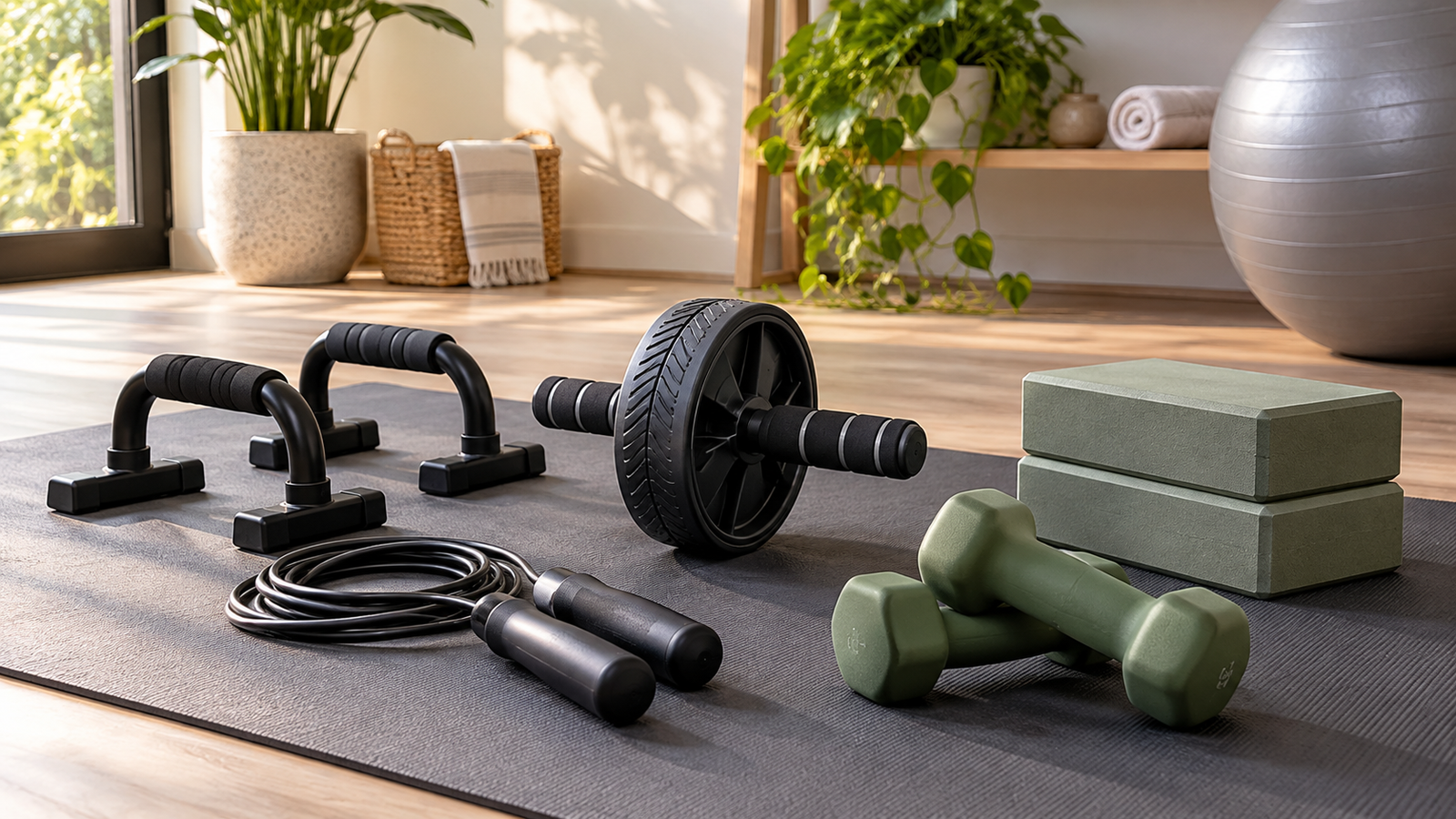
Home workout equipment is designed to withstand repeated movement, resistance and physical contact. But even well-made equipment can deteriorate over time.
A skipping rope may develop a worn section near its handle. A resistance-band attachment might begin to loosen. A push-up handle may develop a crack, while a pull-up bar can gradually shift if its fixing mechanism is not secure.
These problems are easy to overlook, especially when the equipment continues to function.
However, small signs of wear can become important when a product is used under tension or supports body weight.
Regular equipment maintenance is not primarily about keeping workout gear looking new. It is about identifying damage before it contributes to equipment failure or injury.
Unlike large commercial gyms, home workout spaces rarely have a formal equipment inspection program. The responsibility for checking handles, cables, ropes, fasteners and attachment points generally falls on the person using them.
Fortunately, many useful inspections require only a few minutes.
This Physical Glow guide explains how to check common home workout accessories, identify worn components, maintain equipment correctly and decide when replacement is safer than continued use.
1. Why Home Workout Equipment Needs Regular Inspection
Workout equipment experiences repeated mechanical stress.
Each exercise may place force on a handle, cable, rope, frame or attachment.
Over time, materials can experience wear, fatigue, abrasion, loosening or environmental deterioration.
Common Causes of Damage
- Repeated loading and unloading.
- Friction against surfaces.
- Excessive stretching.
- Impact from dropping equipment.
- Exposure to heat or sunlight.
- Moisture and corrosion.
- Incorrect storage.
- Improper assembly.
- Use beyond the manufacturer’s limits.
The rate of deterioration varies considerably.
A skipping rope used occasionally indoors may experience different wear from one used daily on rough concrete.
Likewise, a resistance band stored in a cool, dry area may age differently from one repeatedly left in a hot vehicle.
Why Visual Appearance Is Not Enough
Some damage is obvious, such as a torn band or cracked handle.
Other problems may be less visible.
For example, a bolt may gradually loosen, or internal wear may develop in a piece of equipment.
Routine inspection reduces avoidable risks, but it cannot guarantee that every defect will be detected.
Manufacturer maintenance schedules and replacement requirements remain essential.
2. Which Home Workout Accessories Need the Most Attention?
Different equipment has different potential failure points.
| Equipment | What to inspect | Main concern |
|---|---|---|
| Resistance bands | Cuts, cracking, thinning and tears | Sudden elastic failure |
| Resistance tubes | Tube ends, handles and connectors | Tube or attachment separation |
| Skipping ropes | Cable wear, handles and rotation mechanism | Breakage or loss of control |
| Pull-up bars | Mounting points, grips and frame stability | Detachment or structural failure |
| Push-up bars | Handles, feet and joints | Slipping or collapse |
| Dumbbells | Handles, plates and locking mechanisms | Dropped or loose weights |
| Adjustable benches | Hinges, pins, bolts and upholstery | Movement or collapse |
| Suspension trainers | Straps, stitching, buckles and anchors | Attachment failure |
| Ab rollers | Wheel, axle and handles | Instability or component separation |
| Exercise mats | Tears, separation and slipping | Loss of grip or stability |
Equipment supporting full or partial body weight deserves particular attention.
If a pull-up bar or suspension trainer fails, the consequences may be considerably more serious than the failure of a lightweight accessory.
3. A Simple Three-Level Inspection System
A practical maintenance routine can be divided into three levels.
- Before every use — quick inspectionCheck for obvious damage, unstable parts, loose connections and unsuitable attachment points.
- Periodically — detailed inspectionExamine less visible areas, moving parts, fasteners and signs of accumulated wear. Follow the manufacturer’s prescribed intervals.
- After unusual events — special inspectionReassess equipment after a fall, impact, unexpected slip, overloading event or suspected failure.
The appropriate inspection interval depends on the manufacturer, equipment design, frequency of use and operating conditions. No single weekly or monthly schedule suits every product.
Why Inspections After an Incident Matter
Suppose an adjustable dumbbell is accidentally dropped.
The handle may appear intact, but the locking mechanism could have been damaged.
Similarly, a pull-up bar that unexpectedly shifts should not be used again until the installation has been properly evaluated.
Do not assume equipment is safe simply because it survived one unusual event.
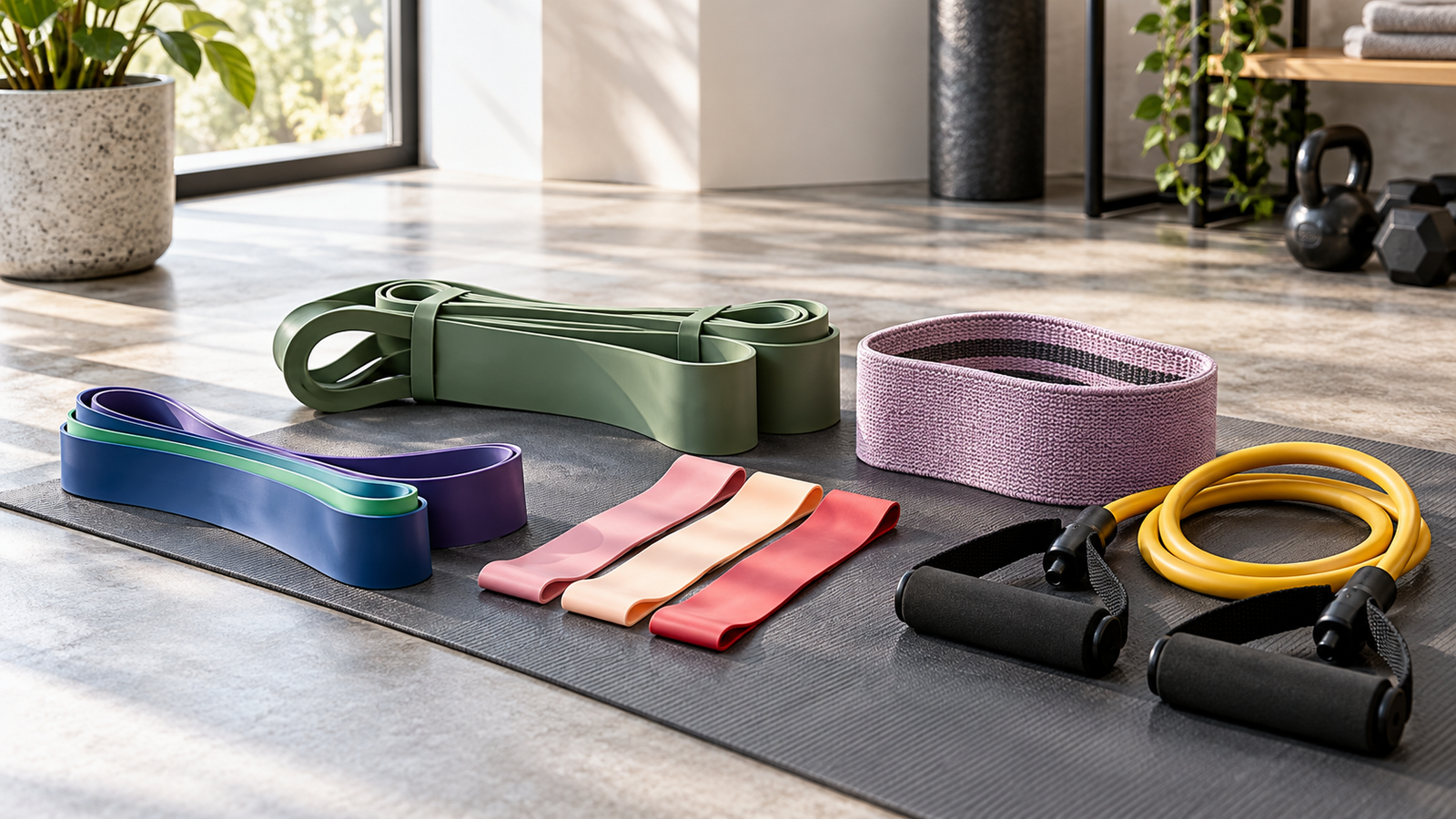
4. Resistance Band Maintenance: What to Look For
Resistance bands are particularly important to inspect because they store elastic energy when stretched.
If a band tears or separates from its attachment, it may recoil unexpectedly.
Inspect the Entire Band
Look for:
- Small cuts.
- Cracks.
- Splitting.
- Structural fraying.
- Thin or weakened sections.
- Unusual permanent deformation.
- Sticky or degraded surfaces.
- Damaged attachment areas.
Pay attention to sections that repeatedly contact anchors or handles.
Check Bands in Their Relaxed Condition
Examine the band without placing it under significant tension.
Avoid stretching damaged material toward your face to determine whether it can withstand another workout.
What About Colour Changes?
Some discolouration may reflect ordinary ageing or environmental exposure.
However, colour alone is not a dependable measure of remaining strength.
If the material shows signs of deterioration or the manufacturer recommends replacement, remove it from service.
Do Not Repair Tears With Tape
Adhesive tape, improvised knots and similar fixes do not reliably restore the original strength of a damaged elastic band.
A torn or structurally compromised band should be replaced.
For detailed guidance on band-specific hazards, see Physical Glow’s related article, Resistance Band Anchor Safety: Fraying, Door Anchors and Snapback.
5. Checking Resistance Tube Handles and Connectors
Resistance tubes often use additional components such as handles, straps, metal clips and attachment hardware.
These components introduce possible failure points beyond the elastic tubing itself.
Inspect Handle Connections
Check whether the tube is securely connected to the handle according to the manufacturer’s design.
Signs of concern may include:
- Loose fittings.
- Visible separation.
- Cracked plastic.
- Exposed internal parts.
- Damaged stitching.
- Deformed connectors.
Check Carabiners and Clips
Some tube systems use metal clips.
Look for obvious deformation, corrosion, damaged gates or loose connections.
A clip that no longer closes properly should not be used.
Inspect Foam Grips
Foam may deteriorate through repeated handling, sweat and environmental exposure.
Surface wear may affect grip even when the underlying handle remains intact.
Avoid Mixing Unverified Components
Not every replacement handle or clip is compatible with every resistance tube.
Use manufacturer-approved components with suitable specifications.
An attachment that physically fits is not necessarily rated for the intended load.
6. Skipping Rope Maintenance: Cables, Handles and Bearings
Skipping ropes experience repeated bending, rotation and floor contact.
Wear often develops near the point where the rope contacts the ground or enters the handle.

Rope or cable surface
Look for abrasion, fraying, exposed wire, kinks or significant damage to the outer coating.

Handle connections
Check the rope attachment, adjustment mechanism and any end caps or locking components.

Rotation mechanism
Listen and feel for unusual resistance, grinding or inconsistent rotation.
Why Surface Choice Matters
Using a skipping rope on rough concrete can accelerate wear on some cable coverings.
A suitable exercise surface may reduce abrasion, depending on the rope’s design.
However, the surface must also provide adequate grip and stability.
Metal Speed Ropes Need Particular Care
Some speed ropes contain thin metal cables.
If the protective coating wears through, exposed wire strands may cause cuts or snagging.
Do not continue using a cable with exposed broken wires.
Can You Replace Only the Rope?
Some skipping-rope designs allow replacement cables.
Use compatible components and follow the manufacturer’s assembly instructions.
If the handle or rotation mechanism is damaged, replacing the cable alone may not solve the problem.
7. How to Inspect Pull-Up Bars
Pull-up bars support body weight and may experience substantial forces during exercise.
Installation and structural condition are therefore particularly important.
Doorway Pull-Up Bars
Check:
- Doorframe compatibility.
- Contact pads.
- Fasteners.
- Mounting or retention mechanism.
- Frame condition.
- Signs of movement.
- Grip stability.
A doorframe can deteriorate or loosen over time.
Do not assume that an installation remains suitable indefinitely.
Wall-Mounted Pull-Up Bars
Inspect the visible mounting hardware and surrounding structure.
Look for:
- Movement.
- Loose fasteners.
- Cracked surfaces.
- Corrosion.
- Bent components.
- Changes in mounting alignment.
Telescopic or Pressure-Mounted Bars
These require special attention to the manufacturer’s installation and locking procedure.
Never assume that extra tightening beyond the manufacturer’s instructions improves safety.
Incorrect installation or unsuitable surfaces can result in sudden detachment.
After an Unexpected Shift
Stop using the bar.
Do not perform another pull-up to test whether it will hold.
Have the installation assessed and corrected in accordance with the manufacturer’s guidance.
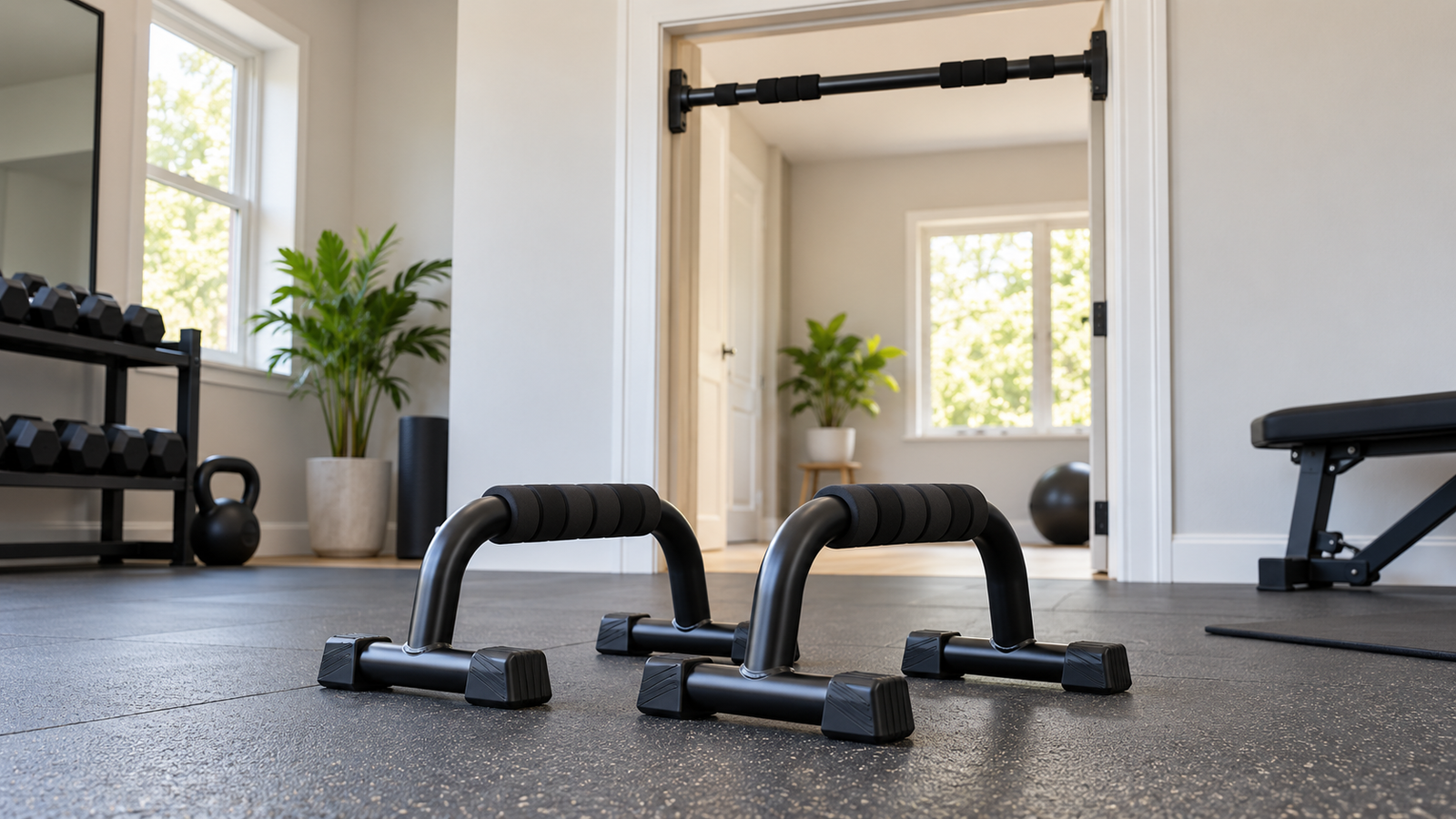
8. Push-Up Handles and Dip Bars: Stability Checks
Push-up handles can improve wrist positioning for some users, but they must remain stable under load.
What to Check
- Cracks in handles.
- Loose screws.
- Uneven feet.
- Worn rubber contact surfaces.
- Bent supports.
- Damaged joints.
- Unexpected movement.
Surface Compatibility
A handle that grips well on a rubber gym floor may slide on polished tile.
Check whether the equipment and floor surface are compatible.
Why Uneven Feet Matter
If one foot no longer makes stable contact with the floor, the handle may rock.
This can affect balance during exercise.
Parallel Dip Bars
Dip bars support substantial body weight.
Inspect frame stability, connections and floor contact according to the manufacturer’s instructions.
Avoid using bars that wobble abnormally or show structural damage.
9. Adjustable Dumbbells: Check Before Lifting
Adjustable dumbbells save storage space, but their mechanisms require attention.
Different designs may use:
- Threaded collars.
- Locking pins.
- Selector dials.
- Sliding mechanisms.
- Proprietary plate-retention systems.
Inspect the Weight-Selection Mechanism
Before lifting, verify that the desired plates are securely engaged.
Follow the manufacturer’s adjustment procedure.
Look for Signs of Damage
Potential warning signs include:
- Cracked housings.
- Loose plates.
- Damaged threads.
- Deformed collars.
- Unusual rattling.
- Inconsistent selection.
- Difficulty locking the mechanism.
Do Not Use a Damaged Adjustable Dumbbell
A loose plate can detach during exercise.
If an adjustment mechanism does not engage correctly, remove the dumbbell from use.
Avoid Dropping Adjustable Dumbbells
Many adjustable systems are not designed for repeated dropping.
An impact may damage internal components even when the exterior appears acceptable.
Follow the product’s handling requirements.
10. Adjustable Workout Bench Maintenance
Adjustable benches rely on structural components and locking mechanisms.
A damaged or incorrectly secured bench may move unexpectedly while supporting the user and additional weights.
Inspect the Main Frame
Look for:
- Visible cracks.
- Bent components.
- Corrosion.
- Loose joints.
- Unusual movement.
Check Adjustment Pins and Locks
Before using the bench, confirm that the backrest and seat adjustments have engaged correctly.
Do not rely on the appearance of the adjustment lever alone.
Examine Upholstery
Torn upholstery may expose foam or underlying materials.
This can affect hygiene and comfort.
Assess Stability
Place the bench on a suitable level surface.
If it rocks or shifts unexpectedly, identify the cause before exercising.
Respect the Rated Load
A bench’s rated capacity may include the combined weight of the user and external weights.
Read the manufacturer’s specification carefully.
Do not assume that a high advertised capacity applies equally to every bench position or type of exercise.
11. Suspension Trainer Strap and Anchor Maintenance
Suspension trainers use straps and anchors to support some or much of the user’s body weight.
Their failure can cause a sudden fall.
Inspect the Webbing
Look for:
- Fraying.
- Cuts.
- Abrasion.
- Loose stitching.
- Heat damage.
- Unusual discolouration.
- Permanent deformation.
Check Buckles and Adjustment Systems
Ensure they function according to the manufacturer’s instructions.
A buckle that slips unexpectedly should not be trusted.
Assess the Anchor
Check whether the anchor is approved for the intended installation and loading.
Do not use unverified ceiling hooks, furniture or decorative fixtures.
Check the Supporting Structure
A strong strap cannot compensate for an unsuitable wall, ceiling or door.
When structural suitability is uncertain, seek qualified installation advice.
12. Ab Roller and Core Wheel Maintenance
Ab rollers can place substantial demands on the shoulders, trunk and supporting equipment.
A wheel or handle failure may cause an uncontrolled movement.
Main Inspection Points
- Wheel condition.
- Axle stability.
- Handle attachment.
- Rubber grip.
- Bearing movement.
- Structural cracks.
- Uneven rotation.
Look for Wobbling
An ab roller that begins to wobble unusually may have a problem with its axle, wheel or handle connection.
Check the Floor
Use a surface compatible with the product.
A wheel that slips unexpectedly can compromise control.
Do Not Ignore Handle Movement
If a handle begins separating from the axle, stop using the product.
Temporary tape or glue repairs should not be relied upon for load-bearing components.
13. Exercise Mat Care: Cleaning, Grip and Surface Damage
Exercise mats are often treated as disposable accessories, but their condition influences workout comfort and stability.
Inspect the Surface
Look for:
- Tears.
- Curling edges.
- Separation between layers.
- Slippery patches.
- Excessive compression.
- Uneven surfaces.
Why Curling Edges Matter
Raised edges can create trip hazards.
Why Surface Grip Matters
A mat that slides on the floor may become unsafe during dynamic movements.
Cleaning
Use the manufacturer’s recommended method.
Some mats can be wiped with mild cleaning solutions, while others require specific care.
Avoid harsh solvents unless explicitly permitted.
Drying and Storage
Allow the mat to dry adequately before rolling or storing it.
Persistent moisture may contribute to odour or deterioration.
14. How Sweat and Humidity Affect Workout Equipment
Sweat contains water and dissolved substances that can accumulate on handles and other contact surfaces.
Humidity may also affect certain materials over time.
Metal Components
Moisture can contribute to corrosion.
Pay attention to:
- Bolts.
- Clips.
- Bearings.
- Adjustable mechanisms.
- Metal handles.
- Exposed cable ends.
Foam Grips
Sweat and repeated friction can cause some foam grips to deteriorate.
Fabric Straps
Damp storage can contribute to odour and material problems.
Rubber and Elastomers
Heat, sunlight and chemicals can affect the ageing of some elastic materials.
Practical Maintenance
Wipe equipment according to its instructions after use.
Dry components before storage.
Avoid leaving equipment in damp areas for extended periods.
Do not apply lubricants or corrosion treatments to components unless the manufacturer permits them.
15. How to Clean Home Workout Accessories Safely
Cleaning and maintenance are related but different tasks.
Cleaning removes dirt, sweat and residue.
Maintenance may also involve inspection, adjustment or replacement.
General Cleaning Principles
- Consult the product instructions.
- Disconnect powered equipment before cleaning when directed.
- Remove visible dirt using an approved method.
- Avoid soaking components not designed for immersion.
- Dry equipment thoroughly when required.
- Inspect the product before returning it to storage.
Avoid Unverified Cleaning Chemicals
Some chemicals can damage plastics, rubber, adhesives and coatings.
A cleaner suitable for metal gym frames may be unsuitable for elastic resistance bands.
Does Disinfection Replace Cleaning?
No.
Disinfectants may not remove visible dirt and residue effectively.
Use an appropriate procedure for the equipment material and intended hygiene requirements.
Shared Workout Equipment
If several people use the same equipment, regular cleaning becomes particularly important.
However, hygiene procedures should not damage the product.
16. When Should You Lubricate Moving Parts?
Some equipment has bearings, hinges or other moving components.
However, not every moving part requires user-applied lubricant.
Follow the Manufacturer’s Instructions
Certain components are sealed or pre-lubricated.
Adding oil or grease unnecessarily may attract dirt, interfere with mechanisms or damage materials.
Skipping Rope Bearings
If the manufacturer provides a maintenance procedure, follow it.
Do not assume that spraying household lubricant into the handle is appropriate.
Exercise Bench Hinges
Some hinges may require inspection or specified maintenance.
Others may not need routine user lubrication.
Treadmills and Cardio Machines
Powered equipment often has model-specific lubrication requirements.
Do not apply generic lubricant without confirming compatibility.
17. Storage: Protecting Equipment Between Workouts
Storage affects both equipment life and household safety.
Keep Bands Away From Sharp Objects
Avoid storing resistance bands beside exposed metal edges or tools.
Avoid High Heat
Do not routinely leave elastic workout equipment in hot vehicles or direct sunlight.
Store Weights Securely
Dumbbells and plates should not be able to roll or fall.
Use appropriate racks or stable low-level storage.
Hang Accessories Correctly
Light accessories may be stored on compatible hooks.
Heavy or load-bearing equipment needs suitable storage designed for its weight.
Protect From Moisture
Keep equipment reasonably dry, particularly if it contains metal parts or fabric components.
Avoid Permanent Tension
Unless specifically required by the manufacturer, store elastic equipment without prolonged stretching.
18. Repair or Replace? Making the Right Decision
Not every maintenance issue requires replacing an entire product.
For example, some manufacturers sell replacement grips, ropes or other components.
However, structural and load-bearing damage requires particular caution.
| Problem | Possible action | Safety consideration |
|---|---|---|
| Dirty handle | Clean according to instructions | Inspect for underlying damage |
| Worn replaceable rope cable | Use compatible replacement | Check handle and locking mechanism |
| Torn resistance band | Replace the band | Do not rely on tape or knots |
| Cracked push-up handle | Remove from use | Structural repair may not be reliable |
| Loose bench bolt | Follow manufacturer service procedure | Verify correct fastener and torque requirements |
| Damaged dumbbell selector | Authorized repair or replacement | Do not lift with insecure plates |
| Frayed suspension strap | Replace approved component or product | Body-weight support is safety-critical |
| Unstable pull-up anchor | Stop use and assess installation | Qualified assistance may be necessary |
| Torn exercise mat | Replace if grip or safety is compromised | Avoid trip hazards |
When Professional Servicing Is Appropriate
Seek qualified or manufacturer-authorized support when:
- Structural components are damaged.
- Internal mechanisms malfunction.
- Load-bearing fasteners repeatedly loosen.
- Electrical components are affected.
- Assembly or installation integrity is uncertain.
Never assume a homemade repair restores the original tested load capacity.
19. Create a Home Gym Maintenance Schedule
A practical maintenance schedule should consider how frequently equipment is used and how critical its components are to safety.
Example maintenance workflow
| When | Task |
|---|---|
| Before each workout | Check the equipment being used for obvious wear and security |
| After each workout | Clean and dry equipment as appropriate |
| Periodically | Conduct more detailed inspections according to product manuals |
| After unusual impacts | Inspect affected equipment before reuse |
| When damage appears | Remove affected equipment from service |
| At manufacturer-specified intervals | Perform prescribed maintenance and replacements |
These are general workflow categories, not substitutes for required inspection intervals in the equipment documentation.
Keep a Simple Record
For equipment used frequently, a basic maintenance note can be useful.
Record:
- Product name.
- Purchase date, if known.
- Inspection date.
- Problems observed.
- Components replaced.
- Next manufacturer-required service.
This is particularly helpful when several people share a home gym.
20. Interactive Home Workout Gear Inspection Checklist
Use this checklist as a quick review before beginning a home workout.
Home workout equipment safety check
0/10All equipment I plan to use has been visually inspected.Resistance bands show no tears, cracks or structural fraying.Handles and grips are securely attached.Ropes and cables have no exposed broken strands or serious abrasion.Clips, straps and connectors appear undamaged.Pull-up bars and anchors are installed and secure according to their instructions.Dumbbell plates and locking mechanisms are properly engaged.Benches and other supports are stable and locked.The floor and exercise mat provide appropriate grip.Damaged or questionable equipment has been removed from use.
Review any unchecked items relevant to your equipment before beginning exercise. Do not use damaged or unsecured load-bearing components.
Reset checklistThis checklist cannot certify structural integrity or replace manufacturer inspections, professional servicing or installation requirements.
21. How to Choose Durable Home Workout Equipment
Maintenance begins before the first workout.
Products with clear instructions, compatible replacement parts and appropriate specifications can be easier to maintain responsibly.
What to Look for Before Buying
| Feature | Why it matters |
|---|---|
| Clear user manual | Explains installation, limitations and care |
| Rated load information | Helps establish intended use |
| Replacement-part availability | Supports authorized servicing |
| Manufacturer support | Useful for defects and maintenance questions |
| Appropriate construction | Must suit the exercise and environment |
| Secure locking systems | Important for adjustable equipment |
| Material information | Helps guide cleaning and storage |
| Warranty terms | Explains coverage and service options |
| Product-specific safety warnings | Identifies prohibited use |
| Authenticity | Reduces risk of misrepresented specifications |
Do Customer Ratings Establish Safety?
No.
Customer reviews can reveal recurring complaints, but positive ratings do not establish that a product is structurally safe.
Look for reliable manufacturer specifications and appropriate instructions.
Is Expensive Equipment Always More Durable?
Not necessarily.
Price may reflect branding, materials, design or additional features.
A more expensive product is not automatically safer.
Compare Equipment by Intended Use
Physical Glow’s Fitness equipment guides section covers different home workout products, including resistance bands, dumbbells, pull-up accessories and recovery equipment.
When evaluating individual products, consider their maintenance requirements alongside price and exercise features.
22. Common Home Workout Gear Maintenance Mistakes
Mistake 1: Inspecting Equipment Only When It Breaks
Routine inspections can reveal deterioration before complete failure.
Mistake 2: Repairing Torn Bands With Tape
Improvised repairs cannot reliably restore original elastic strength.
Mistake 3: Ignoring Loose Handles
A loose handle can create a serious problem during loaded exercise.
Mistake 4: Continuing to Use Frayed Ropes
Damaged cables may break or cause cuts.
Mistake 5: Assuming Heavy Furniture Is a Safe Anchor
Furniture may slide, tip or fail under exercise loads.
Mistake 6: Using Household Cleaning Chemicals Without Checking Compatibility
Some products can damage rubber, plastic or coatings.
Mistake 7: Storing Equipment While Wet
Moisture can contribute to corrosion, odour and material deterioration.
Mistake 8: Dropping Adjustable Dumbbells
Impacts can damage internal mechanisms.
Mistake 9: Ignoring Manufacturer Load Limits
Equipment should not be used beyond its intended capacity.
Mistake 10: Reusing Equipment After an Unexplained Failure
A failure requires assessment rather than another attempt under the same conditions.
23. Frequently Asked Questions
How often should I inspect home workout equipment?
Perform a quick check before use and follow the manufacturer’s more detailed inspection schedule.
How do I know whether a resistance band is worn out?
Cuts, cracks, structural fraying, thinning, unusual deformation and damaged attachment points are warning signs.
Can I repair a torn resistance band?
A torn band should generally be replaced rather than repaired for continued exercise use.
How long does a skipping rope last?
Service life depends on material, usage frequency, surface and storage. Replace worn components according to manufacturer guidance.
Why does my skipping rope cable wear out quickly?
Repeated contact with rough surfaces, excessive abrasion or unsuitable use may accelerate wear.
Can I replace only the skipping rope cable?
Some models support compatible replacement cables. Follow the manufacturer’s instructions.
Should skipping rope bearings be lubricated?
Only if the manufacturer recommends it and specifies an appropriate method.
How can I tell if a pull-up bar is unsafe?
Visible damage, movement, loose fittings, incompatible supports and unstable installation are reasons to stop use.
Can I tighten a pull-up bar more to make it safer?
Not necessarily. Overtightening may damage the equipment or supporting structure. Follow the installation instructions.
How often should dumbbells be checked?
Inspect before lifting, especially adjustable dumbbells with locking components.
Is it safe to use a cracked dumbbell handle?
No. Remove damaged load-bearing equipment from use.
Do adjustable benches need maintenance?
Yes. Check the frame, adjustment mechanisms, fasteners and stability according to the manufacturer.
Can rubber gym mats wear out?
Yes. Tears, compressed sections, curling edges and reduced grip can affect usefulness and safety.
Should I disinfect gym equipment after every workout?
Cleaning frequency depends on usage and whether the equipment is shared. Follow material-compatible instructions.
Can sunlight damage resistance bands?
Prolonged exposure may degrade certain elastic materials. Store bands according to the manufacturer’s guidance.
Is rust on gym equipment dangerous?
Rust may be cosmetic or indicate more significant deterioration. Corrosion affecting load-bearing components requires assessment.
Can I use household lubricant on gym equipment?
Only when compatible and permitted by the manufacturer.
What should I do after dropping an adjustable dumbbell?
Inspect it according to the manufacturer’s guidance and stop using it if damage or malfunction is suspected.
When should I replace a pull-up bar?
Replace or service it when the manufacturer requires it or when damage, instability or loss of structural integrity is identified.
What is the most important home gym maintenance habit?
Checking equipment condition and attachment security before placing it under load.
24. Final Verdict: Inspect Before You Load
Home workout equipment maintenance does not need to be complicated, but it should be consistent.
Before using resistance bands, check for cracks, cuts and structural wear.
Before skipping rope, inspect the cable, handles and rotation mechanism.
Before performing pull-ups or suspension exercises, verify that the equipment and its anchors remain suitable and secure.
For adjustable dumbbells and benches, pay close attention to locks, pins and other load-bearing components.
Keep equipment clean, store it appropriately and follow manufacturer maintenance instructions.
If a component becomes damaged, do not assume that a temporary repair restores its original strength.
Most importantly, stop using equipment that behaves unexpectedly.
The safest maintenance routine is the one that identifies problems before a workout begins, rather than after something fails.
A few minutes of inspection can help protect both your equipment investment and your ability to train consistently.
Editorial References and Further Reading
- U.S. Consumer Product Safety Commission — Product safety information and recalls.
- UK Health and Safety Executive — Work Equipment and Machinery — General principles of equipment inspection, maintenance and suitability.
- American College of Sports Medicine — Strength training and exercise guidance.
- National Strength and Conditioning Association — Strength and conditioning equipment and training resources.
- Manufacturer manuals — The primary source for model-specific inspection intervals, load ratings, replacement parts and maintenance procedures.
Physical Glow Editorial Note: This article provides general fitness-equipment maintenance education. It does not certify any product or installation as structurally safe. Follow manufacturer instructions, remove damaged equipment from use and seek qualified assistance for structural or load-bearing repairs.