How Smart Rings Track Sleep, Recovery and Readiness
Learn how smart rings combine movement, heart-rate patterns, HRV, temperature trends and sleep timing into wellness metrics such as sleep, recovery and readiness—and where the limits are.
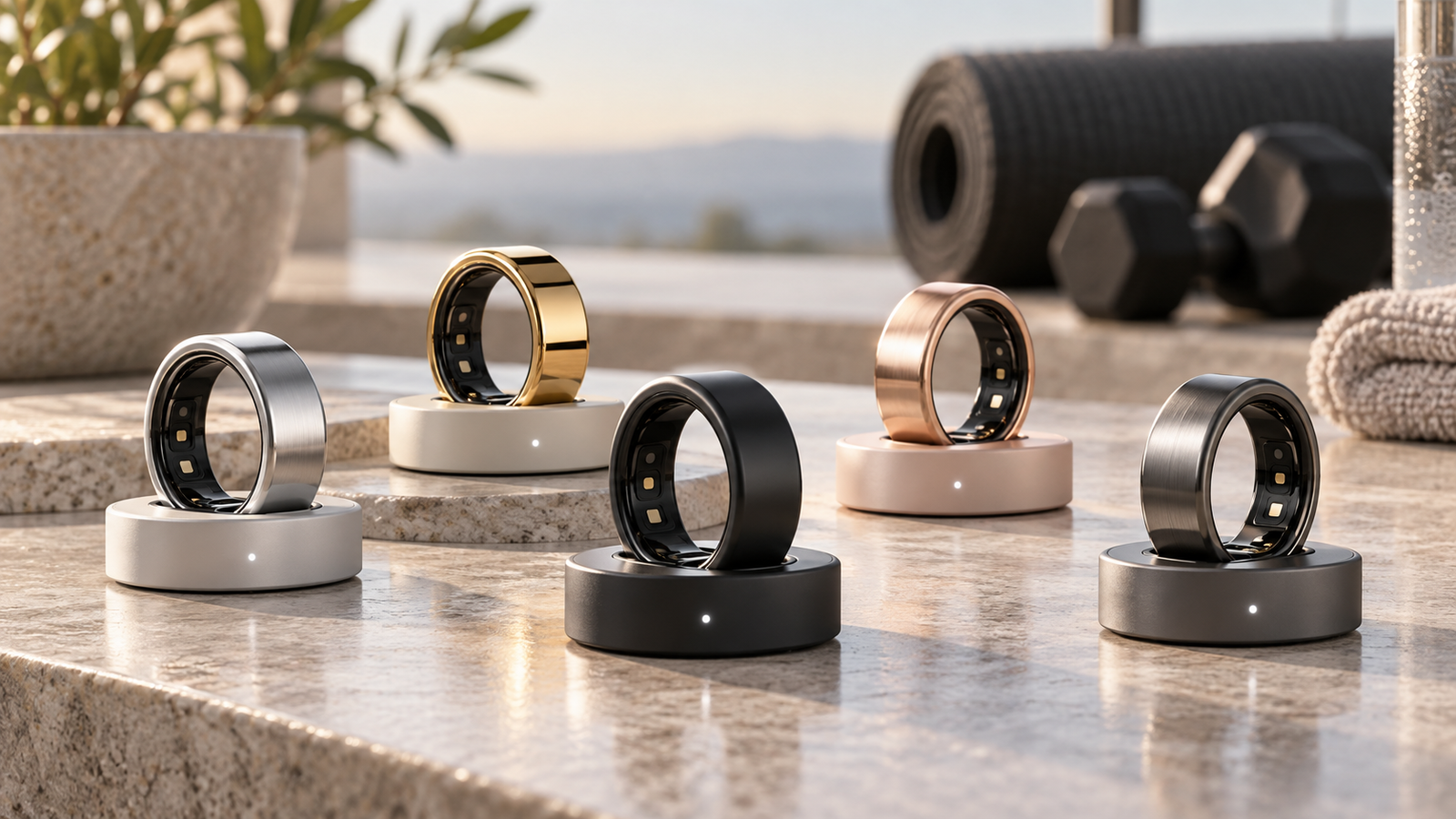
Smart rings are compact wearables designed to track health and fitness signals from the finger. Unlike a smartwatch, they usually have no large display and focus more on passive monitoring, especially sleep, recovery and daily activity trends.
The key point is that a smart ring does not directly “measure recovery” or “measure readiness” as a single biological value. Instead, it collects signals such as movement, heart-rate patterns, heart-rate variability, skin temperature trends and sleep timing, then uses software to combine those signals into simplified scores or insights.
This guide explains what smart rings actually measure, how sleep and recovery scores are created, why different brands can show different results and where consumer wearable data should be treated cautiously.
What Is a Smart Ring?
A smart ring is a wearable device with sensors built into a ring-shaped body.
Depending on the model, it may track signals related to:
- Heart rate
- Heart-rate variability
- Movement
- Sleep duration
- Sleep timing
- Respiratory patterns
- Skin-temperature trends
- Daily activity
The ring sends that data to a phone app, where algorithms convert the raw signals into charts, trends and summary scores.
Why the Finger Is Useful for Wearable Tracking
The finger contains a rich blood supply, which makes it a practical location for optical sensors.
A ring also tends to move less than a loose wrist-worn device during sleep when the fit is correct.
This can help the device collect relatively stable overnight signals.
However, data quality still depends on:
- Ring fit
- Sensor contact
- Movement
- Skin temperature
- Device position
- Algorithm quality
What Sensors Do Smart Rings Use?
Sensor combinations vary by brand, but common technologies include:
Optical heart-rate sensors
These use light to detect changes in blood volume beneath the skin.
The data can be used to estimate:
- Heart rate
- Resting heart rate
- Heart-rate variability
Accelerometers
Movement sensors detect motion and changes in orientation.
They can contribute to:
- Step estimation
- Activity tracking
- Sleep/wake detection
- Movement during sleep
Temperature sensors
Some rings track changes in skin temperature over time.
These readings are usually interpreted as trends relative to your own baseline rather than as a replacement for a clinical thermometer.
How Do Smart Rings Track Sleep?
A smart ring does not watch you sleep.
It infers sleep from a combination of physiological and movement signals.
The algorithm may consider:
- Reduced movement
- Changes in heart rate
- Heart-rate variability patterns
- Respiratory trends
- Time of day
- Temperature changes
Using these signals together helps the device estimate when you fell asleep, when you woke up and how much time you likely spent sleeping.
What Sleep Metrics Can a Smart Ring Show?
Depending on the platform, you may see:
- Total sleep time
- Time in bed
- Sleep efficiency
- Sleep latency
- Bedtime
- Wake time
- Nighttime awakenings
- Estimated sleep stages
These metrics can be useful for identifying long-term patterns.
How Accurate Are Smart Rings for Sleep?
Consumer wearables can be useful for tracking sleep duration and routine trends, but they are not the same as clinical sleep testing.
A ring may misclassify quiet wakefulness as sleep or interpret restless sleep as wake time.
It can also estimate sleep stages, but those estimates should not be treated as identical to measurements from a medical sleep laboratory.
The strongest use is often trend tracking rather than treating every nightly number as exact.
What Is Heart-Rate Variability?
Heart-rate variability, commonly shortened to HRV, describes variation in the time interval between heartbeats.
Your heart does not beat at perfectly identical intervals.
Wearables often use nighttime HRV as one input when assessing recovery because it can change with factors such as:
- Training stress
- Sleep quality
- Illness
- Alcohol
- Psychological stress
- Recovery status
However, HRV differs significantly between individuals.
Your own baseline is generally more informative than comparing your number with someone else’s.
What Is Resting Heart Rate?
Resting heart rate is the number of heartbeats per minute when the body is relatively inactive.
Smart rings often focus on overnight readings because sleep provides long periods with limited movement.
A change from your normal pattern can contribute to recovery calculations.
One unusual reading by itself does not automatically indicate a problem.
How Do Smart Rings Calculate Recovery?
Recovery is usually an algorithmic score rather than a directly measured biological property.
The app may combine:
- Resting heart rate
- HRV
- Previous activity
- Sleep duration
- Sleep consistency
- Temperature trends
- Recent strain
The exact calculation is proprietary and varies between manufacturers.
This means a recovery score of 80 on one platform is not necessarily equivalent to 80 on another.
What Is a Readiness Score?
Readiness is a simplified estimate of how prepared your body may be for normal activity or training.
Different brands may call this:
- Readiness
- Recovery
- Energy
- Body resources
- Wellness score
Although the names differ, the concept is similar: recent physiological and behavioural data are summarised into an easy-to-understand number.
Should You Trust a Readiness Score?
Use it as context, not as an instruction.
If the app reports low readiness but you feel normal, one unusual night’s data may not matter.
If the score is consistently lower than your normal range and you also feel unusually tired, stressed or unwell, the trend may be worth paying attention to.
A wearable should complement how you feel rather than override it.
What Is a Personal Baseline?
A baseline is your usual range over time.
Smart rings become more useful after collecting enough data to understand your normal patterns.
For example, an overnight heart rate that is perfectly normal for one person may be unusually elevated for another.
This is why trends relative to your own history are generally more informative than population comparisons.
How Long Does a Smart Ring Need to Learn Your Baseline?
The exact period varies by platform.
Most wearables become more useful after several days or weeks of consistent use because the software has more information about your normal:
- Sleep schedule
- Heart-rate patterns
- HRV
- Activity level
- Temperature trends
A single night provides much less context than a longer history.
How Do Smart Rings Estimate Sleep Stages?
Sleep stages such as light, deep and REM sleep are estimated from sensor patterns.
The device does not directly measure brain electrical activity in the same way as polysomnography.
Instead, the algorithm uses signals such as:
- Movement
- Heart rate
- HRV
- Breathing-related patterns
These estimates can provide interesting trends but should not be interpreted as perfect measurements of your sleep architecture.
What Is Sleep Efficiency?
Sleep efficiency usually describes how much of the time spent in bed was estimated to be actual sleep.
For example, spending eight hours in bed does not necessarily mean getting eight hours of sleep.
Time spent awake before falling asleep or during the night can reduce estimated sleep efficiency.
What Is Sleep Latency?
Sleep latency refers to how long it takes to fall asleep after going to bed.
A wearable estimates this based on movement and physiological changes.
It may not always identify the exact moment sleep begins.
Can Smart Rings Detect Naps?
Many modern platforms attempt to identify daytime naps automatically.
Short naps or periods where you lie very still may be more difficult to classify accurately.
Some apps allow users to confirm, edit or delete detected sleep periods.
How Do Smart Rings Track Activity?
Activity tracking generally relies heavily on movement sensors.
The ring may estimate:
- Steps
- Active time
- Calories
- Workout duration
- Movement intensity
Activity estimates should be understood as approximations rather than exact measurements.
Are Smart-Ring Step Counts Accurate?
They can provide a useful estimate, but different wearables may produce different totals.
Hand movements can sometimes influence step detection, while certain activities may involve movement patterns that are difficult for the algorithm to classify.
Again, consistency and trends are often more useful than comparing exact numbers across devices.
How Do Smart Rings Track Workouts?
Some rings can automatically identify certain activities, while others require manual workout logging.
Because a ring has limited hardware compared with larger sports watches, serious endurance athletes may prefer a dedicated GPS watch for detailed training data.
A smart ring is generally stronger as a passive wellness tracker than as a complete sports-computer replacement.
Can a Smart Ring Measure Blood Oxygen?
Some models estimate blood-oxygen saturation using optical sensors.
Availability varies by device and market.
Consumer SpO2 measurements should not automatically be treated as equivalent to clinical equipment, particularly when making medical decisions.
Can a Smart Ring Measure Stress?
It can estimate stress-related patterns using combinations of:
- Heart rate
- HRV
- Movement
- Temperature
- Time of day
But “stress” is not a single signal that a ring directly detects.
The device is interpreting physiological patterns that may have several possible causes.
Can Smart Rings Detect Illness?
Wearables can sometimes identify unusual changes in temperature, heart rate or recovery metrics before or during illness.
However, these changes are not specific.
They can also result from:
- Hard training
- Poor sleep
- Alcohol
- Travel
- Stress
- Environmental temperature
A smart ring cannot diagnose an illness based on these trends alone.
Why Alcohol Can Change Recovery Data
Alcohol can alter sleep quality and nighttime physiological signals.
Some users notice:
- Higher resting heart rate
- Lower HRV
- More disrupted sleep
- Lower recovery scores
A wearable can make these patterns easier to see because it collects overnight data consistently.
How Exercise Changes Readiness Scores
A demanding workout can temporarily influence recovery-related metrics.
This is not automatically negative.
Training creates stress that the body then adapts to during recovery.
The useful question is whether workload and recovery remain balanced over time.
Smart Ring vs Smartwatch
| Feature | Smart Ring | Smartwatch |
|---|---|---|
| Display | Usually none | Built-in screen |
| Sleep comfort | Often discreet | Larger on wrist |
| Notifications | Limited or none | Strong |
| GPS | Often relies on phone or may be absent | Common on fitness-focused models |
| Recovery focus | Often a major strength | Varies by platform |
| Workout display | Limited | Usually better |
Can a Smart Ring Replace a Smartwatch?
It depends on what you want.
A smart ring can work well if your priorities are:
- Sleep tracking
- Recovery trends
- Passive wellness monitoring
- Minimal wearable size
A smartwatch may be better if you want:
- Notifications
- Maps
- GPS workouts
- Music controls
- Live exercise metrics
- A visible screen
Can You Wear Both?
Yes.
Some people use a smart ring primarily for sleep and recovery while using a sports watch for workouts.
However, using two ecosystems can create duplicate data and may require choosing which platform should be the main source for activity information.
Why Smart-Ring Fit Matters
A smart ring should maintain reliable sensor contact without being painfully tight.
If it is too loose:
- Sensors may lose contact.
- The ring may rotate.
- Readings can become inconsistent.
If it is too tight, it can become uncomfortable, especially because fingers can swell throughout the day and night.
Should You Use a Sizing Kit?
If the manufacturer offers one, it can be useful.
Smart-ring sizes do not necessarily match ordinary jewellery sizing perfectly.
Wearing a sample size for a day or night can help you assess:
- Comfort
- Nighttime swelling
- Rotation
- Sensor contact
Which Finger Is Best for a Smart Ring?
Follow the manufacturer’s recommendation.
Many devices can be used on several fingers, but certain positions may provide better sensor contact.
The exact preferred finger can differ between models.
Can You Wear a Smart Ring While Sleeping?
Yes. Overnight tracking is one of the main reasons people use smart rings.
If the ring becomes uncomfortable, leaves significant pressure marks or causes numbness, reassess the size.
Smart Ring Battery Life
Battery life varies considerably by model.
A ring that lasts several days between charges can make continuous sleep tracking easier because it needs to be removed less often.
Real battery life can change with:
- Enabled features
- Battery age
- Sensor use
- Software updates
When Should You Charge a Smart Ring?
A practical strategy is to charge it during times when you are less interested in data collection, such as:
- While showering
- During desk work
- While getting ready in the morning
This can make it easier to keep the ring on overnight consistently.
Are Smart Rings Waterproof?
Many have substantial water-resistance ratings, but not all are identical.
Check the exact rating before:
- Swimming
- Showering
- Water sports
- Long underwater exposure
Water resistance can also change over the lifetime of a device.
Can You Lift Weights While Wearing a Smart Ring?
It may be uncomfortable or risky for both the ring and your finger when gripping barbells, dumbbells or metal handles.
Hard pressure can scratch the ring and create a pinch point.
Many users remove rings during heavy strength training.
Can Smart Rings Replace Medical Devices?
No.
Consumer smart rings can provide useful wellness information, but they are not a substitute for clinical assessment, medical-grade monitoring or diagnosis.
Do not change medication, ignore symptoms or make major health decisions based only on a readiness score or wearable alert.
How to Get More Useful Data From a Smart Ring
- Wear it consistently.
- Use the correct size.
- Keep sensors clean.
- Wear it overnight regularly.
- Confirm or edit incorrectly detected activities where the app allows it.
- Look at weekly and monthly trends rather than obsessing over single-day scores.
- Compare data with how you actually feel.
Common Smart-Ring Mistakes
Comparing HRV with other people
Personal baseline matters more than competing over the highest number.
Treating readiness as a command
A score is an algorithmic interpretation, not an instruction from your body.
Buying the wrong size
Poor fit can reduce both comfort and data quality.
Expecting perfect sleep-stage accuracy
Consumer devices estimate sleep stages rather than measuring them exactly like a clinical sleep study.
Checking every metric obsessively
The purpose of tracking is to provide useful context, not to create anxiety around normal day-to-day variation.
How to Choose a Smart Ring
Consider:
- Available ring sizes
- Battery life
- Water resistance
- Android and iOS compatibility
- Sleep metrics
- HRV and recovery tracking
- Subscription requirements
- App quality
- Charging method
- Weight and thickness
Do not choose only by the number of metrics advertised.
A smaller set of clearly presented metrics can be more useful than a dashboard full of numbers you do not understand.
For specific options, see our Top 5 Smart Rings in India.
Frequently Asked Questions
How does a smart ring know I am asleep?
It estimates sleep using combinations of movement and physiological patterns such as heart rate, HRV and other sensor signals.
Can smart rings accurately measure deep sleep?
They estimate sleep stages using algorithms. These estimates can be useful for trends but are not equivalent to clinical brain-wave measurements.
What is a good HRV?
There is no single ideal HRV for everyone. Your own long-term baseline and changes from that baseline are generally more informative.
Why is my readiness score low after a good night’s sleep?
Readiness can include more than sleep duration. Recent exercise, HRV, resting heart rate, temperature trends and previous recovery may also influence the score.
Can a smart ring tell if I am sick?
It may identify unusual physiological trends, but it cannot diagnose an illness. Similar changes can occur for many different reasons.
Is a smart ring worth it for sleep tracking?
It can be useful if you want convenient long-term sleep and recovery trends and are comfortable wearing a ring overnight. It is less useful if you need clinical sleep diagnosis or detailed on-device workout information.
Final Takeaway
Smart rings are most useful as trend-tracking tools.
They collect movement and physiological signals throughout the day and night, then use algorithms to estimate sleep, activity, recovery and readiness.
The individual scores can be convenient, but they should not be confused with direct measurements of how recovered or healthy you are.
Pay more attention to patterns across several days and weeks than to one unusually high or low score.
A well-fitting ring, consistent overnight wear and a good understanding of what the metrics actually mean will usually provide more value than simply choosing the device with the longest list of features.
Physical Glow publishes educational beauty, fitness and wellness content. Consumer wearable data is intended for general wellness use and should not replace medical evaluation, diagnosis or treatment.