How to Use a Pilates Ring: Beginner Exercises and Form Tips
Learn how a Pilates ring creates light spring resistance, where to place it for common beginner exercises and why controlled pressure and alignment matter more than squeezing as hard as possible.
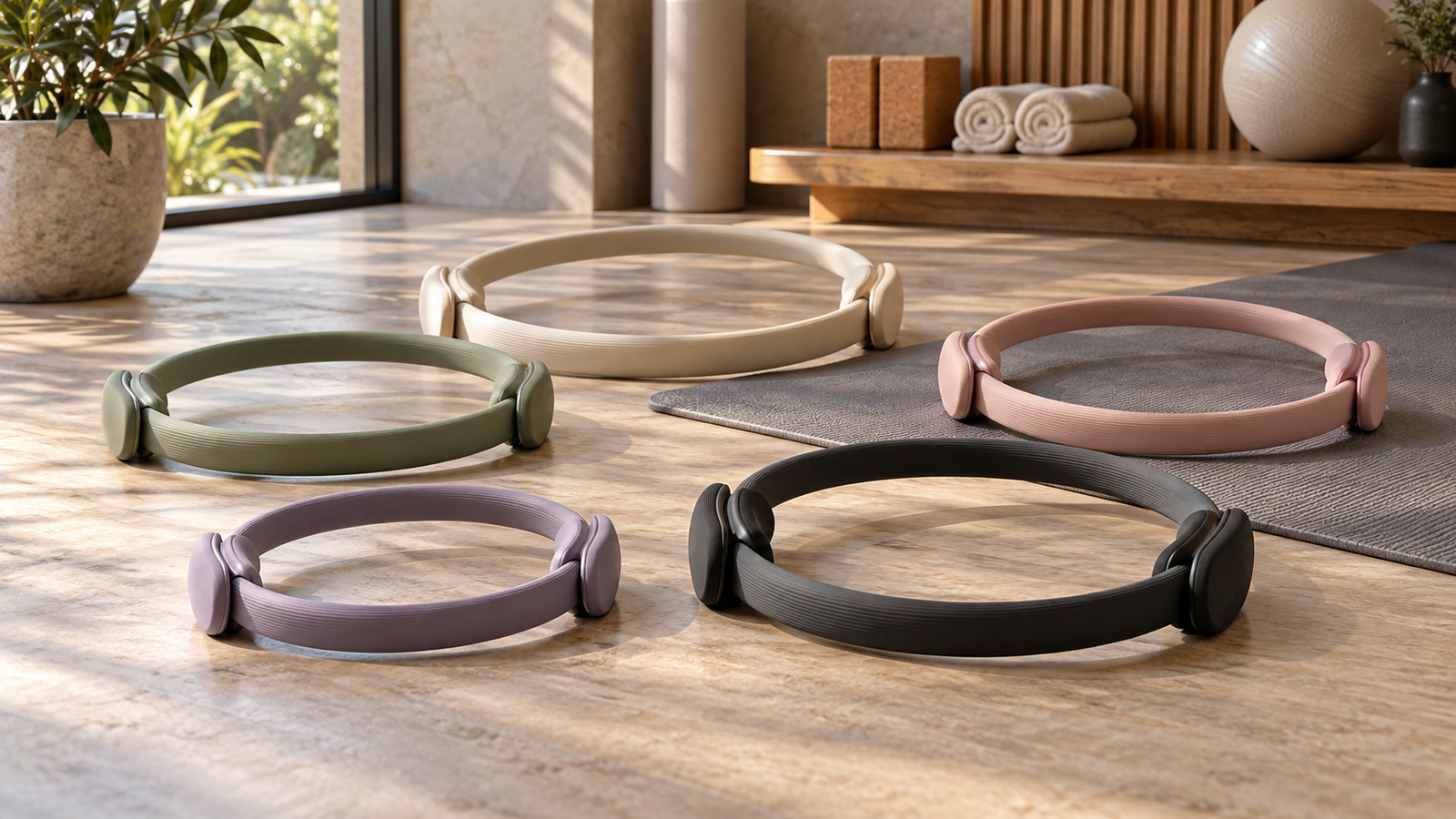
A Pilates ring is a simple resistance tool, but it can make familiar movements feel much more focused. By squeezing or pressing against the ring, you create resistance that can help you engage the inner thighs, glutes, chest, arms and core during controlled exercises.
The key is not to crush the ring as hard as possible. Pilates-style training is usually more effective when the resistance is controlled, the movement stays smooth and the rest of the body remains stable.
This guide explains how to use a Pilates ring, how much pressure to apply, beginner-friendly exercises and the most common form mistakes to avoid.
What Is a Pilates Ring?
A Pilates ring, sometimes called a magic circle, is a flexible resistance ring with padded handles on the inside, outside or both.
Most models are designed to provide light-to-moderate resistance when you:
- Squeeze inward
- Press outward
- Hold the ring between the thighs
- Hold it between the hands
- Use it between the ankles or knees
It is not intended to replace heavy resistance training. Instead, it adds feedback and resistance to controlled bodyweight movements.
What Muscles Does a Pilates Ring Work?
That depends on where the ring is placed.
| Ring Position | Main Areas Challenged |
|---|---|
| Between inner thighs | Adductors and pelvic stability |
| Between knees during bridges | Inner thighs, glutes and core control |
| Between hands | Chest, shoulders and arms |
| Outside the thighs or knees | Hip stabilisers, depending on the exercise |
| Between ankles | Inner thighs and lower-body control |
The ring does not isolate one muscle perfectly. Most Pilates exercises involve several muscles working together to maintain posture and control.
How Much Should You Squeeze a Pilates Ring?
Use enough pressure to feel resistance without losing your position.
You generally do not need to compress the ring as far as possible.
If squeezing harder causes you to:
- Hold your breath
- Lift the shoulders
- Arch the lower back
- Grip with the neck
- Rush the movement
you are probably using more force than necessary.
Start With Control, Not Maximum Resistance
A Pilates ring works best when the resistance supports the exercise rather than dominates it.
For beginners, think about maintaining:
- Steady breathing
- Slow movement
- Neutral posture where appropriate
- Even pressure on both sides of the ring
The goal is muscular control, not simply bending the ring as much as possible.
How to Hold a Pilates Ring
Most rings have padded areas where the hands, thighs or ankles are intended to make contact.
When holding the ring:
- Keep the wrists neutral.
- Avoid squeezing with the fingertips alone.
- Distribute pressure evenly across the pads.
- Keep the shoulders relaxed.
If the ring has both inner and outer pads, check the product instructions because different exercises may use different surfaces.
Beginner Exercise 1: Seated Inner-Thigh Squeeze
This is one of the simplest ways to learn how the ring feels.
- Sit upright on a stable chair.
- Place both feet flat on the floor.
- Position the Pilates ring between the thighs, above the knees.
- Sit tall without leaning backward.
- Gently squeeze the ring.
- Pause briefly.
- Release the pressure slowly without letting the ring drop.
The movement should be small and controlled.
Form tip
Do not force the knees sharply inward. Think about applying steady pressure through the inner thighs.
Beginner Exercise 2: Glute Bridge With Ring
Adding the ring between the thighs can increase awareness of lower-body alignment during a bridge.
- Lie on your back.
- Bend the knees and place the feet flat on the floor.
- Place the ring between the thighs above the knees.
- Apply light inward pressure.
- Lift the hips gradually.
- Pause at the top without excessively arching the back.
- Lower with control.
Form tip
Keep the pressure on the ring moderate. The bridge should still be driven mainly by the hips and glutes.
Beginner Exercise 3: Chest Press With Pilates Ring
This exercise uses the ring between the hands.
- Sit or stand tall.
- Hold the ring at chest height.
- Place the palms against the outer pads.
- Keep the shoulders down.
- Press inward gently.
- Hold for a moment.
- Release slowly.
You should feel the chest and arms working without shrugging the shoulders.
Beginner Exercise 4: Overhead Ring Press
This variation adds an arm-position challenge.
- Hold the ring between both hands.
- Raise the arms overhead only as far as your shoulder mobility allows.
- Keep the ribs controlled.
- Apply gentle inward pressure.
- Release slowly.
Form tip
Avoid flaring the ribs or arching the lower back to get the arms higher.
Beginner Exercise 5: Side-Lying Inner-Thigh Squeeze
This movement targets control around the inner thighs and hips.
- Lie on one side with the body aligned.
- Place the ring between the inner thighs.
- Keep the pelvis stable.
- Squeeze the ring gently.
- Release slowly.
Use a comfortable head position and avoid twisting the torso.
Beginner Exercise 6: Supine Ring Squeeze
This is another simple inner-thigh exercise.
- Lie on your back.
- Bend the knees.
- Place the ring between the thighs.
- Keep the pelvis relaxed and stable.
- Squeeze the ring lightly.
- Pause.
- Release with control.
This can be used as a basic activation exercise before more demanding movements.
Beginner Exercise 7: Dead Bug With Ring Pressure
The Pilates ring can also add upper-body tension during core exercises.
- Lie on your back.
- Bring the hips and knees into a comfortable bent position.
- Hold the ring above the chest between the hands.
- Apply light inward pressure.
- Maintain a stable trunk.
- Slowly move one leg away from the body.
- Return and repeat on the other side.
Only move the leg as far as you can without losing trunk control.
Beginner Exercise 8: Standing Inner-Thigh Press
This version challenges balance more than seated or lying variations.
- Stand tall with feet comfortably positioned.
- Place the ring between the thighs above the knees.
- Keep the knees softly bent.
- Apply gentle inward pressure.
- Maintain upright posture.
- Release gradually.
Hold a stable support if balance is uncertain.
Beginner Exercise 9: Squat With Pilates Ring
The ring can be placed between the thighs to provide feedback during a squat.
- Stand with the feet in a comfortable squat stance.
- Place the ring between the thighs above the knees.
- Apply light inward pressure.
- Lower into a controlled squat.
- Keep the feet stable.
- Stand back up without collapsing the knees inward.
The ring should not force an unnatural leg position.
Beginner Exercise 10: Ring Press With Rotation Control
This can add a small core challenge.
- Sit tall or stand.
- Hold the ring at chest height.
- Apply gentle inward pressure.
- Slowly rotate the torso slightly to one side.
- Return to centre.
- Repeat on the other side.
Keep the movement controlled and avoid using momentum.
How Many Repetitions Should Beginners Do?
There is no universal number.
A practical starting point is to perform a small number of controlled repetitions and stop before technique deteriorates.
For example, you might begin with:
- 8 to 12 controlled repetitions
- 1 to 3 sets
- Slow squeezes rather than rapid pulses
The exact amount depends on the exercise and your current fitness level.
Should You Hold the Squeeze?
You can.
Short isometric holds can increase muscular effort without increasing range of motion.
For example:
- Squeeze the ring gently.
- Hold for several seconds.
- Keep breathing normally.
- Release slowly.
Avoid holding your breath just because the muscles are working hard.
Do Pilates Ring Exercises Burn Fat?
A Pilates ring does not specifically burn fat from the thighs, waist or arms.
Targeted exercises can strengthen and challenge muscles in a particular area, but body-fat reduction occurs through broader energy balance rather than spot reduction.
Can a Pilates Ring Tone the Inner Thighs?
The ring can add resistance to exercises involving the inner-thigh muscles.
That may contribute to strength and muscular endurance over time.
Visible muscle definition depends on both muscle development and overall body composition.
Can a Pilates Ring Build Muscle?
It can provide resistance, but the amount of resistance is limited.
For beginners, that may be enough to make certain movements challenging.
As strength increases, heavier resistance from bands, dumbbells or gym equipment may provide more room for progression.
Pilates Ring vs Resistance Band
| Feature | Pilates Ring | Resistance Band |
|---|---|---|
| Primary resistance | Compression or outward pressure | Stretching resistance |
| Feedback | Rigid circular shape provides clear contact | More flexible movement path |
| Inner-thigh exercises | Very convenient | Often requires looping or anchoring |
| Exercise variety | Moderate | Very high |
| Portability | Good | Excellent |
They complement each other rather than serving exactly the same purpose.
Pilates Ring vs Mini Band
A mini band usually creates outward resistance when placed around the thighs or knees.
A Pilates ring can create inward compression when positioned between the legs.
That means the two tools can challenge different movement directions.
How Much Resistance Does a Pilates Ring Provide?
Many rings do not provide a precise resistance number in kilograms.
The resistance depends on:
- Ring material
- Diameter
- Flexibility
- How far it is compressed
This makes a Pilates ring less precise than a dumbbell, but it can still be useful for controlled training.
Does Ring Size Matter?
Yes.
A ring that is too small or too large may feel awkward during thigh or arm exercises.
Standard Pilates rings are generally designed to fit comfortably between the thighs and hands, but dimensions can vary.
Check the diameter before buying, especially if you are very tall, very petite or want the ring for a specific exercise.
What Material Should a Pilates Ring Have?
Common designs use:
- Flexible metal core
- Fibreglass or composite core
- Foam-covered outer surface
- Padded handles
The material affects how firm the ring feels and how comfortable it is against the body.
Single-Grip vs Dual-Grip Pilates Rings
Some rings have pads only on the outside, while others have both inner and outer padding.
Dual-grip designs can be more comfortable during a wider range of exercises because you have padded contact points whether squeezing from outside or pressing outward from inside.
How to Use a Pilates Ring for the Core
The ring can make core exercises more demanding by creating additional upper- or lower-body tension.
Examples include:
- Dead bug with ring press
- Bridge with inner-thigh squeeze
- Supine leg exercises
- Seated presses with controlled rotation
The ring does not automatically activate the core. You still need to maintain controlled trunk position.
How to Use a Pilates Ring for Arms
Holding the ring between the hands can challenge the chest and arms.
Common variations include:
- Chest-height press
- Overhead press
- Diagonal press
- Press while seated
Keep the shoulders away from the ears and avoid locking the elbows aggressively.
How to Use a Pilates Ring for Glutes
The ring is not primarily a heavy glute-loading tool, but it can support lower-body exercises.
Useful combinations include:
- Bridge with ring between thighs
- Squat with light ring pressure
- Side-lying controlled leg work
For substantial glute-strength progression, heavier resistance may eventually be necessary.
Can You Use a Pilates Ring Every Day?
Light mobility or technique work may be performed frequently, but harder resistance sessions still create muscular fatigue.
You do not need to train the same muscles intensely every day.
Allow recovery when exercises create noticeable soreness or fatigue.
How Long Should a Pilates Ring Workout Be?
There is no required duration.
A ring can be used for:
- A short 10-minute accessory routine
- A longer Pilates session
- Warm-up exercises
- Core activation
- Lower-body finishing work
The quality of movement matters more than extending the session simply to make it longer.
Can Beginners Use a Pilates Ring?
Yes.
It is particularly beginner-friendly because the resistance is easy to control.
You can simply squeeze less firmly if an exercise feels too difficult.
However, beginners should still learn the basic movement pattern rather than relying on the ring to correct form automatically.
Who Should Be Cautious?
Use extra care if you have:
- Recent hip surgery
- Knee pain
- Pelvic-floor concerns
- Recent abdominal surgery
- Shoulder pain
- Significant balance problems
Professional guidance may be appropriate when returning to exercise after injury, surgery or pregnancy.
Common Pilates Ring Mistakes
Squeezing as hard as possible
More pressure is not always better.
Holding your breath
Keep breathing normally during resistance.
Using momentum
The ring works best with slow, controlled movement.
Letting the shoulders shrug
This is common during chest and overhead presses.
Placing the ring directly on a joint
Position it on the fleshy part of the thighs or legs rather than pressing directly into the knee joint.
Forcing range of motion
Do not change a comfortable movement just to compress the ring farther.
A Simple Beginner Pilates Ring Routine
You could start with:
- Seated inner-thigh squeeze
- Glute bridge with ring
- Chest press
- Side-lying leg squeeze
- Dead bug with ring pressure
- Standing squat with light ring pressure
Perform each movement slowly and stop the set if form begins to deteriorate.
How to Progress Pilates Ring Training
You can progress without buying a harder ring immediately.
Try:
- Adding repetitions
- Increasing hold time
- Slowing the release
- Using more controlled range of motion
- Combining the ring with more challenging body positions
Once the ring no longer provides enough resistance for your goals, other equipment can be added.
How to Choose a Pilates Ring
Consider:
- Ring diameter
- Overall firmness
- Inner and outer padding
- Handle comfort
- Core material
- Weight
- Storage space
- Whether you want a softer beginner feel or firmer resistance
For specific options, see our Top 5 Pilates Rings in India.
Frequently Asked Questions
Is a Pilates ring good for beginners?
Yes. It provides manageable resistance and can make it easier to feel which muscles are working during controlled exercises.
How hard should I squeeze a Pilates ring?
Use moderate pressure that allows you to keep breathing and maintain posture. Maximum compression is not necessary.
Can a Pilates ring help strengthen the inner thighs?
Yes. Exercises that squeeze the ring between the thighs add resistance to the adductor muscles.
Can I use a Pilates ring for abs?
Yes. The ring can add tension to core exercises such as bridges and dead-bug variations, although core control still comes from the exercise itself.
Does a Pilates ring replace weights?
No. It provides useful light-to-moderate resistance but does not offer the same loading range as dumbbells or other strength-training equipment.
How many Pilates ring exercises should a beginner do?
A small selection of four to six controlled movements is enough for a simple beginner session. Quality is more important than doing every possible exercise.
Can I use the Pilates ring every day?
Light practice may be fine, but harder resistance sessions still require recovery. Adjust frequency based on soreness and training intensity.
Final Takeaway
A Pilates ring is most effective when it helps you create controlled resistance without disrupting posture or breathing.
Start with simple exercises such as inner-thigh squeezes, bridges and chest presses before progressing to more demanding movements.
You do not need to crush the ring to make the exercise worthwhile. Moderate pressure, slow repetitions and consistent form are more useful than maximum force.
If you are comparing specific models, see our Top 5 Pilates Rings in India guide for the current options shortlisted by Physical Glow.
The ring is best viewed as a compact training accessory: useful for adding feedback and resistance to Pilates and home workouts, but not a replacement for every other form of strength training.
Physical Glow publishes educational beauty, fitness and wellness content. This article is for general informational purposes and is not a substitute for individual medical, physiotherapy or exercise-programming advice.