How to Choose a Stepper for Home Cardio Workouts
Learn how to choose a stepper for home cardio workouts, with practical guidance on stepper type, resistance, stability, footprint and workout style. This beginner-friendly guide helps you make a clear, informed choice without unnecessary complexity.
A stepper can be one of the most compact ways to add cardio training at home.
Depending on the design, a stepper can help you train:
- cardiovascular fitness;
- lower-body muscular endurance;
- work capacity;
- general daily activity;
- climbing-style conditioning.
Compared with larger cardio machines such as:
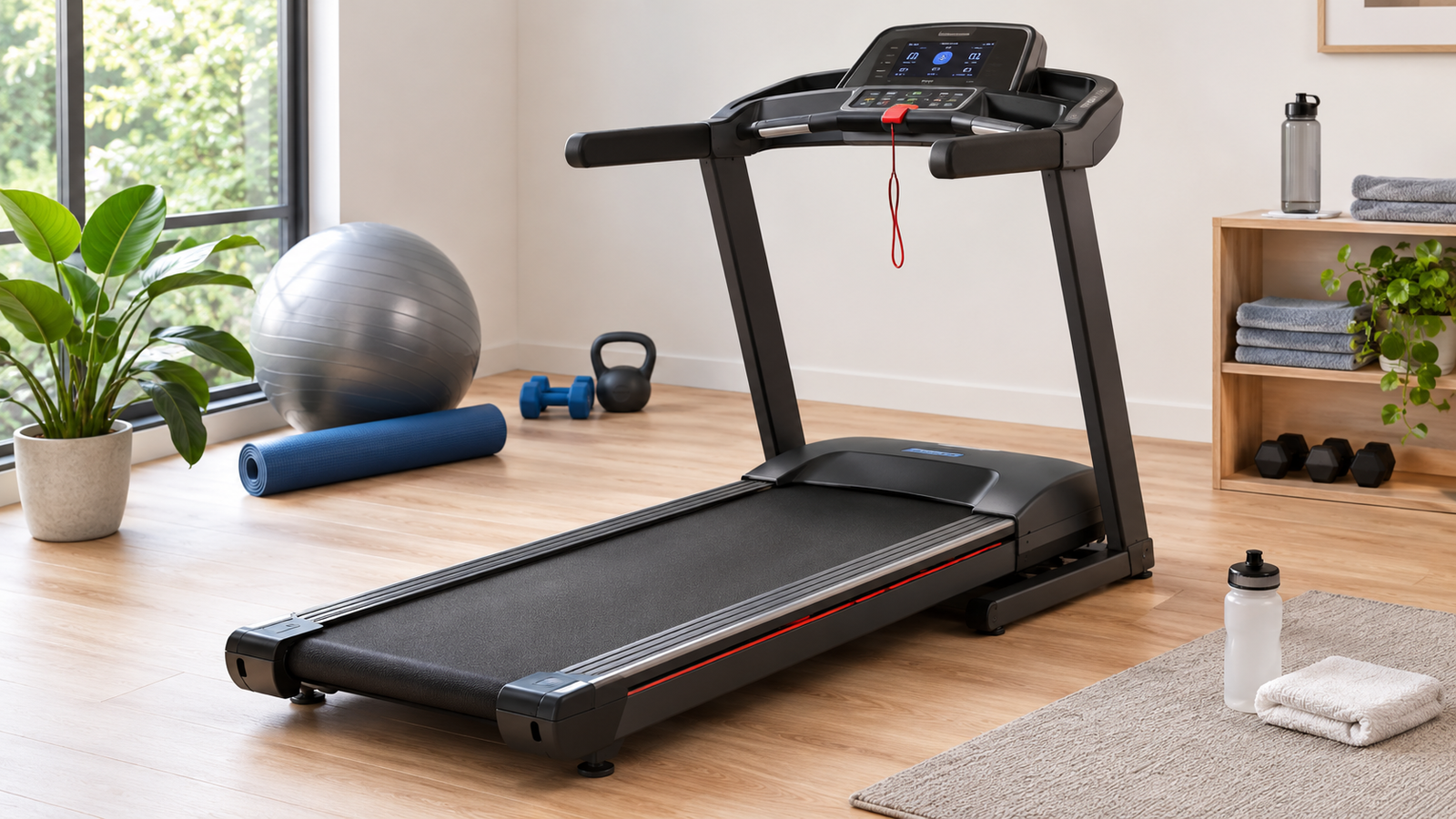
- treadmills;
- ellipticals;
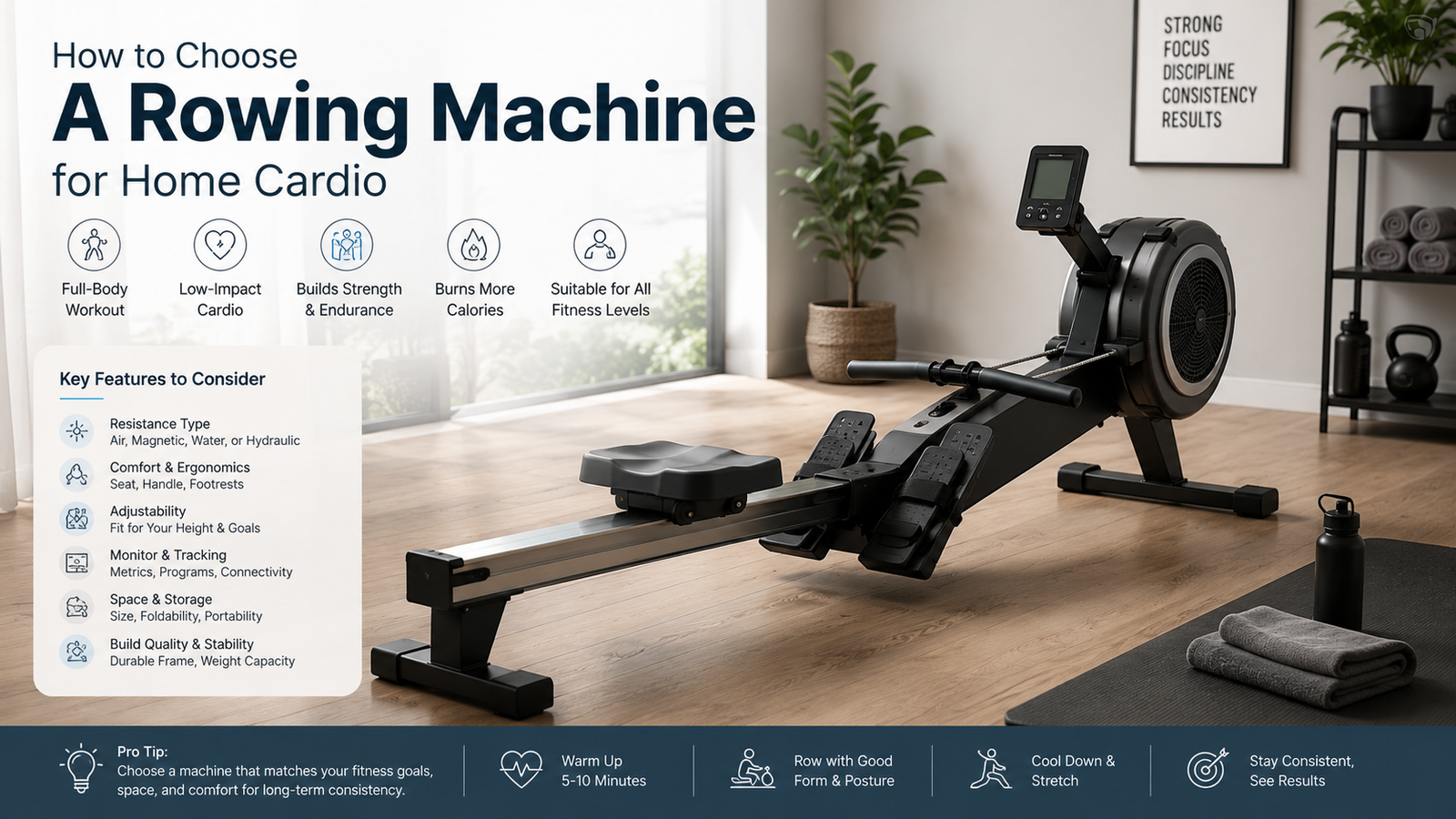
- rowing machines;
steppers can require much less floor space.
But the category includes very different products.
A small hydraulic mini stepper and a commercial-style stair climber may both be described as steppers, yet they differ dramatically in:
- movement pattern;
- resistance;
- stability;
- workout intensity;
- space requirements;
- price.
The most practical way to choose one is:
decide what type of stepping workout you want → check stability and user fit → evaluate resistance and step range → make sure the machine suits your available space → then consider convenience features
The best stepper is not the one that promises the highest calorie burn.
It is the one that lets you maintain a controlled stepping rhythm, increase difficulty gradually and use the machine consistently.
What Is a Stepper?
A stepper is a cardio machine designed to simulate some form of:
- stair climbing;
- upward stepping.
Depending on the machine, your feet may move:
- independently up and down;
- through a short hydraulic arc;
- on rotating staircase-style steps.
Common categories include:
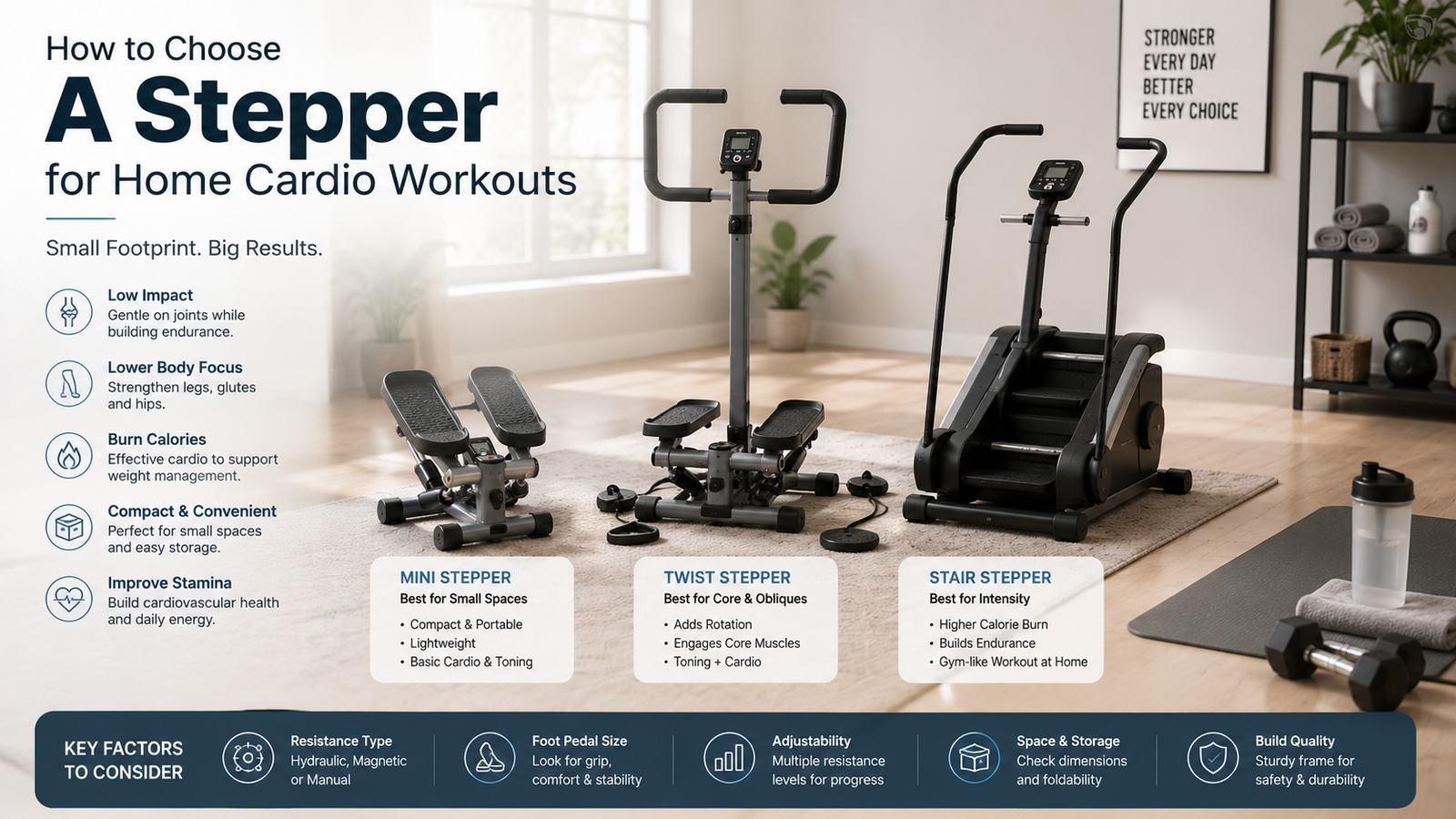
- Mini steppers
- Twist steppers
- Full-size vertical steppers
- Stair climbers or revolving stair machines
These should not be treated as interchangeable.
What Does a Stepper Train?
Stepping primarily involves the lower body.
Muscles commonly involved include:
- quadriceps;
- glutes;
- hamstrings;
- calves.
The trunk also contributes to:
- balance;
- posture.
If the machine includes moving resistance handles or bands, the arms may participate slightly.
But a stepper remains primarily:
lower-body cardio equipment
rather than a full-body strength machine.
Is a Stepper Good for Cardio?
Yes.
Continuous stepping can raise:
- heart rate;
- breathing rate;
- cardiovascular demand.
The intensity can become surprisingly high because you are repeatedly lifting your body against gravity.
Even a compact stepper can produce a challenging workout when used continuously.
Is a Stepper Good for Beginners?
It can be.
But beginners should start with:
- short sessions;
- controlled pace;
- low-to-moderate resistance where adjustable.
Stepping can fatigue the:
- quadriceps;
- calves;
- glutes;
quickly.
A beginner does not need to start with:
- high resistance;
- fast cadence;
- 30-minute continuous sessions.
Five to ten minutes can be enough initially.
Is a Stepper Low Impact?
Generally, steppers are lower impact than:
- running;
- jumping rope.
The feet usually remain in contact with the pedals or steps.
However, low impact does not mean:
- effortless;
- joint-free.
Stepping still requires repeated movement at the:
- knees;
- hips;
- ankles.
A stepper that does not fit your body or that is used with poor technique can still create discomfort.
Why Choose a Stepper?
A stepper may be useful if you want:
- compact cardio equipment;
- stair-style exercise;
- a lower-body-focused workout;
- easy home storage;
- short conditioning sessions.
It is particularly attractive for people who do not have room for:
- treadmill;
- elliptical.
When a Stepper May Not Be the Best Choice
Another cardio machine may be better if you want:
Long Gentle Cardio
Consider:
- exercise bike;
- treadmill walking.
Running-Specific Training
Choose:
- treadmill.
Full-Body Cardio
Consider:
- rowing machine.
More Supported Exercise
Consider:
- recumbent bike.
Very Low Balance Demand
A seated machine may be easier.
The stepper is excellent for certain goals but is not the universal home-cardio solution.
Start With Your Main Goal
Before choosing a stepper, ask:
What do I actually want to use it for?
Short Home Cardio Sessions
Mini stepper may be enough.
Lower-Body Conditioning
Mini or full-size stepper.
Stair-Climbing Training
Full stair climber.
Very Small Space
Compact hydraulic stepper.
Longer Workouts
A larger, more stable stepper may be more comfortable.
Hard Gym-Style Conditioning
Stair climber may suit you better.
Main Types of Steppers
The major categories are:
- mini hydraulic steppers;
- twist steppers;
- full-size vertical steppers;
- stair-climbing machines.
Understanding these categories is more useful than comparing product screens immediately.
Mini Steppers
Mini steppers are small machines with two pedals connected to:
- hydraulic cylinders;
- resistance mechanisms.
They usually have no large console or upright frame.
They are popular because they are:
- compact;
- inexpensive;
- easy to store.
Who Is a Mini Stepper Best For?
A mini stepper can work well for:
- beginners;
- small apartments;
- short workouts;
- people who want inexpensive cardio equipment.
It can also be useful for people who want a machine they can:
- move;
- store;
- use in a small room.
Advantages of Mini Steppers
Common benefits include:
- small footprint;
- relatively low cost;
- no large motor;
- minimal electricity requirements;
- portability.
Many use simple:
- hydraulic resistance;
and require no wall power.
Limitations of Mini Steppers
Potential disadvantages include:
- limited step height;
- limited resistance control;
- reduced stability;
- fewer training metrics;
- shorter comfortable workout duration for some users.
Hydraulic cylinders may also:
- heat during prolonged use.
Always follow manufacturer recommendations for maximum continuous exercise time if provided.
Hydraulic Resistance
Many compact steppers use hydraulic cylinders.
As you press one pedal down, the cylinder provides resistance.
The opposite pedal rises.
This creates an alternating stepping movement.
How Hydraulic Resistance Feels
Hydraulic resistance may feel:
- smooth;
- moderately controlled.
But it can change somewhat as the cylinders:
- warm during use.
Some products therefore include recommended:
- workout duration;
- cooling periods.
Do not ignore those limits.
Adjustable Hydraulic Resistance
Some mini steppers allow adjustment through:
- knob;
- pedal-height setting.
This may change:
- resistance;
- range of motion.
However, not every compact stepper has meaningful resistance adjustment.
Check the actual mechanism rather than simply counting advertised settings.
Step Height on Mini Steppers
Step height affects:
- range of motion;
- muscular demand.
A deeper step generally increases work at the:
- hips;
- knees.
But maximum depth is not automatically better.
A very large range may feel uncomfortable for people with:
- limited mobility;
- knee sensitivity.
Fixed vs Adjustable Step Height
Some machines allow you to control how far the pedals travel.
This can help:
- beginners;
- multi-user households.
A smaller range can make stepping easier.
A larger range can make it more demanding.
Twist Steppers
Twist steppers combine vertical stepping with slight:
- side-to-side;
- rotational movement.
They are often marketed as working:
- waist;
- obliques;
- hips;
more than ordinary steppers.
Does a Twist Stepper Target Belly Fat?
No.
A twisting movement cannot selectively burn fat from:
- waist;
- abdomen.
Fat loss occurs systemically.
The twisting movement may alter:
- muscular demand;
- coordination.
But it does not create targeted fat loss.
Is Twisting Better Than Normal Stepping?
Not necessarily.
Some users enjoy the movement.
Others may find it:
- less natural;
- less stable.
Choose based on comfort.
Do not buy a twist stepper purely because marketing promises:
- waist reduction.
Full-Size Vertical Steppers
These machines usually include:
- larger pedals;
- upright handles;
- stronger frame;
- more adjustable resistance.
They provide a more stable stepping experience than compact mini steppers.
Who Should Consider a Full-Size Stepper?
It may suit someone who wants:
- regular home cardio;
- longer sessions;
- more support;
- more resistance control.
It requires more:
- space;
- budget.
Advantages of Full-Size Steppers
Common advantages:
- better stability;
- larger pedals;
- support handles;
- better displays;
- more resistance levels;
- longer workout comfort.
Disadvantages of Full-Size Steppers
They can be:
- more expensive;
- heavier;
- harder to store.
If your main priority is compactness, a mini stepper may still be more practical.
Stair Climbers
Stair climbers use rotating steps that create a continuous staircase.
They are common in:
- commercial gyms.
Unlike pedal steppers, your feet move from one physical step to another.
Who Is a Stair Climber Best For?
They suit people who want:
- demanding stair-style cardio;
- prolonged climbing workouts;
- high training intensity.
They can provide a very challenging lower-body workout.
Advantages of Stair Climbers
Potential benefits:
- realistic climbing movement;
- large intensity range;
- stable commercial design;
- strong cardiovascular demand.
Disadvantages of Stair Climbers
They are usually:
- large;
- expensive;
- heavy;
- tall.
They may require:
- significant ceiling clearance;
- electrical power.
Most home users do not need a commercial-size stair climber.
Mini Stepper vs Stair Climber
These are very different products.
Mini Stepper
Best for:
- compact use;
- short home workouts;
- budget-conscious buyers.
Stair Climber
Best for:
- serious climbing workouts;
- dedicated gym space;
- high training volume.
Do not expect a small hydraulic stepper to reproduce the exact feel of a commercial stair machine.
Stepper vs Treadmill
Stepper
Advantages:
- smaller;
- stair-style intensity;
- lower-body emphasis.
Treadmill
Advantages:
- walking and running;
- longer workouts;
- more familiar movement.
If you enjoy:
- walking;
a treadmill may be easier to sustain.
If you enjoy:
- climbing;
a stepper may be better.
Stepper vs Exercise Bike
Stepper
- standing;
- weight-bearing;
- stronger climbing-style leg demand.
Bike
- seated;
- lower balance requirement;
- often easier for longer sessions.
Choose according to:
- movement preference;
- joint comfort.
Stepper vs Elliptical
Stepper
Movement is more vertical.
Elliptical
Movement is more gliding and horizontal.
The elliptical may feel better for:
- longer steady cardio.
The stepper can feel more:
- demanding;
- lower-body focused.
Stepper vs Rowing Machine
Stepper
Simpler movement.
Rower
More whole-body involvement and greater technique demand.
If you want straightforward climbing cardio, stepper is simpler.
Stepper vs Jump Rope
Both can provide compact cardio.
Stepper
Lower impact.
Jump Rope
More portable and potentially more intense.
If joint impact matters, a stepper may be more comfortable.
Does a Stepper Build Glutes?
Stepping involves the glutes, particularly when using:
- deeper steps;
- higher resistance.
But a stepper is not the most efficient tool for maximizing glute strength or muscle growth.
For that, resistance training such as:
- squats;
- lunges;
- hip thrusts;
- step-ups;
provides more direct progressive overload.
Does a Stepper Build Quads?
The quadriceps work substantially during stepping.
Long sessions can produce significant quad fatigue.
But this is mainly:
- muscular endurance;
- conditioning.
It does not replace dedicated strength training.
Does a Stepper Train Calves?
Yes.
Calves contribute to:
- ankle stabilization;
- pushing through the foot.
If you stay excessively on the toes, the calves may become overly fatigued.
Try to keep the foot appropriately supported on the pedal.
Does a Stepper Train Hamstrings?
Hamstrings contribute to lower-body movement and stabilization.
But the quadriceps and glutes often feel more dominant.
Does a Stepper Train the Core?
The trunk stabilizes the body while you step.
This can provide some core demand.
But stepper training should not replace dedicated exercises if:
- trunk strength;
is a major goal.
Does Holding the Handles Reduce the Workout?
If you lean heavily on the handles and support a significant portion of your body weight, lower-body demand can decrease.
Use handles for:
- balance;
- safety.
Avoid hanging your body weight from them unless necessary.
No-Handle Stepping
Some experienced users step without holding anything.
This increases:
- balance demand.
But it is not necessary.
If the machine is unstable or you have balance concerns, use support.
Safety is more important than making the workout appear harder.
Resistance Bands on Mini Steppers
Some mini steppers include attached bands for:
- curls;
- presses;
- arm movements.
These can add some upper-body activity.
But they do not convert the machine into a complete full-body strength system.
Are Attached Resistance Bands Useful?
They can add variety.
But check:
- attachment strength;
- band quality;
- range of motion.
Do not pull the bands so aggressively that the lightweight stepper becomes unstable.
Stepper Pedal Size
Pedals should be large enough to support:
- most of your shoe.
Small pedals can make stepping feel:
- insecure.
This is particularly important for people with:
- larger feet.
Non-Slip Pedal Surface
Look for:
- textured;
- rubberized;
- high-friction surfaces.
Sweat can make pedals slippery.
A secure pedal is an important safety feature.
Pedal Angle
The pedal should allow the foot to remain in a reasonably comfortable position.
If the pedal forces excessive:
- heel elevation;
- ankle angle;
you may experience discomfort.
Try the machine where possible.
Independent vs Linked Pedal Movement
Some steppers have pedals that move more independently.
Others are mechanically linked.
The feel may differ.
A smooth predictable movement is more important than one design being universally better.
Step Depth
A larger step depth can increase:
- hip;
- knee range of motion.
This may make the workout more demanding.
Beginners often do better with a moderate step depth.
How Deep Should You Step?
Deep enough to create a controlled workout.
Not so deep that you:
- lose posture;
- experience knee pain;
- bounce.
You do not need to push the pedals to their absolute bottom position on every repetition.
Bottoming Out the Pedals
On some mini steppers, letting the pedal hit the base creates:
- noise;
- impact;
- interrupted rhythm.
Try to maintain continuous tension by changing direction before repeatedly slamming the pedal down.
User Weight Capacity
Always check the maximum user-weight rating.
This is especially important on compact steppers because their frames can be relatively small.
Choose a machine with:
- reasonable margin above the user’s weight.
Do not exceed the manufacturer’s limit.
Stability
A stepper should feel stable from side to side.
Look for:
- wide base;
- non-slip feet;
- solid frame.
Compactness is useful, but an extremely narrow machine may feel less secure.
Wider Base vs Smaller Footprint
A wider base usually improves:
- stability.
But it also takes more space.
For home cardio, stability should generally take priority over saving a few centimetres.
Floor Levelling
Some larger machines include adjustable levellers.
Mini steppers may rely on:
- rubber feet.
Use the machine on:
- flat;
- stable flooring.
An uneven surface can increase wobble.
Equipment Mat
A mat can help:
- protect flooring;
- reduce slipping;
- catch sweat;
- reduce some vibration.
It is especially useful on:
- tile;
- laminate;
- hardwood.
Carpet Use
A thick carpet may make a compact stepper feel unstable.
A firm equipment mat may help create a more stable base.
Check manufacturer guidance.
Stepper Noise
Mini steppers can make noise from:
- hydraulic cylinders;
- pedal stops;
- joints.
Larger steppers may produce:
- mechanical;
- motor;
- belt noise.
A well-maintained stepper should not continuously:
- grind;
- clunk.
Hydraulic Cylinder Noise
Some mild sound may be normal.
But unusual:
- clicking;
- leaking;
- grinding;
may indicate wear or damage.
Heat From Hydraulic Cylinders
Hydraulic cylinders can become hot during use.
Do not touch them immediately after a long workout.
This is particularly important around:
- children;
- pets.
Follow manufacturer cooling instructions.
Maximum Continuous Use Time
Some compact steppers specify a maximum continuous exercise time because the hydraulic system needs to cool.
For example, a manufacturer may recommend stopping after a certain number of minutes.
Follow the specific manual.
Do not assume a small stepper is designed for:
- one-hour continuous sessions.
Choosing a Stepper for Long Workouts
If you plan to exercise for:
- 30–60 minutes regularly;
a larger machine with:
- better cooling;
- more stable frame;
- better resistance system;
may be preferable.
Choosing a Stepper for Short Workouts
A mini stepper can work extremely well for:
- 5-minute;
- 10-minute;
- 15-minute sessions.
This can make it easy to increase daily activity without a large home gym.
Is 10 Minutes on a Stepper Useful?
Yes.
Ten minutes can raise:
- heart rate;
- breathing;
- lower-body demand.
For beginners, that can be a meaningful workout.
You can gradually increase duration.
Is 20 Minutes Enough?
Yes.
A 20-minute stepper workout can provide substantial cardio if performed at an appropriate effort.
Training effectiveness depends on:
- intensity;
- consistency;
- total weekly activity.
How Often Should You Use a Stepper?
For general fitness:
- several times per week;
can work well.
If the sessions are very hard, allow more recovery.
You do not need intense stepper training every day.
General Aerobic Activity Guidelines
Many public-health recommendations encourage adults to accumulate approximately:
- 150 minutes of moderate aerobic activity per week;
or an equivalent amount of more vigorous activity, alongside strength training.
Stepper workouts can contribute to this total.
Moderate Stepper Intensity
Moderate exercise generally means:
- breathing is clearly elevated;
- you can still speak in short sentences.
Do not judge intensity entirely by:
- step count;
- resistance setting.
Machines differ.
Vigorous Stepper Intensity
At vigorous effort:
- breathing is much harder;
- conversation becomes difficult.
This can be effective but creates greater:
- fatigue;
- recovery demand.
Step Cadence
Cadence refers to how quickly you step.
Some machines track:
- steps per minute.
Higher cadence increases cardiovascular demand.
But faster is not automatically better.
Maintain:
- controlled movement;
- stable posture.
Step Count
Some consoles display:
- total steps.
This can be useful for motivation.
But one machine’s step may not equal:
- a real staircase step;
- another machine’s step.
Use the number for personal tracking.
Calories
Calorie displays on steppers are estimates.
They may use:
- time;
- step count;
- resistance;
- body weight if entered.
Do not treat them as precise measurements.
Distance
Some machines may display:
- distance;
- floors climbed.
These values are usually calculated estimates.
Use them to compare your own workouts rather than treating them as exact real-world climbing.
Floors Climbed
Large stair machines may estimate the number of:
- floors;
- vertical metres.
Again, treat the number as a training metric rather than a perfect measurement.
Heart-Rate Monitoring
Larger steppers may include:
- handle sensors;
- wireless heart-rate compatibility.
Mini steppers generally do not.
You can use:
- smartwatch;
- chest strap;
if you want heart-rate data.
Do You Need Heart-Rate Monitoring?
No.
For general fitness, the:
- talk test;
- perceived effort;
can work very well.
Stepper Console
Mini steppers may show only:
- time;
- step count;
- calories.
This is enough for basic workouts.
You do not need an advanced display for effective cardio.
Smart Steppers
Full-size premium machines may offer:
- workout programs;
- app connectivity;
- Bluetooth;
- guided training.
These can be useful but are secondary to:
- stability;
- resistance;
- movement quality.
Resistance Adjustment
Some compact steppers use a knob to change:
- pedal height;
- resistance feel.
Others have fixed resistance.
Full-size machines may offer multiple digital resistance settings.
Do You Need Many Resistance Levels?
No.
You mainly need enough range to provide:
- easy;
- moderate;
- hard workouts.
A machine with 30 levels is not automatically better than one with 10 useful levels.
Resistance vs Speed
You can increase stepper intensity through:
- resistance;
- cadence;
- duration.
Do not increase all three simultaneously.
Progress gradually.
Stepper Incline
Unlike a treadmill, most steppers do not use incline as a separate setting.
The movement itself already simulates:
- climbing.
Some larger machines may allow changes to:
- step height;
- resistance.
Stepper Posture
Good posture should be:
- upright;
- stable;
- relaxed through shoulders.
Avoid leaning dramatically forward.
A slight forward body angle may occur naturally during harder climbing, but do not collapse onto the handles.
Keep the Chest Up
Try to maintain:
- neutral spine;
- controlled trunk.
Looking forward can help.
Constantly looking down may encourage:
- rounded posture.
Knee Tracking
Allow the knees to move naturally in line with the feet.
Avoid intentionally forcing them:
- inward;
- outward.
If the machine’s pedal spacing makes movement uncomfortable, consider another model.
Knee Bend
You do not need an extremely deep knee bend on each step.
A moderate controlled range can provide excellent cardio.
Excessively deep stepping may increase:
- fatigue;
- knee demand.
Foot Position
Place enough of the foot on the pedal for stable support.
Do not remain entirely on:
- toes;
unless the machine’s design naturally requires a particular position.
A more balanced foot position can reduce excessive calf fatigue.
Should Your Heel Stay Down?
The exact position varies with:
- machine;
- anatomy.
Try to avoid constantly lifting the heel excessively if it creates calf or Achilles discomfort.
Keep movement controlled.
Leaning on the Handles
One of the most common mistakes on large stair machines is supporting a large portion of body weight through the arms.
This reduces lower-body work.
Use the rails for:
- balance;
- safety.
Do not hang from them.
Why People Lean Forward
Often because:
- resistance is too high;
- pace is too fast;
- fatigue is increasing.
Reduce the intensity before technique deteriorates.
Stepper and Knee Health
Steppers can be comfortable for many people because there is no running impact.
But they still require repetitive knee flexion.
If you experience:
- persistent knee pain;
reduce:
- step depth;
- resistance;
- duration.
If symptoms continue, seek professional assessment.
Is a Stepper Good for Bad Knees?
It depends on the cause of knee problems.
Someone with one condition may tolerate stepping well.
Another may not.
Do not rely on the generic label:
- low impact.
People with significant knee problems or recent surgery should obtain individualized advice.
Stepper and Hip Health
Stepping requires repeated:
- hip flexion;
- hip extension.
Very deep steps can increase hip demand.
If you experience pinching or pain, reduce range and reassess.
Stepper and Ankle Health
The ankle contributes to each step.
People with limited ankle mobility may find:
- deep stepping;
- high resistance;
less comfortable.
Keep the range controlled.
Stepper and Calf Tightness
Calves may fatigue quickly, especially if you:
- stay high on the toes;
- use high resistance;
- begin with long sessions.
Progress gradually.
Stepper and Achilles Tendon
Stepping places repeated demand on the calf-Achilles system.
If you have Achilles problems, do not assume a stepper is automatically safe because it is low impact.
Seek individualized guidance where appropriate.
Stepper and Back Pain
A compact stepper may require more balance and trunk control than expected.
Poor posture can contribute to:
- lower-back discomfort.
Keep:
- torso upright;
- resistance manageable.
Persistent pain should be evaluated.
Stepper for Older Adults
A stepper may be appropriate for some older adults, particularly those with:
- good balance;
- adequate knee and hip mobility.
Useful features include:
- support handles;
- low step height;
- stable base.
For someone with significant balance limitations, a:
- recumbent bike;
may be safer.
Stepper for Beginners With Balance Concerns
Choose a model with:
- stable upright handles.
A tiny unsupported mini stepper may require more balance.
You can also place the machine near a stable support only if this can be done safely and without interfering with movement.
Stepper During Rehabilitation
Stepping may be used in some rehabilitation programs.
But suitability depends on:
- injury;
- surgery;
- range of motion;
- recovery stage.
Follow guidance from your:
- physiotherapist;
- clinician.
Stepper and Cardiovascular Conditions
Stepping can raise heart rate quickly.
People with known cardiovascular disease may require individualized recommendations regarding:
- intensity;
- duration.
Do not rely solely on generic heart-rate charts.
When to Stop Exercising
Stop and seek appropriate medical assessment if exercise causes concerning symptoms such as:
- chest pain;
- fainting;
- severe unexplained shortness of breath;
- significant dizziness;
- new neurological symptoms.
Normal effort causes:
- increased breathing;
- sweating;
- elevated heart rate.
Severe or unusual symptoms should not be ignored.
Beginner Stepper Workout
A simple first routine:
Warm-Up
3–5 minutes at easy pace.
Main Session
5–10 minutes moderate stepping.
Cool-Down
3 minutes easy.
This may seem short, but stepping can be demanding.
Beginner Progression
Week 1
5–10 minutes.
Week 2
10–12 minutes.
Week 3
12–15 minutes.
Week 4
Increase:
- resistance;
- pace;
slightly if appropriate.
You do not need to increase everything at once.
Steady-State Stepper Workout
Warm-Up
5 minutes easy.
Main Session
20–30 minutes at sustainable moderate effort.
Cool-Down
5 minutes.
This is useful for:
- aerobic conditioning.
Stepper Interval Workout
Warm-Up
5 minutes.
Main Set
Repeat 6 times:
- 1 minute faster stepping;
- 2 minutes easy.
Cool-Down
5 minutes.
Hard intervals do not need to be maximal.
Resistance Interval Workout
If the machine allows resistance changes:
Warm-Up
5 minutes.
Main Set
Repeat:
- 2 minutes moderate resistance;
- 1 minute higher resistance;
- 2 minutes easy.
Continue for:
- 20–25 minutes.
Short Conditioning Workout
Warm-Up
5 minutes.
Main Set
10 rounds:
- 30 seconds hard;
- 60 seconds easy.
Cool-Down
5 minutes.
This can become intense quickly.
Stepper Workout for Beginners Who Fatigue Quickly
Try:
5 Rounds
- 2 minutes stepping;
- 1 minute rest.
This allows you to build total exercise time without forcing continuous effort.
Stepper for Weight Management
Stepper workouts can contribute to:
- energy expenditure;
- general physical activity;
- cardiovascular fitness.
But a stepper does not independently cause weight loss.
Long-term body-weight change depends on:
- energy intake;
- overall activity;
- sleep;
- consistency.
Use stepping as one part of the strategy.
Does a Stepper Burn More Calories Than Walking?
Potentially, depending on:
- pace;
- resistance;
- duration;
- body weight.
Stepping can feel harder per minute because you are repeatedly moving vertically.
But a longer walking session may result in greater total energy expenditure.
Do not choose exercise solely by estimated calories per minute.
Does a Stepper Burn Belly Fat?
No exercise selectively burns fat from one body region.
A stepper can contribute to overall energy expenditure.
Fat loss occurs systemically.
Claims that stepping specifically:
- melts belly fat;
- reduces waist fat;
are misleading.
Does a Stepper Slim the Legs?
Stepper training can contribute to overall energy expenditure and improve:
- muscular endurance.
It cannot selectively remove fat from:
- thighs;
- calves.
Body-fat distribution is influenced largely by:
- genetics;
- hormones;
- overall fat loss.
Will Stepping Make Legs Bulky?
For most people, ordinary stepper cardio is unlikely to create dramatic muscle hypertrophy.
It may improve:
- endurance;
- some muscular development.
Significant muscle growth generally requires:
- progressive resistance training;
- sufficient training volume;
- nutrition.
Stepper for Glute Goals
If your goal is glute development, the stepper can complement exercises such as:
- squats;
- lunges;
- Romanian deadlifts;
- hip thrusts.
Do not rely on the stepper alone.
Stepper for Hiking Fitness
Steppers can be useful for:
- climbing endurance;
- leg conditioning.
They may complement hiking preparation.
However, outdoor hiking also requires:
- balance;
- terrain navigation;
- downhill tolerance.
A stepper cannot reproduce all of these.
Stepper for Stair-Climbing Fitness
This is one of the most specific uses.
If you need to improve tolerance for:
- stairs;
- climbing;
a stepper can provide relevant conditioning.
A revolving stair machine gives the most staircase-like experience.
Stepper for Runners
A stepper can provide additional cardiovascular work without running impact.
But it does not replace running-specific adaptations such as:
- tendon loading;
- running economy;
- foot strike.
Use as cross-training.
Stepper for Cyclists
Stepper exercise adds:
- standing weight-bearing work;
- climbing-style leg demand.
It can provide variety.
But it does not replace cycling-specific training.
Stepper for Strength Training Programs
Steppers can work as:
- warm-up;
- conditioning;
- cardio finisher.
If you have a heavy leg session planned, avoid exhausting the legs beforehand.
Stepper Before Strength Training
If strength is the priority:
- 5–10 minutes easy stepping;
may be enough as a warm-up.
Avoid hard intervals before:
- squats;
- lunges;
- deadlifts.
Stepper After Strength Training
Moderate stepper work can be done afterward.
But after heavy lower-body training, keep intensity reasonable.
Your:
- quads;
- glutes;
may already be fatigued.
Stepper on Recovery Days
Very easy stepping can be used as light activity.
But because stepping is lower-body intensive, walking may sometimes be a more recovery-friendly option.
If your legs are burning, it is not a recovery session.
How to Progress Stepper Training
Increase one variable at a time:
- duration;
- pace;
- resistance;
- step depth.
For example:
First
Increase from:
- 10 minutes to 15 minutes.
Later
Increase resistance.
This reduces the risk of doing too much too quickly.
Progressive Overload
Stepper training can progress through:
- longer workouts;
- faster cadence;
- deeper stepping;
- more resistance.
You do not need to set a personal record every workout.
Common Signs You Progressed Too Fast
- severe calf soreness;
- knee discomfort;
- Achilles irritation;
- excessive fatigue;
- difficulty maintaining posture.
Reduce training load if needed.
Warm-Up
A stepper warm-up is simple.
Start with:
- lower pace;
- shallower step;
- lower resistance.
Continue for:
- 3–5 minutes.
Then gradually increase effort.
Cool-Down
Reduce:
- cadence;
- resistance;
for several minutes before stopping.
This allows breathing and heart rate to decrease gradually.
Hydration
For short home workouts, plain water is usually enough.
Longer or hotter sessions may require more fluid.
Drink according to:
- thirst;
- sweat rate;
- environmental temperature.
Do You Need Electrolytes?
Usually not for a:
- 10–20 minute stepper workout.
Electrolytes may become useful during:
- longer training;
- high heat;
- heavy sweating.
Room Ventilation
Stepping can produce substantial heat quickly.
Use:
- fan;
- ventilation;
- air conditioning where appropriate.
This can improve:
- comfort;
- workout quality.
Stepper for Small Apartments
This is one of the category’s biggest strengths.
A mini stepper can often be stored:
- under furniture;
- in a closet;
- against a wall.
But check the actual dimensions.
Machine Weight
Compact steppers may weigh relatively little.
This makes them easy to move.
But very low machine weight can also reduce:
- stability.
Balance portability against sturdiness.
Handlebar Steppers
Some compact steppers include a vertical handlebar.
This can improve:
- balance;
- confidence.
But it also increases:
- storage size.
Adjustable Handlebar Height
If buying a stepper with handles, check whether the height fits:
- your body;
- other household users.
A handle that is too low may encourage:
- leaning.
Display Position
If there is a display, it should be visible without requiring you to:
- bend forward;
- look down constantly.
For mini steppers, displays may be near the feet.
You do not need to watch the data continuously.
Stepper Smart Features
Compact steppers generally need few electronic features.
Some may connect to:
- apps;
- Bluetooth.
These can be useful for tracking.
But they should not outweigh:
- stability;
- pedal quality;
- resistance.
Battery-Powered Displays
Many mini steppers use a simple battery-operated counter.
This allows:
- time;
- steps;
- estimated calories;
without needing wall power.
Electricity Requirements
Mini hydraulic steppers often require no electricity.
Full-size digital or stair machines may need:
- mains power.
Check:
- voltage;
- outlet requirements.
Full Stair Climbers and Ceiling Height
This is essential.
A stair climber raises your body considerably above floor level.
Calculate:
step height + your height + head clearance
before buying.
A machine can fit the floor plan yet be impossible to use safely because of the ceiling.
Stair-Climber Mounting
Use:
- rails;
- lowest stable step.
Start the machine slowly.
Do not begin at high speed before you are balanced.
Stair-Climber Dismounting
Slow the machine significantly.
Hold the rails.
Step off only when:
- safe;
- stable.
Stair-Climber Speed
Higher step speed dramatically increases effort.
Beginners should start:
- slowly.
There is no benefit in racing the staircase while hanging from the handles.
Stair-Climber Handrails
Use for:
- balance.
Avoid leaning with:
- forearms;
- full upper body.
This can reduce training demand and alter posture.
Looking Down on a Stair Climber
Occasional glances may be necessary to see the steps.
But constantly bending forward can affect posture.
Develop a stable rhythm.
Missing a Step
Rotating stair machines require attention.
Do not use them while:
- distracted;
- fatigued beyond control.
Know where the:
- emergency stop;
is located.
Safety Key or Emergency Stop
Full-size powered machines should have an accessible stop mechanism.
Understand it before starting your first workout.
Mini-Step Safety
Before stepping on:
- Place machine on stable floor.
- Check pedals.
- Confirm hydraulic parts are intact.
- Make sure nothing is underneath the pedals.
- Step on carefully.
A compact machine can shift if placed poorly.
Getting Onto a Mini Stepper
Use a stable support if needed.
Place one foot on a pedal.
Then transfer weight carefully to the other.
The pedals may move immediately.
Getting Off a Mini Stepper
Slow down.
Bring the pedals to a controlled position.
Step off carefully.
Do not jump off while the pedals are moving.
Stepper Safety Around Children
Compact machines may look like toys but contain:
- moving pedals;
- hot hydraulic cylinders;
- pinch points.
Keep children away during and immediately after use.
Safety Around Pets
Pets can walk beneath the pedals.
Keep them away while the machine is operating.
Storage Around Children
Store the machine so children cannot:
- climb;
- play on the pedals;
- touch hot cylinders after use.
Stepper Maintenance
Maintenance depends on the design.
Mini steppers may require:
- bolt checks;
- joint inspection;
- hydraulic-cylinder inspection.
Larger machines may require more extensive service.
Hydraulic Cylinder Inspection
Check for:
- oil leakage;
- damaged seals;
- unusual resistance.
A leaking hydraulic cylinder should not be ignored.
Pivot Points
Pedal mechanisms may use:
- pivots;
- bushings.
If squeaking develops, follow the manufacturer’s lubrication instructions.
Do not apply random lubricant to hydraulic components.
Bolt Checks
Repeated stepping can loosen fasteners.
Periodically inspect:
- pedal bolts;
- base;
- handlebar mounts.
If the machine starts wobbling, stop and inspect it.
Pedal Surface Cleaning
Sweat and dust can reduce grip.
Wipe pedals regularly.
Do not leave them:
- wet;
- oily.
Frame Cleaning
Wipe sweat from:
- metal;
- painted surfaces.
Sweat contains salts that can contribute to:
- corrosion over time.
Hydraulic Cylinder Cooling
If the manual specifies a cooling period:
- follow it.
Do not place cold water directly onto hot cylinders.
Allow them to cool naturally unless manufacturer guidance says otherwise.
Warranty
For a compact stepper, check warranty on:
- frame;
- hydraulic cylinders;
- moving parts.
Hydraulic components are often among the most important wear items.
Warranty Length vs Product Price
Budget steppers may have shorter warranties.
This does not automatically make them poor value.
But frequent users should consider whether replacement or service support is available.
Service Availability
For simple mini steppers, replacement may be easier than professional repair.
For full-size machines, local service becomes much more important.
Check:
- parts;
- technician support.
Buying a Stepper in India
For Indian buyers, consider:
- maximum user-weight rating;
- hydraulic warranty;
- local service;
- replacement parts;
- seller support;
- return policy.
For larger powered steppers, also verify:
- electrical requirements;
- installation;
- city-level service coverage.
Buying Online
Compare:
- stepper type;
- dimensions;
- user-weight capacity;
- pedal size;
- resistance mechanism;
- support handles;
- warranty.
Do not choose primarily because the listing says:
- “maximum fat burning”;
- “waist trimming”;
- “full body transformation.”
Online Reviews
Look for repeated comments about:
- hydraulic resistance becoming weak;
- squeaking;
- overheating;
- unstable frame;
- small pedals;
- poor seller support.
Longer-term reviews are more useful than:
- delivery-day ratings.
Return Policy
This matters especially for:
- compact machines with limited fit;
- large stair climbers.
Check:
- return period;
- assembled-item policy;
- damage replacement.
Budget Steppers
Budget mini steppers can work well for:
- occasional;
- moderate home cardio.
Prioritize:
- stable frame;
- pedal grip;
- adequate weight capacity;
- reliable cylinders.
Mid-Range Steppers
You may gain:
- better resistance;
- larger pedals;
- handles;
- improved frame;
- better warranty.
For frequent home use, this may be worthwhile.
Premium Steppers
Premium full-size steppers may offer:
- digital resistance;
- stronger frames;
- better consoles;
- larger step range.
They can make sense for regular training.
Commercial Stair Climbers
These are built for:
- gyms;
- heavy use.
They usually provide excellent:
- stability;
- durability.
But they require substantial:
- space;
- ceiling height;
- budget.
They are unnecessary for most home users.
Used Steppers
Used machines can offer good value.
Inspect:
- frame;
- pedals;
- resistance;
- cylinders;
- console;
- handles.
For hydraulic machines, check for:
- leakage;
- uneven resistance.
Used Stair Climbers
For powered stair machines, inspect:
- step mechanism;
- motor;
- belt/chain;
- electronics;
- emergency stop.
Service history becomes important.
Common Stepper Buying Mistakes
Buying Based on Calorie Claims
Machine estimates are not exact.
Choosing the Smallest Stepper Regardless of Stability
Compact does not always mean better.
Ignoring User-Weight Capacity
This is a safety issue.
Choosing Tiny Pedals
Foot support matters.
Buying a Twist Stepper for “Belly Fat”
Spot reduction does not work.
Ignoring Hydraulic Workout Limits
Some mini steppers require cooling periods.
Buying Without Checking Resistance Range
You need room to progress.
Ignoring Balance Requirements
Some compact machines offer little support.
Buying a Stair Climber Without Measuring Ceiling Height
A major mistake.
Paying for Displays Before Mechanical Quality
Movement and stability come first.
Common Stepper Training Mistakes
Stepping Too Fast Immediately
Build control first.
Leaning Heavily on Handles
Reduce intensity.
Staying Only on the Toes
May increase calf fatigue.
Slamming Pedals Into the Bottom
Maintain continuous movement.
Using Maximum Resistance From Day One
Progress gradually.
Taking Extremely Deep Steps
More range is not automatically better.
Letting Knees Collapse Inward
Maintain natural alignment.
Doing Hard Stepping Every Day
Recovery matters.
Ignoring Pain
Muscular fatigue and joint pain are not the same.
How to Test a Stepper Before Buying
If possible, use it for several minutes.
Check:
Stability
Does it wobble?
Pedal Size
Do your feet fit comfortably?
Resistance
Does it feel smooth?
Step Depth
Can you maintain a natural range?
Noise
Does it squeak excessively?
Balance
Do you feel secure?
Handles
Are they at a comfortable height if included?
Test at a Realistic Pace
A stepper may feel stable during:
- slow movement;
but unstable when cadence increases.
Try the pace you actually expect to use.
A Simple Choice by Goal
Compact Daily Cardio
Choose:
mini hydraulic stepper
More Stability
Choose:
stepper with upright handles
Lower-Body Conditioning
Choose:
full-size vertical stepper
Serious Stair Training
Choose:
stair climber
Twisting Movement Preference
Choose:
twist stepper, but not for spot-fat-loss claims.
A Simple Choice by Space
Very Small Space
Mini stepper.
Small Apartment
Mini stepper with compact handle.
Medium Home Gym
Full-size stepper.
Dedicated Gym Room
Stair climber.
Measure before buying.
A Simple Choice by Workout Duration
5–15 Minutes
Mini stepper can work very well.
20–30 Minutes
Quality mini or full-size stepper.
30–60 Minutes Frequently
Full-size machine may provide better:
- comfort;
- cooling;
- stability.
A Simple Choice by Balance Needs
Good Balance
Basic mini stepper may be enough.
Want Extra Support
Choose:
- handlebar stepper.
Significant Balance Limitations
Consider a more stable cardio option such as:
- recumbent exercise bike.
A Simple Choice by Intensity
Easy/Moderate Cardio
Mini stepper.
Moderate/Hard Conditioning
Full-size stepper.
Very Hard Continuous Climbing
Stair climber.
Example Beginner Mini-Stepper Routine
Warm-Up
3 minutes easy.
Main Session
8 minutes moderate stepping.
Cool-Down
2–3 minutes easy.
Repeat:
- 3 times per week;
and gradually increase duration if comfortable.
Example 20-Minute Home Stepper Workout
Warm-Up
4 minutes easy.
Main Session
12 minutes moderate.
Every 3 minutes:
- increase pace for 30 seconds.
Cool-Down
4 minutes easy.
Example Stepper Interval Workout
Warm-Up
5 minutes.
Main Set
Repeat 6 times:
- 1 minute hard;
- 2 minutes easy.
Cool-Down
5 minutes.
Example Stair-Climber Workout
Warm-Up
5 minutes slow climbing.
Main Session
20 minutes moderate.
Every 5 minutes:
- increase speed slightly for 1 minute.
Cool-Down
5 minutes.
Stepper Buying Checklist
Before purchasing, ask:
1. What type of stepper do I need?
Mini, twist, full-size or stair climber?
2. How long will my usual workouts be?
Short sessions or prolonged cardio?
3. Is the machine stable enough?
Especially important with compact models.
4. Are the pedals large enough?
Your feet should feel secure.
5. Is the user-weight limit appropriate?
Leave reasonable margin.
6. Can resistance be adjusted?
Useful for progression.
7. Is the step depth comfortable?
Do not assume maximum range is best.
8. Do I need support handles?
Important if balance is a concern.
9. Does the hydraulic system have continuous-use limits?
Check before buying.
10. Is the noise acceptable?
Important for apartments.
11. Does it fit the available space?
Check both workout and storage dimensions.
12. Is ceiling height sufficient?
Essential for full stair climbers.
13. Is the warranty adequate?
Especially for resistance components.
14. Are replacement parts or service available?
Important for frequent use.
15. Will I realistically enjoy using it?
The most important question.
When Should You Seek Professional Guidance?
Individualized exercise or medical guidance may be appropriate if you have:
- significant knee or hip problems;
- Achilles or ankle conditions;
- major balance limitations;
- recent surgery;
- known cardiovascular disease;
- unexplained exercise-related symptoms.
A physiotherapist or qualified exercise professional can also help if stepping repeatedly causes:
- joint pain;
- back pain;
- persistent tendon discomfort.
The Physical Glow Takeaway
A stepper can be an excellent home-cardio option when you want compact equipment with surprisingly high cardiovascular and lower-body demand.
Start by choosing the right category:
- small-space and short workouts → mini stepper;
- more balance support → handlebar stepper;
- regular longer home workouts → full-size stepper;
- serious staircase-style conditioning → stair climber.
Then focus on the features that actually matter:
- stability → the machine should remain secure while stepping;
- pedal size → enough room for safe foot placement;
- step depth → comfortable and controllable;
- resistance → enough range to progress;
- weight capacity → appropriate for the user;
- balance support → handles if needed;
- continuous-use rating → particularly important for hydraulic machines;
- space → realistic for the room;
- ceiling height → essential for stair climbers;
- warranty and service → especially important for frequently used machines.
Do not choose a stepper because it promises:
- belly-fat reduction;
- instant thigh slimming;
- maximum calorie burn.
Those claims oversimplify how exercise and body composition work.
Instead, choose a machine that lets you:
step with control → maintain upright posture → increase duration gradually → add resistance when appropriate → train consistently.
A compact stepper used for 15–20 minutes several times each week can be far more valuable than a large, expensive cardio machine that rarely gets used.
The most useful stepper is ultimately the one that fits both your body and your routine.