How to Choose Home Gym Equipment for Your Space and Goals
Learn how to choose home gym equipment for your available space and goals, with practical guidance on training priorities, floor space, versatility, storage and budget. This beginner-friendly guide helps you make a clear, informed choice without unnecessary complexity.
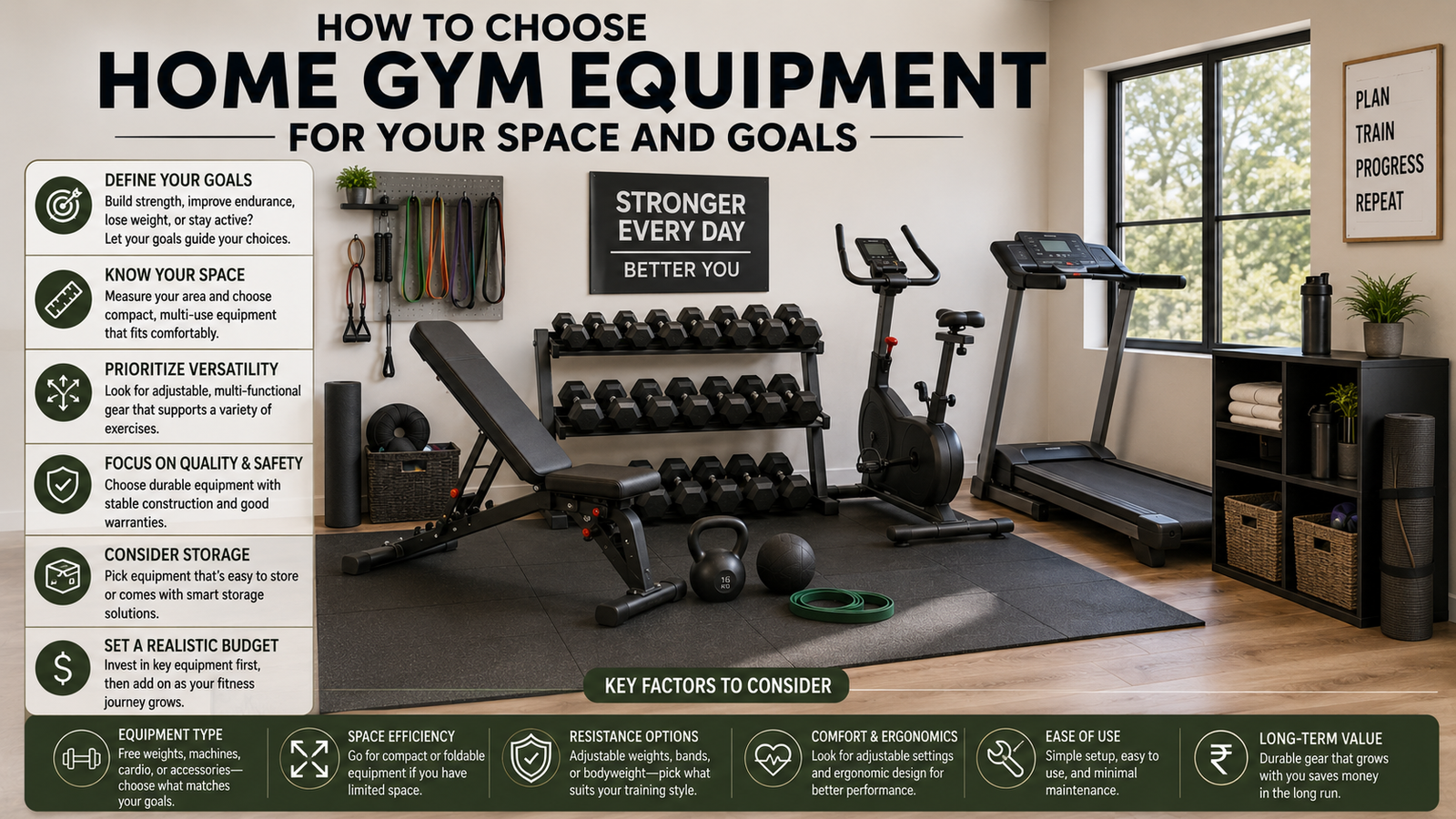
Building a home gym does not require filling a room with expensive machines.
A useful home gym can be created with:
- a few dumbbells;
- resistance bands;
- a bench;
- a yoga mat;
- one cardio machine;
- or a more complete barbell-and-rack setup.
The right equipment depends on:
- your fitness goals;
- available floor space;
- ceiling height;
- training experience;
- budget;
- noise restrictions;
- storage;
- whether several people will use the equipment.
The biggest mistake is buying equipment before deciding what the gym needs to help you accomplish.
A treadmill may be an excellent purchase for someone whose main goal is:
- walking;
- running;
- regular cardio.
But it may consume valuable space for someone primarily interested in:
- strength training.
Similarly, a large barbell rack may be ideal for serious strength training but unnecessary for someone who mainly wants:
- general fitness;
- mobility;
- light resistance training.
The practical approach is:
define your goals → measure the space → choose the training methods that support those goals → buy foundational equipment first → leave room for progression → add specialized equipment only when a real need develops
A home gym should make training easier to perform consistently.
It should not become a collection of expensive equipment that:
- takes up space;
- rarely gets used;
- makes the room difficult to move through.
Start With Your Training Goal
Before comparing equipment, decide what you actually want to improve.
Common goals include:
- general fitness;
- strength;
- muscle building;
- cardiovascular fitness;
- weight management;
- mobility;
- athletic conditioning;
- convenient everyday movement.
You may have more than one goal.
That is normal.
The important question is which ones deserve the most:
- equipment;
- space;
- budget.
General Fitness
A general fitness setup should usually support:
- resistance training;
- cardiovascular activity;
- mobility.
You do not need specialized machines for every muscle.
A small combination such as:
- adjustable dumbbells;
- bench;
- resistance bands;
- mat;
can already support a substantial strength program.
Cardio may come from:
- walking outdoors;
- jump rope;
- treadmill;
- bike;
- rowing machine;
depending on preference.
Strength Training
If increasing strength is a major priority, you need equipment that allows:
progressive resistance
over time.
Useful options include:
- adjustable dumbbells;
- kettlebells;
- barbell;
- weight plates;
- power rack;
- bench.
For long-term heavy strength development, a barbell system offers enormous progression potential.
But a beginner does not necessarily need one immediately.
Muscle Building
Muscle-building training requires enough resistance and exercise variety to train major muscle groups through repeated progression.
Useful home equipment may include:
- dumbbells;
- adjustable bench;
- resistance bands;
- barbell setup;
- cable machine where space and budget permit.
You do not need a separate machine for:
- chest;
- shoulders;
- arms;
- legs.
Free weights can cover much of this effectively.
Cardiovascular Fitness
If cardio is the main goal, prioritize something you actually enjoy using.
Options include:
- treadmill;
- exercise bike;
- rowing machine;
- elliptical;
- stepper;
- jump rope.
A machine that looks impressive but feels unpleasant to use is unlikely to support consistency.
Weight Management
Exercise can support weight management by increasing:
- activity;
- fitness;
- muscle retention;
- energy expenditure.
But no particular home-gym machine guarantees:
- fat loss.
Choose equipment that helps you exercise consistently.
Nutrition and overall energy balance remain major determinants of long-term body-weight change.
Mobility and Flexibility
A mobility-focused setup may require little equipment.
Useful items include:
- exercise mat;
- yoga blocks;
- yoga strap;
- resistance bands;
- foam roller;
- mobility balls.
You do not need a large machine to improve:
- range of motion;
- movement control.
Athletic Conditioning
Athletes may prioritize:
- strength equipment;
- jump rope;
- sled where appropriate;
- plyometric box;
- medicine ball;
- agility tools.
But equipment should reflect the actual sport.
Do not buy generic “performance” tools simply because they look athletic.
Home Gym for Convenience
Some people primarily want to remove barriers to exercise.
The goal may simply be:
walk into room → train for 30 minutes → continue with day
For this user, ease of setup matters more than having every possible exercise option.
Define Your Priority Order
A practical method is to rank goals.
For example:
- Strength
- Muscle building
- Cardio
- Mobility
Your equipment budget should roughly follow that order.
Someone with the opposite priorities may build a completely different gym.
Measure Your Space Before Buying Anything
Do not estimate.
Measure:
- room length;
- room width;
- ceiling height;
- doorway width;
- available storage.
Also identify:
- windows;
- doors;
- electrical outlets;
- ceiling fans;
- lights.
Why Floor Space Alone Is Not Enough
A machine may technically fit into a room but still leave insufficient space for:
- mounting;
- dismounting;
- loading plates;
- moving around;
- emergency clearance.
You need usable space, not just enough room for the equipment footprint.
Make a Floor Plan
A simple sketch can prevent expensive mistakes.
Mark:
- walls;
- doors;
- windows;
- equipment.
Include actual measurements.
You can even use tape on the floor to outline:
- treadmill;
- rack;
- bench.
This helps visualize how large equipment will feel in the room.
Ceiling Height
Ceiling height matters for:
- overhead presses;
- pull-ups;
- treadmills;
- rowing machines stored vertically;
- tall racks.
Treadmill Ceiling Clearance
Remember that the treadmill deck raises you above the floor.
Add:
user height + deck height + running movement clearance
A tall user may need significantly more headroom.
Overhead Press Clearance
If using a barbell overhead, account for:
- your height;
- arm length;
- bar diameter;
- plates.
Ceiling fans and hanging lights can make otherwise adequate ceilings unsafe.
Pull-Up Bar Clearance
A pull-up bar requires space above the hands for:
- head;
- upper body.
A rack may fit under the ceiling while still leaving too little space for comfortable pull-ups.
Doorways and Delivery
Large equipment must first enter the room.
Check:
- doorway width;
- staircases;
- hallway turns;
- lift/elevator dimensions.
This matters especially for:
- treadmills;
- ellipticals;
- commercial benches;
- multi-gyms.
Equipment Footprint vs Working Footprint
Manufacturers usually list the machine footprint.
But your true requirement is larger.
For example, a treadmill may require extra space:
- behind it;
- beside it.
A barbell needs room on both sides to:
- load plates.
Barbell Space
A full-size Olympic bar is approximately:
- 2.2 metres long.
You need additional room beyond both sleeves to:
- add;
- remove plates.
A narrow room may make barbell training awkward even if the bar technically fits.
Rack Space
A rack may occupy a relatively modest rectangle.
But you also need room for:
- bench;
- plates;
- barbell;
- walking around.
Plan the whole training zone.
Small Spaces Can Still Support Excellent Training
You do not need a dedicated room.
Home gyms can be built in:
- bedroom corner;
- garage;
- spare room;
- balcony where environment and equipment suitability allow;
- living room with equipment stored afterward.
The key is choosing compact equipment.
Equipment for a Very Small Space
A highly capable minimal setup can include:
- adjustable dumbbells;
- resistance bands;
- mat.
This may require only a few square metres during use.
Add a Foldable or Vertically Stored Bench
That dramatically expands exercise variety while still preserving space.
Dedicated Gym Room
If you have an entire room, you can consider:
- rack;
- barbell;
- dumbbells;
- cardio equipment.
But avoid filling every corner immediately.
Leave space to:
- move;
- stretch;
- train safely.
Garage Gym
Garages can be excellent because they usually support:
- heavier equipment;
- rubber flooring;
- racks;
- plate storage.
Potential challenges include:
- heat;
- cold;
- humidity;
- dust;
- uneven floors.
Bedroom Home Gym
Prioritize:
- quiet equipment;
- compact storage;
- low odour;
- floor protection.
Large commercial equipment can overwhelm the space.
Apartment Home Gym
Important issues include:
- impact noise;
- vibration;
- floor load;
- neighbours;
- limited storage.
Controlled resistance training is often easier to accommodate than:
- heavy bar dropping;
- treadmill running;
- jump rope.
Consider Noise Before Buying Cardio Equipment
Cardio machines can generate:
- motor noise;
- foot impact;
- vibration;
- fan noise.
This becomes important when sharing walls or floors.
Treadmills Are Often the Noisiest Option
Running creates repeated impacts.
Even a relatively quiet motor cannot eliminate:
- foot strike;
- structural vibration.
If you live above someone, consider this carefully.
Exercise Bikes Are Often Apartment Friendly
Magnetic-resistance bikes can be very quiet.
They can be excellent for:
- apartments;
- early-morning exercise.
Rowing Machines
Noise depends on resistance type.
Magnetic Rowers
Usually quieter.
Air Rowers
Produce noticeable fan noise.
Water Rowers
Create water-sloshing sound.
Ellipticals
Can be relatively quiet when well maintained.
But cheap machines may develop:
- squeaks;
- rattles.
Jump Rope
Requires almost no equipment space but creates:
- repetitive floor impact;
- rope noise.
This may be unsuitable in some apartments.
Strength Training Noise
Noise mainly comes from:
- weight contact;
- plate loading;
- barbell racking;
- dropping.
Rubber flooring and controlled movement can reduce it.
Do Not Assume Rubber Flooring Makes Dropping Silent
Impact can still transfer through:
- concrete;
- structural floors.
If noise matters, avoid dropping weights.
Flooring Is Part of Your Home Gym
Flooring is not merely decorative.
It can protect:
- floor;
- equipment;
- joints;
while improving:
- traction;
- noise control.
Rubber Gym Flooring
One of the best choices for strength-training areas.
Advantages:
- durable;
- grippy;
- impact resistant;
- easy to clean.
Rubber Tiles
Useful because they are modular.
They can be installed only where equipment sits.
Rubber Rolls
Provide fewer seams.
Better for larger dedicated rooms.
Installation may require more effort.
Stall Mats
Heavy rubber mats are sometimes used in garage gyms.
They can be:
- durable;
- inexpensive.
But some may have strong:
- rubber odour.
Make sure the material is appropriate for indoor use.
Foam Puzzle Mats
Fine for:
- stretching;
- bodyweight exercise;
- light dumbbells.
Less suitable for:
- heavy racks;
- deadlifts;
- barbell work.
Heavy equipment can compress or tear them.
Yoga Mats Are Not Gym Flooring
A yoga mat is designed for:
- body contact;
- cushioning.
It is not designed to support:
- heavy dumbbells;
- racks;
- treadmills.
Use it on top of appropriate flooring when needed.
Wooden Floors
Heavy equipment can scratch or dent them.
Use protective mats.
Tile
Tile can crack under dropped weights.
Dense rubber protection is especially important.
Carpet
Carpet may work for light equipment.
But heavy racks can:
- sink;
- wobble.
Cardio equipment may also feel unstable.
A rigid protective platform may help.
Floor Level Matters
A slightly uneven floor can cause machines to:
- rock;
- squeak.
Many machines include:
- adjustable levelling feet.
Structural Floor Capacity
Most ordinary lightweight setups are not a major concern.
But a full home gym may include:
- 150 kg rack;
- 250 kg plates;
- treadmill;
- several people.
On upper floors or unusual structures, professional structural guidance may be appropriate if total concentrated load becomes substantial.
Start With Foundational Equipment
A common home-gym mistake is buying specialized products first.
Instead, begin with equipment that supports many movements.
Good foundations include:
- adjustable dumbbells;
- resistance bands;
- bench;
- mat.
For more serious strength training:
- barbell;
- plates;
- rack.
Adjustable Dumbbells
One of the best first purchases for many home users.
They can support:
- squats;
- lunges;
- presses;
- rows;
- hinges;
- arm exercises.
Why Adjustable Dumbbells Work So Well
One pair may replace:
- 10;
- 15;
- more fixed pairs.
This saves:
- floor space;
- storage;
- often money.
When Fixed Dumbbells Are Better
Choose fixed pairs if:
- space is abundant;
- you perform supersets;
- multiple people train simultaneously;
- fast weight changes matter.
Dumbbell Weight Range
Do not buy only enough weight for your current:
- biceps curls.
Legs and back may quickly require much more resistance.
Choose a system with room for:
- progression.
Resistance Bands
They are inexpensive and take almost no space.
Useful for:
- rows;
- presses;
- mobility;
- pull-up assistance;
- accessory exercises.
Bands are an excellent supplement even in a large home gym.
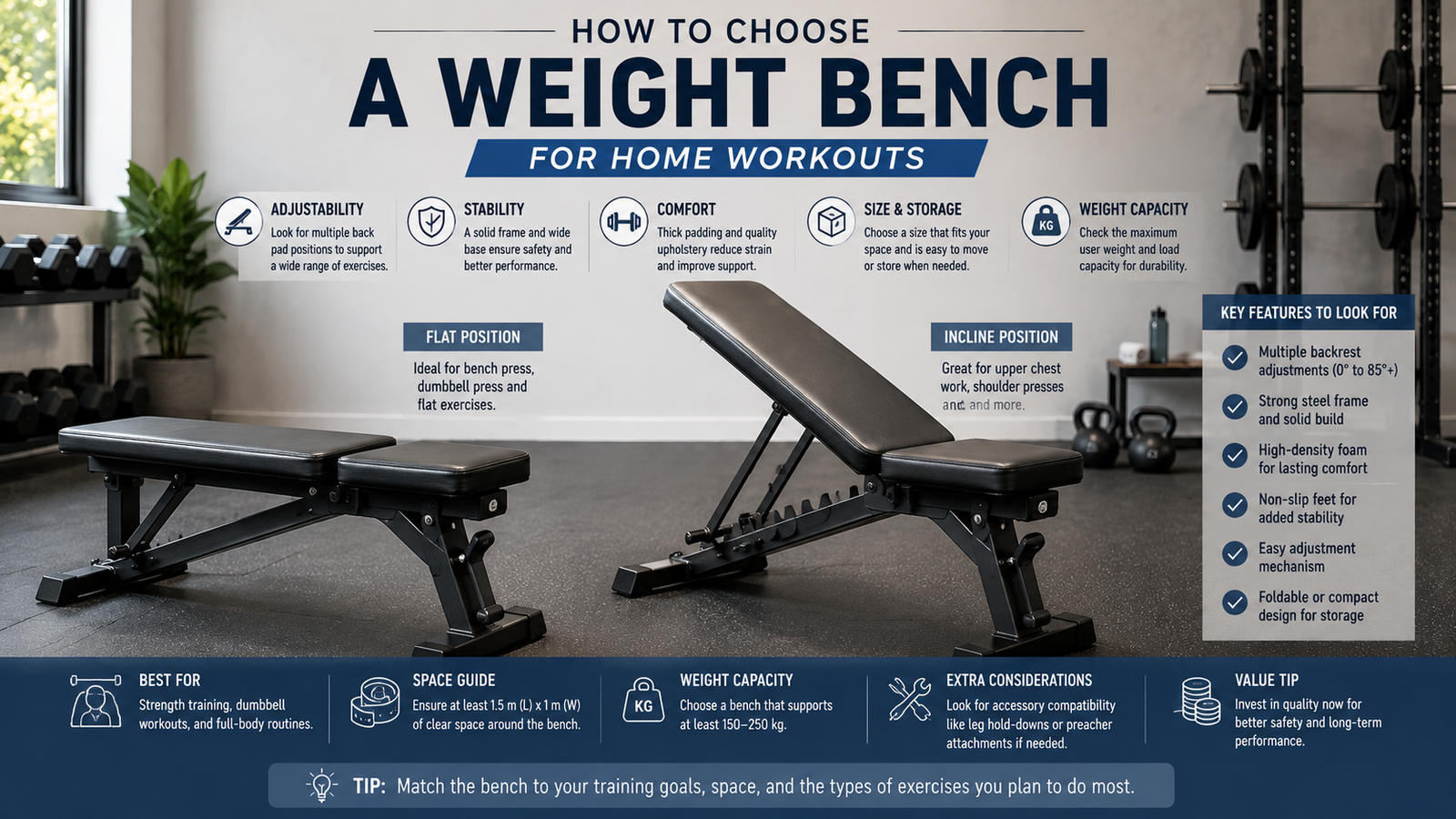
Weight Bench
A bench expands dumbbell training significantly.
It supports:
- flat press;
- incline press;
- seated press;
- chest-supported rows.
An adjustable flat-incline bench is often the most versatile choice.
Exercise Mat
Useful for:
- mobility;
- core work;
- stretching;
- floor exercises.
Do not buy one so thick that it becomes unstable for:
- standing strength work.
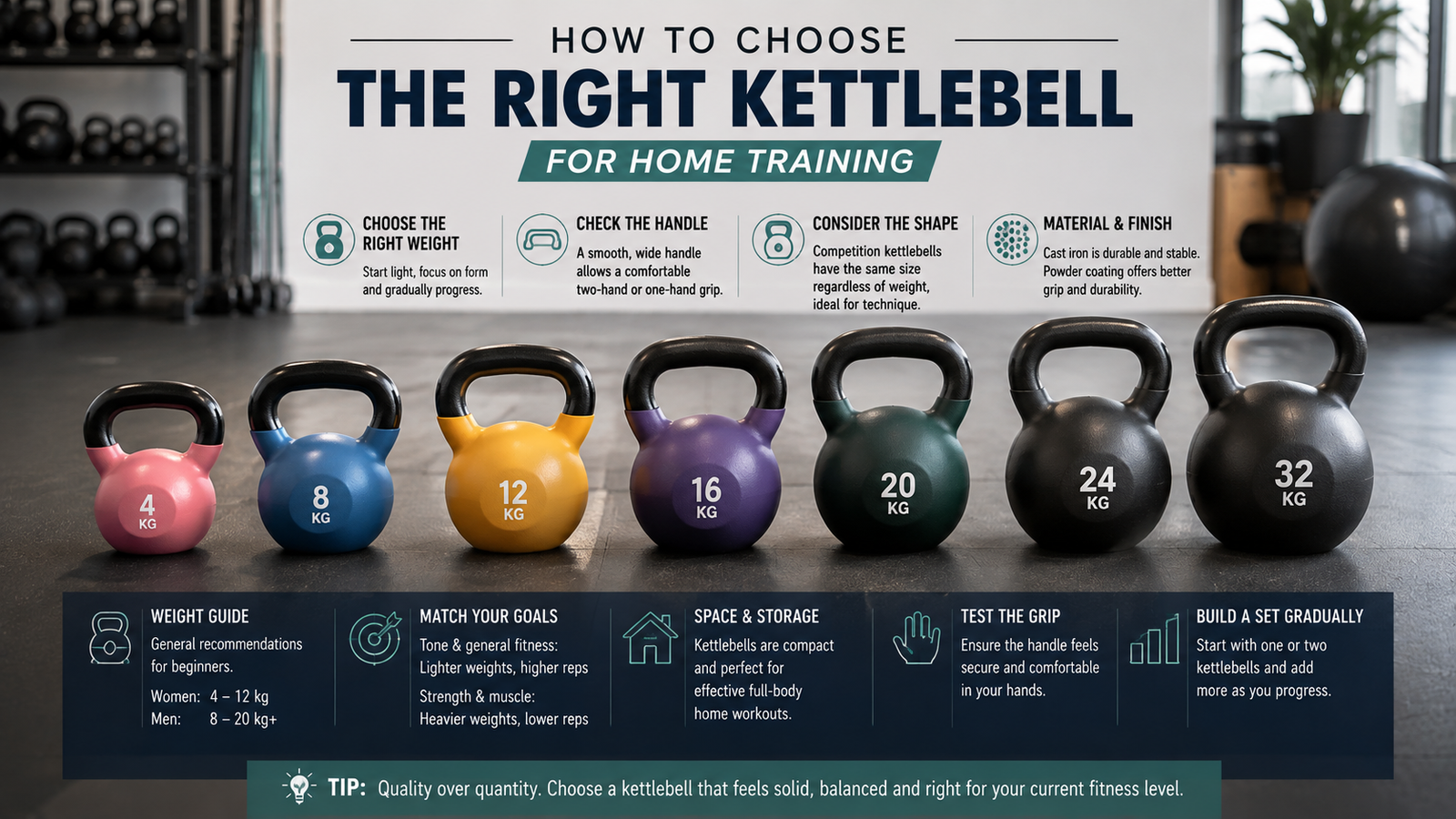
Kettlebell
A single kettlebell can support:
- swings;
- goblet squats;
- carries;
- rows;
- presses.
Excellent for compact full-body training.
Barbell Setup
For long-term heavy strength training, the core system becomes:
- rack;
- barbell;
- plates;
- bench.
This can support years of progression.
Do You Need a Power Rack?
A rack is extremely valuable if you perform:
- barbell squats;
- bench presses.
It provides:
- J-cups;
- safety bars;
- pull-up options.
Power Rack
A four-post structure around the lifter.
Advantages:
- strong safety system;
- versatile;
- many attachments.
Disadvantages:
- large footprint;
- higher cost.
Half Rack
More open than a full power rack.
Can still support:
- squats;
- presses;
- safeties.
It may require less depth.
Squat Stands
Two uprights or a connected stand.
Advantages:
- compact;
- lower cost.
Disadvantages:
- may be less stable;
- safety arms may be shorter.
Excellent for users with limited space if well constructed.
Folding Wall Rack
Can fold toward a wall when not in use.
Very useful for:
- garages;
- multi-purpose rooms.
Wall Rack Installation
Requires strong anchoring to appropriate:
- wall structure.
Incorrect installation can be dangerous.
Follow manufacturer guidance or use professional installation where needed.
Rack Height
Check ceiling clearance before buying.
If you want pull-ups, ensure enough space above:
- bar.
Rack Width
Most racks are designed around standard Olympic bars.
But dimensions vary.
Check compatibility.
Safety Arms and Spotter Straps
These are critical for barbell training.
They can catch a failed:
- squat;
- bench press.
Spotter Straps
Fabric straps spanning the rack.
Advantages:
- quieter;
- gentler on barbell.
Safety Pins / Pipes
Strong steel safeties.
Can be highly durable.
Do Not Build a Barbell Home Gym Without Considering Safety
A rack should not simply hold the bar before the set.
It should also provide a plan for:
- failed repetitions.
Barbell
For most home users, a multipurpose Olympic bar is the practical choice.
It can support:
- squats;
- bench;
- deadlifts;
- rows;
- presses.
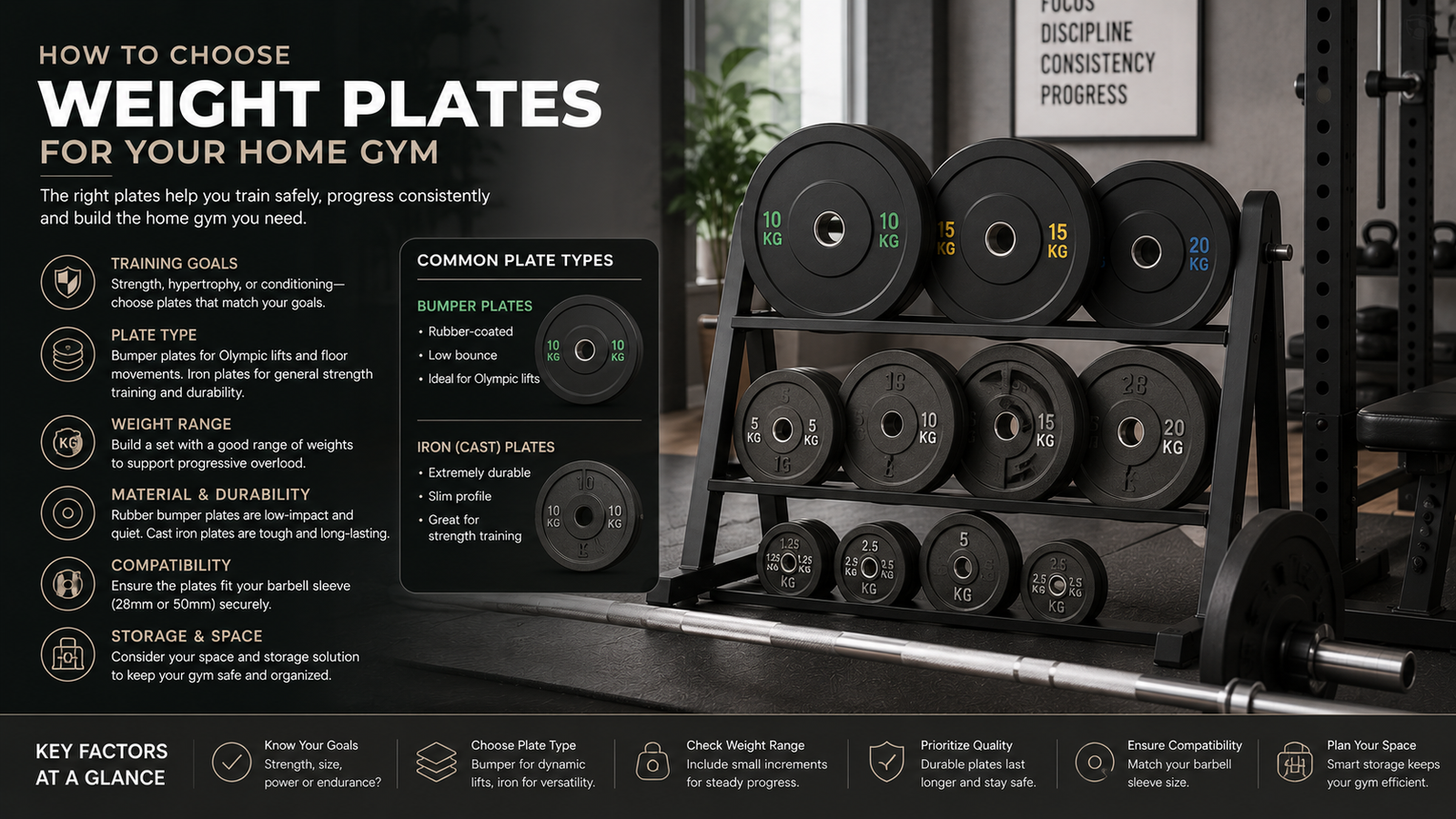
Weight Plates
Choose according to training style.
General Strength
Cast iron or rubber-coated Olympic plates.
Olympic Lifting
Bumper plates.
Powerlifting
Thin iron or calibrated plates where appropriate.
Collars
Simple but essential.
They help stop plates from:
- moving;
- sliding.
Plate Storage
Once you own substantial weight, storage matters.
Options:
- plate tree;
- rack-mounted pegs;
- wall storage.
Keep heavy plates:
- low;
- secure.
Cardio Equipment: Choose One You Will Actually Use
You do not need:
- treadmill;
- bike;
- rower;
- elliptical;
all at once.
One cardio modality used consistently is often enough.
Treadmill
Best suited for people who primarily enjoy:
- walking;
- jogging;
- running.
Treadmill Advantages
- familiar movement;
- speed control;
- incline options;
- useful in bad weather.
Treadmill Disadvantages
- large;
- heavy;
- noisy;
- expensive.
Who Should Prioritize a Treadmill?
Someone who already knows they enjoy:
- walking;
- running.
Not someone hoping an expensive machine will create motivation automatically.
Exercise Bike
Excellent for:
- low-impact cardio;
- small spaces;
- quiet training.
Options include:
- upright;
- recumbent;
- spin-style;
- air bike.
Upright Bike
Comfortable general cardio.
Usually compact.
Recumbent Bike
Provides:
- back support;
- larger seat.
Useful for users who prefer additional stability.
Spin-Style Bike
Designed for more performance-oriented indoor cycling.
Excellent for:
- intervals;
- classes.
Air Bike
Uses moving handles and fan resistance.
Provides intense:
- full-body conditioning.
Usually noisy because of the fan.
Rowing Machine
Provides:
- cardiovascular training;
- substantial involvement of legs, trunk and upper body.
Requires learning proper:
- rowing technique.
Rower Space
Rowers are long.
Some store:
- vertically;
- folded.
Measure both operating and storage dimensions.
Elliptical
Provides low-impact cardio using:
- legs;
- handles.
Can be comfortable for people who dislike running impact.
Elliptical Space
Full-size models can be:
- long;
- tall.
Check ceiling clearance because pedals raise the user.
Stepper
Compact options exist.
Useful for:
- lower-body cardio.
Full stair-climbing machines can be very large and expensive.
Jump Rope
Perhaps the most space-efficient cardio tool.
Advantages:
- inexpensive;
- portable;
- effective conditioning.
Limitations:
- higher impact;
- noise;
- ceiling and floor-space requirements.
Outdoor Cardio Is Still an Option
You do not necessarily need a cardio machine.
You can use:
- walking;
- running;
- cycling outdoors.
Then dedicate home-gym space to:
- strength training.
This may be the most efficient setup.
Do You Need Both Strength and Cardio Equipment?
Not necessarily.
You can combine home strength training with outdoor:
- walking;
- cycling.
Or use a treadmill while strength training at a commercial gym.
A home gym should complement your real routine.
Cable Machines
Cable systems can significantly increase exercise variety.
They allow:
- pulldowns;
- rows;
- triceps work;
- curls;
- lateral raises;
- chest fly variations.
Functional Trainer
Usually includes two adjustable cable columns.
Advantages:
- highly versatile;
- smooth resistance;
- many exercise angles.
Disadvantages:
- expensive;
- large.
Who Benefits From a Functional Trainer?
Users focused on:
- bodybuilding;
- general strength;
- cable-based accessory work.
It can be one of the best premium additions after foundational equipment is already in place.
Single Cable Tower
Uses less space.
Can support:
- lat pulldowns;
- rows;
- curls;
- pushdowns.
A strong option for smaller gyms.
Plate-Loaded Cable Machine
Uses standard weight plates.
Advantages:
- lower cost;
- shares your existing plates.
Disadvantages:
- requires manual loading.
Selectorized Cable Machine
Uses a weight stack.
Advantages:
- fast adjustments.
Disadvantages:
- more expensive;
- very heavy.
Multi-Gym Machines
Combine multiple stations into one unit.
May include:
- chest press;
- lat pulldown;
- leg extension;
- cable exercises.
Advantages
- guided exercises;
- all-in-one convenience.
Disadvantages
- large;
- difficult to move;
- fixed movement paths;
- often limited adjustment.
For many users, free weights provide better:
- versatility per square metre.
When a Multi-Gym Makes Sense
Consider it if you strongly prefer:
- machine-style training;
- guided movements;
and have enough permanent space.
Smith Machine
Uses a bar travelling on fixed rails.
Some home models combine:
- Smith machine;
- cables;
- rack.
Advantages
- guided bar path;
- easy racking;
- useful for many bodybuilding exercises.
Disadvantages
- large;
- expensive;
- fixed path may not suit every exercise.
A Smith machine is not inherently safer or more effective than free weights.
It is simply a different resistance system.
Smith Machine vs Power Rack
Power Rack
Better for:
- free barbell training;
- natural movement path.
Smith Machine
Better for:
- guided bar training;
- certain bodybuilding exercises.
Some premium home gyms include both.
Leg Press
A dedicated leg press can be excellent.
But it requires considerable:
- space;
- weight plates;
- budget.
For most first-time home gyms, exercises such as:
- squats;
- split squats;
- lunges;
provide more efficient use of space.
Leg Extension and Leg Curl Machines
Useful for targeted:
- quadriceps;
- hamstring training.
But again, these are specialized additions.
Buy them after foundational equipment if you have a clear need.
Back Extension Bench
Useful for:
- spinal erectors;
- glutes;
- hamstrings.
Can be valuable but is not essential.
Glute-Ham Developer
Specialized equipment.
Useful for:
- posterior-chain training.
Large footprint relative to number of exercises.
Dip Station
Dips can be performed using:
- rack attachment;
- dedicated station.
If you already own a rack, an attachment often saves space.
Pull-Up Bar
One of the most useful bodyweight tools.
Can be:
- rack mounted;
- wall mounted;
- doorway mounted.
Doorway Pull-Up Bars
Convenient but require careful compatibility.
Some use:
- leverage;
- pressure mounting.
Check doorframe condition and installation.
Wall-Mounted Pull-Up Bars
Strong when properly installed.
Require suitable:
- wall;
- anchors.
Rack Pull-Up Bar
Often the most convenient if you already own a:
- power rack.
Suspension Trainer
Straps anchored to:
- door;
- rack;
- beam.
Useful for:
- rows;
- push-ups;
- core exercises.
Very space efficient.
Suspension Trainer Safety
The anchor must be able to support:
- your body weight;
- movement.
Do not attach to weak fixtures.
Medicine Balls
Useful for:
- throws;
- rotational work;
- conditioning.
But some exercises require:
- reinforced wall;
- open floor area.
Slam Balls
Designed for repeated floor slams.
Do not confuse with medicine balls not intended for:
- slamming.
Stability Ball
Useful for:
- certain core;
- mobility exercises.
But takes more storage space than expected because it remains inflated.
Balance Trainers
Products such as half-dome trainers can support:
- balance;
- rehabilitation-style exercises.
They are not necessary for general strength training.
Unstable Surface Training
Standing on unstable equipment does not automatically make every strength exercise better.
For developing maximal:
- strength;
- power;
stable surfaces are generally more appropriate.
Plyometric Box
Useful for:
- box jumps;
- step-ups;
- elevated exercises.
Choose Box Height Carefully
Higher is not automatically better.
The goal of a box jump is not simply to tuck your knees enough to land on the highest possible object.
Soft Plyometric Boxes
Reduce injury risk from hitting:
- shins.
But may feel less stable if poorly designed.
Wooden Boxes
Stable and durable.
But sharp edges can cause painful impacts.
Adjustable Boxes
Can provide several heights.
Check locking stability.
Sled
Excellent for:
- pushing;
- pulling;
- conditioning.
But requires:
- long open space;
- suitable floor or outdoor surface.
This is rarely practical in small indoor home gyms.
Battle Ropes
Require a large:
- open training area;
- secure anchor.
They can create:
- noise;
- vibration.
They are not necessary for effective conditioning.
Punching Bag
Can support:
- boxing-style conditioning.
Requires:
- appropriate mounting;
- sufficient space.
Hanging Bag Mounting
The structure must safely tolerate:
- bag weight;
- repeated dynamic force.
Professional installation may be appropriate.
Freestanding Punching Bags
Avoid ceiling mounting but take significant:
- floor space.
Mobility and Recovery Equipment
This category should remain simple.
Useful options include:
- foam roller;
- massage ball;
- yoga blocks;
- stretch strap.
Foam Roller
Useful for:
- temporary reduction in muscle stiffness;
- mobility work.
It does not “break up” scar tissue or permanently lengthen muscle.
Massage Gun
Can be a useful convenience accessory.
But it should come after foundational training equipment unless recovery tools are a specific priority.
Home Gym Mirrors
Mirrors can help with:
- room brightness;
- some visual technique feedback.
But they are not essential.
Mirrors and Technique
A mirror can help you see:
- posture;
- position.
But constantly turning your head to watch yourself can alter movement.
Recording video may sometimes provide better feedback.
Mirror Safety
Use properly mounted:
- safety-backed;
- gym-appropriate mirrors.
Do not place free-standing glass close to:
- barbells;
- dumbbells.
Lighting
Good lighting improves:
- safety;
- usability.
You should clearly see:
- plates;
- floor;
- adjustment pins.
Ventilation
This matters particularly in:
- warm climates;
- garages;
- small rooms.
Options may include:
- fan;
- air conditioning;
- ventilation.
Ceiling Fan Safety
Ceiling fans can interfere with:
- overhead presses;
- jump rope;
- pull-ups.
Do not place overhead training directly underneath one.
Standing Fan
Often safer for a home gym.
Position where it cannot be hit by:
- weights;
- people.
Temperature Control
A room that is extremely hot or cold becomes harder to use consistently.
Comfort matters.
Home Gym in Indian Conditions
For many Indian homes, useful considerations include:
- high summer temperatures;
- monsoon humidity;
- apartment space;
- electrical stability;
- dust.
Humidity and Metal Equipment
Humidity can contribute to:
- barbell rust;
- plate corrosion;
- machine deterioration.
Wipe sweat and moisture regularly.
Rubber Odour Indoors
New:
- plates;
- flooring;
- dumbbells;
may emit strong smells.
Ventilate the room before heavy use.
Dust
Cardio machines and cable systems collect dust.
Clean around:
- belts;
- rails;
- electronics.
Electrical Requirements
Motorized equipment such as:
- treadmills;
may require suitable grounded outlets.
Check manufacturer requirements.
Do not rely on inappropriate extension cables.
Surge Protection
If power quality is unstable, follow manufacturer recommendations regarding:
- surge protection;
- stabilizers.
Do not assume any random voltage device is suitable.
Equipment Maintenance Matters
Home equipment may receive less daily abuse than commercial equipment, but it still needs maintenance.
Strength Equipment Maintenance
Regularly inspect:
- bolts;
- welds;
- cables;
- pulleys;
- straps.
Cardio Equipment Maintenance
May require:
- belt lubrication;
- tension adjustment;
- rail cleaning;
- hardware tightening.
Follow the specific manual.
Do Not Ignore Unusual Sounds
New:
- grinding;
- clicking;
- severe squeaking;
may indicate a maintenance issue.
Investigate before continuing high-intensity use.
Equipment Warranty
Large equipment can be expensive to repair.
Check warranty coverage for:
- frame;
- motor;
- electronics;
- parts;
- labour.
Frame Warranty
Often longer than coverage for:
- electronics;
- wear components.
Read the details.
Service Availability
This is especially important for:
- treadmills;
- exercise bikes;
- ellipticals;
- functional trainers.
A machine is less useful if replacement parts are unavailable in your area.
India-Specific Service Consideration
Before buying a major machine, check:
- service network;
- local spare parts;
- installation support.
A slightly less advanced machine with reliable service may be the better long-term purchase.
Commercial vs Home-Use Equipment
Commercial equipment is designed for repeated use by many people.
Advantages:
- durability;
- stability;
- higher capacities.
Disadvantages:
- expensive;
- heavy;
- large.
Most home users do not need commercial equipment for every category.
Where Commercial Quality Matters Most
You may benefit from stronger construction in:
- rack;
- bench;
- barbell;
- frequently used cardio machine.
Decorative accessories do not require commercial-grade build.
User Weight Capacity
Machines and benches have stated weight limits.
Do not choose equipment where your body weight is close to the maximum rating.
Leave reasonable:
- margin.
Cardio Machine Capacity
Higher-capacity machines often have:
- stronger frames;
- larger decks;
- greater stability.
This can improve comfort even for users below the limit.
Equipment for Multiple Users
If several family members will use the gym, consider the strongest and tallest user.
Equipment should accommodate:
- all body sizes;
- resistance requirements.
Adjustable Equipment Becomes More Valuable
Useful examples:
- adjustable dumbbells;
- adjustable bench;
- adjustable bike seat;
- cable pulleys.
One Person’s Ideal Machine May Not Fit Another
For example:
- bike saddle height;
- treadmill belt length;
- rowing rail length.
Check adjustability.
Home Gym for Beginners
A beginner should avoid buying an entire gym on day one.
Start with equipment that supports learning basic patterns:
- squat;
- hinge;
- push;
- pull;
- carry.
Beginner Setup Option 1
- adjustable dumbbells;
- bench;
- resistance bands;
- mat.
This can train almost the entire body.
Beginner Setup Option 2
If cardio is important:
- adjustable dumbbells;
- mat;
- exercise bike.
Beginner Setup Option 3
If serious strength is the priority:
- rack;
- barbell;
- plates;
- bench.
But coaching may be valuable.
Home Gym for Intermediate Lifters
At this stage, limitations become clearer.
You may know you need:
- heavier dumbbells;
- barbell;
- cable system;
- cardio machine.
Add equipment based on actual programming gaps.
Advanced Home Gym
Advanced users often benefit from specialization.
Possible additions:
- calibrated plates;
- specialty bars;
- functional trainer;
- dedicated leg equipment.
But even advanced home gyms should avoid redundant machines.
Home Gym for Muscle Building
A compact but highly effective setup may include:
- adjustable dumbbells;
- adjustable bench;
- pull-up bar;
- resistance bands.
More advanced:
- rack;
- barbell;
- plates;
- cable tower.
Home Gym for Strength
Prioritize:
- rack;
- barbell;
- plates;
- bench;
- dumbbells.
Add cardio separately if desired.
Home Gym for Cardio
Choose one primary modality.
For example:
- treadmill + mat + resistance bands.
Or:
- exercise bike + dumbbells.
Home Gym for Mobility
A very small setup is enough:
- mat;
- yoga blocks;
- strap;
- bands;
- foam roller.
Home Gym for Older Adults
Priorities may include:
- stable equipment;
- easy access;
- simple adjustments;
- low trip risk.
Useful equipment may include:
- resistance bands;
- light dumbbells;
- stable bench;
- recumbent bike depending on preferences.
Avoid cluttering the room with:
- unstable accessories.
Home Gym for Beginners With Higher Body Weight
Check equipment capacities carefully.
A robust:
- bench;
- cardio machine;
- step;
may improve confidence and safety.
Home Gym for Tall Users
Check dimensions such as:
- treadmill belt length;
- bike adjustment;
- rowing rail;
- bench length;
- rack height.
Home Gym for Shorter Users
Consider:
- bench height;
- bike minimum saddle height;
- machine handle positions.
Home Gym for Couples
A versatile shared setup might include:
- adjustable dumbbells with broad range;
- adjustable bench;
- resistance bands;
- cardio machine.
If training simultaneously, one pair of adjustable dumbbells may become limiting.
Home Gym for a Family
Prioritize:
- adjustability;
- secure storage;
- child safety.
Heavy equipment should not become:
- play equipment.
Children and Home Gyms
Keep children away from:
- loaded barbells;
- selector mechanisms;
- weight stacks;
- treadmills.
Treadmill Safety
A treadmill belt can cause significant injury.
Remove or secure the:
- safety key;
when not in use where appropriate.
Follow manufacturer guidance regarding children.
Weight Plate Safety
Do not stack plates where they can:
- fall;
- roll.
Store them properly.
Adjustable Dumbbell Safety
Keep selector mechanisms away from small fingers.
Return dumbbells fully to:
- cradle.
Cable Machines
Weight stacks and pulleys create pinch points.
Keep children away during use.
Pets
Keep pets out of the training area while exercising.
They can unexpectedly move into the path of:
- dumbbells;
- kettlebells;
- barbell;
- cardio machines.
Storage Is Part of Equipment Selection
A cluttered gym becomes less usable and less safe.
Plan storage for:
- dumbbells;
- plates;
- bands;
- mats;
- accessories.
Dumbbell Rack
Useful for fixed dumbbells.
Adjustable systems usually use:
- stands;
- cradles.
Plate Tree
Keeps plates:
- organized;
- accessible.
Wall Storage
Useful for:
- bands;
- jump ropes;
- mats;
- accessories.
Barbell Storage
Use:
- horizontal wall rack;
- vertical holder.
Do not leave bars leaning unsecured.
Bench Storage
Choose:
- vertical-storage;
- folding;
if the room is multi-purpose.
Mat Storage
Simple wall hooks or straps keep mats off the floor.
Accessory Bins
A small container can organize:
- collars;
- straps;
- gloves;
- bands.
Avoid overcomplicated storage systems.
Keep the Floor Clear
The training area should not contain:
- loose plates;
- bands;
- bottles;
- cables;
where you walk.
Trip hazards matter.
Home Gym Budgeting
Equipment can become expensive quickly.
Set an overall budget before shopping.
A practical order is:
- flooring/safety;
- foundational strength equipment;
- preferred cardio;
- storage;
- specialized accessories.
Budget Home Gym
You can create an excellent setup without spending heavily.
Example:
- resistance bands;
- adjustable dumbbells;
- mat.
Mid-Range Home Gym
Add:
- adjustable bench;
- pull-up bar;
- heavier resistance.
Strength-Focused Mid-Range Gym
- rack;
- barbell;
- plates;
- bench.
Premium Home Gym
May include:
- commercial rack;
- full dumbbell set;
- functional trainer;
- cardio equipment.
But premium spending should follow actual training needs.
Do Not Spend Equally on Everything
Some components deserve more investment because they affect:
- safety;
- durability.
Examples:
- rack;
- bench;
- barbell.
You can often save on:
- decorative accessories;
- storage bins;
- simple bands.
Buy Once vs Upgrade Later
There are two reasonable strategies.
Strategy 1 — Buy Once
Purchase high-quality equipment with:
- long-term capacity.
Best for users confident in their training style.
Strategy 2 — Start Simple
Buy affordable basic equipment and upgrade as habits develop.
Better for beginners unsure what they will enjoy.
Do Not Buy Premium Equipment for an Imaginary Future Routine
If you have never trained with:
- rowing machine;
do not automatically buy a premium rower because you imagine using it daily.
Try the modality first where possible.
Used Home Gym Equipment
Strength equipment can be excellent second-hand value.
Good used candidates include:
- iron plates;
- dumbbells;
- racks;
- benches.
Used Cardio Equipment Requires More Caution
Cardio machines contain:
- motors;
- electronics;
- bearings;
- belts.
Repair costs can be significant.
Inspect Used Treadmills
Check:
- motor;
- belt;
- deck;
- incline;
- console.
Ask about:
- service history.
Inspect Used Bikes
Check:
- bearings;
- resistance system;
- pedals;
- frame;
- electronics.
Inspect Used Rowers
Check:
- chain/belt;
- rail;
- monitor;
- resistance system.
Inspect Used Racks
Look for:
- bent uprights;
- cracked welds;
- missing hardware.
Cosmetic scratches are usually irrelevant.
Inspect Used Benches
Check:
- frame;
- adjustment pins;
- pad;
- bolts.
Used Plates
Usually low risk if they are structurally sound.
Refurbished Cardio Equipment
Can offer good value if sold by a reputable provider with:
- warranty;
- service.
Equipment Resale Value
Standardized strength equipment tends to retain value well.
Examples:
- Olympic plates;
- barbells;
- racks;
- dumbbells.
Highly proprietary machines may be harder to:
- sell;
- move.
Equipment Modularity
A modular setup grows more easily.
For example:
rack → dip attachment → pulley → plate storage
This may be more efficient than buying multiple separate stations.
But Do Not Buy Every Rack Attachment
Many become expensive storage clutter.
Only add attachments for exercises you perform regularly.
Functional Trainer vs Rack Pulley
A rack-mounted pulley can provide basic:
- cable rows;
- pulldowns;
- pushdowns;
at lower cost.
A functional trainer provides smoother and more adjustable:
- cable positions.
Choose according to actual use.
Space Efficiency Should Be Measured by Exercise Value
Ask:
How many useful exercises does this square metre of equipment provide?
A bench provides many.
A dedicated biceps machine provides very few.
This is why multifunctional foundational equipment should come first.
Avoid Duplicate Equipment
For example, if you own:
- adjustable dumbbells;
- barbell;
- cable tower;
you may not need multiple machines reproducing the same chest press.
Convenience Can Still Justify Duplication
If a machine makes an exercise:
- significantly easier to set up;
- more comfortable;
- more enjoyable;
it may be worthwhile.
But make the decision intentionally.
Smart Home-Gym Equipment
Modern equipment may include:
- screens;
- apps;
- automatic resistance;
- virtual coaching;
- subscription classes.
Connected Treadmills and Bikes
Can provide:
- classes;
- leaderboards;
- structured workouts.
Useful for people motivated by guided sessions.
Subscription Cost
Calculate:
machine price + monthly subscription × expected years
A machine may become substantially more expensive over time.
What Happens Without the Subscription?
Check whether you can still access:
- manual workouts;
- basic metrics.
Avoid buying a machine that becomes severely limited if you later cancel.
Screen Lifespan
A strength rack may remain useful for decades.
A large integrated touchscreen may become:
- outdated;
- unsupported;
much sooner.
Consider repairability.
Smart Mirrors
These combine:
- screen;
- workout instruction;
- sometimes cameras or sensors.
They can work for guided training but usually provide less resistance progression than a full strength setup unless paired with additional equipment.
Digital Resistance Machines
Some modern systems create resistance using:
- motors;
- electromagnetic systems.
Advantages:
- compact;
- automatic weight changes;
- digital tracking.
Disadvantages:
- expensive;
- electronics-dependent;
- service-dependent.
They can be excellent products but introduce greater long-term reliance on:
- software;
- manufacturer support.
Mechanical Equipment Has Long-Term Advantages
A good:
- barbell;
- dumbbell;
- kettlebell;
can remain useful for decades with minimal maintenance.
This is difficult to match with electronics.
Choose Technology Where It Adds Real Value
Examples:
- guided classes that improve adherence;
- automatic resistance changes you genuinely use.
Do not pay mainly for:
- large screens;
- unnecessary connectivity.
Home Gym and Fitness Trackers
A smartwatch can track workouts independently of gym equipment.
This may reduce the need for every machine to have:
- connected apps.
Mirrors vs Cameras for Form
You can record exercises using a phone to review:
- squat depth;
- bar path;
- technique.
You do not need a smart mirror for this.
Equipment Safety Certifications
For electrical cardio equipment, relevant certifications may indicate compliance with certain:
- electrical;
- manufacturing standards.
Regulatory systems vary by country.
Buy from reputable manufacturers and retailers.
Maximum User Weight
Treat it as a real limit.
Do not assume manufacturers include a huge safety margin.
Maximum Training Load
For racks and benches, check whether the stated rating includes:
- dynamic use;
- safeties;
- attachments.
Rack Attachment Compatibility
Do not assume every attachment fits every rack.
Key dimensions include:
- upright size;
- hole diameter;
- hole spacing.
Proprietary Ecosystems
A rack using unusual dimensions may lock you into one manufacturer’s:
- accessories.
Standardized dimensions can improve upgrade flexibility.
Equipment Installation
Some items should be carefully assembled or professionally installed.
Examples:
- wall racks;
- pull-up bars;
- punching bags;
- heavy cable machines.
Follow the Manual
Do not skip:
- bolts;
- washers;
- anchors.
Home gym equipment supports substantial loads.
Assembly matters.
Tighten Hardware After Initial Use
Bolts can settle after several sessions.
Inspect and retighten according to:
- manufacturer instructions.
Maintenance Schedule
A simple monthly check may include:
- loose bolts;
- cable wear;
- bench mechanisms;
- cardio machine sounds;
- band damage.
Cable Inspection
Look for:
- fraying;
- broken coating;
- kinks.
Do not use severely damaged cables.
Pulley Inspection
Pulleys should rotate smoothly.
Grinding or binding may indicate:
- bearing;
- alignment problems.
Treadmill Belt
Check:
- alignment;
- tension;
- lubrication requirements.
Exercise Bike
Inspect:
- pedal tightness;
- saddle;
- crank;
- resistance.
Rowing Machine
Keep:
- rail;
- chain/belt;
clean according to manufacturer guidance.
Home Gym Cleanliness
Sweat and dust accumulate quickly.
Regularly clean:
- bench pads;
- handles;
- mats;
- machine controls.
Shared Equipment
If multiple household members use the gym, wiping surfaces becomes more important.
Ventilate After Sweaty Workouts
Especially in small rooms.
This reduces:
- moisture;
- odour.
Do Not Leave Wet Towels on Equipment
Moisture can damage:
- upholstery;
- metal.
Home Gym and Motivation
A good home gym reduces effort required to start exercising.
Useful features may include:
- equipment already set up;
- clean floor;
- simple program;
- visible workout space.
More Equipment Does Not Guarantee More Motivation
It may actually increase:
- decision fatigue.
A simple setup with a clear routine can be easier to use consistently.
Keep Frequently Used Equipment Accessible
If your dumbbells require moving:
- boxes;
- furniture;
every session, you may use them less.
Storage Should Reduce Friction
Ideally:
- weights easy to reach;
- bench easy to move;
- bands organized.
Equipment Should Match Your Program
Do not create a program merely to justify the equipment you bought.
Choose the training plan first.
Then buy tools that make it easier.
Common Home Gym Buying Mistakes
Buying Everything at Once
You may discover that half of it is unnecessary.
Choosing Equipment Without Measuring the Room
Large machines may technically fit but remain unusable.
Ignoring Ceiling Height
Common with:
- racks;
- treadmills;
- pull-ups.
Forgetting Loading Clearance Around a Barbell
A bar needs more than its own length.
Buying a Treadmill Because It Seems Like a Default Home-Gym Purchase
Only buy one if you actually want to walk or run indoors.
Buying a Complete Machine Circuit
Takes enormous space.
Choosing Cheap Equipment With Unrealistic Weight Ratings
Safety matters.
Ignoring Service Availability
Especially for motorized equipment.
Buying Too Many Accessories
Bands, straps and gadgets can become clutter.
Ignoring Storage
Floor space disappears quickly.
Choosing Appearance Over Function
Aesthetic equipment is useful only if it trains well.
Common Home Gym Setup Mistakes
Placing Equipment Too Close Together
Maintain movement clearance.
Blocking Doors
Keep exits accessible.
Training Under Ceiling Fans
Dangerous for overhead movements.
Putting Heavy Equipment on Unprotected Tile
Floor damage risk.
Leaving Plates in Walkways
Trip hazard.
Running Without Considering Neighbour Noise
Impact can travel through floors.
Using Weak Furniture as Exercise Equipment
Chairs and tables are not substitutes for:
- benches;
- racks.
Using Unsecured Wall Anchors
Can fail under load.
Build Your Home Gym in Phases
This is often the most efficient approach.
Phase 1 — Establish the Habit
Buy only enough to train consistently.
Example:
- adjustable dumbbells;
- bands;
- mat.
Train for several weeks or months.
Phase 2 — Solve Real Limitations
Ask:
What is preventing progression?
Maybe you need:
- heavier dumbbells;
- bench;
- pull-up bar.
Add accordingly.
Phase 3 — Add Specialized Equipment
Once your training style is established:
- barbell setup;
- cardio machine;
- cable station.
Phase 4 — Optimize Convenience
Add:
- storage;
- mirrors;
- accessory organization.
Phase 5 — Specialize
Only then consider:
- leg press;
- specialty bars;
- advanced machines.
This prevents expensive mistakes.
Example Home Gym Under Very Limited Space
A compact setup:
- adjustable dumbbells;
- resistance bands;
- foldable/vertical bench;
- mat.
This can support a complete program.
Example Small Strength Home Gym
- adjustable dumbbells;
- adjustable bench;
- squat stands;
- Olympic bar;
- plates;
- rubber flooring.
Example Dedicated Strength Gym
- power rack;
- barbell;
- weight plates;
- adjustable bench;
- fixed or adjustable dumbbells;
- pull-up bar;
- cable attachment.
Example Cardio-Focused Home Gym
- treadmill or exercise bike;
- resistance bands;
- dumbbells;
- mat.
This provides enough strength training to complement cardio.
Example Bodybuilding-Focused Home Gym
- adjustable dumbbells;
- adjustable bench;
- rack + barbell;
- plates;
- cable tower;
- pull-up/dip options.
Example Apartment Home Gym
- adjustable dumbbells;
- vertical-storage bench;
- resistance bands;
- mat;
- quiet exercise bike.
Avoid:
- heavy dropping;
- high-impact jumping;
if noise is a concern.
Example Garage Gym
- rack;
- barbell;
- plates;
- bench;
- dumbbells;
- rubber platform;
- bike or rower.
Add ventilation and corrosion management.
Example Mobility and General Wellness Setup
- yoga mat;
- blocks;
- strap;
- resistance bands;
- foam roller;
- light dumbbells.
You do not need a room full of machines.
Example ₹-Conscious Home Gym Strategy
Rather than buying one expensive multifunction machine, prioritize:
- adjustable resistance;
- stable bench;
- basic flooring;
- cardio outside or with inexpensive options.
Upgrade only when you can identify a specific limitation.
How to Choose Home Gym Equipment Step by Step
Step 1 — Write Down Your Goals
Choose the top two or three.
Step 2 — Decide What Types of Exercise You Enjoy
Strength, walking, cycling, rowing?
Step 3 — Measure the Room
Including ceiling and doorways.
Step 4 — Plan a Clear Training Area
Do not fill the entire floor.
Step 5 — Set a Budget
Include:
- flooring;
- delivery;
- installation;
- storage.
Step 6 — Buy Versatile Equipment First
Examples:
- adjustable dumbbells;
- bench;
- bands.
Step 7 — Decide Whether You Need a Barbell Setup
Only if it matches your strength goals.
Step 8 — Select One Main Cardio Method
If indoor cardio matters.
Step 9 — Plan Equipment Storage
Before adding more equipment.
Step 10 — Check Weight Capacities
For every load-bearing product.
Step 11 — Check Service and Warranty
Especially for machines.
Step 12 — Add Equipment Only When Your Program Requires It
Avoid collecting gear for hypothetical workouts.
A Simple Choice by Goal
General Fitness
Choose:
adjustable dumbbells + bench + bands + cardio method
Strength
Choose:
rack + barbell + plates + bench
Muscle Building
Choose:
adjustable dumbbells + bench + barbell/rack + cable option later
Cardio
Choose:
one cardio machine you genuinely enjoy + basic resistance equipment
Mobility
Choose:
mat + blocks + strap + bands
Small-Space Fitness
Choose:
adjustable dumbbells + bands + compact bench
A Simple Choice by Space
Corner of a Room
- bands;
- adjustable dumbbells;
- mat.
Small Spare Room
Add:
- bench;
- compact cardio.
Medium Dedicated Room
Add:
- rack;
- barbell;
- plates.
Large Dedicated Gym
Add specialized equipment only after foundational setup.
A Simple Choice by Budget
Entry Level
- resistance bands;
- dumbbells;
- mat.
Mid-Range
- adjustable dumbbells;
- adjustable bench;
- cardio option.
Serious Strength Setup
- rack;
- barbell;
- plates;
- bench;
- flooring.
Premium
- full dumbbell set;
- functional trainer;
- cardio machine;
- premium storage.
A Simple Choice for Beginners
A strong beginner setup is often:
adjustable dumbbells → adjustable bench → resistance bands → mat
This supports:
- squat;
- hinge;
- push;
- pull;
- carry;
- core training.
You can add larger equipment later.
A Simple Choice for Long-Term Strength
If you know strength training will be a major commitment:
power rack → Olympic bar → weight plates → bench → dumbbells
is one of the most scalable home-gym systems.
A Simple Choice for Apartment Living
Prioritize:
- compact;
- quiet;
- vertically stored equipment.
For example:
adjustable dumbbells + bench + resistance bands + magnetic exercise bike
may provide a very capable setup without major impact noise.
Home Gym Buying Checklist
Before purchasing a piece of equipment, ask:
1. Which specific goal does this equipment support?
If you cannot answer, reconsider it.
2. Can I already perform the same movement with equipment I own?
Avoid unnecessary duplication.
3. Will it physically fit?
Measure, do not estimate.
4. Is there enough working clearance?
Machine footprint alone is not enough.
5. Is the ceiling high enough?
Especially for treadmills, racks and overhead work.
6. Can it get through my doors and hallways?
Important for large machines.
7. Will it create unacceptable noise or vibration?
Especially in apartments.
8. Is the floor protected?
Budget for flooring.
9. Is the weight capacity appropriate?
Leave progression room.
10. Will all intended users fit the equipment?
Check adjustability.
11. Is the equipment easy to adjust?
Friction reduces use.
12. Where will I store it?
Especially benches, plates and accessories.
13. Does it require electricity?
Check outlet and power needs.
14. Is local service available?
Critical for cardio machines.
15. Are replacement parts available?
Useful for long-term ownership.
16. Does the warranty cover the important components?
Read details.
17. Am I buying it because I enjoy this training style?
Or because the equipment looks impressive?
18. Could I start with a simpler option?
Often the better decision.
19. Will this still be useful as I become fitter or stronger?
Progression matters.
20. Will I realistically use it several times each month?
Possibly the most important question.
When Should You Seek Professional Guidance?
Professional help may be useful if you are:
- completely new to strength training;
- planning heavy barbell lifting;
- returning after injury;
- uncertain about equipment setup;
- installing wall-mounted training equipment.
A qualified trainer can help determine whether your home setup supports:
- safe exercise selection;
- appropriate progression.
For wall anchors or unusual structural loads, suitable installation or structural expertise may also be appropriate.
The Physical Glow Takeaway
A good home gym is not the room with the most equipment.
It is the space that makes the training you actually need easier to perform consistently.
Start with:
goals → available space → training style → budget
before choosing individual products.
For many people, the most efficient first setup is:
adjustable dumbbells → adjustable bench → resistance bands → mat
because these four items support a large range of:
- squats;
- lunges;
- hinges;
- presses;
- rows;
- arm exercises;
- core work.
If strength becomes a major priority, expand toward:
rack → barbell → weight plates
which provides enormous long-term progression potential.
If indoor cardio matters, choose one machine you genuinely enjoy:
- treadmill → walking and running;
- exercise bike → compact, lower-impact cardio;
- rowing machine → full-body conditioning;
- elliptical → low-impact cardio;
- stepper → compact climbing-style exercise.
Then protect the space with:
- appropriate flooring;
- organized storage;
- sufficient ventilation;
- clear training zones.
Do not fill every available corner.
A home gym needs empty space for:
- moving;
- lifting;
- stretching;
- loading equipment safely.
And build gradually.
The most efficient sequence is usually:
buy versatile foundations → train consistently → identify a real limitation → add equipment that solves it
rather than buying an entire gym before knowing what you will actually use.
A compact setup used four times per week will do more for your fitness than a room full of premium machines that mainly collect dust.
The best home gym is ultimately the one that makes the next workout easier to start, gives you enough resistance and variety to keep progressing, and fits naturally into the space and routine you already have.