Resistance Band Buying Guide: Types, Resistance Levels and Sets Explained
A practical resistance band buying guide covering band types, resistance levels, materials, handles, anchors and training goals for home workouts.
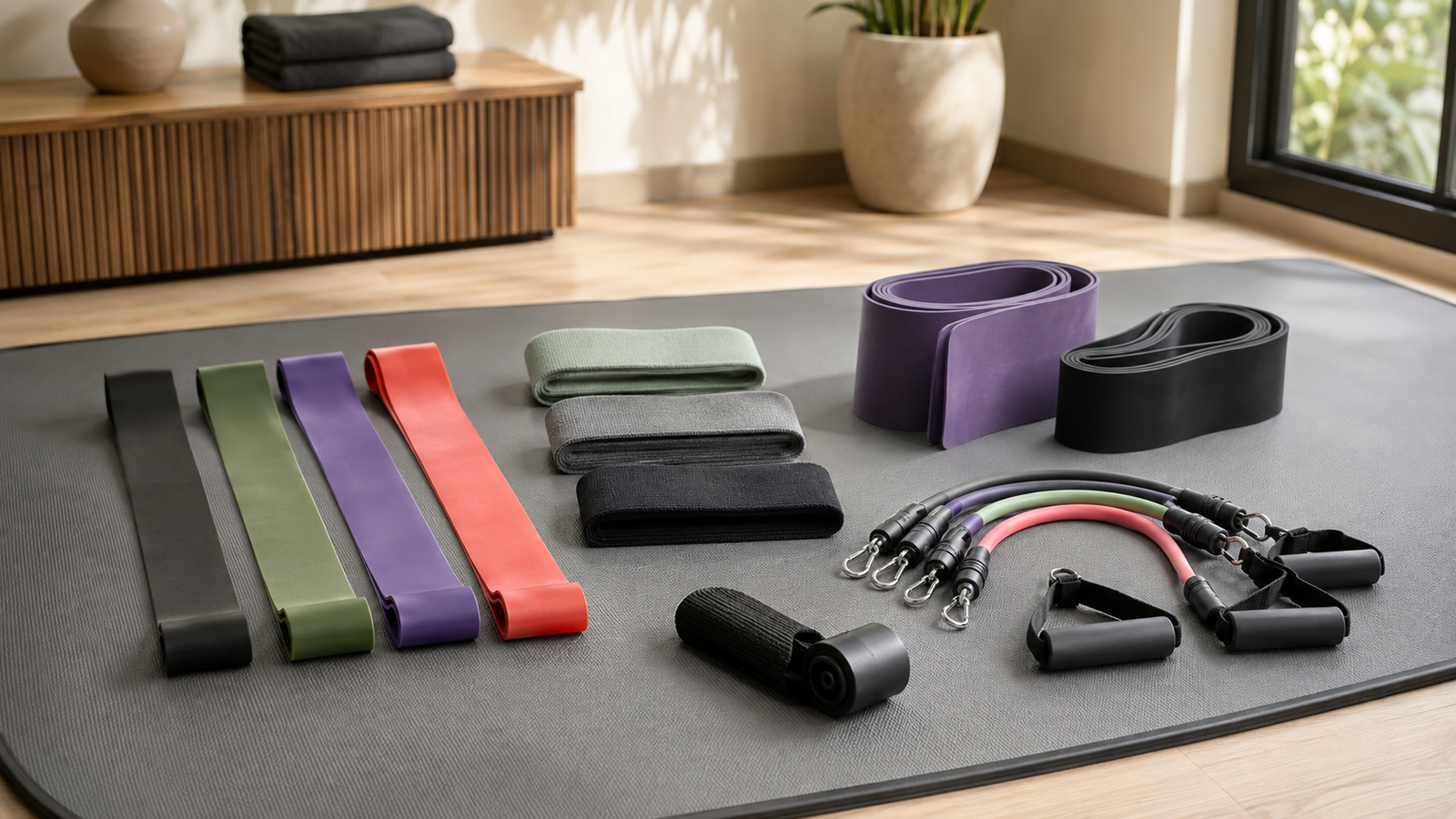
Resistance bands are among the simplest pieces of home fitness equipment, but choosing the right ones can become confusing quickly.
A search for resistance bands may show:
- thin mini loops;
- long flat bands;
- thick pull-up assist bands;
- resistance tubes with handles;
- fabric hip bands;
- multi-band kits with door anchors;
- products labelled by kilograms or pounds;
- colour-coded sets where every brand uses different resistance levels.
They can all be useful, but they are not interchangeable.
A resistance band for assisted pull-ups serves a very different purpose from a small loop band used for lateral walks. A handled resistance tube may work well for home strength exercises but be inconvenient for mobility drills. A fabric hip band may feel secure during lower-body training but is unsuitable for many upper-body exercises.
The useful question is therefore not:
“Which resistance band is best?”
It is:
“Which type of resistance band matches the exercises, resistance range and training setup I actually need?”
For most buyers, the important factors are:
band type → resistance range → exercise goals → material → length → handles and anchors → durability → portability → value.
This guide explains how to compare them without buying a large kit full of bands you rarely use.
What Makes Resistance Bands Different From Weights?
Traditional free weights provide resistance primarily through gravity.
Resistance bands behave differently.
As a band stretches, resistance generally increases.
That means many band exercises become harder toward the end of the movement where the band is stretched more.
This is sometimes described as:
variable resistance.
For example, during a banded squat:
- resistance is lower near the starting position;
- resistance increases as the band stretches.
This does not make bands automatically better than dumbbells or other strength equipment.
It simply creates a different resistance profile.
Bands are particularly useful because they are:
- compact;
- portable;
- inexpensive compared with large equipment;
- usable for many strength and mobility exercises.
Start With What You Want the Bands For
Before comparing colours or resistance ratings, identify the main purpose.
Common uses include:
- general home strength training;
- assisted pull-ups;
- lower-body activation;
- mobility work;
- rehabilitation-style exercises;
- stretching;
- travel workouts;
- adding resistance to existing exercises.
Different goals require different band formats.
The Main Types of Resistance Bands
Most resistance bands fall into five practical categories:
- Long loop resistance bands
- Resistance tubes with handles
- Mini loop bands
- Fabric hip bands
- Flat therapy-style bands
Understanding these categories will eliminate much of the confusion.
1. Long Loop Resistance Bands
These are continuous loops made from relatively thick elastic material.
They may also be called:
- pull-up bands;
- power bands;
- loop bands;
- strength bands.
They come in different widths.
Generally, wider or thicker bands provide greater resistance.
What Are They Useful For?
Long loops are versatile.
They can be used for:
- assisted pull-ups;
- rows;
- squats;
- presses;
- deadlift variations;
- mobility drills;
- stretching;
- banded push-ups;
- exercise warm-ups.
They are one of the most flexible choices for someone who wants a compact home training setup.
Pull-Up Assistance
One of the most popular uses for long loop bands is assisted pull-ups.
The band is anchored to:
- a pull-up bar;
and supports part of your body weight.
A stronger band provides:
more assistance.
That means beginners generally start with a stronger band and gradually progress toward:
- lighter bands;
- unassisted pull-ups.
Do not confuse this with normal strength exercises, where a stronger band usually means:
more resistance.
With assisted pull-ups:
more band tension = more help.
2. Resistance Tubes With Handles
These use elastic tubing attached to handles.
Some sets also include:
- ankle straps;
- door anchors;
- multiple resistance tubes;
- carabiners.
They are particularly convenient for exercises that normally use:
- cable machines;
- dumbbells.
Examples include:
- chest presses;
- rows;
- curls;
- triceps extensions;
- shoulder raises;
- lat-style pulldowns.
Advantages of Handled Tubes
Handles can make many exercises easier and more comfortable.
Instead of gripping elastic material directly, you hold:
- foam;
- rubber;
- plastic;
handles.
This may improve comfort during:
- curls;
- presses;
- rows.
Limitations of Tube Sets
Tubes are less convenient for some exercises such as:
- pull-up assistance;
- large mobility stretches;
- banded push-ups.
Attachment points also create additional components that can wear over time.
Inspect:
- carabiners;
- stitching;
- handle connections;
- tube ends.
3. Mini Loop Bands
Mini bands are small closed loops.
They are often used around:
- thighs;
- knees;
- ankles.
Common exercises include:
- lateral walks;
- clamshells;
- glute bridges;
- hip abduction;
- warm-up drills.
These are popular for:
- lower-body activation;
- mobility;
- accessory training.
Mini Bands Are Not a Complete Strength System
A mini-band set can be useful, but it does not replace:
- long bands;
- tubes;
- dumbbells;
for general full-body resistance training.
If your main goal is:
strength training at home
a mini-band kit alone may feel limiting.
4. Fabric Hip Bands
Fabric resistance bands are usually:
- wider;
- thicker;
- less stretchy;
than thin rubber mini loops.
They are commonly used around the thighs during:
- squats;
- lateral walks;
- glute bridges;
- hip exercises.
Advantages of Fabric Bands
Fabric bands may:
- roll less;
- pinch skin less;
- stay in position better.
This makes them popular for lower-body training.
Limitations of Fabric Bands
Because they are:
- short;
- relatively stiff;
they are less versatile.
They are generally not suitable for:
- pull-up assistance;
- overhead presses;
- rows;
- large stretching movements.
Think of them primarily as:
lower-body accessory bands.
5. Flat Therapy-Style Bands
These are long flat strips without handles or closed loops.
They are commonly associated with:
- physiotherapy;
- mobility work;
- rehabilitation-style exercises.
They can also be useful for:
- stretching;
- light resistance training.
Their simplicity makes them very adaptable.
Resistance Level Is More Important Than Colour
Resistance bands are often colour-coded.
For example:
- yellow;
- red;
- green;
- blue;
- black.
But there is no universal colour standard.
A green band from one manufacturer may provide completely different resistance from a green band from another.
Therefore:
never choose resistance level based on colour alone.
Look for actual resistance information.
How Resistance Is Usually Rated
Manufacturers may describe resistance as:
- light;
- medium;
- heavy;
- extra heavy;
or list ranges such as:
- 5–15 lb;
- 15–35 lb;
- 20–50 lb;
- 40–60 kg.
These numbers should be interpreted cautiously.
Resistance changes depending on:
- how far the band is stretched;
- initial band length;
- exercise setup.
A band labelled:
20 kg
does not behave exactly like a 20 kg dumbbell.
Why Resistance Is Often Given as a Range
Suppose a band is labelled:
15–35 lb.
At moderate stretch, resistance may be closer to the lower end.
At greater stretch, it may approach the higher end.
The exact relationship depends on:
- band construction;
- stretch percentage.
This is why band resistance should be treated as an approximate training range rather than a direct replacement for free-weight kilograms.
Should Beginners Buy Light Bands?
Not always.
The resistance you need depends on the exercise.
For example:
Shoulder mobility
A light band may be appropriate.
Squats
You may need much greater resistance.
Pull-up assistance
A stronger band may actually make the exercise easier.
This is why buying a small range of resistances can be useful.
Single Band vs Set
This is one of the most important buying decisions.
Single Band
Best when you already know:
- the exact exercise;
- resistance level;
you need.
For example:
- a pull-up assistance band;
- a particular heavy loop band.
Resistance Band Set
Better when you want:
- progressive resistance;
- full-body workouts;
- multiple exercises.
A useful set may contain:
- light;
- medium;
- heavy;
options.
More Bands Does Not Automatically Mean Better Value
Some kits advertise:
- 5 bands;
- 8 bands;
- 12 accessories;
- 20-piece sets.
Many of those pieces may be:
- duplicate handles;
- straps;
- storage bags.
Count the components that actually affect training.
A simple set with:
five useful resistance levels
may be more valuable than a 20-piece kit containing accessories you never use.
Stackable Resistance Tubes
Some tube systems allow multiple bands to connect to the same handles.
For example:
- one tube = light;
- two tubes = medium;
- three tubes = heavier resistance.
This can create a wide resistance range.
But check whether the hardware is designed for combined loads.
Do not combine bands in ways the manufacturer does not recommend.
Band Length Matters
Resistance depends partly on band length.
Longer bands allow:
- greater movement range;
- easier anchoring;
- more exercise options.
Short bands may become excessively stretched during certain movements.
Long Bands for Tall Users
Tall users may benefit from longer bands because:
- overhead movements;
- presses;
- rows;
require more range.
If a band is too short, you may start the exercise with excessive tension.
Mini-Band Size
Mini loops are intentionally small.
They should provide enough tension around the:
- thighs;
- ankles;
without needing extreme stretching.
Very small loops may feel restrictive for larger users.
Material
Most resistance bands use:
- natural latex;
- synthetic rubber;
- thermoplastic elastomer;
- fabric-elastic blends.
Material affects:
- stretch;
- durability;
- smell;
- skin feel.
Latex Bands
Latex bands are common because they can provide:
- strong elasticity;
- good resistance;
- compact construction.
Potential limitations include:
- latex smell;
- latex allergy concerns.
Anyone with a known latex allergy should verify the material before use.
Latex-Free Bands
Some manufacturers offer alternatives made from:
- synthetic materials;
- TPE.
These may suit users avoiding latex.
However, durability and stretch characteristics differ between products.
Fabric Bands
Fabric bands usually combine:
- elastic fibres;
- woven material.
They can feel more comfortable around bare skin.
But they may absorb:
- sweat;
- moisture;
more readily than rubber.
That makes cleaning important.
Layered vs Moulded Bands
Some long resistance bands are produced from multiple layers.
Others use a continuous moulding process.
Manufacturers may claim one construction is significantly stronger than another.
What matters practically is whether the band:
- stretches smoothly;
- shows no cracking;
- maintains elasticity;
- has reliable quality control.
Durability Is a Safety Issue
Resistance bands are placed under tension.
If a worn band breaks suddenly, it can snap toward:
- the body;
- face.
Inspect bands regularly.
Look for:
- cracks;
- cuts;
- thinning;
- tears;
- discoloration;
- damaged seams.
Stop using damaged bands.
Do Not Use Damaged Bands
A small tear can become much larger when stretched.
Do not attempt to repair a damaged resistance band with:
- tape;
- glue.
Replace it.
Avoid Sharp Surfaces
Bands can be damaged by:
- sharp metal;
- rough concrete;
- door edges;
- jewellery.
When anchoring a band, make sure the contact surface is:
- smooth;
- secure.
Door Anchors
Many handled tube kits include a door anchor.
This small accessory significantly expands exercise options.
It allows bands to be positioned at:
- low;
- middle;
- high;
anchor points.
Exercises may include:
- rows;
- chest presses;
- pulldowns;
- triceps work.
Door Anchor Safety
A door anchor must be used carefully.
Whenever possible, position it so the exercise pulls the door:
toward the frame rather than open.
Check:
- door strength;
- hinges;
- lock;
- anchor condition.
Do not use an obviously weak or damaged door.
Always follow manufacturer instructions.
Never Wrap Bands Around Unsafe Objects
Avoid anchoring bands around unstable:
- furniture;
- lightweight chairs;
- unsecured poles.
If the anchor moves while the band is stretched, both the object and band can become hazardous.
Handles
Handled resistance tubes may use:
- foam-covered handles;
- rubber grips;
- plastic grips.
Look for handles that:
- fit comfortably;
- do not rotate unpredictably;
- connect securely.
Foam Handles
Foam can feel comfortable but may:
- absorb sweat;
- degrade over time.
Check:
- stitching;
- attachment points;
rather than focusing only on handle softness.
Ankle Straps
Some sets include ankle cuffs for exercises such as:
- hip extensions;
- hamstring curls;
- abduction movements.
The strap should provide:
- secure fastening;
- adequate padding.
A narrow strap may become uncomfortable under resistance.
Carabiners
Metal clips connect components in many tube systems.
They should:
- close securely;
- feel appropriately sized.
Avoid poorly finished clips with sharp edges that could damage:
- tubing;
- straps.
Resistance Bands for Strength Training
Bands can train many major movement patterns.
Examples include:
Push
- chest press;
- shoulder press;
- banded push-up.
Pull
- rows;
- pulldowns;
- face pulls.
Squat
- resisted squat;
- front squat variations.
Hinge
- Romanian deadlift variations;
- good mornings.
Arms
- curls;
- triceps extensions.
This makes long loops and handled tubes especially useful for home training.
Can Resistance Bands Build Muscle?
Resistance training can contribute to muscle development when exercises provide:
- sufficient resistance;
- appropriate volume;
- progression.
Bands can therefore be useful for strength and hypertrophy-oriented training.
However, progress depends on:
- exercise selection;
- training effort;
- nutrition;
- consistency.
The band itself does not guarantee results.
Progressive Overload With Resistance Bands
To continue progressing, you can:
- use a stronger band;
- increase stretch;
- shorten the band;
- add repetitions;
- add sets;
- slow the movement;
- combine bands where designed for it.
Track your setup consistently.
Otherwise it can be difficult to know whether you are actually increasing resistance.
Mark Your Training Setup
Because band resistance depends on stretch, consistency helps.
For exercises using an anchor, note:
- which band;
- anchor height;
- distance from anchor.
This makes workouts more repeatable.
Resistance Bands for Mobility
Light resistance bands can be useful for:
- shoulder mobility;
- warm-ups;
- stretching;
- controlled movement drills.
Mobility exercises generally require less resistance than strength exercises.
Using an unnecessarily heavy band can make the movement more difficult without providing additional benefit.
Resistance Bands for Warm-Ups
Common uses include:
- shoulder external rotation;
- lateral walks;
- glute activation;
- pull-aparts.
The goal is typically:
controlled movement
rather than maximal resistance.
Bands for Pull-Up Progression
If pull-ups are your primary goal, a set of long loop bands may be more useful than handled tubes.
Choose several assistance levels so you can gradually progress.
For example:
Stage 1
Stronger assistance
Stage 2
Medium assistance
Stage 3
Light assistance
Stage 4
Bodyweight pull-up
The exact progression will vary.
Foot Placement and Band Safety
Many exercises require standing on a band.
Make sure:
- the band lies flat;
- footwear does not have sharp edges;
- your stance is secure.
Avoid dragging the band across rough flooring.
Barefoot vs Shoes
Some band exercises can be performed barefoot.
Others may feel more secure with shoes.
If standing on thin tubing, shoes with aggressive edges could accelerate wear.
Check the band regularly.
Range of Motion
Resistance bands should allow you to move through an appropriate range without requiring excessive stretching.
Do not stretch bands beyond manufacturer recommendations.
Overstretching can:
- damage the material;
- increase failure risk.
Resistance Band Length and Stretch Percentage
Some manufacturers provide maximum stretch guidance such as:
- 2× original length;
- 3× original length.
Follow these limits.
A band designed for moderate extension should not be stretched indefinitely simply because it has not broken yet.
Grip Without Handles
Long loop bands require you to grip the band directly during many exercises.
This can occasionally feel uncomfortable.
You can adjust hand position by:
- folding the band;
- gripping a doubled section.
Do not wrap the band tightly around your hand in a way that restricts circulation.
Bands Rolling Up
Thin mini loops sometimes roll during lower-body exercises.
This can be annoying or uncomfortable.
Fabric hip bands generally roll less.
If rolling is a recurring problem, a wider fabric band may suit you better.
Pinching Skin
Thin latex loops can sometimes:
- pinch;
- pull body hair.
Wearing:
- leggings;
- exercise clothing;
can reduce this.
Fabric bands may also feel more comfortable.
Resistance Band Noise
Bands are generally quiet exercise equipment.
This makes them useful for:
- apartments;
- early-morning workouts;
- travel.
Unlike weights, there is little impact noise.
Space Requirements
Resistance bands require very little storage.
However, you still need enough exercise space to stretch them safely.
For example, a horizontal row may need:
- several metres of clear space;
depending on the anchor.
Make sure the stretched band cannot strike:
- furniture;
- another person.
Travel
Resistance bands are particularly useful for travel because an entire resistance setup may fit inside:
- a small pouch;
- backpack.
For travel, consider:
- lightweight long bands;
- resistance tubes;
- door anchor.
Avoid bringing accessories you rarely use.
Storage
Store bands:
- indoors;
- away from direct sunlight;
- away from excessive heat;
- away from sharp objects.
Extreme temperatures and UV exposure can damage some elastic materials.
Cleaning Resistance Bands
For rubber bands, cleaning may involve:
- mild soap;
- damp cloth.
Follow manufacturer guidance.
Avoid:
- harsh chemicals;
- oils;
- solvents;
unless specifically approved.
These may damage the material.
Cleaning Fabric Bands
Fabric bands may absorb more sweat.
Check whether they are:
- hand washable;
- machine washable.
Allow them to dry fully before storing.
Do Not Powder or Oil Bands Without Instructions
Some people apply:
- oils;
- powders;
to elastic products.
Do not do this unless specifically recommended.
Certain substances may degrade rubber.
Resistance Bands vs Dumbbells
Both can provide effective resistance training.
Resistance Bands
Advantages:
- compact;
- portable;
- inexpensive;
- variable resistance.
Dumbbells
Advantages:
- straightforward load measurement;
- predictable resistance;
- easier progression tracking.
Many home gyms benefit from having both.
Resistance Bands vs Cable Machines
Handled bands can mimic many cable-style movements.
But they do not replicate cable machines exactly.
Cable machines typically provide:
- more consistent resistance;
- stable anchors;
- easier load measurement.
Bands provide:
- portability;
- low cost;
- flexible setup.
Resistance Bands vs Suspension Trainers
Suspension trainers primarily use:
- body weight;
- leverage.
Bands provide elastic resistance.
They are different training systems.
Choose based on the exercises you prefer rather than assuming one replaces the other.
Are Expensive Resistance Bands Better?
Not necessarily.
Higher price may reflect:
- stronger materials;
- reinforced stitching;
- better handles;
- more reliable resistance consistency;
- warranties.
But a premium brand does not automatically make the product appropriate for your training.
What Matters More Than Brand
Prioritize:
- correct band type;
- useful resistance range;
- secure construction;
- suitable length;
- safe attachment system;
- replacement availability.
Brand comes after those considerations.
Budget Resistance Band Sets
Affordable sets can be useful for:
- beginners;
- travel;
- occasional home workouts.
Inspect:
- attachment points;
- tubes;
- carabiners;
regularly.
The lowest-cost sets may vary more in:
- resistance consistency;
- hardware quality.
Mid-Range Band Sets
For frequent home training, paying somewhat more may improve:
- handle quality;
- stitching;
- accessories;
- resistance consistency.
A good mid-range set can offer excellent long-term value.
Premium Bands
Premium bands may appeal to:
- frequent users;
- serious strength training;
- commercial gym environments.
But you do not need premium bands for:
- light mobility;
- occasional home workouts.
How Many Resistance Levels Do You Need?
For general home fitness:
3–5 useful levels
are usually enough.
For example:
- light;
- medium;
- heavy;
- extra heavy.
You may need different levels for different body parts.
A band suitable for:
squats
may be far too strong for:
shoulder external rotation.
Do You Need Every Resistance Level?
No.
If you already know your exercises, two or three bands may be sufficient.
Avoid buying an enormous set simply because it appears to offer more value.
How to Compare Resistance Band Sets
When comparing two kits, look at:
Band types
Are they:
- loops;
- tubes;
- mini bands?
Resistance range
Does it suit your actual exercises?
Accessories
Are the handles and anchors useful?
Construction
Are connections reinforced?
Replacement
Can individual bands be replaced?
Warranty
Does the manufacturer provide meaningful support?
Replaceable Components
A modular resistance tube set has an advantage if:
- one tube;
- one handle;
can be replaced individually.
If the entire kit becomes unusable when one component fails, long-term value may be lower.
Common Resistance Band Buying Mistakes
Buying by Colour
Colours are not standardized.
Choosing Only One Heavy Band
Different exercises require different resistance.
Buying Mini Bands for Full-Body Training
They are primarily lower-body accessories.
Buying a Huge Kit Without Checking Components
More pieces do not equal better training.
Ignoring Band Length
Length affects exercise range and starting tension.
Ignoring Anchor Safety
Door anchors need secure setup.
Using Damaged Bands
Small cracks can lead to sudden failure.
Stretching Bands Beyond Their Limits
Elastic material is not indestructible.
Assuming Kilograms Equal Dumbbell Weight
Band resistance varies with stretch.
Buying Based on Marketing Resistance Numbers Alone
Use resistance ranges as guidance, not exact equivalence.
Quick Resistance Band Selection Table
| Main goal | Best starting format |
|---|---|
| Full-body home workout | Long loop bands or handled tube set |
| Pull-up assistance | Long pull-up loop bands |
| Glute activation | Mini loops or fabric hip bands |
| Mobility work | Light long/flat bands |
| Travel workouts | Long loops or compact tube set |
| Cable-style exercises | Handled tubes + door anchor |
| Lower-body accessory work | Fabric hip bands |
| Beginner mixed training | Multi-resistance set |
| Advanced strength work | Heavy long loop bands |
| Rehabilitation-style movements | Light flat bands, where appropriate |
Practical Resistance-Level Guide
This is not an exact prescription, but it can help organize your purchase.
Light Resistance
Useful for:
- mobility;
- shoulder exercises;
- warm-ups.
Medium Resistance
Useful for:
- upper-body training;
- general full-body exercises.
Heavy Resistance
Useful for:
- lower-body exercises;
- rows;
- presses;
- stronger users.
Very Heavy Resistance
Useful for:
- heavy lower-body training;
- pull-up assistance;
- advanced band training.
Remember that the actual load differs between brands.
What to Look for in a Pull-Up Band
If pull-up assistance is your priority, consider:
- loop length;
- resistance range;
- material;
- maximum stretch guidance;
- durability.
You may eventually want:
multiple assistance levels
rather than one very strong band.
What to Look for in a Resistance Tube Set
Prioritize:
- comfortable handles;
- secure carabiners;
- reinforced attachment points;
- door anchor;
- useful resistance range.
An ankle strap can be a useful extra.
A large accessory count is less important.
What to Look for in Mini Bands
Consider:
- resistance levels;
- width;
- tendency to roll;
- material;
- comfort.
A 3–5 band set is usually sufficient.
What to Look for in Fabric Hip Bands
Consider:
- circumference;
- resistance;
- internal grip;
- fabric quality;
- washability.
Because fabric bands stretch less, size is especially important.
Resistance Bands for Beginners
A beginner does not necessarily need the lightest band available.
A better strategy is to buy a small set that provides:
- light;
- medium;
- heavy;
resistance.
Then use the appropriate band for each exercise.
Resistance Bands for Stronger Users
Advanced users may need:
- wider long loops;
- stackable tubes;
- multiple bands.
But bands also work well as accessories alongside:
- dumbbells;
- barbells.
For example:
- banded squats;
- band-resisted push-ups.
Older Adults and Resistance Bands
Resistance bands can provide convenient low-equipment strength training.
However, exercise selection and resistance should match:
- ability;
- mobility;
- balance.
Someone with significant medical or mobility limitations may benefit from professional guidance before starting resistance training.
Rehabilitation and Injury Recovery
Resistance bands are frequently used in rehabilitation environments.
That does not mean every band exercise is appropriate for every injury.
If you are recovering from:
- surgery;
- significant joint injury;
- persistent pain;
follow the guidance of an appropriate clinician or physiotherapist.
Do not simply copy a rehabilitation exercise from social media.
Resistance Bands During Pregnancy
Some people continue resistance exercise during pregnancy.
However, exercise suitability may change depending on:
- pregnancy stage;
- individual circumstances;
- medical advice.
The band itself is not inherently unsafe, but training should be appropriate for the individual.
Children and Resistance Bands
Resistance bands are not toys.
Elastic bands can:
- snap;
- wrap around body parts.
Children should use them only with appropriate:
- supervision;
- age-appropriate exercise.
What About “Anti-Snap” Bands?
Some products use:
- protective sleeves;
- reinforced construction.
These features may reduce risk but do not make bands failure-proof.
Regular inspection remains necessary.
Sleeve-Covered Resistance Tubes
Some tube sets place elastic material inside a fabric sleeve.
This may:
- reduce overstretching;
- contain the tube if it fails.
However, the sleeve can also make visual inspection of the elastic harder.
Check the manufacturer’s maintenance instructions.
When Should You Replace Resistance Bands?
There is no universal replacement schedule.
Replace a band when you notice:
- cracks;
- tears;
- fraying;
- damaged handles;
- weakened elasticity;
- damaged anchor points.
Frequent users should inspect bands regularly.
A Simple Resistance Band Buying Checklist
Before purchasing, ask:
Training goal
- Full-body strength?
- Pull-ups?
- Glute training?
- Mobility?
Band type
- Long loops?
- Tubes?
- Mini bands?
- Fabric bands?
Resistance
- Do I have several useful levels?
- Are resistance ranges clearly listed?
Length
- Is the band long enough for my exercises?
Accessories
- Do I genuinely need handles?
- Door anchor?
- Ankle straps?
Construction
- Are attachments secure?
- Is the material free from defects?
Safety
- Is maximum stretch guidance provided?
Maintenance
- Is cleaning straightforward?
Value
- Am I paying for useful resistance levels or simply more accessories?
A Simple Home Resistance Band Setup
For many users, a practical setup can be very small.
Option A — Strength-Focused
- light long loop;
- medium long loop;
- heavy long loop.
Option B — Cable-Style Training
- handled tube set;
- 3–5 resistance levels;
- door anchor;
- ankle strap.
Option C — Lower-Body Accessory Training
- 3 fabric hip bands;
- light;
- medium;
- heavy.
Option D — Mixed Setup
- long loop set;
- mini-band set.
There is no need to buy all four systems at once.
How to Decide Between Long Loops and Tubes
Choose long loops if you want:
- pull-up assistance;
- mobility;
- versatile strength exercises;
- minimal hardware.
Choose handled tubes if you prefer:
- curls;
- presses;
- cable-style movements;
- comfortable handles.
Neither is universally better.
How to Decide Between Rubber and Fabric Mini Bands
Choose rubber mini bands if you want:
- greater versatility;
- lighter resistance options;
- compact storage.
Choose fabric hip bands if you prioritize:
- comfort;
- reduced rolling;
- lower-body work.
Do You Need a Door Anchor?
A door anchor greatly expands a tube-set workout.
It can allow:
- chest presses;
- rows;
- high pulldowns;
- triceps extensions.
If you want full-body home training with tubes, it is one of the few accessories that can genuinely improve versatility.
Do You Need a Carry Bag?
A storage bag is convenient but should not drive the purchase.
Resistance bands are easy to store in:
- a drawer;
- gym bag;
- small box.
Prioritize band quality over packaging.
Frequently Asked Questions
Which resistance bands are best for beginners?
A set with several resistance levels is usually more useful than a single band because different exercises require different tension.
Are loop bands or tubes better?
Long loops are more versatile for pull-ups, mobility and general strength work. Tubes with handles are convenient for cable-style exercises.
What resistance band should I buy for pull-ups?
Use a long loop pull-up band. Stronger bands generally provide more assistance.
Are fabric resistance bands better?
Fabric bands can be comfortable and resist rolling, but they are mostly suited to lower-body accessory exercises.
Are resistance bands good for home workouts?
Yes. They are compact and can provide resistance for many full-body exercises.
Can resistance bands build muscle?
They can contribute to strength and muscle-building programs when resistance, volume and progression are appropriate.
How do I know which resistance level to use?
Choose a band that allows controlled repetitions with good technique while making the final repetitions appropriately challenging.
Does a 25 kg resistance band equal a 25 kg dumbbell?
No. Band resistance changes as the band stretches, so the numbers are not directly equivalent.
Why are resistance bands different colours?
Manufacturers often use colours to identify resistance levels, but there is no universal colour standard.
How many resistance bands do I need?
For general training, three to five useful resistance levels are usually sufficient.
Can I combine resistance bands?
Some systems are specifically designed for stacking. Follow manufacturer instructions rather than improvising combinations.
Can resistance bands snap?
Yes. Worn, damaged or overstretched bands can fail. Inspect them regularly.
How long do resistance bands last?
There is no fixed lifespan. Usage, storage, material and care all affect durability.
Can I wash resistance bands?
Many can be wiped with mild soap and water, while fabric bands may have different care instructions. Follow the manufacturer guidance.
Can I use resistance bands every day?
That depends on exercise selection, resistance and overall training volume. Muscles still require appropriate recovery.
Are resistance bands good for stretching?
Light long bands can assist some stretches and mobility exercises.
Can resistance bands replace dumbbells?
They can provide substantial resistance training, but dumbbells offer a different resistance profile and easier load measurement. Many people benefit from both.
Are resistance bands suitable for travel?
Yes. Portability is one of their strongest advantages.
Should I buy a resistance-band set or individual bands?
A set is usually better for beginners. Individual bands make sense when you already know the exact resistance and format you need.
What should I check before every workout?
Inspect:
- band surface;
- anchor;
- handles;
- carabiners;
- stitching;
for damage.
The Physical Glow Takeaway
Resistance bands are useful because they can provide a surprising amount of training variety without taking up much space.
But the most important buying decision is not brand, colour or the number of accessories in the box.
Start with the type of training you want to do.
For general full-body workouts, long loop bands or a handled tube set with several resistance levels provide the most versatility.
For pull-up assistance, choose long continuous pull-up bands.
For glute and lower-body accessory exercises, mini loops or fabric hip bands are usually more practical.
For mobility and light controlled exercises, lighter flat or long bands are generally sufficient.
Then compare:
resistance range → length → material → construction → handles/anchors → durability → price.
Avoid treating the resistance number printed on the band as if it were identical to a dumbbell weight. Elastic resistance changes with stretch, so consistency of setup matters.
Most people also do not need a huge 20-piece kit. A small collection of well-chosen resistance levels that covers your actual exercises is usually more useful.
And because bands are repeatedly stretched under tension, durability is more than a value consideration—it is a safety issue. Inspect them regularly and replace any band that shows cracks, tears, fraying or damaged attachment points.
The best resistance-band setup is therefore the one that gives you enough resistance options to progress, enough versatility for your real training routine, and simple enough equipment that you will actually use it consistently.