Treadmill Buying Guide: Motor, Speed, Incline, Belt Size and Space
A practical treadmill buying guide covering motor power, speed, incline, belt size, cushioning, user capacity, folding design, noise and home-gym space.
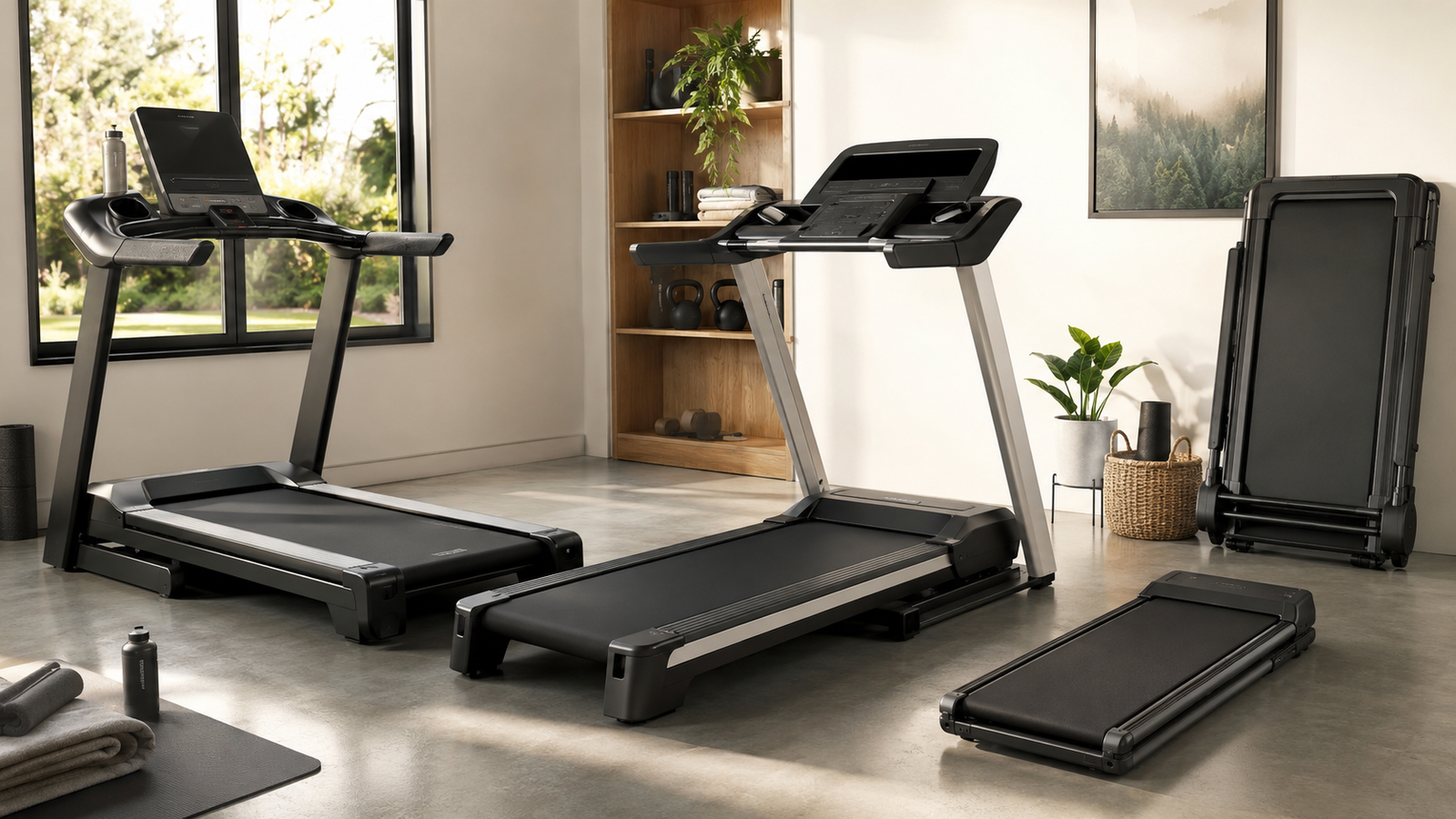
A treadmill can be one of the most useful pieces of home cardio equipment, but it is also one of the easiest fitness purchases to get wrong.
Two treadmills may look almost identical in product photos while differing significantly in:
- motor performance;
- running-area size;
- speed;
- incline;
- cushioning;
- user-weight capacity;
- folding design;
- noise;
- stability;
- maintenance requirements.
A compact walking treadmill may be ideal for someone who wants:
- daily walking;
- light cardio;
- under-desk use.
The same machine may be unsuitable for someone planning:
- regular jogging;
- faster running;
- incline training.
Similarly, a large high-powered treadmill may provide excellent performance but make little sense in a small apartment where:
- space;
- noise;
- storage;
are major priorities.
The useful question is therefore not:
“Which treadmill has the highest horsepower?”
It is:
“Which treadmill is appropriately built for my body size, training speed, workout frequency and available space?”
For most buyers, the important factors are:
intended use → motor → speed → running belt → user capacity → incline → cushioning → stability → space → noise → warranty and service.
This guide explains how to compare those factors without being distracted by specifications that look impressive but may not improve your actual workouts.
Start With How You Plan to Use the Treadmill
Before comparing motors or displays, decide what type of cardio you actually expect to do.
Most home treadmill users fall broadly into four groups:
- Walking
- Brisk walking and light jogging
- Regular running
- Mixed household use
Each requires different equipment.
1. Treadmill for Walking
If your main goal is:
- daily steps;
- brisk walking;
- low-impact indoor cardio;
- staying active during bad weather;
you probably do not need an extremely powerful treadmill.
Priorities are more likely to be:
- comfortable walking surface;
- low starting speed;
- stability;
- quiet operation;
- compact size;
- easy controls.
A walking-focused treadmill may also cost considerably less than a serious running machine.
2. Treadmill for Jogging
Jogging places greater demands on the machine.
You will usually want:
- stronger motor capability;
- higher maximum speed;
- longer running belt;
- better cushioning;
- stronger frame.
A treadmill that feels stable at:
5 km/h
may behave very differently at:
10 km/h.
3. Treadmill for Running
Regular running requires more attention to:
- motor;
- belt dimensions;
- frame stability;
- deck quality;
- cooling;
- user capacity.
At higher speeds, small compromises become much more noticeable.
A short belt can restrict stride.
A narrow deck can feel uncomfortable.
A lightweight frame may feel unstable.
For serious home running, it is usually worth prioritizing core mechanical quality over:
- speakers;
- app features;
- decorative displays.
4. Shared Household Treadmill
If multiple people will use the same treadmill, choose for the:
most demanding realistic user
rather than the lightest user.
Consider:
- heaviest body weight;
- tallest stride;
- fastest intended speed;
- longest expected workout.
This usually provides a better margin for durability and comfort.
Motor Specifications Can Be Confusing
Treadmills are often marketed using terms such as:
- HP;
- CHP;
- peak HP;
- continuous duty;
- DC motor;
- AC motor;
- BLDC motor.
Unfortunately, marketplace descriptions are not always consistent.
That means motor numbers should not be interpreted in isolation.
Continuous vs Peak Horsepower
This distinction matters.
Continuous Power
Represents the power the motor can sustain during normal operation.
Peak Power
Represents a higher short-duration output.
A treadmill advertised as:
4 HP peak
should not automatically be treated as equivalent to a machine offering:
4 HP continuous-duty performance.
When comparing treadmills, try to determine whether the specification refers to:
- peak;
- continuous;
power.
If the manufacturer does not clarify this, use the number cautiously.
Do You Need a Powerful Motor for Walking?
Not necessarily.
Walking at moderate speeds generally places less demand on the treadmill than running.
A walking-focused user should usually prioritize:
- stability;
- belt size;
- low-speed smoothness;
- noise;
rather than choosing the largest motor number available.
Motor Needs Increase With Use
Motor demand generally increases when:
- user weight increases;
- speed increases;
- incline increases;
- workout duration increases;
- multiple users share the treadmill.
This is why someone running for:
45 minutes every day
has different requirements from someone walking:
20 minutes three times per week.
BLDC Motors
Some modern treadmills use brushless DC motors.
Potential advantages can include:
- quieter operation;
- efficiency;
- reduced brush-related wear.
But “BLDC” alone does not prove that one treadmill is better.
Overall quality still depends on:
- motor sizing;
- controller;
- cooling;
- frame;
- deck;
- electronics.
Maximum Speed
Maximum speed is another specification that can look more important than it really is.
Common home treadmills may top out around:
- 6 km/h;
- 8 km/h;
- 12 km/h;
- 14 km/h;
- 16 km/h;
- 18 km/h or more.
Choose according to your real training.
Walking Speed
Many users walk between roughly:
3–6 km/h
depending on fitness and preference.
A machine limited to 6 km/h can therefore be perfectly adequate for dedicated walking.
Jogging Speed
Jogging often requires a treadmill capable of approximately:
8–12 km/h
or more, depending on the individual.
If you expect to jog regularly, do not buy a walking pad with little speed headroom.
Running Speed
Stronger runners may require:
- 14 km/h;
- 16 km/h;
- 18 km/h;
or more.
Do not buy based on maximum speed alone, however.
The treadmill must also remain:
- stable;
- comfortable;
- mechanically appropriate;
at that speed.
Speed Headroom Is Useful
Suppose you currently jog at:
8 km/h.
A treadmill limited to exactly:
8 km/h
offers no room for progression.
A somewhat higher maximum can provide flexibility.
You do not need extreme speed capacity, but some headroom is practical.
Running Belt Size Is Crucial
The usable running surface is one of the most important treadmill specifications.
You should look at:
- belt length;
- belt width.
A treadmill may have a large-looking frame while still providing a relatively small usable deck.
Belt Length
Longer belts provide more room for stride.
This matters especially for:
- taller users;
- runners;
- faster speeds.
Walking generally requires less belt length.
Running usually requires more.
Why Running Needs More Length
During running, stride length increases.
You also move slightly forward and backward on the deck.
A short treadmill may cause you to feel as if you constantly need to monitor your position.
That can make running less natural.
Taller Users
Tall users should pay particular attention to belt length.
The same treadmill that feels spacious for someone:
165 cm tall
may feel restrictive for someone:
190 cm tall.
If possible, check actual usable running dimensions rather than overall machine dimensions.
Belt Width
A wider belt provides more lateral room.
This can increase confidence, particularly during:
- jogging;
- running.
Walking pads are often intentionally narrow to save space.
That is acceptable for controlled walking but may not suit faster training.
Wider Is Not Always Necessary
A very wide belt increases:
- machine footprint;
- weight.
If you only walk and have limited room, a narrower treadmill may be completely appropriate.
Again, match equipment to use.
User Weight Capacity
Treadmills usually specify a maximum user weight.
This number deserves attention.
But you should not treat the stated maximum as the ideal everyday operating weight.
Leave a Practical Margin
If a treadmill is rated for:
100 kg
and the user weighs:
99 kg,
the machine technically fits the specification—but there is almost no margin.
A more conservative choice is preferable.
A practical buffer may improve:
- stability;
- motor workload;
- long-term durability.
Capacity Is Not Just About the Frame
User weight affects:
- motor load;
- belt;
- rollers;
- deck;
- suspension.
That is why heavier users should consider a treadmill with:
- stronger overall construction;
rather than only looking at the headline motor number.
Incline
Incline changes the training stimulus without necessarily requiring faster speed.
There are three main configurations:
- No incline
- Manual incline
- Automatic incline
No-Incline Treadmills
These are simple and may be perfectly adequate for:
- walking;
- basic cardio.
If incline training is not important to you, there is no need to pay extra for it.
Manual Incline
Manual incline usually requires you to:
- stop;
- physically change the treadmill position.
It is less convenient but can provide:
- basic variation;
- lower cost.
It works if you generally set one incline level for an entire workout.
Automatic Incline
Motorized incline can be changed from:
- control panel;
- handle buttons;
- workout program.
This makes it much more useful for:
- interval training;
- hill simulation.
If incline is a major part of your workouts, automatic adjustment is significantly more convenient.
Incline Percentage
Manufacturers may advertise incline as:
- levels;
- percentage.
These are not necessarily equivalent.
For example:
15 incline levels
does not automatically mean:
15% incline.
Check the actual specification.
Does Incline Make Walking Harder?
Yes.
Increasing incline generally increases the effort required at the same speed.
That makes incline useful for someone who wants more challenging cardio without running faster.
But extremely steep incline is not necessary for every workout.
Incline and Stability
As incline increases, the machine’s:
- frame;
- deck;
- motor system;
must remain stable.
For frequent incline use, quality of construction matters.
Walking Pads vs Full Treadmills
Walking pads have become popular because they are compact.
They can work very well—but only for the right use.
Walking Pad Advantages
They are often:
- compact;
- lightweight;
- easy to store;
- suitable for walking.
Some fit:
- under a bed;
- under a desk;
- against a wall.
Walking Pad Limitations
They may have:
- narrower belts;
- shorter belts;
- lower maximum speeds;
- minimal handrails;
- limited incline.
They are generally better for:
walking
than:
serious running.
Under-Desk Walking Pads
These are designed for slow walking while working.
Important features include:
- low minimum speed;
- quiet operation;
- remote control;
- compact dimensions.
The objective is movement—not high-intensity cardio.
Do Not Run on a Walking Pad Unless Designed for It
Some walking pads can support light jogging.
Others should not.
Use the machine only within its intended:
- speed;
- usage;
limits.
Foldable Treadmills
Folding treadmills can save floor space when not in use.
But not all folding systems are equally convenient.
Hydraulic Folding
Hydraulic systems can help:
- raise;
- lower;
the running deck more safely.
This may make daily storage easier.
Folding Does Not Make a Treadmill Small
Even folded, a full treadmill can remain:
- tall;
- heavy;
- bulky.
Check both:
operating dimensions
and:
folded dimensions.
Measure Your Room Before Buying
Before ordering a treadmill, measure:
- length;
- width;
- ceiling height;
- clearance behind;
- doorways.
Do not measure only the treadmill itself.
You need safe space around it.
Rear Clearance
Leave adequate space behind the treadmill.
If you lose balance, you do not want to be immediately against:
- a wall;
- furniture.
Follow manufacturer clearance guidance.
Ceiling Height
Incline raises you higher.
Tall users in rooms with low ceilings should calculate:
user height + treadmill deck height + incline + overhead clearance.
This is especially important in:
- basements;
- lofts.
Delivery Access
Large treadmills may be difficult to move through:
- doors;
- staircases;
- lifts.
Check:
- packaged dimensions;
- assembled dimensions.
A treadmill you cannot physically move into the intended room is obviously not useful.
Treadmill Weight
Heavier treadmills can feel more stable.
However, they are also more difficult to:
- move;
- reposition.
If your machine will stay permanently in one room, extra weight may be less problematic.
Transport Wheels
Most home treadmills include small wheels.
These help with repositioning, but they do not make a 70 kg treadmill easy to carry upstairs.
Deck Cushioning
Running on a treadmill feels different from running on:
- road;
- concrete.
Many treadmills use cushioning systems designed to reduce impact.
Manufacturers may call these:
- shock absorption;
- suspension;
- cushioning zones.
More Cushioning Is Not Automatically Better
A deck that is extremely soft may feel:
- unstable;
- unnatural.
A very hard deck may feel uncomfortable.
The goal is a controlled, stable surface with enough compliance for comfort.
Marketing Claims Around Joint Protection
Be cautious with claims such as:
- protects knees;
- eliminates joint impact;
- medically safer.
A treadmill may provide a different surface than outdoor pavement, but it cannot guarantee:
- pain-free exercise;
- injury prevention.
Joint comfort depends on many factors including:
- training volume;
- technique;
- footwear;
- previous injuries.
Persistent Pain
If walking or running causes persistent:
- knee pain;
- hip pain;
- ankle pain;
do not simply keep changing treadmill settings.
Appropriate professional assessment may be warranted.
Stability
A treadmill should feel stable during:
- foot strike;
- speed changes;
- incline changes.
Look for:
- solid frame;
- minimal shaking;
- secure handrails.
A machine that moves significantly during running may feel unsafe.
Handrails
Handrails can provide:
- support;
- confidence;
- emergency stability.
But you generally should not need to hold them continuously during normal walking or running unless medically necessary.
Holding the rails can change:
- posture;
- workload.
Emergency Stop Key
A safety key is one of the most important treadmill features.
It usually attaches to clothing.
If you move too far from the console, the key disconnects and the treadmill stops.
Use it.
Do Not Disable the Safety Key
It may feel inconvenient, but it exists for a reason.
This becomes especially important during:
- higher speeds;
- incline.
Console and Controls
A treadmill console may display:
- time;
- speed;
- distance;
- calories;
- heart rate;
- incline.
For most users, the most important requirement is:
clear, responsive controls.
Quick Speed Buttons
Buttons for common speeds can make workouts easier.
For example:
- 3 km/h;
- 6 km/h;
- 9 km/h.
These are useful during intervals.
Handle Controls
Some machines place:
- speed;
- incline;
buttons on the handrails.
This can make adjustments easier while moving.
Display Size
A large display is convenient, but it does not improve treadmill mechanics.
Do not sacrifice:
- belt size;
- motor;
- stability;
for a larger screen.
Built-In Programs
Many treadmills include preset workouts such as:
- fat burn;
- hill;
- interval;
- cardio.
These can add variety.
But they are not essential.
You can create effective workouts using only:
- speed;
- incline;
- time.
Calories Display
Treadmill calorie numbers are estimates.
They should not be treated as precise measurements.
Use them primarily for:
- broad comparison;
- consistency.
Heart-Rate Sensors
Some treadmills include metal hand sensors.
These can provide rough readings.
They are generally less practical during running because you must hold the sensors.
If accurate heart-rate monitoring matters to you, a compatible wearable or chest strap may be more useful.
Bluetooth
Bluetooth may be used for:
- speakers;
- apps;
- workout syncing.
This can be convenient.
But it should not be a major reason to choose one treadmill over another.
Speakers
Built-in treadmill speakers can be useful but are rarely exceptional.
Most users can easily use:
- phone;
- headphones;
- external speaker.
Do not overpay for audio.
App Integration
Some treadmills connect with fitness apps.
Features may include:
- workout history;
- virtual routes;
- training programs.
Before paying extra, check:
- whether the app works in your region;
- whether subscription is required;
- whether the treadmill remains fully usable without the app.
Subscription Requirements
A treadmill’s basic functions should ideally remain usable without an ongoing subscription.
Be cautious with equipment that restricts important functionality behind:
- monthly fees.
Calculate the long-term ownership cost.
Tablet and Phone Holders
These can be genuinely useful.
Many people watch:
- videos;
- classes;
while walking.
Check that the holder does not block:
- display;
- controls.
USB Charging
Convenient but not essential.
Modern users may prefer:
- USB-C;
but charging ports should not influence the core purchase decision.
Noise
Noise matters particularly in:
- apartments;
- shared homes.
Treadmill noise comes from several sources:
- motor;
- belt;
- rollers;
- foot impact.
Even a quiet motor cannot eliminate:
running impact.
Walking Is Usually Quieter Than Running
The faster and heavier the foot strike, the more vibration can travel through flooring.
This matters for neighbours below.
Treadmill Mat
A dedicated treadmill equipment mat can help:
- protect flooring;
- reduce movement;
- catch dust;
- reduce some vibration.
It cannot completely soundproof the machine.
Apartment Use
If you live above someone else, consider:
- walking rather than heavy running;
- equipment mat;
- workout timing;
- solid flooring.
A powerful treadmill does not solve structural vibration.
Power Requirements
Treadmills draw significant electricity compared with small fitness accessories.
Check:
- voltage;
- plug type;
- manufacturer guidance.
Do not use unsuitable:
- extension cords;
- adapters;
unless approved.
Dedicated Power
Some higher-powered treadmills may benefit from a suitable dedicated outlet depending on manufacturer requirements.
Follow the electrical guidance supplied with the machine.
Surge Protection
Sensitive treadmill electronics can be affected by power issues.
Use only manufacturer-compatible electrical protection.
If you live in an area with unstable voltage, ask the manufacturer what protection they recommend.
Maintenance
A treadmill is not maintenance-free.
Basic maintenance can include:
- belt cleaning;
- lubrication;
- alignment;
- tension checks;
- tightening hardware.
The exact requirements depend on the model.
Belt Lubrication
Some treadmills require periodic silicone lubrication.
Others use:
- pre-lubricated;
- low-maintenance;
decks.
Never assume.
Follow the manufacturer schedule.
Over-Lubrication
More lubricant is not better.
Too much can:
- contaminate surfaces;
- affect belt behaviour.
Use only the recommended type and amount.
Belt Alignment
The belt should remain reasonably centred.
If it begins moving toward one side, adjustment may be required.
Do not keep using a severely misaligned belt.
Belt Tension
A belt that is too loose may:
- slip.
A belt that is too tight may place unnecessary load on:
- rollers;
- motor.
Follow the manufacturer adjustment procedure.
Cleaning
Dust can accumulate around:
- motor compartment;
- belt;
- rollers.
Regular cleaning can support smoother operation.
Always:
- switch off;
- unplug;
the treadmill before maintenance when instructed.
Do Not Store Objects on the Treadmill
A folded treadmill can become convenient temporary storage.
Avoid placing:
- clothes;
- boxes;
on equipment if they may interfere with:
- ventilation;
- mechanisms.
Home Treadmill Duty Cycle
Some inexpensive treadmills are designed for relatively short home sessions.
Others can tolerate much heavier use.
Check whether the manufacturer specifies:
- maximum continuous use;
- recommended rest time.
This is especially important for households with multiple users.
Multiple Users
Suppose three people each walk:
45 minutes.
That can create much greater daily operating time than a treadmill used by one person for:
20 minutes.
Choose equipment accordingly.
Maximum Continuous Running Time
Do not ignore this specification if provided.
If a treadmill requires a cooldown after:
45 minutes
but your regular workout is:
75 minutes,
it may not fit your needs.
Warranty
A treadmill is mechanically and electronically complex.
Warranty therefore matters much more than it does for simpler products such as:
- yoga mats;
- dumbbells.
Check Separate Warranty Periods
Manufacturers may provide different coverage for:
- motor;
- frame;
- electronics;
- parts;
- labour.
For example:
3-year motor warranty
does not necessarily mean:
3 years on every component.
Read the details.
Service Availability
For a large treadmill, local service can be more important than minor feature differences.
Before buying, check whether the brand offers service in:
- your city;
- your region.
A treadmill is inconvenient and expensive to ship for repairs.
Installation
Some treadmills arrive partially assembled.
Others require more installation.
Check whether:
- professional installation;
- DIY assembly;
is expected.
DIY Assembly
If assembly is required, you may need to:
- attach console;
- install handrails;
- tighten frame bolts.
Follow torque and assembly instructions carefully.
Poor assembly can create:
- vibration;
- instability.
Home Treadmill vs Gym Treadmill
Commercial treadmills are generally designed for:
- longer daily operating hours;
- heavier use;
- larger users.
They are also:
- larger;
- heavier;
- considerably more expensive.
Most homes do not need commercial equipment.
Manual Treadmills
Manual treadmills have no motor driving the belt.
The user moves the belt through walking or running.
They are different from normal motorized treadmills.
Advantages can include:
- no motor;
- low electrical requirements.
But the movement feel is different.
Do not assume a cheap manual treadmill replicates motorized treadmill walking.
Curved Manual Treadmills
Curved treadmills are specialized equipment often used for:
- running;
- athletic training.
They can be expensive and occupy substantial space.
They are not necessary for most home users.
Walking Pad vs Treadmill Comparison
| Factor | Walking Pad | Full Treadmill |
|---|---|---|
| Walking | Excellent | Excellent |
| Running | Usually limited | Better |
| Belt size | Smaller | Larger |
| Handrails | Minimal/none | Full |
| Incline | Rare | Common |
| Storage | Excellent | Moderate |
| Stability | Moderate | Higher |
| Speed | Lower | Higher |
| Apartment suitability | Often good | Depends |
| Price | Usually lower | Usually higher |
Manual vs Automatic Incline
| Feature | Manual | Automatic |
|---|---|---|
| Cost | Lower | Higher |
| Change during workout | No | Yes |
| Maintenance complexity | Lower | Higher |
| Hill intervals | Inconvenient | Excellent |
| Basic walking | Fine | Fine |
Motor Marketing Mistakes
A common buying mistake is comparing treadmills only by:
HP number.
For example:
Treadmill A:
5 HP peak
Treadmill B:
3 HP continuous
You cannot assume A has the stronger practical motor based only on the larger number.
Look at:
- rating type;
- intended user weight;
- maximum speed;
- warranty;
- continuous-use guidance.
Common Treadmill Buying Mistakes
Buying by Horsepower Alone
Motor numbers are often marketed inconsistently.
Ignoring Belt Dimensions
Running space may matter more than extra console features.
Buying a Walking Pad for Running
Choose equipment appropriate for your intended speed.
Choosing Exactly Your Body-Weight Limit
Leave reasonable capacity margin.
Not Measuring the Room
Include folded size and safety clearance.
Ignoring Ceiling Height
Especially with incline.
Assuming “15 Levels” Means 15% Incline
Check the actual specification.
Paying for Screens Instead of Mechanics
Motor, deck and frame come first.
Ignoring Noise
Especially in apartments.
Ignoring Service Coverage
A treadmill eventually may require maintenance.
Not Checking Continuous Usage Limits
Important for long workouts or multiple users.
Treating Peak HP as Continuous HP
They are not the same specification.
How to Compare Two Treadmills
When deciding between two models, compare them in this order.
1. Intended Use
Are both designed for:
- walking;
- jogging;
- running?
2. User Capacity
Is there enough margin above your weight?
3. Running Area
Compare:
- length;
- width.
4. Motor
Compare equivalent specifications where possible.
5. Maximum Speed
Does it provide enough headroom?
6. Incline
Manual or automatic?
7. Stability and Weight
Does the frame suit the intended use?
8. Dimensions
Will it fit your room?
9. Warranty and Service
Can it be supported locally?
10. Extras
Only then compare:
- Bluetooth;
- speakers;
- apps.
What Matters Most for Walking?
Prioritize:
- smooth low-speed operation;
- stable belt;
- sufficient user capacity;
- manageable size;
- low noise;
- easy controls.
You probably do not need:
- extreme top speed;
- huge motor claims.
What Matters Most for Jogging?
Prioritize:
- stronger motor;
- longer belt;
- wider deck;
- adequate speed;
- cushioning;
- stability.
What Matters Most for Running?
Prioritize:
- appropriate motor for sustained running;
- generous belt dimensions;
- strong frame;
- speed headroom;
- adequate user-weight margin;
- deck quality;
- service support.
What Matters Most for Small Apartments?
Prioritize:
- folding design;
- operating dimensions;
- folded dimensions;
- noise;
- transport wheels.
A walking pad may make sense if your primary goal is walking.
What Matters Most for Heavier Users?
Prioritize:
- strong frame;
- higher user capacity;
- motor margin;
- wide deck;
- stable construction.
Do not choose a treadmill where your weight is essentially equal to the advertised maximum.
What Matters Most for Tall Users?
Prioritize:
- longer running belt;
- adequate width;
- ceiling clearance.
Budget Treadmills
Budget models can be useful for:
- walking;
- occasional light jogging.
But compromises often appear in:
- belt size;
- frame stability;
- motor duty;
- service.
Buy according to realistic use.
Mid-Range Treadmills
For many home users, this category offers the strongest balance of:
- motor;
- running surface;
- incline;
- build;
- warranty.
If you plan to use the machine several times per week, spending moderately more may improve long-term value.
Premium Home Treadmills
Premium machines may offer:
- stronger motors;
- larger decks;
- higher speeds;
- automatic incline;
- better displays;
- stronger warranties.
They make more sense for:
- frequent runners;
- larger households;
- serious training.
They are unnecessary for someone who mainly wants casual walking.
Total Ownership Cost
Do not consider only the purchase price.
Potential costs include:
- delivery;
- installation;
- equipment mat;
- lubrication;
- service;
- replacement parts;
- app subscriptions.
A Cheap Treadmill Can Become Expensive
If a machine repeatedly requires:
- belt adjustment;
- repair;
- replacement;
the initial savings disappear.
Warranty and service availability are part of value.
Do You Need a Treadmill Mat?
It is often useful.
A treadmill mat can help:
- protect flooring;
- catch lubricant/dust;
- reduce movement;
- simplify cleaning.
Choose a mat designed for heavy fitness equipment rather than using a soft yoga mat.
Do You Need Incline?
Not necessarily.
Incline is useful if you:
- enjoy hill walking;
- want harder walking workouts;
- train for outdoor elevation.
If you never use it, you may be paying for additional complexity.
Do You Need Bluetooth?
Probably not.
Consider it only if you already know you will use:
- app syncing;
- audio.
Do You Need 12 Preset Workouts?
Preset programs can add variety but are not essential.
Simple manual control can provide excellent cardio training.
Do You Need a Large Screen?
No.
A large integrated screen can be convenient but may:
- increase cost;
- create software dependence.
A tablet holder can provide similar entertainment flexibility.
Do You Need Heart-Rate Handles?
No.
They can provide a rough reference, but they should not determine the treadmill purchase.
Can a Treadmill Help With Weight Loss?
A treadmill can provide a convenient way to increase:
- walking;
- running;
- energy expenditure.
But body-weight change depends on the broader balance of:
- energy intake;
- activity;
- individual factors.
A treadmill itself does not guarantee weight loss.
Is Walking on a Treadmill Effective Exercise?
Yes.
Walking can contribute to:
- physical activity;
- cardiovascular fitness;
- daily movement.
The value depends on:
- pace;
- duration;
- consistency.
You do not need to run for treadmill exercise to be worthwhile.
Treadmill vs Outdoor Walking
Both can be useful.
Treadmill
Advantages:
- weather-independent;
- controlled speed;
- incline;
- predictable surface.
Outdoor Walking
Advantages:
- no equipment cost;
- varied environment;
- fresh air.
Many people use both.
Treadmill vs Exercise Bike
A treadmill supports:
- walking;
- running.
An exercise bike provides:
- seated;
- lower-impact cardio.
Someone with specific joint or mobility concerns may prefer one over the other, depending on individual circumstances.
Treadmill vs Walking Pad
Choose a treadmill if you want:
- jogging;
- running;
- incline;
- larger deck.
Choose a walking pad if you mainly want:
- steps;
- slow walking;
- compact storage.
Treadmill Setup Checklist
Before first use:
- Place the treadmill on a stable surface.
- Use appropriate floor protection if needed.
- Check belt alignment.
- Confirm all assembly bolts are secure.
- Attach the safety key.
- Test controls at low speed.
- Learn the emergency stop procedure.
- Confirm there is sufficient rear clearance.
First Workout
Do not immediately test maximum speed.
Start with:
- slow walking;
- gradual speed increase.
Use the first few sessions to understand:
- controls;
- belt feel;
- incline.
Getting On and Off Safely
Before starting:
- stand securely;
- use handrails if necessary;
- begin at a low speed.
Avoid stepping directly onto a fast-moving belt.
Children and Treadmills
Treadmills can be dangerous around children.
Keep:
- safety key;
- controls;
inaccessible when not in use.
Do not allow children to play:
- on;
- behind;
- underneath;
the treadmill.
Pets
Keep pets away while the treadmill is operating.
Moving belts and rollers can cause serious injury.
Quick Treadmill Selection Guide
| Main priority | What to prioritize |
|---|---|
| Daily walking | Quiet operation + compact design |
| Under-desk walking | Walking pad + low minimum speed |
| Brisk walking | Stable deck + moderate speed range |
| Jogging | Stronger motor + longer belt |
| Running | Large belt + motor + stable frame |
| Incline walking | Automatic incline |
| Small apartment | Folding design / walking pad |
| Tall user | Longer belt |
| Heavier user | Higher capacity + strong frame |
| Multiple users | Higher duty capacity |
| Apartment noise | Stable construction + mat |
| Long-term value | Warranty + local service |
Treadmill Buying Checklist
Before buying, ask:
Intended use
- Walking?
- Jogging?
- Running?
Users
- How many people?
- What is the heaviest user weight?
- What is the tallest user’s stride requirement?
Motor
- Is the specification peak or continuous?
- Is it suitable for the intended workload?
Speed
- Is maximum speed appropriate?
- Is there enough progression headroom?
Belt
- Is it long enough?
- Wide enough?
Incline
- Do I need it?
- Manual or automatic?
Cushioning
- Does the deck feel stable and comfortable?
Space
- Operating dimensions?
- Folded dimensions?
- Rear clearance?
- Ceiling height?
Noise
- Will it be used in an apartment?
Maintenance
- Does it require lubrication?
- Is the belt easy to adjust?
Warranty
- Motor?
- frame?
- parts?
- labour?
Service
- Is service available locally?
Value
- Am I paying for mechanical quality or mainly electronics?
A Simple Treadmill Decision Process
If you are overwhelmed by specifications, use this sequence.
Step 1 — Choose the Use Category
Walking / jogging / running.
Step 2 — Check User Capacity
Leave a sensible margin.
Step 3 — Check Belt Dimensions
Especially for taller users and runners.
Step 4 — Check Motor and Speed
Use comparable specifications where possible.
Step 5 — Decide on Incline
Only pay for automatic incline if you expect to use it.
Step 6 — Measure Your Room
Include safety clearance.
Step 7 — Check Warranty and Service
Especially for higher-priced machines.
Step 8 — Compare Extras
Only after the core equipment meets your requirements.
Frequently Asked Questions
What treadmill is best for home use?
There is no universal best model. The right treadmill depends on whether you walk, jog or run, along with user weight, belt size, space and budget.
How much horsepower should a treadmill have?
It depends on intended use and whether the specification refers to continuous or peak power. Avoid comparing motor numbers without understanding how they are rated.
Is 4 HP good for a treadmill?
It may be, but “4 HP peak” and “4 HP continuous” are not equivalent. Consider the complete machine specification.
What treadmill speed is enough for walking?
A machine capable of around 6 km/h can cover many walking workouts, although individual preferences vary.
What speed do I need for jogging?
Many users will want a treadmill capable of roughly 10–12 km/h or more to provide adequate headroom.
What speed do I need for running?
Regular runners may need 14–18 km/h or more depending on training pace.
Is treadmill belt size important?
Yes. Longer and wider belts generally provide more comfortable movement, especially for running and taller users.
What is a good treadmill width?
It depends on use. Walking can work on narrower decks, while runners usually benefit from more width.
Is a walking pad the same as a treadmill?
A walking pad is a compact treadmill primarily intended for walking. Many have lower speeds, smaller decks and fewer features.
Can I run on a walking pad?
Only if the manufacturer specifically designs and rates the machine for running.
Is incline important?
It can add workout intensity without requiring higher speed. It is useful but not essential.
Is automatic incline better?
It is more convenient for changing incline during workouts. Manual incline is adequate if you rarely change settings.
How much user-weight margin should I leave?
Avoid choosing a machine where your body weight is almost equal to the maximum rating. A reasonable margin is preferable.
Are foldable treadmills good?
They can save space, but check the actual folded dimensions. Full treadmills remain relatively large even when folded.
Are treadmills noisy?
All treadmills create some noise. Running creates more foot-impact noise than walking.
Can I use a treadmill in an apartment?
Yes, but consider noise, vibration, floor protection and neighbours below.
Do I need a treadmill mat?
It can be useful for floor protection, stability and easier cleaning.
Do treadmills require lubrication?
Many do, although requirements vary. Follow the manufacturer maintenance schedule.
How long should a treadmill last?
Lifespan depends on build quality, workload, maintenance and usage. Warranty and service availability can provide useful indicators of long-term support.
Are cheap treadmills worth buying?
They can be good for light walking or occasional exercise if specifications match your needs. Very low-cost machines may be more limited for serious running.
Is a treadmill good for beginners?
Yes. Speed can be controlled precisely, making it easy to begin with walking and progress gradually.
Can treadmills help with fitness?
Regular walking or running can contribute to cardiovascular fitness when performed consistently and at an appropriate intensity.
Is treadmill running easier than outdoor running?
They are different environments. Treadmills provide controlled speed and surface conditions, while outdoor running introduces wind, terrain and natural variation.
What should I prioritize over Bluetooth or speakers?
Prioritize:
- motor suitability;
- running belt;
- user capacity;
- stability;
- warranty;
- service.
The Physical Glow Takeaway
A treadmill is a significant home-fitness purchase, so choose it based on how you will actually train, not the longest specification list.
Start by deciding whether your main use is:
walking → jogging → running.
That decision should drive almost everything else.
For walking, prioritize:
quiet operation → stable deck → practical size → easy controls.
For jogging and running, place greater emphasis on:
motor capability → belt length and width → speed headroom → frame stability → cushioning → user capacity.
Treat advertised motor horsepower carefully. Peak HP is not the same as continuous performance, and a large motor number cannot compensate for:
- a short belt;
- weak frame;
- poor service support.
Similarly, do not automatically choose the treadmill with:
- the highest speed;
- the steepest incline;
- the largest screen.
A machine that fits your room, supports your body weight with a sensible margin, provides enough running space and remains stable at your intended speed will usually be a better purchase.
For smaller homes, a walking pad or folding treadmill may make sense—but only if its speed and deck are appropriate for your actual exercise.
Finally, remember that treadmills are mechanical equipment that require:
- maintenance;
- safe setup;
- adequate clearance;
- reliable after-sales support.
The best treadmill is therefore not the model with the most impressive marketing numbers. It is the one that matches your training intensity, body size, available space and expected frequency of use closely enough that you can use it safely and consistently for years.