Yoga Mat Buying Guide: How to Choose Thickness, Grip, Material and Size
A practical yoga mat buying guide covering thickness, grip, material, cushioning, size and portability so you can choose a mat that fits your practice.
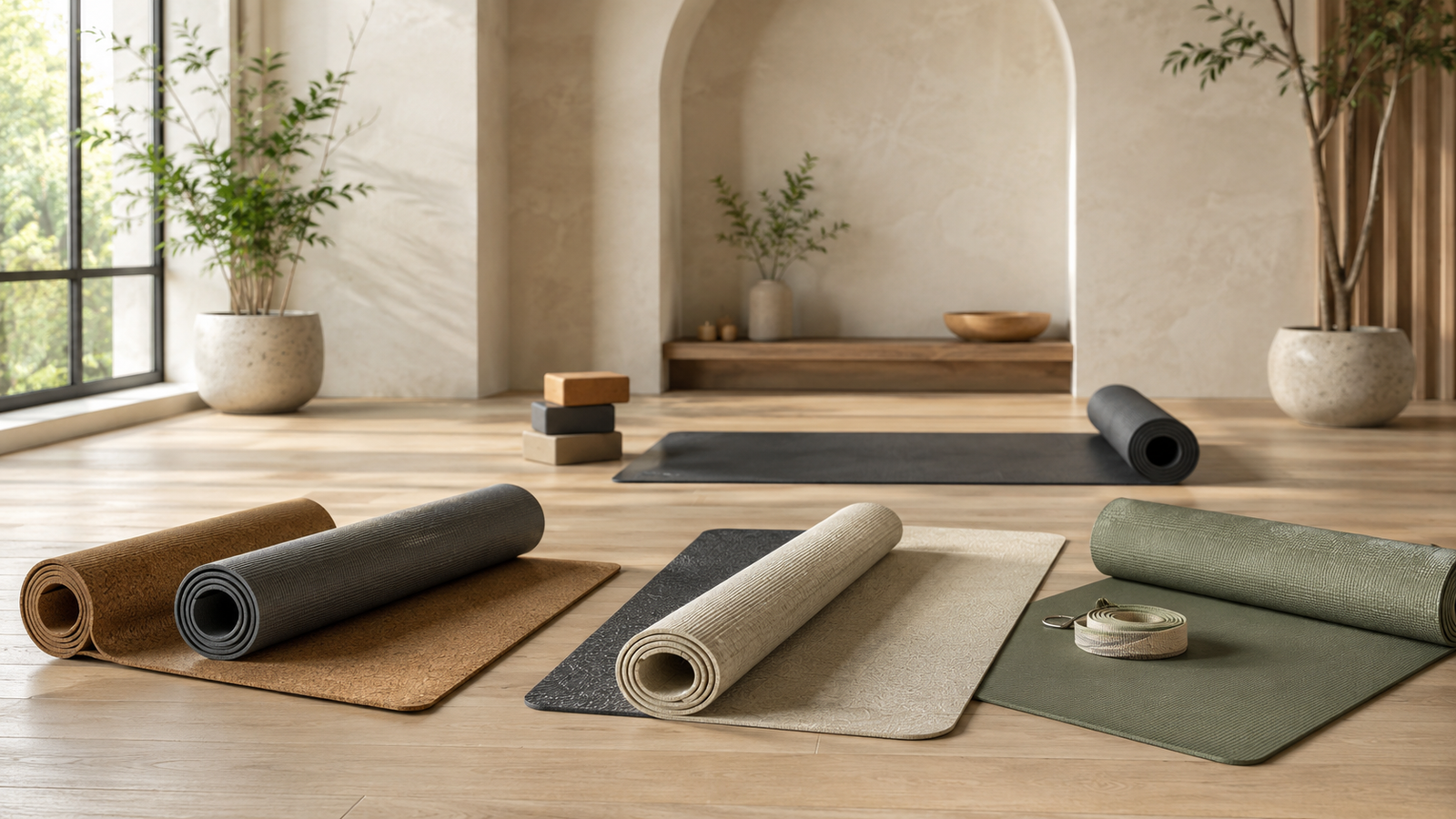
A yoga mat looks simple, but choosing the right one involves more than selecting a colour or buying the thickest option available.
The mat affects how comfortably and securely you can perform:
- yoga poses;
- stretching;
- mobility exercises;
- floor-based strength work;
- Pilates-style movements;
- warm-ups and cooldowns.
A mat that is too thin may feel uncomfortable on hard flooring. A very thick mat may feel cushioned but less stable during standing poses. Some materials provide excellent grip but are heavy. Others are light enough to carry easily but may move around more during exercise.
The useful question is therefore not:
“Which yoga mat is best?”
It is:
“Which combination of thickness, grip, cushioning, material and size fits the way I actually plan to use it?”
For most people, the main decision factors are:
practice type → thickness → grip → material → size → portability → maintenance → budget.
This guide explains each factor so you can choose a yoga mat without paying for features that do not improve your routine.
Start With How You Plan to Use the Mat
Before comparing materials or thicknesses, identify the mat’s main job.
Someone practicing yoga at home may need something different from someone who wants a mat mainly for:
- stretching;
- push-ups;
- mobility work;
- Pilates;
- general floor exercise.
Mostly Yoga
For traditional yoga practice, important characteristics include:
- stable footing;
- dependable grip;
- enough cushioning for knees and joints;
- appropriate length and width.
Too much cushioning can make some standing poses feel unstable.
Mobility and Stretching
Mobility work generally places less demand on standing stability.
You may prefer:
- slightly more cushioning;
- comfortable surface feel;
- enough room for floor positions.
General Home Workouts
If the mat will also be used for:
- bodyweight exercise;
- core training;
- kneeling movements;
durability and cushioning may matter more.
Pilates and Floor Exercise
Pilates-style routines often involve more prolonged contact between the body and floor.
A somewhat thicker mat may therefore feel more comfortable.
This is why the ideal yoga mat cannot be determined by thickness alone.
Yoga Mat Thickness Explained
Thickness is one of the first specifications shoppers notice.
Common options include approximately:
- 3–4 mm;
- 5–6 mm;
- 8 mm;
- 10 mm or more.
Each changes the balance between:
floor connection and cushioning.
3–4 mm Mats
Thinner mats generally provide stronger contact with the floor.
Advantages
They tend to be:
- stable;
- relatively light;
- easy to roll;
- easier to carry.
They may work well for people who prioritize:
- standing yoga poses;
- balance;
- portability.
Possible Drawback
There is less cushioning for:
- knees;
- elbows;
- spine;
- wrists.
On hard tile or concrete flooring, a very thin mat may feel uncomfortable.
5–6 mm Mats
For many users, this is the most versatile range.
A 5–6 mm mat often provides a practical balance between:
- cushioning;
- stability;
- portability.
It can work well for:
- beginner yoga;
- home practice;
- stretching;
- mobility;
- general exercise.
That does not make 6 mm automatically “best,” but it explains why this thickness is so common.
8 mm Mats
An 8 mm mat offers noticeably more cushioning.
This can be useful for people who spend significant time:
- kneeling;
- sitting;
- lying on the floor.
However, the extra thickness may reduce the firm floor connection some people prefer during balance poses.
An 8 mm mat can therefore be a good option when:
comfort matters more than maximum stability.
10–15 mm Mats
Very thick exercise mats are often closer to:
general fitness mats
than traditional yoga mats.
They may work particularly well for:
- abdominal exercises;
- stretching;
- rehabilitation-style floor movements;
- bodyweight routines.
But for yoga requiring stable standing positions, they can sometimes feel:
- soft;
- unstable;
- bulky.
Do Not Automatically Choose the Thickest Mat
More cushioning sounds better, but a yoga mat is not a mattress.
Imagine standing on:
a firm floor
versus:
a soft cushion.
The softer surface requires additional stabilization.
For some yoga poses, especially those involving:
- single-leg balance;
- weight transfer;
- stable hand placement;
too much softness may be counterproductive.
A useful general approach is:
| Main use | Practical thickness direction |
|---|---|
| Balance-focused yoga | Thinner to medium |
| General beginner yoga | Medium |
| Yoga + stretching | Medium |
| Sensitive knees / floor comfort | Medium to thicker |
| Pilates / floor exercise | Thicker |
| Travel | Thin/lightweight |
| General fitness floor mat | Medium to thick |
These are starting points rather than strict rules.
Consider the Floor Underneath
The surface beneath the mat changes how much cushioning you need.
Hard Tile or Stone
A little more cushioning may improve comfort.
Wooden Flooring
A medium mat is often sufficient.
Carpet
A thick soft mat placed on carpet can become unstable because both surfaces compress.
A thinner mat may feel more secure.
Rubber Gym Flooring
Because the floor already provides some cushioning, you may not need an especially thick mat.
Always consider:
mat + floor together
rather than mat thickness in isolation.
Grip Is One of the Most Important Features
A beautiful mat becomes difficult to use if:
- hands slide;
- feet move;
- the mat itself slips across the floor.
There are actually two types of grip to consider.
Surface Grip
This is the friction between:
your hands/feet and the mat.
Floor Grip
This is the friction between:
the mat and the floor.
A mat may perform well in one area and poorly in the other.
Ideally, it should do both reasonably well.
Dry Grip vs Sweaty Grip
Grip can change dramatically with moisture.
Some mats feel excellent when dry but become slippery when:
- palms sweat;
- humidity increases.
Others are designed to maintain traction with moisture.
If you practice:
- vigorous yoga;
- hot yoga;
- high-intensity floor work;
this becomes more important.
For lighter stretching or gentle home yoga, extreme sweat resistance may not matter.
Texture Matters
Yoga mats may have surfaces that are:
- smooth;
- lightly textured;
- heavily textured;
- patterned.
Texture can improve mechanical grip.
But aggressive texture may feel uncomfortable against:
- knees;
- elbows;
- bare skin.
A moderate texture often provides a useful compromise.
Material: What Yoga Mats Are Made From
Material affects:
- grip;
- cushioning;
- weight;
- durability;
- smell;
- cleaning;
- price.
Common materials include:
- EVA;
- PVC;
- TPE;
- NBR;
- natural rubber;
- cork;
- blends.
There is no material that is automatically superior for every user.
EVA Yoga Mats
EVA is commonly used in affordable exercise mats.
It tends to be:
- lightweight;
- cushioned;
- relatively inexpensive.
That can make it practical for:
- beginners;
- general home exercise.
However, the exact density and surface finish vary significantly between products.
Two EVA mats of the same thickness can feel very different.
TPE Yoga Mats
TPE mats are common in mid-range yoga products.
They are often marketed as:
- lightweight;
- flexible;
- relatively easy to carry.
Many offer a good balance of:
- grip;
- cushioning;
- portability.
Again, “TPE” alone does not tell you how well the mat performs.
Surface texture and density still matter.
PVC Yoga Mats
PVC has traditionally been common in yoga mats because it can provide:
- durability;
- grip;
- relatively thin construction.
Some PVC mats can last for years.
However, users who prioritize particular environmental or material preferences may choose alternatives.
When comparing environmental claims, look for specific information rather than relying on vague labels such as:
“eco-friendly.”
NBR Mats
NBR foam is frequently used for:
- thicker;
- softer;
- cushioned exercise mats.
It can be comfortable for:
- stretching;
- floor exercises;
- Pilates-style routines.
For balance-heavy yoga, a very thick NBR mat may feel less stable.
That is why some 10–15 mm mats are better thought of as:
exercise mats
rather than dedicated yoga mats.
Natural Rubber Mats
Natural rubber mats can provide strong:
- grip;
- density;
- floor stability.
They often feel more substantial than lightweight foam mats.
Potential drawbacks include:
- greater weight;
- higher price;
- distinctive rubber smell when new.
Natural rubber may also be unsuitable for someone with a relevant latex allergy or sensitivity.
Cork Yoga Mats
Cork mats typically combine a cork surface with another material underneath.
They can appeal to users who prefer:
- distinctive texture;
- natural-looking surface.
Some cork surfaces become grippier as moisture increases.
However, they may require different cleaning and storage care than conventional foam mats.
Do Not Buy Based on “Eco-Friendly” Alone
Environmental claims on yoga mats can be vague.
Terms such as:
- eco-friendly;
- natural;
- sustainable;
- non-toxic;
can mean different things across manufacturers.
If this matters to you, look for specific information about:
- material composition;
- manufacturing;
- recyclability;
- certifications.
Do not assume a green colour or leaf symbol proves environmental performance.
Mat Density Matters as Much as Thickness
Two mats can both be:
6 mm
but feel completely different.
One may feel:
- dense;
- supportive.
The other may feel:
- soft;
- spongy.
Density influences:
- stability;
- compression;
- durability.
Unfortunately, density is not always clearly listed.
User reviews and physical inspection can sometimes provide useful clues.
Size: Length and Width
A mat should provide enough usable area for your body.
Typical yoga mats are approximately:
- 170–185 cm long;
- 60–68 cm wide.
Exact dimensions vary.
How Long Should Your Yoga Mat Be?
Ideally, you should be able to lie down without:
- head;
- feet;
hanging significantly off the mat.
If you are taller, consider an extended-length mat.
For example, someone around:
185 cm tall
may find a 173 cm mat restrictive.
A longer mat can improve comfort during:
- lying poses;
- stretching;
- floor routines.
Width Matters Too
Standard-width mats work for many users.
Wider mats can provide more space for:
- mobility;
- stretching;
- broader stances;
- floor exercise.
However, increased width also makes the mat:
- heavier;
- bulkier;
- harder to transport.
For home use, this may not matter.
For studio travel, it may.
Bigger Is Not Always Better
An oversized mat sounds appealing, but consider storage.
A large mat requires more space when:
- rolled;
- stored;
- transported.
If your workout area is small, measure the available floor space first.
Weight and Portability
If your mat stays permanently in a home gym, weight may be largely irrelevant.
If you carry it to:
- yoga class;
- park;
- gym;
- office;
weight becomes important.
A dense natural rubber mat may offer excellent stability but be inconvenient to carry every day.
Carrying Straps and Bags
Some mats include:
- elastic straps;
- carrying slings;
- bags.
These are convenient but should not determine the mat purchase.
A good mat without a strap can easily be paired with an inexpensive carrying strap later.
Prioritize:
mat quality first.
How Easily Does the Mat Roll?
Some mats remain tightly curled after being stored.
This can cause:
- edges lifting;
- corners rolling.
Dense materials often flatten more easily than very lightweight foam, although construction varies.
If possible, check whether buyers frequently report:
- curling edges;
- difficulty flattening.
Does the Mat Move During Exercise?
Floor movement is different from hand grip.
A mat may have a good upper surface but still slide across:
- tile;
- polished wood.
Look for a lower surface with:
- texture;
- anti-slip pattern.
Again, test on the type of floor where you will actually use it.
Cushioning for Knees
Knee comfort is a common reason people choose thicker mats.
If kneeling is uncomfortable, there are two solutions:
Option 1 — Thicker Mat
Provides cushioning everywhere.
Option 2 — Normal Mat + Knee Pad
Maintains a firmer overall surface while adding cushioning only when needed.
A small yoga knee pad can therefore be useful for someone who prefers a stable 4–6 mm mat but needs additional cushioning in kneeling poses.
Wrist Comfort
People sometimes assume a thicker mat will solve wrist discomfort.
Not necessarily.
Very soft mats can cause the hands to sink slightly, potentially changing wrist position.
Wrist discomfort may also relate to:
- technique;
- loading;
- mobility;
- previous injury.
Do not buy an extremely thick mat solely as a treatment for wrist pain.
Joint Pain and Medical Conditions
If you have persistent pain involving:
- knees;
- wrists;
- hips;
- spine;
mat selection may improve comfort, but it should not substitute for appropriate professional evaluation.
A yoga mat is exercise equipment, not medical treatment.
Mat Surface and Skin Comfort
If you frequently perform:
- child’s pose;
- forearm positions;
- seated work;
your skin may contact the mat for long periods.
Very aggressive textures can feel rough.
If skin comfort matters, look for:
- moderate texture;
- smooth but grippy surface.
Odour When New
Some foam and rubber mats have a noticeable smell after opening.
This may decrease after:
- airing;
- cleaning according to instructions.
If you are highly sensitive to smell, check:
- material;
- user feedback.
Do not use harsh chemicals to remove odour unless the manufacturer permits them.
Cleaning and Hygiene
Yoga mats come into contact with:
- hands;
- feet;
- sweat;
- floors.
Regular cleaning is therefore important.
Basic maintenance usually involves:
- wiping after sweaty sessions;
- periodic deeper cleaning;
- allowing the mat to dry completely.
Always follow manufacturer instructions.
Do Not Roll a Wet Mat
Rolling while damp can trap:
- moisture;
- odour.
Allow the mat to dry before storage.
Can Yoga Mats Be Machine Washed?
Usually not.
Some specialty mats may have specific washable construction, but most yoga mats should not be placed in:
- washing machines;
- dryers;
unless explicitly permitted.
Excessive heat and agitation can damage:
- foam;
- adhesives;
- surface texture.
Cleaning Products
Avoid automatically using:
- bleach;
- harsh disinfectants;
- strong solvents.
These may damage the mat or reduce grip.
Use cleaning methods suitable for the actual material.
Durability
A mat that loses:
- surface texture;
- cushioning;
- shape;
quickly is poor value.
Durability depends on:
- material;
- density;
- frequency of use;
- footwear;
- cleaning;
- storage.
Using shoes on a mat designed primarily for barefoot yoga may accelerate wear.
Shoes or Bare Feet?
Traditional yoga mats are generally designed for:
- barefoot use.
If you plan to perform shoe-based workouts, choose a mat designed to tolerate that type of abrasion.
For high-impact shoe-based exercise, rubber gym flooring may sometimes be more appropriate than a yoga mat.
Home Yoga vs Studio Yoga
Home Practice
You can prioritize:
- comfort;
- larger size;
- heavier materials.
Portability matters less.
Studio Practice
You may prioritize:
- lighter weight;
- compact rolling;
- easy carrying;
- rapid cleaning.
Travel Yoga Mats
Travel mats are typically:
- thinner;
- lighter;
- easier to pack.
Some can even be folded.
The trade-off is reduced cushioning.
A travel mat is useful for someone who frequently:
- flies;
- commutes;
- attends classes.
For permanent home use, the compromises may not be necessary.
Do You Need Alignment Markings?
Some mats have printed lines designed to help with:
- hand placement;
- foot positioning.
These can be useful visual cues for beginners.
But they are not essential.
A mat without markings can work perfectly well.
Do not pay significantly more for alignment graphics unless you genuinely find them useful.
Printed Designs
Decorative patterns have little impact on performance.
The important properties remain:
- grip;
- thickness;
- stability;
- durability.
A beautiful mat that becomes slippery is still a poor exercise mat.
Double-Layer Mats
Some mats use different surfaces on each side.
For example:
- textured top;
- grippy bottom.
Others may be reversible.
This can be useful if both surfaces provide meaningful performance differences.
But reversible branding alone does not make a mat better.
Which Side of the Yoga Mat Goes Down?
This depends on the design.
Usually the:
- more textured;
- patterned;
bottom surface faces the floor.
The workout surface faces upward.
If uncertain, check the manufacturer’s instructions.
Yoga Mat vs Exercise Mat
These terms are often used interchangeably, but they can describe slightly different priorities.
Yoga Mat
Usually emphasizes:
- grip;
- stability;
- standing poses.
Exercise Mat
Often emphasizes:
- cushioning;
- floor exercises.
A 13 mm NBR exercise mat may therefore be excellent for:
- stretching;
- core training;
but not necessarily ideal for balance-focused yoga.
Yoga Mat vs Gym Flooring
If your goal is:
- lifting weights;
- protecting the floor;
- using heavy equipment;
a yoga mat is usually not the best floor protection.
Consider:
- rubber floor tiles;
- gym flooring.
Yoga mats are designed primarily for the person—not for protecting floors from heavy dumbbells or machines.
Can You Use a Yoga Mat Under a Treadmill?
Generally, a dedicated equipment mat is more suitable.
Exercise machines can:
- compress;
- damage;
- tear;
soft yoga mats.
Use equipment-specific flooring for:
- treadmills;
- exercise bikes;
- heavy benches.
Thickness and Balance: Test Before Committing
If possible, try a simple balance test.
Stand on one leg for several seconds.
If the mat feels:
- excessively squishy;
- unstable;
it may be too soft for your preferred yoga practice.
Try a Kneeling Test Too
Kneel on the mat for 20–30 seconds.
If your knees immediately feel uncomfortable, the mat may not provide enough cushioning for your routine.
These two simple tests help balance:
stability vs comfort.
Grip Test
Place both hands firmly on the mat and gently push forward.
You should not feel your hands slide easily.
Then test the mat against the floor.
If the whole mat moves, floor grip may be inadequate.
Sweat Test
If you sweat heavily, grip may change during exercise.
A mat that feels secure when completely dry may perform differently after 20 minutes.
For sweaty practice, consider testing the mat after:
- lightly dampening your hands.
Do not soak the mat.
Yoga Towels
A yoga towel can be placed over the mat during sweaty sessions.
This may improve:
- hygiene;
- moisture management.
However, the towel itself needs adequate grip.
Do not assume you need both unless sweat is genuinely a problem.
How Much Should You Spend?
Yoga mats range from inexpensive beginner products to premium specialty mats.
Price differences may reflect:
- materials;
- density;
- durability;
- manufacturing;
- grip technology;
- brand positioning.
But price does not guarantee suitability.
Budget Yoga Mats
A budget mat can be completely adequate for:
- beginner practice;
- occasional stretching;
- home workouts.
Pay attention to:
- thickness;
- grip;
- durability.
The main limitation is often material density and long-term wear rather than basic usability.
Mid-Range Mats
This is where many users will find the strongest balance of:
- grip;
- cushioning;
- materials;
- durability.
Someone practicing several times per week may find spending moderately more worthwhile.
Premium Yoga Mats
Premium mats may offer:
- dense natural rubber;
- specialized surfaces;
- stronger grip;
- longer durability.
They may make sense for:
- regular practitioners;
- users with very specific grip preferences.
But a premium price is unnecessary for someone using the mat for:
20 minutes of stretching twice a week.
Cost Per Use Matters
A ₹3,000 mat used:
300 times
costs ₹10 per session.
A ₹700 mat replaced three times in the same period may not actually be cheaper.
Consider:
- expected usage;
- durability;
instead of purchase price alone.
Common Yoga Mat Buying Mistakes
Choosing Only by Thickness
Grip and stability matter too.
Buying the Thickest Mat Possible
More cushioning may reduce balance stability.
Ignoring Dimensions
Tall users can quickly outgrow standard mats.
Ignoring Floor Type
The same mat may behave differently on tile and carpet.
Buying by Material Name Alone
Construction quality matters within every material category.
Ignoring Weight
A heavy mat may be excellent at home but inconvenient for classes.
Paying for Accessories Instead of the Mat
A bag or strap is secondary.
Trusting “Anti-Slip” Without Context
Nearly every mat is marketed this way.
Look at surface construction and real-world use.
Buying a Yoga Mat for Heavy Gym Equipment
Use appropriate floor protection instead.
Expecting a Mat to Fix Pain
Equipment can improve comfort but cannot diagnose or treat injury.
Quick Yoga Mat Decision Table
| Priority | What to prioritize |
|---|---|
| Beginner yoga | 5–6 mm + dependable grip |
| Balance-focused practice | Thin to medium + firm density |
| Sensitive knees | Medium/thicker cushioning |
| Pilates/floor exercise | Thicker cushioning |
| Hot/sweaty practice | Strong wet grip |
| Home use | Comfort + durability |
| Studio use | Portability + grip |
| Travel | Thin + lightweight |
| Tall user | Extended length |
| Small space | Standard size + easy storage |
| Frequent use | Durable material + strong surface |
| Budget-focused | Practical foam mat with good grip |
A Practical Buying Checklist
Before purchasing, ask:
Use
- Will I mainly use it for yoga?
- Stretching?
- Pilates?
- General exercise?
Thickness
- Do I need stronger floor connection?
- Or more cushioning?
Grip
- Is surface traction strong enough?
- Does the bottom grip my flooring?
Material
- Do I care most about weight?
- Durability?
- texture?
- specific material preferences?
Size
- Is the mat longer than or close to my height?
- Is the width comfortable?
Portability
- Will it stay at home?
- Or do I carry it regularly?
Cleaning
- Is maintenance straightforward?
Value
- Am I paying for useful performance or mainly branding?
A Simple Way to Choose Between Two Mats
If two options seem similar, compare them in this order:
1. Which one fits your actual use better?
Yoga vs general exercise.
2. Which offers more appropriate thickness?
Not simply more thickness.
3. Which provides better grip?
Both surface and floor grip.
4. Which has the better size?
Especially if you are tall.
5. Which is easier to live with?
Consider:
- weight;
- storage;
- cleaning.
6. Which offers better long-term value?
Then consider price.
This sequence prevents small cosmetic features from outweighing practical performance.
When You May Need More Than One Mat
Some people genuinely benefit from two different mats.
For example:
Mat 1
A firm 4–6 mm yoga mat for:
- balance;
- standing poses.
Mat 2
A thicker exercise mat for:
- core work;
- floor stretching.
But do not begin by buying both.
Start with the mat that covers the majority of your routine.
Add another only if you repeatedly encounter a specific limitation.
Related Products That Can Be Useful
Depending on your routine, useful accessories may include:
- yoga blocks;
- yoga strap;
- knee pad;
- yoga towel;
- carrying strap.
These should solve specific problems.
For example:
tight mobility → strap
limited reach → block
knee discomfort → knee pad
Do not buy a complete accessory kit simply because it is bundled with the mat.
Physical Glow’s Product recommendations can help you compare specific yoga mats separately; this Buying Guide is intended to explain how to choose, not rank products.
Frequently Asked Questions
What thickness yoga mat is best for beginners?
A medium-thickness mat around 5–6 mm often provides a useful balance of cushioning and stability, although floor type and personal comfort matter.
Is a 6 mm yoga mat good?
For many general users, yes. It provides more cushioning than very thin mats without becoming extremely soft.
Is an 8 mm yoga mat too thick?
Not necessarily. It can be comfortable for floor-based practice, but users focused on balance may prefer a thinner, firmer mat.
Is a 10 mm yoga mat good for yoga?
It can work, but mats in this range are often more suited to stretching and general floor exercise than balance-focused yoga.
Which material is best for a yoga mat?
There is no universal best material. Compare grip, weight, durability, density, maintenance and your own material preferences.
Are natural rubber yoga mats better?
They can provide excellent grip and density, but they are usually heavier and may cost more.
Is TPE better than EVA?
Not automatically. Both materials can perform well depending on density and construction.
Is NBR good for yoga?
NBR is commonly used in thicker cushioned exercise mats. It can be comfortable but may feel too soft for some standing yoga practices.
How long should my yoga mat be?
Ideally, it should accommodate your body comfortably when lying down. Taller users may benefit from extended-length mats.
How wide should a yoga mat be?
Standard widths suit most users, but wider mats provide more room for mobility and floor exercise.
Can yoga mats be used for workouts?
Yes, especially for bodyweight and floor exercises. Avoid using a delicate yoga mat beneath heavy equipment or for exercises that may damage its surface.
Can I wear shoes on a yoga mat?
Some mats can tolerate occasional shoe use, but many are primarily designed for barefoot practice. Repeated shoe use may accelerate wear.
How often should I clean my yoga mat?
Clean it regularly based on usage and sweating, following the manufacturer’s material-specific instructions.
Can I wash a yoga mat in a washing machine?
Usually not unless the manufacturer specifically permits it.
Why is my yoga mat slippery?
Possible causes include:
- surface material;
- sweat;
- cleaning residue;
- worn texture.
A towel or different surface material may help.
Why does my yoga mat slide on the floor?
The bottom surface may not provide enough friction for your flooring. Try testing it on another surface or choose a mat with stronger floor grip.
Is a thicker yoga mat better for knee pain?
Additional cushioning may improve comfort, but persistent knee pain should not be managed solely by changing exercise equipment.
Are alignment lines useful?
They can provide convenient visual cues, particularly for beginners, but they are not necessary for an effective mat.
How long does a yoga mat last?
It depends on material, frequency of use, cleaning and storage. Replace it when grip, cushioning or structural integrity deteriorates significantly.
Is an expensive yoga mat worth it?
It can be if better material, grip and durability genuinely benefit frequent use. Occasional users may be perfectly satisfied with a good budget or mid-range mat.
Should I buy a yoga mat online?
Online shopping provides more choice, but check:
- dimensions;
- thickness;
- material;
- weight;
- return policy.
Photos alone may not communicate density or grip accurately.
The Physical Glow Takeaway
A yoga mat should make your practice:
more stable, more comfortable and easier to maintain consistently.
Start with how you actually plan to use it.
For most general home users, a medium-thickness mat around 5–6 mm offers a practical balance between cushioning and stability. If your practice emphasizes balance and floor connection, consider a thinner, firmer mat. If you mainly perform stretching, Pilates or floor exercise, additional cushioning may be useful.
Then evaluate:
grip → material → density → size → portability → maintenance → price.
Do not choose a mat simply because it is:
- thick;
- expensive;
- labelled eco-friendly;
- bundled with accessories.
And do not assume one material works for everyone.
The best choice is the mat that provides enough cushioning for your floor and joints while remaining stable enough for your movements—and that is easy enough to clean, store and use that it becomes a regular part of your routine rather than another piece of fitness equipment sitting unused.