Yoga Strap Length Guide: 6 ft vs 8 ft vs 10 ft
Compare 6 ft, 8 ft and 10 ft yoga straps by reach, loop size, body height and mobility use so you can choose a practical length for your practice.
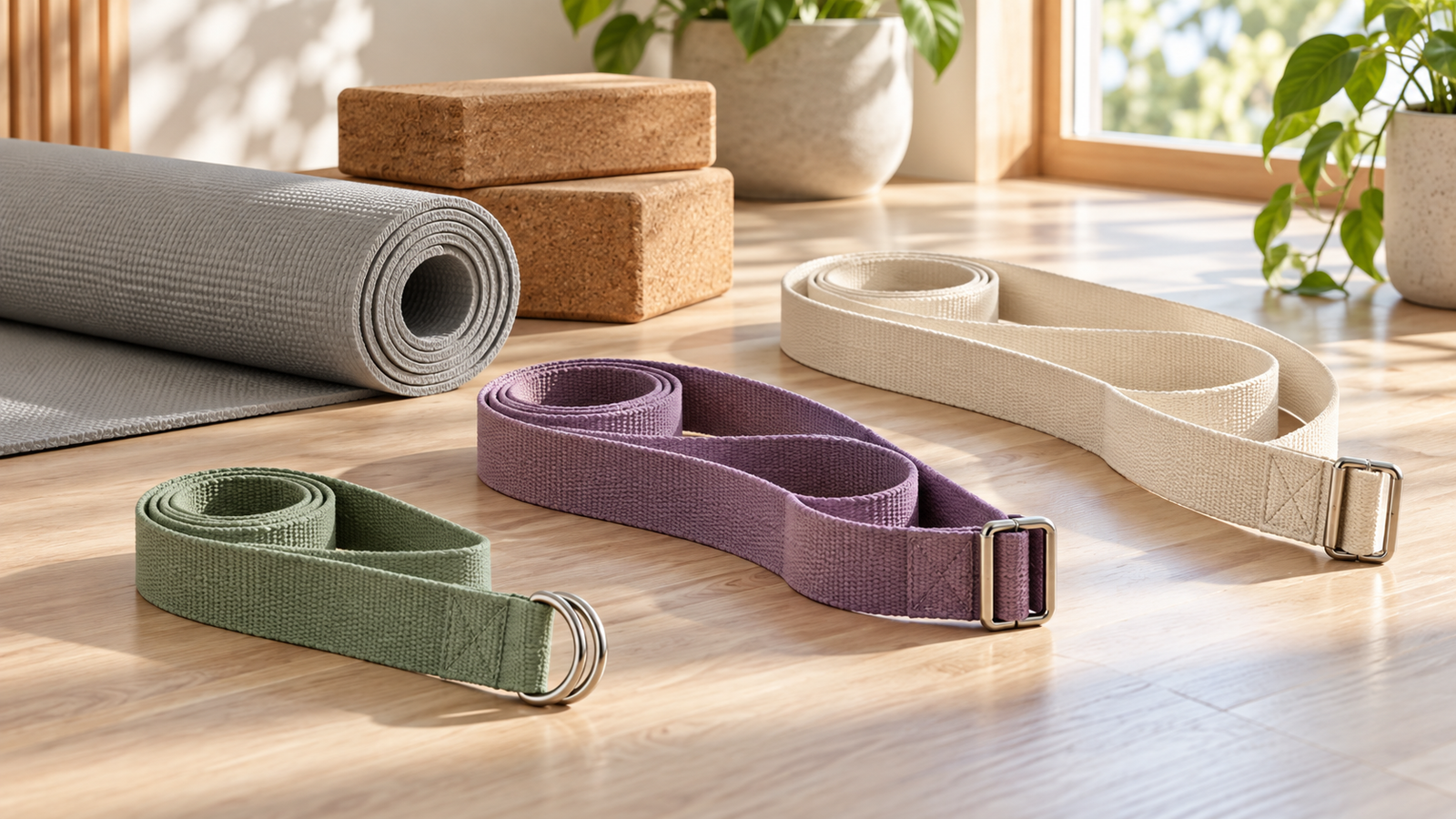
A yoga strap looks like a very simple accessory, but choosing the right length can make a noticeable difference in how comfortable and useful it feels during stretching, mobility work and yoga practice.
Most yoga straps are available in lengths such as:
- 6 feet
- 8 feet
- 10 feet
The best length depends on more than your height. It also depends on:
- Your flexibility
- The poses or stretches you perform
- Whether you use the strap as a straight extension or create loops
- Your shoulder mobility
- Your preferred grip distance
- Whether you want extra length for more advanced positions
For many users, an 8-foot strap is the most versatile middle ground. A 6-foot strap can be enough for basic stretching, while a 10-foot strap offers extra room for taller users, larger loops and movements that require more reach.
This guide explains the practical differences between 6 ft, 8 ft and 10 ft yoga straps so you can choose the length that suits your practice.
What Is a Yoga Strap Used For?
A yoga strap is a relatively firm fabric belt used to extend your reach or help maintain a position.
It can be useful when your hands cannot comfortably reach:
- Your feet
- Each other behind your back
- Around your legs
- Around the body during certain poses
A strap can help you work within your current range of motion instead of forcing yourself into a deeper position.
Common uses include:
- Hamstring stretches
- Seated forward folds
- Shoulder mobility exercises
- Bound poses
- Leg stretches
- Assisted reclining stretches
- Positioning during restorative yoga
The strap should be treated as a positioning aid, not as a tool for pulling the body forcefully into a stretch.
Does Yoga Strap Length Really Matter?
Yes.
A strap that is too short may limit the positions you can use it for.
A strap that is unnecessarily long may create:
- Excess loose fabric
- More material to manage
- Extra time when adjusting loops
Length becomes especially important when you want to create large loops around:
- Both feet
- The torso
- Legs
- Shoulders
The ideal strap should give you enough reach without making the accessory awkward to handle.
6 ft vs 8 ft vs 10 ft: Quick Overview
6-Foot Yoga Strap
Best for:
- Basic stretching
- Smaller users
- Simple seated poses
- General home use
- People who prefer less excess fabric
8-Foot Yoga Strap
Best for:
- Most general yoga users
- Taller users
- Larger loops
- Shoulder mobility
- More versatile practice
10-Foot Yoga Strap
Best for:
- Very tall users
- Large body loops
- Advanced strap-assisted positions
- Restorative yoga setups
- Users who regularly find shorter straps limiting
For many people who are unsure, an 8-foot strap is the most flexible starting point.
6-Foot Yoga Straps
A 6-foot strap is compact and easy to manage.
It is often sufficient for straightforward stretching exercises.
Typical uses include:
- Hamstring stretching
- Seated forward folds
- Single-leg stretches
- Basic shoulder exercises
- Assisted foot reach
For someone with average or shorter height and moderate flexibility, 6 feet may provide enough reach for most basic movements.
Advantages of a 6-Foot Strap
Easier to Handle
There is less loose material during simple stretches.
Compact
It takes up very little space and is easy to pack into a gym or yoga bag.
Suitable for Basic Mobility Work
If you mainly use the strap to extend your reach toward one foot, you may not need additional length.
Simple for Beginners
Beginners performing basic stretches may find a shorter strap easier to control.
Limitations of a 6-Foot Strap
The main limitation is flexibility.
A 6-foot strap may feel too short when:
- You are tall
- You have limited flexibility
- You need a large loop
- You are using the strap around your torso
- You are working on complex shoulder or bound positions
You can always shorten a long strap with your hands or buckle.
You cannot add extra length to a strap that is already too short.
That is why some users eventually move from 6 ft to 8 ft.
8-Foot Yoga Straps
An 8-foot strap is often the most balanced option.
It offers enough extra length for:
- Taller users
- Larger loops
- More varied yoga poses
- Shoulder mobility work
- Assisted leg stretches
while still being easy enough to manage for everyday use.
For many people, this is the safest general recommendation when they are unsure which length to choose.
Advantages of an 8-Foot Strap
Greater Versatility
The extra two feet give more room for different poses.
Better for Taller Users
People with longer legs or arms may find the additional reach useful.
Easier Loop Creation
Larger loops can be made without using almost the entire strap.
Suitable for Mobility Work
It gives more flexibility for shoulder and lower-body drills.
Good Long-Term Choice
An 8-foot strap may remain useful even as your practice changes.
Limitations of an 8-Foot Strap
There is slightly more excess fabric.
For very simple stretching, this may feel unnecessary.
However, most users can simply hold the strap closer or adjust the buckle.
The additional length is rarely a major problem.
10-Foot Yoga Straps
A 10-foot strap provides the greatest reach.
This can be useful for:
- Tall users
- Restorative yoga
- Large loop positions
- Wider body positioning
- More specialised strap work
It is the most flexible option in terms of available length.
However, it is also the most material to manage.
Advantages of a 10-Foot Strap
Maximum Reach
If shorter straps regularly feel restrictive, a 10-foot version solves that problem.
Large Loops
It can be useful when the strap needs to wrap around:
- Feet
- Torso
- Legs
- Shoulders
Useful for Restorative Practice
Some restorative positions require longer loops or wraps.
Suitable for Taller Bodies
Very tall users may appreciate the extra reach during seated and lying stretches.
Limitations of a 10-Foot Strap
More Excess Fabric
For basic stretches, much of the strap may remain unused.
Slightly Slower to Adjust
More fabric can take longer to feed through a buckle or D-ring.
Less Convenient for Travel
Although still compact, it has more material than shorter options.
A 10-foot strap is useful when you know you need the extra length.
It is not automatically better simply because it is longer.
Which Yoga Strap Length Is Best for Beginners?
For many beginners, either 6 ft or 8 ft can work.
An 8-foot strap is usually more forgiving because it provides extra reach.
Beginners often have more limited flexibility, which means a slightly longer strap may be useful.
For example, during a seated forward fold, a beginner may need considerably more strap length to comfortably reach around the feet.
As flexibility improves, the strap can simply be held shorter.
This makes an 8-foot strap a versatile beginner option.
Yoga Strap Length and Height
Height is one factor, but it should not be used alone.
A taller person generally has:
- Longer legs
- Longer arms
- Larger reach requirements
This may make an 8-foot or 10-foot strap more practical.
A shorter person may find 6 feet sufficient.
However, flexibility can matter just as much.
A shorter person with limited mobility may need more strap length than a taller person with excellent flexibility.
Think about both body size and movement range.
Yoga Strap Length and Flexibility
Less flexibility often means you need more strap length.
For example, imagine two people performing a seated hamstring stretch.
One person can almost reach the feet.
The other person is several inches away.
The second person needs more strap available between the hands and feet.
This is why longer straps can be particularly useful for:
- Beginners
- People returning after a long break
- People with limited mobility
- Taller users
As flexibility improves, you can gradually shorten the distance between your hands and the anchor point.
Yoga Strap Length for Hamstring Stretching
Hamstring stretches are one of the most common uses for a yoga strap.
For a lying hamstring stretch, the strap is usually looped around the foot.
A 6-foot strap may be enough for many users.
An 8-foot strap provides additional flexibility if:
- You are tall
- Your leg remains farther from your torso
- You prefer holding the strap farther from the foot
A 10-foot strap is usually unnecessary for a simple single-leg hamstring stretch unless you specifically prefer the extra length.
Yoga Strap Length for Seated Forward Folds
In a seated forward fold, the strap may be wrapped around both feet.
If you have good mobility, a 6-foot strap can be enough.
If your torso remains farther away from the legs, an 8-foot strap may feel much more comfortable.
The strap allows you to maintain a controlled position without aggressively pulling yourself forward.
The goal should be comfortable tension, not forcing the chest toward the knees.
Yoga Strap Length for Shoulder Mobility
Shoulder mobility exercises often require a wider hand position.
For example, some users hold the strap with both hands and move it overhead.
A longer strap gives more space between the hands.
This can be particularly useful when:
- Shoulder mobility is limited
- You are starting with a very wide grip
An 8-foot strap often works well.
A 10-foot strap may be helpful for users who need an especially wide starting position.
As mobility improves, you can gradually narrow your grip.
Yoga Strap Length for Bound Poses
Bound poses can require considerably more strap length.
The strap may need to bridge a gap between:
- Two hands
- Hand and foot
- Arms behind the back
A longer strap can make these positions much more accessible.
For these uses, an 8-foot strap is generally more versatile than a 6-foot strap.
A 10-foot strap may be useful if you frequently practice complex bound positions or need larger loops.
Yoga Strap Length for Restorative Yoga
Restorative yoga often uses props to support the body in comfortable positions for longer periods.
A strap may be used to:
- Hold the legs together
- Support a position
- Create a large loop
- Stabilise props
Longer straps are often more useful in this setting.
An 8-foot or 10-foot strap may provide more flexibility than a 6-foot option.
Buckle vs D-Ring Yoga Straps
Length is not the only factor.
The adjustment system also matters.
Common options include:
- Plastic buckle
- Metal buckle
- Dual D-ring
Each works slightly differently.
D-Ring Yoga Straps
A D-ring strap uses two metal or plastic rings.
The fabric passes through both rings and then loops back through one.
This creates an adjustable loop.
Advantages include:
- Simple construction
- Easy loop adjustment
- Secure hold
- Good versatility
It may take a little practice to learn how to thread the strap.
Buckle Yoga Straps
Buckle systems may use:
- Sliding plastic buckles
- Metal locking buckles
- Quick-release mechanisms
These can be convenient if you frequently adjust strap length.
The best design should:
- Hold securely
- Release easily
- Avoid sharp edges
- Remain comfortable against the body
There is no universal winner between buckle and D-ring systems.
Choose the one you find easier to use.
Cotton vs Polyester Yoga Straps
Material affects how the strap feels in the hands.
Cotton
Cotton straps may feel:
- Soft
- Natural
- Comfortable
- Slightly textured
They can absorb sweat and may require more drying after use.
Polyester or Synthetic Fabric
Synthetic straps may be:
- Smooth
- Durable
- Easy to clean
- Resistant to moisture
Some users find them slightly more slippery.
The weave and thickness matter as much as the material itself.
Should a Yoga Strap Be Stretchy?
Traditional yoga straps are generally not designed to stretch significantly.
They are different from:
- Resistance bands
- Elastic stretching bands
- Exercise tubes
A yoga strap acts as a relatively stable extension of your reach.
If the strap stretches significantly, it becomes harder to maintain a fixed position.
If you want elastic resistance, use an appropriate resistance band instead.
Yoga Strap vs Resistance Band
These two accessories are often confused.
A yoga strap is mainly used for:
- Positioning
- Assisted stretching
- Extending reach
- Holding poses
A resistance band is designed for:
- Strength exercises
- Resistance training
- Activation drills
They should not automatically be used interchangeably.
Using a yoga strap for exercises requiring significant elastic resistance will not provide the same effect.
Yoga Strap Width
Most yoga straps are relatively narrow, but widths vary.
A slightly wider strap can feel more comfortable because it distributes pressure over a larger area.
A very narrow strap may feel more noticeable against the skin or hands during strong tension.
Look for enough width to maintain comfort without making the strap bulky.
Strap Thickness
Thicker fabric can feel more substantial.
However, very thick fabric can become difficult to thread through buckles.
The ideal strap should balance:
- Durability
- Comfort
- Ease of adjustment
A thick appearance alone does not guarantee better quality.
How to Use a Yoga Strap Safely
The most important principle is not to use the strap to force range of motion.
A strap should provide assistance, not leverage for aggressive stretching.
Maintain Controlled Tension
You should feel a stretch, not sharp pain.
Do Not Yank the Strap
Sudden pulling can place unnecessary stress on muscles and joints.
Keep the Body Stable
Avoid twisting or collapsing simply to reach farther.
Release Slowly
Come out of stretches in a controlled way.
Yoga Strap for Hamstrings: Basic Technique
One simple approach is a lying hamstring stretch.
- Lie on your back.
- Loop the strap around one foot.
- Hold one end in each hand.
- Extend the leg upward comfortably.
- Keep the opposite leg positioned comfortably.
- Gently adjust strap tension.
- Hold without bouncing.
- Lower the leg slowly.
You do not need to pull the leg toward your face.
The purpose is simply to maintain a controlled position.
Yoga Strap for Shoulders: Basic Technique
A strap can also assist with shoulder mobility.
- Hold the strap with both hands.
- Start with a wide grip.
- Keep the arms controlled.
- Raise the strap overhead if comfortable.
- Move only through a pain-free range.
- Widen the grip if necessary.
Do not force the shoulders backward simply because the strap is long enough.
Common Yoga Strap Mistakes
Choosing a Strap That Is Too Short
This defeats the purpose of extending your reach.
Pulling Too Hard
The strap should assist movement, not force it.
Using a Strap Like an Elastic Resistance Band
Traditional yoga straps are not designed for elastic resistance.
Wrapping It Too Tightly
Avoid restricting circulation.
Ignoring Buckle Position
A hard buckle pressing into the skin can become uncomfortable.
Position the hardware away from sensitive areas.
Using Damaged Fabric
Replace a strap if you notice:
- Significant fraying
- Torn stitching
- Damaged buckle
- Cracked rings
A strap is simple equipment, but it still needs to remain structurally secure.
Is a Longer Yoga Strap Always Better?
No.
A longer strap gives more options, but it also creates more fabric to manage.
If you only perform basic stretches, a 10-foot strap may feel unnecessarily long.
Think of length as range.
Choose enough range for your practice without adding material you never use.
For many general users, 8 feet provides the best balance.
Who Should Choose a 6-Foot Strap?
A 6-foot strap may be best if:
- You are shorter
- You already have reasonable flexibility
- You perform basic stretches
- You want minimal excess fabric
- You mainly use the strap around one foot at a time
It is a straightforward choice for simple practice.
Who Should Choose an 8-Foot Strap?
An 8-foot strap is a good choice if:
- You want one versatile strap
- You are average to tall
- You are a beginner
- You want room for larger loops
- You perform both leg and shoulder mobility
- You want enough length for more poses
For most people who are uncertain, this is the easiest default choice.
Who Should Choose a 10-Foot Strap?
A 10-foot strap makes sense if:
- You are very tall
- You regularly need more length
- You use large loops
- You practice restorative yoga
- You perform more specialised strap-assisted poses
- An 8-foot strap still feels restrictive
It provides maximum flexibility but is not necessary for everyone.
Can You Shorten a Long Yoga Strap?
Yes.
This is one of the main advantages of choosing a slightly longer strap.
You can:
- Grip it closer
- Create a smaller loop
- Adjust the buckle
- Fold excess material away
This means an 8-foot strap can behave like a shorter strap during many exercises.
The reverse is not possible.
A 6-foot strap cannot become longer when you need extra reach.
Travel and Portability
All three lengths are relatively portable.
A strap weighs very little compared with most fitness equipment.
For travel, 6 feet may be slightly more compact, but the practical difference is small.
Even a 10-foot strap can usually fit easily inside:
- Gym bag
- Backpack
- Yoga-mat bag
Length should therefore be chosen primarily for function rather than portability.
How to Clean a Yoga Strap
Always check the manufacturer’s care instructions.
Depending on the material, cleaning may involve:
- Hand washing
- Gentle machine washing
- Air drying
Metal buckles or rings may require different care.
Avoid storing the strap while damp because this can lead to:
- Odour
- Fabric deterioration
- Mildew
Allow it to dry fully before folding it away.
How Long Does a Yoga Strap Last?
A good strap can last for years if used and stored properly.
Inspect it occasionally for:
- Frayed fabric
- Loose stitching
- Damaged buckles
- Bent rings
- Cuts
Replace it when damage may affect strength.
Can Beginners Use Yoga Straps?
Yes.
In fact, beginners may benefit greatly because straps allow them to adapt poses to their current mobility.
The strap can help a beginner maintain alignment without needing to reach positions their body is not ready for.
It should support gradual progress rather than encourage forcing flexibility.
Can a Yoga Strap Improve Flexibility?
A strap itself does not create flexibility.
It helps you access and maintain stretching positions.
Improved flexibility depends on:
- Consistent practice
- Appropriate stretching intensity
- Adequate recovery
- Gradual progression
The strap simply makes some positions more accessible.
How Much Tension Should You Use?
Use enough tension to feel supported and stretched.
You should not feel:
- Sharp pain
- Numbness
- Tingling
- Joint pressure
Stretching discomfort should remain manageable and controlled.
If you need to pull very hard on the strap, you may be trying to move farther than your current range allows.
When Should You Avoid Strap-Assisted Stretching?
Avoid forcing a stretch through:
- Acute injury
- Significant pain
- Joint instability
- Recent surgery
- Severe swelling
If you have a medical or musculoskeletal condition that affects movement, seek appropriate professional guidance.
Yoga Strap Length Guide: Simple Recommendation
Choose 6 ft if you want:
- Compact size
- Basic stretching
- Less loose fabric
- Simple beginner use
Choose 8 ft if you want:
- The most versatile option
- Extra reach
- Shoulder and leg mobility
- Larger loops
- A good all-purpose strap
Choose 10 ft if you want:
- Maximum reach
- Large body loops
- Restorative yoga
- Extra room for tall users
- More specialised strap work
Frequently Asked Questions
Is a 6-Foot Yoga Strap Long Enough?
For many basic stretches, yes.
Taller users or people needing larger loops may prefer 8 ft or 10 ft.
Is an 8-Foot Yoga Strap Better?
It is not automatically better, but it is one of the most versatile lengths.
It provides enough extra reach without becoming excessively long for most users.
Who Needs a 10-Foot Yoga Strap?
It is most useful for taller users, restorative practice and poses requiring large loops.
Can I Use a Belt Instead of a Yoga Strap?
A normal belt may work for some simple stretches if it is secure and non-elastic, but a purpose-built yoga strap generally provides more length and easier adjustment.
Are D-Ring Straps Better Than Buckle Straps?
Both can work well.
D-rings are simple and secure, while some buckle systems may be quicker to adjust.
Should a Yoga Strap Be Elastic?
Usually no.
Traditional yoga straps are meant to provide relatively stable support.
What Length Yoga Strap Should a Beginner Buy?
An 8-foot strap is a versatile starting point for many beginners because it provides extra reach while remaining manageable.
Can I Use a Yoga Strap Every Day?
Yes, it can be used regularly as part of appropriate stretching or yoga practice, provided you are not forcing painful positions.
Final Takeaway
Yoga strap length is mainly about having enough reach for the movements you perform.
A 6-foot strap works well for simple stretching and users who do not need much additional reach.
An 8-foot strap is the most versatile choice for many people because it gives enough room for both basic and more varied mobility work.
A 10-foot strap is useful when you are tall, need large loops or regularly perform restorative or specialised strap-assisted positions.
If you are unsure which length to buy, 8 feet is usually the most practical all-purpose starting point.
Whatever length you choose, remember that the strap should help you maintain a comfortable position—not force your body deeper into a stretch than it is ready for.