Cork vs Foam Yoga Blocks: Which Should You Buy?
Compare cork and foam yoga blocks by firmness, weight, grip, comfort, portability and the type of support you want in your practice.
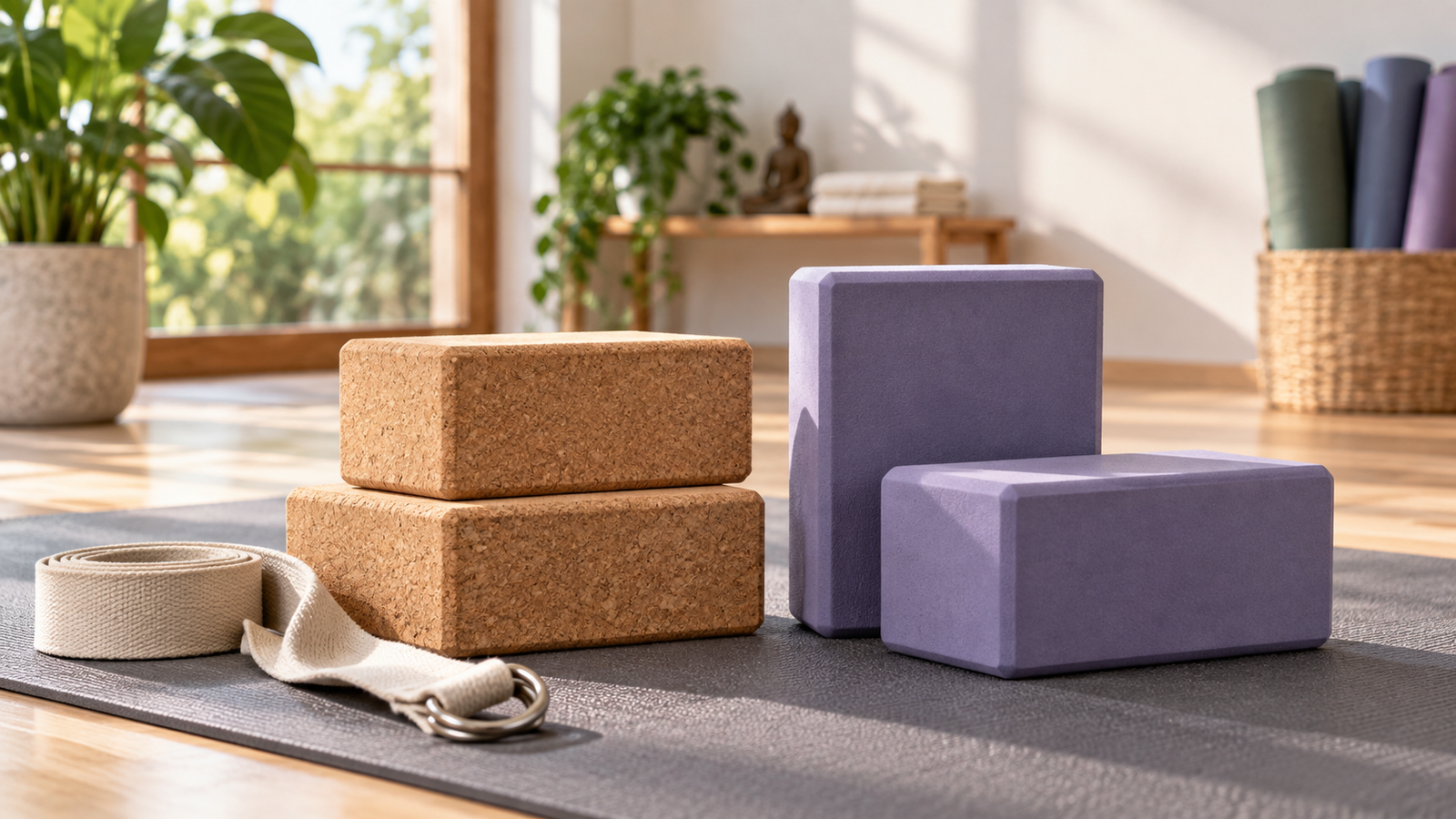
Yoga blocks are simple props, but the material can make a noticeable difference to how they feel during practice.
The two most common options are cork yoga blocks and foam yoga blocks.
Both can help with:
- improving reach
- supporting balance
- modifying poses
- reducing strain in certain positions
- creating more stable alignment
- making some poses more accessible
The main difference is how they feel under the hand or body.
Cork blocks are usually firmer, heavier and more stable. Foam blocks are lighter, softer and easier to carry.
Neither material is universally better.
The right choice depends on your practice style, comfort preferences, portability needs and how much support you want from the block.
What Is a Yoga Block Used For?
A yoga block brings the floor closer to you.
This can be useful when your hands do not comfortably reach the floor or when you want additional support in a pose.
Yoga blocks are commonly used for:
- standing poses
- seated stretches
- balance work
- restorative yoga
- hip-opening poses
- backbends
- strength-focused yoga
- mobility exercises
They can also help you modify a pose instead of forcing your body into a range of motion that is not comfortable.
Why Yoga Block Material Matters
A yoga block needs to provide support, but different materials provide that support differently.
The material affects:
- firmness
- weight
- grip
- comfort
- durability
- portability
- stability
A cork block feels very different from a soft foam block even when both have the same dimensions.
What Is a Cork Yoga Block?
Cork yoga blocks are made from compressed cork material.
They are generally:
- firm
- dense
- heavier than foam
- naturally textured
- relatively rigid
Cork blocks are popular with people who prefer a more solid support surface.
Advantages of Cork Yoga Blocks
Cork blocks can offer:
- strong stability
- firm support
- good grip
- less compression under body weight
- substantial feel during standing poses
They are particularly useful when you want the block to feel more like a stable platform than a cushion.
Disadvantages of Cork Yoga Blocks
Cork blocks can be:
- heavier to carry
- less comfortable under sensitive joints
- harder than foam
- less convenient for travel
If you regularly carry yoga equipment to a studio, the extra weight may matter.
What Is a Foam Yoga Block?
Foam yoga blocks are usually made from EVA or similar lightweight foam materials.
They are generally:
- lightweight
- softer
- slightly compressible
- easy to carry
- widely available
Foam blocks are especially common in beginner yoga kits.
Advantages of Foam Yoga Blocks
Foam blocks can offer:
- lower weight
- softer surface
- easier portability
- more cushioning
- comfortable support in restorative poses
They are often easier to use when the block touches:
- knees
- back
- hips
- other sensitive areas
Disadvantages of Foam Yoga Blocks
Foam blocks may feel less stable under heavier pressure because some formulas compress.
Very soft blocks can feel less secure during poses where you need firm hand support.
Lower-density foam may also show wear more quickly.
Cork vs Foam Yoga Blocks
| Feature | Cork Block | Foam Block |
|---|---|---|
| Firmness | High | Low to medium |
| Weight | Heavier | Lightweight |
| Stability | Excellent | Good, depends on density |
| Cushioning | Minimal | Better |
| Grip | Usually strong | Varies by surface |
| Portability | Lower | Excellent |
| Best for standing support | Excellent | Good |
| Best for restorative use | Good | Excellent |
| Compression | Very little | Some |
| Travel | Less convenient | More convenient |
Which Is Better for Beginners?
Beginners can use either material.
Foam may be a little more approachable because it is:
- lighter
- softer
- easier to move
- usually comfortable in a wide variety of poses
However, cork can be useful if you want a very stable surface for:
- standing poses
- balance work
- stronger weight-bearing positions
The better beginner choice depends on what feels more comfortable and secure.
Which Is Better for Stability?
Cork usually has the advantage.
Because cork is:
- denser
- firmer
- less compressible
it tends to feel more stable when you press down strongly.
This can be useful in poses where your hands rely heavily on the blocks.
A high-density foam block can still be stable, but very soft foam may compress noticeably.
Which Is Better for Comfort?
Foam usually feels more comfortable.
The softer material can be helpful when the block supports:
- the spine
- hips
- knees
- head
during restorative or supported poses.
Cork may feel too hard for some of these positions.
Which Is Better for Restorative Yoga?
Foam blocks are often better suited to restorative practice because they provide more cushioning.
Restorative poses may involve holding support for longer periods.
A slightly softer surface may feel more comfortable during extended holds.
However, some users still prefer cork because of its stability.
Which Is Better for Strength-Focused Yoga?
Cork is often a good choice for more active yoga styles.
It can work well for:
- standing poses
- arm-supported positions
- balance work
- stronger flows
The firm structure gives predictable feedback.
Which Is Better for Hot Yoga?
Grip becomes especially important in hot yoga because of sweat.
Cork often performs well because its textured surface can remain grippy.
Foam grip varies more depending on the finish.
If hot yoga is your main practice, look at:
- surface texture
- sweat resistance
- ease of cleaning
rather than choosing only by material name.
Which Is Better for Travel?
Foam blocks are usually easier to travel with because they are much lighter.
If you frequently carry your block:
- to a studio
- to outdoor classes
- while travelling
foam is more convenient.
Cork can become noticeably heavier when carrying two blocks.
Does Block Weight Matter?
Yes.
A heavier block can feel more planted.
This can improve confidence during supported poses.
However, the same weight makes it less convenient to transport.
Choose based on whether the block will stay:
- at home
- in a studio
- in a gym
or travel with you regularly.
How Firm Should a Yoga Block Be?
Firmness depends on how you use it.
A firmer block is useful when you need:
- strong hand support
- stable elevation
- little compression
A softer block is useful when you need:
- cushioning
- restorative support
- comfort against the body
If possible, avoid extremely soft foam blocks that collapse significantly under pressure.
Does Yoga Block Size Matter?
Yes.
Common yoga blocks are generally designed with three usable heights.
By rotating the block, you can use it on:
- low setting
- medium setting
- high setting
This makes one block suitable for several levels of support.
Before buying, compare the actual dimensions because not every block is identical.
Why Three Heights Are Useful
Changing the block orientation changes how far the floor is brought toward you.
For example:
Low Position
Useful when you need only a little extra reach.
Medium Position
Provides moderate support.
High Position
Provides the greatest height.
The high position generally offers less lateral stability, so use it carefully.
Should You Buy One Yoga Block or Two?
For many people, two blocks are more useful.
Two blocks can provide balanced support in poses such as:
- forward folds
- lunges
- supported backbends
- restorative positions
One block can still be enough for:
- seated poses
- certain balance exercises
- single-side support
If your budget and storage allow, a matching pair usually provides more versatility.
Yoga Blocks for Flexibility
Blocks can help you work within your current range of motion.
For example, if your hands do not comfortably reach the floor in a standing pose, placing your hands on blocks can reduce the distance.
This may help you maintain better positioning without forcing the stretch.
Blocks do not make you flexible by themselves.
They are tools for modifying and supporting movement.
Yoga Blocks for Balance
Blocks can provide an intermediate point of contact.
This may help during:
- standing balance poses
- transitions
- single-leg work
The goal is not necessarily to eliminate the block as quickly as possible.
Use it whenever it helps you maintain control.
Yoga Blocks for Mobility Work
Yoga blocks are also useful outside traditional yoga.
They can support:
- hip mobility
- shoulder mobility
- stretching
- controlled range-of-motion drills
A firm block is usually better when stability is the priority.
Are Cork Blocks Slippery?
Cork generally provides good surface grip.
However, grip still depends on:
- block finish
- moisture
- hand pressure
- product quality
No material is completely slip-proof.
Always place blocks on a stable surface.
Are Foam Blocks Slippery?
Foam grip varies considerably.
Some foam blocks have:
- textured surfaces
- bevelled edges
- matte finishes
Others can feel smoother.
If you rely heavily on hand support, look for a textured surface rather than the cheapest available foam.
Bevelled Edges
Many blocks have rounded or bevelled edges.
This can improve comfort when:
- gripping the block
- placing it under the body
- using it for longer holds
Very sharp edges may feel uncomfortable in the hands.
High-Density Foam vs Soft Foam
Not all foam blocks are the same.
High-Density Foam
Usually offers:
- better stability
- less compression
- stronger support
Softer Foam
Usually offers:
- more cushioning
- less stability
For general yoga use, a medium-to-high-density block often provides a useful balance.
Cork Block Durability
Cork is generally durable when cared for properly.
However, it may:
- chip at edges
- absorb moisture over time
- show surface wear
Avoid soaking cork blocks.
Clean them according to the manufacturer’s instructions.
Foam Block Durability
Foam blocks can also last a long time, but may develop:
- dents
- scratches
- compressed areas
- surface damage
Very low-density foam tends to show wear faster.
How to Clean a Yoga Block
Cleaning instructions vary by material.
Cork Block
Usually:
- wipe with a lightly damp cloth
- use mild cleaning solution if recommended
- avoid soaking
- allow to dry fully
Foam Block
Usually:
- wipe clean with mild soap or suitable cleaner
- avoid harsh chemicals unless approved
- allow to dry before storage
Always follow the manufacturer’s care instructions.
Can Yoga Blocks Get Wet?
Some foam blocks tolerate moisture better than cork.
Cork is naturally porous and should not normally be soaked.
If a block becomes wet:
- wipe it down
- allow it to air-dry fully
- do not store it while damp
Yoga Block for Home Practice
For home use, weight becomes less important.
If the blocks will stay in one place, cork can be a strong choice because of:
- stability
- firmness
- solid feel
Foam is still a good option if comfort is more important.
Yoga Block for Studio Classes
For studio use, consider how far you need to carry the blocks.
If you commute frequently:
- foam may be easier
If you drive or store the blocks at the studio:
- cork weight may not matter much
Yoga Block for Older Adults
Comfort and stability both matter.
A block should:
- feel secure
- provide enough height
- have a comfortable grip
Foam may feel gentler against the body, while cork can provide firmer support.
Individual mobility and balance needs are more important than age alone.
Yoga Block for Larger Bodies
Look for:
- high-density construction
- wider dimensions if preferred
- minimal compression
- stable surface
Cork or dense foam may both work well.
Check manufacturer information if a specific load rating is provided.
Can You Sit on a Yoga Block?
Yoga blocks are often used under the sitting bones during meditation or seated stretches.
Foam may feel more comfortable.
Cork provides a firmer seat.
However, blocks should be used according to their intended design and manufacturer instructions.
Can You Stand on a Yoga Block?
Some yoga exercises use blocks in weight-bearing positions, but standing fully on a block can reduce stability significantly.
Use caution.
Do not use a yoga block as:
- a step stool
- a general-purpose platform
- a substitute for stable exercise equipment
Yoga Block vs Yoga Brick
The terms “yoga block” and “yoga brick” are often used interchangeably.
In some contexts, a brick may refer to a smaller or more compact version.
Always check the dimensions rather than relying only on the product name.
Yoga Block vs Yoga Bolster
These are very different props.
Yoga Block
Used for:
- elevation
- firm support
- balance
- alignment assistance
Yoga Bolster
Used for:
- larger-body support
- restorative yoga
- relaxation
- supported reclining poses
A bolster is much softer and larger.
Common Yoga Block Buying Mistakes
Choosing Only by Colour
Material, density and dimensions matter much more.
Buying Very Soft Foam
Excessive compression can reduce stability.
Assuming Cork Is Always Better
Cork is firmer but also heavier and harder.
Ignoring Dimensions
A block that is too small may not provide enough support.
Buying Only One Without Considering Your Practice
Many poses are easier with a pair.
Choosing the Cheapest Option Without Checking Density
Low-quality foam may deform quickly.
What Should Beginners Prioritise?
A beginner should look for:
- stable construction
- comfortable edges
- standard versatile dimensions
- enough firmness
- material that suits how the block will be used
If uncertain, a pair of high-density foam blocks is often a practical starting point.
If maximum stability is the priority, cork may be preferable.
Cork vs Foam for Different Uses
| Use | Better Starting Choice |
|---|---|
| Beginner yoga | Foam |
| Standing poses | Cork |
| Balance support | Cork |
| Restorative yoga | Foam |
| Travel | Foam |
| Home gym | Either |
| Hot yoga | Cork or high-grip foam |
| Mobility work | Cork |
| Sensitive joints | Foam |
| Maximum firmness | Cork |
These are general starting points, not strict rules.
When Should You Choose Cork?
Choose cork if you prioritise:
- firmness
- stability
- strong hand support
- minimal compression
- substantial feel
It is particularly suitable if the blocks mostly stay at home.
When Should You Choose Foam?
Choose foam if you prioritise:
- low weight
- comfort
- portability
- cushioning
- beginner-friendly use
It is especially practical if you regularly carry your blocks.
How Much Should You Spend on Yoga Blocks?
You do not need the most expensive yoga blocks.
Focus on:
- density
- dimensions
- construction
- grip
- comfort
- durability
A simple, well-made block is more useful than an expensive block chosen mainly for appearance.
Basic Safety When Using Yoga Blocks
Before placing weight on a block:
- check for cracks or damage
- ensure it is positioned flat
- place it on a stable surface
- use the orientation that provides enough stability
- avoid sudden weight shifts
The tallest orientation has the smallest base and may be less stable.
If a pose feels unstable, use a lower block setting.
Frequently Asked Questions
Is cork or foam better for yoga blocks?
Neither is universally better. Cork offers greater firmness and stability, while foam is lighter and more comfortable.
Are cork yoga blocks good for beginners?
Yes. Beginners who prefer firm support may like cork, though foam is usually lighter and softer.
Are foam yoga blocks strong enough?
High-density foam blocks can provide good support. Very soft foam may compress more noticeably.
Which block is better for hot yoga?
Cork is often popular because of its textured grip, although high-grip foam can also work.
Do I need two yoga blocks?
Not always, but two blocks provide more balanced support and increase the number of poses you can modify.
Which block is better for travel?
Foam is generally better because it is much lighter.
Which block lasts longer?
Both can be durable when well made and properly cared for. Quality matters as much as material.
Can yoga blocks improve flexibility?
Blocks can make stretches and poses more accessible, but flexibility develops through consistent, appropriate mobility and movement practice.
Final Takeaway
The choice between cork and foam yoga blocks comes down mainly to stability versus comfort and portability.
Choose cork yoga blocks if you want:
- maximum firmness
- strong stability
- minimal compression
- solid support during standing and strength-focused poses
Choose foam yoga blocks if you want:
- lighter weight
- easier transport
- more cushioning
- comfortable support for restorative practice
For many beginners, high-density foam offers a practical balance of comfort and support.
For people who want a very stable prop that will mostly stay in a home practice area, cork is often worth the additional weight.
Whichever material you choose, focus on appropriate dimensions, sufficient firmness, good grip and a pair of blocks if your practice regularly uses balanced support.
If you are comparing specific options, continue to our Top 5 Yoga Blocks in India guide, where we compare cork and high-density foam blocks for different yoga, mobility and home-practice needs.