How Air Compression Leg Massagers Work: Pressure, Coverage and Safety
Learn how inflatable compression sleeves create cyclical pressure, how foot, calf and thigh coverage differs between devices and which safety checks matter before using one.
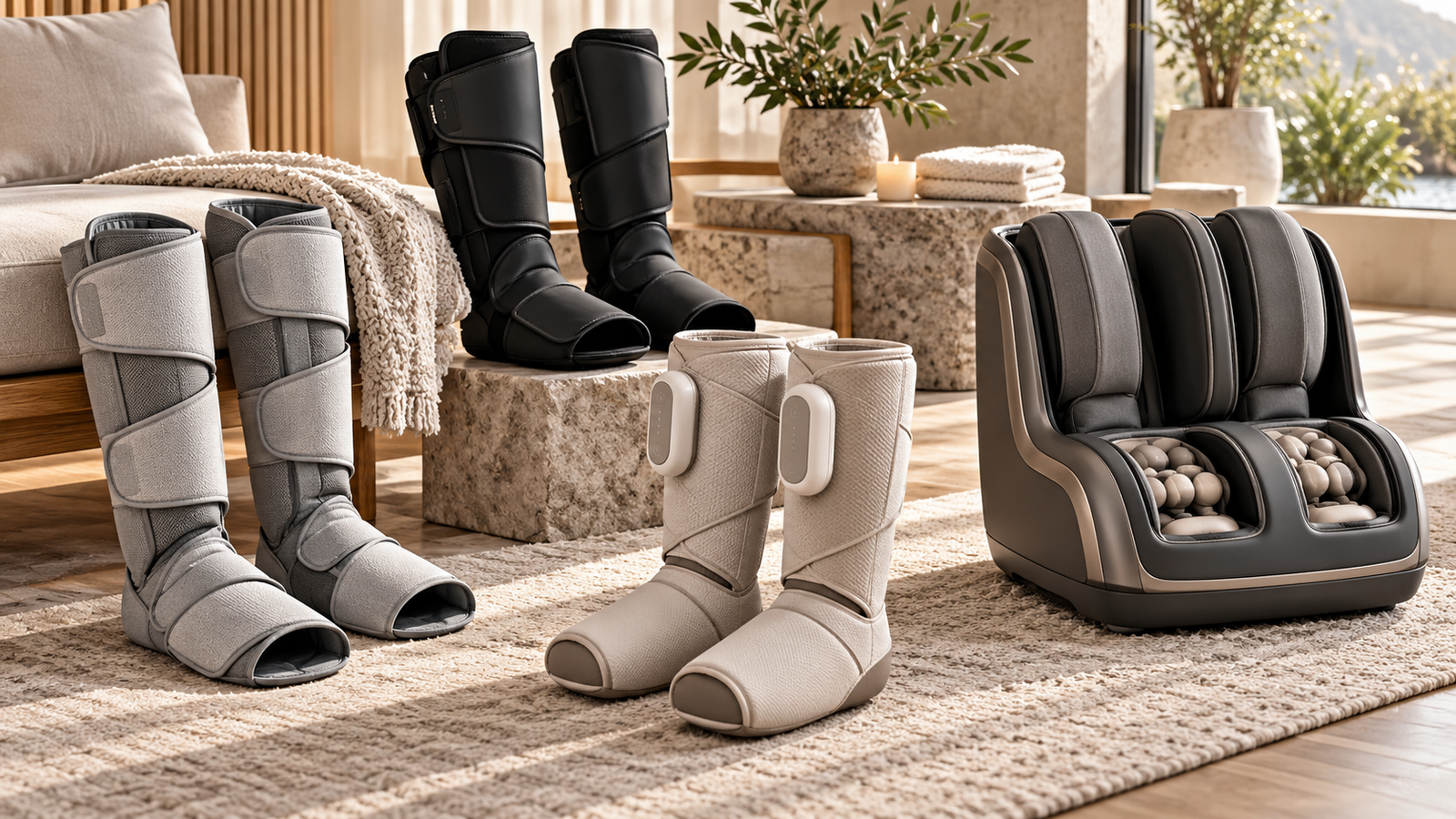
Air compression leg massagers use inflatable chambers to apply rhythmic pressure around the feet, calves or legs. Instead of kneading with rollers, they repeatedly inflate and deflate sections of the wrap to create a squeezing sensation.
The experience can feel relaxing after standing, walking or exercise, but these devices are not all the same. Some cover only the calves, while others extend from the feet toward the thighs. Pressure settings, chamber design and fit can also change how comfortable the massage feels.
This guide explains how air compression leg massagers work, how pressure and coverage differ, what features matter when choosing one and who should be cautious before using compression-based massage.
What Is an Air Compression Leg Massager?
An air compression leg massager is a wearable device that wraps around part of the lower body and uses air-filled chambers to apply external pressure.
Depending on the model, the wraps may cover:
- Feet
- Ankles
- Calves
- Knees
- Thighs
- Most of the leg
A connected control unit or pump inflates the internal chambers according to a programmed sequence.
How Does Air Compression Massage Work?
The basic process is simple:
- The leg wraps are secured around the body.
- The air pump begins filling one or more chambers.
- The inflated chamber applies pressure to the covered area.
- The pressure is held briefly or transitions to another chamber.
- The chamber deflates.
- The sequence repeats.
Different devices use different inflation patterns, so some feel like one large squeeze while others create a wave moving up the leg.
What Does Sequential Compression Mean?
Sequential compression means the device inflates different chambers in a planned order rather than squeezing the entire leg at exactly the same time.
For example, a system may inflate:
- Foot chamber
- Lower-calf chamber
- Upper-calf chamber
- Thigh chamber
It may then release the pressure and repeat the cycle.
The exact sequence depends on the product.
Air Compression vs Kneading Massage
| Feature | Air Compression | Kneading/Roller Massage |
|---|---|---|
| Main mechanism | Inflating air chambers | Motorised rollers or nodes |
| Sensation | Rhythmic squeezing | Direct mechanical pressure |
| Coverage | Can cover large areas of the leg | Usually more localised |
| Pressure direction | Wraps around the limb | Presses from specific contact points |
| Best suited to | Broad compression sensation | Targeted massage feel |
What Does an Air Compression Leg Massager Feel Like?
Most people experience a firm squeezing sensation that builds as the air chambers inflate and releases as they deflate.
At lower settings it may feel gentle and rhythmic.
At higher settings, the pressure can become quite strong.
The device should feel secure and substantial without causing pain, numbness or tingling.
What Areas Can a Leg Massager Cover?
Calf-only massagers
These wrap mainly around the lower legs.
They are compact and simple but do not provide foot or thigh compression.
Foot and calf massagers
These extend from the feet or ankles into the calves.
This design can provide a more continuous lower-leg experience.
Full-leg massagers
These may include separate wraps or connected sections for the feet, calves and thighs.
They provide broader coverage but take longer to put on and require more storage space.
Does More Coverage Mean a Better Massager?
No.
A full-leg system is useful only if you actually want compression across the thighs as well as the calves.
A simpler calf-focused model may be more practical if:
- You mainly want post-workout calf relaxation
- You have limited storage space
- You want faster setup
- You dislike bulky wraps
Choose coverage based on use rather than assuming more material means better performance.
How Do Pressure Levels Work?
Most electric compression massagers offer several pressure or intensity settings.
The device changes how much air enters the chambers or how strongly the chambers compress the leg.
A useful approach is to start at the lowest setting.
You can increase pressure gradually once you know how the device feels.
Should Higher Pressure Feel Better?
Not necessarily.
Higher pressure is simply stronger pressure.
It is not automatically more relaxing or more effective for your needs.
If you find yourself tensing your legs or waiting for the squeeze to end, reduce the intensity.
Signs the Compression Is Too Strong
Stop or reduce pressure if you experience:
- Pain
- Numbness
- Tingling
- Coldness in the foot
- Unusual skin colour change
- Throbbing discomfort
The wraps should never feel as though they are cutting off circulation.
How Tight Should the Wraps Be Before Starting?
The wraps should fit securely but should not already be uncomfortably tight before inflation begins.
Remember that the air chambers still need room to expand.
If the wrap is fastened too tightly initially, inflation can create excessive pressure.
Why Fit Matters
A poor fit can change how pressure is distributed.
If the wrap is too loose:
- Compression may feel weak
- The device may shift
- Pressure may be uneven
If it is too tight:
- Pressure can become uncomfortable
- The wrap may pinch
- The chamber may not inflate as intended
Check Calf and Thigh Circumference
Before buying, check the maximum supported circumference for each section.
Do not assume “one size fits all” means the device will fit every user comfortably.
Measure:
- Widest part of the calf
- Thigh circumference if thigh wraps are included
- Foot size if the device encloses the foot
Can Larger Legs Use Air Compression Massagers?
Yes, provided the wraps are designed for the required circumference.
Some products include extension straps, while others have limited adjustment.
Check actual measurements before buying rather than relying only on photos.
Can Smaller Legs Use Them?
Usually, but the wraps need to tighten enough to create even contact.
If a wrap remains loose at its smallest setting, compression may feel uneven or ineffective.
How Long Should You Use a Leg Compression Massager?
Follow the manufacturer’s recommended session duration.
Many devices are designed around timed sessions rather than continuous use.
There is usually no need to run repeated cycles for hours.
A shorter comfortable session is preferable to prolonged use at excessive pressure.
Can You Use an Air Compression Massager Every Day?
Some users may tolerate regular use, but frequency should depend on comfort, health status and the device instructions.
More frequent use is not automatically better.
If your legs remain sore, irritated or numb after sessions, reduce use and reassess.
Air Compression After Walking
A compression massager can feel relaxing after a long walk because it provides rhythmic pressure to tired lower legs.
However, normal recovery basics still matter:
- Rest
- Hydration
- Appropriate nutrition
- Gradual training progression
A massager is an optional comfort tool, not a replacement for recovery habits.
Air Compression After Exercise
Some people use compression devices after:
- Running
- Strength training
- Sports
- Long periods of standing
The rhythmic pressure may make the legs feel temporarily refreshed or relaxed.
That should not be confused with guaranteed faster muscle recovery or injury healing.
Can Leg Compression Massagers Reduce Muscle Soreness?
They may make sore or tired legs feel more comfortable for some users.
But delayed-onset muscle soreness naturally changes over time, and recovery depends on many factors.
Do not assume that stronger compression will make soreness disappear faster.
Do Air Compression Massagers Improve Circulation?
External compression can influence blood and fluid movement in the limbs, which is why medical compression devices are used in specific healthcare settings.
However, a consumer massage device should not automatically be treated as equivalent to a prescribed medical compression system.
Claims about improving circulation should be interpreted cautiously unless the device has appropriate medical certification for that purpose.
Consumer Massager vs Medical Compression Device
| Feature | Consumer Leg Massager | Medical Compression Device |
|---|---|---|
| Main purpose | Comfort and massage | Specific clinical use |
| Pressure specification | May use simple intensity levels | Often calibrated in defined pressure units |
| Medical supervision | Usually none | May be prescribed or clinically supervised |
| Use case | Wellness and relaxation | Condition-specific treatment or prevention |
What Does mmHg Mean?
Some compression systems state pressure in mmHg, or millimetres of mercury.
This is a pressure unit also used for blood pressure and medical compression garments.
However, many consumer massagers simply label settings as:
- Low
- Medium
- High
If precise compression pressure is important for a medical reason, a consumer intensity label is not enough.
What Is the Difference Between Compression Boots and Leg Massagers?
The terms overlap.
Compression boots usually refer to larger systems that enclose substantial portions of the legs and use multiple air chambers.
Leg massagers can include:
- Smaller calf wraps
- Foot-and-calf units
- Full-leg compression boots
The product design matters more than the marketing name.
Can You Use Air Compression for Swollen Legs?
Unexplained or persistent swelling should not automatically be treated with a consumer massager.
Leg swelling can have many possible causes.
If swelling is:
- Sudden
- Severe
- Only on one side
- Painful
- Associated with redness or warmth
seek medical assessment rather than using a massage device first.
Can You Use a Leg Massager for Varicose Veins?
If you have significant varicose veins or known venous disease, discuss compression-device use with an appropriate healthcare professional.
Medical compression stockings and prescribed compression systems are selected differently from general wellness massagers.
Can You Use One With Deep Vein Thrombosis?
No consumer compression massager should be used to self-treat a suspected blood clot.
Deep vein thrombosis can be serious and requires medical assessment.
If you have known or suspected DVT, do not use a leg compression massager unless a qualified healthcare professional specifically says it is appropriate.
Can You Use a Leg Massager During Pregnancy?
Pregnancy can change circulation and increase swelling, but it also changes clotting risk.
Do not use strong compression simply because your legs feel heavy.
Ask your obstetric clinician whether the specific type of compression device is appropriate for you.
Can People With Diabetes Use Compression Massagers?
People with diabetes may have changes in sensation, circulation or skin integrity.
If you have diabetes, particularly with neuropathy or circulation problems, professional advice is appropriate before using strong mechanical compression.
Peripheral Artery Disease and Compression
People with known arterial circulation problems should not assume compression is safe.
External pressure may be inappropriate in some vascular conditions.
Medical guidance is important before use.
Who Should Be Cautious With Air Compression Massagers?
Seek medical guidance before using one if you have or suspect:
- Deep vein thrombosis
- Peripheral arterial disease
- Severe vascular disease
- Unexplained leg swelling
- Significant neuropathy
- Recent surgery
- Open wounds
- Skin infection
- Serious heart or circulation conditions
Can You Use a Compression Massager Over Clothing?
Many devices can be used over thin clothing, depending on the manufacturer’s instructions.
Light fabric can:
- Improve comfort
- Reduce friction
- Help keep the wraps cleaner
Avoid thick or bunched clothing because it can create uneven pressure.
Should You Use It Directly on Skin?
You can if the product instructions permit it and your skin tolerates the material.
Stop if you develop:
- Persistent redness
- Rash
- Pinching
- Skin irritation
Do Leg Massagers Have Heat?
Some models combine compression with a heating function.
Heat can make the experience feel more relaxing, but it is a separate feature from compression.
Not every user should use heat, particularly when there are circulation or sensation concerns.
Compression With Heat vs Compression Only
| Feature | Compression Only | Compression + Heat |
|---|---|---|
| Main sensation | Rhythmic pressure | Pressure plus warmth |
| Complexity | Lower | Higher |
| Power use | Usually lower | Usually higher |
| Best for | Users focused on compression | Users who specifically enjoy warmth |
Can Heat Be Too Strong?
Yes.
Stop using the heating function if the skin feels excessively hot or uncomfortable.
People with reduced sensation should be especially cautious because they may not detect excessive heat normally.
What Massage Modes Do These Devices Have?
Common modes include:
- Sequential inflation
- Alternating chamber compression
- Full-area compression
- Pulse-style pressure
The mode changes the sensation but does not necessarily make one product medically more effective.
Are More Air Chambers Better?
Not automatically.
More chambers can provide finer control over how pressure moves along the leg.
But chamber quality, fit, pump performance and control software also matter.
A well-designed four-chamber system can be more comfortable than a poorly designed device with more chambers.
Why Chamber Placement Matters
A chamber that does not sit correctly around the intended area may create uneven pressure.
This is particularly important around:
- Ankles
- Calves
- Knees
- Thighs
Make sure the wraps are positioned according to the manufacturer’s diagrams.
Can You Use Only the Calf Section?
Some modular systems allow individual sections to be used independently.
Others require all wraps to remain connected.
Check the product instructions if you mainly want calf massage.
Can You Use the Device on One Leg Only?
Some systems can operate with one wrap, but others are designed to inflate both sides together.
Do not block or disconnect air hoses unless the manufacturer supports single-leg use.
How Loud Are Air Compression Massagers?
The air pump creates some operating noise.
Noise levels vary significantly between devices.
If you plan to use the massager while:
- Watching television
- Reading
- Working
- Relaxing before sleep
pump noise may be worth considering.
Corded vs Rechargeable Leg Massagers
Corded models
These are convenient for longer home sessions because you do not need to manage battery life.
The disadvantage is having a power cable near the chair or bed.
Rechargeable models
These can be easier to use away from a wall outlet.
Check:
- Battery duration
- Charging time
- Whether the pump is built into the wraps
How Portable Are Compression Leg Massagers?
Portability depends heavily on coverage.
Calf-only wraps can fold relatively small.
Full-leg systems with:
- Thigh wraps
- Foot sections
- Air hoses
- Control units
require substantially more space.
How to Use an Air Compression Leg Massager
A basic session usually looks like this:
- Sit or lie in a comfortable position.
- Place the wraps around the correct leg sections.
- Fasten them securely without overtightening.
- Connect the air hoses if required.
- Start at the lowest pressure.
- Select the desired massage mode.
- Increase pressure only if it remains comfortable.
- Allow the device to complete its recommended session.
- Release pressure before removing the wraps.
Should You Sit or Lie Down?
Both may work depending on the device.
Choose a position where:
- The legs are relaxed
- The air hoses are not kinked
- The controller is easy to reach
- The wraps remain correctly positioned
Can You Walk While Wearing Compression Massagers?
No.
These devices are generally intended for seated or lying use.
Walking with inflated wraps or hoses creates unnecessary fall and equipment-damage risk.
Can You Sleep While Wearing One?
Do not assume an electric compression massager is intended for overnight use.
Most consumer devices are designed for timed sessions while you are awake.
Follow the manufacturer’s instructions.
How to Clean Compression Leg Wraps
Because most wraps contain air chambers and electronics, they are usually not machine washable.
A common cleaning approach is:
- Disconnect the device from power.
- Wipe the surface with a slightly damp cloth.
- Use mild soap if the manufacturer permits it.
- Avoid soaking air hoses or electrical components.
- Allow the wraps to dry completely before storage.
Common Air Compression Massager Mistakes
Starting at the highest pressure
Begin low and increase gradually.
Fastening the wraps too tightly
The chambers still need room to inflate.
Using compression on unexplained swelling
Swelling can have medical causes that should be assessed.
Assuming stronger pressure means better recovery
Comfort and safe use matter more than maximum intensity.
Ignoring numbness or tingling
These are reasons to stop, not sensations to train through.
Buying without checking circumference
Correct fit is essential for even compression.
How to Choose an Air Compression Leg Massager
Consider:
- Foot, calf or full-leg coverage
- Number of air chambers
- Pressure settings
- Massage modes
- Maximum calf and thigh circumference
- Heat function if desired
- Controller design
- Timer
- Power source
- Storage size
- Ease of cleaning
For specific options, see our Top 5 Leg Compression Massagers in India.
Who Should Choose a Calf-Only Massager?
A calf-focused model may suit you if you:
- Mainly experience tired calves after activity
- Want quick setup
- Have limited storage space
- Do not need thigh coverage
Who Should Choose a Full-Leg System?
A broader system may be more appropriate if you:
- Want compression from the feet toward the thighs
- Prefer sequential full-leg inflation
- Do not mind a bulkier setup
- Have enough storage space
Frequently Asked Questions
Do air compression leg massagers work?
They can provide rhythmic external pressure and a relaxing massage sensation. They should not be treated as guaranteed medical treatment for circulation problems, swelling or injury.
How tight should a leg compression massager feel?
Firm but comfortable. It should not cause pain, numbness, tingling, unusual colour change or coldness in the foot.
Can I use a compression leg massager every day?
Regular use may be comfortable for some healthy users, but follow the manufacturer’s instructions and reduce use if you develop soreness, skin irritation or unusual symptoms.
Are compression boots good after exercise?
They can provide a relaxing post-exercise sensation, but they should not be expected to replace rest, training management or treatment for injuries.
Can I use a leg massager if my legs are swollen?
Do not use a consumer compression device to self-treat unexplained swelling, particularly sudden or one-sided swelling. Seek medical assessment first.
Is higher compression better?
No. Higher pressure simply produces a stronger squeeze. The appropriate setting is one that remains comfortable and does not cause neurological or circulation-related symptoms.
Can I sleep in compression boots?
Most electric compression massagers are intended for timed sessions while awake rather than overnight use. Follow the instructions for your specific device.
Final Takeaway
Air compression leg massagers work by repeatedly inflating chambers around the feet, calves or thighs to create rhythmic external pressure.
The most important differences between models are not simply how many modes they advertise. Coverage, fit, chamber placement, pressure control and ease of use matter more.
Start with the lowest comfortable pressure and make sure the wraps fit without pinching. A stronger setting is not automatically better, and numbness, pain or unusual colour changes are reasons to stop immediately.
If you are comparing specific products, see our Top 5 Leg Compression Massagers in India guide for the current calf, foot-and-calf and full-leg options shortlisted by Physical Glow.
For general wellness use, the goal is simple: comfortable, evenly distributed compression that helps tired legs feel relaxed without creating unnecessary pressure or being mistaken for medical treatment.
Physical Glow publishes educational beauty, fitness and wellness content. This article is for general informational purposes and is not a substitute for medical advice. People with vascular disease, unexplained swelling, suspected blood clots, significant neuropathy or other circulation-related conditions should seek appropriate professional guidance before using compression devices.