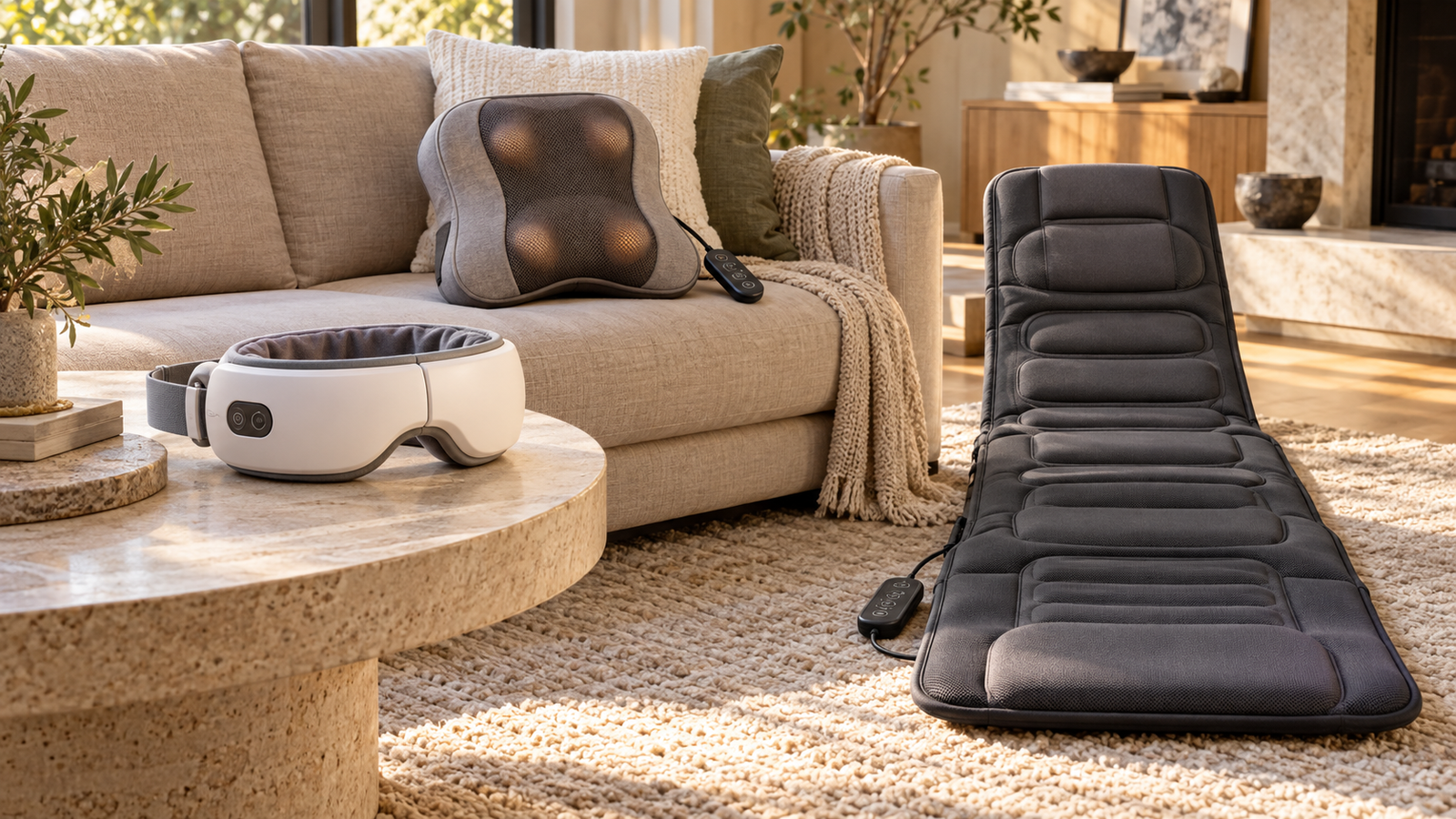
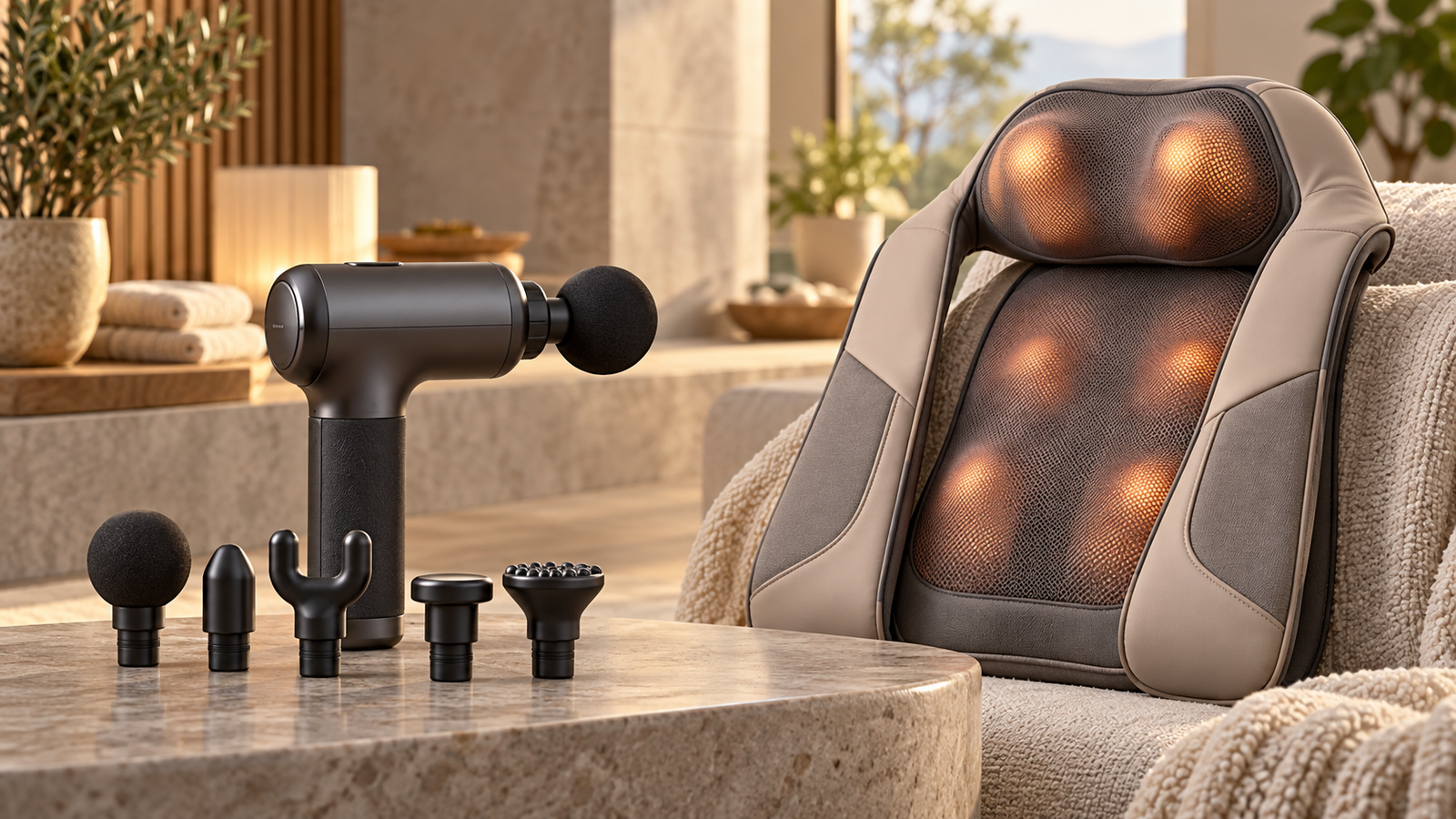
Foot Massager vs Leg Compression Device vs Massage Mat: What to Compare
Compare foot-massager chambers, leg compression devices and vibrating massage mats by mechanism, area covered, controls and safety information.
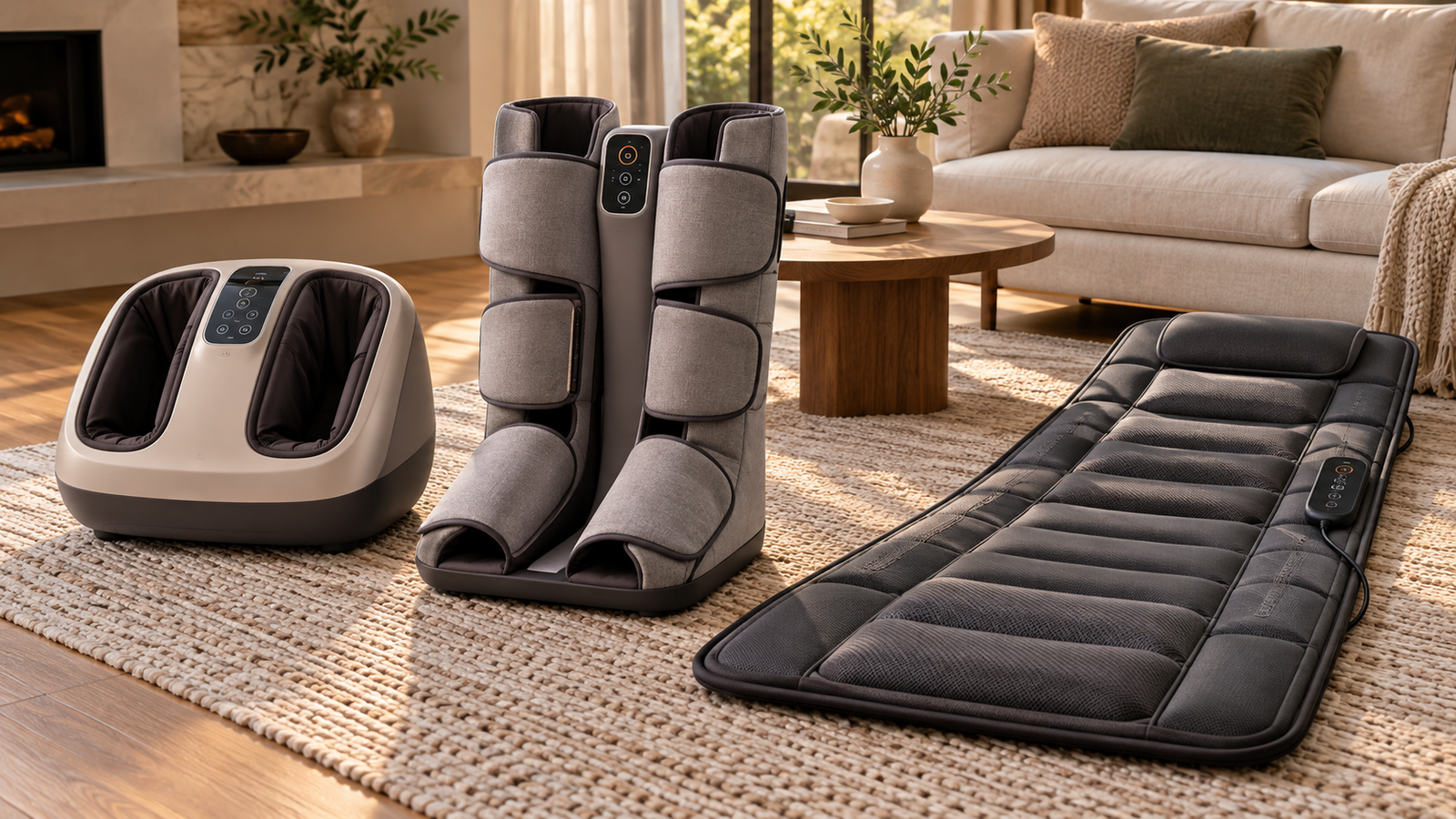
Foot massagers, leg-compression devices and vibrating massage mats are all marketed for home relaxation, but they create very different sensations and cover very different areas of the body.
A foot massager concentrates pressure around the feet and sometimes ankles. A leg-compression device wraps around the calves or thighs and uses inflatable chambers that tighten and release. A massage mat covers a much larger area and generally relies on vibration, with some models also adding heat.
None of these devices should automatically be treated as medical treatment for pain, swelling, poor circulation or another underlying condition. Their main role for most users is comfort, relaxation and convenient at-home use.
What is a foot massager?
A foot massager is a powered device designed to massage the feet while you are seated.
The most common enclosed models use a combination of rotating nodes, rolling mechanisms, air compression and heat.
You place the feet into padded chambers, select a programme and allow the machine to apply pressure.
Depending on the design, the device may focus on the soles, heels, sides of the feet or a combination of these areas.
What is a leg-compression massager?
A leg-compression device usually consists of fabric sleeves that wrap around the calves and sometimes the thighs or feet.
Air chambers inside the sleeves inflate and deflate.
This creates a squeezing sensation rather than the rolling or kneading sensation produced by a typical foot massager.
Some systems inflate different zones in sequence, while simpler models may inflate several chambers together.
What is a vibrating massage mat?
A massage mat is a larger padded device containing several vibration motors distributed along its length.
It is usually placed on a bed, sofa, recliner or another suitable surface.
The user lies or sits on it while the motors create vibration across areas such as the back, hips, thighs and legs.
Some mats also include one or more heating zones.
Unlike a foot massager or leg-compression system, a vibrating mat usually provides broad, relatively gentle stimulation rather than concentrated pressure.
Foot massager vs leg compression vs massage mat at a glance
| Factor | Foot massager | Leg-compression device | Vibrating massage mat |
|---|---|---|---|
| Main area | Feet and sometimes ankles | Calves, thighs and sometimes feet | Back, hips, thighs and legs |
| Main sensation | Kneading, rolling, pressure | Inflating and releasing compression | Vibration |
| Coverage | Small | Medium to large | Very large |
| Pressure intensity | Moderate to strong | Adjustable compression | Usually mild to moderate |
| Heat | Common | Sometimes available | Common on some models |
| Portability | Moderate | Moderate | Low |
| Setup | Place feet inside device | Wrap sleeves around legs | Place mat on suitable surface |
| Best suited to | Focused foot relaxation | Sequential squeezing of legs | Broad whole-body relaxation |
How does a foot massager work?
Different foot massagers use different mechanisms.
Some use rotating massage nodes beneath the soles.
Others add air bags around the sides of the feet.
A more advanced model may combine kneading, rolling, compression and warmth in one programme.
The experience can feel quite intense because the feet contain many sensitive structures and the machine concentrates pressure into a relatively small area.
Shiatsu-style foot massagers
Many foot massagers are described as “Shiatsu” devices.
This generally refers to motorised rotating nodes intended to create a kneading sensation.
An electronic device is not the same as hands-on Shiatsu performed by a trained practitioner.
The term mainly describes the mechanical massage style.
Roller-based foot massagers
Some models use rollers that move under the sole.
They may target areas such as the arch or heel.
The pressure is usually strongest where your foot rests directly over the roller.
Users with very sensitive feet may prefer a lower-intensity setting.
Air compression in foot massagers
Enclosed foot massagers often add inflatable chambers around the top and sides of the feet.
As the chambers inflate, the foot is pressed toward the massage rollers.
This can make the kneading sensation feel stronger.
If the compression becomes uncomfortable, reduce the intensity rather than simply tolerating it.
Heat in foot massagers
Heat is a common feature.
It may make the session feel more comfortable, particularly in cooler weather.
However, the actual temperature and coverage vary.
Some models warm the entire chamber, while others only warm part of the foot area.
Heat should feel mild and comfortable rather than hot.
Foot size matters
Enclosed foot massagers have limited internal space.
Before buying, check the maximum supported foot size.
A device may feel cramped if your feet are larger than the design allows.
Too little space can also cause the massage nodes or air chambers to press into areas they were not intended to target.
Open vs enclosed foot massagers
Open foot massagers place the feet on top of the device.
They are usually easier to fit and may accommodate a wider range of foot sizes.
Enclosed models surround more of the foot and can provide stronger compression.
The trade-off is that enclosed models are usually bulkier and more size-dependent.
What does a leg-compression device feel like?
A leg-compression massager creates a rhythmic squeezing sensation.
The sleeves tighten as the air chambers fill, then loosen as the air is released.
Some users find this relaxing after long periods of standing or sitting.
Others prefer the more direct kneading sensation of a conventional massager.
The experience is quite different from vibration.
Sequential compression
Some leg devices use multiple chambers that inflate in sequence.
For example, a lower chamber may inflate first, followed by one higher on the calf.
This creates a progressive squeezing pattern along the limb.
Marketing sometimes describes this as improving circulation, but consumer compression devices should not be assumed to treat vascular disease or other medical circulation problems.
Calf-only compression devices
Compact models may wrap only around the calves.
These are easier to:
- Put on.
- Store.
- Travel with.
They also provide more limited coverage.
For users whose main goal is calf relaxation after standing or exercise, this may be sufficient.
Full-leg compression systems
Larger systems may cover:
- Feet.
- Calves.
- Knees.
- Thighs.
They provide broader coverage but take longer to put on and require more storage space.
Some also use a separate control unit connected by air hoses.
Check whether the setup is practical for the space where you expect to use it.
Fit matters with compression sleeves
The wrap should fit securely without painfully constricting the leg.
If the sleeve is too loose, compression may feel weak or uneven.
If it is too tight before inflation begins, the final pressure may become excessive.
Use the manufacturer’s size guidance.
Do not deliberately choose a smaller sleeve to create more pressure.
Pressure settings
Compression devices may offer several intensity levels.
Start with the lowest comfortable setting.
Higher pressure is not automatically more useful.
The sensation should be firm but not painful.
Stop immediately if you develop numbness, tingling, unusual colour changes, pain or other concerning symptoms.
What does a massage mat feel like?
A vibrating massage mat usually provides a much gentler sensation.
Instead of mechanical rollers or compression sleeves, small motors create vibration through padded sections of the mat.
The vibration may be distributed across several body zones.
This makes the mat more suitable for broad relaxation than for strong targeted massage.
Massage zones
A mat may divide its motors into areas such as the upper back, lower back, hips, thighs and legs.
Some controllers allow you to activate only selected zones.
This is useful if you want vibration in the lower body without activating the upper section.
Vibration patterns
Some products offer different patterns such as continuous, pulsing or alternating vibration.
These are mainly comfort options.
A more complicated pattern should not automatically be interpreted as producing a stronger health benefit.
Choose the pattern that feels comfortable.
Heat in massage mats
Many mats include heat, but the heating area is often smaller than the vibration area.
For example, a full-length mat may have heating elements only around the lower back.
Check the specification rather than assuming that the entire mat heats up.
Which gives the strongest massage sensation?
For concentrated pressure, a foot massager often feels strongest.
A leg-compression device can also produce substantial pressure, but the sensation is broad squeezing rather than kneading.
A vibrating mat usually feels gentler because the energy is distributed across a much larger area.
This difference matters if you dislike intense pressure.
Which covers the largest area?
The massage mat provides the broadest coverage.
A full-length model can reach from the upper back to the legs.
A full-leg compression system comes next.
A foot massager is the most targeted option.
Which is easiest to use?
A foot massager is usually simple.
You sit down, place your feet inside and select a programme.
A massage mat is also straightforward once positioned.
Compression sleeves take the most setup because they need to be wrapped and adjusted around the legs.
If you want something you can start in seconds, ease of setup may be important.
Which is easiest to store?
A compact calf-compression device may fold down relatively small.
Foot massagers are usually rigid and occupy more cupboard or floor space.
Massage mats can be large even when folded.
Check dimensions before buying, particularly if storage space is limited.
Foot massager for people who stand all day
If your work involves prolonged standing, a foot massager may feel relaxing at the end of the day.
The main advantage is that it focuses specifically on the feet.
However, persistent foot pain, swelling or numbness should not simply be treated with massage.
Those symptoms can have multiple causes and may require proper assessment.
Compression devices after prolonged sitting
Some users enjoy leg compression after long periods of sitting.
The rhythmic squeezing can feel refreshing.
However, leg swelling after sitting is not always a simple comfort issue.
New, unexplained or one-sided swelling should not be self-treated with compression without medical guidance.
Massage mats after desk work
A massage mat may suit someone who wants to lie down after desk work and relax several body areas at once.
It can be particularly practical when discomfort is diffuse rather than focused in one spot.
For example, you may prefer broad vibration over the back and legs rather than intense pressure at one location.
Foot massager after exercise
Some users enjoy foot massage after walking, running or long gym sessions.
The device may help the feet feel relaxed.
But avoid aggressive massage directly over an acute injury.
If you have a recent sprain, fracture, significant bruising or unexplained swelling, do not assume a powered massager is appropriate.
Compression after exercise
Compression devices are sometimes marketed as recovery tools.
They may feel pleasant after training, particularly when the legs feel tired.
However, recovery also depends on factors such as sleep, nutrition, training load and time.
A compression device should not be considered necessary for normal recovery.
Massage mats after exercise
A vibrating mat can be used as a low-intensity relaxation tool after a workout.
Because the sensation is generally mild, some users prefer it when their muscles feel too tender for deeper massage.
Again, this is mainly about comfort rather than guaranteed acceleration of recovery.
Which is better for older adults?
There is no universal answer.
Ease of setup matters.
A foot massager may be simple to use but requires the user to place and remove the feet from the chambers.
Compression sleeves may require more bending and fastening.
A massage mat may be comfortable but requires getting onto and off the chosen surface.
Health conditions also matter more with increasing age, especially when circulation, sensation or mobility problems are present.
Reduced sensation requires extra caution
People with reduced sensation may not accurately feel pressure or heat.
This can occur with certain neurological conditions or peripheral neuropathy.
In that situation, a strong massager or heating device could apply more pressure or temperature than the user realises.
Professional guidance is advisable before using powered massage or compression devices if sensation is significantly reduced.
Diabetes and foot massagers
Some people with diabetes develop reduced sensation, circulation problems or skin complications in the feet.
A foot massager should therefore not automatically be considered safe simply because it is a consumer product.
If you have diabetes with neuropathy, foot wounds, circulation problems or another foot complication, seek medical guidance before using strong massage, compression or heat.
Leg compression and circulation conditions
This is an important safety issue.
People with certain vascular conditions may need medically prescribed compression at a specific pressure level.
A consumer massage sleeve is not necessarily equivalent to medical compression therapy.
Do not self-treat diagnosed vascular disease with a home massager.
One-sided leg swelling
Sudden swelling in one leg deserves particular caution.
Do not simply apply a strong compression massager to unexplained one-sided swelling.
Seek medical assessment, especially if swelling is accompanied by pain, redness, warmth, chest pain or shortness of breath.
Varicose veins
People with varicose veins may be interested in compression devices.
However, suitability depends on the severity and associated symptoms.
Medical compression stockings and powered compression massagers are not the same thing.
If varicose veins are painful, inflamed or associated with swelling, seek professional advice before using strong mechanical compression.
Blood clots
Powered massage or compression is not something to experiment with if a blood clot is suspected or known.
Medical evaluation takes priority.
A consumer device should never be used as a substitute for appropriate treatment.
Pregnancy
Leg discomfort and swelling can occur during pregnancy.
However, pregnancy changes circulation and may involve specific medical risks.
Ask your maternity healthcare professional before using powered compression or strong massage, particularly if you have significant swelling or other pregnancy complications.
Heat and pregnancy
Products with heating functions should also be used cautiously.
Do not assume that every heated massage device is automatically suitable during pregnancy.
Follow professional advice where relevant.
Recent surgery
Avoid strong massage or compression over or near recently operated areas unless a healthcare professional has approved it.
Post-surgical swelling and recovery require condition-specific management.
The same applies to recent fractures or significant injuries.
Open wounds and skin problems
Do not use foot massagers, compression sleeves or heated massage mats directly over areas with open wounds, active infection, severe rash or significant skin irritation.
Mechanical pressure and heat may worsen discomfort.
Wait until the area is appropriately healed or medically assessed.
Can these devices improve circulation?
Marketing commonly uses the phrase “improves circulation.”
Massage and compression can temporarily alter local blood flow and sensation.
That does not mean a consumer device treats poor circulation caused by cardiovascular or vascular disease.
Distinguish relaxation claims from medical claims.
Can these devices reduce swelling?
Compression may affect temporary fluid movement, but unexplained swelling should not be self-diagnosed.
If swelling is persistent, severe or recurrent, the underlying cause matters.
A home compression device should not delay medical evaluation.
Can foot massagers treat plantar fasciitis?
A massage device may feel relaxing to some people with foot discomfort.
However, plantar heel pain can have several causes and requires appropriate management.
A foot massager should not be assumed to cure plantar fasciitis.
If heel pain persists, assessment from an appropriate healthcare professional may be useful.
Can foot massagers cure neuropathy?
No.
Neuropathy is a nerve condition and should not be treated as a simple muscle-tension problem.
In fact, reduced sensation may make strong pressure or heat less safe.
Can massage mats treat back pain?
Vibration may feel relaxing, but it does not diagnose or treat the cause of persistent back pain.
Back pain may be related to muscles, joints, nerves or other conditions.
Seek assessment if pain is severe, worsening or accompanied by weakness, numbness or bladder or bowel changes.
Massage intensity
A common mistake is assuming that stronger pressure equals a better massage.
The useful intensity is the highest level that remains comfortable and controlled.
Pain, burning or numbness are not signs of better performance.
Start low and increase only if needed.
Session length
Follow the manufacturer’s recommended session duration.
Many powered massage devices are designed for relatively short sessions.
Longer use is not automatically more beneficial.
Automatic shut-off timers are useful because they prevent the device from running indefinitely.
Automatic programmes
Some products combine several intensity changes into a preset programme.
For example, a foot massager may alternate between:
- Rolling.
- Compression.
- Heat.
A leg-compression system may change which chamber inflates.
These programmes are mainly convenience features.
You do not need the largest number of modes.
Remote controls
Massage mats often include a wired handheld controller.
Foot massagers may use buttons on the main unit or a remote.
Compression systems usually use a small control unit.
Ease of operation matters, particularly if bending down to reach controls is difficult.
Display quality
A clear display can make it easier to see:
- Intensity.
- Selected zone.
- Heat.
- Remaining time.
This can be more useful than having many complicated programmes.
Power supply
Foot massagers and large massage mats usually use mains electricity.
Compression devices may use mains power or rechargeable batteries.
Check cable length and outlet placement.
If you plan to use the device away from a socket, battery-powered compression may be more convenient.
Noise
Motors, air pumps and moving massage mechanisms all generate sound.
Foot massagers with rollers can create mechanical noise.
Compression units may produce pump sounds.
Massage mats generally produce a vibration hum.
Noise level may matter if you intend to use the device while:
- Watching television.
- Reading.
- Relaxing before bed.
Washable foot liners
Removable washable liners are a useful feature in enclosed foot massagers.
They help manage:
- Sweat.
- Skin oils.
- Odour.
Check whether the liners actually detach.
If they are permanently fixed, cleaning can be more difficult.
Cleaning compression sleeves
Compression wraps sit closely against the legs and can collect sweat.
Most cannot be submerged because air chambers and tubing run through them.
Follow the manufacturer’s cleaning method.
Usually this involves surface wiping and complete air drying.
Cleaning a massage mat
Some mats have removable covers.
Others require spot cleaning.
Disconnect power before cleaning.
Do not allow moisture to reach electrical connections or heating components.
Storage and hoses
Compression devices often include air hoses connecting the sleeves to the pump.
Avoid sharply bending or crushing the hoses during storage.
Damaged tubing can reduce pressure or create uneven inflation.
Keep the system packed loosely where possible.
Massage mat folding
Not every heated massage mat should be folded tightly.
Heating wires and internal motors can be damaged by repeated sharp creases.
Use the storage method recommended by the manufacturer.
Which is best for a small home?
A compact foot massager or calf-compression system is usually easier to accommodate.
A full-length mat needs more storage space.
However, if you have room under a bed or sofa, a foldable mat may still be practical.
Which is better for travel?
A full-size massage mat is usually the least practical.
A rigid foot massager is also bulky.
Lightweight compression sleeves are generally easier to transport, especially if they use a compact rechargeable control unit.
Which is better for relaxation before bed?
All three can work depending on the sensation you prefer.
A foot massager is useful if your feet feel tired.
Compression suits users who like rhythmic squeezing.
A massage mat is better if you want to lie down and relax the back and legs simultaneously.
Do not fall asleep with a powered heating device running unless the manufacturer specifically permits it.
Which is better for strong massage?
A Shiatsu-style foot massager generally produces the strongest focused kneading.
Leg compression can produce substantial squeezing but feels different.
A vibrating mat is usually better for users who prefer gentler stimulation.
Which is better for broad coverage?
A full massage mat.
If you want one device to create sensation from the back down toward the legs, it provides much broader coverage than the other two.
Which is easiest for everyday use?
A foot massager may be the most convenient if your main concern is the feet.
It requires almost no setup.
If you need leg-wide coverage, compression sleeves require a little more effort but can still be practical.
A massage mat is easy to use once positioned but takes more space.
How to compare foot massagers
Look at the massage mechanism, foot-size capacity, compression levels, heat, removable liners, control placement and physical dimensions.
Also check whether pressure can be reduced sufficiently for your comfort.
How to compare leg-compression devices
Important factors include coverage, sleeve sizing, number of air chambers, intensity settings, inflation sequence, hose arrangement and power source.
Do not choose solely by the highest advertised pressure.
How to compare massage mats
Check mat length and width, number of vibration zones, intensity control, heat location, surface material, controller design and storage requirements.
The number of motors alone does not determine comfort.
Common buying mistakes
The most common mistake is buying based on the word “massage” without considering the sensation involved. A person expecting deep kneading may be disappointed by a vibration mat, while someone who dislikes pressure may find a Shiatsu foot device overwhelming.
Other mistakes include overlooking foot-size limits, buying compression sleeves without checking circumference measurements, assuming the entire massage mat is heated, selecting maximum pressure as the default setting and expecting a consumer device to solve persistent pain or swelling.
How to choose according to your main goal
| Main preference | Most relevant device |
|---|---|
| Focused sole and foot massage | Foot massager |
| Rhythmic squeezing around calves or legs | Leg-compression device |
| Broad relaxation over several body areas | Vibrating massage mat |
| Strong kneading sensation | Shiatsu-style foot massager |
| Gentler stimulation | Massage mat |
| Portable leg-focused use | Compact compression sleeves |
| Minimal setup | Foot massager |
| Largest body coverage | Massage mat |
Frequently asked questions
Is a foot massager better than a leg massager?
They target different areas.
A foot massager concentrates on the feet, while a leg-compression device covers more of the calves or thighs.
Is leg compression the same as massage?
Not exactly.
Compression devices create squeezing pressure rather than the rotating kneading sensation of a traditional massager.
Are compression massagers the same as medical compression stockings?
No.
Medical compression garments provide controlled compression prescribed or selected for specific clinical purposes. Consumer powered massagers operate differently.
Can I use a leg-compression device every day?
Follow the manufacturer’s instructions and make sure you do not have a health condition that makes compression inappropriate.
Can a foot massager help tired feet?
It may provide temporary comfort and relaxation, particularly after long periods of standing or walking.
Is heat necessary in a foot massager?
No.
Heat is mainly a comfort feature.
Can a massage mat replace a massage therapist?
No.
A mat provides automated vibration and cannot adapt to your body in the way a trained professional can.
Which device is best for elderly users?
The best option depends on mobility, sensation, circulation and medical conditions. Ease of setup is important, but health suitability should be considered first.
Can I use a foot massager if my feet are numb?
Reduced sensation requires caution because excessive pressure or heat may not be noticed. Seek medical guidance before use.
Can a compression massager be used for swollen legs?
Do not self-treat unexplained swelling. The cause should be established first, especially when swelling is sudden or affects only one leg.
Choosing the right home massager
Start by identifying the sensation and body area you actually want to target.
Choose a foot massager if your priority is concentrated kneading, rolling or compression around the feet.
Choose a leg-compression device if you prefer rhythmic squeezing around the calves, thighs or entire legs.
Choose a vibrating massage mat if you want broad, gentler stimulation across the back and lower body.
After choosing the category, compare intensity control, sizing, heat, cleaning, storage and power requirements.
Most importantly, separate relaxation from treatment. A device may make tired feet or legs feel more comfortable, but persistent pain, significant swelling, numbness or circulation concerns should be properly assessed rather than managed solely with a home massage product.
Physical Glow’s Top 5 Home Foot, Leg, Back and Mat Massagers in India comparison looks at several foot-massage, compression and broader relaxation formats. Use that comparison alongside this guide, then verify the current massage mechanism, coverage area, intensity settings, heat function, dimensions and safety instructions for the exact device you are considering.