How to Choose a Sleep Mask for Better Light Blocking and Comfort
Learn how fit, fabric, strap design, sleeping position and eye pressure affect light blocking and comfort in a sleep mask.
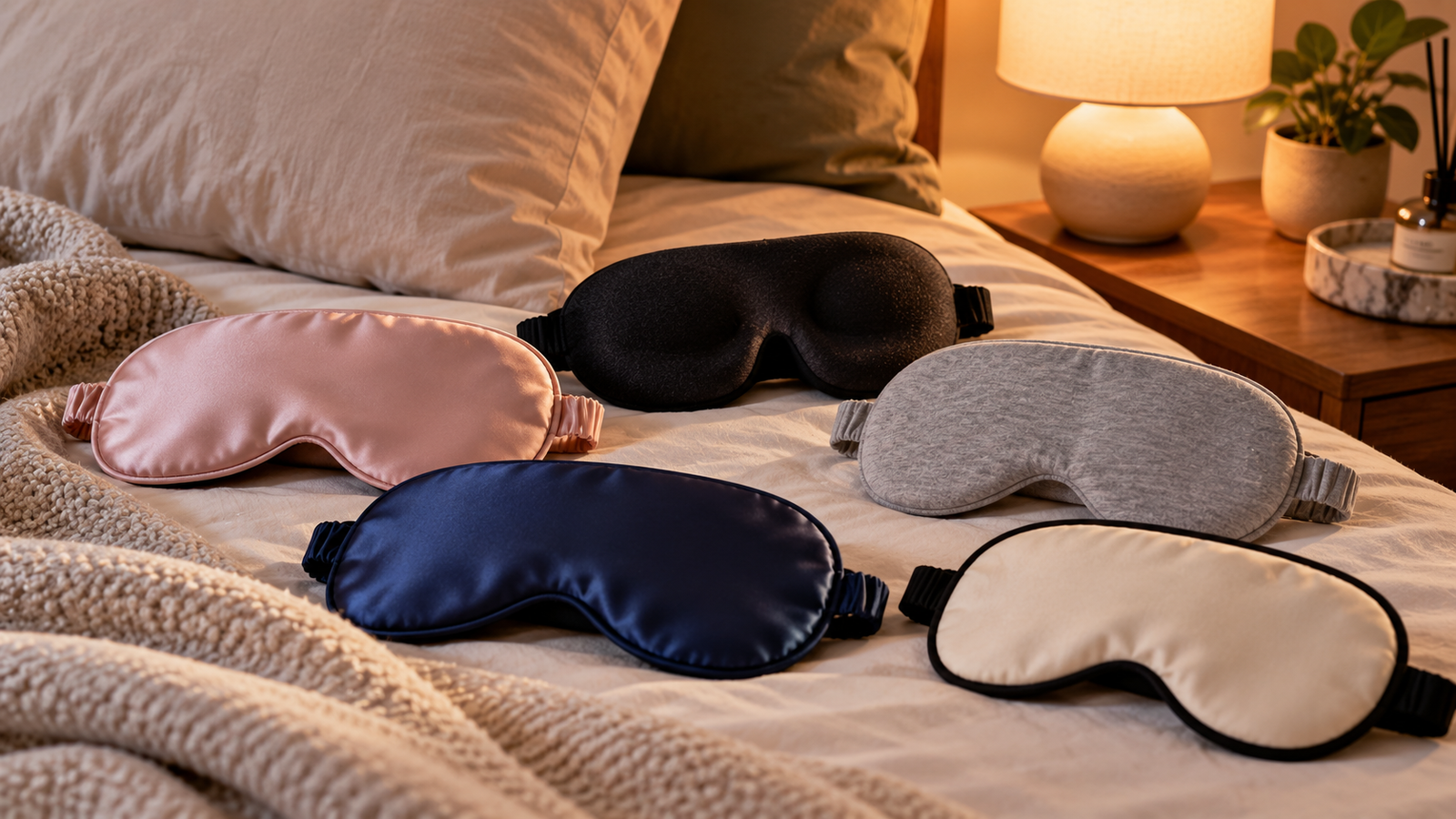
A sleep mask is a simple product, but small differences in shape, fabric, padding and strap design can strongly affect how comfortable it feels through the night.
The main purpose of a sleep mask is straightforward:
- reduce unwanted light
- create a darker sleep environment
- improve comfort when complete room darkness is not possible
However, a mask that blocks light well can still be unpleasant if it presses on the eyes, becomes hot, slips during sleep or feels too tight around the head.
The right sleep mask should balance light blocking, comfort, fit and breathability.
This guide explains how to choose a sleep mask for home use, travel, side sleeping and different comfort preferences.
What Does a Sleep Mask Do?
A sleep mask covers the area around the eyes to reduce exposure to light.
It may be useful when:
- streetlights enter the bedroom
- curtains do not fully block daylight
- you work night shifts and sleep during the day
- you travel frequently
- you share a room with someone using lights or screens
- you want additional darkness without changing the room
A mask does not directly make you sleep.
Its main role is to help create a darker environment that may be more comfortable for sleep.
Why Darkness Matters for Sleep
Light is one of the environmental signals involved in the body’s sleep-wake rhythm.
Bright light, particularly around the time you intend to sleep, can make a room feel less suitable for rest.
A sleep mask is one way to reduce light reaching the eyes.
However, it should be part of a broader sleep environment that may also include:
- comfortable room temperature
- reduced noise
- consistent sleep schedule
- appropriate bedding
- reduced unnecessary light
A sleep mask cannot compensate for every sleep problem.
The Main Types of Sleep Mask
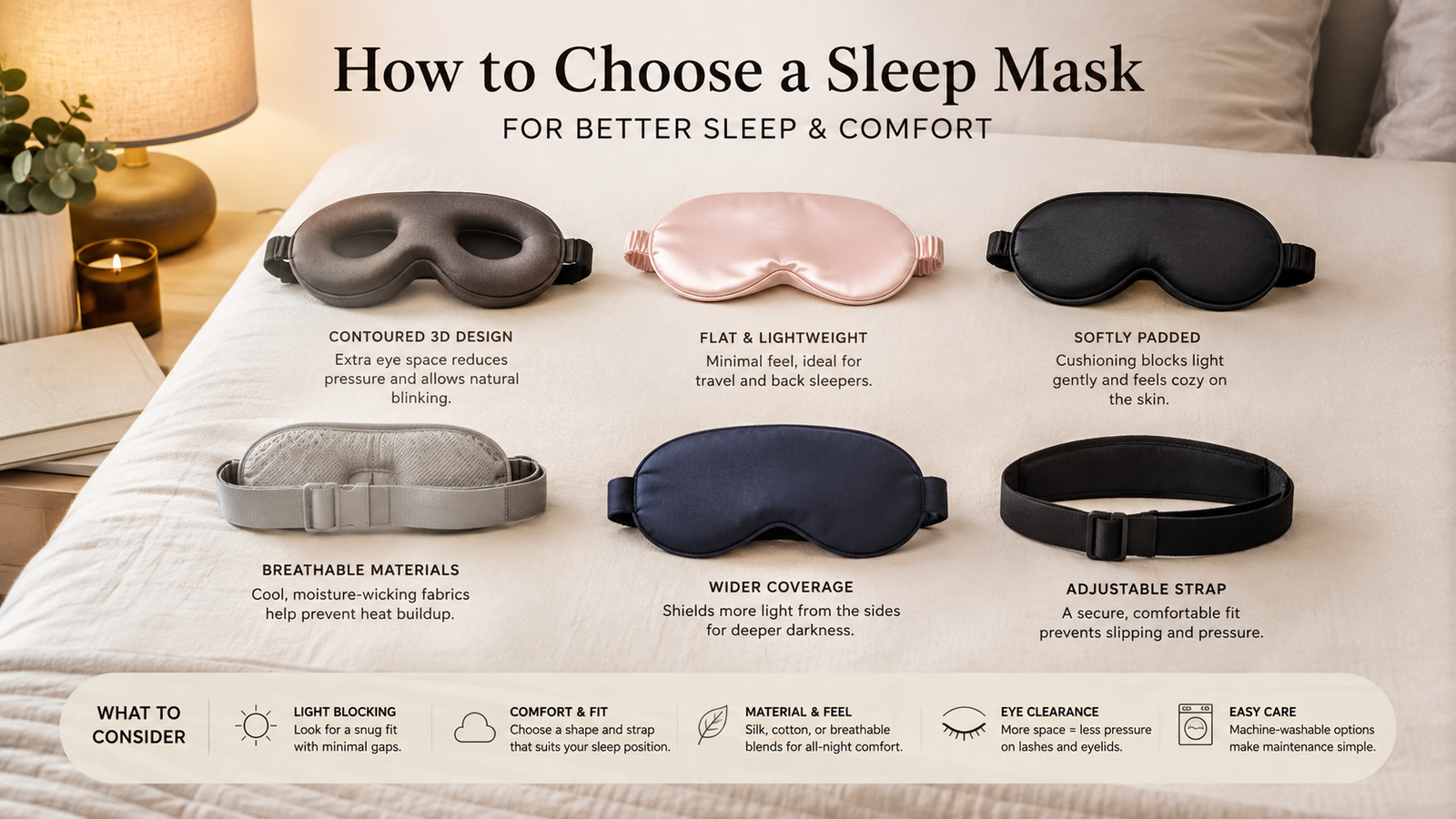
Flat Fabric Sleep Mask
This is the traditional design.
It uses a flat piece of fabric over the eyes.
Common materials include:
- cotton
- polyester
- satin
- silk
- blended fabrics
Advantages:
- lightweight
- compact
- simple
- easy to travel with
Disadvantages:
- may press against eyelids
- may allow light around the nose
- may move during sleep
This style can work well if you prefer minimal bulk.
Contoured Sleep Mask
A contoured mask has moulded or padded cavities around the eyes.
The mask rests more around the eye socket rather than directly on the eyelids.
Advantages:
- less eye pressure
- room to blink
- useful for people wearing eye makeup during travel
- often better light blocking
Disadvantages:
- bulkier
- may feel warm
- shape may not fit every face
Contoured masks are often a good choice for people who dislike fabric touching their eyelashes.
Padded Sleep Mask
Padded masks use thicker cushioning around the eyes and face.
They may feel:
- soft
- comfortable
- secure
However, thicker padding can also trap more heat.
Choose padding based on comfort rather than assuming thicker is always better.
Wraparound Sleep Mask
Wraparound masks use a wider band around the head.
They may provide:
- more stable fit
- additional side coverage
- better light blocking
Some designs also provide partial ear coverage.
These can work well for people whose masks tend to shift at night.
Travel Sleep Mask
Travel masks are usually designed to be:
- compact
- lightweight
- easy to store
- quick to put on
Some come with:
- carry pouch
- earplugs
- adjustable strap
For travel, low bulk can be as important as maximum light blocking.
Light Blocking Is the Most Important Feature
The main job of the mask is to keep light out.
Light commonly enters around:
- nose bridge
- cheeks
- sides of the mask
A mask can use thick material and still perform poorly if the shape does not match your face.
Good light blocking depends on:
- mask shape
- nose design
- strap adjustment
- face fit
- side coverage
Fit matters more than fabric thickness alone.
Check the Nose Area
The nose bridge is one of the most common places for light leakage.
Look for:
- flexible nose contour
- shaped lower edge
- soft nose flap
- moulded design
A mask that sits too high or too loosely around the nose may allow a visible line of light.
If darkness is your main priority, pay special attention to this area.
Flat vs Contoured Sleep Mask
| Feature | Flat Mask | Contoured Mask |
|---|---|---|
| Light blocking | Good if fitted well | Often very good |
| Eye pressure | More likely | Usually lower |
| Bulk | Low | Medium |
| Travel convenience | Excellent | Good |
| Space for eyelashes | Limited | Better |
| Side sleeping | Usually good | Depends on thickness |
| Heat buildup | Usually lower | Can be higher |
| Makeup contact | More contact | Less contact |
Neither is automatically better.
Choose according to comfort and face shape.
Which Is Better for Side Sleepers?
Side sleepers need to pay attention to mask thickness.
A very bulky contoured mask can press into the side of the face when lying on a pillow.
Look for:
- low-profile design
- soft edges
- flexible padding
- slim strap hardware
Avoid large buckles positioned near the side of the head.
For side sleeping, comfort against the pillow can be more important than maximum padding.
Which Is Better for Back Sleepers?
Back sleepers have more flexibility.
They can usually tolerate:
- thicker padding
- deeper eye cups
- larger masks
Because the sides of the mask are not pressed directly into the pillow, bulk is less of an issue.
Which Is Better for Stomach Sleepers?
Stomach sleepers may place more pressure on the face.
A very thick mask may feel uncomfortable.
Look for:
- thin design
- flexible materials
- soft edges
- low-profile strap
The mask should not create significant pressure around the eyes or nose.
Sleep Mask for People With Long Eyelashes
If your eyelashes touch the inside of a flat mask, consider a contoured design.
Eye cups can provide:
- more space
- less lash contact
- reduced pressure on eyelids
This can also be useful for people with eyelash extensions.
However, make sure the eye cavities are deep enough for your needs.
Sleep Mask for Travel
For flights, trains and hotels, useful features include:
- compact size
- carry pouch
- adjustable strap
- easy cleaning
- effective light blocking
- soft material
If you sleep upright during travel, strap stability becomes especially important.
A mask that fits well when lying down may slip differently when sitting upright.
Sleep Mask for Daytime Sleep
People who sleep during daylight, including shift workers, often need stronger light blocking.
Look for:
- wider coverage
- shaped nose area
- darker interior
- secure adjustable fit
A contoured or wraparound design may provide better darkness than a minimal flat mask.
Blackout curtains can also help if room light is a persistent issue.
Sleep Mask for Hot Sleepers
If you tend to feel warm while sleeping, choose:
- lightweight fabric
- breathable padding
- minimal foam
- moisture-friendly materials
Very thick memory-foam-style masks may retain more heat.
Comfort can change significantly after several hours of wear.
Sleep Mask for Sensitive Skin
If your skin reacts easily, look for:
- soft surface fabric
- smooth seams
- washable construction
- minimal rough stitching
Avoid products that feel scratchy or cause friction.
If you know you react to specific materials or fragrances, avoid them.
Stop using a mask if it repeatedly causes:
- rash
- itching
- irritation
- swelling
Silk Sleep Masks
Silk masks are popular because of their smooth feel.
Possible advantages include:
- low-friction surface
- lightweight feel
- soft contact with skin
Possible disadvantages:
- higher price
- more delicate washing requirements
- less structure in some designs
A silk exterior does not automatically mean excellent light blocking.
Fit is still critical.
Satin Sleep Masks
Satin refers to a fabric weave and can be made from materials such as polyester.
Advantages may include:
- smooth texture
- lower price than silk
- easy availability
Quality varies.
A well-designed satin mask can be very comfortable, but the material alone does not determine performance.
Cotton Sleep Masks
Cotton can feel:
- breathable
- soft
- familiar
However, flat cotton masks may absorb moisture and may not block light as effectively unless they include extra layers.
They can be a good option for people who prefer natural-feeling fabrics.
Foam and Memory-Foam Masks
Some contoured masks use foam to create structure.
Advantages:
- good shape retention
- comfortable cushioning
- effective eye cavities
Disadvantages:
- potentially warmer
- bulkier
- harder to wash depending on construction
Check cleaning instructions before buying.
Adjustable Strap vs Elastic Strap
The strap strongly affects comfort.
Adjustable Strap
Advantages:
- easier to customise fit
- useful for different head sizes
- can reduce excessive pressure
Look for a design that does not create a hard pressure point.
Fixed Elastic Strap
Advantages:
- simple
- lightweight
- no buckle
Disadvantages:
- may loosen over time
- cannot always be fine-tuned
- may feel too tight or too loose
For most users, adjustability is useful.
Avoid Over-Tightening the Mask
A sleep mask should stay in place without creating strong pressure.
If the mask is too tight, it may cause:
- discomfort
- pressure around the eyes
- headaches
- strap marks
Tighter does not always mean better light blocking.
A better-shaped mask may block more light with less pressure.
Strap Placement Matters
A strap that sits too high may cause the mask to slide downward.
A strap that sits too low may pull the mask upward.
Look for a design that allows the mask to sit naturally around the eyes.
Some masks use:
- one wide strap
- split straps
- wraparound bands
Try to choose a style that remains stable in your usual sleep position.
Velcro Closures
Hook-and-loop closures are common on adjustable masks.
Advantages:
- easy adjustment
- wide size range
Potential disadvantages:
- may catch hair
- can become noisy
- may lose grip over time
If you have long hair, look for covered or low-profile closures.
Buckles and Sliders
Small adjustment sliders can provide a smoother fit.
However, check where the hardware sits.
For side sleepers, a hard buckle near the temple or behind the ear can become uncomfortable.
Ideally, adjustment hardware should not sit directly between your head and pillow.
How Wide Should a Sleep Mask Be?
A wider mask can improve:
- side coverage
- stability
- light blocking
But excessive width can feel bulky.
The mask should cover the eye area fully without interfering with:
- nose breathing
- ears
- pillow position
Eye Cup Depth
For contoured masks, eye cup depth matters.
Shallow cups may still touch:
- eyelashes
- eyelids
Deep cups provide more clearance.
However, very deep masks become bulkier.
Choose the minimum depth that feels comfortable.
Does Mask Colour Matter?
Dark colours may help reduce visible light passing through thin material.
However, the internal construction matters more than exterior colour.
A light-coloured mask with an effective blackout layer may block light better than a thin black mask.
Do not judge light blocking by colour alone.
Breathability
A mask sits against the face for several hours.
Poor breathability can cause:
- heat buildup
- sweating
- discomfort
Look for:
- breathable fabrics
- ventilation around the eye cups
- moisture-friendly materials
Breathability is especially important in warm climates.
Weight of the Mask
A sleep mask should generally feel light on the face.
Heavy masks can create:
- pressure
- movement
- discomfort
Some weighted eye masks exist and are intentionally designed to provide pressure.
These are different from normal sleep masks and may not suit everyone.
For basic light blocking, low weight is usually preferable.
Weighted Sleep Masks
Weighted sleep masks contain additional material to provide gentle pressure.
Some people find this relaxing.
Others may find it:
- too heavy
- too warm
- uncomfortable around the eyes
If using one, follow the manufacturer’s guidance and stop if it causes discomfort.
People with eye conditions or recent eye procedures should seek appropriate professional advice before applying unusual pressure around the eyes.
Can a Sleep Mask Cause Eye Pressure?
A poorly fitted mask can press on the eyelids and surrounding area.
To reduce this:
- avoid overly tight straps
- choose contoured eye cups
- adjust the mask position
- avoid heavy designs if pressure feels uncomfortable
A sleep mask should not cause pain.
Sleep Masks and Dry Eyes
Some people with dry-eye symptoms may find different mask designs more or less comfortable.
However, a general sleep mask is not a medical treatment for dry eye.
Persistent symptoms such as:
- burning
- persistent redness
- eye pain
- significant dryness
should be assessed appropriately.
Sleep Masks and CPAP Use
If you use CPAP or another sleep-related device, the mask design needs to coexist with the equipment.
Check whether the sleep mask interferes with:
- headgear
- straps
- nasal interface
- seal
Low-profile eye masks may be easier to combine with other equipment.
Do not alter medical-device fit simply to accommodate a sleep mask.
Sleep Mask With Earplugs
Some travel sets include both.
This can be useful if your sleep environment has both:
- light
- noise
However, earplugs and sleep masks solve separate problems.
Choose each based on fit and comfort rather than assuming the included accessories are equally good.
How to Test Light Blocking
When you first try the mask:
- Put it on in a bright room.
- Close your eyes.
- Check for light around the nose.
- Move your head side to side.
- Lie in your usual sleep position.
- Check whether gaps appear.
This gives you a better idea of real performance than trying the mask while sitting still.
How to Test Comfort
Wear the mask for at least several minutes before sleeping in it.
Check for:
- eye pressure
- nose pressure
- strap tightness
- ear discomfort
- heat
- hard buckles
A small irritation may become much more noticeable after several hours.
How to Clean a Sleep Mask
Cleaning depends on the material.
Some masks are:
- machine washable
- hand-wash only
- surface clean only
Follow the manufacturer’s instructions.
If the mask contains:
- memory foam
- shaped inserts
- special padding
machine washing may damage it.
Why Regular Cleaning Matters
A sleep mask comes into contact with:
- skin oils
- sweat
- skincare products
- hair products
Over time, residue can build up.
Regular cleaning can help reduce:
- odour
- oil buildup
- fabric irritation
How often you clean it depends on use, skin type and product instructions.
Consider Buying More Than One
If you use a sleep mask every night, owning two can be practical.
This allows you to:
- wash one
- use the other
- avoid wearing a damp mask
It can also be useful to keep a separate travel mask.
Sleep Mask and Skincare
If you use rich skincare at night, some of it may transfer onto the mask.
Allow products to absorb before putting the mask on.
Otherwise you may experience:
- greasy fabric
- slipping
- faster buildup
Wash the mask regularly.
Sleep Mask and Eye Makeup
Normally, makeup should be removed before sleeping.
However, during travel or short naps, a contoured mask may reduce contact with eye makeup.
This is one reason contoured designs are popular for flights.
It is still better to avoid prolonged sleep in heavy eye makeup where possible.
When a Sleep Mask May Not Be the Best Solution
A sleep mask is useful for localised light around the eyes.
But consider other solutions if:
- the whole room is excessively bright
- the mask repeatedly causes discomfort
- you dislike anything touching the face
Alternatives may include:
- blackout curtains
- window shades
- reducing indoor light sources
- changing screen or device placement
The best solution may combine room-level light control with a mask.
Common Sleep Mask Buying Mistakes
Choosing Only by Fabric
Soft material is useful, but fit matters more for light blocking.
Assuming Thicker Means Better
Thick masks can become hot and bulky.
Ignoring the Nose Area
This is a major source of light leakage.
Ignoring Sleep Position
A bulky mask may be comfortable on your back but uncomfortable on your side.
Buying a Fixed Strap Without Checking Size
Poor strap tension can ruin an otherwise good mask.
Overlooking Washability
A mask used every night needs regular cleaning.
Choosing Maximum Tightness
Light blocking should come mainly from shape and fit, not excessive pressure.
How to Choose a Sleep Mask Step by Step
Step 1: Decide Your Main Problem
Do you need the mask primarily for:
- small amounts of bedroom light
- bright daytime sleep
- travel
- partner’s reading light
More intense light may require better coverage.
Step 2: Choose Flat or Contoured
Choose flat if you want:
- low bulk
- light weight
- travel convenience
Choose contoured if you want:
- less eyelid pressure
- more lash space
- stronger blackout performance
Step 3: Consider Your Sleep Position
Side sleepers should prioritise low-profile edges.
Back sleepers can tolerate thicker designs.
Step 4: Check Strap Design
Choose adjustable fit if possible.
Avoid hardware positioned where it will press against the pillow.
Step 5: Consider Heat
Choose lighter, breathable materials if you sleep warm.
Step 6: Check Cleaning Instructions
Make sure the maintenance routine is practical for regular use.
Sleep Mask Features by Need
| Need | What to Look For |
|---|---|
| Maximum darkness | Contoured fit and nose seal |
| Side sleeping | Low-profile design |
| Long eyelashes | Deep eye cups |
| Travel | Lightweight and compact |
| Daytime sleep | Wider blackout coverage |
| Hot sleeper | Breathable fabric |
| Sensitive skin | Smooth, soft surface |
| Frequent washing | Easy-clean design |
| Minimal eye pressure | Contoured eye cavities |
What Is the Best Sleep Mask for Most People?
A good all-purpose sleep mask generally has:
- effective nose-area coverage
- adjustable strap
- soft edges
- lightweight construction
- enough eye clearance
- washable materials
A contoured mask is often the better starting point if maximum darkness and minimal eyelid contact are important.
A thin flat mask may be better if you prioritise:
- travel
- simplicity
- minimal bulk
How Much Should You Spend?
A sleep mask does not need to be expensive.
Higher-priced models may offer:
- better materials
- more refined contouring
- improved strap design
- deeper eye cups
But the most expensive option is not automatically the most comfortable.
Prioritise:
- fit
- darkness
- comfort
- strap design
- breathability
- cleaning
Frequently Asked Questions
Do sleep masks actually block all light?
Some can block nearly all visible light when fitted correctly, but performance depends strongly on face shape and mask design.
Is a silk sleep mask better?
Silk can feel very smooth, but it is not automatically better at blocking light. Fit and construction matter more.
Is a contoured sleep mask better than a flat mask?
It is often better for people who dislike pressure on their eyelids or want more eyelash clearance. Flat masks are usually lighter and simpler.
Can sleep masks damage eyelashes?
A poorly fitted flat mask may press against lashes. A contoured design provides more clearance.
Can I use a sleep mask every night?
Yes, provided it fits comfortably, stays clean and does not cause irritation or excessive pressure.
Why does my sleep mask keep falling off?
The strap may be too loose, the shape may not suit your face or the material may slide against your hair.
Why does light enter around my nose?
The lower edge may not fit your nose bridge properly. A shaped nose section or flexible nose flap can help.
Are sleep masks good for daytime sleeping?
They can be especially useful during daytime sleep when the room cannot be made fully dark.
Can a sleep mask help with insomnia?
A sleep mask may improve darkness, but insomnia can have many causes. Persistent sleep problems should not be treated as only a light-blocking issue.
Final Takeaway
The best sleep mask is not simply the thickest or softest one.
Choose based on:
- light-blocking performance
- comfort around the eyes
- strap fit
- sleeping position
- breathability
- washability
Choose a contoured sleep mask if you want minimal eyelid pressure, more eyelash space and stronger blackout performance.
Choose a flat fabric mask if you prefer low weight, simplicity and easy travel.
For side sleepers, prioritise a low-profile design without hard hardware near the temples.
For daytime sleepers, focus on wider coverage and an effective nose seal.
Most importantly, the mask should create darkness without needing to be painfully tight.
If you are comparing specific options, continue to our Top 5 Sleep Masks in India guide, where we compare sleep masks for blackout performance, comfort, travel and different sleeping positions.