How to Choose a Sleep Mask for Better Sleep Comfort
Learn how to choose a sleep mask for better sleep comfort, with practical guidance on light blocking, fit, pressure, material, breathability and travel use. This beginner-friendly guide helps you make a clear, informed choice without unnecessary complexity.
A sleep mask is one of the simplest sleep accessories available.
Its job is straightforward:
block unwanted light while remaining comfortable enough to wear for several hours.
That simplicity is also why choosing one should not become unnecessarily complicated.
Sleep masks are now sold with features such as:
- contoured eye cups;
- memory-foam padding;
- silk fabrics;
- cooling inserts;
- weighted sections;
- adjustable nose bridges;
- Bluetooth speakers;
- gel packs;
- blackout layers.
Some of these features can improve comfort for particular users.
Others add:
- bulk;
- heat;
- cleaning requirements;
- charging;
- expense;
without improving the mask’s basic function.
The useful question is therefore not:
“Which sleep mask has the most features?”
It is:
“Which mask blocks the light that bothers me without creating pressure, heat or discomfort that wakes me for a different reason?”
For most people, the priorities are:
light blocking → comfortable fit → appropriate eye clearance → secure strap → breathable material → easy cleaning.
This guide explains how to compare sleep-mask shapes, materials, straps and special features so you can choose something that genuinely improves your sleep environment.
What Does a Sleep Mask Actually Do?
A sleep mask creates a darker environment by covering the eyes.
It may be particularly useful when:
- streetlights enter the bedroom;
- curtains do not block early morning sunlight;
- another person needs a bedside light;
- you sleep during daylight hours;
- you travel frequently;
- hotel rooms have bright electronic lights;
- complete blackout curtains are impractical.
The benefit is primarily environmental.
A mask helps control:
light exposure
It does not directly:
- treat insomnia;
- increase deep sleep by a guaranteed amount;
- cure sleep disorders;
- replace adequate sleep time;
- correct an irregular sleep schedule.
If light is genuinely one of the reasons you wake or struggle to settle, however, a good mask can be an inexpensive and practical solution.
Start by Identifying the Light Problem
Before buying a mask, ask what kind of light is bothering you.
Early Morning Sunlight
If sunrise wakes you earlier than desired, a high-coverage blackout mask may help.
Streetlights
Even relatively dim outdoor light can become noticeable once the room is otherwise dark.
A well-fitting mask can block it without requiring new curtains.
A Partner’s Reading Light
A mask can create personal darkness while allowing another person to continue using a bedside lamp.
Daytime Sleep
Shift workers and people sleeping after night work may benefit particularly from strong light blocking.
In this situation, a mask may work best alongside:
- blackout curtains;
- reduced bedroom noise;
- appropriate sleep scheduling.
Travel
A mask can help create darkness in:
- airplanes;
- trains;
- hotel rooms;
- unfamiliar bedrooms.
For travel, portability and washability may matter more than elaborate features.
Sleep Masks Do Not Need to Create Absolute Darkness for Everyone
Some people prefer complete darkness.
Others are perfectly comfortable with a small amount of ambient light.
The goal is not to achieve a laboratory-black environment simply because a manufacturer uses the word:
“100% blackout.”
The important question is:
Does the remaining light interfere with your sleep?
If not, perfect sealing may be unnecessary.
The Main Types of Sleep Masks
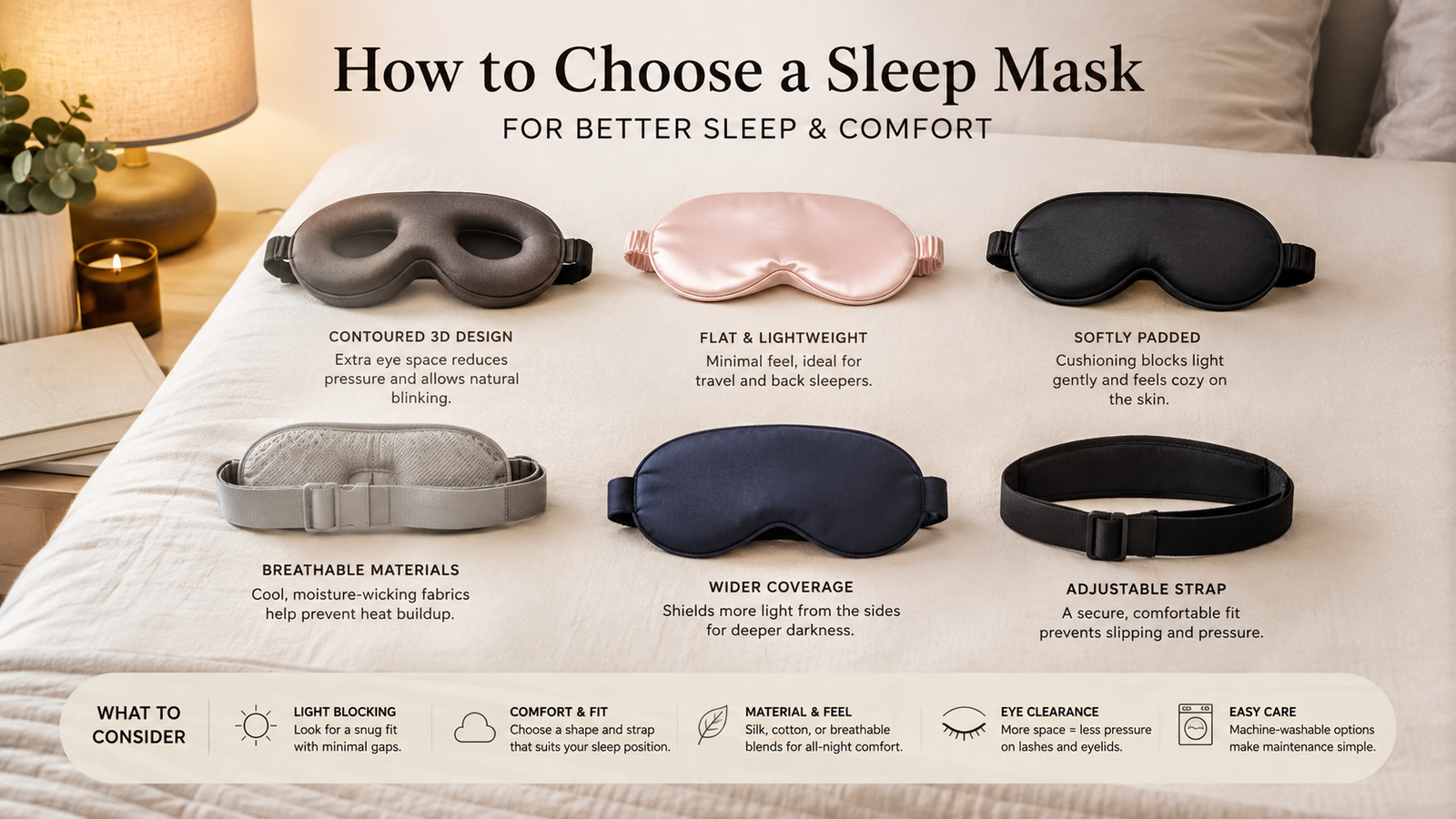
Most sleep masks fall into a few broad designs:
- Flat masks
- Contoured masks
- Padded masks
- Wraparound masks
- Weighted masks
- Cooling or gel masks
- Audio sleep masks
Each suits different preferences.
1. Flat Sleep Masks
Flat masks are the traditional design.
They use a relatively thin piece of fabric that rests across:
- eyes;
- upper cheeks;
- nose area.
Advantages
They are usually:
- lightweight;
- compact;
- inexpensive;
- easy to pack;
- simple to wash.
Potential Drawback
The fabric may press against:
- eyelids;
- eyelashes.
Some people do not mind this.
Others strongly dislike it.
If eyelid pressure bothers you, a contoured design may be more comfortable.
2. Contoured Sleep Masks
Contoured masks have recessed areas over the eyes.
These are often described as:
- eye cups;
- eye cavities;
- 3D contours.
The purpose is to create space between the mask and eyelids.
Advantages
They may allow:
- blinking without touching the fabric;
- less eyelid pressure;
- more space for eyelashes.
They can be particularly appealing to:
- people with long eyelashes;
- anyone who dislikes fabric touching the eyes.
Potential Drawbacks
They are often:
- bulkier;
- warmer;
- more structured.
The contour also has to fit your face.
A poorly positioned eye cup can feel worse than a simple flat mask.
Eye Cup Depth
Deeper does not automatically mean better.
Extremely deep cups may:
- increase mask thickness;
- make side sleeping less comfortable.
You simply need enough space that your:
- eyelids;
- eyelashes;
do not rub uncomfortably against the interior.
3. Padded Sleep Masks
Padded masks add cushioning around the:
- eyes;
- nose;
- face.
This can improve:
- softness;
- light sealing.
However, more padding also means more:
- bulk;
- heat retention.
Hot sleepers may prefer lighter construction.
4. Wraparound Sleep Masks
Some masks use a broader design that wraps farther around the:
- sides;
- back of the head.
These can provide:
- secure fit;
- improved side-light blocking.
But they can also feel warmer.
If you live in a hot or humid climate, consider whether the extra coverage will remain comfortable throughout the night.
5. Weighted Sleep Masks
Weighted masks add small amounts of pressure around the eye area or face.
Some people find the sensation:
- calming;
- relaxing.
Others find it:
- uncomfortable;
- restrictive.
Weight is not required for effective light blocking.
Be Cautious With Excessive Eye Pressure
The purpose of a weighted mask should not be to press heavily on the eyes.
Avoid designs that feel uncomfortable or create significant pressure around:
- eyeballs;
- temples;
- nose.
If you have an eye condition or have recently undergone eye surgery, ask an appropriate clinician before using products that place pressure around the eyes.
6. Cooling or Gel Sleep Masks
Some masks contain:
- cooling gel;
- removable gel inserts.
These may be chilled before use.
They are often marketed for:
- relaxation;
- eye-area comfort;
- headaches.
This is a different function from ordinary overnight light blocking.
Cooling Masks Are Not Always Designed for All-Night Use
Check the instructions.
A chilled gel mask may be intended for:
- 10 minutes;
- 20 minutes;
- short relaxation sessions;
rather than wearing continuously overnight.
Do not assume a product can remain against the skin for eight hours simply because it covers the eyes.
Avoid Extreme Cold
A cooling eye mask should feel:
- cool;
- comfortable.
It should not feel:
- painfully frozen;
- burning;
- numb.
If chilled according to instructions, use the recommended protective layer where applicable.
7. Audio Sleep Masks
Audio sleep masks combine an eye mask with:
- small flat speakers;
- Bluetooth connectivity.
They can play:
- music;
- sleep sounds;
- guided meditation;
- podcasts.
These are useful mainly for people who already know that private audio helps them sleep.
Advantages of Audio Masks
They may be more comfortable than conventional headphones for sleeping because speakers are built into soft fabric.
They can also combine:
light blocking + sound
in one product.
Disadvantages
They add:
- charging;
- electronics;
- more complicated washing;
- potential speaker pressure;
- Bluetooth pairing.
If all you need is darkness, the simpler mask is usually the better choice.
Side Sleepers Need to Consider Mask Thickness
Side sleeping places part of the face against the pillow.
A thick mask may create pressure around:
- temple;
- cheek;
- strap.
This is especially relevant with:
- thick memory foam;
- speakers;
- large side buckles.
If you primarily sleep on your side, look for a low-profile design.
Back Sleepers Have More Flexibility
Back sleepers generally place less direct pressure on the sides of the mask.
That means they may tolerate:
- thicker contours;
- larger straps;
- more padding.
However, comfort around the back of the head still matters.
A large buckle may press into the pillow.
Stomach Sleepers
Stomach sleepers often rotate the head strongly to one side.
A bulky mask may shift or become compressed.
Prioritize:
- thin construction;
- secure fit;
- soft side edges.
Combination Sleepers
If you regularly change position during the night, the mask needs to remain stable.
Useful characteristics include:
- secure but comfortable strap;
- low-profile edges;
- flexible construction.
A mask that works beautifully only while lying perfectly still may not suit an active sleeper.
Light Leakage Around the Nose
One of the most common sleep-mask problems is light entering around the nose.
The bridge of the nose creates a natural gap.
Manufacturers attempt to address this with:
- flexible nose pieces;
- shaped fabric;
- extra padding.
Adjustable Nose Bridges
Some masks include a flexible nose structure that can be shaped.
This can improve blackout performance.
But it should not create excessive pressure.
If the nose bridge feels:
- pinched;
- compressed;
the fit is not right.
Face Shape Matters
Two people can wear the same mask and experience very different light blocking.
Factors include:
- nose shape;
- cheek structure;
- head circumference;
- eye spacing.
This is why product photos alone are not enough.
Look for adjustable features and a good return policy where possible.
Strap Design Is Critical
The mask needs to stay in place without requiring excessive tightness.
Common strap designs include:
- elastic loops;
- adjustable elastic;
- hook-and-loop closure;
- sliding buckle;
- full fabric bands.
Each has trade-offs.
Fixed Elastic Straps
Simple elastic can be:
- lightweight;
- comfortable.
But as it stretches over time, the fit may loosen.
It also offers limited adjustment.
Adjustable Buckles
Sliding buckles allow better fit.
However, placement matters.
A hard buckle resting directly behind the head can become uncomfortable against the pillow.
Side sleepers should also avoid bulky hardware near the temple.
Hook-and-Loop Closures
These provide a wide adjustment range.
Potential drawbacks include:
- catching long hair;
- wearing out;
- creating a bulky overlap.
Check where the closure sits when you lie down.
Broad Fabric Bands
A wide band can distribute pressure over a larger area.
This may reduce:
- localized pressure;
- strap marks.
However, wider coverage can retain more heat.
The Strap Should Not Need to Be Extremely Tight
If the mask only blocks light when pulled very tightly, its shape may not fit your face properly.
Excessive tightness can cause:
- discomfort;
- pressure around the eyes;
- headache;
- skin marks.
A better-fitting mask should achieve darkness with moderate tension.
Hair Matters Too
Long hair can become:
- pulled;
- caught;
- tangled;
in some strap designs.
If this repeatedly bothers you, consider:
- smoother straps;
- wider fabric bands;
- covered closures.
Material Choice
Common sleep-mask materials include:
- cotton;
- polyester;
- microfiber;
- satin;
- silk;
- foam combinations.
Material affects:
- skin feel;
- heat;
- moisture;
- washability.
There is no universally superior material.
Cotton
Cotton can feel:
- soft;
- breathable;
- familiar.
It is often easy to wash.
But construction matters.
A thick padded cotton mask may still feel warm.
Polyester and Synthetic Fabrics
Synthetic materials can be:
- lightweight;
- durable;
- quick drying.
Some people find them comfortable.
Others prefer natural-feeling fabrics.
Judge the actual mask rather than assuming all synthetics feel the same.
Silk Sleep Masks
Silk masks are often marketed as luxury products.
Potential benefits include:
- smooth texture;
- low-friction surface;
- lightweight feel.
However, silk does not automatically provide better:
- blackout;
- fit;
- sleep quality.
It may also require more careful washing.
Satin Is Not Necessarily Silk
“Satin” describes a weave or surface finish rather than a specific fibre.
A satin mask may be made from:
- polyester;
- silk;
- other materials.
If material composition matters to you, check the product details.
Memory-Foam Masks
Memory foam is often used to create:
- contoured eye cups;
- cushioned seals.
It can provide comfortable shaping but may also:
- retain heat;
- increase thickness.
Hot sleepers should pay particular attention to ventilation.
Breathability
A sleep mask covers part of your face for potentially several hours.
If it becomes hot or sweaty, you may:
- remove it unconsciously;
- wake more often.
Look for:
- lighter fabrics;
- breathable construction;
- minimal unnecessary padding;
if heat is a concern.
Hot and Humid Climates
In warm environments, prioritize:
- lighter masks;
- moisture-friendly fabrics;
- lower-profile designs.
A heavily padded mask marketed as luxurious may become uncomfortable in summer.
Skin Sensitivity
The mask repeatedly touches delicate facial skin.
If you are prone to irritation, consider:
- fragrance-free materials;
- smooth seams;
- easy washability.
Wash the mask before first use if the manufacturer recommends it.
Acne-Prone Skin
A sleep mask can collect:
- oil;
- sweat;
- skincare products.
If the mask is worn every night but rarely washed, it may become unpleasant against the skin.
Choose something you can clean regularly.
Eye Makeup
If you sometimes sleep during travel while wearing eye makeup, a contoured mask may reduce direct contact with:
- mascara;
- eyelashes.
However, routinely sleeping in eye makeup is generally not ideal for eye-area hygiene.
The mask should not be considered a substitute for normal cleansing when practical.
Eyelash Extensions
People with eyelash extensions may prefer deeper eye cups.
Check that eyelashes do not press against the inner surface.
Again, excessive depth is unnecessary if moderate contouring provides enough clearance.
Mask Size
Sleep masks are often sold as:
- one size fits most.
But head sizes vary considerably.
Look for:
- wide adjustment range;
- measurements where available.
A mask that is too small may feel tight.
A mask that is too large may:
- shift;
- leak light.
Mask Width
A wider face panel can help block peripheral light.
But excessive coverage increases:
- heat;
- material contact.
Balance blackout performance against comfort.
Nose Cut-Out
A shaped nose area can improve:
- fit;
- airflow around the nose;
- light blocking.
The cut-out should not press uncomfortably on the bridge.
Does a Sleep Mask Improve Melatonin?
You may see marketing claims that a blackout mask “boosts melatonin.”
Light exposure does influence circadian biology and melatonin secretion.
But a consumer mask should not be marketed as if it provides a guaranteed hormonal treatment.
Its direct function is simpler:
reduce light reaching the eyes.
That can help create conditions more consistent with darkness.
Does a Sleep Mask Improve Deep Sleep?
Some research has explored sleep masks in specific environments, but you should be cautious about interpreting broad marketing claims such as:
“increases deep sleep by 40%.”
Individual sleep depends on many factors:
- sleep opportunity;
- environment;
- health;
- stress;
- caffeine;
- alcohol;
- sleep disorders.
Choose a mask to solve unwanted light—not because it promises a particular sleep-stage percentage.
Can a Mask Help With Insomnia?
It may help when light is one factor interfering with sleep.
But persistent insomnia is more complex.
A sleep mask cannot correct:
- anxiety;
- circadian mismatch;
- inappropriate sleep scheduling;
- untreated sleep disorders.
Persistent insomnia may benefit from structured professional assessment, including approaches such as CBT-I.
Sleep Masks for Shift Workers
Shift workers often need to sleep while the outside environment is bright.
A mask can therefore be particularly useful.
A stronger setup may combine:
- blackout curtains;
- sleep mask;
- noise control;
- phone on Do Not Disturb.
The goal is to create a sleep environment that remains reasonably consistent even during daylight hours.
Sleep Masks for Travel
A travel mask should ideally be:
- lightweight;
- washable;
- easy to pack;
- comfortable in several positions.
Consider whether it comes with:
- storage pouch.
A pouch can help keep the mask separate from:
- luggage;
- shoes;
- public surfaces.
Airplane Use
A sleep mask can help on long flights when:
- cabin lights remain on;
- other passengers use reading lamps;
- daylight enters through windows.
For travel, you may also want:
- earplugs;
- neck support;
but do not turn a basic travel sleep kit into a large collection of equipment.
Hotel Use
Hotels often contain unexpected light sources such as:
- alarm clocks;
- thermostat displays;
- smoke-detector LEDs;
- hallway light around the door.
A sleep mask can be much easier than trying to cover every tiny light source.
Naps
A mask can also be useful for:
- daytime naps;
- travel naps.
However, if long daytime naps are interfering with your nighttime sleep, improving nap timing may matter more than creating perfect daytime darkness.
Sleep Masks for Meditation
Some people use eye coverings during:
- meditation;
- relaxation;
- breathing exercises.
This can reduce visual distraction.
The same buying principles apply:
- comfort;
- low pressure;
- easy cleaning.
You do not need a separate “meditation mask” if your sleep mask works comfortably.
Sleep Masks and Headaches
Some people find darkness helpful during:
- migraine;
- light-sensitive headaches.
A soft mask may assist in creating darkness.
However, a tight or weighted mask may be uncomfortable during some headaches.
Severe, sudden or unusual headaches require appropriate medical assessment rather than relying on a mask.
Sleep Masks After Eye Surgery
After procedures involving the eyes, follow the instructions given by your eye-care professional.
Do not use a normal mask if it places pressure on a healing area unless you have been told it is safe.
Special protective eye shields may be required instead.
Dry Eyes
A mask may reduce direct airflow around the eyes in some situations.
But persistent dry-eye symptoms can have multiple causes.
Do not assume that a sleep mask is a treatment.
If you regularly wake with:
- eye pain;
- significant redness;
- blurred vision;
- severe dryness;
seek appropriate eye-care advice.
Avoid Masks That Interfere With Breathing
The mask should sit around the eyes and nose comfortably.
It should not:
- obstruct the nostrils;
- create a sensation of restricted breathing.
If a large mask collapses over the nose during sleep, choose a different shape.
Wash Your Sleep Mask Regularly
Because the mask touches the face every night, cleaning matters.
How frequently you wash it depends on:
- sweating;
- skin type;
- skincare;
- material.
The most important point is that it should not remain visibly:
- oily;
- dirty;
- strongly scented from accumulated products.
Follow the Care Label
Some masks can be:
- machine washed.
Others require:
- hand washing.
Masks containing:
- foam;
- electronics;
- gel inserts;
often need more careful cleaning.
Do not machine wash an electronic audio mask unless specifically designed for it.
Dry Thoroughly
Do not wear or store a mask while it remains damp.
Allow it to dry fully before use.
If you use a mask nightly, owning two simple masks can make washing easier because one remains available while the other dries.
Audio Mask Cleaning
For an audio sleep mask, check whether:
- speakers can be removed;
- electronics can be disconnected.
A product that is very difficult to wash may become inconvenient for daily use.
Ease of maintenance should influence the buying decision.
How Long Should a Sleep Mask Last?
There is no fixed replacement interval.
Replace the mask when:
- elastic no longer holds;
- fabric becomes damaged;
- foam loses shape;
- fastening fails;
- it cannot be cleaned adequately;
- it becomes uncomfortable.
A basic mask can last a long time if properly maintained.
Sleep Mask vs Blackout Curtains
Both solve similar light problems differently.
Sleep Mask
Advantages:
- inexpensive;
- portable;
- personal;
- no installation.
Disadvantages:
- must be worn;
- can shift;
- adds facial contact.
Blackout Curtains
Advantages:
- darken the whole room;
- no facial pressure;
- permanent solution.
Disadvantages:
- cost;
- installation;
- not portable.
For a permanent bedroom, curtains may be the better structural solution.
For:
- travel;
- shared lighting;
- rentals;
a mask can be much easier.
Do You Need Both?
Possibly.
Shift workers or very light-sensitive sleepers may prefer:
blackout curtains + sleep mask
because small amounts of edge light can still enter around curtains.
But if either solution already works, adding the other may be unnecessary.
Sleep Mask vs Eye Pillow
An eye pillow is usually:
- heavier;
- less securely attached;
- intended for relaxation rather than all-night wear.
It may contain:
- fabric filling;
- seeds;
- weighted material.
An eye pillow can be comfortable during:
- meditation;
- short rest.
A strapped sleep mask is usually more practical for overnight use because it stays in place as you move.
Sleep Mask vs Weighted Eye Pillow
Again, consider purpose.
If you want:
darkness while moving during sleep
choose a normal sleep mask.
If you want:
short periods of relaxing pressure while lying still
an eye pillow may suit you.
Do not buy both unless they serve genuinely different routines.
Expensive vs Budget Sleep Masks
A sleep mask does not need to be expensive to work well.
A budget product can perform perfectly if it has:
- good fit;
- light blocking;
- comfortable strap;
- washable construction.
Paying more may make sense when it genuinely improves:
- materials;
- eye contouring;
- durability;
- adjustability.
Premium Claims to Treat Carefully
Be cautious with claims such as:
- clinically engineered for deep sleep;
- increases REM;
- activates melatonin;
- anti-ageing while you sleep;
- detoxifying sleep mask;
- improves circulation around the eyes.
Most people primarily need:
darkness + comfort.
Do not let marketing make the product’s purpose more complicated than it is.
Silk vs Basic Fabric: Is Premium Worth It?
Silk may be worth paying for if you:
- strongly prefer its texture;
- want a smooth fabric;
- are willing to follow its care requirements.
It is not automatically better at blocking light.
A well-designed synthetic or cotton mask may outperform an expensive silk mask if the fit is better.
What About “Anti-Wrinkle” Sleep Masks?
Products may claim that smooth materials reduce:
- facial creasing;
- skin friction.
Material may influence surface friction, but sleep masks should not be treated as significant anti-ageing treatments.
If skin appearance is your concern, broader factors such as:
- sun protection;
- appropriate skincare;
are more important.
Cost Per Use
A sleep mask is an accessory that may be used every night.
That means modestly higher spending can make sense when it genuinely improves:
- comfort;
- durability.
For example, a ₹1,500 mask used for 500 nights costs approximately ₹3 per use.
But a ₹4,000 mask left in a drawer because it feels too hot is poor value.
Return Policies Matter
Face shapes vary.
A mask may fit reviewers perfectly and still:
- leak light around your nose;
- press against your temples.
Check return or exchange conditions before buying an expensive design.
Hygiene restrictions may apply once the product has been used.
How to Test a New Sleep Mask
When you receive a mask:
- Adjust the strap loosely.
- Lie in your normal sleep position.
- Close your eyes.
- Check for light around the nose and edges.
- Notice pressure around the eyes and temples.
- Turn onto your usual sleeping sides.
- Adjust gradually.
Do not begin by tightening it as much as possible.
Test It During the Day
A simple way to evaluate blackout performance is to wear the mask in a bright room during daytime.
This makes:
- nose gaps;
- side leakage;
easy to identify.
But comfort still needs to be tested overnight.
Give Comfort a Few Nights
A new mask may feel unfamiliar initially.
Try it for several nights if it is not causing:
- pain;
- pressure;
- irritation.
However, do not force yourself to adapt to a mask that is clearly uncomfortable.
What If the Mask Falls Off?
Possible reasons include:
- strap too loose;
- poor head fit;
- very slippery material;
- active sleeping.
Try modestly adjusting the strap.
If it requires uncomfortable tightness to remain in place, consider a different design.
What If It Leaves Marks on Your Face?
Temporary mild marks can occur from pressure.
Persistent deep marks suggest:
- excessive tightness;
- firm edges;
- poorly distributed pressure.
Loosen the mask or choose a softer design.
What If It Feels Hot?
Consider:
- thinner material;
- less foam;
- smaller coverage;
- breathable fabric.
Also review:
- room temperature;
- bedding.
The mask should not be the only part of a generally overheated sleep environment you try to solve.
What If It Does Not Block Enough Light?
Possible solutions include:
- adjusting nose fit;
- repositioning the strap;
- choosing wider coverage;
- trying a flexible nose bridge;
- using blackout curtains as well.
Do not overtighten a poorly fitting mask simply to improve blackout.
Common Sleep Mask Buying Mistakes
Buying by Material Alone
Fit determines light blocking.
Assuming More Padding Means More Comfort
Padding can increase heat and bulk.
Choosing an Extremely Tight Mask
Secure does not mean compressed.
Ignoring Side Sleeping
Thick edges and buckles can press against the pillow.
Buying an Audio Mask When You Only Need Darkness
Extra electronics add maintenance.
Assuming Weighted Is Better
Pressure preference is highly individual.
Ignoring Washability
A nightly face-contact product needs regular cleaning.
Buying for Medical Claims
Choose based on environmental function.
Expecting a Sleep Mask to Fix an Entire Sleep Routine
It solves light—not inadequate sleep opportunity.
Quick Sleep Mask Selection Guide
| Your priority | What to look for |
|---|---|
| Maximum light blocking | Good nose seal + wide coverage |
| Eyelash clearance | Contoured eye cups |
| Minimal bulk | Flat lightweight mask |
| Side sleeping | Low-profile edges and strap |
| Hot sleeper | Lightweight breathable material |
| Travel | Compact + washable + storage pouch |
| Shift work | Strong blackout, secure fit |
| Sensitive skin | Smooth washable material |
| Long hair | Hair-friendly strap design |
| Audio at bedtime | Removable-speaker audio mask |
| Unsure about fit | Highly adjustable strap |
A Minimal Sleep-Mask Buying Checklist
Before buying, ask:
- Why do I need a sleep mask?
- Is unwanted light genuinely affecting sleep?
- Do I prefer flat or contoured eye coverage?
- Do I dislike pressure on my eyelids?
- Do I sleep on my side?
- Is the mask low-profile enough?
- Does the nose area block light well?
- Is the strap adjustable?
- Does the strap contain a buckle that may press into my head?
- Will the material feel too warm?
- Is it washable?
- Are electronic components removable if present?
- Will I actually use the extra features?
- Is there a reasonable return policy?
A Simple Sleep Environment With a Mask
A sleep mask works best when it is one part of a sensible sleep environment.
For example:
- Keep a reasonably consistent sleep schedule.
- Reduce unnecessary evening stimulation.
- Keep the bedroom comfortably cool.
- Reduce disruptive noise.
- Turn off unnecessary light.
- Put on the sleep mask when ready to sleep.
The mask should be the final solution to remaining light—not the foundation of the entire sleep routine.
Frequently Asked Questions
Do sleep masks help you sleep better?
They can help when unwanted light is interfering with sleep or causing early waking. Their primary benefit is creating darkness.
Are sleep masks safe to wear every night?
A comfortable, clean mask that does not apply excessive pressure is generally suitable for regular use for many people. Individual eye or skin conditions may require additional guidance.
Is a contoured mask better than a flat mask?
Not universally. Contoured masks reduce eyelid contact, while flat masks are often lighter and simpler.
Which sleep mask is best for side sleepers?
Look for a low-profile design without bulky side hardware. The mask should not create pressure between your temple and pillow.
Is silk better for sleep masks?
Silk provides a smooth texture that some people prefer, but it does not automatically provide better blackout or sleep.
Is memory foam good for a sleep mask?
It can provide comfortable contouring and help block light, but thick foam may feel warmer and bulkier.
Do weighted sleep masks work better?
Some people find light pressure relaxing, but weighting is not required for effective light blocking and may feel uncomfortable to others.
Can a sleep mask damage eyelashes?
A poorly fitting flat mask may press against eyelashes. A contoured design can provide more clearance if this is a concern.
Can I wear a sleep mask with eyelash extensions?
Contoured eye cups may provide more room, but check that the mask does not contact the extensions.
How tight should a sleep mask be?
Tight enough to remain in place but not so tight that it creates pressure, pain, headaches or significant facial marks.
Why does light enter around my nose?
Face shape creates a natural gap around the nose. A shaped or adjustable nose bridge can improve the fit.
Can a sleep mask cause acne?
A dirty mask can accumulate sweat and skin oils. Regular cleaning and using a comfortable material can help maintain hygiene.
How often should I wash my sleep mask?
It depends on material, sweating and skincare use. Wash it regularly according to manufacturer instructions rather than waiting until it becomes visibly dirty.
Can I machine wash a sleep mask?
Some can be machine washed; others require hand washing. Foam, silk, gel or electronic masks may need special care.
Is a cooling sleep mask good for all-night use?
Not necessarily. Many cooling masks are designed for short sessions. Follow the specific product instructions.
Can I freeze a gel eye mask?
Only if the manufacturer says it can be frozen. Some products are intended only for refrigeration.
Does wearing a sleep mask increase melatonin?
Darkness contributes to normal circadian signalling, but a sleep mask should not be treated as a guaranteed hormonal treatment. Its direct function is light reduction.
Does a sleep mask increase deep sleep?
It may improve sleep conditions when light is disruptive, but no consumer mask can guarantee a particular amount of deep sleep.
Can a sleep mask help insomnia?
It may help if unwanted light is part of the problem. Persistent insomnia usually requires a broader approach.
Is a sleep mask useful for shift workers?
Yes. It can be particularly practical for people who need to sleep during daylight hours.
Is a sleep mask useful on flights?
Yes. Its portability makes it one of the simplest travel sleep accessories.
Should I choose a sleep mask or blackout curtains?
For a permanent bedroom light problem, blackout curtains may be more convenient. For travel, shared rooms or occasional use, a mask is simpler.
Can I use both blackout curtains and a sleep mask?
Yes, particularly if you require strong daytime darkness. But if one already solves the problem, both are unnecessary.
Can sleep masks help headaches?
Darkness may feel helpful for some light-sensitive headaches, but severe, unusual or sudden headaches require appropriate assessment.
Who should be cautious with weighted eye masks?
Anyone with an eye condition, recent eye surgery or concerns about pressure around the eyes should seek appropriate professional guidance before using weighted products.
When should sleep problems be evaluated instead of buying another accessory?
Seek appropriate assessment when you experience:
- persistent insomnia;
- excessive daytime sleepiness;
- loud habitual snoring;
- witnessed breathing pauses;
- gasping during sleep;
- frequent morning headaches;
- sleep disruption that materially affects daily life.
The Physical Glow Takeaway
A sleep mask has one primary job:
create comfortable darkness.
Start with fit rather than fabric or premium features. The mask should block enough light around the nose and sides without requiring excessive strap tension.
Choose the shape according to how you sleep:
flat masks for simplicity → contoured masks for eyelid and eyelash clearance → low-profile masks for side sleepers → stronger blackout designs for shift work or daytime sleep.
Then consider material, breathability and washing requirements.
Features such as:
- weighting;
- cooling gel;
- speakers;
- Bluetooth;
are optional. Add them only when they solve a specific need you already have.
Most importantly, keep the product’s role realistic. A sleep mask can solve unwanted light extremely well, but it cannot replace adequate sleep opportunity, consistent habits or appropriate evaluation of persistent sleep problems.
The best sleep mask is therefore not the most expensive or technologically advanced one. It is the one you can put on, forget you are wearing and remain comfortably in the dark until it is time to wake.