How to Choose a Weighted Blanket Weight and Size
Learn how blanket weight, dimensions, bed size and your ability to move the blanket affect suitability, and why choosing the heaviest option is not automatically better.
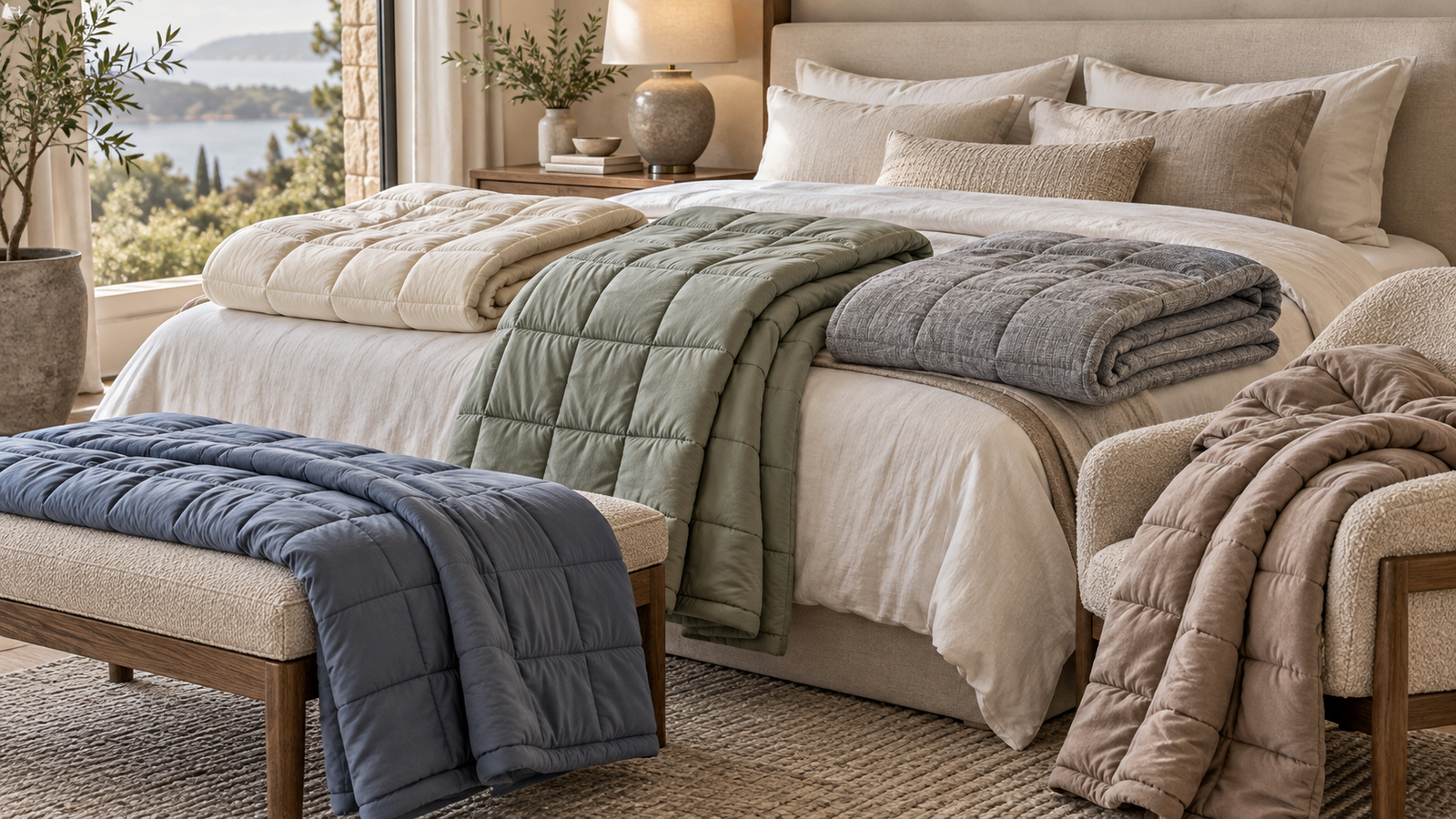
A weighted blanket is designed to provide evenly distributed pressure across the body, but choosing one by simply picking the heaviest option can make it uncomfortable, difficult to move under and impractical for regular sleep.
Weight is only part of the decision. Blanket dimensions, filling material, heat retention, how the weight is distributed and whether one or two people will use it can matter just as much.
This guide explains how to choose weighted blanket weight and size, what the common percentage rule gets right and wrong, how single and shared use differ, and when a lighter or more breathable blanket may be the better choice.
What Is a Weighted Blanket?
A weighted blanket is a blanket containing evenly distributed filling that makes it substantially heavier than an ordinary duvet or comforter.
The added weight may come from:
- Glass beads
- Plastic pellets
- Dense fabric layers
- Other evenly distributed filling materials
The blanket is usually divided into stitched sections so the filling does not collect in one area.
Why Do People Use Weighted Blankets?
People usually choose weighted blankets because they prefer the feeling of steady pressure during rest or sleep.
Some users describe the sensation as calming or cocoon-like.
However, comfort is highly individual.
A weighted blanket should not be treated as a guaranteed treatment for insomnia, anxiety or any medical condition.
How Heavy Should a Weighted Blanket Be?
A common starting rule is to choose a blanket weighing roughly 10% of the user’s body weight.
This can be useful as a general reference, but it is not an exact requirement.
Some people prefer less weight, especially if they:
- Sleep hot
- Move frequently during the night
- Dislike restrictive bedding
- Are new to weighted blankets
- Have lower strength or mobility
The better choice is a blanket that feels comfortably heavy without making it difficult to change position or remove the blanket independently.
Weighted Blanket Weight: Quick Reference
| Body Weight | Approximate 10% Reference | Practical Approach |
|---|---|---|
| 50 kg | About 5 kg | Consider slightly lighter if new to weighted blankets |
| 60 kg | About 6 kg | Use comfort and mobility as the final guide |
| 70 kg | About 7 kg | Around 6–7 kg may be a useful comparison range |
| 80 kg | About 8 kg | Do not automatically choose heavier if you sleep hot |
| 90 kg | About 9 kg | Check whether available blanket sizes distribute the load well |
These numbers are approximate references, not medical prescriptions.
Is the 10% Rule Always Correct?
No.
The 10% rule is popular because it gives shoppers an easy place to start, but body weight alone does not determine comfort.
Other factors include:
- Blanket dimensions
- Weight distribution
- Sleep position
- Body size
- Mobility
- Personal pressure preference
Two people who weigh the same may prefer very different blankets.
What If You Are Between Two Blanket Weights?
If you are unsure between two options, the lighter blanket is often the more conservative starting choice.
You can still experience the weighted sensation without making the bedding unnecessarily difficult to move.
A heavier option may suit experienced users who already know they prefer stronger pressure.
Can a Weighted Blanket Be Too Heavy?
Yes.
A blanket is probably too heavy if you:
- Struggle to move underneath it
- Cannot remove it comfortably
- Feel trapped or restricted
- Wake because of pressure discomfort
- Experience numbness or pain
A weighted blanket should feel substantial, not immobilising.
How Do You Choose Weighted Blanket Size?
A weighted blanket should usually fit the person more closely than a standard duvet.
It does not necessarily need to hang far over the sides of the mattress.
In fact, excessive overhang can pull part of the blanket’s weight toward the floor and make the blanket feel uneven.
Weighted Blanket Size vs Mattress Size
Do not assume that a weighted blanket needs to match the dimensions of your regular bedsheet or comforter.
A single-user weighted blanket can often be narrower because its main job is to cover the sleeper rather than dress the entire bed.
Before buying, compare:
- Blanket length
- Blanket width
- Your height
- Mattress width
- Whether one or two people will use it
Should a Weighted Blanket Hang Over the Bed?
A small amount of overhang may not matter, but large overhang is generally unnecessary.
If a significant portion hangs over the mattress edge, gravity can pull the blanket downward and make it easier for the blanket to slide.
A more body-focused fit usually keeps the weight distributed more evenly over the sleeper.
Weighted Blanket for a Single Sleeper
For one person, choose a size large enough to cover the body comfortably without excessive fabric extending beyond the mattress.
Check the actual dimensions rather than relying only on labels such as:
- Single
- Double
- Queen
- King
Brand sizing can vary.
Weighted Blanket for Two People
Sharing a weighted blanket is more complicated than sharing a normal duvet.
If one large blanket is used by two people, the total weight is spread across both sleepers and the mattress.
This can make it difficult to know how much effective pressure each person receives.
Different sleepers may also prefer different amounts of weight.
Two separate blankets can be more practical
Separate weighted blankets allow each person to choose:
- Their preferred weight
- Their preferred material
- Their preferred warmth
- Their preferred size
This also reduces blanket pulling during sleep.
Should Couples Use One Heavy Weighted Blanket?
Not necessarily.
Choosing a blanket by adding together 10% of both partners’ body weights can result in a very heavy product.
A shared blanket should never be so heavy that either person has difficulty moving or removing it.
Individual blankets are often easier to size correctly.
What Materials Are Used Inside Weighted Blankets?
Glass beads
Fine glass beads are commonly used because they are dense and can add significant weight without creating excessive bulk.
A well-constructed glass-bead blanket can feel relatively smooth and evenly weighted.
Plastic pellets
Plastic filling can also add weight but may feel bulkier than dense glass beads.
Some sleepers may notice more texture or movement depending on the construction.
Fabric-only weighted construction
Some blankets create weight through dense knitted or layered material rather than loose beads.
These can feel very different from traditional pocketed weighted blankets.
Why Weight Distribution Matters
The total number of kilograms does not tell you how the blanket will feel.
A good weighted blanket should distribute the filling reasonably evenly.
If the material shifts into large pockets, some parts of the blanket can feel much heavier than others.
Look for:
- Smaller stitched compartments
- Consistent filling
- Secure seams
- Minimal empty areas
Does Stitching Pattern Matter?
Yes.
Smaller stitched squares or compartments can help prevent filling from travelling across the entire blanket.
Large compartments may allow more internal movement.
Construction quality is therefore an important consideration, not just a cosmetic detail.
Are Weighted Blankets Hot?
They can be.
A weighted blanket adds another layer of material over the body, and some fabrics trap more heat than others.
If you already sleep warm, pay close attention to:
- Outer fabric
- Filling type
- Blanket thickness
- Room temperature
- Whether the blanket has a removable cover
Weighted Blanket for Hot Sleepers
Hot sleepers may prefer:
- Cotton covers
- Breathable woven fabrics
- Lower-bulk filling
- A slightly lighter weight
- A blanket without thick fleece
Terms such as “cooling” should be treated cautiously unless the material and construction actually support better heat dissipation.
Weighted Blanket for Cold Sleepers
If you prefer a warmer sleep environment, plush fabrics such as fleece or minky covers may feel more comfortable.
Just remember that warmth and weight are separate features.
A warmer fabric does not necessarily mean a heavier blanket.
Cotton vs Polyester Weighted Blanket
| Feature | Cotton | Polyester |
|---|---|---|
| Breathability | Often better | Depends on weave and thickness |
| Softness | Natural fabric feel | Can range from smooth to plush |
| Heat retention | Often moderate | Can be warmer in plush formats |
| Care | Depends on construction | Often easy-care |
The outer fabric affects comfort, but the internal construction still determines much of the blanket’s overall feel.
Do You Need a Removable Cover?
A removable cover can make cleaning easier because washing a very heavy blanket can be difficult.
A cover can also let you change the surface feel between seasons.
For example, you might use:
- A cooler cotton cover in summer
- A warmer plush cover in winter
How Do You Wash a Weighted Blanket?
Always follow the care instructions for the exact blanket.
A heavy blanket can exceed the safe capacity of a household washing machine.
Depending on the product, care may involve:
- Machine washing
- Hand washing
- Spot cleaning
- Washing only the removable cover
Never assume a washing machine can safely handle the blanket simply because it physically fits inside the drum.
Can a Weighted Blanket Damage a Washing Machine?
Potentially, if the blanket exceeds the machine’s weight capacity when wet.
Water can make a heavy blanket substantially heavier.
Check both the blanket-care label and washing-machine instructions before cleaning it.
How Should You Use a Weighted Blanket?
For first-time use:
- Place the blanket over your body rather than wrapping it tightly around you.
- Start with a short rest period.
- Make sure you can move and remove it easily.
- Gradually try longer use if it feels comfortable.
- Stop if you feel restricted or uncomfortable.
Do You Put a Weighted Blanket Over or Under a Duvet?
Either arrangement may be possible depending on comfort and temperature.
Placing a weighted blanket under a thick duvet can increase heat retention.
Using it as the uppermost layer may make it easier to remove if you become warm.
There is no required order as long as the blanket remains comfortable and easy to move.
Can You Sleep With a Weighted Blanket All Night?
Many adults who tolerate them well use weighted blankets through the night.
There is no requirement to do so.
You can use one only while relaxing or during part of the night if that feels more comfortable.
Do Weighted Blankets Improve Sleep?
Some people report that the pressure feels calming and helps them settle more comfortably.
However, individual response varies, and a weighted blanket should not be treated as a guaranteed solution for sleep problems.
Persistent insomnia, excessive daytime sleepiness or other sleep concerns may require professional assessment.
Can a Weighted Blanket Cure Anxiety?
No.
A weighted blanket may feel comforting to some people, but it is not a cure for anxiety and should not replace appropriate mental-health care.
Can Children Use Weighted Blankets?
Extra caution is necessary with children.
A child must be able to move freely and remove the blanket independently.
Very young children should not be given heavy bedding that could restrict movement or breathing.
For children, professional guidance and manufacturer age recommendations are especially important.
Who Should Be Cautious With Weighted Blankets?
Weighted blankets may not be appropriate for everyone.
Seek appropriate professional advice before use if there are concerns involving:
- Breathing disorders
- Reduced mobility
- Circulatory problems
- Neurological conditions
- Difficulty removing bedding independently
A person should never be trapped beneath the blanket.
Weighted Blanket and Sleep Apnoea
Anyone with a diagnosed or suspected breathing-related sleep disorder should be cautious about heavy bedding.
A weighted blanket should not be used as a treatment for sleep apnoea.
Discuss suitability with an appropriate healthcare professional if breathing during sleep is a concern.
Weighted Blanket and Pregnancy
Comfort needs change during pregnancy, and extra pressure may not suit everyone.
If you are pregnant and considering a heavy weighted blanket, especially later in pregnancy or with any medical complications, discuss it with your healthcare professional.
Can You Use a Weighted Blanket on Your Legs Only?
Yes.
Some people prefer placing the blanket over the legs or lower body rather than covering the chest.
This can provide a weighted sensation with less overall pressure and heat.
Weighted Blanket vs Heavy Comforter
A heavy comforter and a weighted blanket are not necessarily the same.
| Feature | Weighted Blanket | Heavy Comforter |
|---|---|---|
| Purpose | Distributed pressure | Warmth and bedding comfort |
| Weight distribution | Usually compartmentalised | Not designed around targeted weight |
| Filling | Dense beads or weighted material | Insulating fibre or down-style fill |
| Heat | Varies | Often designed primarily for warmth |
Weighted Blanket vs Duvet
A duvet is primarily intended for insulation and warmth.
A weighted blanket is intentionally heavier and uses more structured weight distribution.
You can use both, but combining them may be too warm for some sleepers.
How Long Does It Take to Get Used to a Weighted Blanket?
Some people enjoy the sensation immediately.
Others need several nights to decide whether they like the added pressure.
Start with shorter use rather than forcing yourself to sleep under it all night from the first day.
What If the Blanket Feels Too Heavy?
Do not assume you simply need to “get used to it.”
If movement feels restricted or the blanket creates discomfort, choose a lighter option.
Comfort should improve sleep, not turn bedtime into a resistance exercise.
Does a Larger Weighted Blanket Feel Lighter?
It can.
If the same total weight is spread over a much larger surface area, the pressure on any one part of the body may feel lower.
This is one reason both weight and dimensions need to be considered together.
Why Two 7 kg Blankets Can Feel Different
Two blankets with identical total weight may feel very different because of:
- Different dimensions
- Different compartment sizes
- Different filling materials
- Different fabric thickness
- Different weight distribution
Do not compare products by kilograms alone.
Common Weighted Blanket Mistakes
Choosing the heaviest option
More weight does not automatically mean more comfort.
Ignoring blanket dimensions
A large blanket distributes weight differently from a compact one.
Buying one blanket for two very different sleepers
Different body sizes and preferences can make one shared weight impractical.
Ignoring washing requirements
A heavy blanket can be difficult to clean at home.
Choosing plush material in a hot climate
The blanket may become uncomfortable even if the weight itself is appropriate.
Using the blanket when movement is restricted
You should always be able to remove it independently.
How to Choose a Weighted Blanket
Consider:
- Total weight
- Blanket length and width
- Your own body weight
- Whether one or two people will use it
- Filling material
- Stitched compartment size
- Outer fabric
- Breathability
- Removable cover
- Cleaning instructions
For specific options, see our Top 5 Weighted Blankets in India.
A Simple Weighted Blanket Buying Checklist
Before ordering, ask:
- Can I move freely under this weight?
- Can I remove the blanket without help?
- Will the dimensions fit my body and bed?
- Will the material be too warm for my climate?
- Can I realistically wash or maintain it?
- Is the filling evenly compartmentalised?
- Do I need a removable cover?
Frequently Asked Questions
What weight weighted blanket should I get?
Around 10% of body weight is a commonly used starting reference, but comfort, mobility and blanket dimensions should determine the final choice.
Is a 7 kg weighted blanket too heavy?
It depends on your body size, blanket dimensions and personal preference. Seven kilograms may feel comfortable for one person and excessive for another.
Should I size up or down if I am between weights?
If you are new to weighted blankets or uncertain, the lighter option is generally the more conservative choice.
Should a weighted blanket cover the whole bed?
Not necessarily. A single-user weighted blanket usually needs to cover the sleeper rather than hang far over every side of the mattress.
Can two people share a weighted blanket?
Yes, but choosing the correct weight becomes more difficult. Separate blankets often provide better individual control.
Are glass beads better than plastic pellets?
Glass beads are denser and can create a thinner blanket, but overall construction and weight distribution matter more than filling material alone.
Can I wash a weighted blanket in a washing machine?
Only if the manufacturer’s care instructions and the washing machine’s weight capacity allow it. Very heavy blankets may require other cleaning methods.
Final Takeaway
Choosing a weighted blanket is not simply a matter of finding 10% of your body weight and ordering the closest number.
Use that percentage as a starting reference, then consider blanket dimensions, mobility, filling, heat retention and how strongly you actually like pressure while sleeping.
A slightly lighter blanket that you can move comfortably under is usually more useful than a heavier one that feels restrictive.
If you are comparing specific products, see our Top 5 Weighted Blankets in India guide for the current options shortlisted by Physical Glow.
The best weighted blanket should feel secure and comfortable while still allowing you to turn, reposition yourself and remove it easily whenever you want.
Physical Glow publishes educational beauty, fitness and wellness content. This article is for general informational purposes and should not be treated as medical advice or as a treatment for sleep, anxiety or other health conditions.