How to Fit a Posture Corrector: Straps, Size and Wear-Time Considerations
Learn how posture-corrector designs and sizing differ, what to check for strap comfort and when professional assessment matters more than a wearable support.
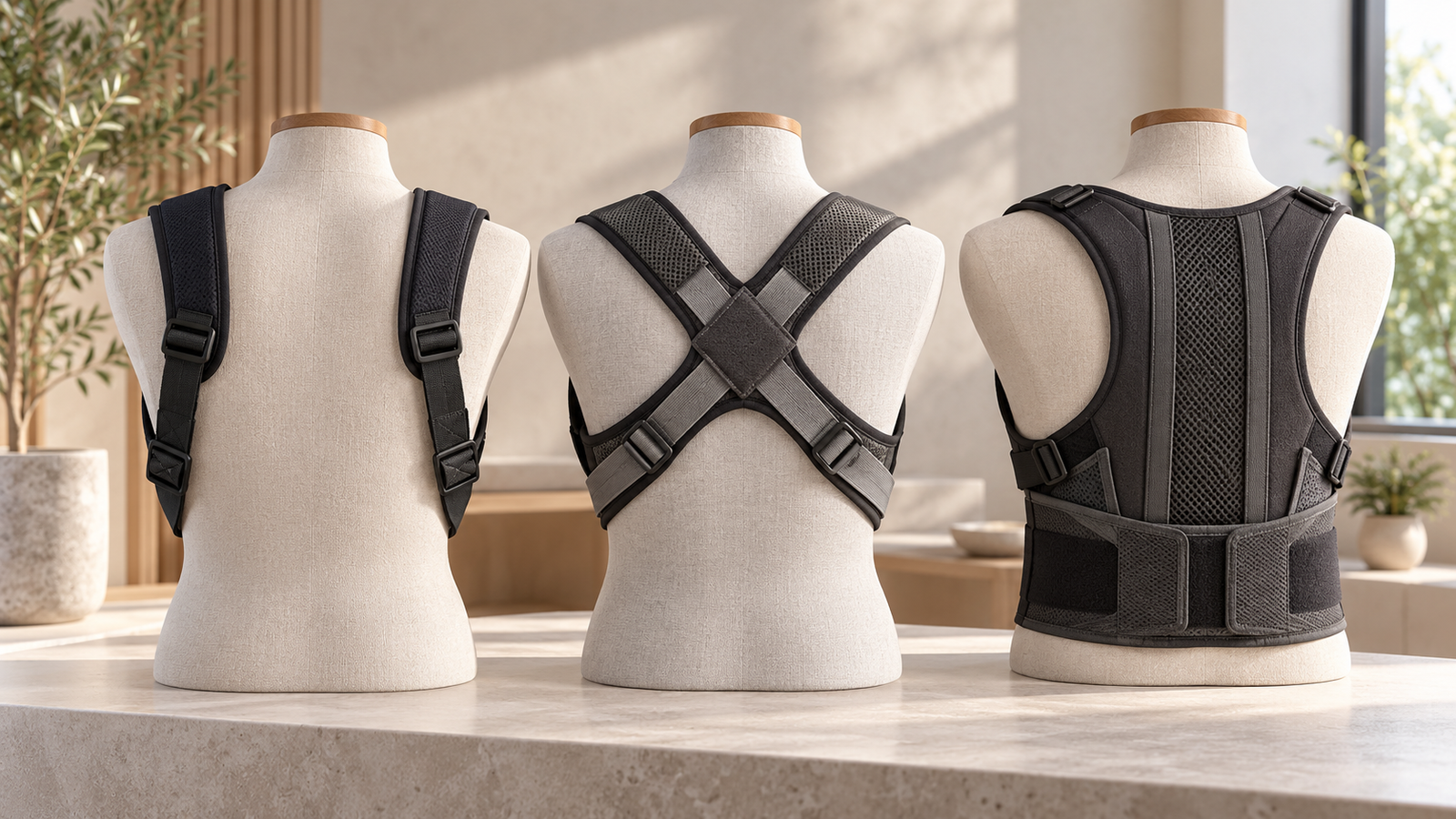
Posture correctors are wearable support products designed to sit around the shoulders, upper back or torso and provide a physical reminder when you move into certain positions.
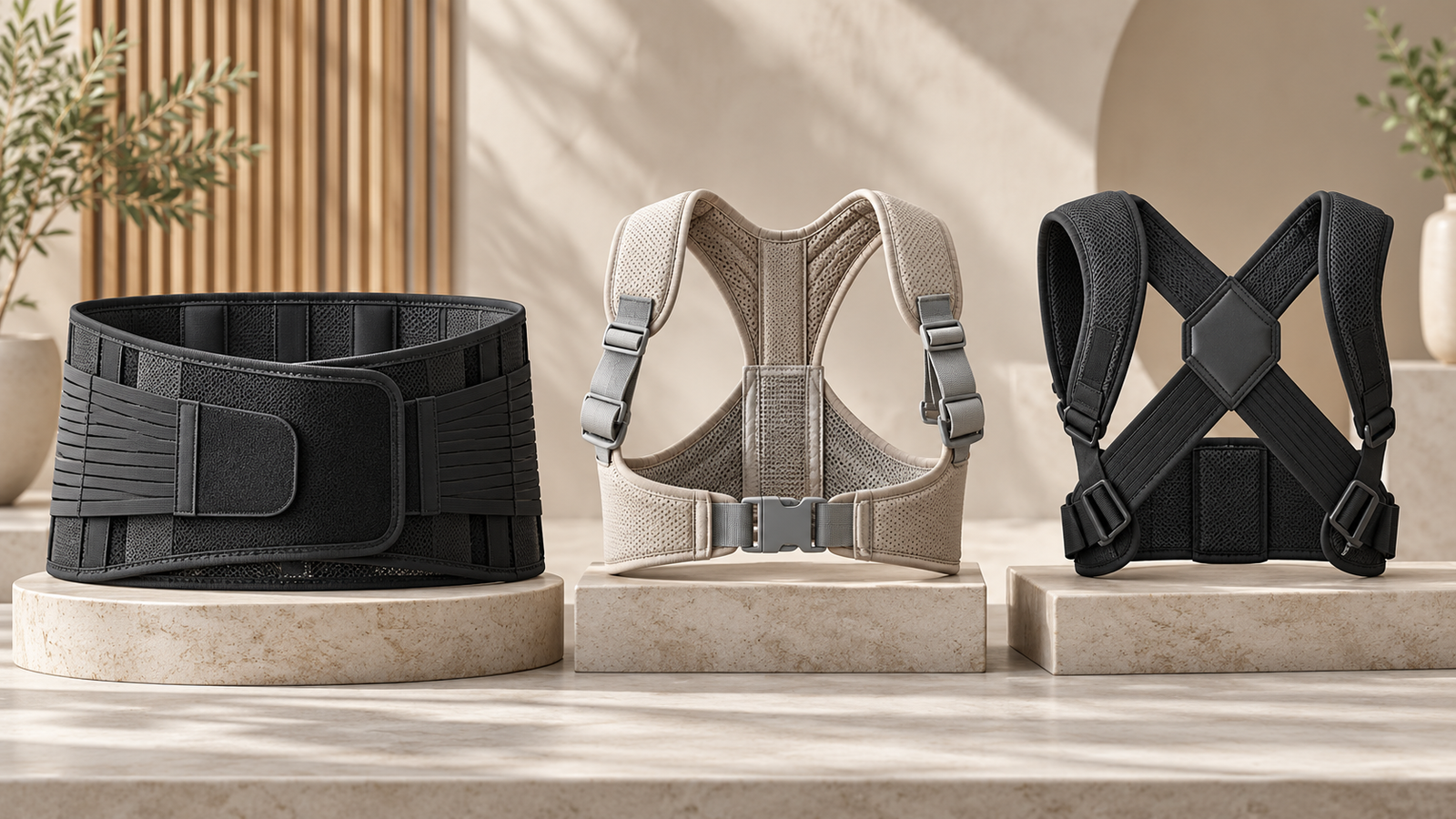
They are available in several designs, ranging from simple shoulder straps to broader upper-back harnesses with adjustable panels.
Getting the size and strap tension right matters more than pulling the device as tightly as possible.
A posture corrector that is too loose may shift around and provide little feedback. One that is too tight can restrict movement, rub the skin or create uncomfortable pressure around the shoulders and underarms.
The goal should be a secure, comfortable fit that encourages awareness without forcing the body into a rigid position.
What is a posture corrector?
A posture corrector is a wearable support intended to influence shoulder or upper-back positioning.
Common designs include:
- Simple shoulder-strap harnesses.
- Crossed-back straps.
- Clavicle-style braces.
- Upper-back support panels.
- Longer posture harnesses extending toward the mid-back.
Some are lightweight and designed to be worn under clothing.
Others use wider padded sections and are more noticeable.
The product should be viewed as a support or reminder device rather than a guaranteed solution for posture problems or back pain.
What can a posture corrector realistically do?
A posture corrector may help some users become more aware of shoulder and upper-back position.
For example, you may notice resistance from the straps when the shoulders move forward.
That feedback can encourage you to reposition yourself.
However, a brace does not permanently retrain posture simply by being worn.
Long-term comfort and movement patterns can also depend on:
- Strength.
- Mobility.
- Workstation setup.
- Activity level.
- Habit.
- Pain.
- Individual anatomy.
A wearable support should therefore be considered one possible part of a broader approach.
Why correct sizing matters
Sizing affects:
- Comfort.
- Strap position.
- Pressure distribution.
- Stability.
- How easily the device can be adjusted.
A size that is too small may:
- Dig into the underarms.
- Pull too strongly across the shoulders.
- Restrict breathing or movement.
- Be difficult to fasten.
A size that is too large may:
- Slide down.
- Twist.
- Fail to provide useful feedback.
- Require excessive strap tightening.
Do not assume that your usual T-shirt size will match a posture corrector size.
How posture-corrector sizing is measured
Different brands use different measurements.
Common sizing methods include:
- Chest circumference.
- Under-bust circumference.
- Shoulder width.
- Upper-torso circumference.
- Height and weight ranges.
The manufacturer’s size chart should be your main reference.
If the product asks for chest circumference, use a soft measuring tape.
Keep the tape:
- Level around the torso.
- Snug but not tight.
- Flat against the body.
Measure while breathing normally.
How to measure your chest
A typical method is:
- Stand normally.
- Wrap a flexible measuring tape around the fullest part of the chest.
- Keep the tape horizontal.
- Do not pull it tightly into the skin.
- Record the measurement.
- Compare it with the manufacturer’s chart.
If your measurement falls directly between sizes, check whether the brand gives specific guidance.
Do not automatically size down to create stronger tension.
Why sizing charts vary between brands
There is no universal posture-corrector sizing system.
A medium from one brand may fit differently from a medium from another.
Differences can come from:
- Strap length.
- Panel width.
- Elasticity.
- Buckle position.
- Product shape.
Always check the individual size chart rather than relying on your previous brace size.
Main posture-corrector designs
| Design | Typical coverage | Main fit consideration |
|---|---|---|
| Simple shoulder harness | Shoulders and upper back | Strap length and underarm comfort |
| Crossed-back harness | Shoulders and upper back | Centre position and strap symmetry |
| Clavicle-style brace | Shoulders and upper chest | Shoulder tension and strap placement |
| Broad back-panel corrector | Upper and mid-back | Torso size and panel alignment |
| Longer posture support | Upper back to lower thoracic area | Overall torso length and fit |
Simple shoulder-strap correctors
These usually resemble a lightweight harness.
Straps pass over the shoulders and under the arms.
Advantages include:
- Low bulk.
- Easy storage.
- Can sometimes be worn beneath clothing.
Potential issues include:
- Underarm rubbing.
- Narrow straps.
- Pressure if overtightened.
Correct strap length is especially important.
Crossed-back posture correctors
These use straps that cross at the back.
The crossed design helps create tension across the upper back when the shoulders move forward.
When fitted correctly, the crossing point should generally sit centrally rather than pulling strongly toward one side.
Uneven strap adjustment can cause the device to rotate.
Broad-panel posture correctors
These include a larger fabric panel across the back.
They may feel more supportive and distribute pressure over a wider area.
They can also be:
- Warmer.
- More visible under clothing.
- Less flexible.
If you want to wear a corrector for short desk-work periods, breathability may matter more than heavy construction.
What should a properly fitted posture corrector feel like?
A correctly adjusted product should generally feel:
- Secure.
- Balanced on both sides.
- Snug rather than restrictive.
- Noticeable when you slump.
- Comfortable enough for normal breathing.
You should still be able to:
- Move your arms.
- Sit.
- Stand.
- Breathe normally.
It should not hold you in a rigid military-style position.
A posture corrector should not force the shoulders far backward
A common mistake is tightening the straps until the shoulders are pulled dramatically back.
That is not the goal.
Natural posture varies from person to person.
The device should provide gentle feedback rather than forcing an exaggerated chest-up, shoulders-back position.
Overcorrection can be uncomfortable and may make normal movement difficult.
How tight should the straps be?
Start looser than you think you need.
Tighten gradually until you can feel mild resistance when the shoulders roll forward.
The straps should not cause:
- Numbness.
- Tingling.
- Restricted breathing.
- Deep marks.
- Sharp pressure.
- Arm weakness.
If any of these occur, loosen or remove the device.
How to put on a simple posture corrector
The exact method depends on design, but a general process is:
- Loosen all adjustable straps.
- Place your arms through the shoulder loops.
- Centre the back section.
- Fasten any front or torso closure.
- Tighten one side slightly.
- Match the opposite side.
- Stand naturally.
- Make small final adjustments.
Do not tighten one side fully before adjusting the other.
Symmetrical adjustment usually creates a more balanced fit.
Why the back panel should be centred
If the centre panel or strap crossing shifts left or right, pressure becomes uneven.
This can cause:
- One strap to dig in.
- Twisting.
- Unequal shoulder tension.
Use a mirror or ask someone to check the first few fittings.
Once the straps are set correctly, subsequent use is usually easier.
Underarm fit is particularly important
Many posture correctors run directly beneath the arms.
This area experiences constant movement and friction.
A poor fit can cause:
- Chafing.
- Red marks.
- Pinching.
- Skin irritation.
The straps should sit securely without cutting into the armpits.
If the device repeatedly rubs even when adjusted correctly, the design may simply not suit your body shape.
Padded straps
Padding can improve comfort around the shoulders and underarms.
Thicker padding is useful when the base strap is narrow.
However, bulky padding can make the product more visible beneath clothing.
Choose based on how and where you plan to wear it.
Wide straps vs narrow straps
Wide straps
Advantages:
- Spread pressure over a larger area.
- Can feel more comfortable.
Potential disadvantages:
- More visible.
- Warmer.
Narrow straps
Advantages:
- Lower profile.
- Easier to conceal.
Potential disadvantages:
- Can create more localised pressure.
Comfort depends on both width and material.
Elastic vs non-elastic straps
Elastic straps allow some movement.
This can make the corrector feel less restrictive.
Non-elastic or less-elastic straps provide firmer positional feedback.
A highly rigid design is not automatically better.
For general posture awareness, some flexibility is usually desirable.
Velcro adjustment
Hook-and-loop closures are common.
They make adjustment quick but can:
- Catch clothing.
- Lose grip as they wear.
- Collect lint.
Check that the closure holds securely before each use.
If the Velcro repeatedly loosens during wear, the brace may no longer fit reliably.
Buckle adjustment
Buckles allow more precise strap-length adjustment.
Once set, they may stay in place better than some hook-and-loop systems.
However, hard buckles should not sit in areas where they press painfully against the body.
Should the posture corrector be worn over or under clothing?
Both can work.
Over a thin shirt
Advantages:
- Reduces skin friction.
- Easier to adjust.
- Helps protect the brace from sweat.
This is often the most comfortable way to begin.
Directly on skin
Advantages:
- Less visible under outer clothing.
Potential drawbacks:
- Greater chance of rubbing.
- More sweat contact.
- Possible irritation.
If you have sensitive skin, wearing the device over a thin fitted shirt may be more comfortable.
Can it be hidden under clothes?
Lightweight models often can.
However, straps or buckles may still show under:
- Thin shirts.
- Tight clothing.
If discreet wear matters, look for:
- Low-profile straps.
- Flat closures.
- Thin back panels.
Do not sacrifice comfort just to make the device invisible.
Breathability
A posture corrector can become warm because it sits close to the body.
Look for materials such as:
- Mesh.
- Perforated fabric.
- Lightweight elastic.
Breathability is particularly useful in warm climates or during long desk sessions.
Heavy neoprene can provide padding but may retain more heat.
How long should you wear a posture corrector?
There is no universal schedule.
A posture corrector is generally more suitable for limited periods than continuous all-day wear.
For a new user, short sessions allow you to assess comfort.
For example, you might begin by wearing it during a period of desk work rather than immediately keeping it on for several hours.
Follow the manufacturer’s directions and any advice from your healthcare professional.
Why wearing it all day may not be ideal
A brace should not become a substitute for normal muscular control and movement.
Very prolonged reliance may encourage you to depend on the device rather than developing strength, mobility and postural awareness.
Short, purposeful use is usually more sensible than wearing it continuously without a clear reason.
Posture correctors for desk work
Desk work is one of the most common situations where people use these products.
A corrector may remind you when the shoulders drift forward.
But workstation setup also matters.
Check:
- Monitor height.
- Chair height.
- Keyboard position.
- Desk depth.
- Arm support.
A brace cannot compensate for an unsuitable workstation.
Movement breaks matter more than one “perfect” posture
Remaining in one position for hours can become uncomfortable even if the posture looks ideal.
Regular movement is important.
During long work periods:
- Stand up.
- Walk.
- Move the shoulders.
- Change sitting position.
A posture corrector does not remove the need for these breaks.
Using a posture corrector while standing
The same fit principles apply.
The brace should provide gentle feedback without forcing the torso.
If you constantly feel pulled backward while standing normally, the straps may be too tight.
Can you exercise in a posture corrector?
Most posture correctors are not intended to replace normal movement during exercise.
A brace can restrict:
- Shoulder movement.
- Arm elevation.
- Rotation.
Unless the manufacturer specifically approves exercise use, it is usually better to remove it for workouts.
Strength exercises should generally be performed using your own muscular control.
Can you wear one while walking?
Light walking may be comfortable in some models.
However, if the device interferes with arm swing or breathing, loosen or remove it.
The product should not restrict natural movement.
Can you sleep in a posture corrector?
Most posture correctors are not designed for sleeping.
During sleep you need to change positions naturally.
Straps can also create prolonged pressure.
Use the device only for the situations and duration recommended by the manufacturer.
Posture correctors and muscle strength
A brace itself does not strengthen the upper back.
If your goal is to improve strength and endurance, exercises may be more useful.
Examples can include movements for:
- Upper back.
- Rear shoulders.
- Core.
- General pulling strength.
A physiotherapist or qualified fitness professional can help select appropriate exercises if you have specific limitations.
Posture and mobility
Some people feel rounded forward partly because the chest and shoulders feel stiff.
Mobility work can complement strength training.
Possible areas include:
- Thoracic extension.
- Chest mobility.
- Shoulder mobility.
However, aggressive stretching is unnecessary.
Posture is influenced by multiple factors, not one “tight muscle.”
There is no single perfect posture
Posture is not a single fixed position that everyone must maintain.
People have different:
- Spinal curves.
- Shoulder shapes.
- Body proportions.
Comfort also depends on the task.
A posture corrector should therefore not be used to force every person into the same alignment.
Can posture correctors fix rounded shoulders?
They may provide a temporary positional reminder.
They should not be expected to permanently correct rounded shoulders by themselves.
Long-term change, where appropriate, may involve:
- Habit.
- Strength.
- Mobility.
- Ergonomic changes.
- Treatment of underlying conditions.
Avoid products promising permanent correction within a few days.
Can they fix a “hunchback”?
A visible upper-back curve can have several causes.
Some are postural; others are structural.
A consumer posture corrector cannot diagnose the cause.
If you have a pronounced or progressive spinal curve, seek professional assessment rather than relying on a brace purchased online.
Can posture correctors reduce back pain?
Some users may feel more comfortable while wearing one, but pain relief is not guaranteed.
Back and neck pain can come from many causes.
If pain is persistent, severe or worsening, proper assessment is more important than repeatedly adjusting a brace.
Red flags that need medical assessment
Seek professional advice if posture concerns are accompanied by symptoms such as persistent numbness, weakness, pain after trauma, progressive deformity or significant unexplained pain.
A wearable posture support should not delay evaluation of neurological or structural symptoms.
Skin irritation
Skin irritation is one of the most common practical problems.
It may be caused by:
- Friction.
- Sweat.
- Tight straps.
- Rough stitching.
- Heat.
If irritation occurs:
- Remove the brace.
- Let the skin recover.
- Check the strap position.
- Wear it over a thin shirt.
- Reduce wearing time.
Do not continue wearing it over broken or irritated skin.
Numbness or tingling
Numbness and tingling are not normal fitting sensations.
They may indicate excessive pressure.
Remove or loosen the corrector.
If neurological symptoms persist even after removing it, seek medical assessment.
Breathing restriction
You should be able to take a normal deep breath.
If the brace feels tight across the chest or ribs, loosen it.
A posture corrector should not function like a tightly cinched corset.
Strap marks
Temporary mild impressions from fabric can happen with fitted garments.
Deep, painful or long-lasting marks suggest excessive pressure.
Check:
- Size.
- Strap tension.
- Padding.
Uneven shoulder pressure
If one side feels tighter, first check whether:
- Straps are adjusted equally.
- The back panel is centred.
- The device has twisted.
Do not assume your body needs one side pulled much harder unless a qualified clinician has advised it.
How to introduce a posture corrector gradually
A sensible approach is to start with short use.
For example:
- Fit it over a thin shirt.
- Wear it for a brief desk-work period.
- Check for pressure points.
- Remove it and inspect the skin.
- Adjust slightly if needed.
- Increase wear only if it remains comfortable.
This gives you time to learn the fit without excessive pressure.
How to know if the brace is too loose
Signs include:
- Sliding down.
- Straps falling off the shoulders.
- Back panel rotating.
- No noticeable feedback when you slump.
Tighten gradually.
Do not jump from very loose to very tight.
How to know if it is too tight
Signs include:
- Underarm pain.
- Numbness.
- Difficulty breathing.
- Deep skin marks.
- Restricted shoulder movement.
- Feeling constantly pulled backward.
Loosen it or reassess the size.
Washing and cleaning
Posture correctors absorb:
- Sweat.
- Skin oils.
- Deodorant.
- Dust.
Regular cleaning is important.
Follow the care label.
Many fabric braces require:
- Hand washing.
- Mild detergent.
- Air drying.
Avoid high heat unless permitted because it can damage:
- Elastic.
- Foam padding.
- Hook-and-loop closures.
Close Velcro before washing
If the product uses hook-and-loop fasteners, closing them before washing can help prevent:
- Snagging.
- Lint buildup.
- Damage to other fabric.
Some products may benefit from being placed in a mesh laundry bag if machine washing is allowed.
Do not wear the brace while damp
Allow it to dry completely.
A damp brace can:
- Feel uncomfortable.
- Increase friction.
- Develop odour.
Having two braces can be convenient for very frequent users, but most people do not need this.
When should a posture corrector be replaced?
Replace the product if:
- Elastic no longer recovers.
- Straps repeatedly loosen.
- Velcro no longer holds.
- Fabric tears.
- Padding becomes permanently compressed.
- Hardware breaks.
A stretched-out brace may no longer provide predictable support.
How to compare posture correctors before buying
| Factor | What to check |
|---|---|
| Size range | Based on actual body measurements |
| Design | Shoulder harness, crossed strap or broad panel |
| Strap width | Wider for comfort, narrower for discretion |
| Adjustability | Enough range for a secure fit |
| Padding | Especially under the arms |
| Material | Breathable and comfortable |
| Closures | Buckle, Velcro or combination |
| Concealment | Low profile if worn under clothing |
| Cleaning | Hand washable or machine washable |
| Coverage | Upper back only or extended torso support |
Common buying mistakes
One common mistake is buying a smaller size because it seems as though greater tightness will produce better posture.
Another is choosing the most complicated brace without considering whether the extra straps make it hotter and harder to fit.
Other mistakes include buying without measuring the chest, ignoring underarm padding, expecting all-day comfort immediately and assuming that a brace alone will permanently change posture.
Fit and usability matter more than how restrictive the product looks.
Which design is best for beginners?
A simple adjustable shoulder harness is often easier to understand.
It lets you learn:
- Strap positioning.
- Correct tension.
- Comfortable wearing time.
A broad multi-strap brace may provide more coverage but also creates more fitting points.
Choose the simplest design that meets your actual need.
Which design is better for larger body frames?
Look for:
- A wide size range.
- Longer straps.
- Broader back panels.
- Clear measurement-based sizing.
Do not rely on “one size fits all” if your measurements fall outside the stated range.
Which design works better under clothing?
Low-profile harnesses are generally easier to conceal.
Look for:
- Flat straps.
- Minimal padding.
- Smooth closures.
However, thin straps can create more concentrated pressure.
Balance discretion with comfort.
Frequently asked questions
How tight should a posture corrector be?
Snug enough to provide gentle feedback, but not tight enough to restrict breathing, movement or circulation.
Should a posture corrector pull my shoulders back?
It may provide mild backward tension, but it should not force the shoulders into an exaggerated position.
How many hours a day should I wear one?
There is no universal duration. Begin with short periods and follow the manufacturer’s instructions or professional advice.
Can I wear a posture corrector all day?
Continuous all-day use is usually unnecessary for general posture awareness and may become uncomfortable.
Can I wear it under a shirt?
Many lightweight models are designed for this, but direct skin contact can increase rubbing. A thin undershirt may be more comfortable.
Should posture correctors hurt at first?
No. Mild awareness of strap pressure is different from pain.
Why does mine hurt under the arms?
The straps may be too tight, the size may be wrong or the design may not suit your body shape.
Can I sleep in it?
Most are not designed for overnight use.
Can I work out while wearing one?
Usually it is better to exercise without unnecessary restriction unless the manufacturer or a healthcare professional specifically recommends otherwise.
Do posture correctors permanently fix posture?
They should not be expected to create permanent change by themselves.
Choosing and fitting a posture corrector
Begin with accurate body measurements and the manufacturer’s size chart.
Once you have the correct size, loosen the straps before putting it on and adjust both sides gradually.
The finished fit should be centred, balanced and comfortable.
You should feel a gentle reminder when the shoulders move forward, not a strong force pulling the chest open.
A posture corrector is most useful when it fits into a broader routine that includes regular movement, sensible workstation setup and appropriate strength or mobility work.
Physical Glow’s Top 5 Posture Correctors for Different Fit Needs in India comparison looks at several shoulder-harness, crossed-strap and broader back-support designs. Use that comparison alongside this guide, then verify the current sizing chart, strap-adjustment range, material, padding and washing instructions for the exact posture corrector you plan to buy.