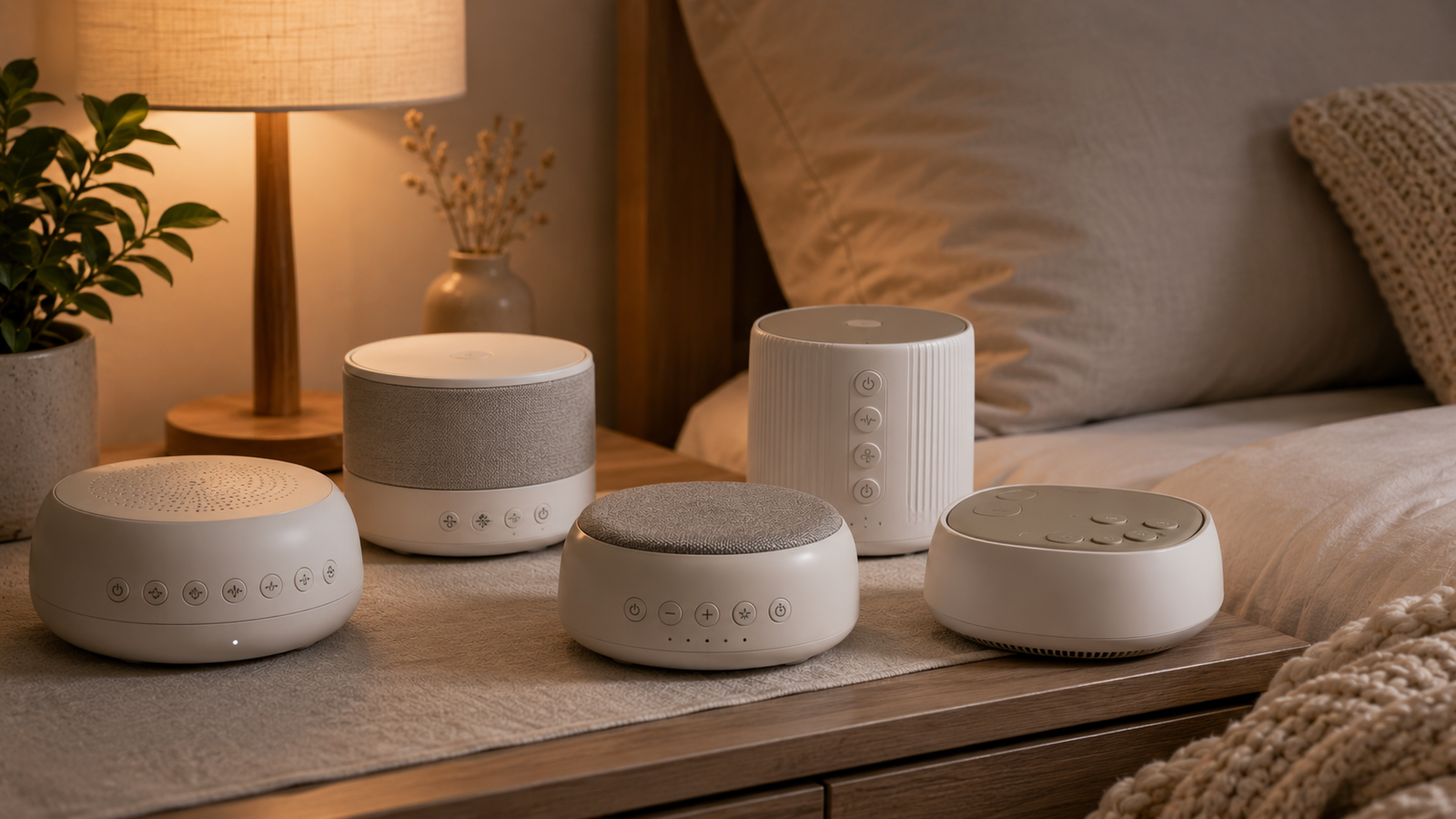
How White Noise Machines Work and How to Choose One
Understand how white noise machines mask irregular sounds and what to compare when choosing a device for a bedroom, office or travel.
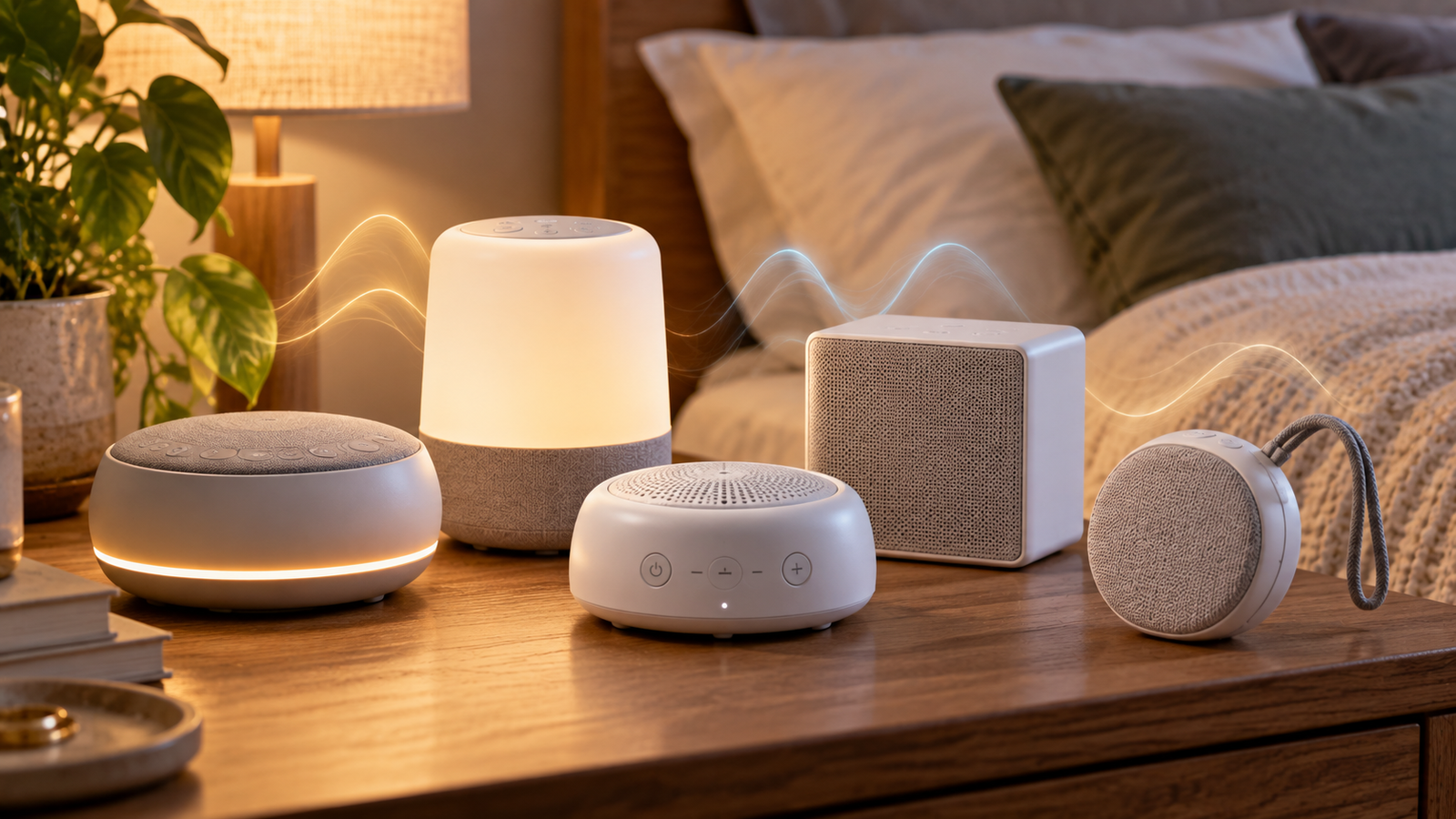
A white noise machine is designed to create a consistent background sound that can make sudden or irregular noises less noticeable.
It does not eliminate outside sound.
Instead, it helps reduce the contrast between a quiet environment and disruptive noises such as:
- traffic
- doors closing
- people talking
- dogs barking
- household movement
- air-conditioner changes
- sounds from neighbouring rooms
For some people, this steadier sound environment can make it easier to relax, concentrate or sleep.
However, white noise machines vary considerably in sound type, speaker quality, volume control and features.
The right machine depends on:
- where you plan to use it
- which sounds bother you
- whether you prefer fan-like noise or digitally generated sound
- how much volume control you need
- whether portability matters
- whether you want additional features such as timers or night lights
This guide explains how white noise machines work and what to look for before buying one.
What Is White Noise?
White noise is a type of sound containing energy across a broad range of audible frequencies.
It is often perceived as a steady:
- hiss
- rush
- static-like sound
The idea is similar to the sound of:
- a running fan
- steady airflow
- continuous rainfall, although rain itself is not technically pure white noise
In practical consumer products, the phrase white noise machine is often used more broadly for devices that produce several types of continuous background sound.
These may include:
- white noise
- pink noise
- brown noise
- fan sounds
- rainfall
- ocean sounds
- other ambient soundscapes
How Does a White Noise Machine Work?
Imagine trying to sleep in a very quiet room.
A sudden car horn or closing door stands out clearly because the difference between silence and the new sound is large.
When a consistent background sound is already present, that sudden noise may feel less prominent.
This process is often described as sound masking.
The machine does not physically block the outside sound.
Instead, it adds a controlled sound that can make other noises less noticeable.
Sound Masking vs Soundproofing
These are very different.
Sound Masking
Adds sound to make unwanted noise less noticeable.
A white noise machine does this.
Soundproofing
Attempts to reduce how much outside sound actually enters a room.
This may involve:
- better windows
- doors
- insulation
- acoustic construction
A white noise machine cannot replace proper soundproofing if the outside noise is extremely loud.
Why Do People Use White Noise Machines?
Common uses include:
- sleep
- concentration
- shared bedrooms
- hotel rooms
- offices
- study spaces
- noisy neighbourhoods
- masking intermittent household sounds
Some people also simply prefer a consistent background sound rather than complete silence.
Can White Noise Help With Sleep?
Some people find consistent background sound useful because it can make environmental noises less distracting.
For example, it may help if your sleep is disturbed by:
- occasional traffic
- neighbours
- doors
- family members moving around
- early-morning activity
However, a white noise machine is not a treatment for every sleep problem.
Persistent difficulties with:
- falling asleep
- staying asleep
- excessive daytime sleepiness
- loud snoring
- breathing interruptions during sleep
may need appropriate professional assessment rather than simply increasing background noise.
White Noise vs Pink Noise vs Brown Noise
Many modern machines offer several noise colours.
The difference is mainly how sound energy is distributed across frequencies.
White Noise
White noise contains a broad range of frequencies at relatively equal intensity.
It often sounds:
- bright
- hiss-like
- airy
Some people like this because it masks higher-pitched environmental sounds effectively.
Others find it too sharp.
Pink Noise
Pink noise has relatively greater emphasis on lower frequencies than white noise.
It is often perceived as:
- softer
- smoother
- more balanced
Some people compare it to:
- steady rain
- wind
- natural environmental sound
It can be a good option if white noise sounds too harsh.
Brown Noise
Brown noise emphasises even lower frequencies.
It generally sounds:
- deeper
- fuller
- more rumbling
Some people prefer it for:
- concentration
- sleep
- masking lower-frequency environmental noise
Preference is highly individual.
There is no universal best noise colour.
Fan-Based vs Digital White Noise Machines
This is one of the most important distinctions.
Mechanical or Fan-Based Machines
These use an actual internal fan or airflow mechanism to create sound.
Advantages may include:
- naturally varying sound
- no obvious audio loop
- traditional fan-like tone
Disadvantages may include:
- fewer sound choices
- more mechanical parts
- larger physical size
These are best suited to people who specifically like the sound of a fan.
Digital White Noise Machines
These use a speaker to reproduce electronically generated or recorded sounds.
Advantages:
- multiple sound choices
- precise volume control
- timers
- compact designs
- travel-friendly options
Disadvantages:
- poor-quality models may have obvious audio loops
- speaker quality can affect sound smoothness
For most users, digital machines provide more flexibility.
Recorded Sounds vs Generated Noise
Some machines play recorded soundtracks such as:
- rainfall
- ocean waves
- forest ambience
Others generate continuous noise electronically.
Generated sound can be useful because there may be no repeated recording pattern.
With recorded sounds, listen for noticeable loops.
A repeated:
- bird call
- wave pattern
- thunder sound
can become distracting once you notice it.
Which Sound Is Best for Sleeping?
There is no single best option.
You may prefer:
White Noise
If you want stronger masking and do not mind a brighter sound.
Pink Noise
If you prefer something softer.
Brown Noise
If you like deeper sound.
Fan Noise
If a running fan already helps you sleep.
Rain
If natural ambience feels more relaxing.
The best sound is generally the one you can comfortably ignore once it is playing.
If you keep actively noticing the sound, it may not be the right choice.
Volume Control Is Critical
A white noise machine should have enough volume range to suit different environments.
Useful controls include:
- small volume increments
- low minimum volume
- enough maximum output for moderate environmental noise
Avoid assuming louder is automatically better.
The goal is to reduce the contrast of unwanted sound, not overwhelm the room.
How Loud Should a White Noise Machine Be?
Use the lowest comfortable volume that achieves the masking effect you need.
The sound should not feel:
- intrusive
- painfully loud
- uncomfortable
- difficult to talk over at normal levels unless the use case specifically requires stronger masking
If the machine is next to your bed, you may need much less volume than if it is positioned across the room.
Very high-volume sound used for long periods can be undesirable for hearing.
Placement Matters
Where you place the machine can change how well it works.
Possible locations include:
- bedside table
- near a doorway
- between the sleeper and the noise source
- on a desk
- near a shared wall
If traffic noise comes mainly from a window, placing the machine between the bed and window may work better than placing it on the opposite side of the room.
You may need to experiment.
Do Not Put It Directly Beside Your Ear
There is usually no need to place the speaker extremely close to your head.
Some distance allows the sound to spread through the room more naturally.
This also reduces the temptation to use excessive volume.
Continuous Play vs Timer
White noise machines typically offer one of two approaches.
Continuous Play
The sound continues until manually stopped.
This may suit people who:
- wake easily from early-morning noise
- want sound throughout the night
Timer
The machine automatically turns off after a selected period.
Common timer options might include:
- 30 minutes
- 60 minutes
- 90 minutes
- several hours
This can be useful if you only need noise while falling asleep.
Choose based on when environmental noise actually affects you.
Should White Noise Run All Night?
It can if the device is designed for continuous use and the volume is comfortable.
Some people prefer overnight sound because a sudden transition to silence can itself be noticeable.
Others prefer a timer.
There is no requirement to use it all night.
Memory Function
A memory feature can save:
- last sound
- last volume
- timer setting
This is convenient if you use the same setup every night.
Without memory, you may have to reconfigure the machine each time.
Speaker Quality Matters
A poor speaker can make white noise sound:
- harsh
- metallic
- distorted
- uneven
For sleep use, smoother sound is generally more comfortable.
Pay attention to:
- distortion at higher volumes
- sudden changes in tone
- buzzing
- noticeable digital artefacts
A machine with many sound options is not necessarily better if the speaker itself is poor.
Look for Smooth Volume Adjustment
Large jumps between volume levels can be frustrating.
For example, one level may feel:
- too quiet
while the next is:
- too loud
More precise volume control is especially useful in a quiet bedroom.
How Many Sound Options Do You Need?
More sounds can be useful, but dozens of options are not essential.
A practical machine might offer:
- white noise
- pink noise
- brown noise
- several fan sounds
- rain
- ocean
The important thing is whether at least one or two sounds suit you.
A machine with 40 sounds is not automatically better than one with 10 well-produced sounds.
Should You Choose a Machine With Nature Sounds?
Nature sounds can be relaxing for some people.
Examples include:
- rain
- ocean
- stream
- forest
However, natural sound recordings may be less effective at masking some environmental noises because their volume and frequency vary.
Continuous white, pink or brown noise may provide more consistent masking.
White Noise Machine vs Fan
A regular fan already produces continuous background noise.
If you already sleep comfortably with a fan, you may not need a separate machine.
A white noise machine becomes useful when you want:
- sound without airflow
- different sound profiles
- lower energy use depending on device
- compact travel use
- precise volume control
White Noise Machine vs Smartphone App
White noise apps can work well.
Advantages:
- inexpensive
- many sound options
- no extra device
Disadvantages:
- phone may need charging
- notifications can interrupt
- phone speaker quality may be limited
- you may prefer not to keep your phone near the bed
A dedicated machine can simplify the bedtime setup.
White Noise Machine vs Smart Speaker
Smart speakers can also play ambient sounds.
They may be useful if you already own one.
However, a dedicated white noise machine often has:
- simpler controls
- no voice commands needed
- no app dependency
- easier bedside use
- more predictable continuous playback
Choose whichever fits your routine.
Mains-Powered vs Rechargeable Machines
Plug-In Machine
Advantages:
- continuous power
- suitable for nightly home use
- no charging routine
Disadvantages:
- less convenient for travel
- requires an outlet
Rechargeable Machine
Advantages:
- portable
- useful for travel
- can work during short power interruptions
Disadvantages:
- requires charging
- battery degrades over time
If you travel frequently, rechargeable models are worth considering.
Battery Life
For portable machines, check:
- stated battery life
- charging time
- charging connector
- whether it can operate while plugged in
A machine advertised for travel should ideally last through your expected use period without needing constant recharging.
USB-C Charging
USB-C can be convenient because many modern devices use the same cable type.
This can reduce the number of chargers needed for travel.
However, charging connector alone should not determine your purchase.
Sound quality and controls matter more.
Portable White Noise Machines
A travel-focused machine should be:
- compact
- lightweight
- rechargeable
- easy to control
- durable
Useful extras may include:
- hanging loop
- travel pouch
- physical lock
- strong battery life
Avoid choosing a large bedside machine if it will regularly travel in hand luggage.
Night-Light Feature
Some machines include an integrated night light.
This may be useful for:
- bedside navigation
- families
- hotel rooms
- people who prefer dim light before sleep
However, if complete darkness is your goal, make sure the light can be fully switched off.
A light that remains illuminated may defeat part of the purpose.
Display Brightness
Digital screens can be distracting in dark bedrooms.
Look for:
- dimmable display
- automatic dimming
- display-off option
Bright blue or white displays may be noticeable even when the sound itself is useful.
Physical Buttons vs Touch Controls
Physical Buttons
Advantages:
- easier to find in darkness
- tactile feedback
- simpler operation
Touch Controls
Advantages:
- clean appearance
- fewer mechanical components
Disadvantages:
- harder to operate without looking
- may be overly sensitive
For bedside use, simple physical controls are often more practical.
Child Lock
Some devices include a control lock.
This can prevent accidental changes to:
- volume
- sound
- timer
It can be useful in homes where buttons are likely to be pressed unintentionally.
White Noise Machines for Babies and Children
Some parents use white noise machines in children’s rooms.
If using one for a child:
- follow the manufacturer’s age and placement guidance
- keep the device at an appropriate distance
- avoid excessive volume
- use the lowest effective sound level
Do not place a high-volume speaker very close to a child’s head.
For specific questions about hearing safety or sleep concerns in infants and children, professional paediatric guidance is appropriate.
White Noise Machines for Adults
Adults may use them for:
- sleep
- concentration
- privacy
- masking household noise
Your priorities may include:
- stronger volume range
- deeper brown noise
- timer
- memory function
- headphone-free masking
White Noise Machines for Studying
Consistent noise can help some people reduce distraction from:
- conversations
- office sounds
- household noise
For studying, you may prefer:
- white noise
- brown noise
- fan sounds
Others work better in silence.
Try several options rather than assuming background noise will improve concentration for everyone.
White Noise for Office Privacy
Sound masking can make nearby conversations less intelligible.
This may provide a sense of increased acoustic privacy in offices.
However, consumer white noise machines should not be treated as a security system.
Sensitive conversations still require appropriate privacy measures.
White Noise and Tinnitus
Some people with tinnitus use background sound to reduce the contrast between tinnitus and silence.
However, tinnitus varies considerably.
A white noise machine is not a cure.
Persistent, one-sided, pulsatile, sudden or worsening tinnitus should be appropriately evaluated by a healthcare professional.
Can You Become Dependent on White Noise?
Some people become accustomed to sleeping with a particular sound environment.
That does not necessarily mean harmful dependence, but you may find it harder to sleep in a very different environment.
If this concerns you, you can:
- use a timer
- gradually lower volume
- reserve the machine for noisier environments
For frequent travellers, portable models can also maintain a familiar sleep environment.
What If White Noise Makes You More Alert?
Stop using it or try another sound.
Some people find high-frequency white noise irritating.
You may prefer:
- pink noise
- brown noise
- fan sound
- rain
The machine should fade into the background rather than become something you actively monitor.
Common White Noise Machine Buying Mistakes
Buying Based Only on Number of Sounds
Sound quality matters more than an enormous library.
Choosing a Machine That Does Not Get Quiet Enough
Low minimum volume is important in quiet bedrooms.
Ignoring Speaker Quality
Distortion can make continuous sound irritating.
Choosing a Bright Display
A sleep device should not add unwanted light.
Ignoring Looping
Short repeated recordings can become distracting.
Paying for Features You Will Not Use
Bluetooth, alarm clocks and coloured lights may add cost without improving the core function.
Using Excessive Volume
More volume is not always more effective.
Features Worth Prioritising
For most users, focus on:
- good sound quality
- white, pink or brown noise options
- wide volume range
- smooth volume adjustment
- continuous-play option
- timer
- memory function
- display-off capability
Travel users should additionally consider:
- battery life
- size
- weight
- charging method
Features That Are Optional
Depending on your needs, these may be useful but are not essential:
- Bluetooth
- alarm clock
- night light
- nature sounds
- app control
- coloured lighting
- wireless connectivity
Do not let optional features distract from sound quality.
How to Choose a White Noise Machine Step by Step
Step 1: Identify the Noise Problem
Is the problem:
- traffic
- neighbours
- conversation
- doors
- household movement
A machine works best against intermittent or moderate environmental noise.
Step 2: Decide Where You Will Use It
Home bedside use and travel use require different designs.
Step 3: Choose Your Preferred Sound
If unsure, choose a machine offering:
- white
- pink
- brown
- fan sounds
This gives you room to experiment.
Step 4: Check Volume Range
Make sure it can play:
- quietly enough for bedtime
- loudly enough for your environment without excessive distortion
Step 5: Check Timer and Continuous Playback
Choose based on whether you want sound:
- only while falling asleep
- throughout the night
Step 6: Check Power Options
Choose plug-in for permanent bedside use.
Choose rechargeable for portability.
Step 7: Check Night-Time Controls
Buttons should be simple to use without turning on bright lights.
White Noise Machine Feature Comparison
| Feature | Why It Matters |
|---|---|
| White/pink/brown noise | Gives different tonal options |
| Fan sounds | Useful for people who like airflow-style noise |
| Volume range | Allows comfortable masking |
| Fine volume steps | Helps find the right level |
| Timer | Automatic shutoff |
| Continuous mode | All-night playback |
| Memory | Restores previous settings |
| Rechargeable battery | Useful for travel |
| Display-off option | Reduces bedroom light |
| Night light | Optional convenience |
| Physical buttons | Easier to use in darkness |
What Is Best for a Bedroom?
For a permanent bedroom machine, prioritise:
- smooth speaker quality
- low minimum volume
- continuous playback
- timer
- memory
- dark or switchable display
A rechargeable battery is less important if the device always stays beside an outlet.
What Is Best for Travel?
Prioritise:
- compact size
- rechargeable battery
- strong battery life
- simple controls
- durable body
- travel-friendly charging
You may also want a model that can play while charging.
What Is Best for a Noisy Apartment?
Look for:
- strong but clean speaker output
- white and brown noise
- wide volume range
- continuous playback
Placement is also important.
Try positioning the machine closer to the direction the disruptive noise comes from.
What Is Best for Light Sleepers?
Light sleepers may benefit from:
- consistent continuous playback
- precise volume settings
- smooth noise without obvious loops
- memory function
Sudden sound changes from the machine itself can be counterproductive.
How to Test a White Noise Machine
When you first receive it:
- Try every main noise colour.
- Listen at low volume.
- Increase gradually.
- Check for distortion.
- Listen for repetitive loops.
- test the timer.
- check whether settings are remembered.
- try it from your actual sleeping position.
Do not judge only while holding the device close to your face.
How Much Should You Spend?
A white noise machine does not need to be expensive.
A basic model can work well if it provides:
- smooth sound
- adequate volume range
- timer
- reliable controls
Spend more if you specifically value:
- premium speakers
- rechargeable operation
- compact travel design
- larger sound library
- advanced controls
Do not pay extra simply because the machine includes many decorative features.
Frequently Asked Questions
Does a white noise machine block outside noise?
No. It masks outside noise by reducing how noticeable it is against a continuous background sound.
Which is better: white, pink or brown noise?
There is no universal winner. White noise sounds brighter, pink noise softer and brown noise deeper. Choose what feels least distracting to you.
Can I leave a white noise machine on all night?
Yes, if the device is designed for continuous operation and you use a comfortable, sensible volume.
How loud should it be?
Use the lowest level that effectively masks the disturbing noise. Louder is not automatically better.
Is a fan the same as a white noise machine?
A fan creates a similar continuous masking effect, but dedicated machines can provide more sound options without producing airflow.
Is an app as good as a white noise machine?
It can be. A dedicated machine mainly offers convenience, simpler controls and independence from your phone.
Where should I place a white noise machine?
Usually somewhere between you and the main noise source or near your sleeping area, without placing it unnecessarily close to your ears.
Is white noise safe for children?
Sound level and placement require extra care. Follow manufacturer guidance, keep volume conservative and seek paediatric advice if you have concerns about hearing or sleep.
Final Takeaway
A white noise machine works through sound masking. It creates a consistent background sound that can make sudden environmental noises less noticeable.
When choosing one, prioritise:
- smooth sound quality
- white, pink or brown noise options
- precise volume control
- timer and continuous-play modes
- memory function
- simple nighttime controls
Choose a plug-in model if it will stay permanently in your bedroom.
Choose a rechargeable compact model if you travel frequently.
Do not assume that the machine with the most sounds is the best. A few high-quality sounds at comfortable volume levels are generally more useful than dozens of poorly reproduced recordings.
Most importantly, use the lowest volume that gives you the masking effect you need.
If you are comparing specific options, continue to our Top 5 White Noise Machines in India guide, where we compare machines for sleep, travel, sound quality and different noise-masking needs.