How to Choose a White Noise Machine for Sleep
Learn how to choose a white noise machine for sleep, with practical guidance on sound options, volume control, looping, timer features, portability and bedroom use. This beginner-friendly guide helps you make a clear, informed choice without unnecessary complexity.
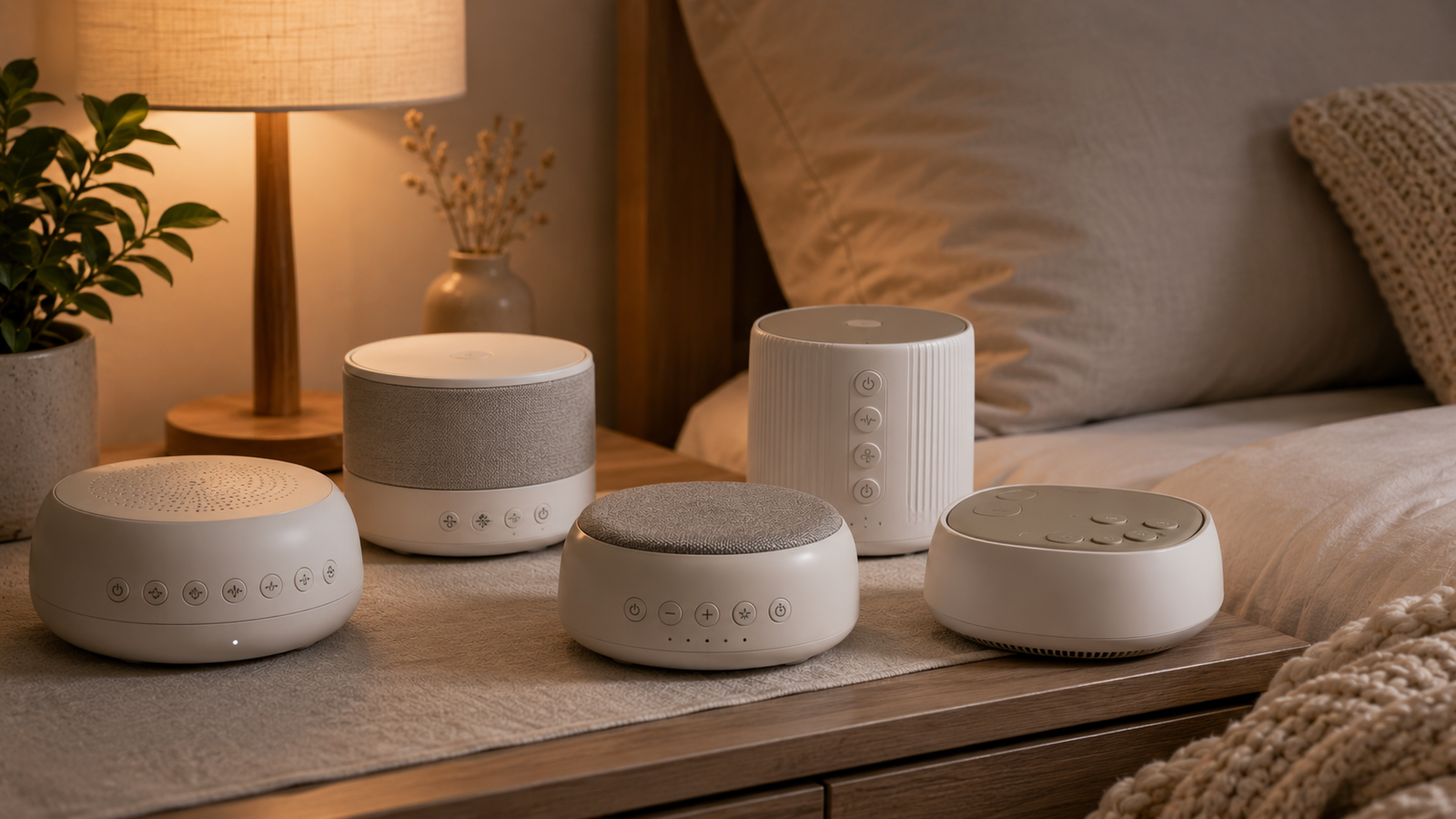
A white noise machine can be useful when the problem keeping you awake is not silence itself, but unpredictable sound.
Examples include:
- traffic;
- neighbours;
- doors opening and closing;
- voices from another room;
- barking dogs;
- lifts or plumbing;
- early-morning household activity.
A sound machine cannot make those noises disappear.
Instead, it creates a steady background sound that reduces the contrast between the bedroom and sudden environmental noises.
That can make disturbances less noticeable.
But white noise machines now come with increasingly long feature lists:
- white, pink and brown noise;
- rain and ocean sounds;
- dozens of sound profiles;
- Bluetooth speakers;
- app control;
- timers;
- night lights;
- alarm clocks;
- rechargeable batteries;
- adaptive volume;
- sleep tracking.
Most people do not need all of this.
The useful question is:
“What sound am I trying to mask, and which machine can provide a comfortable, consistent background sound without becoming another source of disturbance?”
For most users, the priorities are:
sound quality → useful volume control → continuous playback → simple controls → low light → reliability.
This guide explains the different types of background noise, how to choose volume and placement, when timers are useful and when a white noise machine may not be the right solution.
What Is a White Noise Machine?
A white noise machine produces a continuous background sound.
Depending on the device, that sound may be:
- electronically generated;
- mechanically generated using a fan;
- played from digital recordings.
The term white noise machine is often used broadly even when the device also produces:
- pink noise;
- brown noise;
- fan sounds;
- rain;
- waves;
- other ambient sounds.
Its primary purpose is usually sound masking.
What Does Sound Masking Mean?
Imagine a bedroom that is almost silent.
A car horn outside creates a large change:
silence → sudden loud sound
That contrast can attract attention and potentially wake you.
Now imagine there is already a steady fan-like sound in the room.
The horn still occurs, but the change between the background and horn may feel less abrupt.
The white noise machine has not physically blocked the horn.
It has made the sound less distinct against the existing background.
That is the basic principle of sound masking.
White Noise Is Not Soundproofing
This distinction is important.
A white noise machine does not stop sound from entering the room.
If your main problem is extremely loud environmental noise, you may need to consider:
- better window sealing;
- door seals;
- curtains;
- relocating the bed;
- earplugs;
- structural soundproofing.
A sound machine is most useful when the disturbing noises are:
- moderate;
- intermittent;
- difficult to eliminate completely.
Start With the Noise You Are Trying to Mask
Before comparing machines, identify the actual disturbance.
Traffic
You may need:
- consistent low-frequency sound;
- enough volume to soften changing road noise.
Voices
Speech can be particularly attention-grabbing because the brain naturally tries to interpret it.
A steady broadband sound may help make distant conversations less distinct.
Household Noise
Useful for masking:
- doors;
- kitchens;
- television from another room;
- early risers.
Neighbours
A sound machine may help with moderate:
- footsteps;
- voices;
- television.
It will not eliminate extremely loud music or impact noise.
Snoring Partner
Background sound may make mild snoring less noticeable.
However, loud habitual snoring—especially with:
- choking;
- gasping;
- breathing pauses;
- significant daytime sleepiness;
can be a sign of sleep-disordered breathing and should not simply be covered by increasing sound-machine volume.
What Is White Noise?
Technically, white noise contains equal energy across frequencies when considered on a frequency basis.
To many people it sounds similar to:
- static;
- airflow;
- a steady hiss.
Some people find that sound soothing.
Others find it too:
- sharp;
- bright;
- hiss-heavy.
That is why many machines offer alternatives.
What Is Pink Noise?
Pink noise contains relatively greater emphasis at lower frequencies than white noise.
Subjectively it may sound:
- softer;
- smoother;
- less hiss-like.
Examples of sounds that may have a pink-noise-like quality include certain forms of:
- steady rainfall;
- natural ambient sound.
Some users simply prefer the tone.
There is no need to choose pink noise because it is marketed as more advanced.
Use it if it sounds better to you.
What Is Brown Noise?
Brown noise places even more emphasis on lower frequencies.
It usually sounds:
- deeper;
- heavier;
- rumbling.
Some people find this useful when masking:
- traffic;
- low-frequency environmental sound.
Others find it too intense.
Again, preference matters.
White vs Pink vs Brown Noise
A simple comparison:
| Sound type | General character |
|---|---|
| White noise | Brighter, hiss-like |
| Pink noise | Softer, more balanced |
| Brown noise | Deeper, lower-frequency |
These descriptions are approximate.
The best option is the one that masks your environment at a comfortable volume.
Do Different Noise Colours Improve Sleep Differently?
You may encounter claims that:
- pink noise dramatically increases deep sleep;
- brown noise improves focus;
- white noise guarantees better sleep.
Research into different sound environments is ongoing, and results from specific studies should not be turned into universal marketing promises.
For practical home use, the more useful questions are:
- Does the sound mask the disturbance?
- Is it pleasant enough to listen to?
- Can you keep it at a moderate volume?
- Does it help you sleep more consistently?
Personal preference often matters more than choosing the theoretically “correct” colour.
Fan Sounds
Many sound machines include:
- box fan;
- ventilation fan;
- low fan;
- high fan;
profiles.
These can feel more natural to people who already sleep comfortably with a real fan.
A fan-like sound tends to be:
- steady;
- predictable;
- less obviously electronic.
Mechanical White Noise Machines
Some machines create real airflow internally using a small fan rather than playing a recording.
The sound is generated mechanically.
Advantages may include:
- naturally continuous sound;
- no obvious looping;
- simple controls.
Potential disadvantages include:
- fewer sound choices;
- mechanical wear;
- less precise tone selection.
If you want only a steady fan-like sound, this simplicity can be an advantage.
Digital Sound Machines
Digital machines use speakers to reproduce:
- generated noise;
- recorded ambient sounds.
They often provide many more options.
Advantages include:
- multiple noise colours;
- rain and nature sounds;
- volume control;
- timers;
- compact size.
Potential drawback:
low-quality units may use obvious audio loops.
Recorded Sounds vs Generated Noise
This distinction matters.
Generated Noise
Can continue indefinitely without repeating a recognizable recording.
Recorded Nature Sounds
May use an audio loop.
For example:
rain → thunder → rain → bird → repeat
Once you notice the pattern, it can become distracting.
If you enjoy nature sounds, look for:
- long recordings;
- seamless loops;
- non-repetitive playback.
Nature Sounds
Machines commonly include:
- rain;
- waves;
- forest;
- river;
- fireplace;
- birds.
These can be relaxing.
But they may be less useful for masking sound if they contain frequent:
- quiet sections;
- sudden changes.
A steady sound generally provides more consistent masking.
Ocean Sounds
Ocean recordings often rise and fall.
That can feel calming.
But the variation means they may not mask environmental noise as consistently as steady noise.
Choose according to whether your goal is mainly:
- relaxation;
or:
- reliable noise masking.
Rain Sounds
Steady rain can provide an effective middle ground between:
- natural ambience;
- consistent masking.
Look for recordings without:
- dramatic thunder;
- obvious repeating patterns;
unless you specifically enjoy them.
Do You Need 30 or 50 Sounds?
Probably not.
Most users eventually settle on:
- one;
- two;
- perhaps three;
preferred sounds.
A machine with:
40 sound profiles
is not automatically more useful than one with:
6 well-designed sounds.
Prioritize sound quality over sound count.
Volume Control Is One of the Most Important Features
A sound machine should offer enough volume adjustment that you can find the lowest level that effectively masks the disturbance.
Avoid thinking:
“Louder must mask better.”
It does—but excessive volume can create another problem.
The purpose is comfortable background sound, not filling the bedroom with loud noise all night.
Use the Lowest Effective Volume
Start low.
Increase the volume only until the disturbing sound becomes less noticeable.
Once masking is effective, additional volume may provide little benefit.
A good setup should feel:
- present;
- steady;
- comfortable.
It should not dominate the room.
Hearing Safety Matters
Because a sound machine may operate for:
- several hours;
- every night;
volume deserves attention.
Risk depends on:
- sound level;
- distance;
- duration.
Avoid placing a loud machine:
- directly next to the ear;
- under the pillow;
- extremely close to the head.
Keep the volume moderate and use distance to your advantage.
Distance From the Bed
The machine does not necessarily need to sit on your bedside table.
In many situations, a better location is closer to the source of unwanted noise.
For example, if traffic enters through a window, placing the machine:
- between the bed and window;
may mask that disturbance effectively without requiring high volume beside your head.
Positioning Can Be More Important Than Extra Volume
Before increasing volume, experiment with location.
Potential positions include:
- near the bedroom door;
- near the window;
- between you and a noisy wall.
A change of placement may allow you to reduce volume significantly.
Do Not Put the Machine Under a Pillow
Electronic devices need appropriate:
- ventilation;
- stable placement.
Do not cover a sound machine with:
- pillows;
- blankets;
- bedding;
unless the manufacturer specifically says this is safe.
Use it on a stable surface.
Continuous Playback
For many sleepers, continuous playback is more useful than a timer.
If traffic or neighbours remain noisy throughout the night, a machine that stops after:
30 minutes
may allow the original noise to become noticeable again.
Look for a true:
continuous mode
if all-night masking is your goal.
Timers
Timers can still be useful.
Common timer options might include:
- 30 minutes;
- 60 minutes;
- 90 minutes;
- several hours.
A timer may suit you if you primarily need sound:
- while falling asleep;
- during meditation;
- during a nap.
Continuous vs Timer: Which Should You Choose?
| Situation | Better option |
|---|---|
| Traffic all night | Continuous |
| Noisy partner/household | Continuous |
| Only need help settling | Timer |
| Short nap | Timer |
| Relaxation session | Timer |
| Shift-worker daytime sleep | Often continuous |
Ideally, the machine provides both.
Memory Function
A simple but useful feature is remembering:
- previous sound;
- volume;
- timer setting.
Without memory, you may have to reconfigure the device every night.
A machine that powers on with one button at your preferred settings reduces friction.
Physical Controls
Bedside equipment benefits from simple physical controls.
You should ideally be able to:
- turn it on;
- adjust volume;
- change sound;
without:
- opening an app;
- unlocking your phone;
- navigating menus.
Large tactile buttons can be especially useful in a dark room.
Bright Displays Can Defeat the Purpose
A sleep machine should not add unwanted bedroom light.
Look for displays that can:
- dim;
- turn off completely.
A bright digital clock or glowing indicator can become distracting in an otherwise dark bedroom.
Status LEDs
Even small LEDs may be noticeable at night.
Check whether they can be:
- disabled;
- covered safely;
- dimmed.
If not, consider where the machine will be positioned.
Night Lights
Some white noise machines include a built-in night light.
This can be useful if you genuinely want:
- low-level navigation light;
- a bedside lamp.
But if your goal is maximum darkness, the feature adds little.
Ideally the light should be independently controllable.
Colour-Changing Lights
RGB or colour-changing lighting is mainly a convenience or decorative feature.
It has little to do with the machine’s core sound-masking function.
Do not pay significantly more for it unless you know you will use it.
Sunrise Alarms
Some machines combine:
- sound;
- night light;
- alarm;
- sunrise simulation.
This may reduce bedside clutter if you already want all those functions.
But combined devices can also become more complicated.
Ask whether you want:
one multifunction device
or:
one simple sound machine.
Built-In Alarm Clock
An integrated alarm may be convenient if you want to keep your phone away from bed.
Check whether:
- alarm volume is adjustable;
- controls are easy;
- display can be dimmed.
App Control
App-controlled machines may allow you to:
- create schedules;
- save favourite sounds;
- adjust volume remotely.
This can be useful if automation matters to you.
But app dependence introduces:
- account creation;
- Bluetooth or Wi-Fi pairing;
- software updates;
- phone use at bedtime.
For many people, physical controls are simpler.
Scheduled Operation
One smart feature that can genuinely reduce effort is automatic scheduling.
For example:
10:30 PM → sound begins
7:00 AM → sound stops
This can make the device disappear into the routine.
If you value automation, check whether schedules work reliably even when:
- the phone is disconnected;
- the internet is unavailable.
Bluetooth Speakers
Some sound machines also function as Bluetooth speakers.
That can be useful if you want:
- music;
- podcasts;
- guided relaxation.
But Bluetooth is not necessary for basic noise masking.
A dedicated machine can perform its main function perfectly well without it.
Wi-Fi Connectivity
Wi-Fi may enable:
- remote control;
- cloud sounds;
- updates;
- smart-home integration.
Again, ask whether these features improve your actual sleep routine.
A white noise machine does not inherently need internet access.
Privacy
Connected sleep devices may collect:
- account details;
- device usage;
- schedules.
If using an app, check:
- what data is collected;
- whether an account is required;
- which permissions are requested.
A sound machine should not need unrelated access to:
- contacts;
- photos;
- precise location;
for basic operation.
Subscription Services
Some connected machines sell subscriptions for:
- premium sounds;
- sleep stories;
- meditation content.
Calculate the long-term cost.
For ordinary sound masking, there is little reason a basic white-noise function should require an ongoing subscription.
Mains Power vs Rechargeable
Machines may operate through:
- wall power;
- rechargeable battery;
- replaceable batteries.
Choose according to where you plan to use it.
Mains-Powered Machines
Best suited to:
- permanent bedside use.
Advantages include:
- no charging;
- reliable all-night operation.
If the device remains beside the bed every night, battery power may provide little advantage.
Rechargeable Machines
Useful for:
- travel;
- temporary rooms;
- moving around the home.
Look at actual runtime.
For overnight use, the battery should comfortably exceed your expected sleep period.
Do not assume advertised maximum battery life applies at:
- high volume;
- with night light active.
USB-C Charging
USB-C can simplify travel because you may already carry compatible chargers.
This is convenient but not essential.
Check whether the machine can:
- operate while charging;
if you plan to use it overnight.
Battery Indicator
A clear low-battery indicator is useful.
A sound machine shutting down unexpectedly at:
3 AM
can be more disruptive than never using one.
Power-Cut Behaviour
If your area experiences occasional power interruptions, check what happens after power returns.
Does the machine:
- restart automatically;
- stay off;
- reset to default settings?
This can matter for overnight reliability.
Travel White Noise Machines
Travel models prioritize:
- compact size;
- rechargeable battery;
- lightweight construction.
Some include:
- hanging loops;
- clips.
A travel machine may be useful in:
- hotels;
- family homes;
- temporary accommodation.
Do You Need a Travel Machine?
Possibly not.
Your phone can already provide:
- white noise;
- rain;
- fan sounds.
A dedicated travel machine becomes useful if you want to:
- preserve phone battery;
- keep the phone away from bed;
- avoid notifications;
- have more reliable continuous playback.
White Noise Apps
Apps can provide excellent sound quality at very low cost.
They are a sensible way to test whether background sound helps you before purchasing hardware.
Try:
- white noise;
- pink noise;
- brown noise;
- fan sounds;
for several nights.
If you find yourself using the same sound consistently, you can decide whether a dedicated machine would make the routine more convenient.
Phone Limitations
Using a phone means:
- notifications can interrupt;
- battery is being used;
- you may be tempted to scroll;
- the phone remains near the bed.
Use:
- Do Not Disturb;
- airplane mode where appropriate;
- downloaded audio;
if those issues matter.
Smart Speakers
A smart speaker can also produce background sound.
This may be enough if you already own one.
Potential drawbacks include:
- voice commands;
- connectivity dependence;
- unexpected interruptions;
- privacy preferences.
Do not buy a dedicated machine if your existing equipment already solves the problem well.
Fans as White Noise Machines
A normal fan naturally creates steady background sound.
This can provide both:
- airflow;
- masking.
In warm climates, a fan may therefore solve two problems simultaneously.
Fan Limitations
A real fan:
- changes room airflow;
- may dry the eyes or nose;
- may feel cold in winter.
A dedicated sound machine provides fan-like sound without moving air.
Choose according to whether you actually want airflow.
Earplugs vs White Noise Machine
Both address noise differently.
Earplugs
Reduce the sound reaching your ears.
Advantages:
- highly portable;
- inexpensive;
- no power required.
Potential disadvantages:
- some people dislike wearing them;
- can cause pressure;
- require hygiene.
White Noise Machine
Masks environmental noise with another sound.
Advantages:
- nothing worn in the ears;
- useful for shared environments;
- easy all-night use.
Potential disadvantage:
- introduces continuous sound.
Can You Use Earplugs and White Noise Together?
Yes.
People in particularly noisy environments may combine:
earplugs + moderate background noise
This can sometimes provide better comfort without requiring either method to be extreme.
But if you need very high masking volume even with earplugs, consider whether the environmental noise itself needs to be addressed.
White Noise for a Snoring Partner
Background noise may help make mild snoring less noticeable.
Place the machine where it provides effective masking without requiring excessive volume.
But remember:
masking snoring does not address its cause.
If snoring includes:
- gasping;
- choking;
- breathing pauses;
the appropriate next step is medical evaluation, not a louder machine.
White Noise for Shift Workers
Shift workers often sleep while the environment is active.
A white noise machine may help mask:
- daytime traffic;
- household movement;
- construction;
- neighbours.
A strong shift-work sleep environment may combine:
- blackout curtains;
- sleep mask;
- noise control;
- appropriate room temperature;
- phone on Do Not Disturb.
White Noise for Apartment Living
Apartments may have intermittent noise from:
- corridors;
- lifts;
- plumbing;
- neighbouring rooms.
A machine positioned near the most problematic wall or door may reduce the perceptual contrast of these sounds.
Again, experiment with placement before increasing volume.
White Noise for Travel
Environmental unpredictability is one reason sound machines can be particularly useful while travelling.
A hotel may contain:
- lifts;
- corridor noise;
- traffic;
- unfamiliar air-conditioning sounds.
Using the same familiar sound every night may also provide a consistent environmental cue.
Familiar Sound as a Sleep Cue
Over time, you may begin associating a particular sound with:
- bedtime;
- relaxation.
That can make it a useful behavioural cue.
But avoid becoming anxious about sleeping somewhere without the machine.
The device should make sleep easier, not create the belief that sleep is impossible without it.
Dependency vs Habit
There is an important difference between:
“I prefer sleeping with white noise”
and:
“I cannot possibly sleep without this machine.”
If you travel frequently, it can be useful to maintain some flexibility.
A phone app can serve as backup if the dedicated machine is unavailable.
White Noise for Tinnitus
Some people with tinnitus use background sound because complete silence makes internal sounds more noticeable.
Sound enrichment can sometimes make tinnitus less intrusive.
However, persistent or new tinnitus—especially when:
- one-sided;
- pulsatile;
- accompanied by hearing loss or dizziness;
should receive appropriate medical evaluation.
Do not rely solely on a consumer sound machine for unexplained ear symptoms.
Can White Noise Cause Hearing Damage?
Any sound can potentially contribute to hearing risk if it is:
- sufficiently loud;
- used for long enough.
That includes a sound machine.
The solution is straightforward:
- keep volume moderate;
- place the machine at a reasonable distance;
- avoid trying to overpower extremely loud environments.
Do You Need a Decibel Meter?
Probably not for ordinary home use.
If you are concerned about sound level, smartphone sound-meter apps may provide rough estimates, though they are not perfect measuring instruments.
The simplest rule remains:
the sound should feel like comfortable background noise, not something you have to tolerate.
White Noise Machines for Babies and Children
Sound machines are also widely marketed for children.
Children—especially infants—have different safety considerations involving:
- volume;
- distance;
- sleep environment.
Parents and caregivers should follow current pediatric guidance and manufacturer instructions rather than simply using adult settings near a child’s head.
For this guide, the focus is adult sleep use.
Sound Quality
Sound quality may be more important than the number of sounds.
Listen for:
- harsh speaker distortion;
- rattling;
- obvious compression;
- high-frequency hiss that becomes unpleasant.
At low and medium volume, the machine should sound smooth.
Speaker Quality
A tiny inexpensive speaker may distort:
- deep brown noise;
- low-frequency fan sounds.
If deeper tones are your preference, speaker quality becomes more relevant.
You do not need hi-fi audio.
You do need sound that remains pleasant for several hours.
Low-Frequency Performance
People trying to mask:
- road noise;
- low hums;
may prefer deeper sound.
Check whether the machine can reproduce lower frequencies cleanly.
A speaker that turns brown noise into a thin hiss defeats the purpose.
Looping
Nature recordings should not have obvious repeating points.
Once the brain recognizes a pattern, you may begin anticipating it.
For example:
wave → bird → three waves → bird → repeat
This can become more stimulating than calming.
Seamless Sound Is More Important Than a Huge Library
If you mainly use steady noise, prioritize:
- smooth;
- consistent;
- loop-free output.
A machine with four excellent sounds may be better than one with 60 mediocre loops.
Build Quality
A bedside device may run:
- every night;
- for thousands of hours.
Look for:
- stable controls;
- secure power connection;
- speaker without rattling;
- reliable casing.
A machine that develops:
- buzzing;
- clicks;
- motor noise;
can become counterproductive.
Mechanical Machines and Wear
Fan-based mechanical machines contain moving parts.
Over time, they may develop:
- rattling;
- bearing noise.
Good construction matters.
Digital machines have no internal fan mechanism dedicated to creating the sound, but their:
- speaker;
- electronics;
still affect durability.
Warranty
A warranty becomes more relevant when the device is intended to operate for hours every night.
Check:
- warranty period;
- local support;
- replacement policy.
You do not need to pay a large premium purely for warranty, but it adds confidence for higher-priced devices.
Controls in the Dark
Imagine using the machine at:
2 AM.
Can you adjust it without turning on a light?
Useful designs include:
- tactile buttons;
- simple dial;
- clear button spacing.
A touchscreen with tiny icons may be less convenient at night.
Volume Dial vs Buttons
A physical dial can allow rapid fine adjustment.
Buttons may provide:
- precise steps;
- easy memory.
Neither is universally better.
The key is being able to make small adjustments easily.
Automatic Volume Adjustment
Some advanced machines monitor environmental sound and automatically change masking volume.
In theory, this can respond to:
- traffic;
- sudden environmental changes.
But you may find shifting background volume itself noticeable.
This is a premium feature rather than a requirement.
Adaptive Sound Machines
Some products vary sound based on:
- environmental noise;
- sleep stage estimates.
Treat these as optional technology.
There is little reason to assume automatic adaptation is necessary for effective sound masking.
White Noise and Sleep Trackers
A sound machine may interact with some bedside microphones or sleep-tracking devices because constant noise affects the audio environment.
If you use a tracker that analyzes:
- snoring;
- room sound;
check how background noise affects its measurements.
Do not assume every tracked result remains equally accurate.
Do White Noise Machines Improve Sleep Quality?
They may help when environmental noise is genuinely disrupting sleep.
But they are not universal sleep enhancers.
Someone sleeping in a:
- quiet;
- comfortable;
bedroom may notice little benefit.
Use a machine to solve:
noise
rather than adding it simply because white noise has become part of sleep culture.
White Noise and Insomnia
A sound machine may reduce one environmental contributor to insomnia.
But persistent insomnia can involve:
- sleep scheduling;
- stress;
- conditioned wakefulness;
- health conditions;
- medication effects.
If sleep remains poor despite a suitable environment and habits, consider professional assessment.
White Noise Cannot Replace Adequate Sleep Opportunity
This sounds obvious, but it matters.
A machine cannot fix:
2:00 AM bedtime + 6:00 AM wake-up
No amount of:
- brown noise;
- rain sounds;
- pink noise;
can replace missing sleep opportunity.
Maintain the hierarchy:
sleep opportunity → sleep habits → environment → accessories.
A Simple Setup Process
When you first use a sound machine:
Step 1 — Identify the Main Noise Source
Is it coming from:
- window?
- door?
- neighbouring wall?
Step 2 — Position the Machine Strategically
Place it somewhere between:
- you;
- noise source;
when practical.
Step 3 — Choose a Steady Sound
Start with:
- white;
- pink;
- brown;
- fan.
Step 4 — Begin at Low Volume
Gradually increase until environmental sound becomes less noticeable.
Step 5 — Stop Increasing Once Masking Works
Do not keep adding volume unnecessarily.
Step 6 — Decide on Continuous or Timer Mode
Match playback to when the noise occurs.
Step 7 — Use the Same Setup for Several Nights
Avoid changing sound every hour.
Give yourself enough time to decide whether it helps.
Test the Machine Before Bed
During the evening, recreate the likely sleep conditions.
Sit or lie in bed and notice:
- whether traffic remains distracting;
- whether the sound itself feels intrusive.
Make adjustments before you are exhausted and trying to fall asleep.
Give Yourself Time to Adapt
If you normally sleep in complete silence, steady noise may feel unusual initially.
Try the machine for several nights at:
- low;
- comfortable volume.
If you continue to dislike it, white noise may simply not suit you.
There is no reason to force the habit.
What If White Noise Feels Too Harsh?
Try:
- pink noise;
- brown noise;
- fan sound;
- soft rain.
Lower the volume as well.
The frequency balance may matter as much as volume.
What If Brown Noise Feels Too Heavy?
Try:
- pink noise;
- white noise;
- lighter fan sounds.
Preference can vary widely.
What If the Machine Does Not Mask Traffic?
Before turning it much louder:
- Move it closer to the window.
- Try a deeper sound.
- Close gaps where possible.
- Consider curtains or window sealing.
- Consider earplugs.
The problem may exceed what sound masking alone can reasonably address.
What If You Wake When the Timer Stops?
Use continuous playback.
A sudden transition from:
steady sound → silence
can itself be noticeable.
If you need masking overnight, there is little advantage to using a short timer.
What If Your Partner Dislikes White Noise?
Try:
- lower volume;
- different noise colour;
- placing the machine closer to your side;
- earplugs for the person who needs sound reduction;
- sleep headphones.
Shared bedrooms require compromise.
What If the Machine Makes You More Alert?
Stop using it.
Relaxation tools are individual.
Some people find continuous noise:
- soothing.
Others find it impossible to ignore.
A quieter room with earplugs may suit you better.
How Much Should You Spend?
White noise machines range from very inexpensive to premium connected devices.
For basic use, you mainly need:
- clean sound;
- reliable speaker;
- adequate volume control;
- continuous playback.
There is no need to spend heavily for those functions.
When a Budget Machine May Be Enough
A simple unit can provide excellent value if it offers:
- one or more good steady sounds;
- volume control;
- continuous playback;
- reliable power.
That covers the essential function.
When Paying More May Make Sense
Higher spending may be justified for:
- better speaker quality;
- compact rechargeable design;
- reliable scheduling;
- excellent mechanical sound;
- stronger warranty.
Paying significantly more simply for:
- dozens of sounds;
- decorative lighting;
- app dashboards;
may provide less practical value.
Cost Per Use
A machine used eight hours per night for several years can provide a very low cost per use.
That may justify choosing a durable, pleasant-sounding device rather than the cheapest available model.
But durability and sound quality—not feature count—should justify the price.
Common White Noise Machine Buying Mistakes
Choosing by Number of Sounds
You will probably use only a few.
Using Excessive Volume
Masking should be comfortable.
Putting the Machine Directly Beside the Head
Placement near the noise source may work better.
Buying App Features You Do Not Need
Simple controls often suit bedtime better.
Ignoring Display Brightness
A sleep device should not illuminate the room unnecessarily.
Choosing a Short Timer When Noise Continues All Night
Use continuous playback when appropriate.
Ignoring Audio Loops
Repetitive nature sounds can become distracting.
Expecting White Noise to Soundproof the Room
It masks sound; it does not block it structurally.
Using White Noise to Ignore Possible Sleep Apnoea
Snoring with breathing symptoms requires assessment.
Assuming You Need White Noise Because It Is Popular
If your bedroom is already quiet, you may not need one.
Quick White Noise Machine Selection Guide
| Your priority | What to look for |
|---|---|
| Traffic masking | Deeper steady sounds + good speaker |
| Voices/neighbours | Broadband white/pink noise |
| Simple bedtime use | Physical controls + memory |
| All-night noise | Continuous playback |
| Falling asleep only | Timer |
| Travel | Rechargeable compact design |
| Dark bedroom | Display-off function |
| Want fan sound without airflow | Fan-style sound machine |
| Hate repetitive loops | Generated noise/mechanical machine |
| Shared bedroom | Fine volume control |
| Shift work | Continuous sound + strong light control separately |
| Phone-free bedroom | Dedicated machine with physical controls |
Before You Buy: Final Checklist
Ask yourself:
- What noise am I trying to mask?
- Does it occur all night or only occasionally?
- Would earplugs solve the problem more simply?
- Do I prefer white, pink, brown or fan noise?
- Is the sound generated or recorded?
- Are nature-sound loops obvious?
- Does the speaker reproduce the sound cleanly?
- Is volume control gradual?
- Can it play continuously?
- Does it have a timer if I want one?
- Does it remember my previous settings?
- Can the display and LEDs be turned off?
- Can I operate it without an app?
- Does it need a subscription?
- Is it mains-powered or rechargeable?
- Will the battery last through the night?
- Is the device portable enough for my needs?
- Am I buying useful sound quality or unnecessary features?
A Minimal White Noise Setup
For most people, an effective setup can be extremely simple:
- Choose one comfortable steady sound.
- Position the machine between the bed and main noise source.
- Set the volume to the lowest level that masks the disturbance.
- Turn off any unnecessary display lights.
- Use continuous playback if environmental noise continues overnight.
- Leave the settings alone once you find something that works.
You do not need to change sounds every night.
Consistency can be an advantage.
Combine Sound Control With Better Sleep Habits
A white noise machine works best when the rest of your sleep routine is already reasonable.
That includes:
- enough time for sleep;
- reasonably consistent timing;
- manageable caffeine;
- appropriate bedroom temperature;
- light control;
- a calm wind-down routine.
Treat sound masking as one part of the environment rather than the entire sleep solution.
Frequently Asked Questions
Do white noise machines help you sleep?
They can help when unpredictable environmental noise is disturbing sleep. They may provide little benefit in an already quiet bedroom.
What does a white noise machine actually do?
It creates steady background sound that masks changes in environmental noise and makes sudden sounds less noticeable.
Is white noise better than silence?
Not universally. If silence works for you, there is no reason to add noise.
Is white noise or brown noise better for sleep?
Neither is universally better. Brown noise sounds deeper, while white noise sounds brighter. Choose based on comfort and what you are trying to mask.
Is pink noise better for sleep?
Some people prefer its softer sound. Evidence from specific studies should not be interpreted as proof that pink noise is universally superior.
What volume should a white noise machine be?
Use the lowest comfortable volume that effectively masks the unwanted noise. Avoid unnecessarily loud all-night playback.
How far should the machine be from my bed?
There is no universal distance, but avoid placing a loud machine directly beside the ears. Positioning it closer to the noise source can sometimes improve masking.
Should I leave white noise on all night?
If environmental noise continues throughout the night and the sound remains comfortable, continuous playback may be more practical than a short timer.
Is it better to use a timer?
A timer is useful when you only want sound while falling asleep or during a nap.
Can white noise damage hearing?
Excessive sound exposure can affect hearing, regardless of whether the sound is white noise, music or something else. Keep volume moderate.
Is a fan the same as a white noise machine?
A fan can provide a similar steady masking effect while also moving air. A sound machine can reproduce fan-like sound without airflow.
Are mechanical sound machines better than digital ones?
Not universally. Mechanical machines provide naturally continuous fan sound, while digital machines offer more sound choices.
Is a phone app just as good?
It can be. An app is a good way to test whether background noise helps before buying a dedicated device.
Why buy a machine if my phone can play white noise?
A dedicated machine can reduce phone use at bedtime and may offer simpler controls, more reliable all-night playback and better placement.
Do I need Bluetooth?
No. Bluetooth is useful only if you want to play your own audio through the device.
Do I need an app?
No. Many excellent sound machines work entirely through physical controls.
Are nature sounds better than white noise?
They may feel more relaxing, but steady noise often provides more consistent masking. Personal preference matters.
Why can I hear the sound repeating?
Some machines use short recorded loops. Choose longer seamless recordings or generated noise if repetition bothers you.
Can white noise block loud neighbours?
It can make moderate sounds less noticeable, but it cannot physically block extremely loud noise. Structural sound control or earplugs may be necessary.
Can white noise cover snoring?
It may mask mild snoring, but loud snoring with gasping or breathing pauses should be medically assessed.
Is a white noise machine useful for shift workers?
Yes, particularly when daytime environmental noise interferes with sleep.
Is it useful for travel?
It can be, especially if you frequently sleep in noisy hotels or unfamiliar environments. A phone app may also be sufficient.
Can white noise help tinnitus?
Background sound may make tinnitus less noticeable for some people, but persistent or unusual tinnitus deserves appropriate evaluation.
Will I become dependent on white noise?
You may develop a preference for it as part of your sleep routine, but the goal should be convenience rather than believing you are incapable of sleeping without it.
When is a white noise machine not enough?
Consider other solutions when:
- environmental noise is extremely loud;
- structural vibration is the main issue;
- noise comes from a medical symptom such as severe partner snoring;
- sleep problems persist even in quiet environments.
Persistent sleep difficulties may require broader assessment rather than another accessory.
The Physical Glow Takeaway
A white noise machine is most useful when unpredictable environmental sound—not silence itself—is interfering with your sleep.
Start by identifying what you need to mask. Then choose a sound you can comfortably tolerate for several hours:
white noise for broad masking → pink noise for a softer character → brown noise for a deeper tone → fan sounds for a familiar steady background.
Prioritize:
clean sound quality → gradual volume control → continuous playback → simple controls → dark or switchable displays → reliable operation.
Use the lowest volume that effectively masks the disturbance, and experiment with placing the machine closer to the window, door or wall where unwanted noise enters rather than automatically positioning it beside your head.
Features such as:
- Bluetooth;
- apps;
- night lights;
- dozens of nature sounds;
- subscriptions;
are optional. Add them only when they genuinely make the routine easier.
Most importantly, remember what the machine can and cannot do. It can reduce the contrast of environmental noise and create a more predictable sound environment. It cannot soundproof a room, replace adequate sleep or treat underlying sleep disorders.
The best white noise machine is therefore not the one with the longest sound library. It is the one that can produce one comfortable, consistent sound at a sensible volume night after night—without giving you anything else to think about.