Lumbar Belt vs Clavicle Brace vs Posture Corrector: Understanding the Differences
Understand why lumbar belts, clavicle braces and general posture supports cover different areas, and why fit or medical guidance may determine appropriate use.
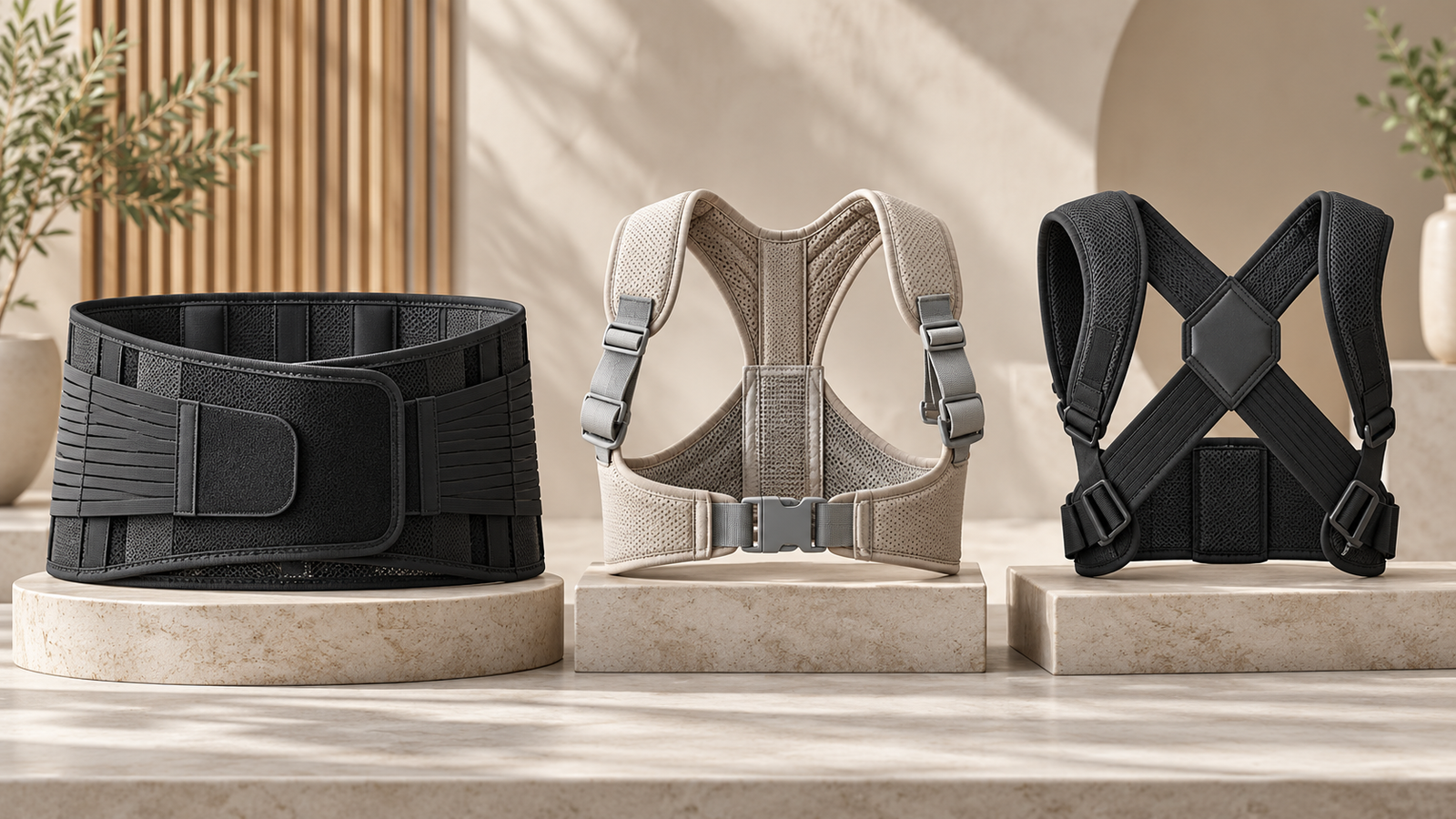
Lumbar belts, clavicle braces and posture correctors are all wearable support products, but they are designed for different parts of the body and should not be treated as interchangeable.
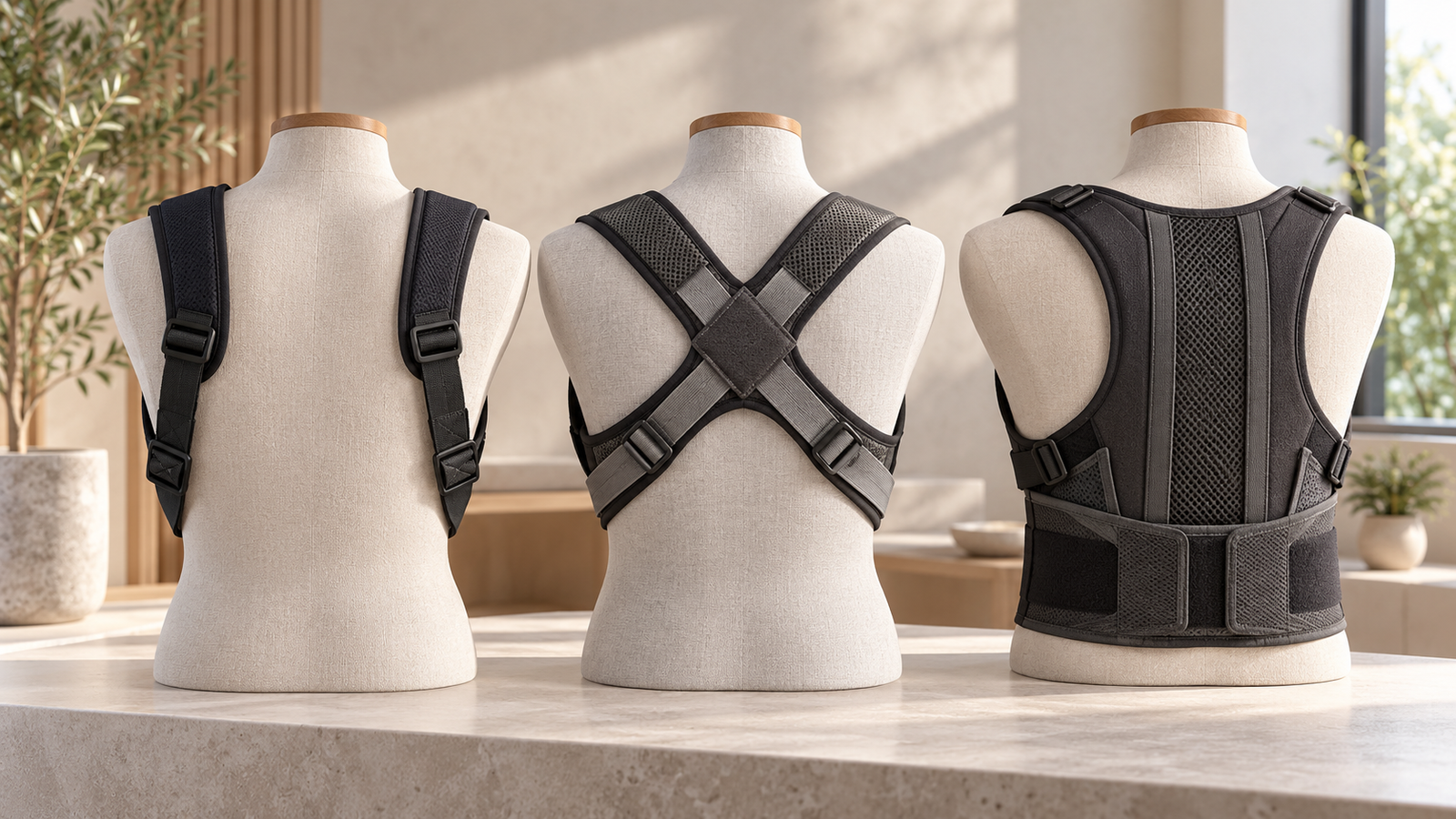
A lumbar belt wraps around the lower torso and supports the lower back. A clavicle brace sits around the shoulders and upper chest, usually pulling the shoulders gently backward. A posture corrector may cover the shoulders, upper back or a larger section of the torso and is generally intended to provide positional feedback rather than rigid support.
The right choice depends first on where support is needed and then on fit, comfort, adjustability and the reason you are wearing it.
These products may provide temporary support or positional awareness, but they should not be assumed to treat the underlying cause of persistent pain, weakness or structural problems.
What is a lumbar belt?
A lumbar belt is a wraparound support worn around the lower back and abdomen.
It may also be described as a:
- Lower-back support.
- Lumbar support belt.
- Back brace.
- Waist support.
Most designs use:
- Elastic fabric.
- Hook-and-loop closures.
- Additional tightening straps.
- Flexible or semi-rigid support stays.
The belt usually sits around the lower torso rather than the shoulders.
What is a clavicle brace?
A clavicle brace is an upper-body support that wraps around the shoulders.
It typically uses straps that travel around or beneath the arms and cross across the upper back.
The brace may encourage the shoulders to remain in a more retracted position.
Some products are marketed for:
- Postural awareness.
- Shoulder positioning.
- Clavicle support.
However, medically prescribed clavicle braces for fractures or other injuries are not the same as generic consumer posture products.
If a clavicle injury is suspected, diagnosis and brace selection should be handled by a qualified healthcare professional.
What is a posture corrector?
“Posture corrector” is a broad consumer category.
A posture corrector may resemble:
- A simple shoulder harness.
- A crossed-strap upper-back brace.
- A broad back panel.
- A longer torso support.
Its main purpose is usually to create gentle resistance when the shoulders or upper torso move into certain positions.
This provides a physical reminder to adjust posture.
A posture corrector is generally less about immobilising the body and more about positional feedback.
Lumbar belt vs clavicle brace vs posture corrector at a glance
| Factor | Lumbar belt | Clavicle brace | Posture corrector |
|---|---|---|---|
| Main area | Lower back and abdomen | Shoulders and upper chest | Shoulders and upper back |
| Main purpose | Lower-torso support | Shoulder positioning/support | Positional awareness |
| Typical closure | Front Velcro with side straps | Shoulder straps | Adjustable shoulder/back straps |
| Rigidity | Soft to semi-rigid | Usually soft to semi-rigid | Usually soft |
| Best suited to | Lower-back support needs | Upper shoulder positioning | General posture awareness |
| Discreet under clothing | Sometimes | Often | Often |
| Main fitting issue | Waist size and belt height | Underarm pressure | Strap balance and comfort |
| Should be tightly restrictive? | No | No | No |
The biggest difference is body location
The easiest way to separate these products is by location.
A lumbar belt belongs around the lower torso.
A clavicle brace belongs around the shoulders and upper chest.
A posture corrector usually belongs across the shoulders and upper back.
If your concern is in the lower back, a shoulder brace is unlikely to be the relevant product.
If the issue is upper-body positioning, a lumbar belt will not address that area.
How does a lumbar belt work?
A lumbar belt creates compression around the lower torso.
Depending on its design, it may provide:
- A sense of support.
- Increased awareness of trunk position.
- Light restriction of excessive movement.
- A reminder to brace during certain activities.
Semi-rigid models may include vertical stays that help the belt maintain shape.
The support should feel firm but not excessively tight.
Elastic lumbar belts
Elastic models are usually lightweight.
Advantages include:
- Easier movement.
- Lower bulk.
- Better comfort for short periods.
They may be useful when you want mild support without strong restriction.
Semi-rigid lumbar braces
These may include:
- Plastic stays.
- Metal stays.
- Reinforced back panels.
They feel firmer.
Greater rigidity should not automatically be interpreted as better.
The correct level of support depends on the purpose.
A rigid medical brace should be prescribed or selected appropriately rather than chosen simply because it looks stronger.
What do extra compression straps do?
Many lumbar belts use a main front closure plus secondary side straps.
These allow the user to increase circumferential tension.
They can improve fit but are also easy to overtighten.
The belt should still allow normal breathing.
If it creates abdominal discomfort, numbness or excessive pressure, loosen it.
Where should a lumbar belt sit?
Most general lower-back belts sit around the lower torso with the back panel covering the lumbar region.
Exact placement depends on the product.
It should not:
- Ride up constantly.
- Fold into the waist.
- Sit so low that it interferes with hip movement.
The front closure should remain secure without digging into the abdomen.
Lumbar belt sizing
Most belts are sized by:
- Waist circumference.
- Abdominal circumference.
Do not choose based only on clothing size.
Use the manufacturer’s measurement method.
A belt that is too small may barely close or create excessive pressure.
A belt that is too large may shift during movement and fail to provide consistent support.
What does a clavicle brace do?
A clavicle-style brace applies tension around the shoulders.
The straps typically encourage the shoulders to move backward.
This can create a noticeable upper-body reminder.
The device should not force the chest into an exaggerated position.
It should allow:
- Normal breathing.
- Arm movement.
- Comfortable sitting and standing.
Clavicle brace vs posture corrector
These categories overlap.
Many consumer products marketed as “clavicle braces” are essentially lightweight posture harnesses.
The distinction becomes more important when a brace is being used for an actual clavicle injury.
A medically indicated clavicle brace is selected for a clinical reason.
A posture corrector is generally intended for posture awareness.
Do not use a generic posture product as a substitute for medical fracture management.
How does a posture corrector work?
A posture corrector usually uses adjustable straps across the shoulders.
When the shoulders move forward, the straps create tension.
This gives tactile feedback.
That feedback may encourage the wearer to reposition.
It does not physically retrain muscles simply by being worn.
Long-term posture depends on multiple factors including:
- Habit.
- Strength.
- Mobility.
- Work environment.
- Fatigue.
- Comfort.
Simple harness vs broad-panel posture corrector
Simple harness
Advantages:
- Lightweight.
- Easier to conceal.
- Usually cooler.
Potential drawbacks:
- Narrow straps can dig into the underarms.
- Less pressure distribution.
Broad back-panel design
Advantages:
- Spreads pressure.
- Can feel more supportive.
- May remain centred more easily.
Potential drawbacks:
- Warmer.
- More visible.
- Bulkier.
Which support is best for lower-back discomfort?
If the goal is temporary lower-back support, a lumbar belt is the relevant category.
However, back discomfort has many possible causes.
A belt may feel supportive without addressing the underlying reason.
Persistent lower-back pain should not be managed indefinitely with a consumer belt alone.
Seek assessment if symptoms are severe, recurrent or associated with weakness, numbness or other neurological symptoms.
Which is best for rounded shoulders?
A posture corrector or lightweight clavicle-style harness is more relevant than a lumbar belt.
These products may provide positional reminders.
They should not be expected to permanently “fix” rounded shoulders by themselves.
Strength, mobility and everyday habits may also matter.
Which is best after a clavicle injury?
This is a medical question rather than a general product-comparison question.
If a clavicle fracture or other injury is suspected or diagnosed, follow the brace or sling recommendation from the treating clinician.
Do not substitute a generic posture corrector.
Which is best for desk work?
A posture corrector may be the most relevant if your main goal is shoulder-position awareness.
A lumbar belt may feel supportive if lower-back fatigue is the issue.
But workstation setup matters more than simply adding wearable support.
Check:
- Chair height.
- Desk height.
- Monitor position.
- Keyboard position.
- Foot support.
A poorly designed workstation cannot be fully corrected by a brace.
Which is best for lifting?
This depends on what you mean.
Some people use lumbar belts during work or lifting tasks.
However, a consumer lumbar support belt is not the same as a weightlifting belt.
A weightlifting belt is designed to support bracing during heavy resistance training.
A soft lumbar brace is designed more for general lower-back support.
These categories should not be confused.
Lumbar belt vs weightlifting belt
A weightlifting belt is usually:
- Thicker.
- More rigid.
- Designed for high-force bracing.
A lumbar support belt is generally:
- More elastic.
- Softer.
- Designed for longer wear.
Do not assume a medical-style lumbar belt is the ideal tool for barbell squats or deadlifts.
Can posture correctors be worn during workouts?
Usually, posture correctors are better suited to short periods of everyday use than training.
They may restrict natural shoulder movement during exercise.
Unless the manufacturer or clinician specifically recommends otherwise, it is usually better to develop strength and control without unnecessary restriction.
Can lumbar belts be worn during exercise?
Some people wear them during low-intensity activity.
Whether that is appropriate depends on:
- The activity.
- The reason for using the belt.
- The product design.
If you are recovering from injury, exercise guidance should come from an appropriate professional.
How tight should a lumbar belt be?
It should feel secure and supportive without restricting normal breathing.
Too tight can cause:
- Abdominal pressure.
- Skin irritation.
- Discomfort when sitting.
- Numbness.
Too loose can lead to:
- Sliding.
- Folding.
- Uneven support.
Start moderate and adjust gradually.
How tight should a clavicle brace be?
The straps should provide mild positional feedback.
They should not pull the shoulders sharply backward.
Overtightening can cause:
- Underarm pressure.
- Tingling.
- Numbness.
- Restricted arm movement.
If you feel neurological symptoms, remove or loosen the brace.
How tight should a posture corrector be?
The same principle applies.
You should notice resistance when slouching, but you should still be able to move naturally.
A posture corrector should not behave like a rigid restraint.
Breathing should remain normal
All three devices wrap partly around the torso or shoulder girdle.
You should be able to take a deep breath.
If a support prevents comfortable breathing, it is too tight or incorrectly sized.
Fit and skin pressure
Wearable supports create friction.
Common pressure areas include:
- Underarms.
- Lower ribs.
- Waist.
- Shoulder straps.
Inspect the skin after early use.
Persistent redness, chafing or deep marks suggest the fit needs adjustment.
Wearing over clothing
A thin shirt beneath the device can improve comfort.
Advantages include:
- Reduced friction.
- Less sweat buildup.
- Easier cleaning.
This is especially helpful with lumbar belts and shoulder harnesses.
Wearing under clothing
Low-profile posture correctors and clavicle braces can sometimes be worn discreetly.
However, direct skin contact may increase irritation.
If concealment requires excessive tightening, choose comfort over invisibility.
Breathable materials
Look for:
- Mesh.
- Perforated fabric.
- Lightweight elastic.
- Moisture-managing materials.
This matters especially in warm conditions.
Thick neoprene may feel supportive but can become hot.
Neoprene lumbar belts
Neoprene is commonly used because it is:
- Flexible.
- Cushioned.
- Durable.
Potential drawback:
- Heat retention.
If you sweat heavily, breathable mesh panels may be more comfortable.
Support stays in lumbar belts
Some belts include vertical stays.
These help:
- Maintain shape.
- Reduce folding.
- Add structure.
The stays should not dig into the ribs or hips.
If they do, the belt may be the wrong height or size.
Belt height matters
A taller lumbar belt covers more of the torso.
This may provide a stronger supportive sensation.
However, a tall belt can interfere with:
- Sitting.
- Hip bending.
- Rib movement.
Shorter belts may feel less restrictive.
Choose according to torso length and intended use.
Strap width in clavicle braces
Wider straps spread pressure more evenly.
Narrow straps are easier to hide but may dig into the shoulders or underarms.
Padding can improve comfort.
Symmetrical adjustment
Shoulder-based supports should generally be adjusted evenly.
If one side is much tighter, the brace may rotate or create uneven pressure.
Use a mirror when fitting it for the first time.
How long should you wear these supports?
There is no universal duration.
For general consumer use, short periods are often more sensible than continuous all-day wear.
The appropriate duration depends on:
- Product type.
- Medical reason, if any.
- Comfort.
- Professional guidance.
A brace should not become something you feel unable to function without.
Why all-day use may not be ideal
Long-duration reliance can reduce opportunities for normal movement.
It may also create:
- Heat.
- Skin irritation.
- Pressure points.
For posture devices, the goal is usually awareness rather than continuous restraint.
Can support belts weaken muscles?
Short-term use does not automatically weaken muscles.
However, relying heavily on external support while avoiding normal movement and exercise may reduce opportunities to build strength and control.
Use these products as tools, not replacements for appropriate movement.
Strength training alongside posture support
Depending on your goals, useful areas to train may include:
- Upper back.
- Core.
- Glutes.
- General pulling strength.
Exercise selection should match your abilities and symptoms.
If pain is present, seek professional guidance before starting a demanding programme.
Mobility work
Mobility may also be relevant.
Examples can include:
- Thoracic extension.
- Shoulder mobility.
- Hip mobility.
Avoid forcing stretches into painful ranges.
There is no one “perfect posture”
People have different:
- Spinal curves.
- Shoulder positions.
- Body proportions.
Posture also changes depending on the task.
The goal should be comfortable, adaptable movement rather than maintaining one rigid position all day.
Can a lumbar belt fix posture?
Not really.
Its main role is lower-torso support.
It does not directly position the shoulders.
If your concern is upper-body posture, a posture corrector is more relevant.
Can a posture corrector fix lower-back pain?
Not directly.
Most posture correctors target the upper body.
A lumbar belt is the more relevant category for lower-back support, but persistent pain still requires proper evaluation.
Can a clavicle brace fix shoulder pain?
Not automatically.
Shoulder pain may come from many structures.
A brace should not be used to self-diagnose the cause.
If shoulder pain persists or limits movement, assessment is more important than choosing a tighter brace.
Warning signs to stop using the support
Remove the device if you develop:
- Sharp pain.
- Numbness.
- Tingling.
- Weakness.
- Difficulty breathing.
- Significant swelling.
- Skin breakdown.
Do not “push through” these symptoms.
When back pain needs assessment
Seek professional advice if lower-back pain is:
- Severe.
- Persistent.
- Following significant trauma.
- Associated with leg weakness.
- Associated with numbness.
- Accompanied by bladder or bowel changes.
A consumer support belt should not delay urgent evaluation.
When upper-body symptoms need assessment
A posture brace or clavicle strap should not be used as the sole response to:
- Progressive weakness.
- Numbness in the arms.
- Severe shoulder pain.
- Visible deformity after injury.
- Suspected fracture.
These require proper diagnosis.
Washing lumbar belts
Check the care label.
Many belts require:
- Hand washing.
- Mild detergent.
- Air drying.
Remove detachable stays if instructed.
Close Velcro before washing to prevent snagging.
Washing posture correctors and clavicle braces
These usually absorb sweat around the shoulders and underarms.
Regular cleaning can improve comfort.
Avoid high heat if elastic is present.
Make sure the device is completely dry before wearing it again.
Velcro wear
Hook-and-loop closures gradually lose grip.
Replace the device if closures repeatedly open during normal use.
Loose closures can make fit unpredictable.
Elastic fatigue
Over time, elastic straps may stretch permanently.
Signs include:
- Constantly needing more tightening.
- Straps slipping.
- Uneven tension.
At that point, the support may need replacement.
How to compare lumbar belts
| Factor | What to check |
|---|---|
| Size | Waist or abdominal circumference |
| Height | Low-profile or tall support |
| Compression | Single or dual-strap adjustment |
| Structure | Flexible or semi-rigid |
| Stays | Number and position |
| Material | Mesh, elastic or neoprene |
| Closure | Secure hook-and-loop system |
| Comfort | Sitting and standing fit |
| Cleaning | Washable design |
How to compare clavicle braces
| Factor | What to check |
|---|---|
| Size | Chest or shoulder measurement |
| Strap width | Narrow or wide |
| Padding | Especially under the arms |
| Adjustment | Symmetrical and easy to change |
| Back design | Simple crossing or panel |
| Material | Breathable fabric |
| Intended use | General posture support or clinical brace |
| Concealment | Low profile if needed |
How to compare posture correctors
| Factor | What to check |
|---|---|
| Design | Harness, crossed strap or broad panel |
| Size | Actual body measurement |
| Adjustability | Enough range without overtightening |
| Padding | Underarm comfort |
| Breathability | Important for regular use |
| Coverage | Shoulder only or extended back |
| Profile | Under-clothing visibility |
| Cleaning | Easy maintenance |
| Wearing time | Manufacturer guidance |
Common buying mistakes
A common mistake is selecting a product by how “strong” or restrictive it looks rather than by the body area it is designed to support.
Other mistakes include buying a lumbar belt for upper-back posture, using a generic clavicle brace for a suspected fracture, choosing a size smaller than recommended to create more compression, overtightening straps and assuming that a support can permanently correct a musculoskeletal problem on its own.
The first question should always be: What area is this product designed for?
Which should you choose for lower-back support?
Choose a lumbar belt if the goal is temporary support around the lower torso.
Then compare:
- Belt height.
- Compression.
- Stays.
- Breathability.
- Sizing.
Avoid excessive compression.
Which should you choose for upper-shoulder positioning?
A clavicle-style brace may provide more focused shoulder retraction.
However, for general posture awareness, a simple posture corrector may be more comfortable.
Which should you choose for everyday posture reminders?
A lightweight adjustable posture corrector is usually the most practical category.
It should provide feedback without strongly restricting movement.
Which is easiest to hide under clothing?
Simple clavicle braces and lightweight posture harnesses usually have the lowest profile.
Lumbar belts are harder to conceal because they wrap around the waist.
Which is easiest to wear while sitting?
This depends on fit.
A tall lumbar belt can dig into the ribs or hips while sitting.
A posture corrector can be comfortable for desk use if the underarm straps do not rub.
Try to choose a design suited to your normal daily position.
Frequently asked questions
Is a lumbar belt the same as a posture corrector?
No.
A lumbar belt supports the lower torso.
A posture corrector usually targets the shoulders and upper back.
Is a clavicle brace the same as a posture corrector?
Sometimes the consumer designs overlap, but medically indicated clavicle braces are a separate clinical category.
Can I wear a lumbar belt all day?
Continuous all-day use is usually unnecessary for general support unless specifically recommended by a healthcare professional.
Can a posture corrector permanently fix posture?
It should not be expected to create permanent correction by itself.
Should a clavicle brace pull the shoulders strongly back?
No.
It should not force an exaggerated position or cause numbness or pain.
Can I wear these supports while sleeping?
Most general consumer supports are not designed for sleep unless explicitly recommended.
Can a lumbar belt be used for gym lifting?
A lumbar support belt is not the same as a weightlifting belt.
Can a posture corrector help desk workers?
It may provide positional awareness, but workstation setup and regular movement still matter.
What if the straps cause tingling?
Loosen or remove the device. Persistent tingling or numbness should be assessed.
Which is best for back pain?
That depends on where the pain is and why it is occurring. Lower-back support products and upper-body posture products serve different roles, and persistent pain deserves proper assessment.
Choosing the right support type
Start with the body area.
Choose a lumbar belt if your goal is temporary support around the lower back and abdomen.
Choose a clavicle brace if the product has been specifically recommended for shoulder or clavicle positioning, particularly when there is a medical reason.
Choose a posture corrector if you mainly want a lightweight reminder for upper-back and shoulder positioning during activities such as desk work.
After selecting the correct category, compare sizing, strap placement, breathability, adjustability and comfort.
The most restrictive product is not automatically the best. A support should help you feel more secure or aware without causing pain, numbness or excessive dependence.
Physical Glow’s Top 5 Adjustable Shoulder, Lumbar and Posture Supports in India comparison looks at several lumbar belts, clavicle-style braces and posture-corrector designs. Use that comparison alongside this guide, then verify the current size chart, support coverage, strap configuration, material and manufacturer usage instructions for the exact support you are considering.