Water Flosser vs Electric Toothbrush: What Each Device Actually Does
Understand why water flossers and electric toothbrushes serve different cleaning tasks, which features to compare and why neither replaces professional dental advice.
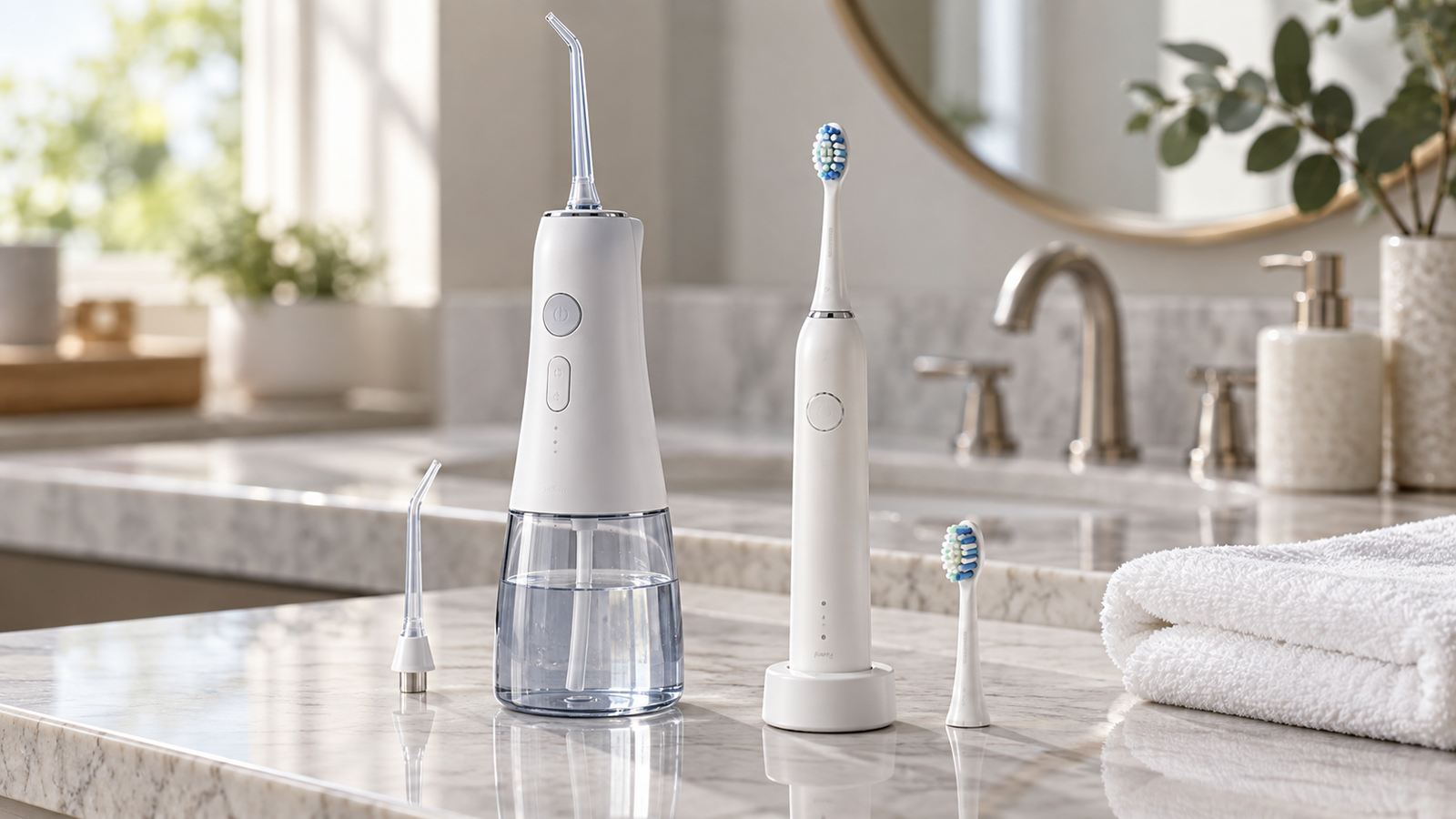
Water flossers and electric toothbrushes are both oral-care tools, but they do different jobs.
An electric toothbrush is primarily designed to clean the surfaces of the teeth and along the gumline. A water flosser uses a pressurised stream of water to clean around the gumline and between teeth.
They are not direct alternatives.
For most people, the main question is not “Which one is better?” but rather “Which problem am I trying to solve?”
What does an electric toothbrush do?
An electric toothbrush uses a powered brush head to clean the teeth.
Depending on the design, the head may:
- Oscillate.
- Rotate.
- Vibrate.
- Move side to side.
- Use sonic-style high-frequency movement.
Its main purpose is to remove plaque and debris from tooth surfaces and along the gumline.
Electric toothbrushes can also help users maintain more consistent brushing habits through features such as:
- Timers.
- Pressure sensors.
- Quadrant reminders.
- Multiple brushing modes.
The basic job, however, remains brushing.
What does a water flosser do?
A water flosser directs a controlled stream of water between the teeth and around the gumline.
It is also commonly called an oral irrigator.
Water flossers are often used for:
- Cleaning between teeth.
- Cleaning around braces.
- Cleaning around bridges.
- Cleaning around dental implants.
- Flushing debris from difficult-to-reach areas.
- Supporting interdental hygiene.
They are generally used after or alongside brushing.
Water flosser vs electric toothbrush at a glance
| Factor | Water flosser | Electric toothbrush |
|---|---|---|
| Main purpose | Interdental and gumline cleaning | Tooth-surface and gumline brushing |
| Replaces brushing? | No | It is the brushing tool |
| Main cleaning action | Pressurised water stream | Powered brush movement |
| Best for | Between teeth, braces, bridges, implants | Everyday tooth brushing |
| Learning curve | Moderate | Low to moderate |
| Mess | Can splash | Minimal |
| Travel convenience | Varies by model | Usually easier |
| Water required | Yes | No |
| Main consumable | Replacement tips | Replacement brush heads |
Why these tools are not substitutes
A water flosser does not brush the tooth surfaces.
An electric toothbrush does not fully clean every interdental space.
This means they complement each other.
A practical oral-care routine may involve:
- Brushing with an electric or manual toothbrush.
- Cleaning between the teeth with a water flosser, string floss or interdental brushes.
The exact combination depends on your dental needs.
Which tool is more essential?
If you had to choose only one, brushing is the essential daily step.
That means an electric toothbrush is generally more fundamental than a water flosser.
However, you do not need an electric toothbrush specifically. A manual toothbrush can also clean effectively when used with proper technique.
A water flosser is an additional interdental-cleaning tool rather than a replacement for brushing.
Can a water flosser replace string floss?
Sometimes it can be used as an alternative interdental tool, but not every person has the same dental needs.
A water flosser can be especially practical for people who find string floss difficult to use.
However, string floss, interdental brushes and water flossers all work differently.
For tightly packed contacts, floss may physically scrape the tooth surfaces more directly.
For larger spaces, an appropriately sized interdental brush may be very effective.
For braces, bridges or implants, a water flosser can be particularly convenient.
Your dentist or dental hygienist can recommend the most suitable approach.
How an electric toothbrush cleans
Powered toothbrushes use repeated mechanical movement.
You guide the brush along the teeth while the motor provides much of the brushing action.
Compared with manual brushing, this can make it easier to maintain consistent movement.
But an electric toothbrush still needs correct positioning.
You should not simply place it randomly against the teeth and expect complete cleaning.
Oscillating-rotating electric toothbrushes
These usually have a small round head.
The head moves back and forth or rotates in small motions.
Advantages can include:
- Easy access around individual teeth.
- Compact brush head.
- Controlled positioning.
Some users like the smaller head because it helps them focus on one tooth area at a time.
Sonic-style electric toothbrushes
These usually have a more traditional elongated brush head.
The bristles vibrate rapidly.
Advantages can include:
- Familiar toothbrush shape.
- Large contact area.
- Smooth brushing experience.
The best design depends mainly on preference and comfort.
Is one electric toothbrush type always better?
Not necessarily.
Actual cleaning performance depends on:
- Brush-head design.
- Brushing technique.
- Time spent brushing.
- Pressure.
- Bristle condition.
- User consistency.
Features can help, but regular correct use matters more than choosing the most expensive motor technology.
What does a water flosser actually clean?
A water flosser helps remove debris and disturb plaque around:
- Gum margins.
- Tooth gaps.
- Orthodontic brackets.
- Bridgework.
- Implant areas.
- Crowns.
It is particularly useful in places where threading floss can be awkward.
However, it does not replace the mechanical brushing needed on broad tooth surfaces.
Countertop vs cordless water flossers
Water flossers commonly come in two formats.
Countertop water flosser
Usually has:
- Larger water tank.
- More pressure levels.
- Larger motor.
- Separate handpiece.
- More tip options.
Advantages:
- Longer continuous use.
- More adjustability.
- Good for home use.
Disadvantages:
- Takes up more space.
- Requires a power outlet.
- Less convenient for travel.
Cordless water flosser
Usually has:
- Smaller tank.
- Rechargeable battery.
- Integrated reservoir.
- Compact design.
Advantages:
- Portable.
- Easier to store.
- Travel-friendly.
Disadvantages:
- Smaller reservoir.
- May need refilling during use.
- Can feel heavier in the hand.
Water-tank size matters
A small reservoir may only provide enough water for part of your routine.
Larger tanks allow longer cleaning sessions.
When comparing products, look at:
- Tank capacity.
- How easy it is to refill.
- Whether the reservoir is removable.
- How easy it is to clean.
A large tank is useful, but it also makes the device bulkier.
Pressure settings
Many water flossers offer multiple pressure levels.
Lower settings are generally more comfortable for beginners.
Higher settings create a stronger stream.
More pressure is not automatically better.
Excessive pressure can feel uncomfortable and may irritate sensitive gums.
Start low and increase only if comfortable.
How to use a water flosser
A basic approach is:
- Fill the reservoir with clean water.
- Attach the appropriate tip.
- Lean over the sink.
- Place the tip in your mouth before switching on.
- Close your lips slightly around the tip.
- Aim along the gumline.
- Move slowly from tooth to tooth.
- Pause briefly between teeth.
- Empty and rinse the reservoir afterward.
Follow the exact instructions for your device.
Why beginners often make a mess
The water stream can splash significantly if you switch the device on before positioning it in your mouth.
A common mistake is turning it on while holding it above the sink.
Instead:
- Place the tip first.
- Lean over the basin.
- Keep lips partly closed.
- Let water drain into the sink.
Most users become comfortable after a few sessions.
How to position the water stream
Aim near the gumline rather than randomly spraying the teeth.
Move slowly along both the outer and inner surfaces.
Pause briefly between teeth.
Avoid directing the jet painfully into gum tissue.
If the product includes specific tip-angle instructions, follow them.
Water flosser for braces
Braces create extra surfaces where food and plaque can collect.
A water flosser can help clean around:
- Brackets.
- Wires.
- Bands.
- Hard-to-reach spaces.
This can make oral hygiene easier.
However, it does not replace brushing around brackets.
Some people may also need interdental brushes or orthodontic brushes.
Water flosser for dental implants
Implants require careful hygiene.
A water flosser may help clean around implant-supported restorations, depending on individual advice.
Use suitable pressure and follow guidance from your dentist.
Implant maintenance can differ from normal tooth cleaning, especially around complex restorations.
Water flosser for bridges
Bridges can make traditional flossing more difficult because the false tooth is connected to adjacent teeth.
A water flosser may help remove debris underneath the bridge.
However, special floss threaders or interdental brushes may also be recommended.
Water flosser for crowns
Crowns still require cleaning around the gumline.
A water flosser can be used around crowned teeth, but brushing remains essential.
Persistent gum irritation around a crown should not simply be treated by increasing water pressure.
It may require dental assessment.
Electric toothbrush for braces
Electric toothbrushes can also be useful with braces.
You need to clean:
- Above brackets.
- Below brackets.
- Around wires.
- Along the gumline.
A smaller brush head can make this easier.
Some brands sell orthodontic-style brush heads, but standard heads can still work when used carefully.
Pressure sensors on electric toothbrushes
A pressure sensor warns you when you press too hard.
This can be useful because excessive pressure may:
- Cause gum discomfort.
- Increase bristle wear.
- Reduce brushing comfort.
Some brushes use:
- Lights.
- Vibrations.
- Motor slowdown.
A pressure sensor is particularly useful if you tend to scrub aggressively.
Timers
Many electric toothbrushes include a two-minute timer.
Some also provide 30-second quadrant reminders.
These features help users divide brushing time across:
- Upper right.
- Upper left.
- Lower right.
- Lower left.
A timer does not guarantee good cleaning, but it can improve consistency.
Brushing modes: do they matter?
Common modes include:
- Clean.
- Sensitive.
- Gum care.
- Whitening.
- Deep clean.
The names vary between brands.
Most users only need one comfortable mode.
Extra modes are useful if you prefer different intensity levels, but they are not essential for effective brushing.
“Whitening” mode limitations
A toothbrush can help remove some surface stains by cleaning more effectively.
It cannot bleach the natural tooth colour in the way professional or peroxide-based whitening can.
Be cautious with marketing that suggests an electric toothbrush alone can dramatically whiten teeth.
Brush-head size
Smaller heads can reach:
- Back teeth.
- Crowded areas.
- Around braces.
Larger heads cover more surface at once.
Choose based on mouth size and comfort.
Soft vs medium bristles
Soft bristles are generally suitable for most people.
Very stiff brushing is not necessary for good plaque removal.
Aggressive brushing with hard bristles can increase discomfort.
If you have gum sensitivity, ask your dental professional which bristle type is appropriate.
How often should brush heads be replaced?
Brush heads should be replaced when:
- Bristles become frayed.
- Bristles spread outward.
- Cleaning performance declines.
- The manufacturer’s recommended replacement interval is reached.
Worn bristles clean less effectively.
Some heads include colour indicators to show wear.
Water-flosser tips
Different tips may be designed for:
- General use.
- Orthodontics.
- Periodontal pockets.
- Tongue cleaning.
- Implants.
Use only tips intended for your device.
Do not assume a specialised tip is necessary unless you actually need it.
Replacement-tip cost
Like brush heads, water-flosser tips need replacement over time.
When comparing devices, check:
- Replacement availability.
- Price.
- Whether generic tips are compatible.
- How frequently replacement is recommended.
A low device price may be less attractive if replacement parts are expensive or hard to find.
Battery-powered vs rechargeable toothbrushes
Basic powered toothbrushes may use replaceable batteries.
Rechargeable models usually provide:
- More consistent power.
- Charging stands.
- Extra modes.
- Pressure sensors.
Rechargeable models cost more but can be more convenient for daily use.
Travel convenience
Electric toothbrushes are generally easier to travel with than countertop water flossers.
A cordless water flosser is more portable but still requires:
- Reservoir space.
- Charging.
- Water access.
If you travel frequently, consider size and charger compatibility.
Charging systems
Electric oral-care devices may use:
- Inductive charging stands.
- USB cables.
- Proprietary chargers.
- Magnetic bases.
For travel, USB charging is often convenient.
Before buying, check what is included in the box.
Waterproofing
Many electric toothbrushes and cordless water flossers are water-resistant.
But “waterproof” should not be assumed unless explicitly stated.
Check:
- Whether the device can be rinsed.
- Whether it is safe to use in the shower.
- Whether the charging base must stay dry.
Follow manufacturer guidance.
Can you use a water flosser in the shower?
Some cordless models may be designed for shower use.
Others are not.
Do not assume all rechargeable bathroom devices are safe to submerge.
Check the water-resistance rating and instructions.
What kind of water should you use?
Clean tap water is suitable for many users, depending on local water quality and device instructions.
Some people prefer lukewarm water because cold water can feel sensitive.
Do not add:
- Essential oils.
- Thick mouthwash.
- Salt.
- Homemade solutions.
unless the manufacturer explicitly allows it.
These substances may damage the device or irritate the mouth.
Can mouthwash go in a water flosser?
Some manufacturers allow diluted mouthwash.
Others do not.
If permitted, the reservoir and internal system should usually be rinsed afterward.
Check the instructions for the specific model.
Which should you use first: brush or water flosser?
Either sequence can be used, but many people prefer interdental cleaning before brushing.
Cleaning between the teeth first can remove debris and allow fluoride toothpaste to contact more surfaces.
Consistency matters more than obsessing over the exact order.
Should you rinse after brushing?
For most fluoride toothpastes, avoiding vigorous rinsing immediately after brushing can help leave fluoride on the teeth longer.
Spit out excess toothpaste rather than washing everything away with large amounts of water.
If your dentist has given you different instructions, follow them.
How long should you brush?
Two minutes is a common recommendation.
Spend time on:
- Outer surfaces.
- Inner surfaces.
- Chewing surfaces.
- Gumline.
Do not rush only because the toothbrush is powered.
How hard should you press?
Light, controlled pressure is usually enough.
A common mistake with electric toothbrushes is pressing too hard because the motor is doing the movement.
Let the brush head work.
If the pressure sensor activates frequently, reduce force.
Can an electric toothbrush damage gums?
Used incorrectly, any toothbrush can cause problems.
Potential issues include:
- Aggressive pressure.
- Hard bristles.
- Repeated scrubbing.
- Poor technique.
An electric toothbrush is not inherently damaging.
In fact, pressure sensors can help users avoid excessive force.
Can a water flosser damage gums?
A properly used water flosser at an appropriate pressure should be comfortable.
However, very high pressure or incorrect positioning may irritate sensitive gums.
Start low.
If you experience persistent pain or bleeding, do not simply keep increasing the pressure.
Bleeding gums
Some people notice bleeding when they first improve interdental cleaning.
This may reflect existing gum inflammation.
However, persistent bleeding should not be ignored.
If bleeding continues regularly, see a dentist or dental hygienist.
Gum disease needs assessment rather than simply stronger cleaning.
Bad breath and oral-care devices
Brushing and interdental cleaning can help reduce food debris and plaque associated with bad breath.
However, persistent bad breath can also be related to:
- Gum disease.
- Dry mouth.
- Tongue coating.
- Dental decay.
- Other medical causes.
An electric toothbrush or water flosser is not a complete solution if the problem persists.
Tongue cleaning
Some toothbrushes and water flossers include tongue-cleaning features.
A tongue scraper or toothbrush can help remove surface coating.
Water-flosser tongue tips can also be used if included.
Again, these are optional extras.
Electric toothbrush for sensitive teeth
If you have sensitive teeth, look for:
- Soft bristles.
- Sensitive mode.
- Pressure sensor.
Avoid excessive force.
Tooth sensitivity may also be caused by:
- Gum recession.
- Decay.
- Cracks.
- Enamel wear.
Persistent sensitivity should be evaluated.
Water flosser for sensitive gums
Start at the lowest setting.
Use lukewarm water.
Increase pressure only if comfortable.
Sensitive gums do not require an aggressive jet.
Which is easier for people with limited hand dexterity?
Electric toothbrushes can be very helpful because the motor performs much of the brushing movement.
This may benefit users with:
- Reduced hand dexterity.
- Arthritis.
- Difficulty with fine brushing movements.
Water flossers can also be easier than string floss for some people, though holding and aiming the device still requires coordination.
Which is better for children?
Age suitability depends on the product and the child.
Electric toothbrushes designed for children typically have:
- Smaller heads.
- Softer bristles.
- Gentler power.
- Timers.
Water flossers may be useful for some older children, especially with braces, but supervision is advisable.
Follow age recommendations from the manufacturer and dentist.
Do expensive electric toothbrushes clean better?
Not necessarily.
Premium models may add:
- Apps.
- Displays.
- More modes.
- Travel cases.
- Advanced pressure feedback.
These features improve convenience but do not automatically make the toothbrush dramatically better at basic cleaning.
A simpler model with:
- Good brush heads.
- Two-minute timer.
- Pressure sensor.
may meet most users’ needs.
Do expensive water flossers work better?
Not automatically.
Higher-priced models may offer:
- More pressure levels.
- Larger tanks.
- Better build quality.
- More tips.
- Quieter operation.
Choose based on practical features rather than price alone.
Common mistakes with electric toothbrushes
Moving it like a manual toothbrush too aggressively
Let the powered head do most of the work.
Pressing too hard
Use the pressure sensor if available.
Ignoring the back teeth
Spend equal time across the mouth.
Keeping the same brush head too long
Replace worn heads.
Brushing for too little time
Use the timer.
Common mistakes with water flossers
Using maximum pressure immediately
Start low.
Spraying randomly
Follow the gumline and pause between teeth.
Turning the device on outside the mouth
This creates a mess.
Ignoring reservoir cleaning
Keep the tank clean.
Assuming it replaces brushing
It does not.
How to compare water flossers before buying
| Factor | What to check |
|---|---|
| Type | Countertop or cordless |
| Tank size | Enough for one cleaning session? |
| Pressure levels | Adjustable range |
| Tips | Standard, orthodontic or specialised |
| Battery | Runtime and charging method |
| Cleaning | Removable reservoir and easy maintenance |
| Portability | Important for travel |
| Replacement parts | Tip availability and cost |
| Water resistance | Especially for cordless models |
How to compare electric toothbrushes before buying
| Factor | What to check |
|---|---|
| Brush movement | Oscillating or sonic-style |
| Pressure sensor | Useful for aggressive brushers |
| Timer | Two-minute timer and quadrant alerts |
| Brush heads | Availability and replacement cost |
| Modes | Only those you will actually use |
| Battery | Runtime and charging system |
| Head size | Comfortable for your mouth |
| Travel case | Useful if you travel frequently |
| App features | Optional, not essential |
Which should you buy first?
If you currently use only a manual toothbrush and want to upgrade one part of your routine, an electric toothbrush is generally the more fundamental first purchase.
If brushing is already consistent but cleaning between teeth is difficult, a water flosser may provide more value.
For people with braces, bridges, implants or limited dexterity, a water flosser may be especially practical.
Do you need both?
Not everyone needs both.
A complete routine can be built using:
- Manual toothbrush + floss.
- Electric toothbrush + floss.
- Electric toothbrush + interdental brushes.
- Electric toothbrush + water flosser.
The best combination is the one you can use correctly and consistently.
Frequently asked questions
Is a water flosser better than an electric toothbrush?
They perform different jobs.
An electric toothbrush cleans tooth surfaces.
A water flosser cleans between teeth and around the gumline.
Can I use only a water flosser?
No.
You still need to brush your teeth.
Can an electric toothbrush replace flossing?
No.
It does not fully replace interdental cleaning.
Is a water flosser better than string floss?
It may be easier and more practical for some users, especially around braces and dental work.
The best interdental tool depends on your mouth and dental needs.
Should I use a water flosser before or after brushing?
Either can work.
Many people prefer to use it before brushing.
Can a water flosser remove tartar?
No home oral-care device should be expected to remove hardened tartar reliably.
Tartar generally requires professional dental cleaning.
Do electric toothbrushes whiten teeth?
They can help remove surface stains, but they do not bleach the teeth.
Is higher water pressure better?
No.
Use the lowest pressure that cleans comfortably.
Are multiple brushing modes necessary?
No.
Most people only need one comfortable, effective mode.
How often should I use a water flosser?
Many people use it once daily as part of interdental cleaning.
Follow dental advice and device instructions.
Choosing the right oral-care device
Start by identifying the gap in your current routine.
If your main issue is inconsistent or ineffective brushing, an electric toothbrush may be the more useful upgrade.
If your main issue is cleaning between teeth, around braces, bridges or implants, a water flosser may be more valuable.
For many users, the two tools work well together because they address different parts of oral hygiene.
The goal is not to buy the most advanced device. It is to build a routine you can perform correctly every day.
Physical Glow’s Top 5 Water Flossers and Electric Oral-Care Tools in India comparison looks at several powered brushing and interdental-cleaning formats. Use that comparison alongside this guide, then verify the current pressure settings, reservoir size, brush-head availability, replacement costs and charging system for the exact device you are considering.