Eye Makeup Basics: How to Choose Products for Your Look
Learn how the main eye makeup products work together and how to choose them, with practical guidance on eyeshadow, eyeliner, mascara, finish, colour and everyday wear. This beginner-friendly guide helps you make a clear, informed choice without unnecessary complexity.
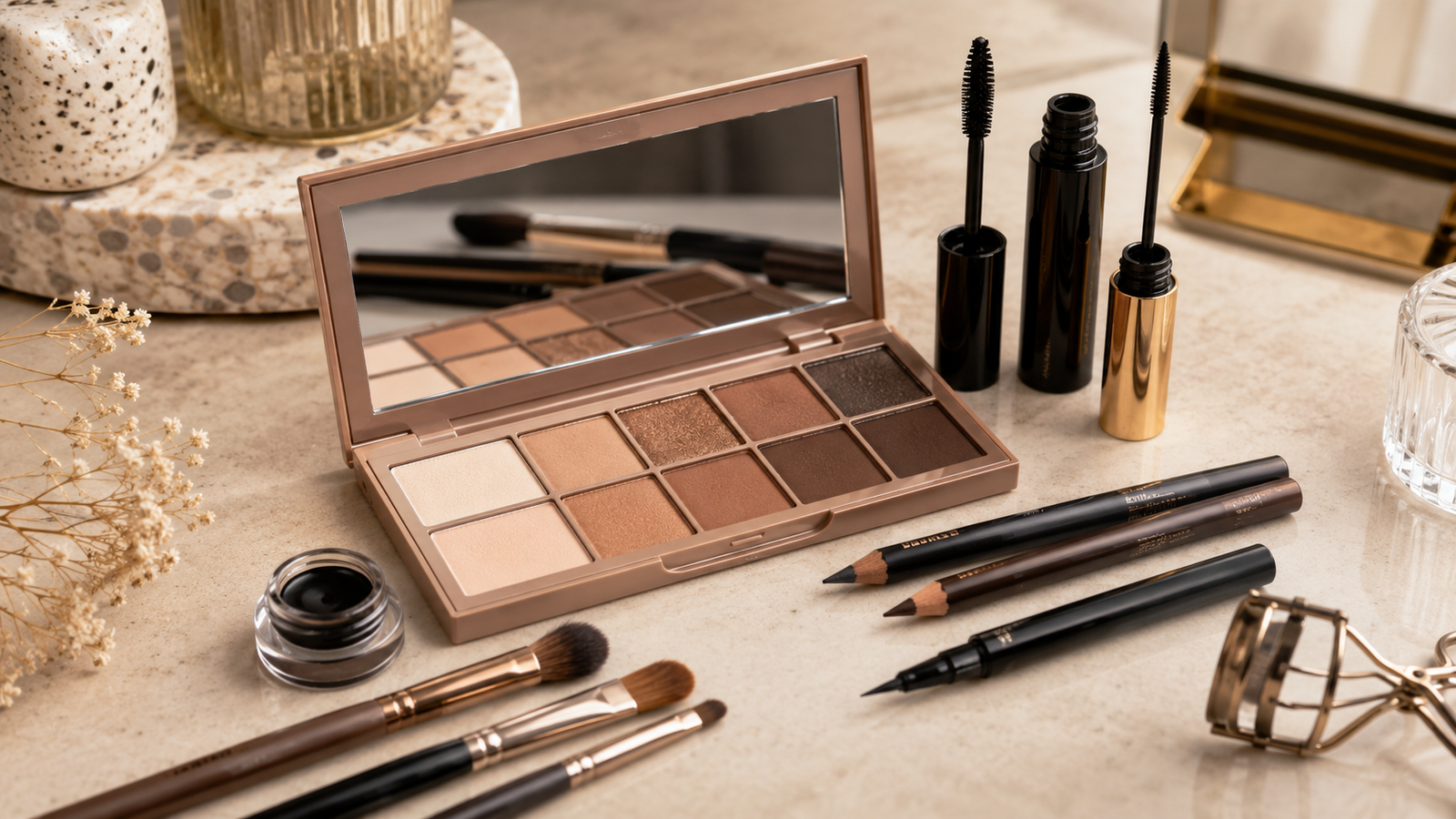
Eye makeup can be as simple as:
- mascara;
- one neutral eyeshadow;
- a soft pencil liner.
Or it can involve:
- multiple eyeshadows;
- primer;
- eyeliner;
- mascara;
- shimmer;
- detailed blending.
Neither approach is better.
The right eye-makeup products depend on the result you want, how much time you want to spend applying makeup and how comfortable you are using different formulas.
A practical way to build an eye-makeup routine is:
choose the look → select the minimum products needed → choose suitable colours and finishes → learn how each formula behaves → build complexity only when you want it
You do not need a large eyeshadow collection or professional-level technique to create polished eye makeup.
What Does Eye Makeup Include?
The main eye-makeup categories are:
- eyeshadow;
- eyeshadow primer;
- eyeliner;
- mascara;
- eye pencils;
- shimmer or glitter products.
Some routines also include:
- brow products;
- false eyelashes.
But these perform separate enough functions that they do not need to be part of every eye look.
For a beginner, the core three are usually:
eyeshadow → eyeliner → mascara
And even these are optional.
Start With the Look You Want
Before buying products, decide what you actually want your eye makeup to accomplish.
Natural Everyday Look
You may only need:
- neutral eyeshadow;
- brown eyeliner;
- mascara.
Bright, Open-Eye Look
You may prioritize:
- lighter eyeshadow;
- curled lashes;
- lengthening mascara;
- subtle liner.
Defined Eyes
You may want:
- darker liner;
- medium-depth eyeshadow;
- mascara.
Smoky Eye
You may need:
- several eyeshadow depths;
- blendable pencil or shadow;
- stronger mascara.
Glamorous Look
You may want:
- shimmer;
- deeper outer-corner colour;
- liquid eyeliner;
- volumizing mascara.
Colourful Makeup
You may prioritize:
- pigmented shadows;
- colourful liner;
- contrasting shades.
The product should follow the look—not the other way around.
Do You Need Eyeshadow?
No.
Mascara and eyeliner alone can create a complete eye look.
Eyeshadow becomes useful when you want to add:
- colour;
- depth;
- dimension;
- brightness;
- definition.
It can also visually change how the eye area appears by controlling where:
- darker;
- lighter;
- reflective colours;
are placed.
Understanding Eyeshadow Colour
Eyeshadow colour is partly personal preference.
There are no shades that a particular eye colour or skin tone is forbidden from wearing.
However, some colour combinations create more:
- harmony;
- contrast;
- intensity.
Understanding this can help you predict the result.
Neutral Eyeshadow
Neutral shades include variations of:
- beige;
- taupe;
- brown;
- cream;
- bronze;
- soft grey.
They are useful because they work across many:
- occasions;
- outfits;
- makeup styles.
A beginner does not need a palette with 30 colours.
A small neutral palette containing:
- light shade;
- medium shade;
- deeper shade;
- optional shimmer;
can create numerous looks.
Warm Eyeshadows
Warm shades may include:
- caramel;
- bronze;
- copper;
- warm brown;
- peach;
- terracotta;
- gold.
They can create:
- warmth;
- richness;
- softness.
Warm palettes are especially common for everyday and evening makeup.
Cool Eyeshadows
Cool shades include:
- taupe;
- cool brown;
- grey;
- mauve;
- plum;
- silver.
They can create a more:
- muted;
- smoky;
- sophisticated appearance.
If warm brown shadows repeatedly look unusually orange on you, trying cooler browns or taupes may produce the result you prefer.
Colourful Eyeshadow
Colour can be used:
- across the entire eyelid;
- as eyeliner;
- in the outer corner;
- beneath the lower lashes;
- as an accent.
Beginner-friendly colours include:
- olive;
- navy;
- plum;
- burgundy;
- muted teal.
These provide visible colour without necessarily creating an extremely bright look.
Do Eyeshadows Have to Match Your Eye Colour?
No.
You can use any shade you enjoy.
However, contrasting colours can make an iris appear more noticeable.
For example, broadly:
Brown Eyes
Extremely versatile.
Possible colours include:
- bronze;
- gold;
- green;
- plum;
- navy.
Hazel Eyes
Shades such as:
- bronze;
- green;
- plum;
- warm brown;
may emphasize different colours in the iris.
Green Eyes
Contrasting red-purple families such as:
- mauve;
- plum;
- burgundy;
can make green appear more prominent.
Blue Eyes
Warm contrasts such as:
- copper;
- bronze;
- peach;
- warm brown;
can emphasize blue.
These are styling principles, not restrictions.
Skin Tone Matters More for Visibility Than Rules
A shade that looks intense on fair skin may appear subtle on deeper skin.
Conversely, very pale shadows may appear:
- chalky;
- ashy;
on deeper complexions if they lack sufficient pigment.
The question is not simply:
Is this colour flattering?
Also ask:
Will this particular formula and depth actually show clearly on my complexion?
Eyeshadow Undertone
Like foundation and blush, eyeshadow can have:
- warm;
- cool;
- neutral;
undertones.
Matching your overall makeup palette can create harmony.
For example:
warm peach blush + warm bronze eye + warm lip
creates a cohesive warm look.
But intentional contrast can also look excellent.
Powder Eyeshadow
Powder is the most common eyeshadow format.
Advantages include:
- broad shade range;
- easy layering;
- blendability;
- control.
It is usually the easiest format for learning:
- crease placement;
- gradients;
- smoky looks.
Matte Eyeshadow
Matte shadows contain little or no visible shimmer.
They are useful for:
- crease definition;
- outer corners;
- soft eyeliner;
- everyday makeup.
A basic palette should generally contain at least a few matte shades because they provide structure.
Satin Eyeshadow
Satin shadows have subtle light reflection.
They fall between:
matte ↔ shimmer
They can be extremely flattering because they add dimension without obvious sparkle.
Useful for:
- eyelid;
- soft everyday looks.
Shimmer Eyeshadow
Shimmer reflects more light.
It can make the eyelid appear:
- brighter;
- more dimensional.
Common areas include:
- centre of lid;
- inner corner;
- entire mobile lid.
Shimmer does not have to be reserved for evening.
A subtle champagne or bronze shimmer can work well during the day.
Metallic Eyeshadow
Metallic shadows create stronger reflection.
They can resemble:
- gold;
- silver;
- copper;
- foil.
They work particularly well for:
- festive;
- evening;
- dramatic looks.
Many metallic shadows apply more intensely with:
- fingertip;
- dampened appropriate brush where the formula allows.
Follow manufacturer directions.
Glitter Eyeshadow
Glitter contains visibly larger reflective particles.
It creates a more dramatic effect than ordinary shimmer.
Because the eye area is sensitive, use only products specifically formulated and labelled for eye-area cosmetic use.
Do not apply:
- craft glitter;
- decorative glitter;
around the eyes.
Particles not intended for eye use can create avoidable risk if they enter the eye.
Cream Eyeshadow
Cream shadow can come in:
- pots;
- sticks;
- tubes.
It is useful for:
- fast application;
- one-shadow looks;
- strong colour;
- easy travel.
You can often apply it with:
- finger;
- brush.
Eyeshadow Sticks
Shadow sticks are particularly beginner-friendly.
You can:
- Draw across the eyelid.
- Blend the edges.
- Stop there.
They are useful when you want a polished eye look without:
- palette;
- several brushes.
Look for enough working time to blend before the product sets.
Liquid Eyeshadow
Liquid eyeshadow can provide:
- shimmer;
- metallic effect;
- long wear.
Many formulas set quickly.
Apply one eye at a time if necessary.
Use small amounts because concentrated liquid products can become:
- patchy;
- thick;
when over-layered.
Powder vs Cream Eyeshadow
Choose Powder If You Want:
- maximum flexibility;
- easy gradients;
- smoky looks;
- multiple shades.
Choose Cream If You Want:
- speed;
- one-and-done application;
- fewer tools.
Choose Liquid If You Want:
- strong shimmer;
- metallic intensity;
- potentially longer wear.
None is universally better.
Eyeshadow Pigmentation
Pigmentation refers to how strongly colour transfers.
Sheer Eyeshadow
Useful for:
- beginners;
- natural looks;
- gradual building.
Highly Pigmented Eyeshadow
Useful for:
- deep skin tones;
- colourful looks;
- dramatic makeup.
But highly pigmented does not automatically mean higher quality.
Blendability and control matter too.
Why Extremely Pigmented Shadow Can Be Harder for Beginners
If one brush tap creates intense colour, mistakes become more difficult to correct.
A slightly buildable formula allows you to:
apply → assess → add more
rather than immediately needing to remove excess.
For everyday makeup, buildability can be an advantage.
Eyeshadow Palette vs Single Shadow
Palette
Useful if you regularly create:
- multidimensional looks;
- different styles.
Single Shadow
Useful if you:
- wear one favourite colour;
- want minimal products;
- need to replace one specific shade.
Do not buy a large palette if you know you will use only:
- one brown;
- one shimmer.
How Many Eyeshadows Does a Beginner Need?
A functional beginner collection could contain only four shades:
1. Light Neutral
For:
- base;
- subtle brightness.
2. Medium Neutral
For:
- crease;
- everyday definition.
3. Deep Neutral
For:
- outer corner;
- liner.
4. Shimmer
For:
- eyelid;
- inner corner.
That is enough for numerous looks.
What Is an Eyeshadow Primer?
Eyeshadow primer is applied to the eyelid before eyeshadow.
It can help:
- improve adhesion;
- reduce creasing;
- intensify colour;
- improve longevity.
It is useful if your eyelids become:
- oily;
- makeup fades quickly;
- shadows crease.
Does Everyone Need Eyeshadow Primer?
No.
If your eyeshadow already lasts well, skip it.
Some people use:
- a thin layer of concealer;
instead.
That can work, but concealer and dedicated eye primer are not identical.
Concealer may contain more:
- emollients;
- oils;
and may crease on oily eyelids.
Tinted Eyeshadow Primer
A tinted primer can also help even out:
- visible veins;
- discoloration.
Choose a shade close to your skin tone unless you deliberately want a coloured base.
White Eyeshadow Base
White bases can make bright colours appear more vivid.
They are useful for:
- colourful;
- editorial makeup.
They are unnecessary for most everyday looks.
Eyeliner Basics
Eyeliner adds definition along the lash line.
It can make lashes appear:
- denser;
- more prominent.
Depending on placement, liner can make the eye look:
- elongated;
- rounded;
- softer;
- more dramatic.
Main eyeliner types include:
- pencil;
- gel;
- liquid;
- shadow used as liner.
Pencil Eyeliner
Pencil is generally the easiest eyeliner for beginners.
Advantages:
- easy control;
- softer result;
- can be smudged;
- mistakes are easier to correct.
It works well for:
- everyday liner;
- smoky eyes;
- lower lash line.
Kohl and Kajal Eyeliner
Kohl/kajal-style pencils are typically softer and more intensely pigmented.
They can create:
- dark lash lines;
- smoky effects;
- waterline definition.
Because soft pencils can smudge more easily, they may not provide the longest wear on oily eyelids.
Gel Eyeliner
Gel eyeliner typically provides:
- stronger pigmentation;
- more control than liquid;
- good longevity.
It may come in:
- pot;
- pencil.
Pot gel liner usually requires a brush.
It is excellent for:
- wings;
- smoky liner;
- strong definition.
Liquid Eyeliner
Liquid liner creates:
- sharp;
- precise;
- high-definition lines.
Common applicators include:
- felt tip;
- brush tip.
It is particularly useful for:
- winged liner;
- graphic liner.
But it generally requires more practice than pencil.
Felt-Tip Eyeliner
Felt tips feel more like a marker.
They can be easier for beginners because the tip is relatively firm.
Useful for:
- simple wings;
- upper lash line.
Brush-Tip Eyeliner
Brush tips are more flexible.
They can create:
- very thin lines;
- precise wings.
But they require more hand control.
If you are new to liquid liner, felt-tip products may feel easier.
Eyeshadow as Eyeliner
You can use a dark powder eyeshadow with a small angled brush.
This creates a:
- soft;
- diffused;
- forgiving line.
It is one of the easiest eyeliner techniques for beginners.
Try:
- brown;
- charcoal;
- plum;
- navy.
Black vs Brown Eyeliner
Black
Creates:
- stronger contrast;
- more dramatic definition.
Brown
Creates:
- softer;
- more natural definition.
Neither is better.
For very light everyday makeup, brown can look more subtle.
For dramatic looks, black provides maximum intensity.
Coloured Eyeliner
Coloured liner is an easy way to experiment without wearing full colourful eyeshadow.
Useful shades include:
- navy;
- plum;
- green;
- bronze;
- burgundy.
You can wear coloured liner with otherwise neutral makeup.
Upper Lash-Line Eyeliner
Applying liner close to the upper lashes can make the lash line appear fuller.
For a subtle result:
- keep the line thin.
For stronger definition:
- gradually thicken toward the outer corner.
Tightlining
Tightlining generally means placing liner near the upper lash roots or upper waterline.
It can make lashes look denser without obvious eyeliner above them.
Because the product is close to the eye, use only cosmetics specifically intended for that placement.
Stop if it causes:
- irritation;
- watering;
- discomfort.
Waterline Eyeliner
The waterline is the inner rim of the eyelid.
Different colours create different effects.
Black/Dark Brown
Creates stronger definition.
May make the eye appear visually smaller depending on the look.
Beige/Nude
Can create a brighter appearance.
White
Creates stronger contrast and a more graphic brightening effect.
Only use products specifically labelled as appropriate for the waterline/eye area.
Lower Lash-Line Eyeliner
Dark liner beneath the eye can increase definition.
But very heavy lower liner may make some eyes appear visually smaller or more downward-focused.
For a softer look:
- use eyeshadow;
- use brown;
- apply mainly to outer portion.
Winged Eyeliner
A wing extends the liner beyond the outer corner.
It can visually create:
- elongation;
- lift.
There is no single wing shape that works for everyone.
Your ideal shape depends on:
- eyelid anatomy;
- eye position;
- desired effect.
Hooded Eyes and Eyeliner
With hooded eyes, part of the mobile eyelid is covered when the eyes are open.
Very thick liner can take up much of the visible lid.
A thinner liner may preserve more visible eyelid space.
For wings, try drawing while looking:
straight ahead
rather than only with the eye closed.
This helps you see how the liner will actually appear normally.
Monolids and Eyeliner
Monolids can work beautifully with:
- thin lash-line definition;
- thicker graphic liner;
- gradient shadow.
The ideal technique depends on how much liner remains visible when the eye is open.
There is no need to imitate a crease that is not naturally present unless that is the look you want.
Deep-Set Eyes
Deep-set eyes naturally sit farther beneath the brow structure.
Very dark shadow across the entire socket may increase the appearance of depth.
If you want to visually bring the lid forward, consider:
- lighter;
- reflective shades;
on the mobile lid.
Prominent Eyes
If you want to visually reduce prominence, deeper matte shades can create more depth.
If you enjoy emphasizing the eye shape, shimmer can highlight it.
These are visual effects, not correction rules.
Close-Set Eyes
If you want to create a more outward visual emphasis:
- keep inner corner lighter;
- concentrate deeper colour toward outer corner.
Wide-Set Eyes
If you want stronger definition toward the centre:
- carry some medium depth closer to inner crease.
Again, these are optional styling techniques.
You do not need to “correct” natural eye shape.
Mascara Basics
Mascara coats the eyelashes.
Depending on the formula and brush, it can create:
- length;
- volume;
- separation;
- curl;
- darker lashes.
Mascara alone can provide significant eye definition.
Lengthening Mascara
Lengthening formulas aim to make lashes appear longer.
They may use:
- lightweight waxes;
- fibres;
- separating brushes.
Best if your main goal is:
visible length without excessive thickness
Volumizing Mascara
Volumizing mascara creates the appearance of thicker lashes.
It may have:
- richer formula;
- larger brush.
Best for:
- dramatic lashes;
- sparse-looking lash lines.
Curling Mascara
These formulas aim to help lashes hold an upward shape.
They can be useful for:
- straighter lashes.
For stronger curl, combine with an eyelash curler if appropriate.
Defining Mascara
Defining mascara focuses on:
- separation;
- clean lash appearance.
Useful for:
- natural makeup;
- people who dislike clumps.
Tubing Mascara
Tubing mascaras form polymer tubes around individual lashes.
They are known for:
- reduced smudging;
- distinctive removal with warm water.
They can be useful if traditional mascara frequently transfers under your eyes.
Waterproof Mascara
Waterproof mascara is designed to resist:
- water;
- tears;
- humidity.
Useful for:
- weddings;
- swimming where appropriate;
- humid weather;
- emotional events.
But it can require more effort to remove.
Frequent aggressive removal can increase lash stress.
Do You Need Waterproof Mascara Every Day?
No.
If ordinary mascara lasts well, waterproof may be unnecessary.
Waterproof formulas are particularly useful when you specifically need greater resistance.
Choose based on your routine.
Brown vs Black Mascara
Black
Creates maximum contrast.
Brown
Creates softer definition.
Brown can work particularly well for:
- very natural makeup;
- lighter hair;
- softer eye looks.
There are no complexion restrictions.
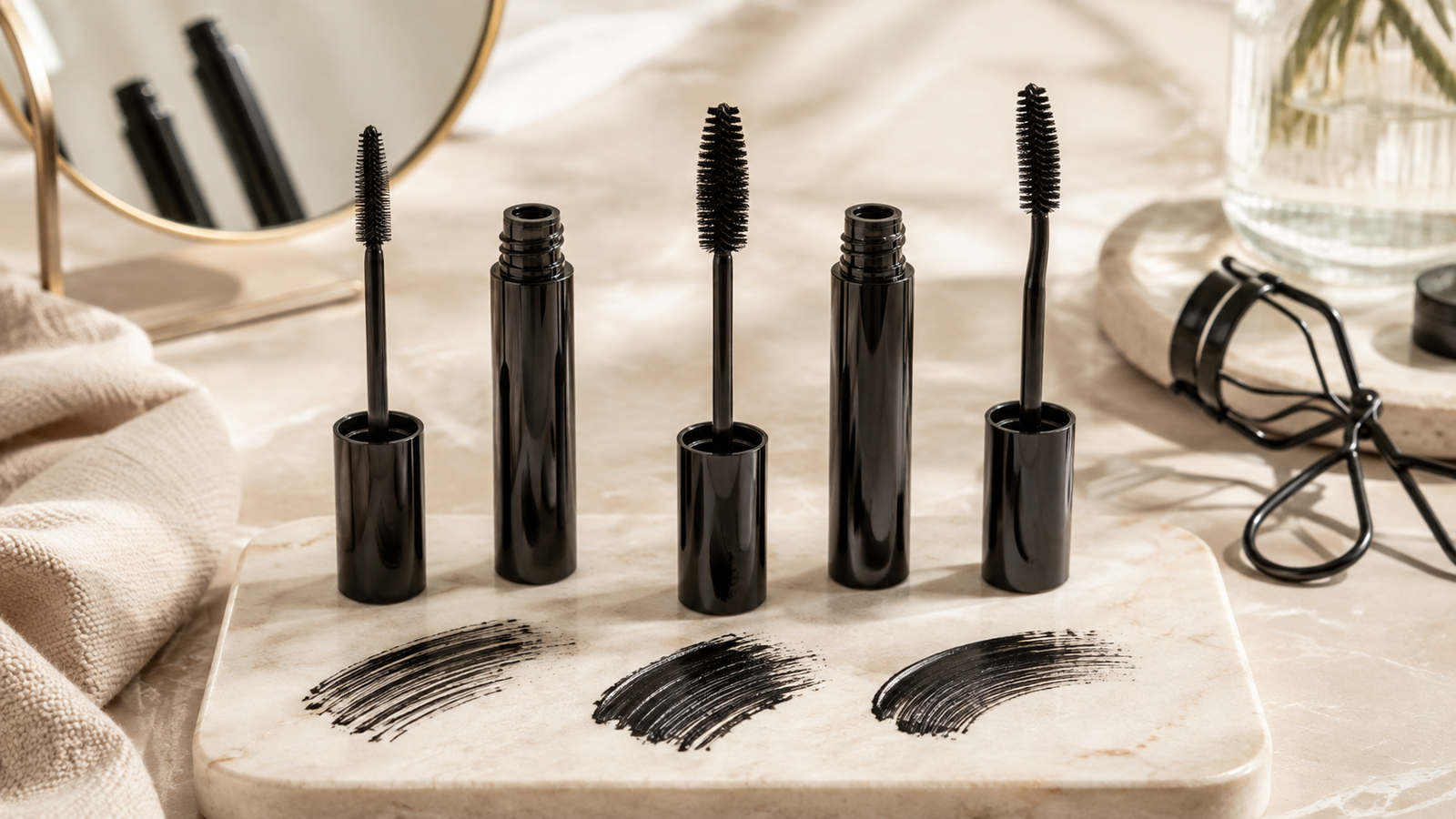
Mascara Wand Shape Matters
The brush influences how mascara applies.
Large Fluffy Brush
Often emphasizes:
- volume.
Thin Brush
Useful for:
- separation;
- short lashes;
- lower lashes.
Curved Brush
Can help lift and curl.
Rubber/Silicone Brush
Often provides:
- strong separation;
- defined application.
The best wand depends on what your lashes need.
How to Apply Mascara
A simple technique:
- Place wand close to lash roots.
- Wiggle gently.
- Pull upward toward tips.
- Add another coat if needed.
For lower lashes:
- use minimal product;
- concentrate carefully.
More Mascara Coats Are Not Always Better
Additional coats increase:
- volume;
- intensity.
But too many can cause:
- clumps;
- stiffness;
- flaking.
Apply the minimum needed for the result you want.
Should You Curl Lashes Before Mascara?
Generally, yes.
If using a traditional eyelash curler:
curl first → mascara afterward
Using a mechanical curler over dried mascara can increase the risk of lashes:
- sticking;
- breaking.
Use gentle pressure.
Heated Eyelash Curlers
Some devices use mild heat to shape lashes.
Follow manufacturer instructions carefully.
Avoid placing excessive heat near the eye.
Eye Makeup Brushes
You do not need a large professional brush collection.
A useful beginner set may contain:
- Flat or small shader brush
- Fluffy blending brush
- Small angled or detail brush
That covers most basic looks.
Flat Eyeshadow Brush
Useful for placing colour onto the eyelid.
It deposits more product than a large fluffy brush.
Best for:
- shimmer;
- concentrated colour.
Fluffy Blending Brush
Used to diffuse eyeshadow edges.
Important for:
- crease colour;
- soft gradients.
For beginners, this is probably the most useful eyeshadow brush.
Small Pencil Brush
Useful for:
- lower lash line;
- outer corner;
- precise blending.
Angled Brush
Useful for:
- eyeshadow liner;
- gel eyeliner;
- brows if desired.
Do You Need Expensive Makeup Brushes?
No.
A brush should mainly have:
- appropriate shape;
- soft enough bristles;
- reasonable durability.
Affordable brushes can perform extremely well.
Technique matters more than branding.
Fingers for Eyeshadow
Fingers are excellent for:
- cream shadow;
- shimmer;
- metallic shadow.
Body warmth can help spread creams.
Finger application may also make shimmer appear more intense than a fluffy brush.
Use clean hands.
A Basic One-Shadow Look
One of the easiest eye looks requires a single colour.
Step 1
Choose:
- taupe;
- brown;
- bronze;
- peach;
- mauve.
Step 2
Apply across mobile lid.
Step 3
Blend the edge slightly above the crease.
Step 4
Add mascara.
This can look polished without complex technique.
A Basic Two-Shadow Look
Use:
Shade 1
Medium neutral across lid and crease.
Shade 2
Slightly deeper shade on outer corner.
Blend.
Add mascara.
This creates more dimension while remaining beginner-friendly.
A Basic Three-Shadow Look
Light Shade
On lid or inner portion.
Medium Shade
Through crease.
Deep Shade
Outer corner and lash line.
This creates a simple gradient.
A Classic Neutral Eye
A straightforward routine:
- Eyeshadow primer if needed.
- Medium brown through crease.
- Light beige/bronze on lid.
- Deep brown on outer corner.
- Brown or black liner.
- Mascara.
This works across many occasions.
A Soft Smoky Eye
A smoky eye does not need to be black.
You can use:
- brown;
- taupe;
- plum;
- bronze.
Basic approach:
- Apply medium shade across lid.
- Add darker shade near lashes and outer corner.
- Blend edges thoroughly.
- Apply pencil liner.
- Smudge slightly.
- Finish with mascara.
The defining feature is a gradient from deeper to softer colour, not necessarily extreme darkness.
A Shimmer Eye Look
For a simple evening look:
- Medium matte shade in crease.
- Shimmer across lid.
- Deep shade at outer corner.
- Liner if desired.
- Mascara.
One shimmer can transform an otherwise basic neutral eye.
Inner-Corner Highlight
A small amount of:
- light shimmer;
- satin shadow;
at the inner corner can visually brighten the eye area.
Do not place loose glitter directly near the tear duct.
Use products designed for eye-area application.
Lower Lash-Line Shadow
Using eyeshadow beneath the lower lashes can connect the upper and lower eye makeup.
For subtle definition:
- use medium brown;
- blend softly.
For smoky makeup:
- use deeper shade;
- keep edges diffused.
Avoid dragging shadow too far downward unless deliberately creating that look.
How Far Should Eyeshadow Extend?
There is no fixed boundary.
For everyday makeup, keep most colour between:
- inner eye;
- outer eye;
- crease/visible lid.
For more dramatic looks, extend outward toward:
- temple;
- brow structure.
Your natural anatomy can guide placement.
Should Eyeshadow Reach the Brow?
A light transition colour may extend upward.
But dark shadow all the way to the brow creates a much stronger look.
For beginners, keep deeper colours lower and gradually diffuse upward.
How to Blend Eyeshadow
Good blending does not mean endlessly moving the brush.
A basic technique:
- Apply small amount.
- Place colour where you want most intensity.
- Use clean or lightly loaded fluffy brush.
- Blend only the edge.
- Add more if needed.
This preserves colour while softening harsh lines.
Why Eyeshadow Looks Muddy
“Muddy” eye makeup can occur when multiple colours blend into an indistinct brown-grey mixture.
Possible causes:
- too many shades;
- over-blending;
- using the same brush for every colour;
- layering opposite colours excessively.
To prevent this:
- use fewer shades;
- clean brushes;
- maintain separate areas of depth.
Why Eyeshadow Looks Patchy
Possible causes include:
- uneven primer;
- oily eyelids;
- too much pigment at once;
- dry or textured skin;
- poor formula.
Try:
- thin primer;
- smaller product amount;
- gradual layering.
Why Eyeshadow Creases
Eyeshadow may collect in eyelid folds because of:
- oil;
- creamy products;
- heavy application.
A primer can help.
For cream shadows, choose formulas designed to set.
Eyeshadow Fallout
Powder particles may fall onto the cheeks during application.
This is common with:
- dark shadows;
- glitter;
- loosely pressed shimmer.
Strategies include:
- tapping excess product off the brush;
- doing eyes before foundation;
- using smaller amounts.
Should You Do Eye Makeup Before Foundation?
Either order works.
Eyes First
Useful for:
- smoky eyes;
- glitter;
- dark shadows.
You can clean fallout before complexion makeup.
Foundation First
Useful for:
- simple everyday makeup;
- quick routines.
Choose whichever makes the process easier.
Mascara Smudging Under the Eyes
Possible causes:
- oily skin;
- eye watering;
- creamy concealer;
- mascara formula.
Try:
- tubing mascara;
- waterproof mascara where appropriate;
- lightly setting under-eye makeup.
Eyeliner Smudging
If eyeliner transfers onto the upper lid:
- use primer;
- choose longer-wear formula;
- set pencil liner with matching eyeshadow.
For intentional smoky liner, smudging can be part of the look.
Should Eyeliner Be Set With Eyeshadow?
You can apply matching powder shadow over pencil liner.
This can:
- soften the line;
- improve wear.
It is especially useful for:
- smoky;
- brown;
- diffused liner.
Eye Makeup for Glasses
Glasses can change how eye makeup appears.
Frames may visually compete with liner.
You may prefer:
- stronger mascara;
- slightly more defined liner;
- brighter lid shade.
But this depends entirely on:
- frame thickness;
- prescription;
- personal style.
There is no special mandatory glasses makeup.
Eye Makeup for Contact-Lens Wearers
If you wear contact lenses:
- insert lenses with clean hands;
- avoid letting powders or liner particles enter the eye;
- choose products appropriate for eye-area use.
If makeup repeatedly causes:
- redness;
- pain;
- watering;
stop using the product.
Persistent symptoms should be assessed by an eye-care professional.
Eye Makeup and Sensitive Eyes
If your eyes are easily irritated, consider:
- fragrance-free eye products where available;
- avoiding heavy glitter;
- minimizing waterline products;
- replacing old eye cosmetics promptly.
Stop immediately if a product causes:
- burning;
- significant watering;
- swelling.
Eye makeup should not be painful.
Eye Makeup and Watery Eyes
Watery eyes can make:
- liner;
- mascara;
smudge more easily.
Water-resistant formulas may help.
However, persistent unexplained watering can have causes unrelated to makeup and should not simply be hidden with stronger products.
Cosmetic Glitter Safety
Use only glitter specifically intended for cosmetic use around the eye area.
Avoid:
- craft glitter;
- art glitter.
Even cosmetic glitter should be applied carefully.
If particles enter your eye and cause persistent:
- pain;
- redness;
- visual changes;
seek appropriate medical attention.
Should You Share Eye Makeup?
It is better not to share products that directly contact:
- eyes;
- lashes;
- waterline.
Examples include:
- mascara;
- liquid liner;
- eye pencils.
Sharing can increase contamination risk.
Mascara Hygiene
Do not repeatedly pump the mascara wand in and out of the tube.
This can introduce more air and may dry the formula faster.
Instead:
- gently twist;
- pull the wand out normally.
Do Not Add Water to Old Mascara
Adding water can alter:
- preservation;
- microbial safety;
- formula consistency.
If mascara has dried significantly, replace it.
How Often Should Mascara Be Replaced?
Follow the product’s period-after-opening guidance.
Mascara deserves particular hygiene attention because the applicator repeatedly comes close to the eye and returns to the container.
Replace sooner if you notice:
- unusual smell;
- major texture change;
- contamination concern.
Eyeliner Hygiene
Sharpenable pencils have one advantage:
- sharpening removes some of the exposed surface.
Still keep:
- caps clean;
- products closed.
Do not share waterline pencils.
Eyeshadow Hygiene
Dry powder eyeshadows generally have lower microbial risk than wet formulas, but they still need proper handling.
Use:
- clean brushes;
- dry hands.
Do not keep products indefinitely if they change noticeably in:
- smell;
- texture;
- performance.
Cleaning Eye Makeup Brushes
Wash brushes regularly.
This is particularly important for brushes used with:
- cream shadow;
- gel liner.
Let them dry completely before storage.
Dirty brushes can also make blending worse.
Removing Eye Makeup Properly
Eye makeup should be removed without aggressive rubbing.
Depending on the products, use:
- gentle cleanser;
- micellar water;
- cleansing oil;
- cleansing balm;
- dedicated eye-makeup remover.
Waterproof mascara may need an oil-based remover.
Removing Waterproof Mascara
A practical technique:
- Saturate cotton pad or reusable soft pad with appropriate remover.
- Hold gently against closed eye for several seconds.
- Allow the product to dissolve mascara.
- Wipe gently.
Avoid repeatedly pulling lashes.
Sleeping in Eye Makeup
Remove eye makeup before sleeping.
Leaving:
- mascara;
- eyeliner;
- shadow;
on overnight can increase:
- product buildup;
- irritation;
- mascara stiffness.
Regular cleansing is preferable.
Eye Makeup and Lash Breakage
Mascara itself does not automatically damage lashes.
Breakage is more likely when:
- mascara becomes very stiff;
- removal is aggressive;
- eyelash curlers are used improperly;
- false lashes are removed roughly.
Gentle technique matters.
False Eyelashes
False lashes are optional.
They can create:
- additional volume;
- length;
- drama.
Common types include:
- strip lashes;
- individual clusters.
They require adhesive.
Lash Adhesive
Use adhesives specifically designed for cosmetic lash application.
Avoid unrelated household adhesives.
If you know you have sensitivities to adhesive ingredients, check the formula carefully.
Removing False Lashes
Do not pull aggressively.
Use the appropriate remover or method recommended for the adhesive.
Repeated forceful removal can pull natural lashes.
Magnetic Lashes
Some systems use:
- magnetic liner;
- magnetic lash components.
They can reduce the need for traditional glue.
But they still require careful application close to the eye.
Follow manufacturer instructions.
Do You Need False Lashes?
No.
A good mascara can create enough definition for most everyday looks.
False lashes are mainly useful when you want:
- additional drama;
- specific shape;
- photography/event makeup.
Eye Makeup for Mature Skin
There is no age limit for:
- shimmer;
- eyeliner;
- colour.
If you want a softer result, you may prefer:
- satin shadow;
- finely milled shimmer;
- soft pencil liner;
- flexible mascara.
Matte shadows can provide structure.
Shimmer can still look beautiful when placed intentionally.
Does Shimmer Emphasize Texture?
Reflective finishes can make surface texture more visible because they reflect light.
If this bothers you, place shimmer mainly on:
- smooth mobile lid;
- inner corner.
Use matte or satin around more textured areas.
But there is no rule that mature or textured eyelids must avoid shimmer.
Eye Makeup for Beginners
A beginner does not need to learn:
- cut crease;
- graphic liner;
- complex gradients.
Start with three skills:
1. Apply One Eyeshadow Evenly
2. Create a Soft Lash-Line Definition
3. Apply Mascara Without Clumping
Once these are comfortable, add complexity.
A Minimal Beginner Eye-Makeup Kit
A practical starter kit could contain:
1. Small Neutral Eyeshadow Palette
With:
- light neutral;
- medium brown/taupe;
- dark brown;
- shimmer.
2. Brown or Black Pencil Eyeliner
Pencil is forgiving.
3. Mascara
Choose:
- length;
- volume;
- definition;
according to your preference.
4. Two Brushes
- flat shader;
- fluffy blending brush.
That is enough.
A Five-Minute Everyday Eye Look
Step 1
Apply medium neutral shadow across lid.
Step 2
Blend slightly into crease.
Step 3
Apply brown pencil close to upper lash line.
Step 4
Smudge lightly.
Step 5
Apply mascara.
Done.
A Natural Eye Look
- Light neutral shadow.
- Medium taupe through crease.
- Brown shadow along lashes.
- One coat of mascara.
This creates definition without looking heavily made up.
A Soft Glam Eye Look
- Primer.
- Medium brown in crease.
- Shimmer on lid.
- Deep brown on outer corner.
- Thin black/brown liner.
- Two mascara coats.
A Smoky Evening Eye
- Primer.
- Medium neutral through crease.
- Dark brown/plum on lid and outer corner.
- Blend edges.
- Pencil liner along upper and lower lash line.
- Smudge.
- Add shimmer if desired.
- Mascara.
A Colourful Beginner Eye
Use colour in one controlled area.
For example:
- Neutral shadow on lid.
- Navy or green eyeliner.
- Mascara.
Or:
- Neutral crease.
- Plum shadow on lid.
- Brown liner.
- Mascara.
You do not need five bright colours at once.
Choosing Eye Makeup for Work
If you prefer understated makeup:
- matte/satin neutrals;
- brown liner;
- defining mascara.
But workplace appropriateness depends on:
- environment;
- personal style.
There is no universal requirement for neutral eye makeup.
Choosing Eye Makeup for Evening
You may increase:
- depth;
- shimmer;
- liner intensity;
- mascara volume.
An easy transition from day to evening is:
- Add deeper shadow to outer corner.
- Intensify eyeliner.
- Add shimmer.
- Add another mascara coat if appropriate.
Choosing Eye Makeup for Weddings
Prioritize:
- longevity;
- photography;
- tear resistance where useful.
A practical combination:
- eyeshadow primer;
- long-wear shadow;
- waterproof liner;
- water-resistant or waterproof mascara.
Test the complete look before the event when possible.
Choosing Eye Makeup for Hot or Humid Weather
Look for:
- eye primer;
- long-wear cream shadow;
- waterproof or tubing mascara;
- transfer-resistant liner.
Use fewer thick layers.
Oily eyelids often benefit from primer.
Choosing Eye Makeup for Dry Weather
Powder generally remains easy to wear.
If eyelids feel dry:
- avoid excessive powder;
- use cream shadow;
- prepare skin appropriately.
Do not apply heavy facial moisturizer directly into the eyes.
Does Expensive Eye Makeup Work Better?
Not necessarily.
Premium products may offer:
- elegant packaging;
- sophisticated textures;
- specialized finishes;
- broader shade stories.
But affordable products can provide excellent:
- pigmentation;
- blendability;
- wear.
Performance should be judged by:
- formula;
- colour;
- ease of use.
What Makes a Good Eyeshadow?
Look for:
Blendability
Edges should diffuse without becoming patchy.
Appropriate Pigmentation
Enough colour for your complexion and preferred look.
Wear
Should resist excessive:
- fading;
- creasing.
Texture
Should not be unnecessarily:
- chalky;
- flaky.
Useful Shade Selection
A palette is only valuable if you use the colours.
What Makes a Good Eyeliner?
Look for:
- appropriate softness;
- good colour payoff;
- enough working time;
- acceptable wear.
For a pencil, you want it soft enough to apply comfortably but firm enough to control.
What Makes a Good Mascara?
Look for the result you actually want:
- length;
- volume;
- curl;
- separation.
Also consider:
- smudging;
- flaking;
- ease of removal.
A mascara that creates dramatic volume but constantly transfers beneath your eyes is probably not the right formula for you.
Common Eye-Makeup Mistakes
Buying Huge Palettes as a Beginner
You may only need four useful shades.
Assuming Maximum Pigmentation Means Better Quality
Buildability can be easier.
Applying Too Much Dark Shadow Immediately
Build gradually.
Using the Same Brush Without Cleaning Between Colours
Can make shades muddy.
Applying Thick Eyeliner Before Learning Control
Start thinner.
Pulling the Eyelid Aggressively While Lining
This can distort the final shape.
Using Too Many Mascara Coats
Can create clumps.
Curling Lashes Aggressively After Mascara
Can increase breakage.
Applying Products Not Intended for Eye Use
Especially glitter.
Sharing Mascara or Waterline Liner
Avoid this.
Keeping Old Eye Makeup Indefinitely
Eye-area hygiene deserves extra attention.
Eye-Makeup Buying Checklist
Before buying, ask:
1. What kind of look do I actually wear?
Natural, smoky, colourful or glam?
2. Do I need a palette?
Or would one or two shadows be enough?
3. Do I prefer matte, satin or shimmer?
Choose finishes you will genuinely use.
4. Do my eyelids become oily?
Consider primer and long-wear formulas.
5. Do I want soft or sharp eyeliner?
Pencil for softer definition, liquid for precision.
6. What do I want from mascara?
Length, volume, curl or separation?
7. Do my eyes water easily?
Consider water-resistant products.
8. Do I wear contact lenses or have sensitive eyes?
Prioritize comfort and eye-area-approved products.
9. Will I actually use highly colourful shades?
Do not buy a large palette for one interesting colour.
10. Can I create several looks with a small number of products?
Versatility usually provides better value.
A Practical Beginner Collection
If you are starting from nothing, you could build a complete eye-makeup collection with only:
- one small neutral eyeshadow palette;
- one pencil eyeliner;
- one mascara;
- one blending brush;
- one shader brush.
Optional additions:
- eye primer if longevity is a problem;
- shimmer shadow for evening looks;
- coloured liner for variety.
That is enough to learn almost every fundamental skill.
When Should You Stop Using an Eye Product?
Stop using a product if it causes:
- burning;
- persistent redness;
- significant watering;
- swelling;
- pain.
If eye symptoms continue after removing the makeup, seek appropriate medical or eye-care advice.
Do not continue using a product simply because it was expensive or previously worked well.
The Physical Glow Takeaway
Eye makeup becomes much easier when you build it around the look you actually want, rather than collecting every product category.
For most beginners, the essentials are simple:
- eyeshadow → adds colour and dimension;
- eyeliner → defines the lash line and eye shape;
- mascara → makes lashes more visible and defined.
Choose eyeshadow according to the effect:
- matte → structure and depth;
- satin → subtle dimension;
- shimmer → brightness;
- metallic → stronger impact.
Choose eyeliner according to your skill and finish:
- pencil → easiest and most forgiving;
- gel → controlled and long-wearing;
- liquid → sharpest and most precise.
Choose mascara according to what your lashes need:
- lengthening → longer-looking lashes;
- volumizing → fuller-looking lashes;
- defining → cleaner separation;
- waterproof/tubing → useful when smudging or water resistance is a concern.
Most importantly, do not make eye makeup more complicated than necessary.
A polished look can be as simple as:
one neutral shadow → soft liner → mascara
Learn those fundamentals first.
Then add:
- deeper colours;
- shimmer;
- wings;
- smoky techniques;
- brighter shades;
only when they help create a look you actually want to wear.
Eye makeup should give you more creative control—not more products to manage.