How to Choose Lip Products: Finish, Comfort and Wear Explained
Lip products can look similar in packaging but behave very differently on the lips. Learn how balms, glosses, lipsticks, liquid formulas, stains and liners compare so you can choose based on the finish, comfort and wear you actually want.
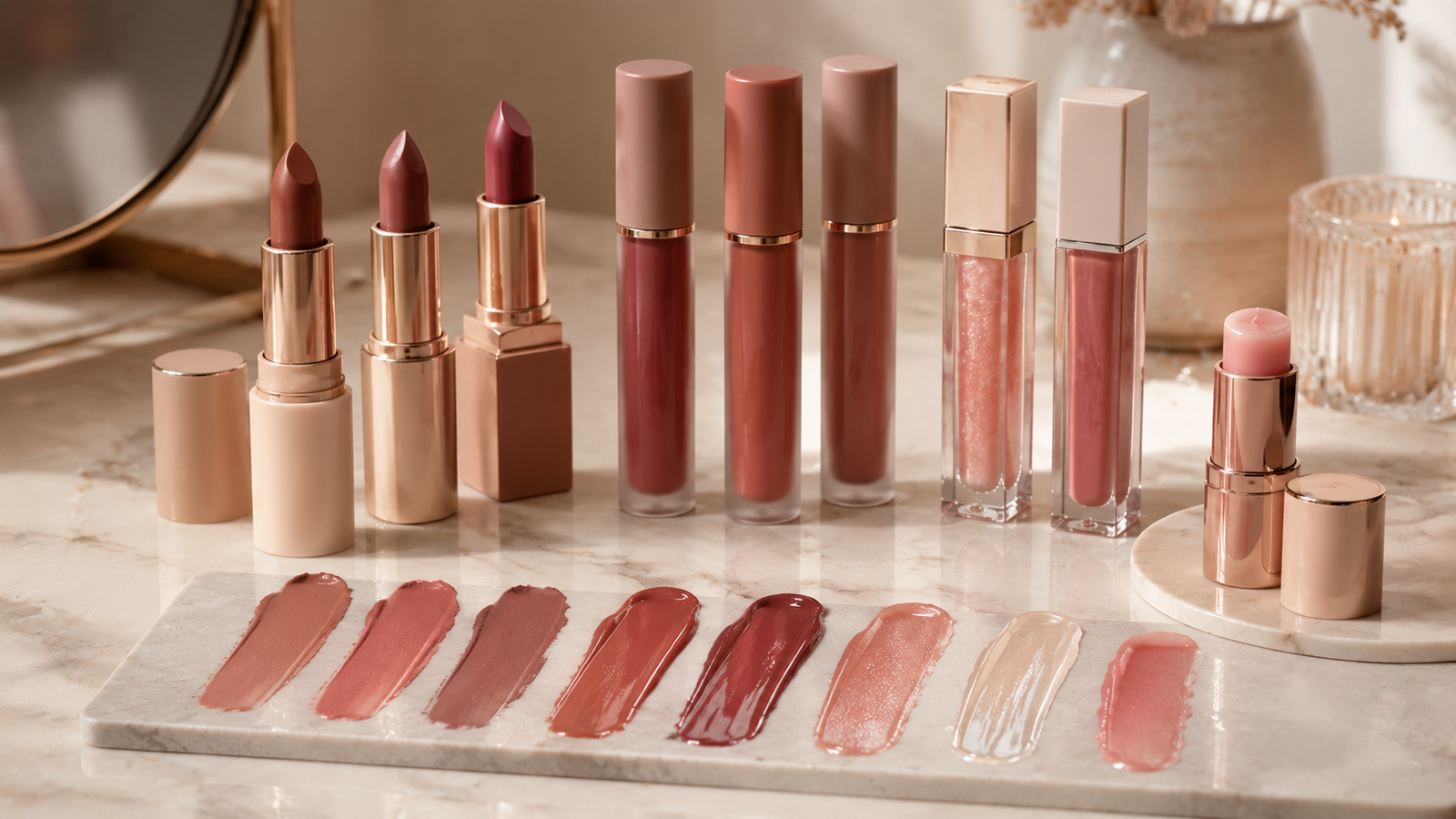
Lip products are among the easiest makeup products to buy—and among the easiest to collect without actually using.
A shade may look beautiful but feel uncomfortable after an hour. A lipstick may promise long wear but require more maintenance than you want. A gloss can create exactly the finish you like but may not provide enough colour. And two products described as “matte lipstick” can feel completely different on the lips.
Rather than choosing only by colour, it helps to consider four things:
finish, pigmentation, comfort and wear.
Once you know which of these matters most to you, choosing between lip balm, gloss, lipstick, liquid lipstick, stain and liner becomes much easier.
Start With the Result You Want
Before thinking about formulas, decide what you actually want your lip product to do.
You may want:
- subtle everyday colour;
- shine without much pigment;
- comfortable hydration;
- bold opaque colour;
- a soft matte look;
- long-lasting colour;
- something quick to apply without a mirror;
- more definition around the lip line.
There is no single “best” type of lip product.
Someone who values comfort and effortless reapplication may prefer a tinted balm.
Someone who wants stronger colour that stays visible for longer may prefer lipstick or a stain.
And someone who wants a polished lip shape may care more about lip liner than either.
Lip Balm: Best for Simplicity and Comfort
Lip balm is primarily used to provide a protective or conditioning layer to the lips.
Traditional balms may have little or no colour, while tinted versions combine conditioning with subtle pigment.
Consider a lip balm if you want:
- easy application;
- a natural appearance;
- minimal maintenance;
- comfortable everyday wear;
- subtle colour rather than strong coverage.
Tinted balms can be particularly useful for people who want their lips to look slightly more polished without feeling as though they are wearing obvious lipstick.
The trade-off is usually wear time.
Because balms tend to remain flexible and emollient, colour generally needs to be reapplied during the day.
For many people, that is not a disadvantage. Easy reapplication may matter more than longevity.
Lip Gloss: Best for Shine
Lip gloss creates a reflective finish that can make lips appear smoother and more dimensional.
Glosses range from:
- nearly transparent;
- lightly tinted;
- strongly pigmented;
- shimmer-containing;
- high-shine formulas.
Consider lip gloss if:
- shine is your main priority;
- you prefer a softer makeup look;
- you like layering products;
- you do not mind occasional reapplication.
Gloss can be worn alone or over lipstick and liner.
The texture matters considerably.
Some glosses are lightweight and slippery. Others are deliberately thicker or tackier, which can help them remain on the lips longer but may feel less comfortable to some users.
A glossy finish is not automatically hydrating, so distinguish the appearance of moisture from how the formula actually feels on your lips.
Traditional Lipstick: The Most Versatile Category
Traditional bullet lipstick remains one of the most flexible lip-product formats.
It can range from sheer and creamy to highly pigmented and matte.
Common finishes include:
- sheer;
- satin;
- cream;
- semi-matte;
- matte.
Sheer lipstick
Provides a wash of colour while allowing the natural lip tone to remain visible.
This can be useful for an everyday look or for shades that might feel too intense at full opacity.
Cream lipstick
Usually balances colour with a smoother, more emollient feel.
It may not last as long as drier matte formulas, but many people find it comfortable for everyday wear.
Satin lipstick
Satin finishes generally sit between creamy shine and full matte.
They can provide substantial pigment while retaining some softness and dimension.
Matte lipstick
Matte formulas minimise shine and can create a more defined, saturated appearance.
Some feel comfortable and flexible; others can feel noticeably drier.
The word matte tells you what the product is intended to look like, not necessarily how comfortable it will feel.
Liquid Lipstick: Strong Colour With Different Trade-Offs
Liquid lipsticks apply as a fluid or cream and then typically set to a more stable finish.
Many are designed around:
- strong pigmentation;
- precision;
- matte or semi-matte finishes;
- extended wear.
They can be useful when you want bold colour with less frequent reapplication.
But wear time comes with trade-offs.
Some long-wearing formulas may feel drier or less flexible than traditional lipstick. Others can become uncomfortable as the day progresses.
When choosing a liquid lipstick, think beyond whether it is “transfer-proof.”
Ask:
Would I still want to wear this for several hours?
Longevity matters only if the experience of wearing the product is acceptable to you.
Lip Stain: Colour That Becomes Part of the Look
Lip stains are designed to leave colour behind rather than maintaining a thick visible layer of product on the surface.
They can create anything from a subtle flushed effect to stronger colour.
Lip stains may suit you if:
- you dislike the feel of traditional lipstick;
- you want colour with less visible product;
- you want something that fades differently from creamy lipstick;
- you like natural or blurred lip looks.
Some stains can initially apply quite strongly before settling.
Because the natural colour and condition of your lips can influence the final appearance, stain shades may not look identical on everyone.
Lip Liner: More Than an Outline
Lip liner is often treated as optional, but it can serve several practical purposes.
It can:
- define the edge of the lips;
- adjust the appearance of lip shape;
- provide a base for lipstick;
- add colour on its own;
- help create a more precise application.
You do not necessarily need a separate liner for every lipstick.
A versatile neutral liner close to your natural lip colour can work with several shades.
Alternatively, matching the liner closely to your lipstick can create a more defined monochromatic result.
What Is a Lip Oil?
Lip oils have become another popular hybrid category.
They generally combine a glossy appearance with an emollient feel and may include tint.
Conceptually, they often sit somewhere between:
lip care + gloss
depending on the formula.
Choose one primarily if you enjoy a glossy, flexible lip product and prefer that texture over conventional gloss.
Do not assume that the word “oil” automatically means the product will suit every dry-lip concern—the complete formula still matters.
Choosing the Right Finish
Finish has a major effect on the overall appearance of a lip colour.
Glossy
Creates noticeable light reflection.
Good if you want:
- shine;
- visual fullness;
- a softer finish.
Satin
Provides some light reflection without looking strongly glossy.
Good if you want a balance between:
- pigment;
- dimension;
- comfort.
Cream
Usually looks smooth and slightly luminous.
A practical everyday option for many makeup styles.
Matte
Provides little visible shine.
Good if you want:
- strong definition;
- bold colour;
- a more graphic lip look.
Blurred or soft matte
Creates a less sharply defined matte appearance.
This can be useful for a softer, diffused makeup style.
How Much Pigmentation Do You Need?
Pigmentation describes how much colour the product deposits.
Sheer products
Allow your natural lip colour to influence the final shade.
They are often forgiving and easy to apply.
Medium pigmentation
Provides visible colour while still allowing some flexibility in application.
Opaque pigmentation
Produces stronger, more uniform colour.
This makes shade selection and application precision more important.
If you are new to a bold shade such as red, berry or deep brown, trying it first in a sheerer formula can be an easier introduction.
Your Natural Lip Colour Matters
Lip products do not appear against a blank canvas.
The natural pigmentation of your lips can affect how sheer and semi-sheer colours appear.
A pale nude shade, for example, may look very different depending on:
- natural lip depth;
- undertone;
- pigmentation;
- how opaque the product is.
This is why online swatches can be useful references without guaranteeing an identical result.
When possible, look for swatches on complexions or lip tones similar to yours.
Understanding Warm, Cool and Neutral Lip Colours
Just like complexion makeup, lip shades have undertones.
A red lipstick might lean:
- orange;
- blue;
- brown;
- pink;
- neutral.
A nude shade might lean:
- peach;
- beige;
- pink;
- caramel;
- mauve;
- brown.
There is no requirement that you wear only shades traditionally associated with your skin undertone.
Undertone is a tool for understanding how colours interact—not a rule restricting what you can wear.
What Does “Nude Lipstick” Actually Mean?
“Nude” should not mean one universal pale beige.
A useful nude shade generally relates in some way to the wearer’s natural colouring.
Depending on your complexion, that could mean:
- beige;
- peach;
- pink;
- rose;
- mauve;
- caramel;
- brown;
- deeper neutral tones.
The goal may be subtlety, but that does not require making the lips disappear.
For an everyday nude, consider looking for a shade relatively close to your natural lip colour but with the undertone and depth you prefer.
Comfort vs Longevity
One of the most useful ways to compare lip products is to think about the balance between comfort and wear time.
Very generally:
More emollient / glossy→ often easier and more comfortable to reapply→ usually more movement and transferMore set / long-wearing→ potentially longer-lasting colour→ may feel less flexible depending on formula
This is not an absolute rule. Modern formulations vary considerably.
But it explains why choosing purely by “longest lasting” can lead to a product you rarely wear.
The best everyday lip product is often the one whose compromises you are comfortable with.
Do You Actually Need Transfer-Proof Lipstick?
Transfer resistance can be useful if you:
- dislike frequent touch-ups;
- drink from cups throughout the day;
- want a more stable bold lip;
- need makeup to last through a longer event.
But maximum transfer resistance is not necessary for everyone.
A traditional lipstick that transfers slightly but feels comfortable and is easy to reapply may work better for normal daily use.
Choose the feature based on your routine rather than treating it as an automatic sign of a superior product.
How to Prepare Your Lips
Lip products tend to look better when applied to a reasonably smooth surface.
Before makeup:
- Make sure the lips feel comfortable.
- Apply lip balm if needed.
- Allow very rich balm to settle before applying strongly pigmented products.
- Remove excessive product if it prevents lipstick from adhering evenly.
Avoid aggressively scrubbing the lips simply to make lipstick look smoother.
If your lips are persistently cracked, painful or irritated, addressing that problem is more important than forcing a matte formula over them.
How to Apply Lipstick More Precisely
For everyday lipstick, direct application from the bullet may be completely adequate.
For a more precise result:
Step 1: Define the lip line
Use liner around the natural lip boundary.
Step 2: Fill the corners
Pay attention to areas that are easy to miss.
Step 3: Apply lipstick
Work from the centre outward.
Step 4: Check symmetry
Correct small areas rather than continuously enlarging the shape.
For bold colours, precision becomes more noticeable, so taking slightly more time can make a significant difference.
Should Lip Liner Be Darker Than Lipstick?
It can be—but it does not have to be.
For a seamless appearance, choose a liner close to the lipstick shade.
For greater dimension, a slightly deeper liner can create deliberate contrast.
The important part is that the difference looks intentional.
Makeup technique is aesthetic; there is no universal rule that liner must exactly match lipstick.
Can You Wear Lip Liner Alone?
Yes.
A liner can be:
- applied around the edges;
- softly blended inward;
- filled across the entire lip;
- topped with balm or gloss.
This can create a long-wearing base or a relatively simple lip look using fewer products.
If filling the whole lip with liner, consider whether the pencil texture remains comfortable over time.
How to Make Lip Colour Last Longer
If longevity matters, several techniques can help:
- begin with a thin, even application;
- use liner underneath where appropriate;
- avoid excessively thick layers;
- blot if suitable for the formula;
- reapply strategically rather than continuously layering.
The exact technique depends on the product.
A gloss will behave differently from a setting liquid lipstick, so there is no one method that makes every lip product last all day.
Why Lip Products Fade Unevenly
Lip colour experiences constant movement.
Throughout the day you may:
- speak;
- drink;
- eat;
- press your lips together;
- touch the lips.
The inner portion of the lips often encounters more moisture and friction than the outer edge, so some products can fade unevenly.
Highly visible long-wear shades can make this contrast more noticeable.
Before buying a product specifically for longevity, consider not just how long it lasts but how it looks as it wears away.
SPF Lip Products: A Separate Consideration
Some lip balms and lip products include labelled sun protection.
If sun protection is your goal, treat that as a functional feature rather than simply another makeup claim.
Follow the product’s directions and remember that a decorative lipstick applied occasionally is not automatically equivalent to intentionally using an appropriately labelled sun-protection lip product.
For everyday outdoor routines, this may be worth considering separately from colour and finish.
Common Lip Product Mistakes
Buying colour without considering formula
You may love the shade but dislike wearing the texture.
Evaluate both.
Choosing only by hand swatches
A shade can behave differently against your natural lip pigmentation.
Assuming matte always means long-lasting
Finish and wear are related but not identical.
Assuming glossy means moisturising
A shiny appearance does not necessarily tell you how conditioning the formula will feel.
Buying every product in the same shade family
Before purchasing another nude or pink lipstick, consider whether it creates a meaningfully different result from what you already own.
Prioritising longevity over comfort
A product lasting ten hours has little practical value if you want to remove it after two.
A Simple Lip Product Wardrobe
You do not need dozens of lip products to cover most situations.
A practical small collection might include:
1. Comfortable everyday option
Tinted balm, sheer lipstick or comfortable nude.
2. Glossy option
Clear or tinted gloss for shine.
3. More polished lipstick
A shade you can use for work, dinners or occasions.
4. Stronger statement shade
Perhaps red, berry, deeper brown or another colour you enjoy.
5. Versatile lip liner
Something compatible with several products you already own.
That can cover a surprisingly wide range of makeup looks.
A Simple Lip Product Selection Checklist
Before buying, ask:
1. What finish do I want?
Glossy, satin, cream or matte?
2. How much colour do I want?
Sheer, medium or opaque?
3. How much maintenance am I comfortable with?
Frequent easy reapplication or longer-lasting wear?
4. How important is comfort?
Would I sacrifice some longevity for a more flexible feel?
5. What does my natural lip colour do to the shade?
6. Do I already own something very similar?
7. Will I realistically wear this formula?
Those questions are usually more useful than simply asking which lipstick lasts longest.
The Physical Glow Takeaway
Choosing a lip product starts with understanding the experience you want from it.
Choose a balm or tinted balm when comfort and simplicity matter most.
Choose gloss when shine is the priority.
Choose traditional lipstick when you want versatility across finishes and coverage levels.
Choose a liquid lipstick when strong pigmentation and longer wear matter more.
Choose a stain when you want colour with less visible product sitting on the lips.
And use lip liner when greater definition, shape control or a colour base would improve the look.
The best product is not necessarily the longest-lasting or most pigmented one. It is the one whose colour, finish, comfort and maintenance level fit the way you actually wear makeup.