How to Choose Targeted Skincare Treatments for Your Skin Concerns
Learn how to choose targeted skincare treatments for specific concerns, with practical guidance on your main concern, active ingredients, strength, compatibility and tolerance. This beginner-friendly guide helps you make a clear, informed choice without unnecessary complexity.
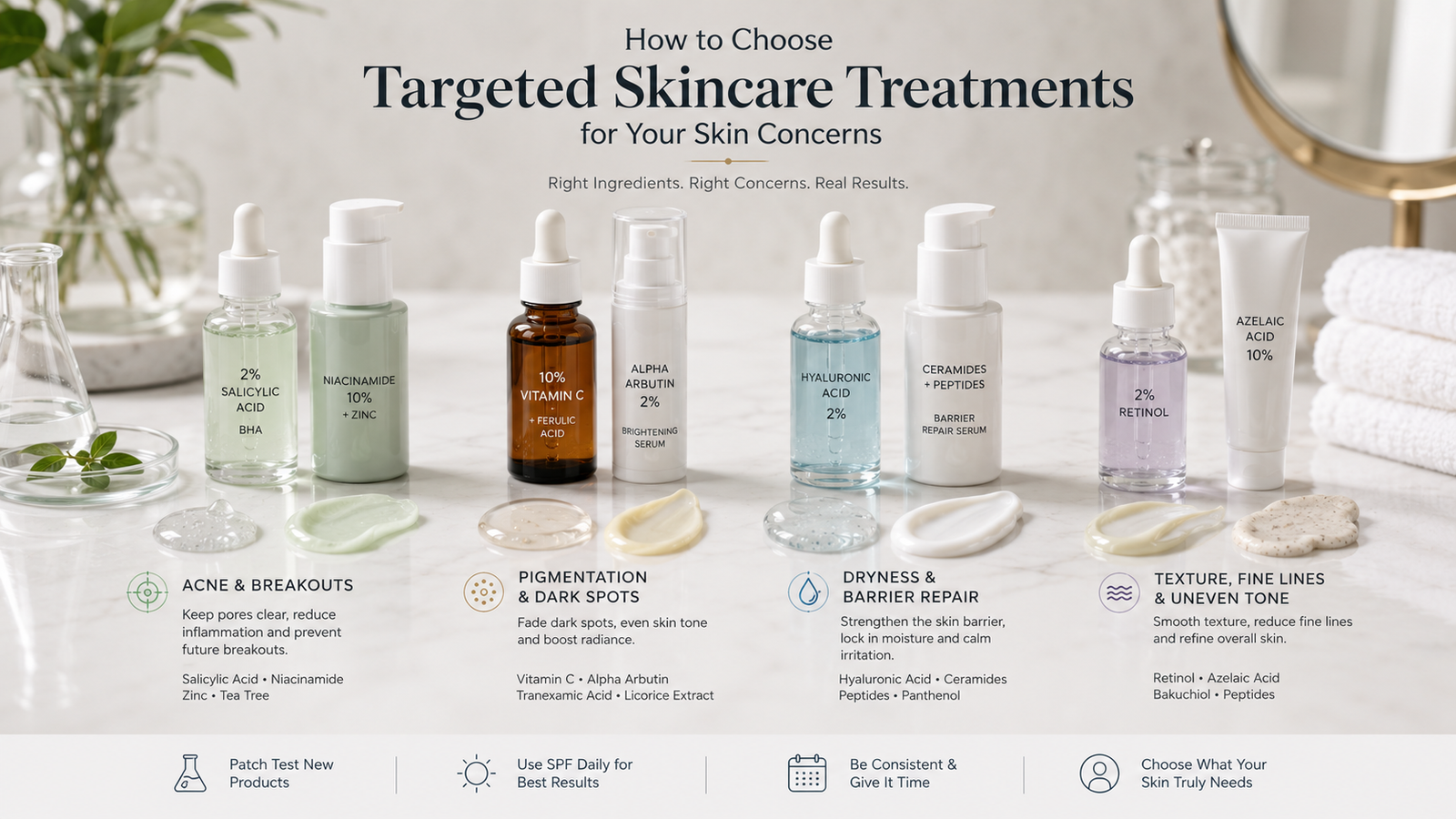
Targeted skincare treatments are products designed to address a specific concern more directly than a basic cleanser, moisturizer or sunscreen.
They may be used for concerns such as:
- acne;
- blackheads;
- dark spots;
- uneven tone;
- redness;
- fine lines;
- rough texture;
- dehydration;
- barrier damage.
The challenge is that targeted treatments are often where skincare routines become unnecessarily complicated.
It is easy to end up using:
- vitamin C;
- niacinamide;
- salicylic acid;
- glycolic acid;
- retinoid;
- azelaic acid;
- alpha-arbutin;
- peptide serum;
all at the same time.
That does not automatically create better results.
It can create:
- irritation;
- dryness;
- confusion;
- unnecessary cost;
- difficulty identifying which product is actually helping.
A better approach is:
identify your main concern → choose one evidence-supported treatment → introduce it gradually → keep the rest of the routine simple → assess results over time
The goal of targeted skincare is not to use the maximum number of active ingredients.
It is to use the fewest products necessary to address the concerns that actually matter to you.
What Is a Targeted Skincare Treatment?
A targeted treatment contains one or more ingredients intended to address a specific skin concern.
These products may come as:
- serums;
- creams;
- gels;
- lotions;
- toners;
- spot treatments;
- medicated products.
Examples include:
Salicylic Acid
Often used for:
- blackheads;
- clogged pores;
- oily skin.
Benzoyl Peroxide
Used for:
- inflammatory acne.
Retinoids
Used for concerns including:
- acne;
- photoageing;
- uneven texture.
Vitamin C
Often used for:
- antioxidant support;
- dullness;
- uneven-looking pigmentation.
Azelaic Acid
May be used for:
- acne;
- redness;
- post-acne marks.
Niacinamide
May support:
- barrier function;
- oil regulation;
- uneven tone.
The treatment should be selected according to the concern, not according to which ingredient is currently trending.
Start With a Basic Routine
Before adding targeted treatments, establish a basic skincare foundation.
For most people, this means:
Morning
- Gentle cleanser or rinse
- Moisturizer if needed
- Sunscreen
Evening
- Cleanser
- Moisturizer
This basic routine matters because targeted treatments often work better when the skin barrier is:
- comfortable;
- stable;
- not already irritated.
If your face is currently:
- burning;
- peeling;
- persistently red;
adding stronger active ingredients is unlikely to improve the situation.
Why a Simple Base Routine Matters
Suppose you start three active products simultaneously and develop irritation.
You may not know whether the problem came from:
- retinoid;
- exfoliating acid;
- vitamin C;
- combination of all three.
A simple foundation allows you to introduce one treatment at a time.
This makes it much easier to understand:
- what works;
- what irritates;
- what is unnecessary.
Choose Your Main Concern First
Ask:
What bothers me most about my skin?
Examples:
- acne;
- blackheads;
- pigmentation;
- rough texture;
- redness;
- dryness;
- signs of sun damage.
Prioritize one or two concerns.
Do not try to solve every visible imperfection simultaneously.
Many targeted ingredients can address more than one concern anyway.
Treatment for Blackheads and Clogged Pores
For blackheads and clogged pores, one of the most useful ingredients is:
salicylic acid
Salicylic acid is a beta-hydroxy acid that is oil-soluble.
This makes it particularly useful in oily environments around pores.
It may help improve:
- blackheads;
- whiteheads;
- congestion;
- excess oil.
How to Use Salicylic Acid
It may appear in:
- cleanser;
- toner;
- serum;
- spot treatment.
You generally do not need all of them.
Choose one primary salicylic-acid product.
For example:
Evening
- Cleanser
- Salicylic-acid leave-on treatment
- Moisturizer
Start:
- a few times per week;
depending on product instructions and tolerance.
Salicylic Acid for Oily Skin
Salicylic acid can be useful if oily skin is accompanied by:
- congestion;
- blackheads.
But oily skin does not need to be aggressively stripped.
Use moisturizer as needed.
Excessive exfoliation can create:
- irritation;
- dehydration.
Salicylic Acid for Dry Skin
Dry skin can use salicylic acid if clogged pores are a concern.
But use:
- lower frequency;
- moisturizing support.
A rinse-off salicylic-acid cleanser may be easier to tolerate than a strong leave-on product.
Treatment for Inflammatory Acne
Acne involving:
- red pimples;
- inflammatory lesions;
may respond to ingredients such as:
benzoyl peroxide
Benzoyl peroxide has antimicrobial activity against acne-associated bacteria and can help reduce inflammatory acne.
It may be available in:
- cleansers;
- gels;
- leave-on treatments.
Benzoyl Peroxide Strength
Higher strength does not automatically mean better results.
Lower concentrations can often provide meaningful benefit while causing less:
- dryness;
- irritation.
Follow product directions.
If acne is persistent or significant, medical treatment may be more appropriate than continually increasing OTC strength.
Benzoyl Peroxide Side Effects
Common issues include:
- dryness;
- peeling;
- irritation.
It can also bleach:
- towels;
- pillowcases;
- clothing.
Use white fabrics or take precautions.
Benzoyl Peroxide and Moisturizer
Moisturizer can improve comfort.
A simple routine:
- Cleanser
- Benzoyl-peroxide treatment
- Moisturizer
If irritation is significant, product frequency may need adjustment.
Salicylic Acid vs Benzoyl Peroxide
These ingredients address acne differently.
Salicylic Acid
Particularly useful for:
- blackheads;
- clogged pores;
- oily skin.
Benzoyl Peroxide
Particularly useful for:
- inflammatory acne.
Some acne routines use both.
But beginners may find it easier to introduce them separately.
Treatment for Acne and Texture: Retinoids
Retinoids are derivatives of vitamin A.
They are among the most important skincare treatment categories because certain retinoids have strong evidence for:
- acne;
- photoageing;
- fine lines;
- uneven texture.
Different retinoids vary substantially in:
- strength;
- formulation;
- prescription status.
Retinol vs Retinal vs Prescription Retinoids
Retinol
Common cosmetic retinoid.
Generally:
- milder;
- slower acting.
Retinal/Retinaldehyde
Closer to active retinoic acid in the conversion pathway.
May be more potent than retinol depending on formulation.
Prescription Retinoids
Examples include:
- tretinoin;
- adapalene in jurisdictions where prescription status varies.
These have stronger therapeutic evidence for specific indications.
Do not assume all products labelled “retinoid” perform identically.
Who Might Consider a Retinoid?
Retinoids may be useful for:
- acne;
- uneven texture;
- fine lines;
- sun-damaged appearance.
But they require patience.
They may initially cause:
- dryness;
- peeling;
- irritation.
Start gradually.
How to Introduce a Retinoid
A conservative approach might be:
First Few Weeks
Use:
- once or twice weekly.
If Comfortable
Gradually increase according to:
- product directions;
- tolerance.
Do not immediately use every night because social media says nightly use is optimal.
How Much Retinoid Should You Use?
For many facial retinoid products, a pea-sized amount for the entire face is commonly enough.
Follow the actual product instructions.
Using several times more product usually increases:
- irritation;
rather than effectiveness.
Retinoid Placement
Avoid applying too close to sensitive areas such as:
- eyelid margins;
- corners of nose;
- corners of mouth;
unless the product specifically allows it and your skin tolerates it.
These areas can irritate more easily.
The Retinoid Sandwich Method
If your skin is sensitive:
- Apply moisturizer.
- Apply retinoid.
- Apply moisturizer again.
This may reduce irritation.
You may sacrifice some intensity, but tolerability is more important than forcing aggressive use.
Retinoids and Sunscreen
Daily sunscreen is particularly important in any routine aimed at:
- photoageing;
- pigmentation;
- texture.
A simple pairing is:
Morning
Sunscreen.
Evening
Retinoid.
This is one of the most practical long-term skincare combinations.
Retinoids During Pregnancy
Retinoid use generally requires particular caution during pregnancy.
If you are:
- pregnant;
- trying to conceive;
- breastfeeding;
review the exact retinoid product with an appropriate healthcare professional before use.
Do not assume a cosmetic-strength retinol is automatically appropriate.
Treatment for Dark Spots and Uneven Tone
Pigmentation is one of the most common reasons people build complicated skincare routines.
Possible ingredients include:
- vitamin C;
- azelaic acid;
- niacinamide;
- alpha-arbutin;
- tranexamic acid;
- retinoids;
- AHAs.
But pigmentation treatment starts with:
sun protection
Without consistent sunscreen, many brightening treatments are much less effective.
Why Sunscreen Matters for Pigmentation
UV and, in some cases, visible light can contribute to:
- darkening;
- persistence;
- recurrence of pigmentation.
If you use brightening ingredients but skip sunscreen, you may be working against your own routine.
For pigmentation-prone skin, prioritize:
- broad-spectrum sunscreen;
- strong UVA protection.
Tinted sunscreen may also be useful for some forms of pigmentation.
Vitamin C
Vitamin C is an antioxidant.
Certain well-formulated vitamin C products may help support:
- protection against oxidative stress;
- brightening;
- uneven tone.
The best-studied form is:
L-ascorbic acid
but many derivatives are also used.
L-Ascorbic Acid
L-ascorbic acid can be effective but is relatively unstable.
Formulation factors such as:
- concentration;
- pH;
- packaging;
matter.
It may oxidize when exposed to:
- air;
- light;
- heat.
A darkening colour can indicate degradation.
Vitamin C Concentration
Higher concentration is not automatically better.
Very high levels may increase:
- irritation.
A well-formulated moderate-strength serum used consistently can be more useful than an extremely strong product your skin cannot tolerate.
Vitamin C for Sensitive Skin
Sensitive skin may prefer:
- lower-strength L-ascorbic acid;
- vitamin C derivatives.
Examples of derivatives include:
- sodium ascorbyl phosphate;
- magnesium ascorbyl phosphate;
- ascorbyl glucoside.
Evidence and performance vary.
But they may be easier to formulate and tolerate.
When to Use Vitamin C
Vitamin C is commonly used in the morning.
Example:
- Cleanser
- Vitamin C serum
- Moisturizer if needed
- Sunscreen
This allows antioxidant support to complement sun protection.
It can also be used at night.
Vitamin C and Sunscreen
Vitamin C does not replace sunscreen.
Think of it as:
antioxidant support + sunscreen
rather than:
vitamin C instead of sunscreen
Niacinamide
Niacinamide is a form of vitamin B3.
It is widely used because it may support:
- skin-barrier function;
- oil regulation;
- uneven tone;
- overall skin resilience.
It is one of the more versatile skincare ingredients.
Niacinamide for Oily Skin
Niacinamide may help with:
- oil balance;
- appearance of pores indirectly through oil reduction.
But it does not permanently shrink pores.
It can work particularly well in:
- oily;
- combination routines.
Niacinamide for Dry Skin
Niacinamide can also support barrier function.
It may be useful in moisturizers for:
- dry;
- sensitive skin.
You do not need to use it only because your skin is oily.
Does Niacinamide Need to Be 10%?
No.
Higher concentrations are not automatically more effective.
Many moisturizers use lower percentages successfully.
Some people find 10% or higher formulations:
- irritating;
- sticky.
Choose according to tolerability.
Niacinamide Serum vs Moisturizer
If your moisturizer already contains niacinamide, you may not need a separate serum.
Look for redundancy.
A simple moisturizer can often deliver the ingredient effectively enough for a basic routine.
Azelaic Acid
Azelaic acid is a versatile ingredient used for concerns including:
- acne;
- post-acne marks;
- redness;
- uneven tone.
It has anti-inflammatory and antimicrobial properties and may help with pigmentation pathways.
It is particularly useful because one ingredient can address several concerns simultaneously.
Who Might Consider Azelaic Acid?
It may be useful for:
- acne-prone skin;
- post-inflammatory hyperpigmentation;
- redness-prone skin.
It is sometimes used in routines for:
- rosacea;
under appropriate guidance.
Azelaic Acid Strength
Products may be available in different concentrations depending on:
- country;
- cosmetic vs prescription status.
Higher strengths may provide stronger effects but may also cause more:
- stinging;
- dryness.
Start according to product instructions.
Azelaic Acid Side Effects
Possible early effects include:
- tingling;
- mild stinging;
- dryness.
Persistent significant irritation is not something to ignore.
Reduce frequency or discontinue if necessary.
Azelaic Acid and Pregnancy
Azelaic acid is often considered among the more pregnancy-compatible acne/pigmentation treatment options, but pregnancy skincare decisions should still be reviewed with an appropriate clinician based on the exact product and situation.
Alpha-Arbutin
Alpha-arbutin is commonly used in products targeting:
- uneven pigmentation;
- dark spots.
It works through pathways involved in melanin production.
It may be useful for:
- post-acne marks;
- localized pigmentation.
It generally works gradually.
Alpha-Arbutin Is Not a Skin Bleach
The goal should be improving:
- uneven pigmentation;
not changing someone’s natural skin colour.
Be cautious with products making aggressive:
- whitening;
- bleaching;
claims.
Tranexamic Acid
Topical tranexamic acid is increasingly used in skincare for:
- uneven pigmentation;
- melasma-support routines.
Evidence is growing, but results depend on:
- formulation;
- concentration;
- consistency.
It should be used as part of a broader pigmentation routine including sunscreen.
Tranexamic Acid for Melasma
Melasma is complex and often influenced by:
- hormones;
- UV;
- visible light;
- heat;
- genetics.
Topical tranexamic acid may be useful in some cases, but melasma often benefits from dermatologist-directed treatment.
Do not expect one serum to permanently eliminate it.
Kojic Acid
Kojic acid is used in some products designed to reduce the appearance of pigmentation.
It can be effective but may cause:
- irritation;
- sensitivity.
Use carefully.
If irritation appears, discontinue or reduce use.
Licorice Extract
Licorice-derived ingredients may support:
- soothing;
- uneven-tone routines.
They are often included in:
- brightening serums;
- moisturizers.
They can be useful supportive ingredients.
But they are generally not as directly potent as prescription pigmentation treatments.
AHAs for Pigmentation
AHAs such as:
- glycolic acid;
- lactic acid;
can help improve superficial uneven pigmentation by increasing surface-cell turnover.
But excessive exfoliation can worsen inflammation and potentially make pigmentation more noticeable.
This is especially important for deeper skin tones.
Use controlled frequency.
Treatment for Redness
Redness can have many causes.
It may result from:
- irritation;
- acne;
- rosacea;
- barrier damage;
- environmental exposure.
The right treatment depends on the cause.
Do not assume redness always needs:
- stronger exfoliation;
- more acids.
Niacinamide for Redness
Niacinamide may support:
- barrier function;
- skin comfort.
It can be useful in mild redness related to barrier stress.
But it is not a treatment for every redness condition.
Azelaic Acid for Redness
Azelaic acid may help redness in certain acne and rosacea-related routines.
This makes it a useful multi-purpose treatment.
But persistent facial redness should be evaluated when:
- significant;
- recurrent;
- associated with flushing;
- accompanied by visible vessels.
Centella and Soothing Ingredients
Ingredients such as:
- centella asiatica;
- panthenol;
- beta-glucan;
- colloidal oatmeal;
may improve comfort.
They are useful when redness comes from:
- mild irritation;
- dryness.
But they are supportive rather than definitive medical treatments.
Treatment for Rough Texture
Rough surface texture may respond to:
- AHAs;
- retinoids;
- moisturization.
Which option is best depends on the cause.
Dry, Flaky Texture
Prioritize:
- moisturizer;
- barrier support.
Congested Texture
Consider:
- salicylic acid.
Dull Surface Roughness
Consider:
- AHA.
Long-Term Uneven Texture
Retinoids may help gradually.
Do not treat every texture concern with stronger scrubs.
Treatment for Enlarged-Looking Pores
No topical skincare product can permanently close pores.
But you may improve their appearance by addressing:
- oil;
- congestion;
- texture.
Useful ingredients may include:
- salicylic acid;
- niacinamide;
- retinoids.
The improvement is usually:
- optical;
- related to reduced congestion or oil.
Pores remain normal skin structures.
Treatment for Fine Lines
Fine lines can be influenced by:
- dehydration;
- facial movement;
- sun exposure;
- collagen changes.
Different strategies address different causes.
Dehydration Lines
These may look temporarily better with:
- moisturizer;
- humectants;
- hyaluronic acid.
Hydration can make the skin appear:
- plumper;
- smoother.
But this is not the same as reversing established wrinkles.
Retinoids for Fine Lines
Retinoids are among the better-supported topical categories for signs of photoageing.
Over time, they can improve:
- fine lines;
- texture;
- uneven pigmentation.
Results require:
- months;
- consistency.
They are not overnight treatments.
Peptides
Peptide products are often marketed for:
- firmness;
- collagen support;
- anti-ageing.
Different peptides have different evidence.
Some may provide useful benefits.
But peptides generally should not be prioritized over:
- sunscreen;
- retinoids;
- moisturizer;
for an evidence-focused anti-ageing routine.
Growth-Factor and Advanced Serums
Some premium products use:
- growth-factor-like proteins;
- signaling peptides;
- biotechnology-derived ingredients.
These can be interesting.
But they are not necessary for most skincare routines.
Evaluate:
- evidence;
- formulation;
- cost.
Do not assume higher price means proportionally greater benefit.
Treatment for Dullness
Dull-looking skin may result from:
- dehydration;
- surface-cell buildup;
- uneven pigmentation.
Therefore, choose treatment according to the likely cause.
Dehydrated Dullness
Use:
- moisturizer;
- humectants.
Rough Dullness
Consider:
- AHA.
Uneven Pigmentation
Consider:
- vitamin C;
- azelaic acid;
- alpha-arbutin;
- other pigmentation treatments.
Sun-Related Dullness
Prioritize:
- sunscreen.
Treatment for Dehydration
Dehydration is best addressed with:
- humectants;
- moisturizer;
- reduced irritation.
Useful ingredients include:
- glycerin;
- hyaluronic acid;
- panthenol;
- beta-glucan.
But dehydration is often worsened by:
- aggressive cleansing;
- over-exfoliation.
Adding more serum without fixing the cause may not solve the problem.
Hyaluronic Acid Serum
Hyaluronic-acid serums can provide:
- lightweight hydration;
- temporary plumping.
They are particularly useful for:
- dehydrated skin.
But if your moisturizer already contains effective humectants, a separate HA serum may be redundant.
Treatment for Damaged Skin Barrier
If your skin is:
- burning;
- peeling;
- unusually sensitive;
- stinging when moisturizer is applied;
the priority should be barrier recovery, not active treatment.
Temporarily simplify.
Morning
- Gentle cleanse/rinse
- Moisturizer
- Sunscreen
Evening
- Gentle cleanser
- Moisturizer
Pause strong:
- acids;
- scrubs;
- retinoids;
until the skin is comfortable.
Barrier-Support Ingredients
Useful ingredients may include:
- ceramides;
- cholesterol;
- fatty acids;
- glycerin;
- panthenol;
- petrolatum;
- dimethicone.
You do not need a dedicated “barrier serum” if your moisturizer already contains these.
How to Prioritize Multiple Concerns
Suppose you have:
- acne;
- dark spots;
- texture.
Instead of using three separate treatment serums, choose an ingredient that addresses several concerns.
For example:
Retinoid
May support:
- acne;
- texture;
- pigmentation.
Azelaic Acid
May support:
- acne;
- redness;
- post-acne marks.
Salicylic Acid
May support:
- congestion;
- oiliness;
- blackheads.
This keeps the routine simpler.
One Treatment Can Solve More Than One Problem
This is one of the most useful skincare principles.
Do not think:
one concern = one serum
Instead, look for overlap.
For example:
Niacinamide
May help:
- barrier function;
- oil regulation;
- uneven tone.
Retinoid
May help:
- acne;
- texture;
- photoageing.
Azelaic Acid
May help:
- acne;
- redness;
- pigmentation.
A simpler routine is often easier to maintain.
How Many Active Ingredients Should You Use?
There is no universal maximum.
But beginners should usually start with:
one main targeted treatment
Once that is tolerated and useful, a second treatment can be considered.
You do not need five actives because each has a different marketing claim.
Introduce One Treatment at a Time
This is critical.
When starting a new active:
- Keep the rest of the routine stable.
- Introduce one product.
- Observe for several weeks.
- Add another only if needed.
This makes it easier to identify:
- benefit;
- irritation;
- breakouts.
Why Skincare Routines Become Irritating
Common combinations include:
- retinoid;
- glycolic acid;
- salicylic acid;
- benzoyl peroxide.
Each can be useful.
But together they can increase:
- dryness;
- peeling;
- irritation.
Your skin responds to total treatment intensity.
It does not care that the products came from different categories.
Can You Use Vitamin C and Niacinamide Together?
Yes.
The old claim that they must never be combined is outdated.
Modern formulations can generally be used together.
But that does not mean you need both.
If your routine already works, adding niacinamide because you use vitamin C is unnecessary.
Can You Use Vitamin C and Retinol Together?
Potentially, yes.
But beginners may find using them at different times easier.
For example:
Morning
Vitamin C.
Evening
Retinoid.
This keeps the routine simple and may reduce irritation.
Can You Use Retinol and AHA Together?
They can technically be used within the same overall routine.
But combining them on one night can be irritating.
A safer approach:
Monday
Retinoid.
Wednesday
AHA.
Friday
Retinoid.
Adjust according to tolerance.
Can You Use Retinol and Salicylic Acid Together?
Again, possible but potentially irritating.
If treating acne, some people may use:
Morning
Salicylic acid.
Evening
Retinoid.
Or alternate days.
There is no need to maximize intensity immediately.
Can You Use Benzoyl Peroxide and Retinoids Together?
This depends on the specific retinoid and formulation.
Some combinations are specifically formulated and medically used.
However, separate OTC products may create significant:
- irritation.
Some retinoids can also be affected by certain formulations.
If using a prescription acne regimen, follow the prescriber’s instructions rather than creating your own combinations.
Can You Use Azelaic Acid and Retinoid Together?
Yes, they can often coexist.
A simple approach:
Morning
Azelaic acid.
Evening
Retinoid.
Or alternate evenings.
Start gradually.
Can You Use Azelaic Acid and Niacinamide Together?
Yes.
This is generally a compatible combination.
But if both are already in well-formulated products, avoid unnecessary duplication.
Can You Use Vitamin C and AHA Together?
They can be used in the same routine, but this may increase irritation.
If you are sensitive:
- vitamin C in morning;
- AHA on selected evenings.
There is no prize for fitting every active into one routine.
Can You Use Multiple Brightening Ingredients Together?
Yes, but carefully.
For example, a pigmentation serum may already combine:
- niacinamide;
- alpha-arbutin;
- tranexamic acid.
That can be simpler than layering three separate serums.
Choose a well-formulated multi-active product rather than endlessly stacking.
Morning vs Evening Treatments
Some treatments are easier to use at particular times.
Morning-Friendly
- vitamin C;
- niacinamide;
- azelaic acid;
- hydrating serums.
Evening-Friendly
- retinoids;
- stronger exfoliating acids.
But these are not absolute rules.
The product instructions matter most.
Treatment Order
A simple general sequence is:
- Cleanser
- Thin treatment serum
- Moisturizer
- Sunscreen in morning
You do not need to obsess over whether one watery serum must go 30 seconds before another.
The main priorities are:
- follow product instructions;
- avoid excessive layering;
- maintain comfort.
Thin to Thick Rule
You may hear:
apply products from thinnest to thickest
This is a useful general guide.
But it is not a scientific law.
Some treatment products have specific directions that override texture order.
For example:
- prescription treatments;
- retinoids;
- medicated creams.
Follow their instructions.
How Long Should You Wait Between Products?
Usually, you do not need long waiting periods.
Allow each product enough time to:
- spread;
- stop feeling excessively wet.
Then continue.
Exceptions may apply when a product specifically instructs:
- dry skin application;
- waiting period.
Do not turn a simple routine into a 45-minute process unless necessary.
Patch Testing
Patch testing can be useful for:
- sensitive skin;
- stronger actives;
- products with many botanical ingredients.
Apply to a limited area according to directions.
Watch for:
- persistent redness;
- itching;
- swelling;
- burning.
Patch testing cannot guarantee no reaction across the whole face, but it may identify obvious intolerance.
What Is Purging?
Purging is often used to describe temporary acne worsening after starting ingredients that increase skin-cell turnover.
It may occur with treatments such as:
- retinoids;
- exfoliating acids.
But many supposed purges are actually:
- irritation;
- breakouts from unsuitable products;
- normal acne fluctuation.
How to Tell Purging From Irritation
Purging may occur in areas where you commonly develop acne.
Irritation may also include:
- burning;
- itching;
- redness;
- widespread tiny bumps;
- peeling.
If your entire face becomes uncomfortable, do not assume this is healthy purging.
Simplify the routine.
How Long Should You Give a Treatment?
Skincare often takes longer than expected.
Approximate timing depends on the concern.
Hydration
May improve relatively quickly.
Acne
Often requires:
- several weeks;
- sometimes months.
Pigmentation
Often requires:
- weeks to months.
Fine Lines
Retinoid-related improvements may take:
- several months.
Do not switch products every five days.
Take Progress Photos
If you are treating:
- acne;
- pigmentation;
- texture;
photos can help.
Use:
- similar lighting;
- same camera;
- similar angle.
Compare every few weeks rather than checking the mirror obsessively every day.
Gradual changes can be difficult to notice otherwise.
Why Stronger Is Not Always Better
Skincare marketing often encourages:
- 20% vitamin C;
- 10% niacinamide;
- 30% acid peel;
- maximum-strength retinoid.
But higher strength may produce:
- more irritation;
- lower consistency.
The best treatment is one that you can use regularly without damaging your skin barrier.
Why More Frequent Is Not Always Better
Applying an active every day may sound more effective.
But if daily use causes:
- peeling;
- redness;
- frequent breaks;
you may achieve less than someone using the same product:
- three times per week consistently.
Consistency matters more than intensity.
Spot Treatment vs Full-Face Treatment
Some treatments are designed for:
- individual blemishes.
Others work best over the acne-prone area.
For example:
Benzoyl-Peroxide Spot Treatment
May be used on specific inflamed pimples depending on the product.
Retinoid
Often works best across the acne-prone area rather than only on individual spots because it helps prevent future comedones.
Follow product instructions.
Acne Patches
Hydrocolloid patches can be useful for:
- superficial pimples;
- lesions that have come to a head.
They may:
- absorb fluid;
- reduce picking.
They do not prevent all forms of acne.
They are less useful for:
- deep cysts;
- blackheads.
Pimple Patches With Actives
Some patches contain:
- salicylic acid;
- niacinamide;
- microneedle-style projections.
Effectiveness varies.
The biggest benefit of a basic hydrocolloid patch may simply be:
- protection from touching.
Treatment for Picking and Acne Marks
If you frequently pick blemishes, the most effective targeted strategy may include:
- hydrocolloid patches;
- reducing touching;
- proper acne treatment.
Picking increases risk of:
- inflammation;
- pigmentation;
- scarring.
A brightening serum cannot fully compensate for repeated trauma.
Dark Spot Correctors
Products marketed as dark spot correctors may combine:
- niacinamide;
- alpha-arbutin;
- tranexamic acid;
- vitamin C derivatives;
- exfoliating acids.
These can be convenient.
Check whether the formula duplicates treatments you already use.
Spot Treatment for Pigmentation
Localized application can be useful for:
- individual post-acne marks.
But some pigmentation conditions cover wider areas.
In those cases, a full-face or region-based treatment may make more sense.
Skin Lightening vs Pigmentation Treatment
The goal of pigmentation treatment should be:
- making uneven pigmentation more uniform;
not attempting to change someone’s natural complexion.
Be cautious with products marketed as:
- whitening;
- bleaching;
- fairness treatments.
Especially avoid unregulated products containing undisclosed or inappropriate ingredients.
Hydroquinone
Hydroquinone is a potent pigmentation treatment used in some countries under:
- prescription;
- OTC frameworks depending on jurisdiction.
It can be effective for certain pigmentation disorders.
But it should not be treated like a casual cosmetic brightening serum.
Long-term or inappropriate use can cause complications.
Professional dermatological guidance is appropriate.
Steroid-Containing Fairness Creams
Avoid using topical corticosteroid creams for cosmetic skin lightening unless prescribed for a legitimate medical condition.
Improper steroid use can cause:
- skin thinning;
- acne-like eruptions;
- visible blood vessels;
- rebound symptoms.
Unregulated combination fairness creams can be particularly problematic.
Mercury in Skin-Lightening Products
Some illegal or poorly regulated skin-lightening products have been found to contain mercury.
Mercury exposure can be harmful.
Buy skincare from:
- reputable;
- regulated sources.
Avoid products with:
- unclear ingredients;
- suspiciously dramatic claims.
Treatment for Melasma
Melasma is a complex pigmentation condition.
Management may include:
- strong sun protection;
- visible-light protection;
- topical treatments;
- dermatologist-prescribed therapy.
Useful ingredients may include:
- azelaic acid;
- tranexamic acid;
- hydroquinone under appropriate medical guidance;
- retinoids in suitable patients.
Do not expect one brightening serum to permanently cure melasma.
Treatment for Post-Inflammatory Hyperpigmentation
PIH often follows:
- acne;
- irritation;
- injury.
Useful strategies include:
- sunscreen;
- azelaic acid;
- retinoids;
- AHAs;
- niacinamide;
- pigment-focused ingredients.
But the first priority is controlling whatever causes the inflammation.
Otherwise, new marks continue forming.
Treatment for Post-Inflammatory Erythema
Red or pink post-acne marks are different from brown pigmentation.
These vascular-type marks may fade gradually.
Using harsh brightening acids does not necessarily accelerate the process.
Avoid excessive irritation.
If persistent or severe, dermatological procedures may be more effective than topical cosmetics.
Treatment for Rosacea
Rosacea is not simply ordinary redness.
It may involve:
- flushing;
- persistent redness;
- bumps;
- visible blood vessels.
Some topical treatments such as azelaic acid may be used.
But diagnosis and management are best guided medically when symptoms are significant.
Avoid treating persistent rosacea with repeated exfoliation.
Treatment for Eczema
Eczema requires:
- barrier support;
- avoidance of triggers;
- medical treatment when needed.
Strong targeted cosmetic serums are usually not the priority during active eczema.
Use:
- gentle cleanser;
- rich moisturizer.
Prescription anti-inflammatory treatment may be necessary.
Treatment for Seborrheic Dermatitis
Seborrheic dermatitis may cause:
- redness;
- oily scaling;
- flaking;
commonly around:
- nose;
- eyebrows;
- scalp.
This is not simply dry skin.
Antifungal or other medical treatments may be required.
Do not continually apply rich oils assuming flakes mean dryness.
Treatment for Perioral Dermatitis
Perioral dermatitis can appear as:
- small bumps;
- redness;
around the mouth or nose.
Heavy creams and inappropriate steroid use may worsen it.
If you suspect this condition, simplify the routine and seek appropriate medical advice.
Treatment for Keratosis Pilaris
Keratosis pilaris commonly affects:
- upper arms;
- thighs.
Useful topical ingredients may include:
- lactic acid;
- salicylic acid;
- urea.
Moisturizing consistently is important.
Avoid aggressive scrubbing.
Body Acne Treatments
Body acne may respond to:
- benzoyl-peroxide washes;
- salicylic-acid products.
Use carefully because benzoyl peroxide can bleach fabrics.
Persistent:
- chest acne;
- back acne;
may require dermatological treatment.
Treatment for Ingrown Hairs
Ingredients such as:
- salicylic acid;
- glycolic acid;
may help reduce surface buildup around follicles.
Avoid using immediately after aggressive:
- waxing;
- shaving;
if skin is irritated.
Treatment for Razor Bumps
Razor bumps may occur when hairs curl back into the skin.
Helpful approaches may include:
- improved shaving technique;
- salicylic acid;
- glycolic acid.
Persistent cases may benefit from professional advice.
Can Targeted Treatments Be Used on the Neck?
Some can.
But neck skin may be more sensitive.
Retinoids and acids may cause more irritation there.
Introduce:
- lower frequency;
- smaller amount.
Do not assume your neck tolerates exactly what your face does.
Can Treatments Be Used Around the Eyes?
Be cautious.
Many treatments specifically advise avoiding:
- eyelids;
- immediate eye area.
Do not apply:
- acids;
- acne treatments;
- strong retinoids;
close to the eye unless the product is designed for that area.
Eye Cream With Retinol
Some eye creams contain low-strength retinoids specifically formulated for the orbital area.
These may be easier to tolerate.
Still introduce gradually.
Stop if you develop:
- significant irritation;
- persistent dryness.
Do You Need an Eye Serum?
Usually not.
If your concern is:
- dryness;
a gentle moisturizer may be enough.
If you want a targeted eye product, choose one for a clear purpose.
Do not add an eye serum simply because the category exists.
Treatment for Lips
Avoid applying facial actives directly to the lips unless the product is designed for them.
Strong:
- acids;
- retinoids;
can cause significant irritation.
For dry lips, prioritize:
- simple balm;
- petrolatum;
- appropriate lip moisturizer.
Targeted Treatments During Pregnancy
Pregnancy requires extra attention to active skincare.
Some ingredients have clearer pregnancy-use profiles than others.
If you are:
- pregnant;
- trying to conceive;
- breastfeeding;
review stronger active ingredients with your clinician.
Particular caution applies to:
- retinoids;
- prescription acne treatments.
Do not rely on social-media lists alone.
Treatments for Sensitive Skin
Sensitive skin can still use targeted treatments.
The strategy should be:
- lower strength;
- lower frequency;
- simpler routine.
Potentially gentler options include:
- niacinamide at moderate levels;
- azelaic acid;
- PHA;
- low-strength retinoids depending on tolerance.
But there is no universally safe active for all sensitive skin.
How to Buffer Strong Treatments
Buffering means reducing direct treatment intensity using moisturizer.
For example:
moisturizer → retinoid
or:
moisturizer → azelaic acid
depending on the product and directions.
This can improve tolerance.
Does Buffering Make Treatments Ineffective?
Not necessarily.
It may reduce penetration somewhat, but a treatment you tolerate consistently is often more useful than one you apply aggressively and then stop due to irritation.
Should Treatments Burn?
No.
Some products may cause:
- mild tingling;
- transient warmth.
But persistent:
- burning;
- pain;
- severe stinging;
is not a sign of superior effectiveness.
If this occurs:
- rinse where appropriate;
- discontinue;
- reassess.
The Skin Barrier Comes First
If your routine causes:
- constant peeling;
- redness;
- discomfort;
you may be using too many actives.
An impaired barrier can make every product feel irritating.
Reduce the routine to:
gentle cleanse → moisturizer → sunscreen
until the skin becomes comfortable again.
Signs You Are Using Too Many Treatments
Watch for:
- moisturizer suddenly stinging;
- persistent redness;
- peeling;
- shiny but tight skin;
- increased sensitivity;
- frequent irritation.
These are signals to simplify.
What Is “Active Overload”?
Active overload occurs when multiple treatment ingredients are used without enough attention to:
- total irritation;
- frequency;
- skin tolerance.
For example:
Morning
Vitamin C + exfoliating toner + niacinamide + acne serum.
Evening
BHA + retinol + benzoyl peroxide.
Each ingredient may be useful individually.
Together, the routine may be unnecessarily aggressive.
How to Simplify an Overloaded Routine
Choose:
One Main Treatment
Example:
- retinoid.
One Supporting Treatment
Example:
- azelaic acid.
Then use:
- moisturizer;
- sunscreen.
Remove duplicate serums.
Assess for several weeks.
Can You Cycle Active Ingredients?
Yes.
Some people prefer schedules such as:
Monday
Retinoid.
Tuesday
Recovery.
Wednesday
Exfoliant.
Thursday
Recovery.
This is sometimes called:
- skin cycling.
The concept can help prevent excessive active use.
But you do not need to follow a rigid named system.
Simply space irritating treatments according to tolerance.
Do You Need a “Recovery Night”?
Not necessarily.
But nights containing only:
cleanser → moisturizer
can be useful.
Your skin does not need an active treatment every evening.
How Long Should You Test a Treatment?
If the product is tolerated, give it enough time.
A reasonable assessment period may be:
- 6–12 weeks;
for many concerns.
Pigmentation and photoageing can take longer.
Do not expect:
- dark spots;
- acne scars;
- wrinkles;
to disappear in one week.
When Should You Stop a Treatment?
Stop or reassess if you develop:
- severe irritation;
- rash;
- swelling;
- persistent burning;
- worsening dermatitis.
Also stop if the product simply provides no meaningful benefit after a reasonable trial and correct use.
Not every ingredient works equally well for every person.
Does Expensive Treatment Work Better?
Not necessarily.
Many highly effective ingredients are inexpensive:
- salicylic acid;
- benzoyl peroxide;
- niacinamide;
- azelaic acid;
- retinoids.
Premium products may offer:
- elegant texture;
- specialized delivery;
- sophisticated packaging.
But price does not guarantee better clinical performance.
When Is a Premium Serum Worth It?
Possibly when it offers:
- better stability;
- more tolerable formulation;
- useful ingredient combination;
- packaging that protects unstable actives.
For example, vitamin C formulation quality matters.
But for simple niacinamide, expensive packaging may add little.
Ingredient Percentage Is Not Everything
Consumers often compare products only by percentage.
But effectiveness depends on:
- ingredient form;
- pH;
- vehicle;
- stability;
- penetration;
- supporting ingredients.
A 10% product is not automatically twice as effective as a 5% product.
Why Formulation Matters
For example, vitamin C may degrade if poorly formulated.
A retinoid may be:
- encapsulated;
- stabilized.
An acid’s activity depends partly on:
- pH.
This is why ingredient-list comparison alone cannot completely predict performance.
Packaging Matters for Some Actives
Ingredients sensitive to:
- light;
- air;
may benefit from protective packaging.
Examples include some forms of:
- vitamin C;
- retinoids.
Opaque or air-limiting packaging may improve stability.
Fragrance in Treatment Serums
Fragrance is not necessary for treatment efficacy.
If your skin is sensitive, fragrance-free formulas may reduce one potential source of irritation.
Especially when using already active ingredients, additional fragrance may add little value.
Essential Oils in Treatments
Essential oils can cause irritation in some users.
They do not make a treatment more effective simply because they are botanical.
If the main goal is acne or pigmentation, prioritize the active ingredient over scent.
Alcohol in Treatment Products
Volatile alcohol may be used to:
- improve penetration;
- create lightweight texture.
This is not automatically bad.
But high-alcohol formulas may be drying for some skin types.
Judge the entire formulation.
“Clean” Active Skincare
Clean beauty has no single scientific definition.
A treatment is not automatically safer because it excludes:
- silicones;
- parabens;
- synthetic ingredients.
Evidence and formulation quality matter more.
Natural Treatments
Natural ingredients can be useful.
But natural does not mean:
- safer;
- stronger;
- better.
Examples such as:
- lemon juice;
- baking soda;
- undiluted essential oils;
can irritate skin significantly.
Use properly formulated products.
DIY Vitamin C Serum
Homemade vitamin C serum has problems with:
- pH;
- concentration;
- oxidation;
- preservation.
A properly formulated product is more reliable.
Lemon Juice for Dark Spots
Avoid.
Raw lemon juice can cause:
- irritation;
- unpredictable acidity;
- photosensitivity-related concerns.
Use formulated pigmentation treatments instead.
Toothpaste on Pimples
Avoid using toothpaste as an acne treatment.
It may contain ingredients that irritate facial skin.
Use:
- benzoyl peroxide;
- salicylic acid;
- hydrocolloid patch;
where appropriate.
Baking Soda for Acne
Avoid.
Its high pH can disrupt the skin barrier.
It is not a suitable acne treatment.
Essential Oils for Acne
Tea tree oil has some antimicrobial evidence, but undiluted essential oils can cause:
- irritation;
- dermatitis.
A properly formulated product is safer than applying concentrated essential oil directly.
Targeted Treatment Routine for Blackheads
Morning
- Gentle cleanser
- Moisturizer if needed
- Sunscreen
Evening — Selected Nights
- Cleanser
- Salicylic-acid treatment
- Moisturizer
Other nights:
cleanser → moisturizer
Targeted Treatment Routine for Inflammatory Acne
Morning
- Gentle cleanser
- Benzoyl-peroxide treatment if appropriate
- Moisturizer
- Sunscreen
Evening
- Cleanser
- Retinoid if appropriate
- Moisturizer
This combination may be highly effective but can be irritating, so professional guidance is useful for persistent acne.
Targeted Routine for Post-Acne Marks
Morning
- Cleanser
- Vitamin C or niacinamide
- Moisturizer if needed
- Sunscreen
Evening
- Cleanser
- Azelaic acid or retinoid
- Moisturizer
You do not need every brightening ingredient simultaneously.
Targeted Routine for Hyperpigmentation
Morning
- Cleanser
- Vitamin C or pigment serum
- Moisturizer
- High-protection sunscreen
Evening
- Cleanser
- Azelaic acid, retinoid or dedicated pigment treatment
- Moisturizer
Consistency matters.
Targeted Routine for Fine Lines
Morning
- Cleanser
- Antioxidant serum if desired
- Moisturizer
- Sunscreen
Evening
- Cleanser
- Retinoid
- Moisturizer
This is generally more rational than purchasing several “anti-ageing” serums with overlapping claims.
Targeted Routine for Sensitive, Uneven Skin
Morning
- Gentle cleanser
- Niacinamide or azelaic acid if tolerated
- Moisturizer
- Sunscreen
Evening
- Gentle cleanser
- Treatment only a few times per week
- Moisturizer
Keep the routine conservative.
Targeted Routine for Damaged Barrier
Morning
- Rinse or gentle cleanser
- Moisturizer
- Sunscreen
Evening
- Gentle cleanser
- Moisturizer
Temporarily pause:
- exfoliants;
- retinoids;
- unnecessary serums.
Recovery comes before treatment.
Targeted Routine for Oily, Congested Skin
Morning
- Gentle cleanser
- Niacinamide if useful
- Lightweight moisturizer if needed
- Sunscreen
Evening
- Cleanser
- Salicylic acid
- Lightweight moisturizer
Do not use strong astringent toner simply to make the face feel squeaky clean.
Targeted Routine for Dry, Dull Skin
Morning
- Gentle cleanse/rinse
- Vitamin C if desired
- Rich moisturizer
- Sunscreen
Selected Evenings
- Cleanser
- Mild lactic acid or retinoid depending on goal
- Moisturizer
Do not use both immediately if your skin is sensitive.
Common Targeted-Treatment Mistakes
Treating Every Concern at Once
Prioritize.
Using Several Products With the Same Active
Check ingredient duplication.
Increasing Strength Too Quickly
More irritation does not mean faster improvement.
Adding a New Product Every Week
You will never know what works.
Expecting Overnight Results
Most skin concerns require time.
Ignoring Sunscreen While Treating Pigmentation
Counterproductive.
Using Retinoid and Multiple Acids Immediately
Often too irritating.
Assuming Every Breakout Is Purging
It may be irritation.
Using Spot Treatments on Broken Skin
Allow wounds to heal.
Buying by Percentage Alone
Formulation matters.
Chasing Trends
Choose according to your skin concern.
Continuing a Product That Burns
Pain is not proof of effectiveness.
Using Cosmetic Products for Medical Skin Conditions
Some concerns need professional treatment.
How to Build a Targeted Routine Step by Step
Step 1 — Identify the Main Concern
Choose one.
Step 2 — Select One Evidence-Supported Ingredient
For example:
- blackheads → salicylic acid;
- inflammatory acne → benzoyl peroxide;
- acne + texture → retinoid;
- post-acne marks → azelaic acid;
- dullness → vitamin C or AHA;
- dehydration → humectants;
- fine lines → retinoid.
Step 3 — Introduce It Gradually
Do not immediately use daily unless appropriate.
Step 4 — Keep the Rest Simple
Use:
- cleanser;
- moisturizer;
- sunscreen.
Step 5 — Assess After Several Weeks
Look for:
- improvement;
- irritation.
Step 6 — Add Another Treatment Only if Needed
Choose something that addresses a remaining concern.
This is a much more reliable approach than starting an eight-product routine.
Targeted-Treatment Buying Checklist
Before buying, ask:
1. What exact concern am I treating?
If you cannot answer this clearly, you may not need the product.
2. Is this ingredient appropriate for that concern?
Do not rely only on marketing claims.
3. Do I already use another product with the same active?
Avoid duplication.
4. Am I already using strong treatments?
Consider total irritation.
5. Is the concentration sensible for my experience level?
Start lower when appropriate.
6. Can I use it consistently?
Consistency matters more than maximum strength.
7. Does the packaging protect the formula?
Important for unstable actives.
8. Does my routine include moisturizer?
Treatment should not come at the expense of barrier support.
9. Does my routine include sunscreen?
Especially important for pigmentation and photoageing.
10. Am I expecting a cosmetic serum to treat a medical condition?
Know when professional care is more appropriate.
When Should You See a Dermatologist?
Seek professional advice if you have:
- persistent moderate-to-severe acne;
- painful cysts or nodules;
- acne scarring;
- rapidly worsening pigmentation;
- suspected melasma;
- persistent rosacea;
- eczema;
- unusual rash;
- repeated skincare reactions;
- a skin lesion that changes or does not heal.
Professional treatment may include:
- prescription topical medication;
- oral medication;
- procedures;
- diagnosis of an underlying condition.
Do not keep buying stronger cosmetic serums when the problem requires medical treatment.
The Physical Glow Takeaway
Targeted skincare works best when it is focused, deliberate and simple.
Start with the concern—not the ingredient trend.
A practical guide:
- blackheads and clogged pores → salicylic acid;
- inflammatory acne → benzoyl peroxide;
- acne, texture and photoageing → retinoids;
- post-acne marks, redness and uneven tone → azelaic acid;
- dullness and antioxidant support → vitamin C;
- barrier support and oil regulation → niacinamide;
- pigmentation → ingredients such as alpha-arbutin or tranexamic acid may be useful;
- rough surface texture → AHA may help;
- dehydration → humectants and moisturizer;
- damaged skin barrier → stop adding actives and simplify.
Most importantly, avoid turning skincare into an ingredient collection.
You usually do not need:
vitamin C + niacinamide + alpha-arbutin + tranexamic acid + glycolic acid + salicylic acid + retinol + peptides
all in the same routine.
Choose:
one main concern → one appropriate treatment → consistent use → moisturizer → sunscreen
and give the skin enough time to respond.
Targeted skincare should make your routine more precise, not more complicated.
The best treatment is not the one containing the most fashionable ingredient or the highest percentage.
It is the one that addresses your actual concern, fits comfortably into your routine and can be used consistently without compromising the health of your skin barrier.