How to Choose the Right Moisturizer for Your Skin Type
Learn how to choose the right moisturizer for your skin type, with practical guidance on texture, hydration, skin type, barrier support and routine layering. This beginner-friendly guide helps you make a clear, informed choice without unnecessary complexity.
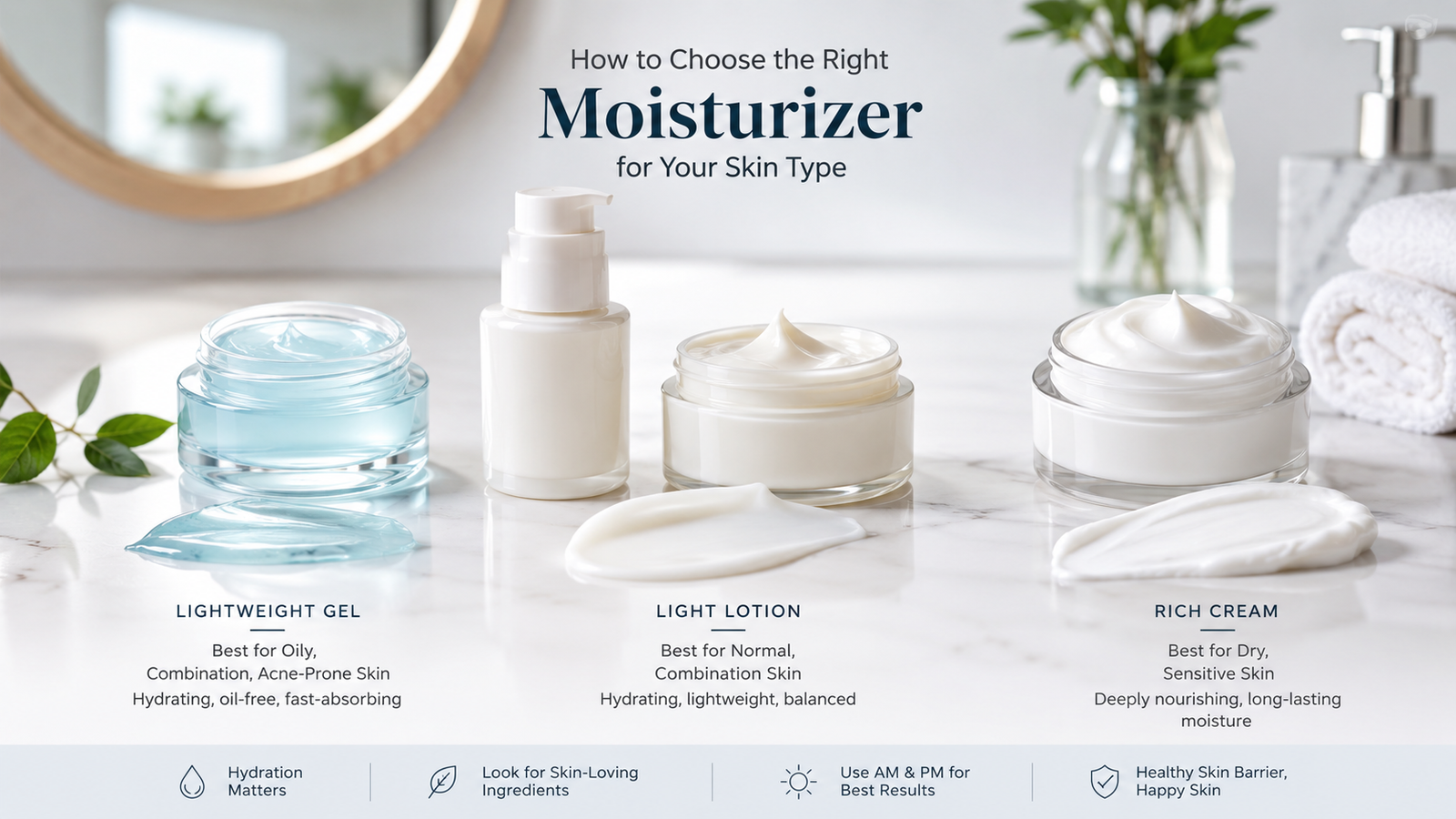
Moisturizer is one of the most useful products in a skincare routine because almost every skin type needs some level of support maintaining:
- hydration;
- softness;
- flexibility;
- skin-barrier function.
But choosing a moisturizer is not as simple as deciding between:
- gel for oily skin;
- cream for dry skin.
The right moisturizer depends on several factors:
skin type → current skin condition → climate → other skincare products → texture preference → time of day
You may have oily skin but still be dehydrated.
You may have dry skin but dislike heavy creams.
You may need a lightweight moisturizer in summer and a richer one in winter.
A practical approach is:
identify what your skin actually needs → choose the appropriate texture → look for a balanced combination of humectants, emollients and barrier-supporting ingredients → adjust according to season and routine
The best moisturizer is not necessarily the richest one.
It is the one that keeps your skin comfortable, flexible and well supported without creating unnecessary heaviness or irritation.
What Does a Moisturizer Actually Do?
The skin’s outermost layer helps reduce water loss and protects against the external environment.
When this barrier becomes less effective, skin may feel:
- dry;
- tight;
- rough;
- flaky;
- sensitive.
Moisturizers help by combining different types of ingredients that:
- attract water;
- smooth the skin surface;
- reduce water loss;
- support the skin barrier.
A good moisturizer does not simply “add moisture.”
It creates an environment that helps the skin retain hydration more effectively.
The Three Main Types of Moisturizing Ingredients
Most moisturizers use some combination of:
- humectants;
- emollients;
- occlusives.
Understanding these categories makes product selection much easier.
What Are Humectants?
Humectants attract and hold water within the upper layers of skin.
Common examples include:
- glycerin;
- hyaluronic acid;
- sodium hyaluronate;
- urea;
- panthenol;
- propylene glycol;
- beta-glucan.
Humectants are useful across almost all skin types.
They are especially common in:
- gel moisturizers;
- hydrating lotions;
- serums.
Glycerin
Glycerin is one of the most useful and well-established moisturizing ingredients.
It can help improve:
- hydration;
- softness;
- skin comfort.
It is inexpensive, effective and commonly found in both:
- budget;
- premium moisturizers.
A product does not need a trendy ingredient list to moisturize effectively if it contains a well-designed glycerin-based formula.
Hyaluronic Acid
Hyaluronic acid is a humectant capable of holding water.
It is commonly marketed for:
- hydration;
- plumping.
Different molecular weights may behave somewhat differently in formulations.
But the important point is that hyaluronic acid is only one moisturizing ingredient.
A moisturizer does not automatically become superior simply because it contains several forms of hyaluronic acid.
Is Hyaluronic Acid Enough by Itself?
Not always.
A hydrating serum containing mostly humectants may make skin feel better temporarily.
But dry skin often also needs:
- emollients;
- occlusives;
- barrier-supporting lipids.
That is why a full moisturizer can be more useful than relying on a hyaluronic-acid serum alone.
Urea
Urea is naturally present within the skin’s moisturizing system.
At lower concentrations, it can function mainly as a:
- humectant.
At higher concentrations, it can also have:
- keratolytic;
- smoothing effects.
It is commonly useful for:
- very dry;
- rough skin.
Higher-strength urea products are more commonly used on the body rather than as a basic facial moisturizer.
Panthenol
Panthenol, also known as provitamin B5, can support:
- hydration;
- skin comfort;
- barrier function.
It is often found in moisturizers designed for:
- sensitive;
- irritated;
- dry skin.
What Are Emollients?
Emollients smooth the spaces between skin cells and improve the skin’s surface feel.
They can make skin feel:
- softer;
- smoother;
- more flexible.
Common emollients include:
- squalane;
- fatty alcohols;
- oils;
- esters;
- shea butter;
- triglycerides.
Emollients are particularly important for:
- dry;
- rough;
- barrier-impaired skin.
Squalane
Squalane is a lightweight emollient.
It can improve:
- softness;
- flexibility.
It is generally easier to tolerate than very heavy oils.
This makes it useful across:
- normal;
- dry;
- combination skin.
Some oily skin types also tolerate it well.
Fatty Alcohols
Ingredients such as:
- cetyl alcohol;
- stearyl alcohol;
- cetearyl alcohol;
are fatty alcohols.
They are not the same as drying volatile alcohols such as ethanol.
Fatty alcohols are commonly used to provide:
- cream texture;
- softness;
- emollience.
Do not avoid a moisturizer simply because the ingredient list contains the word alcohol.
Plant Oils
Moisturizers may contain oils such as:
- sunflower;
- jojoba;
- argan;
- avocado;
- coconut.
These can act as emollients.
But plant oils differ substantially.
Some are:
- lightweight.
Others are:
- rich;
- occlusive.
Natural origin does not automatically make an oil better for the skin.
Shea Butter
Shea butter is a rich emollient.
It is commonly found in moisturizers designed for:
- dry;
- very dry skin.
It may feel too heavy for some:
- oily;
- acne-prone skin.
But skin response varies.
What Are Occlusives?
Occlusives form a barrier that reduces water loss from the skin.
Examples include:
- petrolatum;
- mineral oil;
- dimethicone;
- waxes.
These are particularly valuable for:
- very dry skin;
- damaged skin barrier;
- cold weather.
Petrolatum
Petrolatum is one of the most effective occlusive skincare ingredients.
It significantly reduces water loss from the skin surface.
It is commonly used in:
- ointments;
- barrier creams;
- lip products.
Despite marketing concerns around petroleum-derived ingredients, cosmetic-grade petrolatum is widely used and can be extremely useful.
Mineral Oil
Mineral oil is another effective emollient/occlusive ingredient.
It can help:
- reduce water loss;
- soften skin.
Like petrolatum, it is sometimes unfairly dismissed because it is petroleum-derived.
The origin of an ingredient alone does not determine whether it is useful or safe in a properly formulated cosmetic.
Dimethicone
Dimethicone is a silicone commonly used in moisturizers.
It can:
- smooth the skin;
- reduce water loss;
- improve texture.
It generally feels lighter than very heavy occlusives.
It is particularly useful in products designed for:
- sensitive;
- dry;
- acne-prone skin.
Silicones do not need to be avoided automatically.
What Are Ceramides?
Ceramides are lipids naturally present in the skin barrier.
They help support the structure of the outermost layer.
Moisturizers containing ceramides may be particularly useful for:
- dry skin;
- irritated skin;
- barrier-compromised skin.
They are commonly found alongside:
- cholesterol;
- fatty acids.
These combinations can mimic some components naturally found within the skin barrier.
Do You Need Ceramides in Every Moisturizer?
No.
Ceramides are useful, but many excellent moisturizers work without them.
A product containing:
- glycerin;
- emollients;
- occlusives;
can still moisturize extremely well.
Do not choose a moisturizer based on one hero ingredient alone.
Cholesterol and Fatty Acids
These are also normal components of the skin’s lipid barrier.
Some barrier-focused moisturizers combine:
ceramides + cholesterol + fatty acids
This can be useful for:
- very dry;
- compromised skin.
But the total formulation remains more important than simply seeing those words on the label.
Start With Your Skin Type
The classic skin-type categories are:
- dry;
- oily;
- combination;
- normal;
- sensitive.
These categories are useful starting points.
But they are not permanent identities.
Your skin may behave differently depending on:
- climate;
- hormones;
- medications;
- age;
- skincare routine.
Choose according to your current skin condition.
Moisturizer for Dry Skin
Dry skin generally produces less oil and may struggle to retain moisture effectively.
Signs can include:
- tightness;
- roughness;
- flaking;
- dull appearance.
A dry-skin moisturizer usually benefits from a combination of:
- humectants;
- emollients;
- occlusives.
Look for textures such as:
- cream;
- rich lotion;
- balm.
Useful ingredients may include:
- glycerin;
- ceramides;
- squalane;
- fatty alcohols;
- petrolatum;
- shea butter;
- dimethicone.
Does Dry Skin Always Need a Heavy Cream?
No.
Some dry skin prefers:
- several light layers;
- medium cream.
A very heavy product may feel:
- greasy;
- uncomfortable.
The goal is not to find the thickest moisturizer.
It is to find enough barrier support for your skin to remain comfortable for several hours.
Moisturizer for Very Dry Skin
Very dry skin may need:
- richer cream;
- ointment-like product in certain areas;
- more frequent application.
A practical routine might be:
gentle cleanser → moisturizer → small amount of occlusive on very dry areas
especially at night.
Persistent severe dryness can also have causes such as:
- eczema;
- medication;
- environmental exposure.
If dryness becomes significant or painful, professional advice may be appropriate.
Moisturizer for Oily Skin
Oily skin produces more sebum.
But that does not mean moisturizer is unnecessary.
Oily skin can still be:
- dehydrated;
- irritated;
- barrier-compromised.
The most comfortable formulations are often:
- gel;
- gel-cream;
- lightweight lotion.
Look for:
- glycerin;
- hyaluronic acid;
- niacinamide;
- lightweight silicones.
Avoid choosing an extremely rich moisturizer unless your skin genuinely needs it.
Does Moisturizer Make Oily Skin Oilier?
A product that is too heavy may make oily skin feel more greasy.
But a suitable lightweight moisturizer does not necessarily increase sebum production.
Skipping moisturizer altogether may also leave the skin:
- tight;
- uncomfortable;
especially if you use acne treatments.
The solution is usually lighter texture, not no moisturizer.
Moisturizer for Combination Skin
Combination skin may be:
- oily through the T-zone;
- normal or dry on cheeks.
You have several options.
Option 1
Use one medium-light moisturizer over the whole face.
Option 2
Use more product on dry areas and less on oily areas.
Option 3
Use two products when the difference is significant.
For example:
- gel on T-zone;
- cream on dry cheeks.
You do not have to treat every area identically.
Moisturizer for Normal Skin
Normal skin usually feels:
- comfortable;
- neither excessively oily nor dry.
You may prefer:
- lightweight lotion;
- gel-cream;
- medium cream.
Choose mainly according to:
- climate;
- finish;
- personal preference.
You do not need a highly specialized product.
Moisturizer for Sensitive Skin
Sensitive skin is a broad term.
It may describe skin that frequently experiences:
- stinging;
- burning;
- redness;
- irritation.
Choose moisturizers with:
- relatively simple formulas;
- minimal fragrance;
- comfortable texture.
Useful ingredients can include:
- glycerin;
- ceramides;
- panthenol;
- dimethicone;
- colloidal oatmeal.
Avoid adding several active ingredients through your moisturizer if your skin reacts easily.
Fragrance-Free vs Unscented
These terms can mean different things.
Fragrance-Free
Usually indicates that fragrance ingredients were not intentionally added for scent.
Unscented
May still contain ingredients used to mask odour.
If you have a known fragrance sensitivity, check the ingredient list rather than relying solely on front-label wording.
Moisturizer for Acne-Prone Skin
Acne-prone skin still needs moisture.
This becomes especially important if you use treatments such as:
- benzoyl peroxide;
- salicylic acid;
- retinoids.
These may cause:
- dryness;
- irritation.
A lightweight, comfortable moisturizer can improve treatment tolerance.
What Should Acne-Prone Skin Look for?
Useful qualities include:
- lightweight texture;
- fragrance-free if sensitive;
- non-greasy finish.
Ingredients such as:
- glycerin;
- ceramides;
- niacinamide;
- dimethicone;
may work well.
But no ingredient list guarantees that a product will never cause breakouts.
Individual response matters.
What Does “Non-Comedogenic” Mean?
“Non-comedogenic” generally means a product was formulated or evaluated with pore-clogging concerns in mind.
But there is no universal guarantee that:
- every person;
- every acne type;
will tolerate it.
Use it as a useful clue rather than a guarantee.
Moisturizer for Dehydrated Skin
Dehydration is different from dry skin.
Dry Skin
Lacks oil.
Dehydrated Skin
Lacks water.
This means you can have:
oily + dehydrated skin
Signs of dehydration may include:
- tightness;
- dullness;
- fine dehydration lines;
- skin feeling oily but uncomfortable.
Look for:
- glycerin;
- hyaluronic acid;
- panthenol;
- beta-glucan.
Then use enough emollient support to reduce water loss.
Oily but Dehydrated Skin
This is common when people use:
- harsh cleansers;
- frequent exfoliation;
- acne treatments;
- alcohol-heavy products.
The skin may feel:
- shiny;
- tight.
A lightweight hydrating moisturizer can help.
Do not respond to tightness by adding stronger cleansers.
Moisturizer for Mature Skin
Skin tends to become drier with age because of changes in:
- lipid production;
- barrier function;
- natural moisturizing factors.
Mature skin often benefits from:
- richer lotions;
- creams;
- ceramides;
- humectants;
- emollients.
But age alone does not determine moisturizer texture.
An older person with oily skin may still prefer a lighter formula.
Moisturizer for Men
Skin needs—not gender—determine moisturizer choice.
Someone with:
- oily skin;
may prefer gel.
Someone with:
- dry skin;
may prefer cream.
The same ingredients work regardless of gender.
Moisturizer for Teenagers
Teen skin may produce more oil.
A simple lightweight moisturizer is often enough.
A practical routine:
- Gentle cleanser
- Lightweight moisturizer
- Sunscreen
If acne treatment is being used, moisturizer can help improve comfort.
Teenagers do not need expensive anti-ageing creams.
Gel Moisturizers
Gel moisturizers are typically:
- lightweight;
- water-rich;
- fast-absorbing.
They often contain:
- glycerin;
- hyaluronic acid;
- lightweight polymers.
They work particularly well for:
- oily;
- combination skin;
- hot climates.
Who Should Avoid Gel-Only Moisturizers?
Very dry skin may find some gel moisturizers insufficient.
If your skin feels comfortable immediately but becomes tight within an hour, the product may lack enough:
- emollience;
- occlusion.
Consider a gel-cream or lotion instead.
Gel-Cream Moisturizers
Gel-creams combine:
- lightweight feel;
- more emollience than a pure gel.
They are extremely versatile.
They can work for:
- normal;
- oily;
- combination;
- mildly dry skin.
For many people, gel-cream is the easiest everyday moisturizer category.
Lotion Moisturizers
Lotions are fluid emulsions.
They generally provide more conditioning than gels but feel lighter than rich creams.
They work well for:
- normal;
- combination;
- moderately dry skin.
They are also useful during:
- warm weather.
Cream Moisturizers
Creams contain a richer balance of:
- water;
- emollients;
- oils.
They are useful for:
- dry;
- mature;
- barrier-stressed skin.
Some creams still absorb very elegantly and do not necessarily feel greasy.
Texture varies substantially between formulas.
Balm Moisturizers
Balms tend to be rich and often contain relatively little water.
They provide stronger occlusion.
Useful for:
- very dry areas;
- cold weather;
- compromised barrier.
They may be too heavy for routine full-face use on oily skin.
Ointments
Ointments are even more occlusive.
Petrolatum-based ointments can be very useful for:
- severely dry patches;
- irritated skin;
- lips.
They are not usually the most comfortable all-over daytime facial moisturizer.
Day Moisturizer vs Night Moisturizer
The distinction is mostly about texture and additional ingredients.
Day Moisturizer
Often:
- lighter;
- works under sunscreen/makeup.
Night Moisturizer
Often:
- richer;
- more occlusive.
But your skin does not biologically require a product labelled “night cream.”
You can use the same moisturizer morning and night if it works.
Do You Need a Separate Night Cream?
No.
Use a separate one only if you want:
- richer nighttime texture;
- lighter daytime finish.
The label itself does not make the product more effective at night.
Moisturizer With SPF
Some daytime moisturizers include sunscreen.
This can simplify the routine if:
- SPF is adequate;
- you apply enough product.
But many people naturally apply moisturizer in a much smaller quantity than needed to reach labelled SPF.
If reliable sun protection is important, a separate dedicated sunscreen is often easier to dose properly.
Moisturizer Under Sunscreen
A common morning order:
- Cleanser or rinse
- Serum if used
- Moisturizer
- Sunscreen
But oily skin may find sunscreen itself moisturizing enough.
In that case:
serum → sunscreen
may be sufficient.
You do not need moisturizer underneath sunscreen simply because routines online say so.
Can Sunscreen Replace Moisturizer?
Sometimes.
Many modern sunscreens contain:
- humectants;
- emollients.
If your skin feels comfortable using sunscreen alone, you can skip separate morning moisturizer.
Dry skin may still need both.
Moisturizer Under Makeup
A good moisturizer should create a comfortable base.
Allow it to settle before foundation.
If makeup repeatedly:
- slides;
- pills;
- separates;
you may be using:
- too much moisturizer;
- a formula that is too rich;
- too many skincare layers.
Reduce product before assuming the foundation is wrong.
Moisturizer and Primer
You may not need both.
If moisturizer already creates a:
- smooth;
- comfortable makeup base;
primer may be unnecessary.
Use primer only if you need additional:
- oil control;
- pore blurring;
- grip.
How Much Moisturizer Should You Use?
There is no universal exact amount.
Use enough to create a thin, comfortable layer over the face.
A common starting point might be:
- pea-sized;
- slightly more depending on texture and dryness.
If skin still feels tight:
- add more.
If it feels greasy for hours:
- use less;
- choose lighter texture.
When Should You Apply Moisturizer?
Moisturizer is usually applied after:
- cleansing;
- treatment serums.
And before:
- sunscreen in the morning.
At night, it is generally the final step unless you add:
- facial oil;
- occlusive.
Should You Apply Moisturizer to Damp Skin?
You can.
Applying moisturizer to slightly damp skin can help trap some of that surface water.
This works particularly well with humectant-rich formulas.
But you do not need your face dripping wet.
Avoid leaving very active treatment products wet on the skin and immediately diluting them unless appropriate.
Moisturizer After Cleansing
After cleansing:
- Pat the skin gently.
- Leave it slightly damp if desired.
- Apply moisturizer.
Avoid waiting until the skin feels:
- tight;
- completely dried out.
Moisturizer After Serum
A common sequence:
cleanser → serum → moisturizer
The moisturizer can help reduce water loss and improve comfort.
You do not need multiple serums before moisturizing.
Moisturizer Before or After Retinol?
Traditional sequence:
cleanser → retinoid → moisturizer
But sensitive skin may benefit from the sandwich method:
moisturizer → retinoid → moisturizer
This can reduce irritation for some people.
Follow product and professional guidance.
Moisturizer With Retinoids
Retinoids can cause:
- dryness;
- peeling;
- irritation;
particularly early in use.
A simple barrier-support moisturizer can make the routine easier to tolerate.
Look for:
- glycerin;
- ceramides;
- fatty alcohols;
- dimethicone.
Avoid adding unnecessary strong actives to the same moisturizer.
Moisturizer With Exfoliating Acids
A simple acid night:
- Cleanser
- Exfoliant
- Moisturizer
This is usually enough.
A comfortable moisturizer can help reduce:
- dryness;
- tightness.
Moisturizer With Benzoyl Peroxide
Benzoyl peroxide can cause:
- dryness;
- irritation.
Moisturizer may be applied:
- after;
- sometimes before depending on treatment instructions and tolerance.
The goal is to maintain treatment while minimizing irritation.
Moisturizer With Salicylic Acid
Salicylic acid can be drying for some people.
Pair it with a suitable moisturizer.
Oily acne-prone skin often does well with:
- lightweight gel-cream.
Moisturizer With Vitamin C
Morning routine can be:
- Cleanser
- Vitamin C serum
- Moisturizer
- Sunscreen
If sunscreen provides enough hydration, you may omit the moisturizer.
Moisturizer With Niacinamide
Niacinamide is commonly already included in moisturizers.
If your moisturizer contains niacinamide, you may not need a separate niacinamide serum.
Avoid buying duplicate steps unless there is a specific reason.
Moisturizer With Hyaluronic Acid Serum
You can use both.
Sequence:
hyaluronic-acid serum → moisturizer
But if your moisturizer already contains good humectants, the separate serum may add little.
Test whether removing it changes anything.
Facial Oil vs Moisturizer
They are not the same.
Moisturizer
Usually contains:
- water;
- humectants;
- emollients;
- occlusives.
Facial Oil
Contains mostly:
- oils;
- oil-soluble ingredients.
Oil can reduce water loss and add softness.
But it does not provide the same water-based hydration as a moisturizer.
Can Facial Oil Replace Moisturizer?
For some people with naturally balanced skin, possibly.
But dry or dehydrated skin usually benefits more from a proper moisturizer.
A useful order is:
moisturizer → facial oil
if additional richness is needed.
What Is Slugging?
Slugging involves applying a strong occlusive, typically petrolatum, over moisturizer.
Example:
moisturizer → thin petrolatum layer
The goal is to reduce overnight water loss.
This can be useful for:
- very dry skin;
- barrier irritation.
Who Should Avoid Slugging?
Slugging may be too heavy for:
- very oily skin;
- people who dislike occlusive textures.
Also be cautious when using strong active ingredients underneath because occlusion can potentially increase their effects or irritation.
Do not seal a strong exfoliating or irritating routine under thick petrolatum without considering tolerance.
Moisturizer for Damaged Skin Barrier
Signs of possible barrier stress include:
- products suddenly stinging;
- unusual dryness;
- persistent tightness;
- redness;
- peeling.
Simplify the routine.
Use:
- Gentle cleanser
- Simple moisturizer
- Sunscreen
Temporarily reduce:
- exfoliating acids;
- scrubs;
- retinoids;
if they are contributing to irritation.
What Makes a Good Barrier Moisturizer?
Look for:
- glycerin;
- ceramides;
- cholesterol;
- fatty acids;
- dimethicone;
- petrolatum;
- panthenol.
But a simple formula containing just a few of these can still work extremely well.
How Long Does the Skin Barrier Take to Recover?
It depends on:
- severity;
- cause;
- ongoing irritation.
Mild over-exfoliation may improve over days.
More significant dermatitis or barrier damage may require professional treatment.
Do not keep restarting strong actives every time the redness fades for one day.
Give the skin adequate time to become comfortable.
Moisturizer for Eczema-Prone Skin
Eczema-prone skin usually benefits from:
- fragrance-free;
- rich;
- barrier-supportive moisturizers.
Ointments and creams may be more effective than light lotions for very dry areas.
If you have active eczema with:
- significant inflammation;
- cracking;
- persistent itch;
moisturizer alone may not be enough.
Medical treatment may be required.
Colloidal Oatmeal
Colloidal oatmeal is commonly used in products for:
- dry;
- itchy;
- sensitive skin.
It can help support:
- soothing;
- barrier comfort.
This may be particularly useful for eczema-prone skin.
Moisturizer for Rosacea-Prone Skin
Rosacea-prone skin can be sensitive.
Choose:
- gentle;
- fragrance-free;
- barrier-focused moisturizers.
Avoid formulas that create:
- burning;
- intense cooling;
- warmth.
Persistent facial redness or flushing should be evaluated appropriately rather than repeatedly covered with soothing creams alone.
Moisturizer for Seborrheic Dermatitis
Seborrheic dermatitis is a medical skin condition.
Some people with it tolerate lightweight moisturizers better than very rich oily products.
Treatment depends on the affected area and severity.
If you have persistent:
- greasy scaling;
- redness;
- itching;
seek appropriate guidance rather than trying increasingly rich moisturizers.
Moisturizer for Perioral Dermatitis
If you develop persistent small bumps and irritation around:
- mouth;
- nose;
do not assume the skin simply needs more heavy moisturizer.
Perioral dermatitis can worsen with certain occlusive products.
Professional evaluation may be appropriate.
Fragrance in Moisturizer
Fragrance makes products smell pleasant.
It does not improve moisturization.
If your skin tolerates it, fragrance may not be a problem.
But if you have:
- eczema;
- fragrance allergy;
- very reactive skin;
fragrance-free products can reduce one potential irritant.
Essential Oils in Moisturizer
Essential oils may be included for:
- fragrance;
- botanical marketing.
Examples include:
- lavender;
- citrus;
- peppermint.
They can irritate some skin types.
They are not necessary for moisturization.
Alcohol in Moisturizer
Not all alcohols are equal.
Fatty Alcohols
Examples:
- cetyl alcohol;
- cetearyl alcohol;
- stearyl alcohol.
These are useful emollients.
Volatile Alcohols
Examples:
- alcohol denat.;
- ethanol.
These may help formulas feel lighter and absorb quickly.
Whether they are drying depends on:
- concentration;
- full formulation.
Do not judge one ingredient in isolation.
Niacinamide in Moisturizer
Niacinamide can support:
- barrier function;
- uneven tone;
- oil regulation.
It is widely used.
Many people tolerate it well.
But higher concentrations can irritate some sensitive skin.
A moisturizer does not need 10% niacinamide to be effective.
Peptides in Moisturizers
Peptides are often marketed for:
- ageing;
- firmness;
- repair.
Different peptides have different levels of evidence.
They may be useful additions, but they are not essential for basic moisturization.
Do not choose a product solely because it contains peptides.
Antioxidants in Moisturizers
Moisturizers may include antioxidants such as:
- vitamin E;
- green tea;
- vitamin C derivatives.
These can complement the formulation.
But moisturizer should still perform its main job:
keeping the skin comfortable and reducing water loss.
Retinol Moisturizers
Some moisturizers contain retinol or retinoid ingredients.
These are treatment products rather than simple moisturizers.
Do not treat a retinol cream like an ordinary moisturizer.
Introduce it:
- gradually;
- according to instructions.
Use separate moisturizer if needed for comfort.
Acid-Containing Moisturizers
Some moisturizers contain:
- lactic acid;
- salicylic acid;
- urea.
These may help treat:
- roughness;
- acne;
- texture.
But again, they are treatment moisturizers.
If your barrier is irritated, choose a simpler formula without exfoliating actives.
“Natural” Moisturizers
Natural ingredients may appeal to some consumers.
But natural does not automatically mean:
- safer;
- gentler;
- more effective.
Plant extracts can also trigger:
- irritation;
- allergy.
Synthetic ingredients such as:
- dimethicone;
- petrolatum;
can be extremely effective.
Organic Moisturizers
Organic certification relates mainly to:
- ingredient sourcing;
- agricultural standards.
It does not automatically determine:
- performance;
- safety;
- skin compatibility.
Choose according to the formula and your preferences.
Vegan Moisturizers
Vegan products avoid animal-derived ingredients according to the manufacturer’s standard.
This may matter ethically.
It does not directly predict:
- moisturization;
- irritation risk.
“Clean” Moisturizers
“Clean beauty” has no single universal scientific definition.
Different brands exclude different ingredients.
A clean-labelled moisturizer is not automatically:
- safer;
- healthier;
- superior.
Evaluate:
- formulation;
- tolerance;
- evidence.
Parabens in Moisturizers
Parabens are preservatives.
Water-based moisturizers need effective preservation to prevent microbial contamination.
A paraben-free product still contains some alternative preservation system.
Do not assume paraben-free means safer.
Mineral Oil and Petrolatum Myths
These ingredients are often described online as:
- suffocating skin;
- toxic;
- inherently pore-clogging.
These claims are oversimplified.
Cosmetic-grade mineral oil and petrolatum are widely used because they are effective:
- emollients;
- occlusives.
They can be particularly useful for:
- dry;
- sensitive skin.
Do Moisturizers “Let Skin Breathe”?
Skin does not breathe like lungs.
The idea that a moisturizer must allow the skin to breathe is mostly marketing language.
Occlusive ingredients can reduce water loss without preventing skin from functioning normally.
Does Moisturizer Clog Pores?
Any particular product may not suit a particular person.
Rich products may feel too heavy for some acne-prone skin.
But there is no reliable rule that every:
- cream;
- oil;
- silicone;
clogs pores.
Individual response matters.
Coconut Oil as a Face Moisturizer
Pure coconut oil is quite occlusive and may feel heavy.
Some people tolerate it.
Others, particularly acne-prone individuals, may find it unsuitable.
It also lacks the balanced water-based humectant system of a formulated moisturizer.
For facial skincare, a properly formulated moisturizer is usually more versatile.
Aloe Vera Gel as Moisturizer
Aloe gel can provide:
- lightweight hydration;
- cooling sensation.
But pure gel often lacks enough:
- emollients;
- occlusives;
for dry skin.
It may work as an additional hydrating layer but not always as a complete moisturizer.
Facial Oils as Moisturizer
As discussed earlier, oils are mainly:
- emollient;
- occlusive.
They may work for some skin types, but dehydrated skin often benefits from water-based hydration underneath.
Moisturizer for Hot and Humid Weather
In humid weather, skin may feel:
- oilier;
- more congested.
Choose:
- gel;
- gel-cream;
- lightweight lotion.
You may need less product.
If your sunscreen is sufficiently moisturizing, you may skip morning moisturizer.
Moisturizer for Indian Summers
Hot conditions often make heavy creams uncomfortable.
A practical daytime routine might be:
- Cleanser
- Lightweight serum if needed
- Gel-cream moisturizer only if necessary
- Sunscreen
At night:
- use slightly richer moisturizer if skin feels dehydrated.
Do not choose a heavy product just because you have dry skin year-round.
Seasonal adjustment is sensible.
Moisturizer for Cold Weather
Cold air and indoor heating can increase:
- water loss;
- dryness.
You may need:
- cream instead of lotion;
- more frequent application;
- additional occlusion.
Areas such as:
- cheeks;
- around mouth;
may need extra support.
Moisturizer in Air-Conditioned Environments
Air conditioning can make the environment feel dry.
If your skin becomes tight during long hours indoors, consider:
- slightly richer moisturizer;
- hydrating layers.
You do not need to repeatedly spray water onto the face if it simply evaporates without adequate moisturizer.
Morning Moisturizer
A morning moisturizer should ideally be:
- comfortable;
- compatible with sunscreen;
- compatible with makeup if used.
For oily skin, lighter is often easier.
For dry skin, use enough cream to prevent tightness.
Night Moisturizer
Nighttime allows you to use richer textures because:
- makeup compatibility is irrelevant;
- shine is less important.
Dry skin may prefer:
- cream;
- balm-like moisturizer.
Oily skin may still prefer gel.
There is no requirement to use a heavy night cream.
How to Layer Moisturizer With Multiple Serums
A typical order:
- Cleanser
- Thin water-based serum
- Treatment serum
- Moisturizer
But you do not need to use multiple serums.
If adding several serums makes your routine:
- sticky;
- irritating;
- prone to pilling;
simplify.
Moisturizer and Pilling
Pilling occurs when product layers form:
- small balls;
- flakes.
Possible causes:
- too much moisturizer;
- several polymer-heavy serums;
- rubbing;
- sunscreen incompatibility.
Try:
- smaller amounts;
- fewer layers;
- allowing products to settle.
Moisturizer and Makeup Separation
If foundation slides or separates:
- reduce moisturizer amount;
- allow more setting time;
- choose lighter texture.
Skin should feel comfortable before makeup—not wet or greasy.
Why Moisturizer Stings
Moisturizer can sting because of:
- damaged skin barrier;
- fragrance;
- active ingredients;
- individual sensitivity.
If even a simple moisturizer suddenly stings, your skin may be irritated from:
- over-exfoliation;
- retinoids;
- harsh cleansing.
Simplify the routine.
Persistent or severe burning deserves attention.
Why Moisturizer Burns Around the Eyes
The eye area can be more sensitive.
Products may migrate.
Avoid applying facial moisturizer too close to the eyes if it causes:
- watering;
- burning.
Use an eye-compatible product if needed.
Do You Need Eye Cream?
Not necessarily.
Many facial moisturizers can be used around the orbital area if:
- tolerated;
- manufacturer allows it.
Eye creams mainly offer:
- different texture;
- targeted ingredients.
They are optional.
Why Moisturizer Feels Sticky
Possible reasons:
- too much product;
- high humectant content;
- humid environment;
- formula texture.
Use less or switch to:
- gel-cream;
- lighter lotion.
Why Moisturizer Feels Greasy
The product may contain more:
- oils;
- occlusives;
than your skin needs.
Try a lighter formulation.
Do not assume greasiness means the moisturizer is more nourishing.
Why Moisturizer Is Not Enough
If skin feels tight soon after application, possible reasons include:
- moisturizer too light;
- cleanser too harsh;
- environment too dry;
- active treatments causing irritation.
You may need:
- richer cream;
- less aggressive routine.
Why Skin Feels Dry Despite Heavy Moisturizer
Heavy occlusion cannot fully compensate for:
- over-cleansing;
- excessive acids;
- retinoid irritation.
Treat the cause.
A richer cream is not always the solution.
How to Tell if a Moisturizer Suits You
After application, skin should ideally feel:
- comfortable;
- flexible;
- smooth.
Over the next several hours, it should not become:
- extremely tight;
- excessively greasy;
- irritated.
A moisturizer does not need to create an instant dramatic transformation.
Consistency and comfort matter more.
Signs Your Moisturizer Is Too Light
You may experience:
- tightness;
- flaky areas;
- dryness returning quickly.
Try:
- more product;
- richer lotion;
- cream.
Signs Your Moisturizer Is Too Heavy
You may notice:
- greasy film;
- discomfort;
- foundation sliding;
- excessive shine;
- recurrent breakouts associated with the product.
Try a lighter formulation.
Signs Your Moisturizer Is Irritating
Watch for:
- burning;
- persistent itching;
- redness;
- rash;
- swelling.
Stop the product if symptoms persist.
Do not assume your skin needs to “adjust” to an ordinary moisturizer.
Should Moisturizer Cause Purging?
No.
A basic moisturizer should not cause true purging.
If you break out after introducing a moisturizer, possible explanations include:
- product not suiting your skin;
- irritation;
- normal acne fluctuation.
“Purging” is primarily associated with certain active ingredients that affect cell turnover.
Do not continue an irritating moisturizer for weeks because of a purging claim.
Should You Change Moisturizer Seasonally?
Often, yes.
For example:
Summer
Gel-cream.
Winter
Cream.
You may also adjust based on:
- travel;
- air conditioning;
- active skincare.
There is no need to remain loyal to one texture all year if your skin needs change.
Does Expensive Moisturizer Work Better?
Not necessarily.
Moisturizing ingredients such as:
- glycerin;
- petrolatum;
- dimethicone;
- ceramides;
- fatty alcohols;
are available in affordable products.
Luxury pricing may reflect:
- packaging;
- fragrance;
- texture;
- branding.
An inexpensive moisturizer can perform extremely well.
What Makes a Premium Moisturizer Worth It?
Possibly:
- exceptionally elegant texture;
- specialized delivery system;
- advanced active ingredients;
- luxurious experience.
But if your main goal is basic barrier support, you do not need luxury pricing.
Jar vs Pump Packaging
Jar
Easy for thick creams.
But repeatedly opening the jar exposes the product to:
- air;
- fingers.
Pump
Provides:
- cleaner dispensing;
- reduced exposure.
But packaging does not automatically determine product quality.
Use clean hands with jar products.
Airless Pumps
Airless packaging can help protect formulations containing ingredients sensitive to:
- oxygen;
- contamination.
This can be useful for some treatment moisturizers.
For a basic cream, it is not essential.
Moisturizer Expiry
Check:
- expiry date;
- period-after-opening symbol.
Replace if the product develops major changes in:
- smell;
- colour;
- texture.
Do not add water to an old thickened moisturizer.
This can compromise preservation.
Refrigerating Moisturizer
Usually unnecessary.
Use the storage conditions recommended by the manufacturer.
A chilled gel may feel pleasant, but refrigeration does not automatically make skincare work better.
Choosing a Moisturizer for Minimal Skincare
If you want a simple routine, choose a moisturizer that already contains several useful components.
For example:
- glycerin;
- ceramides;
- niacinamide.
Then you may not need separate:
- hydration serum;
- barrier serum;
- niacinamide serum.
One well-formulated product can simplify the routine significantly.
Choosing a Moisturizer for Active Skincare
If you use:
- retinoids;
- acids;
- benzoyl peroxide;
choose a simpler moisturizer.
You do not necessarily need additional:
- exfoliating acids;
- retinol;
- strong vitamin C;
inside the moisturizer too.
Let the treatment product treat.
Let the moisturizer support.
A Simple Routine for Oily Skin
Morning
- Gentle cleanser
- Lightweight gel moisturizer if needed
- Sunscreen
Evening
- Cleanser
- Treatment if used
- Gel-cream moisturizer
If sunscreen is moisturizing enough, morning moisturizer can be skipped.
A Simple Routine for Dry Skin
Morning
- Gentle cleanser or rinse
- Cream moisturizer
- Sunscreen
Evening
- Gentle cleanser
- Serum/treatment if needed
- Rich moisturizer
Optional:
- small amount of petrolatum on very dry areas.
A Simple Routine for Combination Skin
Morning
- Cleanser
- Lightweight lotion
- Sunscreen
Apply slightly more moisturizer to:
- cheeks.
Less to:
- T-zone.
A Simple Routine for Sensitive Skin
Morning
- Gentle cleanser/rinse
- Fragrance-free moisturizer
- Sunscreen
Evening
- Gentle cleanser
- Same moisturizer
Avoid adding multiple actives until the skin is comfortable.
A Simple Routine for Acne-Prone Skin
Morning
- Gentle cleanser
- Acne treatment if appropriate
- Lightweight moisturizer
- Sunscreen
Evening
- Cleanser
- Acne treatment
- Moisturizer
Do not skip moisturizer simply because acne treatment dries your skin.
A Simple Routine for Dehydrated Oily Skin
- Gentle cleanser
- Hydrating serum if needed
- Lightweight gel-cream
- Sunscreen in morning
Reduce:
- harsh cleansers;
- excessive exfoliation.
The goal is hydration without heaviness.
A Simple Routine With Retinoid
Retinoid Night
- Gentle cleanser
- Allow skin to dry if required by product instructions
- Retinoid
- Moisturizer
If sensitive:
- Cleanser
- Thin moisturizer layer
- Retinoid
- Moisturizer
Common Moisturizer Mistakes
Skipping Moisturizer Because Skin Is Oily
Choose a lighter texture instead.
Choosing the Richest Cream Because Skin Is Dry
Richness must still be comfortable.
Buying Based on One Hero Ingredient
The whole formulation matters.
Using Too Many Hydrating Serums Under Moisturizer
Often unnecessary.
Assuming Expensive Means Better
Basic moisturization does not require luxury pricing.
Applying Heavy Cream Under Already-Moisturizing Sunscreen
Can make makeup greasy.
Treating Every Dry Patch With Exfoliation
Sometimes the skin simply needs more barrier support.
Using Treatment Moisturizer as if It Were a Basic Cream
Acids and retinoids still count as active ingredients.
Assuming Natural Oils Are Always Better
Formulated moisturizers provide a more balanced combination of ingredients.
Ignoring Seasonal Changes
Your ideal moisturizer may change throughout the year.
Moisturizer Buying Checklist
Before buying, ask:
1. What is my skin type right now?
Dry, oily, combination or balanced?
2. Is my skin dehydrated as well?
Oiliness and dehydration can coexist.
3. What texture do I prefer?
Gel, gel-cream, lotion or cream?
4. Do I use strong active treatments?
Choose a supportive, simpler moisturizer.
5. Does my skin react to fragrance?
Consider fragrance-free.
6. Do I need a separate morning and night moisturizer?
Probably not unless you prefer different textures.
7. Does my sunscreen already moisturize enough?
You may not need another morning layer.
8. Does the formula contain a useful mix of humectants, emollients and occlusives?
Balance matters.
9. Does my skin stay comfortable several hours after application?
That is more important than instant glow.
10. Can I use it consistently?
The best moisturizer is one you will actually use.
When Should You See a Dermatologist?
Seek professional advice if dryness or irritation is:
- severe;
- persistent;
- painful;
- cracking;
- bleeding;
- associated with significant rash;
- not improving with basic skincare.
You may be dealing with conditions such as:
- eczema;
- contact dermatitis;
- rosacea;
- another inflammatory skin disorder.
A moisturizer can support these conditions but may not be sufficient treatment.
The Physical Glow Takeaway
Choosing a moisturizer becomes much easier when you stop asking:
“Which moisturizer is best?”
and instead ask:
“What does my skin need right now?”
A simple guide:
- oily skin → gel or lightweight gel-cream;
- combination skin → lightweight lotion or targeted application;
- normal skin → gel-cream or lotion according to preference;
- dry skin → cream with humectants, emollients and occlusives;
- very dry or barrier-stressed skin → richer cream or targeted occlusive support;
- sensitive skin → simple, fragrance-free barrier-support formula where possible;
- acne-prone skin → lightweight moisturizer that keeps treatment-related dryness under control.
Look for a balanced formulation rather than chasing one fashionable ingredient.
Useful categories include:
- humectants such as glycerin and hyaluronic acid → attract and retain water;
- emollients such as squalane and fatty alcohols → soften the skin;
- occlusives such as petrolatum and dimethicone → reduce water loss;
- ceramides and related lipids → support the skin barrier.
And remember:
You do not necessarily need:
hydrating toner → essence → hyaluronic serum → barrier serum → moisturizer → facial oil
to keep skin hydrated.
For many people:
gentle cleanser → one well-formulated moisturizer → sunscreen
is an excellent foundation.
The right moisturizer should leave your skin:
comfortable → flexible → smooth → supported
without making it:
tight → greasy → irritated → overloaded.
That is what effective moisturization should feel like.