How to Choose the Right Face Powder for Your Skin and Makeup
Learn how to choose face powder for your skin and makeup routine, with practical guidance on powder format, finish, oil control, coverage and application. This beginner-friendly guide helps you make a clear, informed choice without unnecessary complexity.
Face powder can make makeup look smoother, reduce unwanted shine and help foundation and concealer last longer.
But it is also one of the easiest complexion products to overuse.
Too much powder can make skin look:
- dry;
- flat;
- cakey;
- textured;
- heavy.
The right approach is not:
foundation → powder everywhere → more powder during the day
A better approach is:
identify why you need powder → choose the right powder type → match the finish to your skin → apply only where necessary → use the smallest effective amount
For many people, powder works best as a targeted finishing product, not a compulsory layer over the entire face.
What Does Face Powder Actually Do?
Face powder usually performs one or more of four jobs:
- Sets makeup
- Controls shine
- Adds coverage
- Changes the finish of the complexion
Depending on the formula, powder can help:
- reduce foundation movement;
- limit concealer creasing;
- absorb surface oil;
- soften visible shine;
- blur the appearance of texture;
- add another layer of pigment.
But not every powder performs all these jobs equally well.
A lightweight translucent setting powder is very different from a heavily pigmented powder foundation.
Do You Actually Need Face Powder?
Not necessarily.
If your foundation:
- sets well on its own;
- lasts long enough;
- does not become excessively shiny;
you may need little or no powder.
Someone with dry skin may only powder:
- under the eyes;
- around the nose.
Someone with oily skin may prefer powder through the:
- forehead;
- nose;
- chin.
Someone wearing a matte long-wear foundation may not need additional powder at all.
Powder should solve a problem.
Do not use it simply because it appears in every makeup tutorial.
Setting Powder vs Finishing Powder
These terms are often used interchangeably, but they can serve slightly different purposes.
Setting Powder
Primarily designed to help set:
- foundation;
- concealer.
It usually helps reduce:
- tackiness;
- movement;
- shine.
Finishing Powder
Often designed more for the final appearance.
It may help:
- blur;
- soften texture;
- create a polished finish.
Some powders perform both functions.
Always look at what the product actually claims to do rather than relying only on its category name.
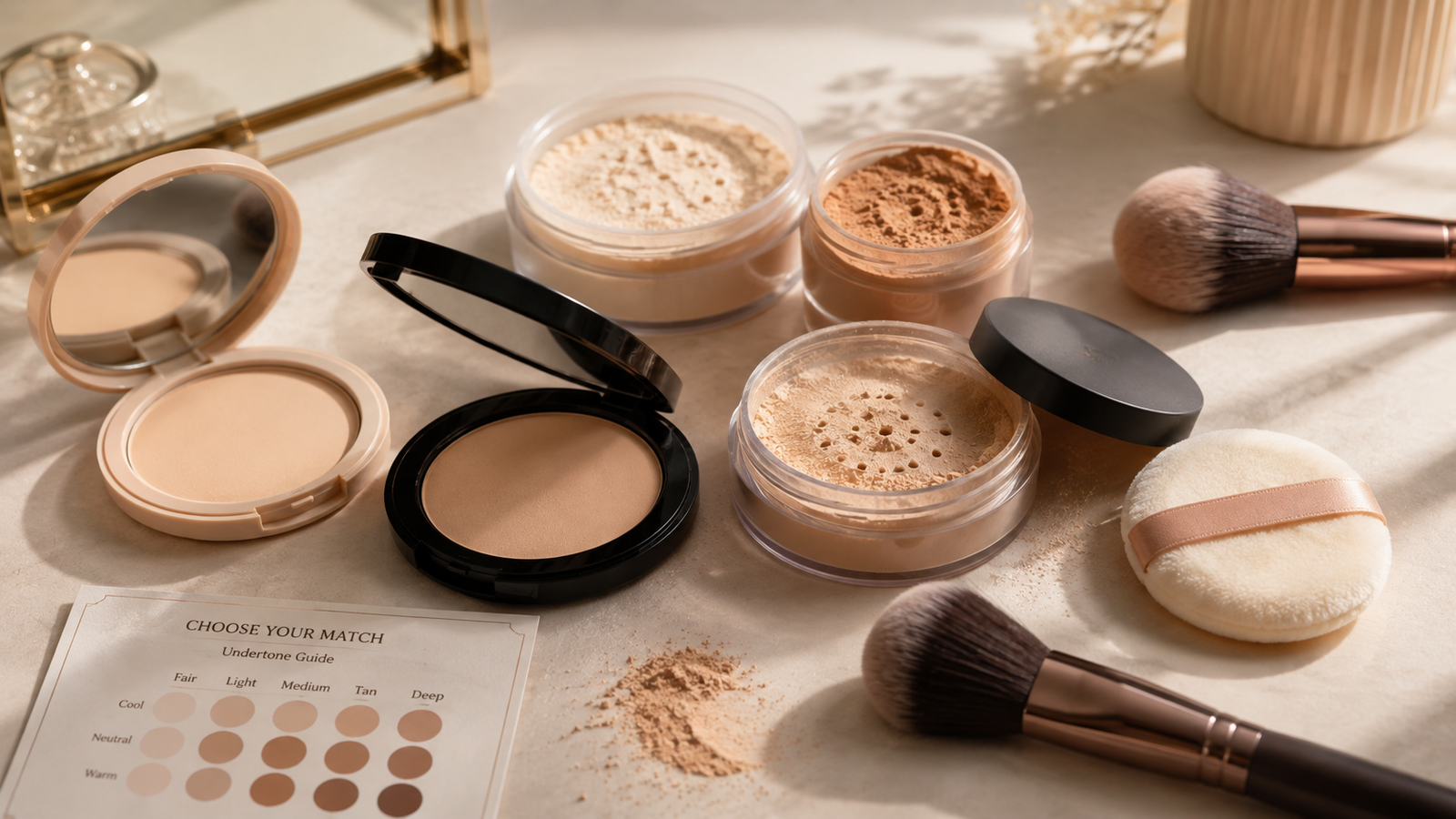
Loose Powder vs Pressed Powder
One of the first decisions is whether you want:
- loose powder;
- pressed powder.
Both can work well.
Loose Powder
Loose powder comes in a jar with finely milled powder.
Advantages include:
- excellent control over amount;
- lightweight application;
- easy setting over large areas;
- useful for long-wear makeup.
It is popular for:
- setting foundation;
- under-eye setting;
- professional makeup.
The main disadvantages are:
- mess;
- less convenient travel;
- easier to accidentally apply too much.
Pressed Powder
Pressed powder is compressed into a compact.
Advantages include:
- portability;
- easier touch-ups;
- less mess;
- convenient application.
Pressed powders may range from:
- sheer setting powder;
- tinted powder;
- full powder foundation.
For everyday use, a pressed compact can be more practical than loose powder.
Which Is Better: Loose or Pressed?
Neither is inherently better.
Choose loose powder if you prioritize:
- precise setting;
- lightweight application;
- makeup longevity.
Choose pressed powder if you prioritize:
- convenience;
- touch-ups;
- portability.
Many people use:
loose powder at home + pressed powder for touch-ups
but owning both is optional.
Translucent Powder
Translucent powder is designed to add little visible colour.
It primarily helps:
- set makeup;
- control shine.
It may appear:
- white;
- pale beige;
- nearly colourless.
But “translucent” does not always mean invisible on every complexion.
Can Translucent Powder Look Ashy?
Yes.
Some pale translucent powders may leave a:
- grey;
- white;
- chalky cast;
on medium-to-deep skin.
This is especially noticeable:
- in photography;
- under flash;
- when too much powder is applied.
If you have deeper skin, consider:
- truly transparent formulas;
- tinted translucent powders;
- powders specifically formulated for deeper complexions.
Tinted Setting Powder
Tinted powders contain some skin-tone pigment.
They may help:
- avoid white cast;
- subtly even the complexion;
- add a little coverage.
Common tone families include:
- light;
- medium;
- tan;
- deep.
Some brands also offer undertones such as:
- yellow;
- peach;
- pink.
A close shade match matters more when the powder contains visible pigment.
Powder Foundation
Powder foundation contains significantly more pigment than setting powder.
It can be used:
- alone;
- over light foundation;
- for touch-ups.
It is designed to provide actual complexion coverage.
Coverage can range from:
- light;
- medium;
- full.
Who Might Prefer Powder Foundation?
It can be useful for people who want:
- fast makeup;
- matte or natural finish;
- portable coverage;
- fewer liquid products.
It is often particularly convenient for:
- oily;
- combination skin.
But dry skin can wear powder foundation too with good preparation and a suitable formula.
Setting Powder vs Powder Foundation
This distinction is important.
Setting Powder
Main purpose:
set and control shine
Usually:
- less pigmented;
- lighter.
Powder Foundation
Main purpose:
provide coverage
Usually:
- more pigment;
- greater opacity.
Using a full-coverage powder foundation on top of full-coverage liquid foundation can easily create a heavy result.
Start With Your Skin Type
Your skin type can help determine:
- texture;
- finish;
- application amount.
Common categories include:
- oily;
- dry;
- combination;
- normal;
- sensitive.
But remember that your skin can change because of:
- weather;
- skincare;
- age;
- hormones;
- environment.
You may need to adjust powder use seasonally.
Face Powder for Oily Skin
Oily skin is one of the clearest reasons to use powder.
Look for formulas that help:
- absorb surface oil;
- reduce unwanted shine;
- improve makeup wear.
Matte setting powders can be useful.
Focus on areas where oil appears most:
- forehead;
- nose;
- chin.
You do not necessarily need heavy powder on the entire face.
Should Oily Skin Use a Lot of Powder?
Not automatically.
Too much powder mixed with skin oil can eventually form a:
- thick;
- patchy;
- cakey layer.
It is usually better to:
- Apply a thin initial layer.
- Blot excess oil later.
- Add small amounts of powder only where necessary.
This gives a cleaner result than continuously adding powder over oil.
Face Powder for Dry Skin
Dry skin can use powder, but restraint matters.
The main risks are:
- emphasizing flakes;
- increasing tightness;
- making fine lines look more visible.
Look for:
- finely milled powders;
- natural or satin finish;
- products described as lightweight.
Apply only to areas that need setting.
Should Dry Skin Skip Powder?
Sometimes.
You might powder only:
- under-eye concealer;
- around nose;
- areas where foundation moves.
Leave the:
- cheeks;
- outer face;
unpowdered if you want to preserve luminosity.
Face Powder for Combination Skin
Combination skin often benefits from targeted powdering.
For example:
T-Zone
Use more powder on:
- forehead;
- nose;
- chin.
Cheeks
Use:
- minimal;
- or no powder.
This allows you to manage oil without making drier areas look flat.
Face Powder for Normal Skin
Normal skin gives you flexibility.
Choose based on:
- desired finish;
- makeup longevity.
A light dusting may be enough.
If foundation already performs well, you may not need powder across the whole face.
Face Powder for Sensitive Skin
If your skin reacts easily, consider:
- fragrance-free options;
- simple formulas;
- products you already tolerate.
Powder itself can also become irritating if repeatedly rubbed onto already inflamed skin.
Use:
- soft brushes;
- gentle pressing motions.
Stop using a product if it causes:
- burning;
- itching;
- rash.
Face Powder for Acne-Prone Skin
Powder can be useful because it can reduce shine without requiring heavy cream products.
But avoid:
- aggressively buffing over inflamed acne;
- applying thick powder over flaky healing blemishes.
Use clean tools.
If acne is raised or textured, adding layers of powder will not make the texture disappear.
Face Powder for Mature Skin
Mature skin may have more visible:
- fine lines;
- dryness;
- texture.
This does not mean powder should be avoided completely.
Use:
- finely milled formula;
- very small amount;
- strategic placement.
Focus on:
- areas that crease;
- areas where makeup moves.
Avoid automatically baking the entire under-eye area.
Matte Powder
Matte powder reduces visible shine.
It is useful for:
- oily skin;
- hot weather;
- long-wear makeup;
- areas that become shiny quickly.
But matte does not always mean dry.
Modern matte powders can still feel lightweight.
Natural-Finish Powder
Natural-finish powders reduce excess shine while allowing some skin-like dimension to remain.
They can be useful for:
- normal skin;
- combination skin;
- everyday makeup.
This is often the easiest finish for beginners.
Luminous Powder
Luminous powders contain subtle reflective particles.
They can create:
- soft radiance;
- smoother-looking finish.
They are different from highlighter because the reflection is usually much more subtle.
Useful for:
- dry skin;
- dull-looking skin;
- people who dislike fully matte makeup.
Is Luminous Powder Good for Oily Skin?
It can be.
You do not need to avoid luminosity simply because your skin is oily.
A useful strategy:
- matte powder through T-zone;
- luminous powder lightly over outer face.
This creates controlled dimension.
Shimmer Powder
Powders with obvious shimmer can behave more like:
- finishing products;
- subtle highlighter.
Using visible shimmer across the entire face may emphasize:
- pores;
- texture.
Choose intentionally.
Blur Powder
Blurring powders aim to reduce the visible appearance of:
- pores;
- texture;
- fine lines.
They often use particles that scatter light.
The effect is optical.
They do not physically remove pores or texture.
A blur powder can make complexion makeup look smoother, but the effect depends on:
- lighting;
- application;
- skin preparation.
Pore-Blurring Powder
These often contain ingredients designed to create a smoother surface appearance.
Apply lightly to areas such as:
- sides of nose;
- inner cheeks;
- forehead.
Heavy powder over pores may actually make texture more obvious.
What Does “Finely Milled” Mean?
Finely milled powder has very small particles.
This can help it feel:
- smoother;
- lighter;
- less obvious.
But “finely milled” is also a common marketing phrase.
The real test is whether the powder:
- blends easily;
- avoids patchiness;
- does not sit heavily on the skin.
Powder Shade Selection
If the powder is truly translucent, shade matching may be less important.
If it is tinted, choose according to:
- skin depth;
- undertone.
A powder that is too light can create:
- ashiness.
A powder that is too dark may make the complexion look:
- muddy;
- uneven.
Should Powder Match Foundation Exactly?
For tinted powder, close matching is ideal.
It does not need to be mathematically identical.
But avoid large differences.
If you use powder only for setting, something close to your foundation depth or truly translucent is generally easiest.
Yellow Setting Powder
Yellow-toned powders are often called:
- banana powders.
They can help add warmth and reduce some:
- purple;
- dull tones.
They may work well on:
- warm;
- golden;
- some olive undertones.
But a strong yellow powder can look unnatural on very cool or fair complexions.
What Is Banana Powder?
Banana powder is typically a yellow-toned setting powder.
It became popular for:
- under-eye setting;
- brightening;
- medium-to-deep complexions.
But “banana” is not a standardized cosmetic shade.
One brand’s banana powder may be:
- pale yellow;
- golden yellow;
- deep warm yellow.
Choose based on your actual complexion.
Pink Setting Powder
Pink-toned powders can create a subtle brightening effect.
They may work particularly well for:
- fair;
- light;
- cool or neutral complexions.
On deeper skin, very pale pink can become ashy unless formulated appropriately.
Peach Setting Powder
Peach powder can help create subtle warmth and may support under-eye brightening.
It can work well for:
- medium;
- tan complexions.
Again, choose the depth carefully.
Deep Tinted Powders
For deeper complexions, consider powders with shades such as:
- caramel;
- golden brown;
- chestnut;
- deep neutral.
These reduce the risk of:
- grey cast;
- flashback.
What Is Flashback?
Flashback occurs when powder appears unusually:
- pale;
- white;
in flash photography.
This can be influenced by:
- certain powder ingredients;
- excessive powder quantity;
- strongly reflective particles.
It is most obvious in photographs taken with bright direct flash.
Does Silica Cause Flashback?
Silica is commonly used in powders for:
- oil absorption;
- smooth texture.
Some highly reflective formulations may contribute to flashback when applied heavily.
But silica itself is not automatically a problem.
The full formula and application amount matter.
If photography is important, test your makeup under flash before the event.
Powder and Photography
For events:
- weddings;
- parties;
- professional photography;
test your powder in advance.
Take photos:
- in daylight;
- indoors;
- with flash.
This can reveal:
- white cast;
- excessive mattness;
- unevenness;
that may not be obvious in the mirror.
Should Powder Go Before or After Foundation?
Traditional order:
foundation → concealer → powder
Powder is usually used to set liquid and cream products.
However, some techniques deliberately apply powder underneath foundation for oil control.
That is an advanced method and not necessary for most people.
Powder Before Foundation
This technique may involve:
- Skincare.
- Primer.
- Very light powder.
- Foundation.
Some oily-skinned users find it improves longevity.
But it can also make makeup:
- heavy;
- difficult to blend.
For beginners, traditional layering is simpler.
Should Powder Go Before Blush?
Depends on blush formula.
Powder Blush
Usually:
foundation → powder → powder blush
This helps powder blush blend smoothly.
Cream Blush
Usually:
foundation → cream blush → powder
because cream generally applies better before setting powder.
Can Cream Blush Go Over Powder?
It can, depending on the formula.
But cream over heavily powdered skin may:
- grab;
- lift foundation;
- become patchy.
A safer sequence is usually:
cream products first → powders afterward
Should Powder Go Before Bronzer?
If using powder bronzer:
setting powder → bronzer
usually blends more easily.
Applying powder bronzer directly onto sticky foundation can cause:
- skipping;
- uneven patches.
Should You Set the Entire Face?
Not necessarily.
A modern targeted approach may be:
Powder
- under eyes;
- forehead;
- nose;
- around mouth;
- chin.
Leave More Natural
- outer cheeks;
- high points of face.
This preserves skin-like dimension.
Where Does Makeup Usually Need Setting?
Common areas include:
- under eyes;
- sides of nose;
- nasolabial area;
- forehead;
- chin.
These are areas where:
- oil develops;
- makeup moves;
- creasing occurs.
How Much Powder Should You Use?
Less than you think.
Start with:
- a very small amount.
For loose powder:
- Tap a little into lid.
- Load brush or puff.
- Remove excess.
- Apply.
You should not necessarily see a thick layer sitting on top of the skin.
Powder Brush vs Puff
Application tool dramatically changes the result.
Large Fluffy Brush
Creates:
- light;
- diffused application.
Best for:
- dry skin;
- natural finish;
- setting large areas lightly.
Smaller Powder Brush
Provides:
- more precision.
Useful for:
- under eyes;
- T-zone.
Powder Puff
Provides more concentrated application.
Useful for:
- oily areas;
- long-wear makeup;
- setting around nose.
A puff can press powder into the makeup rather than simply dusting it over the surface.
Velour Puff
Velour-style puffs are popular with loose powder.
They can create a smooth, controlled finish.
Use a small amount.
Fold the puff to reach areas around:
- nose;
- under eyes.
Makeup Sponge for Powder
A sponge can apply powder with strong concentration.
This is commonly used for:
- baking;
- heavy setting.
For everyday makeup, a fluffy brush or puff usually provides more control.
Brush vs Puff: Which Is Better?
Brush
Best for:
- lighter coverage;
- natural finish.
Puff
Best for:
- stronger setting;
- oily areas;
- long wear.
Many people benefit from using both techniques in different areas.
Pressing vs Swirling Powder
Once foundation is applied, aggressively swirling a brush may disturb the base.
Instead, try:
- pressing;
- rolling;
- tapping.
Then lightly sweep away excess if needed.
This is especially useful for fuller-coverage foundation.
What Is Baking?
Baking involves applying a visible layer of loose powder and leaving it on temporarily before removing the excess.
Common areas include:
- under eyes;
- jawline.
It became popular in:
- stage makeup;
- drag makeup;
- full-glam techniques.
Do You Need to Bake?
No.
For everyday makeup, baking often adds more powder than necessary.
It can emphasize:
- dryness;
- under-eye lines;
- texture.
Use it only when you specifically want:
- strong setting;
- very matte finish;
- full-glam longevity.
Baking Under the Eyes
This can be particularly drying.
If you have:
- dry under-eyes;
- mature skin;
- visible fine lines;
a small amount of powder is usually more flattering.
Setting Concealer Properly
A simple under-eye method:
- Apply concealer.
- Blend.
- Allow excess product to settle.
- Gently smooth any creasing.
- Apply a tiny amount of powder.
- Press rather than aggressively sweep.
This helps minimize product collecting in lines.
Why Under-Eye Powder Looks Dry
Possible reasons include:
- too much concealer;
- too much powder;
- dry skin;
- powder formula too matte;
- excessive baking.
Try reducing the amount before switching products.
Powder Around the Nose
This area often becomes oily and makeup can separate.
Use a small puff or brush to set:
- sides of nose;
- nostril area.
Avoid heavy buildup in natural folds.
Powder Around the Mouth
Foundation may crease near:
- smile lines;
- corners of mouth.
Apply powder lightly.
Too much can collect in expression lines and make them more visible.
Powder on the Forehead
Useful for:
- oil control;
- reducing shine.
If you still want some luminosity, leave a small amount of natural sheen at:
- temples;
- high points.
Powder on the Cheeks
If your cheeks are dry, you may not need powder there.
If you plan to apply powder:
- blush;
- bronzer;
a very light setting layer may help those products blend.
How to Apply Powder Foundation
Powder foundation can be applied with:
- brush;
- sponge.
Brush
Produces:
- lighter;
- more natural coverage.
Sponge
Produces:
- stronger coverage.
Build gradually.
Avoid repeatedly layering until the skin looks flat.
Powder Foundation on Bare Skin
A quick routine:
- Moisturizer.
- Sunscreen.
- Allow skincare to settle.
- Apply powder foundation.
- Spot conceal if needed.
- Add blush/bronzer.
This can create a simple everyday complexion.
Powder Foundation Over Liquid Foundation
This provides much more coverage.
It can be useful for:
- photography;
- full-glam makeup.
But it can easily become heavy.
For most people, use:
- setting powder;
rather than full powder foundation over a full-coverage liquid base.
Powder Over Sunscreen
You can apply powder over sunscreen.
Allow sunscreen to:
- settle;
- form an even film.
Then gently press or dust powder on top.
Avoid aggressively rubbing because you may disturb the sunscreen layer.
Powder with SPF does not replace proper sunscreen application.
SPF Face Powders
Some powders contain sunscreen ingredients.
They may offer additional protection.
But most people do not apply anywhere near enough powder to achieve the labelled SPF evenly.
Use them as:
- supplemental protection;
not your only sunscreen.
Face Powder for Hot Weather
In hot weather, powder can improve comfort and longevity.
Focus on:
- T-zone;
- areas where foundation moves.
Use thin layers.
Heavy powder mixed with sweat can become:
- patchy;
- cakey.
Face Powder for Humid Weather
Humidity increases the need for:
- oil control;
- long-wear makeup.
Try:
thin foundation → targeted powder → setting spray
rather than adding a very thick powder layer.
Face Powder for Cold Weather
Cold air and indoor heating may increase dryness.
Use less powder.
You may switch from:
- matte;
to:
- natural-finish;
- lightweight powder.
Face Powder for Indian Weather
Hot and humid conditions can make makeup:
- shiny;
- prone to movement.
A practical approach is:
- long-wear base;
- finely milled setting powder;
- stronger powder through T-zone;
- lighter application on cheeks.
Do not assume you need a fully matte face.
Controlled shine can still look natural.
Face Powder for Everyday Makeup
For everyday use, prioritize:
- lightweight texture;
- natural finish;
- easy touch-ups.
A sheer pressed powder or translucent loose powder is often enough.
Use it only where required.
Face Powder for Office Makeup
A practical office routine may be:
- Foundation or skin tint.
- Concealer.
- Powder T-zone.
- Blush.
- Carry pressed powder for touch-ups.
This keeps the complexion polished without becoming excessively matte.
Face Powder for Bridal Makeup
Bridal makeup often needs:
- strong longevity;
- photography-friendly finish.
A common approach is:
- thin foundation layers;
- targeted loose powder;
- additional setting around oily areas;
- powder blush/bronzer.
Test for:
- flashback;
- dryness;
- texture;
before the event.
Face Powder for Full Glam
You can use more powder when the makeup style intentionally requires:
- full coverage;
- strong contour;
- longer wear.
But even full glam generally looks better when powder is placed strategically rather than piled everywhere.
Face Powder for No-Makeup Makeup
Use minimal powder.
Apply only where needed:
- sides of nose;
- under eyes;
- centre forehead.
Leave natural skin shine elsewhere.
Touching Up Powder During the Day
Do not immediately powder over visible oil.
First:
- Blot excess oil.
- Assess the makeup.
- Apply a small amount of powder only if needed.
This prevents layers of:
oil + powder + oil + powder
from becoming thick.
Blotting Papers vs Powder
Blotting Papers
Remove surface oil without adding product.
Powder
Absorbs some oil while changing finish.
For midday shine, blotting first is often cleaner.
Then powder if necessary.
Can Tissue Be Used for Blotting?
Yes.
A clean tissue can gently remove some surface oil.
Press rather than rub.
This can be useful if blotting papers are unavailable.
Why Powder Looks Cakey
Common reasons include:
- too much foundation;
- too much powder;
- dry skin;
- powder applied over unset wet foundation;
- multiple touch-ups;
- incompatible products.
Try reducing product before changing formulas.
How to Fix Cakey Powder
You can try:
Option 1
Use a clean fluffy brush to remove excess.
Option 2
Lightly press with a damp sponge.
Option 3
Use a small amount of setting spray.
Do not add more foundation immediately.
Setting Spray After Powder
A setting spray can help powder layers visually merge with the complexion.
It may reduce the visibly:
- dry;
- powdery finish.
But not every spray increases wear.
Some are primarily:
- hydrating;
- finishing sprays.
Others are formulated specifically for longevity.
Face Mist vs Setting Spray
Face Mist
Primarily provides:
- hydration;
- freshness.
Setting Spray
May help:
- improve makeup longevity;
- reduce transfer.
Some products overlap.
Read the product claims.
Powder and Setting Spray Together
A common sequence is:
foundation → concealer → powder → colour products → setting spray
This can create good longevity.
For very oily skin, some people use setting spray at multiple stages.
But multiple layers are not always necessary.
Why Powder Looks Patchy
Possible causes include:
- foundation underneath too sticky;
- powder deposited unevenly;
- applying too much in one spot;
- dry patches.
Try:
- lighter powder load;
- pressing gradually;
- better skin preparation.
Powder Clinging to Dry Patches
Powder will often make flaking more visible.
Before makeup:
- moisturize;
- avoid over-exfoliating.
Do not try to bury dry patches under extra powder.
Powder Emphasizing Pores
Heavy layers can sit around pores.
Use:
- finely milled powder;
- small amount;
- pressing motions.
Optical blur works better with less product than with a visibly thick layer.
Powder and Fine Lines
Powder can collect in natural lines.
This is especially common:
- under eyes;
- around mouth.
Use less product and target only areas that genuinely need setting.
Some movement is normal.
Why Powder Turns Orange
Tinted powder may:
- oxidize;
- be too warm;
- be too dark.
Try a:
- neutral;
- cooler;
- lighter shade.
Also consider whether the foundation underneath is changing colour.
Why Powder Looks Grey
Possible causes:
- powder too light;
- undertone mismatch;
- white translucent powder on deeper skin.
Choose:
- tinted;
- truly transparent;
- deeper powder.
Why Powder Makes Makeup Darker
Pigmented powders can add substantial colour.
If your foundation is already a good match, use:
- translucent setting powder;
- a powder very close in shade.
Fragrance in Face Powder
Some powders contain fragrance.
If you tolerate fragrance, this may not be a problem.
People with:
- fragrance sensitivity;
- reactive skin;
may prefer fragrance-free options.
Talc in Face Powder
Talc has historically been widely used in powder cosmetics because it provides:
- slip;
- softness;
- oil absorption.
Modern cosmetic talc is subject to regulatory and manufacturing standards that vary by jurisdiction.
If you prefer talc-free powder, many alternatives are available.
But talc-free does not automatically mean:
- safer;
- better-performing.
Talc-Free Powders
These may use ingredients such as:
- silica;
- starches;
- mica.
Performance varies.
Choose based on:
- finish;
- oil control;
- shade suitability.
Silica in Face Powder
Silica can help provide:
- oil absorption;
- smooth feel;
- blurring.
Highly absorbent silica-rich powders may feel dry on some skin types.
Apply sparingly if your skin is already dry.
Mica in Powder
Mica can add:
- slip;
- subtle luminosity.
It is common in:
- finishing powders;
- luminous powders.
The amount and particle size influence how reflective the product appears.
Cornstarch and Other Starches
Some powders use plant-derived starches for:
- absorption;
- texture.
They can work well.
Again, individual formula quality matters more than whether an ingredient sounds natural.
Mineral Powder
“Mineral makeup” commonly refers to powders containing ingredients such as:
- mineral pigments;
- zinc oxide;
- titanium dioxide;
- mica.
The term itself does not automatically mean the formula is:
- more natural;
- safer;
- better for sensitive skin.
Evaluate the full product.
Does Face Powder Clog Pores?
A particular powder may not suit a particular person, but powder as a category does not automatically clog pores.
Factors include:
- complete formula;
- skin type;
- hygiene;
- makeup removal.
If a product repeatedly causes breakouts, discontinue it.
“Non-Comedogenic” Powder
This can be a useful label for acne-prone users, but it is not a guarantee.
Skin responses vary.
Proper cleansing at the end of the day remains important.
Face Powder and Acne
If you are acne-prone:
- use clean brushes;
- avoid sharing products;
- remove makeup thoroughly;
- avoid repeated rubbing over inflamed lesions.
Powder can reduce shine, but it does not treat acne.
Hygiene With Pressed Powder
Brushes and puffs collect:
- skin oils;
- makeup;
- debris.
Clean them regularly.
Avoid using visibly dirty puffs repeatedly.
Hygiene With Loose Powder
Do not return used product from your hand or palette back into the container.
Keep the lid closed.
Avoid exposing the powder unnecessarily to:
- moisture.
How Often Should Powder Puffs Be Washed?
Wash them regularly, particularly if used:
- daily;
- on oily skin;
- over liquid foundation.
Allow them to dry completely before reuse.
Having two puffs can make rotation easier.
Powder Brush Cleaning
Wash personal brushes regularly with an appropriate cleanser.
A powder brush used only on dry products may not need washing as frequently as a foundation brush.
But visible buildup is a sign it needs cleaning.
Face Powder Expiry
Check:
- period-after-opening symbol;
- manufacturer guidance.
Powders often remain physically stable longer than liquid products, but they should not be kept indefinitely.
Replace if you notice changes in:
- smell;
- texture;
- colour;
- performance.
Pressed Powder Hard Pan
Sometimes pressed powder develops a hard shiny surface.
This is called hard pan.
It may occur when oils from:
- skin;
- brushes;
- sponges;
transfer to the compact.
The surface becomes difficult to pick up.
Using clean tools can help prevent this.
Can You Repair Broken Pressed Powder?
Pressed powders can sometimes be re-pressed after breaking, but altering the product may affect:
- texture;
- hygiene;
- performance.
For a small crack, simply using the product carefully may be safer and easier.
Does Expensive Face Powder Work Better?
Not necessarily.
Premium powders may offer:
- elegant packaging;
- finer texture;
- sophisticated shade range;
- luxury feel.
Affordable powders can still provide excellent:
- oil control;
- setting;
- wear.
The right powder is the one that performs well on your skin.
What Makes a Good Setting Powder?
Look for:
Fine Texture
Should not look visibly grainy.
Appropriate Oil Control
Enough for your skin, but not excessively drying.
Minimal Cast
Should suit your complexion.
Easy Application
Should distribute evenly.
Longevity
Should help makeup last appropriately.
Finish
Should create the amount of matte or luminosity you want.
How Many Face Powders Do You Need?
Most people need only one.
For example:
Option 1
Translucent loose setting powder.
Or:
Option 2
Pressed powder compact.
You may eventually choose two if you have distinct needs:
- loose powder for initial setting;
- pressed powder for touch-ups.
But this is convenience, not necessity.
Choosing Your First Face Powder
For a beginner, a good starting product is usually:
- sheer;
- finely milled;
- natural-matte;
- easy to control.
Choose:
- translucent if it truly works for your complexion;
- lightly tinted if you are concerned about ashiness.
Avoid beginning with an extremely:
- mattifying;
- full-coverage powder;
unless that is specifically what you need.
Common Face Powder Mistakes
Powdering the Entire Face Automatically
Only set where needed.
Using Too Much Under the Eyes
Can emphasize lines and dryness.
Baking Every Day
Often unnecessary.
Applying Powder Over Visible Oil
Blot first.
Using Pale Powder on Deep Skin
Can create ashiness or flashback.
Using Powder Foundation as Setting Powder Without Realizing It
Can make makeup overly heavy.
Applying Powder With a Heavily Loaded Brush
Start small.
Buffing Aggressively Over Foundation
May disturb the base.
Trying to Hide Texture With More Powder
Usually makes texture more noticeable.
Ignoring Dry Patches
Prepare the skin first.
A Simple Powder Routine for Oily Skin
- Complete skincare.
- Apply foundation.
- Apply concealer.
- Press powder lightly through T-zone.
- Use smaller amount on outer face.
- Apply blush/bronzer.
- Blot during the day before re-powdering.
A Simple Powder Routine for Dry Skin
- Moisturize well.
- Apply foundation.
- Conceal where needed.
- Powder only:
- under eyes;
- around nose;
- areas that move.
- Leave cheeks largely unpowdered.
- Finish with hydrating mist if desired.
A Simple Powder Routine for Combination Skin
- Foundation.
- Concealer.
- Powder T-zone more firmly.
- Lightly dust cheeks only if applying powder blush/bronzer.
- Leave naturally luminous areas unpowdered where possible.
A Simple Routine for Mature Skin
- Prepare skin with appropriate moisturizer.
- Apply thin foundation.
- Use minimal concealer.
- Smooth creases before powder.
- Apply tiny amount with small soft brush.
- Avoid heavy baking.
- Leave outer face natural.
A Simple Long-Wear Makeup Routine
- Skincare.
- Primer if needed.
- Thin foundation.
- Concealer.
- Press loose setting powder into high-movement areas.
- Lightly powder remaining necessary areas.
- Apply powder colour products.
- Finish with long-wear setting spray.
This usually lasts better than applying one very thick powder layer.
A Simple Powder-Foundation Routine
- Moisturizer.
- Sunscreen.
- Allow skincare to settle.
- Spot conceal if needed.
- Buff or press powder foundation over the face.
- Add extra coverage only where necessary.
- Apply blush/bronzer.
Face Powder Buying Checklist
Before choosing, ask:
1. Why do I need powder?
Setting, oil control, coverage or touch-ups?
2. Is my skin oily or dry?
This determines how much mattifying power you need.
3. Do I want loose or pressed?
Loose for setting; pressed for convenience.
4. Do I need translucent or tinted powder?
Deeper complexions may benefit from tinted options.
5. Do I want matte, natural or luminous finish?
Choose intentionally.
6. Is this a setting powder or powder foundation?
Do not confuse them.
7. Will I use it under the eyes?
Look for a finely milled formula.
8. Do I need it for photography?
Test for flashback.
9. Does it make my makeup smoother or heavier?
Performance matters more than marketing.
10. Can I get the result using less?
Start with the minimum amount.
When Should You Stop Using a Face Powder?
Stop if the product repeatedly causes:
- itching;
- rash;
- burning;
- irritation.
If powder consistently makes your skin appear:
- extremely dry;
- cracked;
- uncomfortable;
you may need to:
- reduce use;
- adjust skincare;
- choose a different formula.
The Physical Glow Takeaway
The best face powder is not the one that makes your complexion completely matte.
It is the one that gives you the amount of setting, shine control and coverage your makeup actually needs.
Start by choosing the right category:
- loose setting powder → best for controlled setting and long wear;
- pressed powder → best for convenience and touch-ups;
- translucent powder → sets with minimal added colour;
- tinted powder → useful when you want to avoid ashiness or add subtle colour;
- powder foundation → provides actual complexion coverage.
Then match it to your skin:
- oily skin → stronger oil control through the T-zone;
- dry skin → finely milled powder used only where needed;
- combination skin → target oily areas and leave drier areas lighter;
- mature skin → use minimal powder and avoid heavy baking.
Most importantly:
powder strategically, not automatically.
You do not need to cover every centimetre of your face.
Set the areas that:
- crease;
- move;
- become excessively shiny.
Leave the rest alone when possible.
A well-used face powder should make makeup look:
more stable → smoother → controlled
without making the skin look:
dry → cakey → flat → overloaded.
That balance is what makes powder useful.