How to Choose the Right Foundation for Your Skin
Finding the right foundation is about more than matching a shade. Learn how skin type, undertone, coverage, finish and application affect which foundation is likely to work best for you.
Foundation can be one of the most useful products in a makeup routine—and one of the easiest to get wrong.
The challenge is not simply finding a bottle labelled “light,” “medium” or “deep.” Foundation also varies by undertone, coverage, finish, texture and how it behaves on different skin types.
A shade can look close in the bottle but noticeably different once applied. A foundation that looks smooth on one person may emphasise dryness on another. And a formula that promises full coverage may be completely unnecessary if you prefer a natural, skin-like finish.
The easiest way to choose foundation is to break the decision into five parts:
skin type → coverage → finish → undertone → shade
Once those are clear, the number of suitable options becomes much smaller.
First Decide What You Want Foundation to Do
Foundation is primarily used to create a more even-looking complexion.
That does not necessarily mean covering everything.
Some people want foundation mainly to soften the appearance of uneven tone. Others prefer more coverage for redness, pigmentation, blemishes or other areas they would like to minimise.
Before choosing a formula, ask:
- Do I want my natural skin to remain clearly visible?
- Do I want noticeable coverage?
- Do I prefer a matte or radiant look?
- Do I need makeup to last for a long day?
- Do I want something quick enough for everyday use?
Your answers matter more than simply choosing whichever foundation is currently popular.
Step 1: Choose Your Coverage Level
Coverage describes how much of your natural complexion remains visible through the foundation.
Sheer coverage
Sheer foundations provide a light veil of colour.
They can help make the complexion appear more even while allowing freckles, natural colour variation and much of the skin to remain visible.
They are useful if you prefer a very natural makeup look.
Light coverage
Light coverage offers slightly more evening of the complexion while still maintaining a relatively natural appearance.
It can work well for everyday makeup where heavy coverage is not the goal.
Medium coverage
Medium-coverage foundations provide more visible correction and can usually cover more unevenness while still being blended into a natural-looking finish.
Many medium formulas are also buildable, allowing additional product to be applied only where needed.
Full coverage
Full-coverage foundation is designed to conceal substantially more of the underlying complexion.
It may be useful for someone who wants a polished, high-coverage finish, but it also requires more attention to shade matching and application.
Higher coverage is not automatically better.
Choose the lowest coverage level that gives you the result you want.
Step 2: Pick a Finish
Foundation finish describes how the product looks on the skin after application.
Matte
Matte foundations minimise visible shine and create a flatter, less reflective finish.
They are often marketed toward oily or combination skin, although anyone can choose matte foundation if they prefer the appearance.
Very matte formulas may feel less forgiving on visibly dry or flaky areas.
Natural or satin
Natural and satin finishes sit somewhere between matte and dewy.
They are designed to resemble the appearance of normal skin rather than looking strongly powdery or highly luminous.
For beginners, this can be a versatile place to start.
Radiant or dewy
Radiant foundations create a more luminous or light-reflective finish.
They are often appealing to people who prefer fresh-looking, glowy makeup.
However, someone who becomes very shiny through the day may prefer to use radiant foundation selectively or set particular areas with powder.
Soft-matte or semi-matte
These formulas aim to control shine without producing an extremely flat finish.
They can be useful if you want some oil control but still want the complexion to retain dimension.
Step 3: Consider Your Skin Type
Skin type does not dictate which foundation you are allowed to wear, but it can influence how comfortable a formula feels and how it wears throughout the day.
Oily skin
If your skin becomes noticeably shiny, you may prefer:
- matte or soft-matte formulas;
- lightweight textures;
- products designed for longer wear;
- strategic powdering.
But an aggressively matte foundation is not always necessary.
Sometimes a natural-finish foundation combined with powder in the oilier areas gives a more balanced result.
Dry skin
Dry skin may look better with formulas that do not emphasise rough or flaky areas.
You may prefer:
- natural or radiant finishes;
- more flexible textures;
- lighter layers rather than heavy coverage.
Good skin preparation can also make a substantial difference to how foundation sits.
Combination skin
Combination skin may be oily in some areas and normal or dry in others.
Instead of trying to find one formula that behaves identically everywhere, you can adjust the rest of your routine.
For example:
- use less foundation on dry areas;
- powder the oilier areas;
- avoid over-powdering the entire face.
Sensitive-feeling skin
If your skin is easily irritated, check the full formula rather than relying only on labels such as “gentle” or “for sensitive skin.”
If you already know that fragrance or another ingredient bothers your skin, the ingredient list becomes especially useful.
Step 4: Understand Undertones
Shade depth tells you roughly how light or deep the foundation is.
Undertone describes the underlying colour direction within that shade.
Common undertone categories include:
Warm
Usually described as having golden, yellow or peach tones.
Cool
Often associated with pink, rosy or reddish tones.
Neutral
A balance between warm and cool characteristics.
Olive
Often has a muted greenish or golden quality that may not fit neatly into traditional warm/cool labels.
Undertones can be one of the main reasons a foundation looks “almost right” but still appears noticeably different from the surrounding skin.
A foundation can match your depth but still look too pink, too yellow, too orange or too grey.
Don’t Rely Too Heavily on Vein Tests
You may have seen advice such as:
Blue veins mean cool undertones and green veins mean warm undertones.
This can occasionally provide a clue, but it is not a reliable universal test.
Lighting, skin depth and the visibility of veins can all affect what you see.
Comparing actual foundation shades against your skin is more useful.
Step 5: Find Your Shade
When possible, test foundation somewhere near the jawline, where you can compare it with both the face and neck.
The ideal shade should blend into the surrounding skin without creating an obvious boundary.
Avoid choosing foundation exclusively by testing it on your hand.
The skin tone on your hand can differ considerably from your face and neck.
Compare several nearby shades
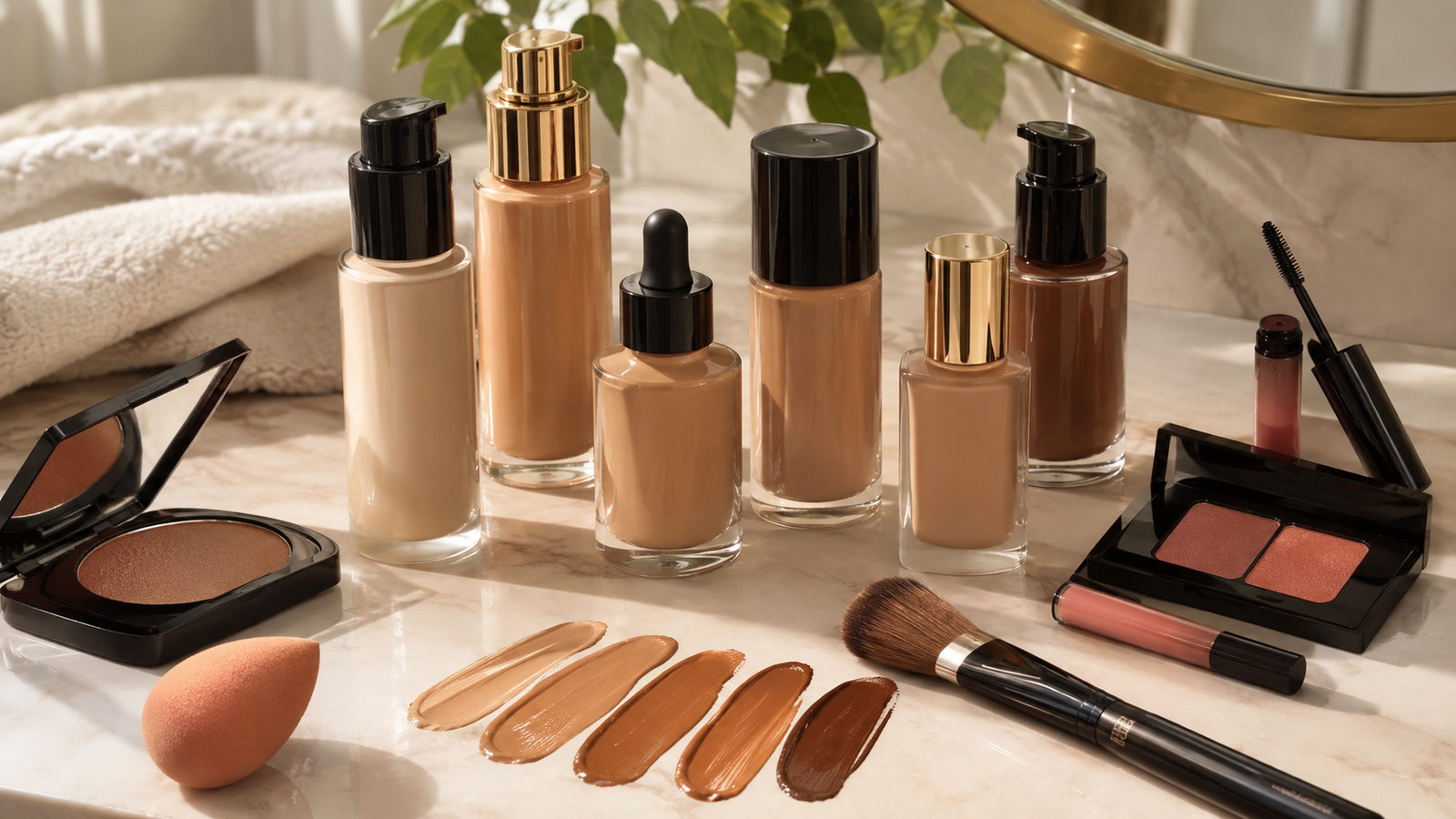
If possible, apply two or three narrow swatches next to one another.
The correct shade often becomes much easier to recognise when compared directly against neighbouring options.
Check it in natural light
Store lighting can distort colour.
After applying a test shade, look at it in natural daylight if possible.
A foundation that seems perfect under warm indoor lighting may appear noticeably different outside.
Give the Foundation Time Before Deciding
Some foundations change slightly after application as they dry and interact with air, skin oils or other products.
This is often referred to as oxidation.
Instead of making your decision immediately after applying a wet swatch, allow it to settle and then check the shade again.
If it becomes significantly deeper, warmer or more orange, you may need another shade or formula.
Should Foundation Match Your Face or Neck?
Ideally, foundation should create a natural transition between the face, jaw and neck.
The face can sometimes be lighter, darker or redder than the neck due to sun exposure, pigmentation or natural colour variation.
Matching only one small area can therefore create a visible contrast elsewhere.
Testing around the jawline helps you judge the overall transition rather than matching a single patch of skin.
What If You Cannot Find an Exact Shade?
Shade ranges are not perfect.
If two shades are close but neither is ideal, some people mix them.
This can also be useful when your skin tone changes slightly between seasons.
However, mixing should be a practical solution rather than something you feel forced to do because a brand has an inadequate shade range.
If another foundation offers a closer match from the start, it may simply be the better choice.
Liquid, Cream, Stick or Powder Foundation?
Foundation format affects application and feel.
Liquid foundation
One of the most common formats.
Available in almost every combination of:
- sheer to full coverage;
- matte to radiant finish;
- lightweight to richer textures.
This variety makes liquid foundation a practical starting point for many people.
Cream foundation
Cream products generally have a richer texture and can provide substantial coverage.
They may work well for people who prefer a more emollient feel, although formulas vary widely.
Stick foundation
Stick formats are portable and convenient for targeted application.
They can make it easy to apply foundation selectively rather than covering the entire face.
Powder foundation
Powder foundations combine complexion coverage with a powder texture.
They can be particularly convenient for quick application and touch-ups.
However, the finish may be less forgiving on visibly dry or textured areas depending on the formula and application.
Do You Need Primer Under Foundation?
Not necessarily.
Primer can be useful when you have a specific problem such as:
- excessive shine;
- visible texture;
- dryness;
- difficulty getting makeup to adhere;
- wanting additional luminosity.
But if foundation already applies smoothly over your normal skincare and lasts as long as you need, primer may add an unnecessary step.
Start by trying the foundation with your existing skincare routine.
Add primer only when you know what problem you want it to solve.
Foundation and Sunscreen
If you use sunscreen during the day, apply it according to its directions as part of your skincare routine before makeup.
Foundation with an SPF claim should not automatically be treated as a replacement for properly applied sunscreen.
The amount of foundation people normally apply for cosmetic coverage may differ substantially from the amount required for a sunscreen product to provide its labelled protection.
Makeup can sit on top of sunscreen once the underlying products have had time to settle appropriately.
How Should You Apply Foundation?
There is no single correct tool.
Fingers
Fingers can work particularly well with lightweight liquid foundations and skin tints.
They are quick and require no additional tools.
Makeup sponge
A damp sponge can help blend liquid or cream products and often creates a softer-looking finish.
It can absorb some product, however, so application may be less efficient.
Foundation brush
Brushes can offer precise application and can work well for both light and fuller coverage depending on the brush and technique.
Instead of asking which tool is universally best, consider which one gives you the finish you prefer with your particular foundation.
Start With Less Than You Think You Need
A common foundation mistake is applying a full layer everywhere immediately.
Try:
- applying a small amount to the centre of the face or areas needing coverage;
- blending outward;
- checking the result;
- adding additional product only where necessary.
This often creates a more natural appearance than using the same amount across every part of the face.
Should Foundation Cover Blemishes Completely?
It can, but it does not have to.
If most of your complexion only needs light evening but one or two areas require additional coverage, use foundation lightly and add concealer selectively.
This avoids using heavy foundation across the entire face simply to cover a few smaller areas.
How to Tell When a Foundation Isn’t Working
The shade looks obvious around your jaw
Reassess the shade depth or undertone.
It becomes much darker after application
The formula may be oxidising noticeably on your skin.
Makeup separates around oily areas
You may need to adjust:
- skincare;
- the amount of foundation;
- primer;
- powder;
- or the foundation formula itself.
Dry areas become more noticeable
A very matte formula, heavy powdering or inadequate skin preparation may be contributing.
The foundation feels heavy
Try using less product or choosing a lighter-coverage formula.
You constantly need other products to fix the finish
If you need multiple primers, powders and sprays simply to make a foundation wearable, the foundation itself may not suit your preferences.
A Simple Foundation Checklist
Before buying, ask:
1. How much coverage do I actually want?
Sheer, light, medium or full?
2. What finish do I prefer?
Matte, natural, satin or radiant?
3. How does my skin behave?
Oily, dry, combination or sensitive-feeling?
4. What is my undertone?
Warm, cool, neutral or olive?
5. Does the shade blend into my jaw and neck?
Not just the back of my hand.
6. Does it still match after it dries down?
Give it time before deciding.
7. Does it work with my normal skincare?
A foundation should fit reasonably into your routine rather than requiring you to rebuild everything around it.
The Physical Glow Takeaway
The best foundation is not simply the one with the highest coverage or the most fashionable finish.
Start with the result you want.
Choose your preferred coverage and finish, consider how your skin behaves, identify your undertone and then test the closest shades around the jawline.
A good match should make the complexion look more even without making the foundation itself the first thing you notice.
And if you prefer your skin without foundation, that is also a perfectly valid makeup routine.