How to Choose an Elliptical Trainer for Your Workouts
Learn how to choose an elliptical trainer for your workouts, with practical guidance on stride length, resistance, incline, footprint, stability and comfort. This beginner-friendly guide helps you make a clear, informed choice without unnecessary complexity.
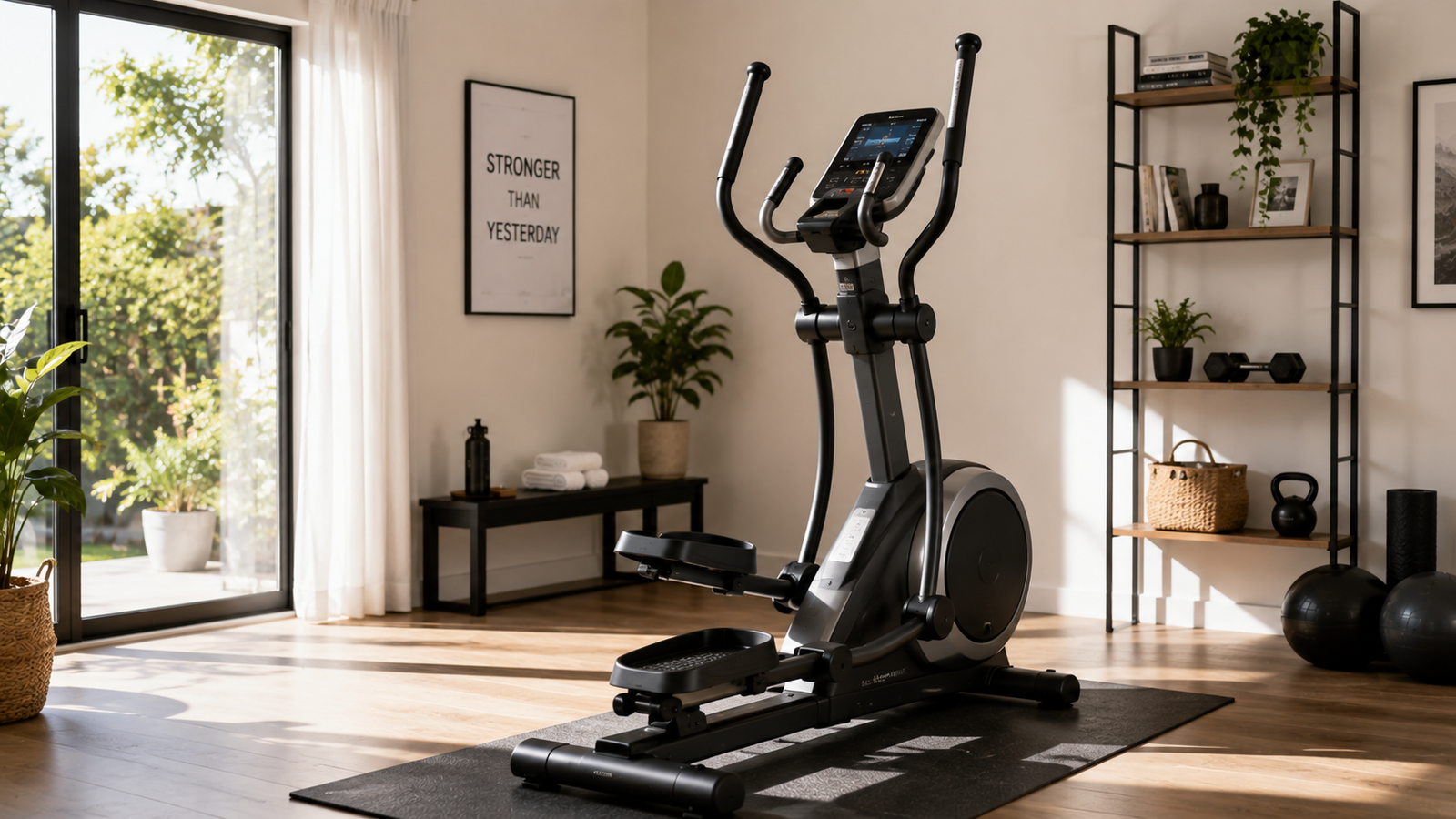
An elliptical trainer can be a practical choice for home cardio because it provides a smooth, repetitive movement without the repeated foot strike associated with running.
Depending on the machine, elliptical training can involve:
- legs;
- glutes;
- cardiovascular system;
- trunk stabilization;
- arms through moving handles.
It can work well for:
- beginners;
- steady-state cardio;
- interval training;
- people who prefer lower-impact exercise;
- home users who want a standing cardio machine.
But ellipticals vary significantly in:
- stride length;
- resistance system;
- flywheel design;
- incline;
- pedal spacing;
- machine size;
- stability;
- handle design;
- console features;
- noise;
- price.
The right machine should be chosen according to:
your body size → preferred stride → training goals → available space → joint comfort → resistance needs → budget
The best elliptical is not automatically the one with:
- the most resistance levels;
- the largest screen;
- the heaviest flywheel;
- the longest list of workout programs.
It is the machine that allows you to move through a comfortable stride, increase effort progressively and exercise consistently without feeling cramped or unstable.
What Is an Elliptical Trainer?
An elliptical trainer is a stationary cardio machine that guides the feet through an oval or elliptical movement pattern.
Unlike walking or running, your feet usually remain in contact with the pedals throughout the movement.
Many models also include moving handles that allow the upper body to participate.
The machine may provide resistance using:
- magnetic systems;
- electromagnetic systems;
- other mechanical resistance mechanisms.
Some models also allow you to change:
- incline;
- stride path;
- resistance.
What Does an Elliptical Train?
The lower body does most of the work.
Commonly involved muscles include:
- quadriceps;
- glutes;
- hamstrings;
- calves.
Depending on the machine and technique, moving handles also involve:
- shoulders;
- upper back;
- arms.
The trunk helps stabilize the body.
However, elliptical training should not be viewed as a complete replacement for:
- strength training.
It primarily develops:
- cardiovascular fitness;
- muscular endurance;
- general conditioning.
Is Elliptical Training Low Impact?
Generally, yes.
Because the feet remain supported by the pedals, elliptical exercise avoids the repeated landing forces associated with:
- running;
- jumping.
This can make it more comfortable for some people who dislike high-impact cardio.
But low impact does not mean no stress.
Elliptical training still involves:
- repeated knee flexion;
- hip movement;
- ankle movement.
A poorly fitting machine or excessive resistance can still cause discomfort.
Why Choose an Elliptical?
An elliptical may appeal if you want:
- standing cardio;
- lower impact than running;
- full-body-style movement;
- easy resistance control;
- indoor exercise;
- moderate-to-hard cardio without running.
It can also provide a useful alternative for people who find:
- treadmills too jarring;
- exercise bikes too seated;
- rowing too technical.
Is an Elliptical Good for Beginners?
Yes.
Most ellipticals allow beginners to start with:
- low resistance;
- short duration;
- comfortable cadence.
A beginner can use the machine without learning as much technical coordination as rowing requires.
The movement is generally intuitive.
Still, proper posture and machine fit matter.
Start With Your Main Goal
Before comparing machines, decide what you want the elliptical to do.
General Fitness
Most good-quality ellipticals can work.
Low-Impact Cardio
Elliptical is particularly suitable.
Weight-Management Support
Any machine that helps you exercise consistently can contribute.
Interval Training
Choose a machine with:
- responsive resistance;
- useful incline;
- stable frame.
Full-Body Cardio
Choose a model with:
- effective moving handles.
Compact Home Exercise
Look for:
- front-drive compact designs;
- foldable models where available.
More Natural Long Stride
Prioritize:
- stride length;
- pedal path.
Elliptical vs Cross-Trainer
These terms are often used interchangeably.
Some manufacturers use cross-trainer for machines with:
- moving upper-body handles.
Others use elliptical for the whole category.
Do not rely too heavily on the name.
Look at the actual design.
Main Elliptical Drive Configurations
Ellipticals can place their main drive/flywheel system:
- at the front;
- at the rear;
- in the centre.
These designs can influence:
- movement path;
- machine size;
- pedal feel;
- stability.
Front-Drive Ellipticals
Front-drive machines place the flywheel near the front.
They often have:
- relatively compact layouts;
- slightly more climbing-like movement.
They can be practical for home use.
Potential downsides may include:
- more mechanical parts in the front linkage;
- movement that feels less flat to some users.
Rear-Drive Ellipticals
Rear-drive machines place the main flywheel behind the user.
They often produce a:
- flatter;
- longer-feeling stride.
Many users find them smooth.
Potential downsides:
- larger machine footprint;
- more room required behind the user.
Centre-Drive Ellipticals
Centre-drive machines position the mechanism more centrally.
They may provide:
- upright posture;
- compact front-to-back dimensions.
Some users find them particularly stable.
But availability and price vary.
Is One Drive Type Better?
No.
The movement feel matters more than the label.
Two front-drive ellipticals can feel completely different.
If possible, test:
- stride;
- pedal angle;
- body position.
Choose what feels natural.
Stride Length Is One of the Most Important Specifications
Stride length describes how far the pedals move front to back.
This has a major effect on comfort.
If the stride is too short, taller users may feel:
- cramped;
- restricted.
If it is unnecessarily long, shorter users may feel:
- stretched;
- unstable.
How Much Stride Length Do You Need?
There is no perfect universal number.
As a broad guideline:
Shorter Users
May be comfortable with a somewhat shorter stride.
Average-Height Users
Often prefer a moderate stride.
Taller Users
Usually benefit from a longer stride.
Many full-size home ellipticals offer a stride around:
- 18–20 inches;
- sometimes longer.
But the number alone does not guarantee comfort.
Pedal geometry matters too.
Why Stride Length Numbers Can Be Misleading
Two machines with the same advertised stride length may feel different because of:
- pedal angle;
- stride height;
- drive position;
- linkage design.
That is why testing is valuable.
Adjustable Stride Ellipticals
Some premium machines allow stride length to change.
This can be useful for:
- multiple household users;
- different workout styles.
It may also allow movement resembling:
- stepping;
- longer running-style motion.
But adjustable-stride machines are often:
- larger;
- more expensive.
Elliptical Path Shape
The pedal path may feel:
- flat;
- oval;
- climbing-oriented.
A very vertical movement can feel more like:
- stepper.
A flatter path can feel more like:
- cross-country skiing or running.
Neither is automatically better.
Choose based on comfort.
Pedal Spacing
The horizontal distance between pedals is another important factor.
If pedals are positioned very far apart, some users may feel that they are standing with an unnaturally wide stance.
This can affect comfort at:
- knees;
- hips.
Q-Factor on Ellipticals
The term Q-factor is sometimes used to describe pedal spacing.
A narrower pedal spacing can feel more natural for some people.
But body structure varies.
Do not select solely by a specification.
Try the machine.
Pedal Size
Pedals should provide enough room for your shoes.
Look for:
- secure platform;
- adequate length;
- non-slip surface.
People with larger feet should pay particular attention.
Pedal Angle
Some elliptical pedals remain relatively flat.
Others angle slightly.
Excessive pedal angle may create discomfort for:
- ankles;
- feet.
A well-designed pedal should feel stable through the full stride.
Articulating Pedals
Some machines allow pedals to pivot slightly during the stride.
This may reduce:
- foot pressure;
- ankle discomfort.
But not everyone prefers the sensation.
Again, test when possible.
Foot Numbness on Ellipticals
Some people experience:
- numbness;
- tingling;
- forefoot pressure.
Because the feet stay planted on the pedals, pressure can remain in one area for long periods.
Possible solutions include:
- reducing resistance;
- shifting foot position slightly;
- using supportive footwear;
- choosing articulated pedals.
Persistent numbness should not be ignored.
Resistance Systems
Most modern ellipticals use some form of magnetic resistance.
Resistance determines how difficult it is to move the pedals.
Magnetic Resistance
Magnets create resistance around the flywheel.
Advantages include:
- smooth operation;
- quiet performance;
- relatively low wear.
This is generally well suited to home use.
Electromagnetic Resistance
Some higher-end machines use electronically controlled magnetic systems.
These may allow:
- precise resistance changes;
- automatic program adjustments;
- app integration.
They can feel extremely smooth.
But they introduce more:
- electronics;
- repair complexity.
Resistance Levels
Manufacturers may advertise:
- 8;
- 16;
- 20;
- 32;
- 100 resistance levels.
More levels do not necessarily mean greater maximum resistance.
A machine with 20 well-spaced levels may provide more useful training than one with 100 tiny increments.
Focus on:
- total resistance range;
- smooth progression.
How Much Resistance Do You Need?
For general fitness, the machine should provide:
- easy resistance;
- moderate resistance;
- challenging resistance.
You should be able to increase difficulty without making the stride:
- jerky;
- unstable.
For high-intensity training, a wider resistance range is useful.
Resistance and Cadence
Workout intensity depends on both:
- how fast you move;
- how much resistance you use.
Low Resistance + Fast Cadence
Can create cardiovascular intensity.
Higher Resistance + Slower Cadence
Creates more muscular demand.
Both approaches can be useful.
Does High Resistance Build Muscle?
Higher resistance increases lower-body muscular demand.
But elliptical training remains primarily:
- cardio;
- muscular endurance exercise.
It is not a substitute for strength exercises such as:
- squats;
- lunges;
- leg presses.
Flywheel Weight
Some ellipticals advertise flywheel weight heavily.
A heavier flywheel may contribute to:
- smoother momentum;
- more stable movement.
But overall quality also depends on:
- bearings;
- resistance system;
- linkage design;
- frame stability.
Do not choose by flywheel weight alone.
Incline
Some ellipticals allow the pedal path or ramp to incline.
This can alter:
- movement;
- muscle emphasis;
- cardiovascular demand.
Incline can increase the challenge without requiring very high cadence.
Manual Incline
Some budget machines require you to:
- stop;
- adjust the ramp manually.
This is acceptable if you only change incline occasionally.
Motorized Incline
Allows adjustment from:
- console;
- handle controls.
This is more convenient for:
- interval workouts;
- hill-style sessions.
Does Incline Target the Glutes?
Increasing incline may shift some demand toward:
- glutes;
- posterior chain.
But marketing claims such as:
“targets glutes specifically”
should be interpreted cautiously.
Muscle recruitment still depends on:
- body position;
- resistance;
- movement pattern.
Maximum Incline
A very high incline range is not necessary for most users.
Moderate incline variation can already make workouts substantially harder.
Choose extreme incline only if you know you will use it.
Moving Handles
Many ellipticals include long moving handles connected to the pedal motion.
These allow:
- pushing;
- pulling.
They can add upper-body involvement.
Do Moving Handles Make It Full Body?
They increase participation from:
- shoulders;
- arms;
- back.
But the lower body still generates much of the work.
Do not think of elliptical handle use as equivalent to:
- resistance training for the upper body.
It remains cardio-oriented movement.
Fixed Handles
Most ellipticals also include fixed handles near the console.
These are useful for:
- balance;
- getting on/off;
- heart-rate sensors.
You can use them during:
- lower-body-focused training.
Should You Hold the Moving Handles?
Usually yes if you want upper-body participation.
But do not:
- pull aggressively;
- lean heavily.
The handles should support coordinated movement rather than carry your body weight.
Upper-Body Contribution
To involve the arms more:
- actively push;
- pull the handles.
Do not simply let them move your arms passively.
But avoid forcing exaggerated arm effort that disrupts posture.
Reverse Elliptical Motion
Many ellipticals allow backward pedalling.
This changes movement emphasis and can add variety.
It may increase demand on different muscles.
But reverse pedalling is not necessary.
Use it only if:
- movement feels stable;
- machine allows it safely.
Is Backward Elliptical Training Better?
No.
It is simply another variation.
Forward motion is enough for effective cardio.
Backward movement can be used occasionally for:
- variety.
Frame Stability
Stability is critical.
During harder exercise, the machine should not:
- rock;
- sway;
- shift.
This matters especially for:
- taller users;
- heavier users;
- high resistance;
- fast intervals.
Machine Weight
Heavier ellipticals often feel more stable.
But they are also harder to:
- move;
- install.
If you plan to relocate the machine frequently, check:
- transport wheels;
- total weight.
User Weight Capacity
Always check the manufacturer’s maximum weight rating.
Choose a machine with a reasonable margin above the user’s weight.
This can help support:
- stability;
- long-term durability.
Do not operate continuously near or above the stated limit.
Height Accommodation
Tall users need more than just adequate stride length.
Also consider:
- handle height;
- ceiling clearance;
- pedal height.
A machine may support the legs but still feel cramped in the upper body.
Ceiling Height
Ellipticals raise the user above the floor.
You need to account for:
pedal height + your height + vertical movement + ceiling clearance
This is particularly important in:
- basements;
- low-ceiling rooms.
Step-Up Height
The height of the lowest pedal determines how difficult the machine is to mount.
A high step-up can be challenging for people with:
- limited mobility;
- balance issues.
Some centre-drive machines have lower step-up heights.
Getting On an Elliptical Safely
A practical approach:
- Hold a stable handle.
- Step onto the lower pedal first.
- Place the second foot on the opposite pedal.
- Stabilize yourself before starting.
The pedals may move when you step on.
Be prepared.
Getting Off Safely
Slow down.
Allow the pedals to:
- nearly stop.
Hold fixed handles.
Step off carefully.
Do not jump off while the pedals are moving quickly.
Balance Requirements
Ellipticals require more balance than:
- recumbent bikes.
But generally less dynamic balance than:
- outdoor running.
If you have balance problems, use:
- fixed handles;
- low resistance;
- slow speed.
Another machine may be more appropriate if balance is significantly limited.
Elliptical Posture
Good posture should feel:
- upright;
- controlled.
Keep:
- chest open;
- head neutral;
- shoulders relaxed.
Avoid leaning heavily forward.
Looking Down
Constantly looking at the pedals may encourage:
- rounded posture.
Once comfortable, look forward.
Leaning on the Handles
If you place a large amount of body weight through the handles, you reduce the natural training demand.
Use handles for:
- movement;
- stability;
not as a support surface.
Knee Position
Knees should track comfortably through the movement.
Avoid deliberately forcing them:
- inward;
- outward.
If the pedal spacing causes discomfort, the machine may not fit your anatomy well.
Knee Pain on an Elliptical
Possible causes include:
- excessive resistance;
- inappropriate stride;
- pedal spacing;
- too much training volume;
- pre-existing knee issues.
Reduce intensity.
If pain persists, reassess the machine and seek professional advice if necessary.
Hip Discomfort
A stride that is:
- too long;
- too wide;
may create hip discomfort.
This is why stride length and pedal spacing matter.
Do not assume a longer stride is always better.
Lower-Back Discomfort
Common contributors include:
- leaning forward;
- poor trunk control;
- excessive resistance.
Maintain upright posture.
If back pain persists, stop and assess whether the movement is suitable for you.
Ankle and Foot Discomfort
Because feet remain planted, some users experience:
- foot pressure;
- ankle stiffness.
Try:
- reducing resistance;
- slightly changing foot placement;
- supportive shoes.
Articulating pedals may help some users.
Elliptical Shoes
You do not need specialized footwear.
Use comfortable athletic shoes with:
- secure fit;
- adequate support.
Running shoes are usually fine.
Cross-training shoes may also work.
Barefoot Elliptical Use
Most machines are designed for normal footwear.
Barefoot use may increase:
- pressure;
- slipping;
- friction.
Use appropriate shoes unless the manufacturer specifically permits another setup.
Elliptical Cadence
Some machines display:
- RPM;
- strides per minute.
Cadence indicates how quickly you are moving.
A higher cadence is not automatically better.
The stride should remain:
- controlled;
- smooth.
Strides Per Minute
Different manufacturers count strides differently.
Some may count each pedal cycle.
Others may report movement differently.
Use the metric mainly to compare your own workouts on the same machine.
Speed Metrics
Some ellipticals display simulated:
- km/h;
- mph.
These numbers are not directly equivalent to outdoor running or cycling speed.
Use them only as internal workout metrics.
Distance
Distance on an elliptical is calculated based on the machine’s movement assumptions.
It does not represent real-world travel.
Comparing:
5 km elliptical vs 5 km running
does not provide meaningful physiological equivalence.
Calorie Estimates
Treat calorie displays as estimates.
Accuracy depends on:
- entered body weight;
- resistance;
- movement;
- heart rate;
- manufacturer formulas.
Actual energy expenditure varies.
Heart-Rate Sensors
Many ellipticals include sensors in fixed handles.
These can provide rough heart-rate information.
They may be less reliable than:
- chest straps.
If heart-rate training matters, look for external sensor compatibility.
Chest-Strap Compatibility
A machine that connects to a chest strap can provide more consistent heart-rate data.
Useful for:
- endurance workouts;
- structured interval training.
Do You Need Heart-Rate Monitoring?
No.
The talk test works well.
Easy
Comfortable conversation.
Moderate
Breathing faster but controlled.
Hard
Conversation becomes difficult.
This is enough for general fitness.
Console Features
Basic useful metrics include:
- time;
- resistance;
- distance;
- cadence;
- heart rate if available.
You do not need a large screen to get a good workout.
Built-In Programs
Common programs include:
- intervals;
- hills;
- cardio;
- resistance challenges;
- heart-rate training.
These can provide structure.
But manual adjustments can create the same training effect.
“Fat Burn” Programs
A machine’s fat-burn mode usually selects:
- lower or moderate intensity.
It does not create a special metabolic state that automatically causes more long-term fat loss.
Weight management still depends on:
- overall energy balance;
- consistent activity.
Smart Ellipticals
Premium machines may include:
- touchscreen displays;
- virtual routes;
- automatic resistance;
- streaming;
- guided classes.
These can improve enjoyment.
But mechanical quality should come first.
Subscription Costs
If the machine depends on:
- live classes;
- app membership;
calculate the annual cost.
Ask:
- Can I use manual mode without membership?
- Can resistance still be adjusted?
- Does workout history remain available?
Do not discover these limitations after purchase.
Tablet Holder
A tablet holder may provide all the entertainment you need.
It allows use of:
- your own apps;
- videos;
- music.
This can reduce dependence on proprietary software.
Bluetooth Connectivity
Ellipticals may connect to:
- fitness apps;
- heart-rate straps;
- smart devices.
Verify exact compatibility.
A Bluetooth logo alone does not guarantee connection to your preferred platform.
Power Requirements
Some ellipticals require:
- electrical outlet.
Others may use:
- batteries;
- self-powered consoles.
Smart and electronically controlled machines typically need mains power.
Self-Powered Ellipticals
Some higher-end machines generate enough power through movement to operate the console and resistance system.
These can be useful where outlet placement is inconvenient.
But they may cost more.
Noise
Ellipticals are often quieter than treadmills because there is no repeated foot strike.
Noise can come from:
- flywheel;
- rollers;
- joints;
- frame;
- resistance system.
Magnetic machines are generally quiet.
Squeaking
Squeaks may develop from:
- dry pivot joints;
- loose bolts;
- worn bushings.
Do not randomly apply lubricant.
Follow manufacturer instructions.
Some components need specific:
- grease;
- lubrication.
Apartment Use
Ellipticals can work well in apartments because they usually generate less impact vibration than running.
However, a large unstable machine can still:
- shake;
- transmit vibration.
Use:
- equipment mat;
- stable level floor.
Equipment Mat
A mat can:
- protect flooring;
- catch sweat;
- reduce some vibration;
- improve stability.
Choose one large enough for the machine’s full footprint.
Floor Space
Ellipticals can be surprisingly large.
Measure:
- length;
- width;
- handle movement.
Remember that moving handles extend beyond the static frame.
Front and Rear Clearance
Allow enough space for:
- safe access;
- moving parts.
Do not position the machine so close to a wall that:
- handles;
- pedals;
could strike it.
Folding Ellipticals
Some models fold the pedals or rails.
These can reduce storage footprint.
But full-size folding ellipticals can remain:
- heavy;
- tall.
Check actual folded dimensions.
Compact Ellipticals
Compact machines may use:
- shorter stride;
- steeper movement.
This can be useful for small rooms.
But do not sacrifice comfort simply to save a small amount of floor space.
Under-Desk Ellipticals
These small pedal devices are designed for seated use.
They are not equivalent to a full standing elliptical.
They can provide:
- light movement;
- increased daily activity.
They are not ideal for:
- vigorous cardio;
- full-body training.
Who Might Use an Under-Desk Elliptical?
They may work for someone who wants:
- gentle activity while seated;
- compact movement equipment.
But ergonomic compatibility with:
- desk height;
- chair position;
matters.
Elliptical for Weight Management
Elliptical workouts can increase:
- energy expenditure;
- cardiovascular activity.
This can support weight-management efforts.
But the machine does not independently cause fat loss.
Body-weight change depends on:
- energy balance;
- food intake;
- total activity;
- sleep;
- consistency.
Elliptical vs Treadmill for Weight Loss
Neither is automatically superior.
A treadmill may allow:
- running;
- higher-impact intensity.
An elliptical may allow you to exercise longer if it feels more comfortable.
A 40-minute elliptical workout performed consistently may be more useful than a 15-minute treadmill session you dislike.
Elliptical vs Exercise Bike
Elliptical
- standing;
- more weight-bearing;
- potential upper-body movement.
Exercise Bike
- seated;
- often more compact;
- lower balance requirement.
Choose based on:
- comfort;
- preference.
Elliptical vs Rowing Machine
Elliptical
- easier technique;
- standing;
- smooth repetitive motion.
Rower
- seated;
- more technical;
- greater pulling involvement.
For beginners wanting easy-to-learn cardio, elliptical may feel simpler.
Elliptical vs Stair Stepper
Elliptical
Longer gliding stride.
Stepper
More vertical climbing movement.
Steppers generally create strong:
- quadriceps;
- glute;
- calf demand.
Ellipticals often feel more balanced for longer steady cardio.
Elliptical vs Walking
Walking is:
- simpler;
- free;
- highly accessible.
An elliptical provides:
- resistance;
- controlled indoor training;
- less weather dependence.
You do not need an elliptical if you enjoy walking regularly outside.
Elliptical for Runners
Elliptical training can be useful cross-training because it provides cardiovascular work with less repeated impact.
It may be useful when:
- reducing running volume;
- adding aerobic training.
But it does not fully reproduce:
- running mechanics;
- tendon loading;
- running economy.
If running performance is the goal, continue some running where appropriate.
Elliptical for Cyclists
Elliptical training provides:
- standing;
- weight-bearing movement.
It can add variety to cycling-focused training.
But it is not sport-specific enough to replace cycling preparation.
Elliptical for Strength Athletes
Elliptical can provide moderate cardio without the technical demands of:
- rowing;
- running.
It may work well on:
- conditioning days;
- light recovery days.
Hard resistance sessions can still fatigue the legs.
Elliptical Before Strength Training
If strength is your priority:
- keep elliptical warm-up easy.
For example:
5–10 minutes low resistance.
Do not perform a hard 30-minute interval workout immediately before:
- squats;
- deadlifts;
unless cardio performance is the priority.
Elliptical After Strength Training
Moderate cardio can be performed afterward.
But if your legs are already fatigued, keep:
- resistance;
- incline;
reasonable.
Elliptical on Recovery Days
Easy elliptical work can be used as active recovery.
Keep intensity low enough that:
- breathing remains easy;
- legs are not burning.
Hard incline training is not a recovery session.
Elliptical for Joint Sensitivity
Some users choose elliptical specifically because running causes discomfort.
The smooth pedal path may feel more comfortable.
But this does not make the elliptical medically appropriate for every:
- knee;
- hip;
- ankle condition.
If symptoms persist, seek individualized advice.
Elliptical and Knee Health
Elliptical training can be well tolerated because impact is low.
But knee movement is repetitive.
Potential issues can arise from:
- poor stride length;
- very high resistance;
- excessive training volume.
Pain is not an expected requirement.
Is an Elliptical Good for Bad Knees?
It may be useful for some people, but “bad knees” can describe many different conditions.
Someone with:
- arthritis;
- ligament injury;
- postoperative limitations;
may require specific guidance.
Do not assume all low-impact machines are automatically safe for every knee problem.
Elliptical and Hip Health
Ellipticals require repeated hip movement.
A machine with too-wide pedals or too-long stride may feel uncomfortable.
Try the machine if possible.
Elliptical and Back Problems
An upright posture may feel comfortable for some users.
But leaning heavily or using excessive resistance can increase strain.
People with significant spinal conditions should choose exercise based on professional guidance.
Elliptical for Older Adults
Ellipticals can be useful for older adults who have:
- adequate balance;
- comfortable joint mobility.
Important features include:
- stable handles;
- low step-up height;
- smooth resistance;
- easy controls.
For users with significant balance limitations, a recumbent bike may be more accessible.
Elliptical During Rehabilitation
Ellipticals are sometimes used during rehabilitation.
But suitability depends on:
- injury;
- surgery;
- range of motion;
- stage of recovery.
Follow your physiotherapist’s or clinician’s plan.
Elliptical and Cardiovascular Conditions
Cardio exercise can be beneficial.
But people with known cardiovascular conditions may need specific recommendations regarding:
- exercise intensity;
- heart-rate targets.
Do not rely exclusively on a machine’s built-in heart-rate program.
When to Stop Exercising
Stop and seek appropriate medical evaluation if exercise causes concerning symptoms such as:
- chest pain;
- fainting;
- severe unexplained shortness of breath;
- significant dizziness;
- unusual neurological symptoms.
Normal exercise should increase:
- heart rate;
- breathing.
Severe or unusual symptoms should not be pushed through.
Beginner Elliptical Workout
A simple starting session:
Warm-Up
5 minutes low resistance.
Main Session
15–20 minutes moderate effort.
Maintain a pace where:
- breathing is elevated;
- conversation remains possible.
Cool-Down
5 minutes easy.
Beginner Interval Workout
Warm-Up
5 minutes.
Main Set
Repeat 6 times:
- 1 minute moderate-hard;
- 2 minutes easy.
Cool-Down
5 minutes.
There is no need for maximal intervals.
Steady-State Elliptical Workout
Warm-Up
5 minutes.
Main Session
25–40 minutes at a sustainable moderate effort.
Cool-Down
5 minutes.
This can build:
- aerobic endurance.
Incline Elliptical Workout
If the machine supports incline:
Warm-Up
5 minutes flat/light incline.
Main Session
Repeat:
- 3 minutes moderate incline;
- 2 minutes low incline.
Continue for:
- 20–30 minutes.
Cool-Down
5 minutes.
Resistance Interval Workout
Warm-Up
5 minutes.
Main Set
Repeat 8 times:
- 1 minute higher resistance;
- 2 minutes lower resistance.
Keep cadence controlled.
Short Conditioning Workout
Warm-Up
5 minutes.
Main Set
10 rounds:
- 30 seconds hard;
- 60 seconds easy.
Cool-Down
5 minutes.
This can become demanding quickly.
How Hard Should Beginners Train?
Use a manageable effort.
You should be able to maintain:
- posture;
- controlled stride;
- smooth breathing.
If you must:
- lean heavily;
- pull on handles;
- bounce;
the resistance may be too high.
How Often Should You Use an Elliptical?
For general fitness:
- several sessions per week;
can work well.
Mix:
- easy;
- moderate;
- harder sessions.
You do not need to train intensely every day.
How Long Should Elliptical Workouts Be?
Useful workouts may last:
- 10 minutes;
- 20 minutes;
- 30 minutes;
- 60 minutes or more.
Duration should depend on:
- fitness;
- intensity;
- overall training.
Short sessions still count.
Is 10 Minutes on the Elliptical Worth It?
Yes.
Especially for:
- beginners;
- busy schedules.
You can accumulate several short exercise sessions across the day.
General Aerobic Activity Targets
Many public-health recommendations encourage adults to accumulate approximately:
- 150 minutes per week of moderate aerobic exercise;
or an equivalent amount of vigorous exercise, along with strength training.
Elliptical sessions can contribute to that total.
Moderate Elliptical Intensity
A moderate workout usually feels like:
- elevated breathing;
- controlled effort;
- still able to speak.
Resistance level numbers are not comparable across machines.
Use effort.
Vigorous Elliptical Intensity
At vigorous effort:
- breathing becomes much harder;
- conversation becomes difficult.
This intensity can improve fitness but requires more recovery.
Zone 2 Elliptical Training
Zone 2 generally refers to moderate aerobic exercise based on physiological or heart-rate models.
A practical approximation:
- breathing is clearly elevated;
- you can still maintain a conversation.
Do not obsess over exact formula-derived heart-rate numbers.
HIIT on an Elliptical
Ellipticals can work well for interval training because intensity can be increased through:
- cadence;
- resistance;
- incline.
This creates hard cardio without sprint-running impact.
But high-intensity intervals remain physically demanding.
Does Elliptical Training Burn Belly Fat?
No exercise specifically removes fat from one body area.
Elliptical training can contribute to overall:
- energy expenditure.
Fat loss occurs systemically according to:
- energy balance;
- genetics;
- physiology.
You cannot target abdominal fat by choosing a particular cardio machine.
Do Moving Handles Burn More Calories?
Active upper-body participation may increase total work slightly.
But the difference depends on:
- effort;
- resistance.
Do not exaggerate arm movement solely to increase calorie numbers.
Elliptical and Glute Training
Higher incline and resistance may increase glute contribution.
But elliptical training is still not a substitute for:
- hip thrusts;
- squats;
- lunges;
if glute strength or hypertrophy is your goal.
Elliptical and Quads
The quadriceps work significantly during the pedal cycle.
Higher resistance may increase quadriceps demand.
Elliptical and Hamstrings
Hamstrings contribute, particularly during certain phases of the stride and at different incline settings.
Backward pedalling may alter muscle emphasis.
But elliptical exercise does not isolate individual muscles in the same way as resistance exercises.
Elliptical and Calves
Calves help control:
- ankle;
- lower-leg movement.
But foot position remains relatively fixed, so the movement differs from:
- walking;
- running.
Elliptical and Upper Body
Moving handles involve:
- chest;
- shoulders;
- upper back;
- arms.
But resistance is generally insufficient for substantial upper-body strength gains.
Use proper strength training separately.
Does Elliptical Build Bone Density?
Elliptical training is weight-bearing because you exercise while standing.
That may provide more skeletal loading than seated cycling.
However, it provides less impact than:
- running;
- jumping.
Bone health benefits from a broader program including:
- resistance training;
- appropriate weight-bearing activity.
Cardio vs Strength on an Elliptical
Increasing resistance makes the workout harder.
But it does not turn the elliptical into a strength machine.
If strength is your priority, use:
- dumbbells;
- barbells;
- resistance machines;
- bodyweight training.
Reverse Pedalling
Backward pedalling can provide variety.
Start at:
- lower resistance;
- slower pace.
Ensure the machine is designed to allow it.
Do not suddenly reverse direction at high speed.
Changing Direction Safely
Slow down first.
Then change from:
- forward;
- backward.
Avoid abruptly reversing a fast-moving flywheel.
Using Handles Correctly
Grip lightly.
Push and pull naturally.
Avoid:
- shrugging shoulders;
- locking elbows.
If your hands become tired long before your legs, you may be gripping too hard.
Using Fixed Handles
Fixed handles can be useful if you want:
- more balance;
- lower-body-only exercise.
But avoid leaning your full body weight onto them.
No-Hands Elliptical Training
Some experienced users let go of handles to increase balance demand.
This is not necessary.
It can increase fall risk.
Use handles if needed.
Safety matters more than making the exercise look harder.
Core Engagement
Maintain a stable trunk.
Do not deliberately:
- overbrace;
- suck in the stomach.
Simply keep:
- upright controlled posture.
Warm-Up
A good warm-up:
- Start at low resistance.
- Move slowly for 5 minutes.
- Gradually increase cadence.
- Add resistance.
This is enough for most sessions.
Cool-Down
After harder exercise:
- Reduce resistance.
- Slow cadence.
- Continue for several minutes.
This can make the transition to rest more comfortable.
Hydration
Drink according to:
- thirst;
- workout duration;
- temperature.
Indoor cardio can produce substantial sweating because airflow is limited.
A fan can improve comfort.
Do You Need Electrolytes?
Not for most short or moderate workouts.
Electrolytes may be useful during:
- long sessions;
- high heat;
- heavy sweating.
Plain water is usually enough for ordinary home cardio.
Room Ventilation
Elliptical workouts can generate significant heat.
Use:
- fan;
- ventilation;
- air conditioning where appropriate.
Better cooling may improve workout comfort and performance.
Sweat and Equipment Care
Sweat can damage:
- metal;
- bolts;
- console;
- grips.
Wipe the machine after use.
Elliptical Maintenance
Maintenance may include:
- cleaning rails;
- inspecting rollers;
- checking bolts;
- lubricating specified pivot points;
- checking belt or drive components.
Follow manufacturer instructions.
Roller Maintenance
Some ellipticals have wheels moving along tracks.
Keep tracks:
- clean;
- free of debris.
Dust can cause:
- clicking;
- uneven motion.
Pivot Points
Moving arms and pedal linkages contain joints.
If they begin to squeak, use only:
- manufacturer-approved lubricant.
Random oils may damage:
- bushings;
- plastics.
Drive Belt
Many ellipticals use an internal drive belt.
If the machine develops:
- slipping;
- unusual noise;
it may require service.
Do not open covered drive components unless the manufacturer allows it.
Fastener Checks
Repeated movement can loosen bolts over time.
Periodically inspect:
- handles;
- frame;
- pedal assemblies.
If the machine suddenly feels unstable, stop using it until inspected.
Console Care
Keep moisture away from electronics.
Use:
- slightly damp cloth;
rather than spraying cleaner directly onto the console.
Elliptical Warranty
Check warranty separately for:
- frame;
- parts;
- electronics;
- labour.
A long frame warranty does not necessarily cover:
- resistance motor;
- console;
- bearings.
Service Availability
This is particularly important for:
- motorized incline;
- electronic resistance;
- smart displays.
Check whether technicians and spare parts are available in your area.
Buying an Elliptical in India
For Indian buyers, consider:
- service coverage in your city;
- replacement-part availability;
- installation support;
- warranty terms;
- voltage compatibility;
- app/subscription availability.
Large fitness equipment can become difficult to maintain if local service is poor.
Assembly
Ellipticals often require more assembly than:
- exercise bikes.
Components may include:
- pedal arms;
- moving handles;
- uprights;
- console;
- stabilizers.
The machine may be:
- heavy;
- awkward.
Professional installation can be worthwhile.
Doorway and Stair Access
Measure:
- doorway width;
- lift dimensions;
- staircases.
A large elliptical may fit the room but not the path to the room.
This is a surprisingly common buying mistake.
Buying Online
Compare:
- stride length;
- pedal spacing;
- resistance system;
- user-weight capacity;
- dimensions;
- step-up height;
- incline;
- warranty;
- service.
Do not choose primarily by:
- number of programs;
- screen size.
Online Reviews
Look for repeated comments about:
- squeaking;
- unstable frame;
- uncomfortable stride;
- poor pedal angle;
- resistance failure;
- service quality.
Long-term reviews are more useful than:
- “received today, looks great.”
Return Policy
Ellipticals are:
- heavy;
- awkward to repackage.
Check:
- return window;
- assembled-item policy;
- shipping costs;
- damaged-delivery replacement.
Budget Ellipticals
Budget machines can work for:
- light;
- moderate use.
Prioritize:
- comfortable stride;
- stable frame;
- adequate resistance.
Avoid sacrificing core mechanical quality for:
- Bluetooth;
- decorative displays.
Mid-Range Ellipticals
This is often the best value category for regular home users.
You may gain:
- longer stride;
- better resistance;
- stronger frame;
- improved incline;
- better warranty.
Premium Ellipticals
Premium machines may provide:
- adjustable stride;
- commercial-grade construction;
- advanced incline;
- large touchscreen;
- better ergonomics.
They can be worthwhile for:
- high-frequency users;
- multi-user households.
But they are not required for general cardio.
Commercial Ellipticals
Commercial machines are designed for:
- gyms;
- many hours of daily use.
They are often:
- very heavy;
- large;
- expensive.
A high-quality residential elliptical is sufficient for most homes.
Used Ellipticals
Buying used can save substantial money.
Inspect:
- rollers;
- bearings;
- pedals;
- handles;
- resistance;
- console;
- frame.
Test at:
- low;
- high resistance.
Listen for:
- grinding;
- clicking;
- squeaking.
Smart Elliptical Software Support
For used smart machines, check whether:
- app still works;
- subscription remains available;
- account can be transferred.
A built-in screen adds little value if the software ecosystem has been abandoned.
Elliptical Safety Around Children
Ellipticals have many:
- moving arms;
- linkages;
- pedals.
These can create:
- pinch;
- impact hazards.
Keep children away during use.
Safety Around Pets
Moving pedals and arms can injure pets.
Keep them away from the machine while exercising.
Power-Off Safety
If the machine has electronic controls:
- turn it off;
- unplug if manufacturer recommends;
when not in use.
Some pedals may still move mechanically even when the machine is off.
Common Elliptical Buying Mistakes
Ignoring Stride Length
One of the most important specifications.
Choosing the Most Compact Model Regardless of Fit
Short stride may feel cramped.
Comparing Only Flywheel Weight
Overall design matters more.
Assuming More Resistance Levels Means More Difficulty
Not necessarily.
Ignoring Pedal Spacing
Can affect knee and hip comfort.
Forgetting Ceiling Height
Pedals raise you above floor level.
Ignoring Step-Up Height
Important for mobility.
Paying for Screens Before Mechanical Quality
Fit and stability come first.
Ignoring User-Weight Capacity
Safety matters.
Buying Without Checking Local Service
Large machines are difficult to repair without support.
Common Elliptical Training Mistakes
Using Too Much Resistance
If movement becomes jerky, reduce it.
Going Too Fast With Almost No Resistance
Maintain control.
Leaning Heavily on Handles
Stay upright.
Looking Down Constantly
Look forward once comfortable.
Allowing Knees to Collapse Inward
Maintain natural tracking.
Treating Every Workout Like HIIT
Easy cardio is useful too.
Ignoring Foot Numbness
Adjust position and intensity.
Believing the Calorie Display Is Exact
It is an estimate.
Using Incline and Resistance Too Aggressively at Once
Progress gradually.
How to Test an Elliptical Before Buying
If possible, use it for:
- at least 5–10 minutes.
Try:
- low resistance;
- moderate resistance;
- higher resistance;
- incline if available.
What Should You Evaluate?
Stride
Does it feel natural?
Pedal Spacing
Do your hips and knees feel comfortable?
Stability
Does the machine wobble?
Handles
Do they fit your reach?
Resistance
Does it change smoothly?
Noise
Is it acceptable?
Foot Comfort
Any numbness or excessive pressure?
Step-Up
Can you get on/off easily?
Test at Your Real Workout Speed
A machine can feel comfortable when moving slowly and awkward when used at:
- normal training cadence.
Test it the way you expect to use it.
A Simple Choice by Goal
General Fitness
Choose:
standard magnetic elliptical
Low-Impact Cardio
Choose:
stable full-stride elliptical
Interval Training
Choose:
elliptical with responsive resistance and incline
Full-Body Cardio
Choose:
elliptical with well-designed moving handles
Small Space
Choose:
compact front-drive or folding model, provided stride remains comfortable.
A Simple Choice by User Height
Shorter User
Prioritize:
- comfortable stride;
- low step-up.
Average-Height User
Many standard full-size models may fit.
Taller User
Prioritize:
- longer stride;
- sufficient handle reach;
- ceiling clearance.
Height recommendations are starting points, not guarantees.
A Simple Choice by Noise
Quiet Home Use
Look for:
- magnetic resistance;
- belt drive;
- smooth rollers.
Apartment Use
Also consider:
- equipment mat;
- frame stability.
A Simple Choice by Space
Very Limited Space
Consider:
- compact elliptical;
- under-desk unit if only light movement is required.
Medium Home Gym
Choose:
- standard front-drive elliptical.
Dedicated Gym Space
Consider:
- full-size rear-drive;
- centre-drive;
- premium adjustable-stride machine.
A Simple Choice by Training Intensity
Easy Cardio
Standard resistance range is enough.
Moderate Training
Look for:
- smooth multi-level resistance.
Hard Intervals
Prioritize:
- strong resistance;
- stable frame;
- responsive controls.
Example Beginner Elliptical Routine
Warm-Up
5 minutes easy.
Main Session
20 minutes moderate.
Cool-Down
5 minutes easy.
Use low-to-moderate resistance.
Example Moderate Cardio Routine
Warm-Up
5 minutes.
Main Session
30 minutes steady.
Every 5 minutes:
- increase resistance slightly for 1 minute.
Cool-Down
5 minutes.
Example Interval Routine
Warm-Up
10 minutes.
Main Set
8 rounds:
- 1 minute hard;
- 2 minutes easy.
Cool-Down
5–10 minutes.
Example Incline Routine
Warm-Up
5 minutes.
Main Session
Repeat:
- 3 minutes incline;
- 2 minutes low incline.
Continue for:
- 25 minutes.
Cool-Down
5 minutes.
Example Short High-Intensity Routine
Warm-Up
5–10 minutes.
Main Set
10 rounds:
- 30 seconds hard;
- 60 seconds easy.
Cool-Down
5 minutes.
Do not begin with maximal resistance if you are inexperienced.
Elliptical Buying Checklist
Before purchasing, ask:
1. Does the stride length fit me?
This is one of the most important factors.
2. Does the pedal path feel natural?
Do not rely only on advertised stride length.
3. Is pedal spacing comfortable?
Check knee and hip alignment.
4. Is the user-weight capacity sufficient?
Leave reasonable margin.
5. Is the frame stable?
Test at higher effort if possible.
6. Does resistance increase smoothly?
Avoid jerky changes.
7. Do I need incline?
Useful, but not essential for everyone.
8. Are the moving handles comfortable?
Check reach and motion.
9. Can I get on and off safely?
Consider step-up height.
10. Is there enough ceiling clearance?
Include pedal height.
11. Does the machine fit the room?
Measure length, width and handle travel.
12. Is the noise appropriate for my home?
Important in apartments.
13. Is the storage system realistic?
Folding does not always mean portable.
14. What does the warranty cover?
Check parts and labour.
15. Is local service available?
Important for long-term ownership.
16. Will I actually enjoy using it?
This is the most important question.
When Should You Seek Professional Guidance?
Individualized advice may be appropriate if you have:
- significant knee or hip problems;
- major balance limitations;
- recent surgery;
- known cardiovascular disease;
- substantial back problems;
- unexplained exercise-related symptoms.
A physiotherapist or qualified exercise professional can help determine whether elliptical exercise is appropriate and how to adjust training.
The Physical Glow Takeaway
Choosing an elliptical trainer should begin with movement quality, not technology.
The most important question is:
Does the machine allow your body to move through a comfortable, natural stride?
A practical buying hierarchy is:
- stride length → appropriate for your height and movement;
- pedal spacing → comfortable for hips and knees;
- stability → secure during harder workouts;
- resistance → enough range for progression;
- incline → useful if you want additional training variety;
- handle position → comfortable upper-body movement;
- step-up height → safe to get on and off;
- space and ceiling clearance → realistic for your home;
- noise → suitable for your living environment;
- warranty and service → important for long-term ownership.
Only after those factors are right should you prioritize:
- touchscreens;
- virtual routes;
- speakers;
- subscriptions;
- dozens of built-in programs.
And remember:
- low impact does not mean ineffective;
- high resistance does not automatically mean better;
- more stride length is not always more comfortable;
- calorie displays are estimates;
- moving handles do not replace upper-body strength training.
The best elliptical is the one that lets you:
step on comfortably → move smoothly → increase effort gradually → maintain good posture → repeat the workout consistently.
If the machine fits your body and your home, elliptical training can provide a highly practical combination of low-impact movement, cardiovascular challenge and long-term workout flexibility.