How to Choose an Exercise Bike for Your Fitness Goals
Learn how to choose an exercise bike for your fitness goals, with practical guidance on bike style, resistance, adjustability, comfort, space and workout intensity. This beginner-friendly guide helps you make a clear, informed choice without unnecessary complexity.
An exercise bike can be one of the most practical cardio machines for home workouts because it offers:
- low-impact cardiovascular exercise;
- adjustable resistance;
- compact home-gym use;
- interval training;
- steady-state cardio;
- indoor cycling regardless of weather.
But not all exercise bikes are designed for the same type of user.
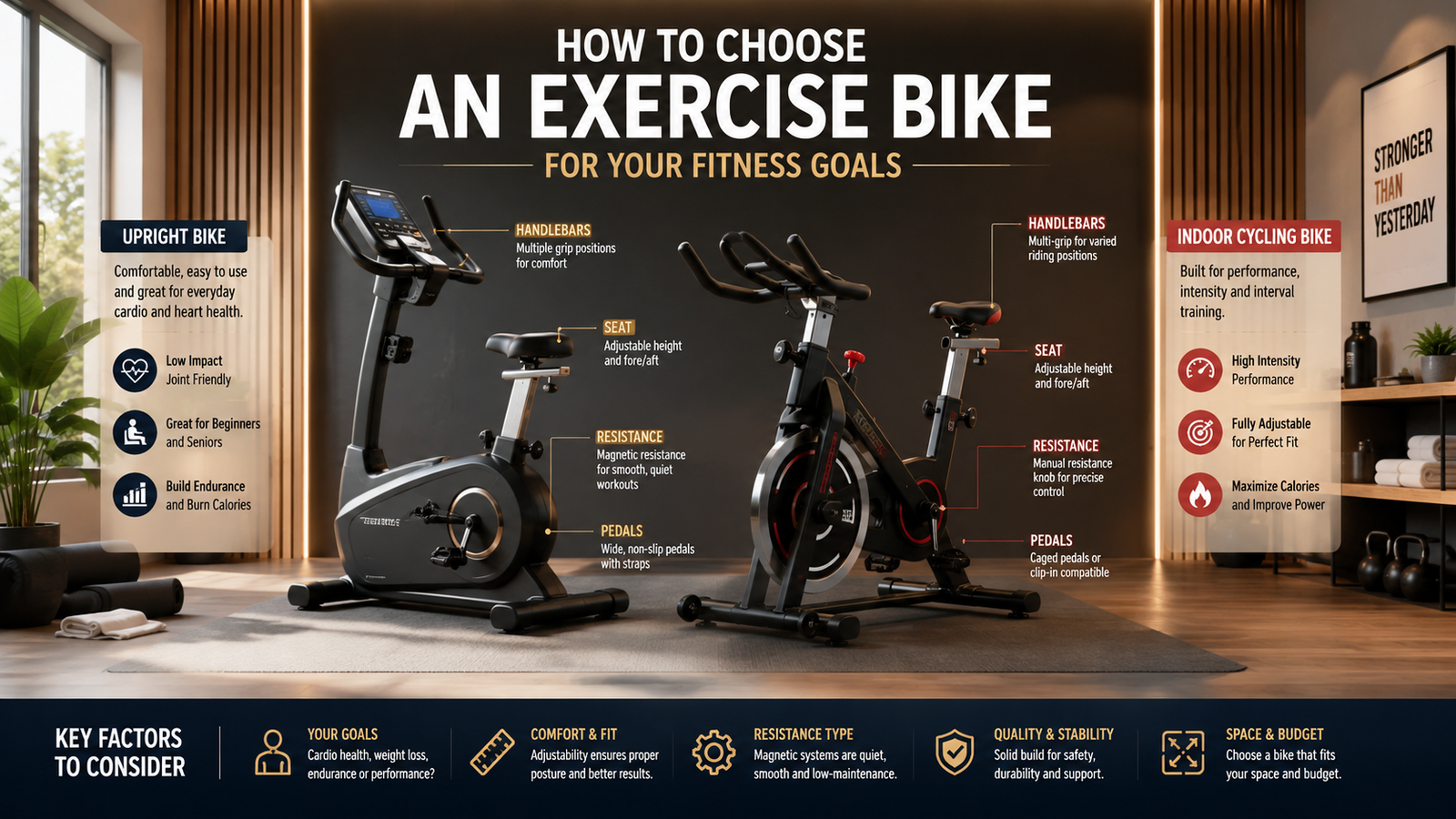
An upright bike, recumbent bike, indoor cycling bike and air bike can feel completely different even though all involve pedalling.
The right choice depends on:
your fitness goal → preferred riding position → joint comfort → intensity → available space → adjustability → resistance system → budget
The best exercise bike is not automatically:
- the one with the heaviest flywheel;
- the most resistance levels;
- the largest touchscreen;
- the highest price.
It is the bike that fits your body correctly, provides enough resistance for your goals and is comfortable enough that you will use it consistently.
What Is an Exercise Bike?
An exercise bike is a stationary cardio machine that simulates aspects of outdoor cycling.
Depending on the design, it may be intended for:
- light activity;
- rehabilitation-style exercise;
- moderate cardio;
- indoor cycling;
- high-intensity intervals;
- athletic conditioning.
Common categories include:
- upright exercise bikes;
- recumbent bikes;
- indoor cycling or spin-style bikes;
- air bikes;
- compact pedal exercisers.
Choosing between these categories should come before comparing individual models.
Why Choose an Exercise Bike?
Cycling has several advantages for home cardio.
It can provide meaningful cardiovascular effort while producing less repeated impact than activities such as:
- running;
- jumping rope.
Exercise bikes also tend to be:
- more compact than treadmills;
- quieter than many treadmills;
- easy to adjust for different intensities.
They can work for:
- beginners;
- experienced exercisers;
- people who simply want more daily movement.
What Can Exercise-Bike Training Improve?
Regular cycling can support:
- aerobic fitness;
- cardiovascular endurance;
- lower-body muscular endurance;
- work capacity;
- general physical activity;
- energy expenditure.
Harder bike workouts can also improve:
- interval performance;
- tolerance for sustained effort.
However, stationary cycling should not be viewed as a complete replacement for:
- strength training;
- walking;
- general daily movement.
A balanced fitness routine can include all of them.
Is an Exercise Bike Good for Beginners?
Yes.
One major advantage of a stationary bike is that intensity can usually be adjusted gradually.
A beginner can start with:
- low resistance;
- short duration;
- comfortable cadence.
There is no requirement to begin with:
- standing climbs;
- high-resistance intervals;
- intense cycling classes.
A simple 15–20 minute ride can be a perfectly useful starting point.
Is Cycling Low Impact?
Stationary cycling is generally considered low impact because the feet remain in contact with the pedals rather than repeatedly striking the ground.
This can reduce impact forces compared with:
- running;
- jumping.
But low impact does not mean zero stress.
Cycling still places demands on:
- knees;
- hips;
- lower back.
Poor bike setup or inappropriate resistance can still cause discomfort.
Start With Your Main Fitness Goal
Before choosing a bike, decide what you actually want from it.
General Fitness
An upright bike or recumbent bike may be enough.
Weight-Management Support
Any bike can work if it helps you exercise consistently.
High-Intensity Cardio
Consider:
- indoor cycling bike;
- air bike.
Low-Impact Steady Cardio
Consider:
- upright bike;
- recumbent bike.
Structured Indoor Cycling
Choose an indoor cycling bike.
Supported Seated Exercise
A recumbent bike may be more comfortable.
Full-Body Conditioning
An air bike with moving handles may suit you.
Compact Home Cardio
A basic upright bike or folding bike may be practical.
The Main Types of Exercise Bikes
The four major categories are:
- Upright exercise bikes
- Recumbent bikes
- Indoor cycling bikes
- Air bikes
Understanding these differences is more useful than immediately comparing specifications.
Upright Exercise Bikes
An upright exercise bike places you in a relatively vertical seated position.
It resembles recreational cycling more than a recumbent bike but is usually less aggressive than a performance-oriented indoor cycling bike.
You sit on a saddle with:
- pedals beneath you;
- handlebars in front.
Who Is an Upright Bike Best For?
It works well for:
- general home fitness;
- moderate cardio;
- beginners;
- people who want compact equipment.
It can support both:
- easier steady rides;
- harder resistance sessions.
Advantages of Upright Bikes
Typical advantages include:
- relatively small footprint;
- straightforward use;
- moderate price range;
- comfortable cardio training;
- simple resistance adjustment.
They are often a strong all-round choice.
Limitations of Upright Bikes
Possible disadvantages include:
- saddle discomfort;
- more upright posture may not suit everyone;
- less performance-oriented than an indoor cycling bike;
- some budget models have limited adjustability.
If you plan to cycle frequently, check whether the:
- seat;
- handlebars;
can be adjusted sufficiently for your body.
Recumbent Exercise Bikes
Recumbent bikes use a larger seat with:
- back support;
- pedals positioned farther forward.
Instead of sitting over the pedals, you ride in a more reclined position.
Who May Prefer a Recumbent Bike?
A recumbent bike may suit people who value:
- back support;
- a larger seat;
- lower balance demands;
- easier mounting.
It may also be attractive for some:
- older adults;
- beginners;
- people returning to exercise.
But individual medical or musculoskeletal conditions still require individualized advice.
Advantages of Recumbent Bikes
Potential benefits include:
- comfortable seating;
- greater stability;
- supported back;
- lower need for upper-body balance.
They can work well for longer steady cardio sessions.
Limitations of Recumbent Bikes
They are often:
- larger;
- heavier;
- less compact.
They may also provide less of the:
- performance cycling;
- standing climb;
experience some users want.
They can still deliver hard workouts through increased:
- resistance;
- duration.
Indoor Cycling Bikes
Indoor cycling bikes are sometimes informally called:
- spin bikes.
They are designed to resemble a more performance-oriented cycling position.
Common features include:
- heavier flywheel;
- substantial resistance;
- narrow saddle;
- multiple hand positions;
- extensive seat adjustment.
Who Should Consider an Indoor Cycling Bike?
Choose this style if you want:
- challenging cycling workouts;
- structured classes;
- standing intervals;
- high resistance;
- athletic conditioning.
It is often the best option for users who specifically enjoy cycling as an exercise rather than simply wanting seated cardio.
Indoor Cycling Position
The rider generally leans forward more than on a standard upright bike.
This can provide:
- efficient hard pedalling;
- multiple hand positions.
But it may be less comfortable for people who dislike:
- forward torso position;
- narrow cycling saddles.
Proper setup matters considerably.
Advantages of Indoor Cycling Bikes
Common advantages:
- stable under harder effort;
- good resistance range;
- suitable for intervals;
- highly adjustable;
- realistic cycling feel.
Limitations of Indoor Cycling Bikes
Possible disadvantages:
- saddle may feel uncomfortable initially;
- correct fitting requires more attention;
- some models are heavier;
- premium models may rely on subscriptions.
If you only want gentle 20-minute cardio, a simpler upright bike may be more comfortable.
Air Bikes
Air bikes use a large fan to create resistance.
Many designs include moving handles, so you can use:
- arms;
- legs;
at the same time.
Resistance increases as you push harder.
Who Should Consider an Air Bike?
Air bikes are particularly useful for:
- high-intensity intervals;
- conditioning;
- short hard workouts;
- functional fitness.
They can also be used more gently, but their main strength is demanding intensity.
Why Air Bikes Feel So Difficult
Fan resistance responds to your output.
The harder you pedal and push:
- the greater the resistance becomes.
There is no fixed upper resistance setting in the same way as many magnetic bikes.
This makes them ideal for:
- short maximal or near-maximal efforts.
Air Bike Advantages
Potential advantages:
- arms and legs both work;
- resistance automatically responds to effort;
- excellent for intervals;
- simple mechanical training concept.
Air Bike Disadvantages
They can be:
- noisy;
- demanding;
- uncomfortable for long easy sessions.
If your main goal is quiet evening cycling in an apartment, an air bike may not be ideal.
Compact Pedal Exercisers
Mini pedal devices can be placed:
- in front of a chair;
- under some desks.
They allow light pedalling.
These can be useful for:
- gentle movement;
- increasing activity.
But they are not equivalent to a full exercise bike.
Who Should Consider a Mini Pedal Exerciser?
They may suit someone who wants:
- basic movement;
- minimal storage requirements.
But they usually provide limited:
- stability;
- resistance;
- exercise intensity.
For serious cardio training, a full bike is more suitable.
Folding Exercise Bikes
Some upright-style bikes fold inward for storage.
These can be useful in:
- small apartments;
- multipurpose rooms.
However, folding models may compromise:
- frame rigidity;
- adjustability;
- maximum resistance.
They are often best for:
- light;
- moderate use.
Choose Based on Your Preferred Position
This is one of the easiest ways to narrow the options.
Prefer Upright, Relaxed Position
Choose:
- upright bike.
Want Maximum Back Support
Choose:
- recumbent bike.
Want Performance Cycling Position
Choose:
- indoor cycling bike.
Want Hard Full-Body Intervals
Choose:
- air bike.
Your comfort in the riding position matters more than marketing claims.
Seat Comfort
Saddle comfort is a common issue when people begin stationary cycling.
The body may need some time to adapt.
But persistent pain should not simply be ignored.
Seat comfort depends on:
- saddle shape;
- width;
- padding;
- riding position;
- bike fit.
More Padding Is Not Always Better
A very thick soft saddle can seem comfortable initially.
During longer rides, excessive padding may create:
- pressure;
- friction.
Performance-oriented bikes often use firmer saddles because they support the sitting bones more effectively.
Casual users may prefer somewhat more cushioning.
Wide vs Narrow Saddle
Wider Saddle
Often works better with:
- upright;
- recumbent positions.
Narrower Saddle
Common in:
- performance cycling.
The more upright you sit, the more body weight tends to rest on the saddle.
The more forward you lean, the support pattern changes.
Can You Replace the Saddle?
Many exercise bikes allow saddle replacement.
Check whether the seat uses:
- standard rails;
- proprietary fitting.
This can be valuable if you like the bike but dislike its original saddle.
Padded Seat Covers
Seat covers can temporarily increase cushioning.
They may help beginners.
But they do not correct:
- poor saddle shape;
- incorrect bike fit.
Do not use padding as a substitute for proper adjustment.
Seat Height Is Critical
Incorrect saddle height is one of the most common causes of cycling discomfort.
A seat that is too low can increase:
- knee flexion;
- pressure around the front of the knee.
A seat that is too high may cause:
- hip rocking;
- overreaching;
- strain behind the knee.
Basic Saddle-Height Setup
A simple starting point:
- Sit on the bike.
- Put one pedal near the bottom of the stroke.
- Keep your foot in normal pedalling position.
- The knee should remain slightly bent rather than fully locked.
This is only a starting point.
Comfort and individual anatomy matter.
Heel Method for Saddle Height
A common rough setup method:
- Place your heel on the pedal.
- Move the pedal to the bottom.
- The leg should be almost straight without the hip rocking.
- When the forefoot returns to normal pedalling position, the knee will have some bend.
This can provide a useful initial estimate.
It is not a professional bike fit.
Seat Fore-Aft Adjustment
Many indoor cycling bikes allow the saddle to move:
- forward;
- backward.
This helps adjust the relationship between:
- hips;
- knees;
- pedals.
A bike with only height adjustment may not fit every user equally well.
Handlebar Height
Handlebar position affects:
- posture;
- shoulder comfort;
- back angle.
Beginners often prefer handlebars:
- relatively high.
More experienced indoor cyclists may choose a lower position.
You do not need to imitate an aggressive road-cycling posture.
Handlebar Fore-Aft Adjustment
Some indoor bikes also allow handlebars to move:
- closer;
- farther away.
This improves fit for users with different:
- torso;
- arm lengths.
More adjustability is particularly valuable if several household members will use the bike.
Multi-User Households
If multiple people will use the bike, prioritize:
- wide seat-height range;
- fore-aft adjustment;
- handlebar adjustment;
- easy adjustment mechanisms.
A bike that fits one person perfectly may feel very uncomfortable for another.
User Height Range
Manufacturers may provide recommended height ranges.
Check them.
This matters particularly for:
- very short;
- very tall users.
Do not assume all exercise bikes are universally adjustable.
User Weight Capacity
Always check the maximum user-weight rating.
The bike should support your weight with an appropriate margin.
A bike operated continuously near its maximum capacity may experience more:
- frame stress;
- instability.
A robust frame is especially important during:
- high-resistance;
- standing cycling.
Bike Stability
The frame should remain stable during:
- easy pedalling;
- high resistance;
- standing intervals where allowed.
Watch for:
- side-to-side rocking;
- frame flex;
- unstable handlebars.
This is particularly important for indoor cycling bikes and air bikes.
Floor Levellers
Many bikes have adjustable feet that help compensate for slightly uneven flooring.
These can significantly improve:
- stability.
Check that the bike sits flat before exercising.
Exercise-Bike Resistance Systems
Resistance determines how difficult it is to pedal.
Common systems include:
- magnetic resistance;
- friction resistance;
- air resistance.
Each behaves differently.
Magnetic Resistance
Magnetic systems use magnets to create resistance around the flywheel.
Advantages often include:
- quiet operation;
- smooth resistance;
- low wear because there is less physical contact.
Magnetic resistance is common in:
- upright bikes;
- recumbent bikes;
- premium indoor cycling bikes.
Who Should Choose Magnetic Resistance?
It is particularly useful if you value:
- quiet workouts;
- smooth adjustment;
- low maintenance.
This is often the most practical system for home environments.
Friction Resistance
Friction systems use a pad that physically presses against the flywheel.
Common on:
- traditional indoor cycling bikes.
Advantages:
- simple mechanism;
- strong continuous resistance;
- often lower initial cost.
Friction Resistance Disadvantages
The resistance pad may:
- wear;
- require replacement.
It may also produce slightly more:
- noise;
- maintenance.
But a good friction system can still provide excellent training.
Air Resistance
Air resistance uses a fan.
The faster and harder you work:
- the more resistance you encounter.
This creates a naturally progressive feel.
It is common in:
- air bikes.
Air Resistance Noise
The large fan creates substantial airflow and sound.
For some users this is motivating.
For others it is too noisy.
Try one before buying if noise matters.
Resistance Levels
Magnetic bikes often advertise:
- 8;
- 16;
- 32;
- 100 resistance levels.
More levels do not automatically mean more resistance.
A bike with 100 weak steps may not be harder than one with 20 well-spaced levels.
The important factors are:
- overall resistance range;
- smooth progression.
How Much Resistance Do You Need?
For general fitness, the bike should offer:
- very easy resistance;
- moderate steady resistance;
- challenging resistance.
For serious interval training, you need enough resistance that hard efforts remain demanding as fitness improves.
Resistance Knob vs Buttons
Manual Knob
Common on indoor cycling bikes.
Advantages:
- immediate adjustment;
- easy to use during intervals.
Digital Buttons
Common on magnetic upright and recumbent bikes.
Advantages:
- precise levels;
- programmable workouts.
Both can work well.
Emergency Resistance Stop
Some indoor cycling bikes allow the resistance knob to be pressed down to:
- stop the flywheel quickly.
This is a useful safety feature.
Know how to use it before training.
Flywheel
The flywheel helps create:
- momentum;
- smooth pedalling.
Heavier flywheels are commonly promoted as superior.
The reality is more nuanced.
Does a Heavier Flywheel Mean a Better Bike?
Not automatically.
A heavier flywheel can create:
- smooth rotational momentum.
But overall performance also depends on:
- resistance design;
- bearings;
- drivetrain;
- frame construction.
A lighter flywheel paired with a high-quality magnetic system may feel excellent.
Do not compare bikes only by flywheel weight.
Belt Drive vs Chain Drive
The pedals transfer power to the flywheel through mechanisms such as:
- belt;
- chain.
Belt Drive
Usually:
- quieter;
- lower maintenance.
Common in modern home bikes.
Chain Drive
Can feel somewhat more like a traditional bicycle.
But it may require:
- more maintenance;
- lubrication;
- produce more noise.
For most home users, belt drive is convenient.
Pedals
Exercise-bike pedals can include:
- simple flat platforms;
- toe cages;
- adjustable straps;
- clip-in systems.
Choose based on your training style.
Flat Pedals
Easy for:
- beginners;
- casual users.
Use normal athletic shoes.
Toe Cages and Straps
These help secure the foot.
They can improve confidence during:
- faster pedalling;
- harder intervals.
The strap should feel secure without restricting circulation.
Clip-In Pedals
Performance-oriented bikes may support cycling shoes with cleats.
Advantages can include:
- secure connection;
- cycling-specific feel.
But they are not necessary for general fitness.
Dual-Sided Pedals
Some indoor bikes offer:
- flat/toe-cage side;
- clip-in side.
This gives flexibility for different household users.
Pedal Q-Factor
Q-factor refers roughly to the horizontal distance between the pedals.
A very wide pedal stance may feel less natural for some users.
Performance-oriented riders may care more about this measurement.
For most general users, comfort during actual riding matters more than the number itself.
Crank Length
Crank length influences the circular path of the pedal.
Most consumer bikes use fixed crank lengths.
Extremely tall or short users may notice fit differences.
But seat and handlebar adjustment are usually more important for general home use.
Upright vs Recumbent Pedalling Mechanics
Both train the lower body, but body position differs.
An upright bike places the hips above the pedals.
A recumbent bike places the legs more forward.
This changes:
- posture;
- muscle emphasis;
- comfort.
Neither is automatically more effective.
What Muscles Does an Exercise Bike Use?
Primary lower-body muscles include:
- quadriceps;
- glutes;
- hamstrings;
- calves.
The exact contribution depends on:
- resistance;
- cadence;
- body position.
Indoor cycling also requires some:
- trunk stabilization.
Air bikes add substantial:
- arm;
- shoulder involvement.
Can Exercise Bikes Build Muscle?
They can improve:
- muscular endurance;
- some muscle development, particularly in beginners.
High-resistance cycling can challenge the legs substantially.
But exercise bikes are not a complete replacement for progressive strength training if your main goal is:
- maximizing strength;
- muscle growth.
Cycling and Glutes
Higher resistance and certain cycling positions can increase glute involvement.
Standing climbs and stronger resistance may recruit more:
- hip extensors.
But simply increasing resistance to an extreme level does not automatically create better glute development.
Strength exercises provide more direct progressive overload.
Cycling and Quadriceps
Quadriceps are heavily involved in:
- pushing the pedal downward.
Hard resistance can create significant quad fatigue.
This is normal.
Persistent knee-joint pain is different and should be assessed.
Cadence
Cadence is the number of pedal revolutions per minute, usually expressed as:
RPM
Cadence gives useful information about pedalling speed.
Low vs High Cadence
Lower Cadence + Higher Resistance
Feels more like:
- climbing;
- strength-endurance work.
Higher Cadence + Lower Resistance
Feels more like:
- fast aerobic spinning.
Both can be useful.
Avoid pedalling extremely fast with almost no resistance because control may decrease.
Is a High RPM Better?
No.
Cadence should match:
- resistance;
- workout goal;
- experience.
A controlled 80 RPM can be more useful than an unstable 120 RPM.
Technique matters.
Resistance vs Cadence
Workout difficulty depends on both.
You can make a session harder by:
- increasing resistance;
- increasing cadence;
- extending duration.
Change variables gradually.
Watts and Power Output
Some bikes display:
- watts.
Power measures the rate at which mechanical work is performed.
For performance training, watts can be extremely useful because they provide a more direct measure of exercise output than:
- speed.
Do You Need Accurate Power Measurement?
Not for general fitness.
If your main goals are:
- health;
- regular cardio;
- weight management;
you can train effectively using:
- time;
- resistance;
- cadence;
- perceived effort.
Accurate power becomes more useful for:
- competitive cycling;
- structured performance training.
Bike Speed Display
Stationary bikes may show:
- km/h;
- mph.
This is largely a simulated metric because the bike is not actually travelling.
Different bikes calculate speed differently.
Do not compare:
- 30 km/h on one stationary bike;
directly with another model.
Distance Display
Distance is similarly calculated from:
- flywheel movement;
- cadence;
- internal formulas.
Use it to track your own workouts consistently.
Do not assume indoor bike kilometres equal outdoor kilometres in physiological demand.
Calorie Display
Bike calorie estimates should be treated as approximations.
Accuracy depends on whether the machine knows:
- body weight;
- heart rate;
- actual power output.
Use the number for rough comparison rather than exact energy accounting.
Heart-Rate Monitoring
Some bikes include:
- grip sensors;
- wireless sensor compatibility.
Heart-rate data can help estimate workout intensity.
But grip sensors may be less reliable during:
- intense exercise;
- sweaty workouts.
Chest-Strap Compatibility
If you care about accurate exercise heart rate, check whether the bike can connect to a:
- chest strap.
This can be especially useful for:
- endurance training;
- heart-rate-based intervals.
Do You Need a Heart-Rate Monitor?
No.
You can use:
- talk test;
- perceived exertion.
Easy
Can talk comfortably.
Moderate
Breathing is faster but controlled.
Hard
Speaking becomes difficult.
For general fitness, this can be enough.
What Is a Good Beginner Intensity?
Start at a pace where you can:
- breathe faster;
- maintain control;
- complete the session comfortably.
You should not feel as if you are sprinting from the first workout.
Progression matters more than initial intensity.
Exercise-Bike Console
Basic consoles may show:
- time;
- distance;
- speed;
- calories;
- heart rate.
These are enough for most users.
Do You Need a Touchscreen?
No.
A touchscreen can add:
- guided workouts;
- entertainment;
- virtual cycling.
But it can also increase:
- price;
- software dependence;
- repair cost.
Prioritize mechanical quality first.
Built-In Workout Programs
Programs may include:
- intervals;
- hills;
- heart-rate workouts;
- endurance programs.
These can provide variety.
But they are optional.
You can create effective workouts manually by changing:
- resistance;
- cadence.
Smart Bikes
Smart exercise bikes may integrate with:
- training apps;
- virtual cycling platforms;
- live classes.
They can automatically track:
- cadence;
- resistance;
- power;
- heart rate.
These features can be useful if they increase motivation.
Subscription-Based Bikes
Some premium bikes are closely tied to monthly subscriptions.
Before buying, check:
- membership cost;
- which features require membership;
- whether basic cycling works without it.
Calculate long-term cost.
A bike may become much more expensive over several years.
App Compatibility
If you want to use apps, verify:
- Bluetooth support;
- ANT+ where relevant;
- FTMS compatibility;
- specific platform support.
Do not assume that because a bike says “Bluetooth” it can connect to every fitness app.
Bluetooth FTMS
Bluetooth Fitness Machine Service is a standardized protocol that can allow compatible fitness equipment to communicate workout data to apps.
Support may include:
- speed;
- cadence;
- resistance;
- power.
Check the actual implementation.
Tablet Holder
A tablet holder can be more useful than an expensive built-in screen.
You can use your own device for:
- entertainment;
- training apps;
- classes.
This reduces dependence on proprietary software.
Phone Holder
Useful for:
- music;
- workout timers;
- apps.
Make sure it holds the device securely during high-cadence workouts.
Bottle Holder
Cycling can produce substantial sweating.
A bottle holder makes hydration easy during longer sessions.
Check placement.
You should be able to reach it without:
- twisting awkwardly.
Built-In Fan
Some upright or recumbent bikes include small fans.
Useful, but often not powerful.
A separate room fan may provide much better cooling during hard workouts.
Exercise-Bike Noise
Noise comes from:
- resistance system;
- drivetrain;
- fan;
- frame vibration.
Magnetic belt-drive bikes are generally among the quietest.
Best Bikes for Quiet Home Use
Often:
- magnetic upright bike;
- magnetic recumbent bike;
- magnetic indoor cycling bike.
These can be well suited to:
- apartments;
- early morning workouts.
Air Bike Noise
Air bikes are significantly louder because of:
- fan resistance.
This is normal.
If you share walls with neighbours, consider:
- workout timing;
- room placement.
Friction Bike Noise
Friction pads can create:
- light rubbing sound.
Noise may increase if the pad:
- wears;
- becomes misaligned.
Maintenance can help.
Exercise Mat Under the Bike
A suitable mat can:
- protect flooring;
- reduce vibration;
- catch sweat;
- prevent some movement.
It is particularly useful on:
- hardwood;
- laminate;
- carpet.
Floor Space
Measure before buying.
Check:
- length;
- width;
- handlebar clearance;
- mounting space.
Recumbent bikes can be much longer than they appear in photos.
Ceiling Height
Usually less of a concern than with:
- treadmill;
- elliptical.
But it still matters if:
- tall user;
- elevated bike platform;
- low-ceiling room.
Indoor cycling includes some vertical body movement when standing.
Transport Wheels
Most full-size bikes include small wheels.
These allow you to:
- tilt;
- roll the machine.
But a heavy indoor cycling bike can still be difficult to move.
Machine Weight
A heavier frame may provide greater stability.
But it reduces portability.
If you plan to store the bike after every workout, choose a design you can realistically move.
Folding Bikes and Portability
Folding bikes can reduce storage space.
But check:
- folded dimensions;
- weight.
A foldable bike may still occupy significant vertical space.
Recumbent Bike Step-Through Design
Some recumbent bikes provide a very low step-through area.
This can make mounting easier for people with:
- limited mobility;
- balance concerns.
If this matters, check actual frame geometry rather than assuming all recumbent bikes are equally easy to enter.
Indoor Cycling Bike Mounting
Performance cycling bikes typically require:
- stepping over the frame;
- balancing on a relatively narrow saddle.
This may not suit every user.
Correct Pedalling Technique
A good pedal stroke should feel:
- smooth;
- controlled.
Avoid allowing knees to move dramatically:
- inward;
- outward;
if this creates discomfort.
Your knees should generally track comfortably in line with your feet.
Individual anatomy varies.
Knee Position
Cycling should not require you to force the knees into an unnaturally narrow position.
Adjust:
- seat height;
- seat position;
- foot placement.
If knee pain persists, review the fit.
Common Cause of Front Knee Pain
A saddle that is too low can increase knee flexion.
Other factors include:
- too much resistance;
- excessive training volume;
- existing knee issues.
Do not diagnose persistent pain from bike position alone.
Pain Behind the Knee
Possible contributors can include:
- saddle too high;
- overreaching.
But persistent pain may have other causes.
Adjust conservatively and seek professional advice if needed.
Hip Rocking
If your hips rock side to side at the bottom of the pedal stroke, the saddle may be:
- too high.
Reduce the height slightly and reassess.
Lower-Back Comfort
If you experience back discomfort, consider:
- handlebar height;
- saddle distance;
- torso position.
A very low handlebar setup may place more demand on the back.
Raising the handlebars can make the position more upright.
Neck and Shoulder Tension
Do not support excessive body weight through:
- arms;
- shoulders.
Keep shoulders relatively relaxed.
If you constantly reach for the handlebars, adjust them:
- closer;
- higher.
Wrist Comfort
Avoid locking your elbows and placing excessive weight through the hands.
Change hand position during longer rides.
Performance bikes often provide multiple grip positions.
Recumbent-Bike Posture
Sit with the back supported.
Avoid setting the seat so close that your knees become excessively bent.
At full extension, the knees should retain some bend.
Standing on an Indoor Cycling Bike
Standing increases:
- cardiovascular demand;
- body involvement.
Before standing:
- add adequate resistance;
- ensure the bike is stable.
Do not stand and pedal aggressively on a lightweight bike not designed for it.
Standing With Too Little Resistance
This can make the pedals move:
- uncontrolled;
- excessively fast.
Use enough resistance to maintain control.
Air Bike Technique
Because arms and legs both move:
- coordinate the push-pull action.
You can also sometimes train using:
- legs only;
- arms only;
depending on the machine.
For full-body intervals, maintain stable posture rather than rocking excessively.
Warm-Up
A simple bike warm-up:
5 Minutes
- low resistance;
- comfortable cadence.
Then gradually increase:
- resistance;
- effort.
This is enough for many moderate sessions.
Cool-Down
After a hard ride:
- Reduce resistance.
- Pedal easily for several minutes.
- Allow heart rate and breathing to decrease.
Avoid finishing a maximal interval and immediately stepping off if you feel light-headed.
Beginner Exercise-Bike Workout
Warm-Up
5 minutes easy.
Main Session
15–20 minutes moderate cycling.
Aim for an effort where:
- breathing increases;
- conversation is still possible.
Cool-Down
5 minutes easy.
Progress gradually.
Beginner Interval Workout
Warm-Up
5 minutes.
Main Set
Repeat 6 times:
- 1 minute slightly harder;
- 2 minutes easy.
Cool-Down
5 minutes.
The hard interval does not need to be maximal.
Moderate Steady-State Workout
Warm-Up
5 minutes.
Main Session
25–40 minutes at a consistent moderate effort.
Cool-Down
5 minutes.
This is useful for building:
- aerobic endurance.
Indoor Cycling Hill Workout
Warm-Up
5–10 minutes.
Main Set
Repeat:
- 3 minutes moderate resistance;
- 2 minutes higher resistance;
- 2 minutes easier.
Keep cadence controlled.
Do not use so much resistance that technique deteriorates.
Air-Bike Interval Workout
Air bikes are excellent for short intervals.
Example:
Warm-Up
5 minutes easy.
Main Set
8 rounds:
- 20 seconds hard;
- 100 seconds easy.
Cool-Down
5 minutes.
Beginners should avoid treating every hard interval as an all-out sprint.
Exercise Bike for Weight Management
Exercise bikes can contribute to:
- weekly energy expenditure;
- daily activity;
- cardiovascular fitness.
But they do not independently produce fat loss.
Body-weight change depends on long-term:
- energy intake;
- energy expenditure.
Use cycling as one component of a broader lifestyle.
Is Cycling Better Than Walking for Weight Loss?
Neither is universally better.
Cycling may allow:
- higher intensity;
- greater energy expenditure per minute.
Walking may be easier to:
- recover from;
- perform frequently.
The better option is the one you can sustain consistently.
Exercise Bike vs Treadmill
Choose based on movement preference and impact.
Exercise Bike
Advantages:
- lower impact;
- compact;
- quieter.
Treadmill
Advantages:
- walking/running specificity;
- weight-bearing exercise;
- familiar movement.
Neither is inherently superior.
Exercise Bike vs Elliptical
Both can provide low-impact cardio.
Bike
- seated;
- smaller footprint;
- easier balance.
Elliptical
- standing;
- potentially more upper-body involvement;
- more weight-bearing.
Choose based on comfort.
Exercise Bike vs Rowing Machine
Exercise Bike
Simpler technique.
Rower
Uses more upper-body musculature and requires more technical skill.
If you want low-complexity cardio, the bike is easier.
If you enjoy full-body rhythmic exercise, rowing may appeal more.
Exercise Bike vs Outdoor Cycling
Indoor cycling provides:
- predictable conditions;
- no traffic;
- controlled resistance;
- easy interval training.
Outdoor cycling provides:
- changing terrain;
- balance demands;
- real-world cycling skill.
Indoor cycling is excellent for fitness but does not fully reproduce:
- bike handling;
- wind;
- outdoor terrain.
Does Indoor Cycling Improve Outdoor Cycling?
Yes, it can improve:
- aerobic fitness;
- leg endurance;
- cycling-specific conditioning.
But outdoor riders also need:
- bike-handling skills;
- road awareness;
- terrain experience.
Exercise Bike for Runners
Cycling can be useful cross-training for runners because it provides aerobic work with less repeated impact.
It may help maintain cardiovascular training volume when:
- reducing running load.
But cycling does not fully replace running-specific adaptation.
Exercise Bike for Strength Athletes
Cycling can provide:
- conditioning;
- recovery-friendly cardio.
Easy cycling may fit well around strength training.
Very hard leg intervals can interfere with lower-body recovery if poorly scheduled.
Cycling Before Strength Training
If strength is your priority, keep pre-lifting cycling:
- short;
- easy.
A 5–10 minute warm-up can be fine.
Avoid exhausting your legs before:
- squats;
- deadlifts;
unless cardio performance is the priority.
Cycling After Strength Training
Moderate cycling can be done after lifting.
But hard cycling intervals after a demanding leg workout may increase fatigue substantially.
Adjust based on:
- recovery;
- goals.
Cycling on Recovery Days
Easy cycling can work as active recovery.
Keep resistance:
- low;
- effort easy.
If your legs are burning and heart rate is very high, it is no longer a recovery ride.
How Often Should You Use an Exercise Bike?
Frequency depends on:
- intensity;
- other training;
- fitness level.
For general fitness, several sessions per week can work well.
You can alternate:
- moderate rides;
- harder intervals;
- easier recovery rides.
You do not need maximal cycling every day.
How Long Should You Ride?
Useful sessions can range from:
- 10 minutes;
- 20 minutes;
- 30 minutes;
- 60 minutes or more.
Duration should match:
- fitness;
- intensity;
- schedule.
Short sessions still count.
Is 15 Minutes on an Exercise Bike Useful?
Yes.
Especially for a beginner, 15 minutes can:
- increase physical activity;
- provide cardiovascular stimulus.
You can gradually extend duration.
A sustainable short workout is better than an ambitious plan you stop doing.
General Aerobic Exercise Targets
Public-health guidelines often recommend adults accumulate approximately:
- 150 minutes of moderate aerobic activity per week;
or an equivalent amount of vigorous activity, alongside strength training.
Individual requirements vary.
You can use cycling for some or all of that aerobic activity.
What Is Moderate Cycling?
Moderate effort generally feels like:
- elevated heart rate;
- faster breathing;
- still able to speak.
This does not depend on a specific resistance number because bikes differ.
Use effort rather than comparing resistance levels between machines.
Vigorous Cycling
Vigorous effort produces:
- much harder breathing;
- substantial cardiovascular demand.
Conversation becomes difficult.
This can be useful but requires more recovery.
Zone 2 Cycling
Zone 2 generally refers to moderate aerobic work based on physiological or heart-rate models.
In practical home training, you can often approximate it as an effort where:
- breathing is clearly elevated;
- you can still maintain controlled conversation.
Do not obsess over one formula-derived heart-rate number.
HIIT on an Exercise Bike
Bikes are particularly well suited to high-intensity interval training because speed and resistance can be changed without the impact of sprint running.
But HIIT is demanding.
One or two hard sessions may be enough for many recreational exercisers.
Does HIIT Burn More Fat?
HIIT can produce high energy expenditure in a shorter workout.
But it is not a magical fat-loss method.
Long-term fat loss still depends on overall:
- energy balance;
- consistency.
Steady cycling and intervals can both be effective.
Fasted Cycling
Cycling before eating is sometimes promoted for fat loss.
While fasting may change fuel use during the session, it does not automatically lead to greater long-term fat loss.
Choose based on:
- comfort;
- performance;
- health considerations.
People with blood-glucose-related medical conditions should seek individualized advice.
Exercise Bike and Knee Health
Stationary cycling is often comfortable for the knees because it is low impact.
But poor bike fit can still create pain.
Important factors include:
- saddle height;
- resistance;
- cadence;
- training volume.
Is Cycling Good for Bad Knees?
It can be useful for some people, but “bad knees” is not a diagnosis.
Different knee conditions have different needs.
If you have:
- significant pain;
- recent surgery;
- diagnosed joint disease;
follow professional guidance.
Excessive Resistance and Knee Stress
Very high resistance at low cadence increases force per pedal stroke.
If you are a beginner, do not immediately perform long sessions of:
- heavy grinding.
Use manageable resistance and smooth cadence.
Exercise Bike for Back Problems
An upright or indoor cycling bike may require sustained trunk positioning.
A recumbent bike provides more back support.
But some people with back conditions may still experience discomfort in a recumbent position.
Choose according to the actual condition.
Exercise Bike for Balance Limitations
A recumbent bike may be useful because:
- seat is larger;
- riding position is more stable.
Upright bikes still require relatively little balance compared with outdoor cycling.
But mounting and dismounting should remain safe.
Exercise Bike for Older Adults
Older adults may benefit from exercise bikes when cycling is appropriate.
Useful features include:
- easy mounting;
- stable frame;
- clear controls;
- low starting resistance.
A recumbent bike may be particularly comfortable for some users.
Exercise Bike During Rehabilitation
Exercise bikes are commonly used in rehabilitation environments.
However, the correct:
- seat position;
- resistance;
- range of motion;
depends on the injury or surgery.
Do not create your own rehabilitation plan solely from generic cycling advice.
Exercise Bike and Cardiovascular Conditions
Cycling can be beneficial for cardiovascular health.
But people with known:
- heart disease;
- rhythm disorders;
- uncontrolled blood pressure;
may need individualized exercise recommendations.
Do not rely only on:
- console heart-rate zones.
When to Stop Exercising
Stop and seek appropriate medical assessment if cycling causes concerning symptoms such as:
- chest pain;
- fainting;
- severe unusual breathlessness;
- significant dizziness;
- concerning palpitations.
Normal exercise causes:
- faster breathing;
- sweating;
- elevated heart rate.
Severe or unusual symptoms should not be pushed through.
Cycling and Numbness
Some people experience numbness or pressure from:
- saddle;
- hand position.
If numbness persists:
- stop;
- adjust bike fit;
- reassess saddle and posture.
Persistent genital or neurological numbness deserves appropriate evaluation.
Saddle Pressure
Long rides can create pressure around the sitting area.
Helpful strategies include:
- proper saddle width;
- correct height;
- standing briefly when appropriate;
- padded cycling shorts for frequent riding.
Do not assume a heavily padded saddle is the only solution.
Padded Cycling Shorts
Cycling shorts contain a padded insert called a:
- chamois.
They can improve comfort during longer indoor rides.
They are optional for casual cycling.
Footwear
For ordinary upright and recumbent bikes:
- comfortable athletic shoes;
are usually enough.
Indoor cycling enthusiasts may prefer:
- firm-soled cycling shoes.
Why Stiff-Soled Shoes Can Help
A firmer sole can distribute pedal pressure more evenly.
This may feel better during:
- longer;
- higher-resistance rides.
But specialized shoes are not necessary for beginners.
Barefoot Cycling
Avoid barefoot cycling unless the machine is specifically designed for it.
Pedals can create:
- pressure;
- slipping;
- injury.
Use suitable footwear.
Hydration During Cycling
Indoor cycling can generate substantial sweating because there is no natural outdoor airflow.
Drink according to:
- thirst;
- session length;
- temperature.
A fan can improve comfort significantly.
Do You Need Electrolytes?
For short moderate rides, usually not.
Electrolytes become more relevant during:
- longer sessions;
- high heat;
- heavy sweating.
Plain water is adequate for many ordinary home workouts.
Room Ventilation
Cycling indoors produces heat.
Use:
- fan;
- ventilation;
- air conditioning where appropriate.
Poor cooling can make a moderate workout feel much harder.
Sweat Protection
Sweat can damage:
- frame;
- bolts;
- handlebars;
- electronics.
Wipe the bike after use.
This is particularly important for indoor cycling bikes because sweat often drips directly onto:
- frame;
- flywheel area.
Bike Maintenance
Maintenance depends on the design.
Check:
- bolts;
- pedals;
- resistance components;
- drivetrain.
Follow manufacturer instructions.
Belt-Drive Maintenance
Belt drives generally require little regular maintenance.
But inspect if you notice:
- slipping;
- unusual noise.
Do not dismantle internal systems unnecessarily.
Chain-Drive Maintenance
Chain systems may require:
- lubrication;
- tension checks.
Follow manufacturer guidance.
Friction-Pad Maintenance
Friction resistance pads gradually wear.
Signs may include:
- uneven resistance;
- increased noise.
Replacement is usually straightforward on well-supported models.
Magnetic Resistance Maintenance
Magnetic systems have less physical contact, which can reduce wear.
But:
- sensors;
- electronics;
- resistance motors;
can still require service.
Tightening Pedals
Pedals can loosen over time.
Check them periodically.
A loose pedal can damage:
- crank threads.
Install according to the correct left/right threading directions.
Cleaning the Bike
After use:
- Wipe sweat.
- Clean seat and handlebars.
- Keep console dry.
- Inspect around pedals.
Do not spray large amounts of liquid directly onto:
- electronics;
- bearings.
Bike Mat Cleaning
Sweat can collect underneath the machine.
Move or clean the mat periodically to prevent:
- moisture;
- odour;
- floor damage.
Warranty
Check separate warranties for:
- frame;
- parts;
- electronics;
- labour.
A long frame warranty is useful but does not necessarily protect:
- resistance unit;
- display.
Service Network
For smart or motorized magnetic bikes, local service availability matters.
Before purchasing, check:
- repair support;
- replacement parts;
- technician availability.
This is particularly important for expensive equipment.
Buying an Exercise Bike in India
For Indian buyers, also consider:
- local service centres;
- spare-parts availability;
- warranty coverage in your city;
- installation;
- maximum user weight;
- humid-climate corrosion resistance.
For smart bikes, check whether:
- apps;
- subscriptions;
- Bluetooth functions;
actually work in your region.
Assembly
Most exercise bikes require some assembly.
Typical components include:
- stabilizer bars;
- seat;
- handlebars;
- pedals;
- console.
Indoor cycling bikes can be heavy.
Professional assembly may be worthwhile for larger models.
Pedal Installation
Pedals often have different threading:
- right pedal;
- left pedal.
Installing them incorrectly can permanently damage the crank.
Follow the manual carefully.
Buying Online
Compare actual specifications such as:
- bike type;
- resistance system;
- user-weight capacity;
- adjustment range;
- machine dimensions;
- flywheel/resistance design;
- warranty;
- service.
Do not choose mainly by:
- star rating;
- product photo.
Reviews
Useful reviews discuss:
- long-term noise;
- saddle adjustment;
- frame stability;
- resistance range;
- service quality.
Early reviews such as:
- “looks beautiful”;
- “delivered today”;
tell you little about durability.
Return Policy
Large fitness equipment can be difficult to return.
Check:
- return window;
- damage-replacement policy;
- assembled-item restrictions;
- return shipping costs.
Budget Exercise Bikes
Budget bikes can work very well for:
- light;
- moderate exercise.
Prioritize:
- frame stability;
- adequate adjustability;
- safe pedals;
- reasonable resistance.
Do not sacrifice core quality for:
- screen;
- speakers.
Mid-Range Exercise Bikes
This is often the best value category for regular users.
You may gain:
- smoother resistance;
- better adjustability;
- stronger frame;
- improved console;
- better warranty.
Premium Exercise Bikes
Premium models may provide:
- highly accurate power;
- automatic resistance;
- large screens;
- virtual training;
- premium construction.
They may be worthwhile for:
- serious cyclists;
- high-frequency users.
But they are not necessary for basic fitness.
Commercial Exercise Bikes
Commercial-grade machines are built for:
- heavy daily usage;
- multiple users.
They are generally:
- heavier;
- more expensive.
A quality residential model is enough for most homes.
Used Exercise Bikes
Used bikes can be excellent value because they have relatively simple mechanics.
Check:
- frame;
- saddle adjustment;
- pedal condition;
- crank;
- resistance;
- bearings;
- console.
Listen for:
- grinding;
- clicking;
- irregular resistance.
Used Indoor Cycling Bikes
Inspect:
- flywheel;
- resistance pad;
- belt/chain;
- pedal threads.
Heavy gym use can create significant wear even if the bike looks clean.
Smart-Bike Software Support
If buying a used smart bike, check whether:
- software remains supported;
- membership can transfer;
- account activation is possible.
An old touchscreen is not useful if the platform no longer supports it.
Exercise-Bike Safety Around Children
Stationary bikes contain:
- pedals;
- flywheels;
- moving handles.
Keep children away during use.
Air bikes and indoor cycling bikes can have rapidly moving components.
Safety Around Pets
Pets can walk near:
- pedals;
- crank;
- flywheel.
Keep them away while exercising.
Moving Handles on Air Bikes
Air-bike handles move forcefully.
Make sure children or other people are not standing close to:
- handle path.
Stopping the Bike
Most standard bikes stop as you stop pedalling.
Indoor cycling bikes with heavy flywheels may continue rotating.
Use the:
- brake;
- emergency-stop system;
when necessary.
Fixed-Gear Indoor Bikes
Some indoor cycling bikes use a drivetrain where the pedals continue moving with the flywheel.
Do not suddenly take your feet off the pedals while the wheel is spinning.
Reduce speed gradually or use the stop mechanism.
Should You Stand While Cycling?
Only on bikes designed to support standing exercise.
Check:
- manufacturer instructions;
- frame stability.
Do not stand aggressively on a lightweight upright folding bike.
Correct Resistance When Standing
Use enough resistance that:
- pedals remain controlled.
Very high cadence with almost no resistance can become unstable.
Beginner Indoor Cycling Mistakes
Setting the Saddle Too Low
Common cause of discomfort.
Using Too Much Resistance
Makes movement inefficient and may overload the knees.
Pedalling Too Fast With No Resistance
Reduces control.
Leaning Heavily on Handlebars
Increases upper-body tension.
Copying Advanced Classes Immediately
Build fitness gradually.
Standing Too Much
Seated cycling is perfectly effective.
Ignoring Saddle Discomfort Forever
Some adaptation is normal, persistent pain is not.
Common Exercise-Bike Buying Mistakes
Choosing Only by Flywheel Weight
Overall design matters.
Ignoring Adjustability
Fit is critical.
Buying a Spin Bike When You Want Comfortable Casual Cardio
Choose the correct category.
Buying a Recumbent Bike Without Measuring Space
They can be long.
Assuming More Resistance Levels Means Harder Resistance
Not necessarily.
Ignoring User-Weight Capacity
Safety matters.
Paying for Smart Features Before Frame Quality
Mechanics first.
Ignoring Subscription Cost
Calculate long-term expense.
Buying Without Checking Local Service
Important for smart equipment.
Choosing a Bike That Several Household Users Cannot Adjust
Check range.
How to Test an Exercise Bike Before Buying
If possible, ride it for:
- at least several minutes.
Try:
- low resistance;
- moderate resistance;
- higher resistance.
If it is an indoor cycling bike, test:
- seated;
- standing where appropriate.
What Should You Check During a Test Ride?
Fit
Can you position the saddle correctly?
Reach
Can you reach handlebars without strain?
Knee Comfort
Does the pedal stroke feel natural?
Stability
Does the bike rock?
Resistance
Is the transition smooth?
Noise
Is it acceptable?
Saddle
Is the shape tolerable?
Controls
Can you change resistance easily?
Don’t Judge a Bike in 30 Seconds
Saddle discomfort or poor reach may only become obvious after:
- several minutes.
If you plan to ride for 30 minutes regularly, test the bike longer where possible.
Which Exercise Bike Is Best for Weight Loss?
There is no single winner.
Any bike can support weight-management goals if it allows enough:
- duration;
- intensity;
- consistency.
Choose:
Upright Bike
For versatile everyday cardio.
Recumbent Bike
For comfortable longer sessions.
Indoor Cycling Bike
For harder cycling workouts.
Air Bike
For intense intervals.
Consistency matters more than category.
Which Exercise Bike Is Best for Beginners?
For many beginners:
- upright bike;
- recumbent bike;
are the easiest starting options.
Choose recumbent if you prefer:
- more support.
Choose upright if you want:
- compact;
- more traditional cycling.
Which Bike Is Best for Hard Workouts?
Choose:
- indoor cycling bike;
- air bike.
The indoor bike is better for:
- sustained cycling.
The air bike is excellent for:
- short demanding intervals.
Which Bike Is Best for Small Spaces?
Consider:
- compact upright bike;
- folding bike.
Recumbent bikes tend to require more floor length.
Indoor cycling bikes can be surprisingly compact but are often heavy.
Which Bike Is Best for Apartments?
Prioritize:
- magnetic resistance;
- belt drive;
- stable frame;
- equipment mat.
These tend to reduce noise.
An air bike is generally less suitable if noise is a major concern.
Which Bike Is Best for Multiple Users?
Look for:
- large height range;
- easy saddle adjustment;
- fore-aft seat adjustment;
- handlebar adjustment;
- high weight capacity.
Indoor cycling bikes often provide excellent adjustability.
Which Bike Is Best for Long Rides?
Comfort becomes very important.
Possible choices:
- recumbent bike;
- well-fitted indoor cycling bike;
- quality upright bike.
The best choice depends on your preferred posture.
A Simple Exercise-Bike Buying Framework
Step 1 — Choose the Bike Type
Upright, recumbent, indoor cycling or air bike.
Step 2 — Check Fit
Seat and handlebar adjustment.
Step 3 — Check Stability
Frame and user-weight capacity.
Step 4 — Check Resistance
Enough range for your current and future fitness.
Step 5 — Check Noise
Important for home use.
Step 6 — Measure Space
Including mounting area.
Step 7 — Review Warranty and Service
Especially for smart bikes.
Step 8 — Evaluate Technology
Only after the mechanical basics are right.
Exercise-Bike Buying Checklist
Before purchasing, ask:
1. What style of training will I actually do?
Gentle cardio, long rides or hard intervals?
2. Which riding position feels best?
Upright, reclined or performance-oriented?
3. Can the bike fit my height?
Check adjustment range.
4. Is the saddle adjustable forward and backward?
Particularly useful for indoor cycling.
5. Are the handlebars adjustable?
Important for posture.
6. Is the user-weight capacity appropriate?
Leave reasonable margin.
7. Is the frame stable?
Especially at high resistance.
8. What resistance system does it use?
Magnetic, friction or air?
9. Is it quiet enough?
Important for shared homes.
10. Does it fit the available floor space?
Measure before buying.
11. Will I need to move it often?
Check weight and wheels.
12. Is the warranty adequate?
Check parts and labour.
13. Is local service available?
Important for electronics and smart resistance.
14. Does it require a subscription?
Understand ongoing costs.
15. Would I actually enjoy riding it several times each week?
This is the most important question.
A Simple Choice by Goal
General Fitness
Choose:
upright bike
Maximum Comfort and Support
Choose:
recumbent bike
Indoor Cycling and Performance Training
Choose:
indoor cycling bike
High-Intensity Full-Body Intervals
Choose:
air bike
Compact Light Cardio
Choose:
folding upright bike
A Simple Choice by Skin—No, by Space
When comparing home fitness equipment, product choices sometimes become unnecessarily complicated. For exercise bikes, space is straightforward.
Very Small Room
Consider:
- folding upright bike.
Small-to-Medium Home Gym
Consider:
- upright bike;
- indoor cycling bike.
More Floor Space Available
Consider:
- recumbent bike.
Dedicated Conditioning Area
Consider:
- air bike;
- heavy indoor cycling bike.
Measure first rather than estimating from product photographs.
A Simple Choice by Noise
Quietest Options
Often:
- magnetic belt-drive bikes.
Moderate Noise
- friction indoor cycling bikes.
Loudest
Usually:
- air bikes.
Actual construction still matters.
A Simple Choice by Intensity
Gentle
- recumbent;
- upright.
Moderate to Hard
- upright;
- indoor cycling.
Very Hard Intervals
- air bike;
- indoor cycling bike.
Any bike can still be adjusted across a range of effort.
Example Beginner Upright-Bike Routine
Warm-Up
5 minutes easy.
Main Session
20 minutes moderate.
Every 5 minutes:
- slightly increase resistance for 1 minute.
Cool-Down
5 minutes easy.
Example Beginner Recumbent-Bike Routine
Warm-Up
5 minutes low resistance.
Main Session
20–30 minutes steady pedalling.
Maintain:
- comfortable cadence;
- supported posture.
Cool-Down
5 minutes.
Example Indoor Cycling Routine
Warm-Up
10 minutes gradually increasing effort.
Main Session
Repeat 5 times:
- 3 minutes moderate;
- 1 minute hard;
- 2 minutes easy.
Cool-Down
5–10 minutes.
Example Air-Bike Conditioning Routine
Warm-Up
5 minutes.
Main Session
6 rounds:
- 30 seconds hard;
- 90 seconds easy.
Cool-Down
5 minutes.
Do not begin with maximal intervals if you are new to exercise.
When Should You Seek Professional Guidance?
Individualized advice may be useful before demanding cycling if you have:
- known cardiovascular disease;
- significant knee problems;
- major hip problems;
- recent surgery;
- balance limitations;
- unexplained exercise-related symptoms.
A physiotherapist or qualified exercise professional can also help with bike fit when you experience persistent:
- knee pain;
- back pain;
- numbness.
The Physical Glow Takeaway
Choosing an exercise bike becomes much easier when you start with how you want to train rather than comparing screens and resistance numbers.
A simple guide:
- general home cardio → upright bike;
- comfortable supported cardio → recumbent bike;
- serious indoor cycling and harder training → indoor cycling bike;
- high-intensity full-body conditioning → air bike.
Then evaluate the features that actually influence everyday use:
- fit → seat and handlebar adjustment should suit your body;
- stability → the frame should remain secure during harder efforts;
- resistance → enough range for both easy and challenging workouts;
- noise → magnetic systems are often better for quiet homes;
- user-weight capacity → choose adequate safety margin;
- space → measure the room before purchasing;
- maintenance → understand the resistance and drive system;
- warranty and service → particularly important for smart bikes.
And do not get distracted by specifications that sound impressive but do not improve your training.
You do not necessarily need:
- 100 resistance levels;
- a 22-inch screen;
- live classes;
- a giant flywheel;
- advanced power metrics.
For many users, a stable, quiet, well-adjusted bike with a useful resistance range provides everything necessary.
The best exercise bike is the one that lets you:
sit comfortably → pedal smoothly → control the intensity → progress gradually → keep riding consistently.
That consistency is far more important than owning the most technologically advanced bike in the room.