How to Choose the Right Gym Bag
Learn how to choose a gym bag that fits your workout routine, with practical guidance on capacity, compartments, material, comfort and everyday carry needs. This beginner-friendly guide helps you make a clear, informed choice without unnecessary complexity.
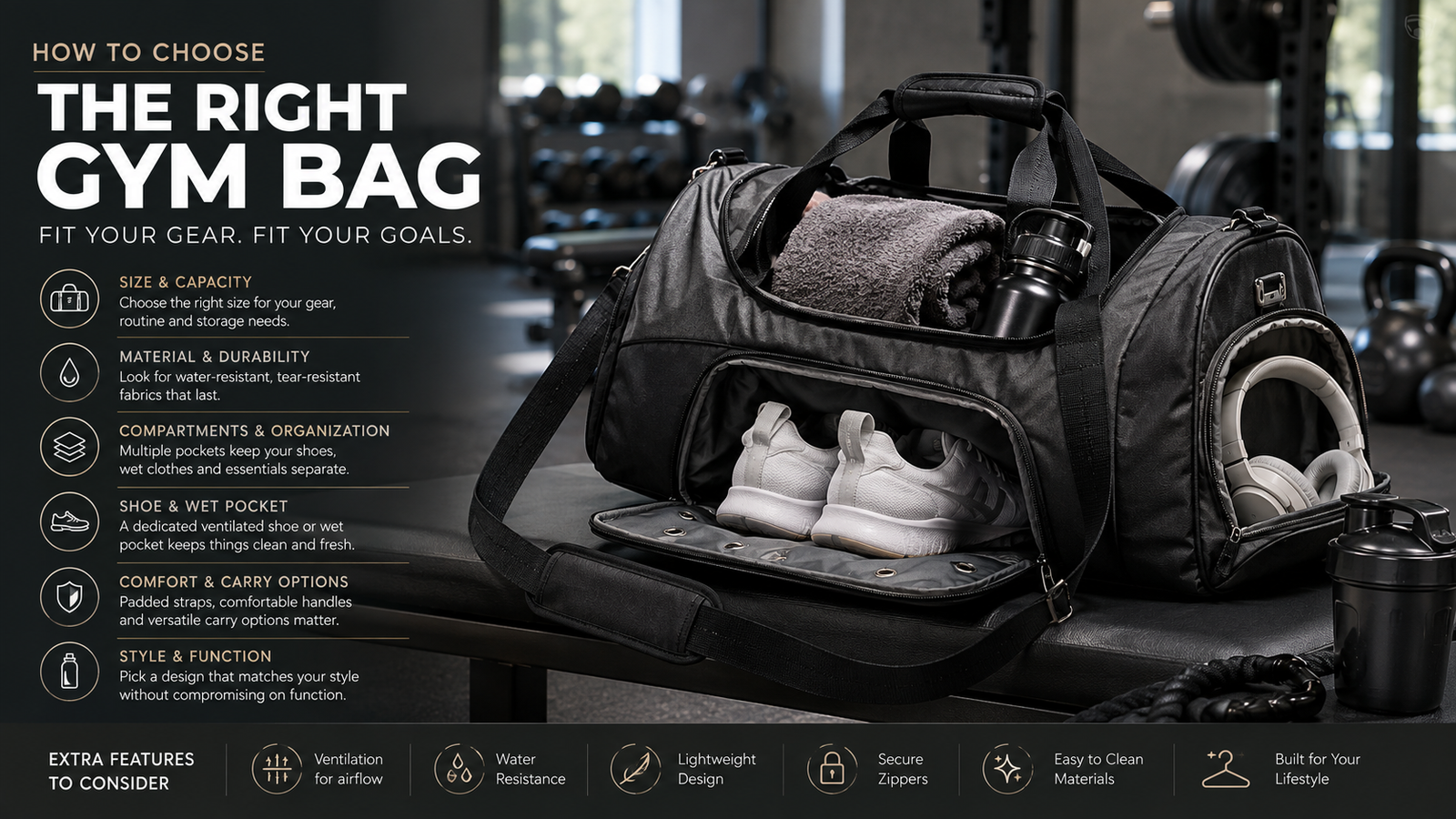
A gym bag should make your workout routine easier.
It should help you carry:
- shoes;
- workout clothes;
- towel;
- water bottle;
- toiletries;
- accessories;
- small personal items;
without turning into a disorganized, uncomfortable bag that is difficult to carry or clean.
But gym bags vary considerably in:
- size;
- shape;
- compartment design;
- material;
- ventilation;
- shoe storage;
- water resistance;
- carrying style;
- durability.
The right choice depends on:
what you carry → how often you train → whether you travel directly from work → how you commute → whether you need separate shoe or wet-clothing storage → available locker space
The best gym bag is not necessarily the:
- largest;
- most expensive;
- most compartment-heavy.
It is the one that carries your normal workout essentials comfortably while keeping:
- clean;
- dirty;
- wet;
- fragile;
items organized appropriately.
Start With What You Actually Carry
Before choosing a bag, list what normally goes to the gym with you.
A basic gym setup might include:
- T-shirt;
- shorts or leggings;
- socks;
- training shoes;
- water bottle;
- small towel;
- phone;
- wallet;
- keys.
Someone training before work may also need:
- change of clothes;
- shower towel;
- toiletries;
- deodorant;
- grooming products;
- laptop;
- lunch.
Someone doing specialized training may carry:
- lifting belt;
- resistance bands;
- gloves;
- straps;
- knee sleeves;
- jump rope.
The amount you actually carry should determine bag capacity.
Do not buy a huge duffel simply because it looks more versatile.
Oversized bags tend to accumulate:
- unnecessary equipment;
- old clothes;
- forgotten accessories.
What Is a Gym Bag?
A gym bag is simply a bag designed or adapted for carrying exercise-related items.
Common forms include:
- duffel bags;
- gym backpacks;
- hybrid backpack-duffels;
- small holdalls;
- tote-style gym bags.
There is no requirement to buy something specifically labelled:
gym bag
if another well-designed bag provides the:
- space;
- compartments;
- durability;
you need.
Main Types of Gym Bags
The most common designs are:
- Duffel bags
- Gym backpacks
- Hybrid backpack-duffels
- Compact holdalls
- Tote-style bags
Each works better for different routines.
Duffel Gym Bags
The classic gym bag is a duffel.
It usually includes:
- large central compartment;
- short handles;
- shoulder strap;
- one or more side pockets.
Advantages of a Duffel
Duffels are particularly good for carrying bulky items.
They can easily accommodate:
- shoes;
- towels;
- change of clothes;
- lifting accessories.
The wide opening also makes packing easy.
Disadvantages of a Duffel
A fully loaded duffel can become uncomfortable when carried over:
- one shoulder.
It may also be awkward during:
- walking;
- cycling;
- public transport.
If you commute a significant distance, a backpack may distribute weight more comfortably.
Gym Backpacks
Gym backpacks use two shoulder straps.
They are particularly useful for people who:
- walk;
- commute;
- ride public transport;
- carry the bag for longer periods.
Advantages of a Gym Backpack
Weight is distributed across:
- both shoulders.
This can make carrying easier.
Backpacks can also provide good organization through:
- multiple pockets;
- laptop sleeves;
- bottle holders.
Disadvantages of a Gym Backpack
The main compartment is often narrower than a duffel.
Bulky items such as:
- shoes;
- thick towels;
- lifting belts;
may consume much of the available space.
Some backpacks also have limited ventilation for:
- sweaty clothing.
Hybrid Gym Bags
Hybrid bags can often be carried as either:
- backpack;
- duffel.
They may include:
- shoulder straps that tuck away;
- duffel handles;
- multiple carrying options.
Who Should Consider a Hybrid Bag?
Useful if your routine changes frequently.
For example:
- backpack during commuting;
- duffel carry inside the gym.
They can provide excellent versatility.
The downside is that extra straps and hardware may increase:
- weight;
- complexity.
Tote-Style Gym Bags
Tote bags offer:
- large open compartment;
- simple access.
They can work for light gym routines.
But they often provide less:
- structure;
- secure organization;
- carrying comfort.
They are better for someone carrying only a few items.
Compact Gym Bags
A small bag can be ideal if you:
- arrive already dressed for training;
- shower at home;
- carry only essentials.
A compact bag might hold:
- towel;
- bottle;
- straps;
- keys;
- headphones.
Smaller bags are easier to:
- store;
- carry;
- fit into lockers.
How Big Should a Gym Bag Be?
Bag capacity is commonly measured in:
litres
You might see sizes such as:
- 15 L;
- 20 L;
- 30 L;
- 40 L;
- 50 L.
These numbers are useful, but internal design matters too.
A poorly shaped 30 L bag may hold less useful gym equipment than a well-designed 25 L bag.
Small Gym Bags: Around 15–25 L
Usually suitable for:
- basic clothing;
- small towel;
- bottle;
- a few accessories.
Best for:
- short workouts;
- people who do not shower at the gym;
- minimalist packing.
May feel cramped if you also need:
- shoes;
- large towel.
Medium Gym Bags: Around 25–40 L
This is often the most practical range.
It can usually accommodate:
- workout clothing;
- shoes;
- towel;
- toiletries;
- accessories.
Useful for:
- regular gym users;
- before-work or after-work training.
Large Gym Bags: Around 40–60 L
Useful if you carry:
- multiple clothing changes;
- full-size towel;
- large shoes;
- lifting gear;
- shower supplies.
Also useful for:
- sports;
- overnight travel.
For an ordinary one-hour gym visit, this size may be excessive.
Extra-Large Bags
Very large duffels may make sense for:
- team sports;
- combat sports;
- travel;
- equipment-heavy training.
They are rarely necessary for ordinary fitness.
A larger bag also becomes:
- heavier;
- more awkward;
- harder to fit into lockers.
Locker Size Matters
Before buying a large bag, consider where you will store it.
Some gyms have:
- narrow;
- shallow lockers.
A rigid 50 L bag may not fit.
A softer medium-size bag can compress more easily.
If possible, estimate your gym’s locker dimensions.
Do You Need a Shoe Compartment?
A dedicated shoe compartment is one of the most useful gym-bag features for many people.
It separates shoes from:
- clean clothes;
- towel;
- personal items.
This can improve both:
- hygiene;
- organization.
Shoe Compartments Are Especially Useful If You:
- change shoes at the gym;
- train outdoors before going indoors;
- carry muddy or dusty shoes;
- commute from work.
How Large Should the Shoe Compartment Be?
This depends on your footwear.
Large training shoes may require more space than:
- lightweight flat shoes.
If you wear a larger shoe size, check actual compartment dimensions where available.
Some advertised shoe pockets fit only:
- smaller shoes;
- one pair packed tightly.
Ventilated Shoe Compartments
Ventilation holes or mesh panels can reduce trapped:
- moisture;
- odour.
This is useful.
But ventilation does not replace:
- drying shoes properly after training.
Do not leave sweaty shoes sealed inside the bag for days.
Shoe Pocket Trade-Off
A large shoe compartment takes space away from the main compartment.
This is normal.
When manufacturers advertise a 30 L bag, remember that shoe storage may occupy a significant portion of that total space.
Wet Compartment
Some gym bags include a waterproof or water-resistant section for:
- wet towel;
- swimming clothes;
- sweaty clothing.
This can be extremely useful.
Who Needs a Wet Compartment?
Particularly valuable for people who:
- shower at the gym;
- swim;
- train in very hot conditions;
- carry heavily sweat-soaked clothing.
It keeps moisture away from:
- clean clothes;
- electronics;
- paperwork.
Waterproof vs Water-Resistant Pocket
These terms are not interchangeable.
Water Resistant
Can help contain limited moisture.
Waterproof
Implies a much stronger moisture barrier.
Many gym-bag “wet pockets” are actually:
- water-resistant linings;
rather than fully waterproof sealed compartments.
Do not assume they can safely contain:
- leaking bottles;
- standing water.
Use a Separate Wet Bag if Necessary
A washable waterproof pouch can be more reliable for:
- swimwear;
- soaking towel.
It can also be removed and cleaned independently.
This can be better than relying solely on the bag lining.
Main Compartment Design
The main compartment should be easy to access.
Consider:
- opening width;
- zipper shape;
- internal visibility.
U-Shaped Openings
A wide U-shaped zipper allows the top to open broadly.
This makes it easier to:
- see contents;
- pack shoes;
- remove towels.
It is one of the most convenient duffel designs.
Narrow Top Openings
These can make bags look sleek.
But retrieving an item from the bottom becomes more difficult.
If you carry many items, prioritize:
- wide access.
Clamshell Openings
Some backpack-style gym bags open nearly flat like luggage.
This can make organization easier.
Useful for people combining:
- gym;
- work;
- travel.
Internal Pockets
Internal pockets are useful for smaller items such as:
- keys;
- wallet;
- earphones;
- locker card;
- medication if needed.
But too many pockets can make organization unnecessarily complicated.
A few strategically placed compartments are usually enough.
Zippered Security Pocket
A small zipped compartment is useful for:
- wallet;
- keys;
- jewellery.
This prevents them from becoming lost beneath:
- clothing;
- towels.
Phone Pocket
A dedicated phone compartment can keep the device away from:
- wet towel;
- leaking bottle.
Ideally it should be:
- easy to access;
- padded or protected.
Laptop Compartment
If you travel directly between:
- office;
- gym;
a laptop sleeve can be extremely useful.
Look for:
- padding;
- secure closure;
- separation from wet clothing.
Should a Laptop Go in a Gym Bag?
It can, if the bag has a dedicated protected compartment.
Avoid placing electronics in the same section as:
- damp towels;
- toiletries;
- bottles.
A leaking shampoo bottle can be far more expensive than the bag itself.
Laptop Sleeve Size
Check compatibility with your actual laptop dimensions.
A claim such as:
- “fits 15-inch laptop”
does not guarantee every 15-inch model fits.
Modern device dimensions vary.
Water Bottle Pocket
An external bottle holder can be very useful.
It keeps the bottle:
- upright;
- separate from electronics.
Elastic Mesh Bottle Pockets
Advantages:
- lightweight;
- adaptable.
Potential drawback:
- elastic may loosen over time.
Zippered Bottle Compartments
More secure.
Useful for:
- larger bottles.
But they may reduce internal bag space.
Should the Bottle Be Inside the Main Compartment?
Only if it has a reliable:
- leak-proof lid.
Even then, keeping liquids separate from electronics is preferable.
Toiletry Compartment
If you shower at the gym, a small separate toiletry area can help organize:
- shampoo;
- body wash;
- deodorant;
- comb;
- grooming items.
A removable toiletry pouch may be even better.
Why Removable Pouches Can Be Better
You can take the pouch directly into the:
- shower area.
It is also easier to:
- clean;
- replace.
This avoids needing a heavily compartmentalized gym bag.
Dirty-Laundry Storage
Sweaty clothing should ideally be separated from:
- clean clothes.
Options include:
- dedicated ventilated compartment;
- laundry pouch;
- waterproof drawstring bag.
Should Dirty Clothes Be Stored in Plastic?
A temporary plastic bag can isolate moisture.
But storing damp clothes sealed for long periods can encourage:
- odour;
- microbial growth.
Remove them when you get home.
Wash and dry promptly.
Ventilation
Ventilation is particularly useful in areas storing:
- shoes;
- sweaty clothing.
Common ventilation designs include:
- mesh;
- eyelets;
- perforated panels.
Does a Fully Ventilated Bag Prevent Odour?
No.
Odour mainly develops when sweat and moisture remain trapped in:
- clothing;
- shoes;
- bag fabric.
Ventilation helps but does not replace cleaning and drying.
Bag Material
Common gym-bag materials include:
- polyester;
- nylon;
- canvas;
- synthetic leather;
- coated fabrics.
The best material depends on:
- durability;
- weight;
- moisture resistance;
- cleaning.
Polyester Gym Bags
Polyester is common because it is:
- affordable;
- durable;
- relatively lightweight.
It can be a good all-round choice.
Higher-density polyester fabrics may feel more robust.
Nylon Gym Bags
Nylon can be:
- lightweight;
- durable;
- abrasion-resistant.
Quality varies considerably.
Premium nylon bags may offer excellent durability without excessive weight.
Canvas Gym Bags
Canvas provides:
- substantial structure;
- classic appearance.
But it may:
- absorb moisture;
- take longer to dry.
For extremely sweaty routines, synthetic fabrics can be easier to maintain.
Synthetic Leather
Often chosen for:
- appearance.
It may provide some surface water resistance.
But lower-quality synthetic leather can:
- crack;
- peel;
with time and repeated moisture exposure.
It is often less practical than nylon or polyester for heavy gym use.
Genuine Leather Gym Bags
Leather can be:
- durable;
- premium-looking.
But it is often:
- heavy;
- expensive;
- less convenient around wet clothing.
It requires additional maintenance.
For purely functional gym use, synthetic technical fabrics are usually easier.
Ripstop Fabric
Ripstop construction includes reinforced threads designed to reduce propagation of tears.
Useful for:
- travel;
- equipment-heavy use.
But ripstop alone does not guarantee overall bag quality.
Fabric Density
Some bags list measurements such as:
- 600D polyester;
- 900D nylon.
The “D” refers to denier, which relates to fibre thickness.
Higher denier often means:
- heavier;
- more abrasion-resistant fabric.
But material type and weave also matter.
Do not compare durability using denier alone.
Water Resistance
A water-resistant outer fabric can help protect contents from:
- light rain;
- wet floors;
- accidental splashes.
Useful for commuters.
Do You Need a Waterproof Gym Bag?
Usually not.
Fully waterproof construction often adds:
- cost;
- stiffness.
Most gym users simply need:
- easy-to-clean;
- moderately water-resistant material.
If you routinely commute in heavy rain, stronger weather protection may be worthwhile.
Coated Fabrics
Some bags use coatings such as:
- polyurethane-based layers;
to improve water resistance.
These can work well.
But coatings may degrade over time from:
- abrasion;
- folding;
- washing.
Follow cleaning instructions.
Bottom Panel
The bottom of the bag often touches:
- locker-room floors;
- gym floors;
- car boots.
A reinforced bottom can improve durability.
Water-Resistant Bottom
This is particularly useful.
It can reduce moisture transfer when the bag is placed on:
- damp changing-room floors.
Structured vs Soft Bottom
Structured Bottom
Helps the bag:
- hold shape;
- stand upright.
Soft Bottom
Allows easier:
- folding;
- storage.
Choose according to preference.
Reinforced Corners
Corners experience high wear.
Extra material or reinforcement can improve durability, particularly if the bag is frequently placed on:
- rough surfaces.
Zipper Quality
Zippers are one of the most common failure points on bags.
Look for:
- smooth movement;
- substantial zipper teeth;
- strong pull tabs.
The zipper should not catch repeatedly on:
- fabric;
- lining.
Double Zippers
Two zipper pulls make large compartments easier to access.
They also allow you to position the opening where convenient.
Lockable Zippers
Some travel-oriented gym bags allow small locks to be attached.
This may be useful for:
- commuting;
- travel.
But a soft fabric bag is not truly theft-proof.
Use lockers where available.
Stitching
Inspect:
- strap attachment points;
- handles;
- zipper seams.
These areas experience the greatest load.
Look for:
- reinforced stitching;
- bar tacks;
- multiple seam lines.
Shoulder Strap
Duffel bags often include a removable long strap.
A good strap should be:
- adjustable;
- wide enough;
- securely attached.
Shoulder Padding
Padding can improve comfort when carrying a heavier bag.
A very narrow strap can dig into the shoulder.
If you carry:
- shoes;
- laptop;
- water;
- lifting gear;
a padded strap is worthwhile.
Swivel Clips
Shoulder straps may use rotating clips.
These reduce:
- twisting.
Check that hardware feels strong.
Metal vs Plastic Hardware
Metal
Usually feels more robust.
But adds:
- weight.
Quality Plastic
Can be lightweight and durable.
Cheap brittle plastic is more concerning than the material category itself.
Carry Handles
Handles should be comfortable when the bag is fully loaded.
Look for:
- reinforced stitching;
- padded wrap;
- adequate length.
Handle Drop
The space between the top of the bag and handle affects whether you can carry it:
- by hand;
- over shoulder.
Some duffels have handles long enough for both.
Backpack Straps
If choosing a gym backpack, shoulder straps should ideally be:
- wide;
- padded;
- adjustable.
Thin straps may become uncomfortable under heavier loads.
Back Padding
Useful if you carry:
- laptop;
- shoes;
- heavier accessories.
It can improve comfort.
But heavy padding also:
- retains heat;
- increases weight.
Breathable Back Panels
Mesh or channelled padding can improve airflow.
Useful for commuters who walk substantial distances.
But no backpack remains completely dry against the back during:
- hot weather.
Sternum Strap
A sternum strap connects the backpack shoulder straps across the chest.
It can improve stability when:
- walking quickly;
- cycling;
- carrying heavier loads.
It is optional for ordinary short-distance use.
Waist Belt
Rarely necessary on a normal gym backpack.
It may help on larger travel/gym hybrid bags.
For a typical 20–30 L bag, it is usually unnecessary.
Carrying Comfort Matters More as Distance Increases
If you drive directly to the gym and carry the bag:
- 20 metres;
almost any handle system may work.
If you:
- walk 2 km;
- take public transport;
- cycle;
carrying comfort becomes far more important.
Choose the bag based on your commute.
Gym Bag for Driving
A duffel works very well.
Prioritize:
- easy access;
- organization;
- shoe compartment.
Backpack comfort matters less.
Gym Bag for Public Transport
A backpack may be easier because:
- hands stay free;
- load stays close to body.
A large duffel can be awkward in crowded:
- buses;
- trains.
Gym Bag for Cycling
A secure backpack is usually the most practical choice.
Avoid carrying a loose duffel over one shoulder while cycling.
Look for:
- stable straps;
- compact profile;
- reflective details if riding outdoors at night.
Gym Bag for Walking
A backpack may distribute weight more evenly.
If choosing a duffel, ensure the shoulder strap is:
- comfortable;
- wide.
Gym Bag for Work
If you travel:
home → work → gym → home
you may need:
- laptop sleeve;
- clean-clothes compartment;
- shoe section;
- toiletries;
- bottle pocket.
A 25–40 L hybrid bag can work well.
One Bag for Work and Gym
This can simplify commuting.
But make sure:
- wet clothing;
- dirty shoes;
do not share space with:
- laptop;
- documents.
Internal separation becomes particularly important.
Professional Appearance
If you carry the bag into an office, you may prefer:
- understated design;
- neutral styling;
- minimal logos.
This is a personal preference rather than a functional requirement.
Gym Bag for Before-Work Training
You may need to carry:
- workout clothes;
- work clothes;
- shoes;
- towel;
- toiletries;
- grooming products.
This generally requires more capacity than an after-work session where you arrive already wearing work clothes.
Keeping Work Clothes Wrinkle-Free
A gym bag is not ideal for formal clothing.
If you need to carry:
- shirts;
- trousers;
- jackets;
look for:
- garment compartment;
- structured packing system.
A garment-duffel hybrid may be more useful.
Garment Duffel Bags
These unfold into a garment carrier and then zip into a duffel.
They can be useful for:
- work;
- travel;
- gym.
But they are often heavier and more complicated than ordinary bags.
Choose one only if formal clothing storage is a frequent need.
Gym Bag for Swimming
Swimming requires stronger wet-item management.
Useful features:
- waterproof wet pouch;
- quick-drying material;
- ventilation;
- bottle pocket;
- separate sandals compartment.
A removable wet bag is highly useful.
Gym Bag for Yoga
Yoga generally requires less equipment inside the bag but may require a way to carry:
- yoga mat.
Some bags include:
- external mat straps;
- sleeves.
Yoga Mat Straps
External straps let you carry the mat without filling the bag.
Check whether the straps fit your actual:
- mat diameter;
- thickness.
Gym Bag for Strength Training
You may carry accessories such as:
- belt;
- straps;
- wrist wraps;
- sleeves;
- chalk.
A medium duffel with a wide opening can be very practical.
Carrying a Lifting Belt
A rigid lifting belt can occupy considerable space.
Options:
- place around inside perimeter of duffel;
- clip externally if bag allows;
- use a larger compartment.
Do not fold a very stiff leather belt sharply.
Chalk Storage
If you use gym chalk, keep it in:
- sealed container;
- chalk pouch.
Loose chalk can coat everything inside the bag.
Liquid chalk can also leak.
Keep it separately contained.
Resistance Bands and Straps
These can tangle with other equipment.
Use a small accessory pouch for:
- bands;
- straps;
- wraps.
This keeps the main compartment organized.
Gym Bag for Boxing or Combat Sports
These sports may require:
- gloves;
- wraps;
- headgear;
- shin guards;
- towel.
Ventilation becomes particularly important.
You may need a much larger bag than a standard gym user.
Boxing Gloves Need Airflow
Do not leave sweaty gloves sealed inside a gym bag for long periods.
Remove them after training.
Allow them to:
- dry;
- ventilate.
The bag should be temporary transport, not permanent storage.
Gym Bag for Team Sports
Team-sport bags may need space for:
- footwear;
- uniforms;
- protective equipment;
- towel;
- bottle.
A 40–60 L duffel may be appropriate.
Gym Bag for Travel
If you want one bag for:
- gym;
- weekend travel;
consider:
- 35–45 L;
- clamshell opening;
- laptop sleeve;
- shoe compartment.
Check airline carry-on dimensions if flying.
Airline Carry-On Limits
Airlines use specific dimensional and weight limits.
A bag advertised as:
- travel-ready;
- cabin size;
is not guaranteed to meet every airline’s rules.
Check your airline before travel.
Bag Weight
The empty bag itself adds to what you carry.
A heavily structured premium bag may weigh significantly more than a simple nylon duffel.
If commuting long distances, empty weight matters.
Minimalist Bags
A minimalist bag may include:
- one main compartment;
- one side pocket;
- bottle sleeve.
This can be enough.
More pockets do not necessarily improve organization.
Too Many Compartments
A bag with 15 pockets can create the opposite problem:
- you forget where things are.
Good organization usually requires only:
- main compartment;
- shoe/wet section;
- small valuables pocket;
- bottle holder.
External Pockets
Useful for frequently accessed items:
- membership card;
- phone;
- keys.
Avoid putting valuable items in easily accessible outer pockets during crowded commuting.
Hidden Pocket
Some backpacks include a rear hidden compartment.
Useful for:
- wallet;
- travel documents.
Key Clip
A small key tether can prevent keys from becoming lost at the bottom.
Simple feature, but useful.
Headphone Storage
A small internal pocket can help protect:
- earbuds;
- charging cases.
Keep electronics away from wet sections.
Power Bank Storage
If carrying one, keep it in a:
- dry;
- protected compartment.
Do not place it alongside:
- wet towel;
- leaking toiletries.
Toiletry Bottles
Use:
- secure caps;
- travel-size bottles.
Consider placing liquids in a separate:
- zip pouch.
Shampoo leaks are common gym-bag problems.
Full-Size Toiletries vs Travel Size
Unless you train daily and shower at the gym, travel-sized products are usually more practical.
They reduce:
- weight;
- space.
Refill from full-size products at home.
Deodorant
Stick or roll-on products may be less likely to accidentally discharge than:
- aerosol cans.
If carrying aerosol, protect the cap.
Do not leave pressurized containers in:
- extremely hot cars.
Towel Size
A full shower towel consumes substantial bag space.
Consider:
- compact microfiber towel;
if storage is limited.
Microfiber Gym Towels
Advantages:
- lightweight;
- fast drying;
- compact.
Some people prefer the feel of:
- cotton.
Choose according to comfort.
Cotton Towels
Advantages:
- absorbent;
- familiar feel.
Disadvantages:
- bulky;
- slower drying.
They increase required bag capacity considerably.
Water Bottle Size
A 1-litre bottle takes significantly more space than a:
- 500 mL bottle.
If the bag has an external holder, verify:
- diameter;
- height.
Large Insulated Bottles
These can be heavy.
Make sure the pocket or compartment can support the weight securely.
Shaker Bottles
If you carry protein drinks, choose a bottle with:
- reliable seal.
Rinse it promptly after use.
A protein shake left in a warm gym bag can develop strong:
- odour.
Meal Containers
Some people combine:
- gym;
- work;
and carry food.
If so, consider a bag with separate:
- insulated compartment;
or use a dedicated lunch bag.
Do not rely on a normal gym bag to maintain safe food temperature.
Gym Bag for Hot Climates
In hot conditions, prioritize:
- ventilation;
- quick-drying fabrics;
- easy cleaning.
Sweaty clothing left in a closed bag can develop odour quickly.
Gym Bag in Indian Conditions
For many Indian users, practical features may include:
- moisture-resistant fabric;
- ventilated shoe compartment;
- washable lining;
- bottle holder;
- durable zippers.
During monsoon conditions, stronger water resistance can also be valuable for commuters.
Monsoon Commuting
If you walk or ride outdoors in rain, consider:
- coated nylon/polyester;
- protected zippers;
- rain cover.
Remember that most gym bags are not fully waterproof.
Place important electronics in a separate:
- waterproof sleeve;
- pouch.
Dust
Outdoor commuting can expose bags to:
- dust;
- pollution.
Dark or textured fabrics may hide dirt better, but easy-clean surfaces matter more.
Colour
Colour is mostly personal preference.
Lighter bags may show:
- dirt;
- sweat marks;
more quickly.
Dark bags may show:
- salt residue.
Choose something you are willing to clean regularly.
Reflective Details
Useful if you:
- walk;
- cycle;
- run;
in low light.
But small reflective logos are not a substitute for proper:
- lights;
- visibility equipment.
Bag Structure
Some bags are:
- rigid;
- semi-structured;
- collapsible.
Structured Bags
Advantages:
- easier organization;
- stand upright;
- protect contents.
Disadvantages:
- take more storage space;
- may be heavier.
Collapsible Bags
Advantages:
- easy to store when empty;
- lighter.
Disadvantages:
- contents shift;
- harder to organize.
Compression Straps
Some backpacks include external straps that compress the load.
Useful when the bag is:
- partly empty.
They can also secure:
- jacket;
- mat.
Expansion Zippers
Some bags can expand to provide more capacity.
This can be useful for:
- occasional travel;
- gym + work days.
But expanded bags may become:
- bulky;
- less stable.
Detachable Compartments
Certain bags have removable:
- shoe bags;
- wet pouches.
This adds flexibility.
It also makes cleaning easier.
Cleaning a Gym Bag
Gym bags should be cleaned periodically.
Sweat, shoes and locker-room floors introduce:
- moisture;
- dirt;
- odour.
Check the Care Label First
Some bags are:
- machine washable.
Others require:
- hand washing;
- wiping only.
Do not assume a structured or coated bag can go in a washing machine.
Basic Cleaning Method
For many bags:
- Empty every compartment.
- Shake or vacuum loose dirt.
- Wipe interior.
- Clean exterior with mild soap if appropriate.
- Air dry fully.
Follow the manufacturer’s directions.
Turn Pockets Inside Out Where Possible
This helps remove:
- dust;
- chalk;
- crumbs;
- lint.
Gym bags often collect surprising amounts of debris.
Do Not Store the Bag Damp
Allow the bag to dry after cleaning or after carrying:
- wet gear.
Closing it while damp can encourage:
- odour;
- mildew.
Wash Removable Inserts
If the shoe compartment or wet pouch is removable:
- clean it separately.
This can simplify maintenance.
Cleaning Shoe Compartments
Wipe them more frequently than the rest of the bag.
They collect:
- dirt;
- sweat;
- floor debris.
Gym Bag Odour
Odour generally results from:
- damp fabric;
- sweaty clothing;
- shoes;
- insufficient drying.
Fragrance sprays may temporarily mask it but do not solve the cause.
How to Prevent Odour
After every workout:
- Remove wet clothing.
- Remove towel.
- Remove shoes where possible.
- Open compartments.
- Allow bag to air.
This is much more effective than using perfume sprays.
Shoe Deodorizers
They may help reduce odour.
But drying shoes properly is more important.
Do not leave damp shoes permanently inside the bag.
Silica Gel or Moisture Absorbers
These may help with residual moisture.
But they cannot compensate for:
- soaking wet towels;
- unventilated shoes.
Keep moisture-control products safely away from:
- children;
- pets.
Washing Gym Clothes Promptly
Sweaty clothes left overnight in a bag may develop persistent odour.
Remove them as soon as practical.
If they cannot be washed immediately, allow them to:
- dry;
- air out.
Gym Bag Hygiene and Skin
Dirty gym gear can accumulate:
- sweat;
- oil;
- microorganisms.
Keeping clothing and towels clean is particularly relevant if you are prone to:
- body acne;
- skin irritation.
Avoid repeatedly using:
- unwashed towels;
- sweaty clothing.
Sharing Gym Bags
There is usually little reason to share personal gym bags.
If several family members use one, clean it regularly.
Personal towels and clothing should remain separate.
Bag on Locker-Room Floor
Locker-room floors can be:
- wet;
- dirty.
A water-resistant bottom helps.
Whenever possible, place the bag:
- inside locker;
- on bench;
- hook.
Bag Hooks
Some gym backpacks include loops that can hang from:
- locker hooks.
Useful in small changing rooms.
But verify that the loop is strong enough to support the loaded bag.
Theft Considerations
A gym bag does not provide meaningful security by itself.
Keep valuable belongings:
- locked in a locker;
- with you where appropriate.
Do not rely on hidden pockets for high-value items in an unattended changing room.
Zipper Locks
Small locks may discourage casual access.
But soft fabric can still be:
- cut;
- opened.
Use the gym’s secure storage.
Carry Only Necessary Valuables
Avoid bringing unnecessary:
- jewellery;
- large cash amounts;
- extra devices.
Simpler is safer.
Gym Bag as Daily Storage
Do not let the bag become permanent storage for all exercise equipment.
Removing items periodically prevents:
- clutter;
- forgotten damp clothing;
- expired products.
Weekly Bag Reset
Once a week:
- Empty bag completely.
- Remove rubbish.
- Refill toiletries if needed.
- Check accessories.
- Air the bag.
This takes a few minutes and keeps the routine organized.
Packing the Bag Efficiently
A useful packing system:
Bottom / Shoe Compartment
- shoes.
Main Compartment
- workout clothes;
- towel.
Wet Pouch
- used clothing after workout.
Small Pocket
- keys;
- wallet;
- earphones.
External Bottle Holder
- water.
This keeps the most important categories separated.
Use Packing Cubes?
Small packing cubes can be helpful if you carry:
- work clothes;
- travel items.
For a basic gym routine, they may add unnecessary complexity.
Simple pouches are usually enough.
Dedicated Accessory Pouch
This is useful for items such as:
- lifting straps;
- wrist wraps;
- bands;
- locks;
- earphones.
It prevents small equipment from disappearing at the bottom.
Dedicated Shower Pouch
Keep:
- shampoo;
- body wash;
- grooming items;
together.
This saves time before and after the workout.
Packing Shoes Heel-to-Toe
If you do not have a shoe compartment, place shoes:
- heel-to-toe;
to reduce occupied space.
Use a separate shoe bag to keep soles away from:
- clothing.
Shoe Bags
Simple drawstring shoe bags are inexpensive and useful.
They allow you to convert almost any:
- backpack;
- duffel;
into a more gym-friendly bag.
Does Every Gym Bag Need a Shoe Compartment?
No.
If you already wear your workout shoes to the gym, the compartment may waste space.
Choose only features relevant to your routine.
Does Every Gym Bag Need a Wet Pocket?
No.
If you:
- do not shower at the gym;
- rarely carry wet gear;
a simple laundry pouch may be enough.
Avoid Feature Checklist Shopping
A bag does not become better because it has:
- 12 compartments;
- USB port;
- shoe tunnel;
- hidden pocket;
- headphone port;
- charging cable.
Focus on what you genuinely need.
USB Charging Ports
Some backpacks have external USB pass-through ports.
They usually require your own internal:
- power bank.
This is a convenience feature.
It adds little value for many gym users and creates another opening that may eventually fail.
Headphone Ports
These were once common.
With wireless earphones, they are increasingly unnecessary.
Do not prioritize obsolete features.
Built-In Combination Locks
Some bags include integrated locks.
Useful for travel, but rarely essential for a gym.
A proper locker is more secure.
Gym Bag Weight Distribution
Heavy items should be positioned closer to the body when using a backpack.
This can improve carrying comfort.
Examples:
- laptop;
- bottle.
Avoid placing all heavy items at the outermost edge.
Carrying One-Shoulder Duffels
Alternating shoulders may reduce repetitive discomfort.
If the bag is very heavy, a backpack may be better.
Persistent shoulder or neck discomfort is a sign to reconsider:
- load;
- carrying style.
How Heavy Should a Gym Bag Be?
There is no single ideal weight.
But if the bag feels burdensome before you even start training, you may be carrying too much.
Review whether you genuinely need:
- full-size products;
- multiple shoes;
- unnecessary accessories.
Reduce Bag Weight
Easy strategies:
- use travel toiletries;
- carry only the day’s accessories;
- use lighter towel;
- remove unused items weekly.
Gym Bag for Multiple Training Styles
If you alternate between:
- cardio;
- lifting;
- yoga;
use modular pouches rather than permanently carrying everything.
For example:
Strength Day
Add:
- belt;
- straps.
Yoga Day
Add:
- strap;
- blocks if needed.
This keeps the bag lighter.
Durability
A gym bag used five days a week experiences substantial wear.
Common failure points:
- zippers;
- handle seams;
- shoulder-strap attachments;
- bottom corners.
Check Strap Attachment Points
A strap is only as strong as its stitching.
Look for:
- reinforced seams;
- box stitching;
- bar tacks.
Check Zipper Tracks
Open and close them several times.
The zipper should move smoothly.
A stiff zipper when new may become frustrating in daily use.
Hardware Durability
Look at:
- clips;
- buckles;
- adjusters.
They should not feel:
- thin;
- brittle.
Warranty
Premium bag brands may provide:
- multi-year;
- lifetime warranties.
Read what is actually covered.
Some warranties exclude:
- normal wear;
- cosmetic damage.
Repairability
A bag with:
- replaceable shoulder strap;
- standard buckles;
- simple zipper design;
may be easier to repair.
This can extend usable life.
Sustainability
A durable bag that lasts years may be more environmentally practical than repeatedly buying cheap bags.
Some manufacturers also use:
- recycled polyester;
- recycled nylon.
These can be worthwhile considerations, but durability should still be evaluated.
Recycled Materials
Recycled fabric does not automatically mean lower quality.
Good recycled nylon or polyester can perform very well.
Check:
- construction;
- warranty.
Price
Gym bags exist at almost every price.
More expensive bags may offer:
- stronger fabrics;
- better zippers;
- more structured organization;
- premium hardware.
But basic gym use does not require a luxury bag.
Budget Gym Bags
Can be completely adequate.
Prioritize:
- working zippers;
- reinforced handles;
- appropriate size;
- washable material.
Do not worry about premium branding.
Mid-Range Gym Bags
Often provide the best balance of:
- durability;
- organization;
- comfort.
Useful for someone training:
- several days a week.
Premium Gym Bags
May be worthwhile for:
- daily commuters;
- frequent travellers;
- heavy users;
- people carrying electronics.
Pay for:
- construction;
- comfort;
- useful design;
rather than logo alone.
Designer Gym Bags
A designer label does not make a bag more suitable for:
- sweat;
- wet towels;
- shoes.
If style matters, that is a personal choice.
But functional gym use still requires:
- durability;
- cleanability.
How Long Should a Gym Bag Last?
A good bag can last for:
- years;
depending on:
- usage;
- construction;
- maintenance.
Replace or repair it when:
- zippers fail;
- straps tear;
- lining cracks;
- odour cannot be removed;
- structural damage affects carrying safety.
Signs Your Gym Bag Is Too Small
- zipper barely closes;
- shoes crush clean clothes;
- bottle must lie sideways;
- no room for used clothing;
- constant repacking.
Move up one size rather than forcing everything in.
Signs Your Gym Bag Is Too Large
- items disappear inside it;
- bag is mostly empty;
- it does not fit locker;
- you carry unnecessary equipment;
- commute becomes awkward.
Downsizing can make the routine easier.
Signs the Layout Is Wrong for You
- you constantly search for keys;
- clean clothes get wet;
- shoes contact everything;
- laptop has no protected area.
The problem may be:
- compartment design;
rather than overall size.
Common Gym Bag Buying Mistakes
Buying the Largest Bag “Just in Case”
More space often creates more clutter.
Ignoring Locker Dimensions
A large duffel may not fit.
Choosing Looks Over Carry Comfort
Important if you commute.
Buying a Shoe Compartment That Is Too Small
Check dimensions.
Assuming a Wet Pocket Is Fully Waterproof
Often it is not.
Ignoring Bag Weight
Heavy bags become uncomfortable.
Buying Too Many Compartments
Organization can become confusing.
Ignoring Zipper Quality
A common failure point.
Choosing Non-Ventilated Shoe Storage
Can increase odour.
Buying Without Considering Cleaning
Gym bags get dirty.
Common Gym Bag Use Mistakes
Leaving Wet Clothes Inside Overnight
Remove them promptly.
Leaving Shoes Permanently Inside
Allow them to dry.
Keeping Protein Shakers Unwashed
Rinse immediately.
Storing the Bag Damp
Air dry it.
Carrying Unnecessary Equipment Every Day
Pack for the actual workout.
Putting Electronics With Toiletries
Keep them separated.
Never Emptying the Bag
Perform a weekly reset.
Putting the Bag on Wet Floors Repeatedly
Use a locker or bench where possible.
How to Choose a Gym Bag Step by Step
Step 1 — List What You Carry
Do not guess.
Lay everything out.
Step 2 — Decide Whether You Need Shoes Inside
This determines whether a dedicated compartment is worthwhile.
Step 3 — Decide Whether You Shower at the Gym
If yes, prioritize:
- wet storage;
- toiletries;
- towel capacity.
Step 4 — Consider Your Commute
Drive, walk, cycle or public transport?
Step 5 — Choose Bag Style
Duffel, backpack or hybrid.
Step 6 — Choose Capacity
Small, medium or large.
Step 7 — Evaluate Compartments
Only those you genuinely need.
Step 8 — Check Materials and Zippers
Durability matters.
Step 9 — Check Locker and Storage Space
Make sure it fits.
Step 10 — Test It Loaded
A bag may feel very different when carrying:
- shoes;
- bottle;
- towel.
A Simple Choice by Routine
Arrive Already Dressed, No Shower
Choose:
15–25 L compact bag
Carry Shoes and Change of Clothes
Choose:
25–35 L medium gym bag
Shower and Change at Gym
Choose:
30–40 L bag with wet/shoe separation
Work + Gym
Choose:
25–40 L backpack or hybrid with laptop sleeve
Sports or Equipment-Heavy Training
Choose:
40–60 L duffel
A Simple Choice by Commute
Drive
Duffel works well.
Walk
Backpack usually more comfortable.
Public Transport
Compact backpack or hybrid.
Cycle
Secure backpack.
Travel Frequently
Hybrid gym/travel bag.
A Simple Choice by Organization
Minimalist User
One main compartment + valuables pocket.
Shoes Carried Daily
Add shoe compartment.
Shower User
Add wet compartment.
Office User
Add laptop/document compartment.
Strength Athlete
Choose wider main compartment for gear.
A Simple Choice by Material
Everyday General Use
Polyester.
Lightweight Durability
Nylon.
Premium Traditional Look
Canvas or leather, accepting maintenance trade-offs.
Wet/Humid Environments
Coated synthetic material with easy-clean lining.
A Simple Choice for Indian Conditions
For a typical hot and humid gym routine, a practical bag might include:
- 25–35 L capacity;
- ventilated shoe compartment;
- moisture-resistant polyester or nylon;
- washable internal lining;
- external bottle holder;
- small valuables pocket.
If you commute during monsoon season, stronger:
- outer water resistance;
- protected electronics storage;
becomes more valuable.
Example Minimal Gym Packing List
- water bottle;
- towel;
- phone;
- wallet;
- keys;
- headphones;
- small accessory pouch.
A 15–20 L bag may be enough.
Example After-Work Gym Packing List
- workout shirt;
- shorts/leggings;
- socks;
- training shoes;
- towel;
- bottle;
- deodorant;
- phone;
- wallet;
- keys.
A 25–35 L bag is often suitable.
Example Before-Work Gym Packing List
- workout clothing;
- training shoes;
- work clothes;
- underwear;
- socks;
- shower towel;
- toiletries;
- grooming items;
- bottle;
- laptop if needed.
A 30–40 L bag may be more practical.
Example Strength-Training Packing List
- shoes;
- towel;
- bottle;
- belt;
- straps;
- wrist wraps;
- chalk;
- headphones.
A wide-opening 30–40 L duffel may work particularly well.
Example Swimming/Gym Packing List
- swimwear;
- towel;
- sandals;
- goggles;
- toiletries;
- change of clothes;
- bottle;
- wet bag.
Prioritize:
- wet-item separation.
Gym Bag Buying Checklist
Before purchasing, ask:
1. What do I carry on a normal training day?
Buy for reality, not hypothetical situations.
2. Do I carry training shoes?
If yes, consider a dedicated shoe compartment.
3. Do I shower or swim?
If yes, wet-item storage is useful.
4. What capacity do I genuinely need?
Avoid oversized bags.
5. Will it fit my gym locker?
Measure or estimate first.
6. How do I commute?
This helps decide between:
- duffel;
- backpack.
7. Is the main compartment easy to access?
Wide openings are often better.
8. Does it keep valuables separate?
A secure pocket is useful.
9. Do I carry a laptop?
Choose proper protected storage.
10. Is there a secure bottle pocket?
Particularly useful around electronics.
11. Are the fabrics easy to clean?
Gym bags get dirty.
12. Is there adequate ventilation?
Especially for shoes.
13. Are the bottom and corners reinforced?
These areas wear quickly.
14. Do the zippers and straps feel durable?
Check the main failure points.
15. Is the bag comfortable when fully loaded?
Test this if possible.
16. Will I actually use all the compartments?
More is not always better.
The Physical Glow Takeaway
The right gym bag should make the transition between:
home → work → workout → shower → home
simpler rather than adding more clutter.
Start with the amount you actually carry.
For most people:
- minimal gym routine → 15–25 L;
- regular workout with shoes and clothing → 25–35 L;
- shower, work or additional gear → 30–40 L;
- sports or equipment-heavy training → 40 L or more.
Then choose the design that matches your commute:
- short car journey → duffel;
- walking or public transport → backpack;
- mixed commute/travel → hybrid backpack-duffel.
Prioritize useful features:
- wide main opening → easier packing;
- shoe compartment → separates footwear from clean clothing;
- wet pocket → useful for towels, swimwear and sweaty clothes;
- valuables pocket → keeps small items organized;
- bottle holder → reduces leak risk;
- laptop sleeve → valuable for work-to-gym routines;
- ventilation → useful around shoes and sweaty gear;
- reinforced straps and zippers → important for durability.
And do not expect the bag itself to solve hygiene problems.
After training:
remove wet clothing → take out shoes → empty the shaker → air the bag → wash dirty items
A well-designed bag helps you organize those items, but it should never become permanent storage for:
- damp towels;
- sweaty clothing;
- wet shoes.
The best gym bag is ultimately the one that carries exactly what you need, remains comfortable during your normal commute and makes it easy to arrive at your workout prepared rather than overloaded.