How to Choose Workout Gloves for Training
Learn how to choose workout gloves for strength and gym training, with practical guidance on fit, grip, padding, wrist support, breathability and training style. This beginner-friendly guide helps you make a clear, informed choice without unnecessary complexity.
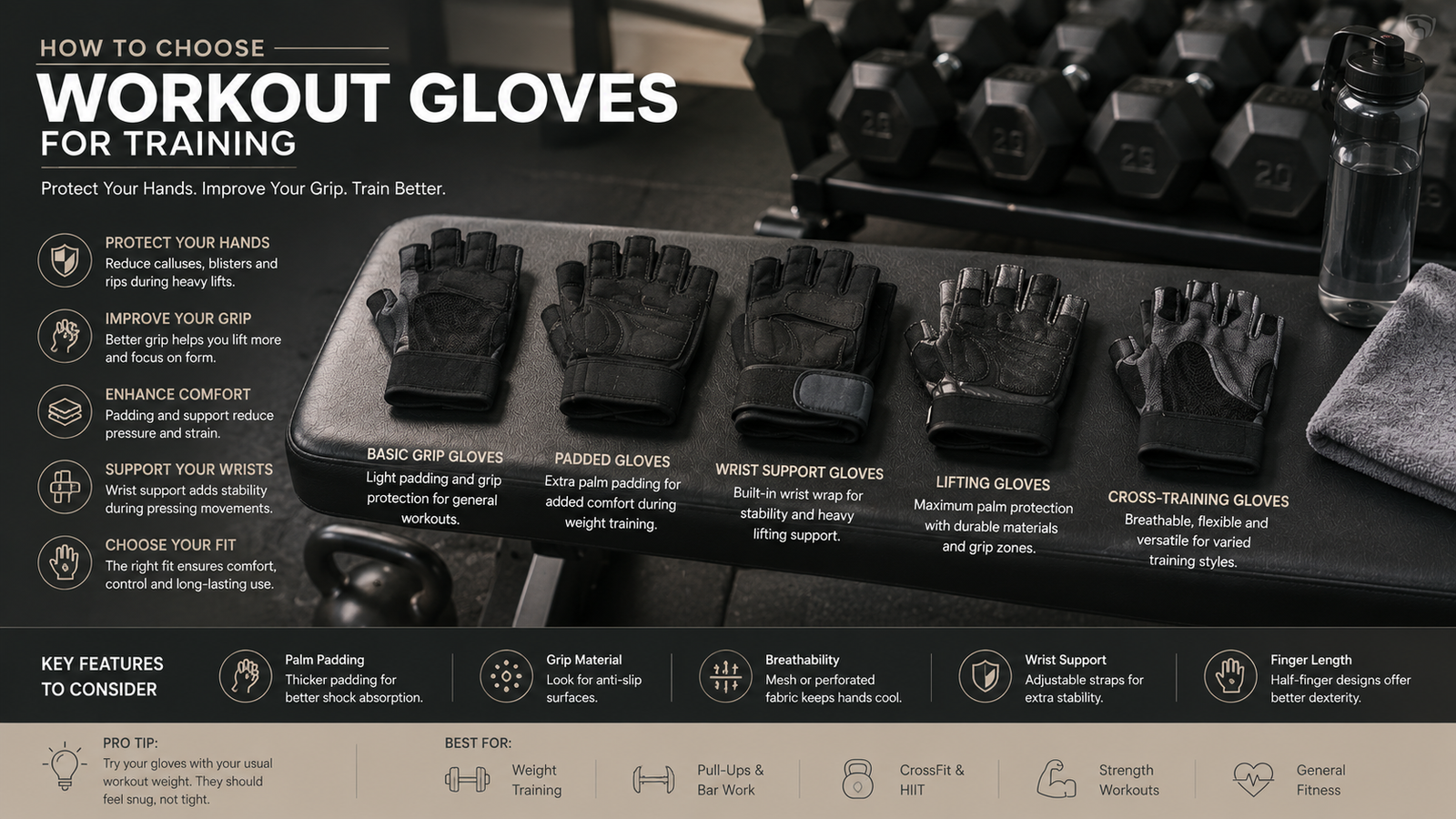
Workout gloves are a simple fitness accessory, but choosing the right pair can make a noticeable difference to:
- grip comfort;
- skin protection;
- sweat management;
- confidence during pulling and pushing exercises;
- hand fatigue;
- overall training comfort.
They are especially common during:
- dumbbell workouts;
- resistance-machine training;
- cable exercises;
- pull-ups;
- rowing;
- cycling;
- general gym sessions.
But workout gloves are not essential for everyone.
Some people prefer training with bare hands because they want:
- more direct contact with the bar;
- better tactile feedback;
- less material between the hand and equipment.
Others prefer gloves because they experience:
- calluses;
- blistering;
- sweaty palms;
- uncomfortable pressure from bars or handles.
The practical way to choose workout gloves is:
decide why you want gloves → choose the appropriate coverage and padding → make sure the fit is secure → evaluate grip material and wrist design → check breathability and washability → then consider specialist features
The best glove is not automatically:
- the thickest;
- the most padded;
- the most expensive;
- the one with the strongest wrist strap.
A good workout glove should protect your hands without interfering with your ability to:
grip → feel → control → release the equipment safely.
Do You Actually Need Workout Gloves?
No.
Workout gloves are optional.
Many experienced lifters train without them.
Others use gloves throughout their entire training career.
There is no requirement to develop:
- callused hands;
- bare-hand grip;
to train effectively.
Similarly, wearing gloves does not make someone less serious about training.
The decision is primarily about:
- comfort;
- grip preference;
- skin tolerance;
- training style.
Why Do People Wear Workout Gloves?
The most common reasons are:
- reducing friction;
- protecting calluses;
- absorbing sweat;
- improving comfort on rough handles;
- reducing pressure on the palms;
- increasing confidence when hands become slippery.
Some gloves also provide:
- limited wrist support;
- additional grip texture.
What Workout Gloves Cannot Do
Gloves should not be expected to:
- automatically improve grip strength;
- prevent all hand injuries;
- fix poor lifting technique;
- eliminate wrist pain;
- replace lifting straps;
- guarantee that a bar cannot slip.
They are primarily a:
comfort and grip-management accessory.
Gloves vs Bare Hands
Both approaches have advantages.
Training Bare-Handed
Advantages may include:
- direct bar contact;
- better tactile feedback;
- no extra grip thickness;
- easier use of chalk;
- less equipment to carry.
Potential disadvantages:
- calluses;
- skin tearing;
- discomfort from knurling;
- sweat-related slipping.
Training With Gloves
Advantages may include:
- reduced skin friction;
- improved comfort;
- sweat absorption;
- barrier between hands and shared equipment.
Potential disadvantages:
- thicker grip;
- less direct bar feel;
- glove bunching;
- reduced feedback if heavily padded.
Neither approach is universally better.
Start With the Type of Training You Do
Different activities benefit from different glove designs.
General Gym Training
Choose:
- fingerless;
- lightly padded;
- breathable gloves.
Heavy Dumbbell or Machine Training
Look for:
- durable palm material;
- moderate padding.
Pull-Ups and Rows
Prioritize:
- grip;
- palm durability;
- minimal bunching.
Cycling
Look for:
- pressure-distributing palm padding;
- breathable back;
- secure fit.
Functional Fitness
Choose:
- low-profile glove;
- strong grip;
- flexible palm.
High-Rep Training
Prioritize:
- ventilation;
- sweat management;
- durable seams.
Outdoor Training
You may want:
- full-finger coverage;
- weather protection.
Fingerless vs Full-Finger Gloves
This is one of the first decisions.
Fingerless Workout Gloves
These cover:
- palm;
- lower fingers;
while leaving fingertips exposed.
They are the most common type for gym training.
Advantages of Fingerless Gloves
- good ventilation;
- easy equipment handling;
- better fingertip sensitivity;
- less heat buildup.
They work well for:
- weights;
- machines;
- cables.
Disadvantages of Fingerless Gloves
They provide less protection around:
- fingertips;
- upper finger joints.
For most indoor strength training, this is not a major issue.
Full-Finger Workout Gloves
These cover the entire hand.
They may be useful for:
- outdoor training;
- cycling;
- obstacle training;
- colder environments.
Advantages of Full-Finger Gloves
- greater skin coverage;
- better protection from rough surfaces;
- useful in cold conditions.
Disadvantages
They may:
- feel hotter;
- reduce tactile feedback;
- retain more sweat.
For normal indoor lifting, they are usually unnecessary.
Half-Finger Length
Even among fingerless gloves, finger coverage varies.
Some end near:
- first finger joint.
Others extend farther.
Longer coverage can reduce rubbing.
Shorter coverage may provide more:
- freedom;
- ventilation.
Palm Material
The palm is the most important part of a workout glove.
Common materials include:
- synthetic leather;
- genuine leather;
- microfiber;
- silicone-coated fabric;
- rubberized grip material;
- mesh combinations.
Synthetic Leather
Common in general gym gloves.
Advantages:
- relatively durable;
- affordable;
- easier maintenance than some natural leather.
Quality varies significantly.
Genuine Leather
Can provide:
- durable grip;
- good feel;
- long life when properly maintained.
Potential disadvantages:
- more expensive;
- may require more care;
- can retain moisture.
Microfiber Palms
Lightweight and flexible.
They may provide:
- comfortable grip;
- good dexterity.
Durability depends on construction.
Silicone Grip Patterns
Some gloves use silicone strips or dots to increase friction.
These can help with:
- dumbbells;
- cable handles.
But excessive grip texture can feel awkward if it catches during:
- bar repositioning.
Rubber Grip
Provides strong friction.
Useful for certain training styles.
But rubberized sections may eventually:
- peel;
- crack.
Is More Grip Always Better?
No.
You need enough traction to control equipment.
But an excessively sticky glove may make it difficult to:
- reposition the hand;
- release quickly.
This can matter during dynamic training.
Grip should feel secure without locking your hand unnaturally to the equipment.
Palm Padding
Padding is one of the most heavily marketed glove features.
Common materials include:
- foam;
- gel;
- layered fabric.
Why Padding Helps
It can distribute pressure from:
- dumbbell handles;
- barbell knurling;
- machine grips.
This may improve comfort during:
- high-repetition workouts.
More Padding Is Not Always Better
Thick padding increases the effective diameter of the bar.
That can make gripping harder.
For example, holding a dumbbell handle through a thick glove requires your fingers to wrap around:
- additional material.
This can increase grip fatigue.
Light Padding
Best for people who want:
- some protection;
- strong bar feel;
- minimal bulk.
Often suitable for:
- strength training;
- pull-ups.
Medium Padding
Good general-purpose option.
Useful for:
- machines;
- dumbbells;
- moderate barbell training.
Heavy Padding
May benefit people who prioritize:
- maximum palm comfort.
But it can reduce:
- control;
- feedback.
It is usually more common in cycling-oriented gloves.
Gel Padding
Gel inserts may distribute pressure well.
But they can make gloves:
- thicker;
- warmer.
They may be useful for users who experience pressure points.
Foam Padding
Usually:
- lighter;
- simpler.
It may compress over time.
Padding Placement Matters More Than Total Thickness
Padding should align with pressure areas such as:
- base of fingers;
- central palm;
without creating thick ridges.
Poorly positioned padding can cause:
- bunching;
- additional friction.
Calluses
Calluses form when skin adapts to repeated:
- pressure;
- friction.
They are common in strength training.
Are Calluses Bad?
Not inherently.
Moderate callus development is a normal adaptation.
Problems arise when calluses become:
- excessively thick;
- dry;
- cracked;
- torn.
Gloves may reduce some friction but will not always prevent calluses completely.
Callus Tears
Heavy pulling can cause thick calluses to:
- catch;
- tear.
Keeping calluses reasonably smooth may help.
Gloves can also reduce direct friction.
Hand-Care Routine for Lifters
A simple approach:
- wash hands;
- moisturize when needed;
- gently smooth excessively thick calluses.
Do not aggressively remove all callused skin.
Blisters
Blisters result from repeated friction and pressure.
Gloves may reduce blister risk if:
- properly fitted.
Poorly fitted gloves may actually increase friction.
Loose Gloves and Blisters
If the glove moves independently of your hand, material can rub repeatedly against:
- skin.
This is why fit matters so much.
The Most Important Feature: Fit
Workout gloves should feel:
- snug;
- secure;
- flexible.
They should not:
- slide;
- bunch;
- restrict finger movement.
Gloves That Are Too Large
Potential problems:
- palm bunching;
- poor grip;
- shifting padding;
- reduced control.
Gloves That Are Too Small
Potential problems:
- restricted circulation;
- finger pressure;
- seam irritation;
- difficulty closing the hand.
How to Measure Your Hand
Manufacturers usually ask for:
- palm circumference;
- sometimes hand length.
Palm circumference is often measured around the widest part of the hand, excluding the thumb.
Use the brand’s exact sizing instructions.
Sizing Is Not Standardized
A medium in one brand may fit like:
- small;
- large;
in another.
Always check the individual chart.
Between Two Sizes
The correct choice depends on:
- material;
- stretch;
- brand guidance.
A stretchy glove may work slightly snug.
A rigid leather glove may require more initial room.
Do not intentionally buy painfully tight gloves expecting them to stretch perfectly.
Finger Opening Fit
Finger openings should not:
- cut into skin;
- create numbness.
They should also not be so loose that the glove shifts.
Thumb Fit
The thumb area should allow:
- natural movement;
- grip.
Poor thumb construction can make gloves feel awkward even when overall size is correct.
Palm Creasing
Close your hand around a bar or similar object.
The glove should not create a large fold of material across the palm.
If it does, the glove may be:
- too large;
- poorly shaped.
Pre-Curved Design
Some gloves are shaped to mimic a partially closed hand.
This may reduce material bunching during:
- gripping.
It can improve comfort.
Glove Stretch
Some materials become slightly more flexible with use.
But significant structural looseness may worsen over time.
Choose a secure initial fit.
Wrist Closure
Gloves may use:
- elastic cuffs;
- Velcro straps;
- extended wrist wraps.
Elastic Wrist
Simple and lightweight.
Suitable for:
- general training.
Velcro Wrist Strap
Allows more adjustment.
Useful if you want:
- snug wrist fit.
Extended Wrist-Wrap Gloves
These combine glove and wrap in one product.
The strap may circle the wrist one or more times.
Do Wrist-Support Gloves Actually Support the Wrist?
They can provide:
- some compression;
- some stiffness.
But they are generally less supportive than dedicated:
- wrist wraps.
Do not expect them to fix persistent wrist pain.
When Wrist Support May Be Useful
Some users prefer extra support during:
- bench pressing;
- overhead pressing;
- push exercises.
But correct wrist positioning and appropriate load still matter.
Glove vs Wrist Wrap
A glove primarily protects:
- hand.
A wrist wrap primarily supports:
- wrist.
If you need strong wrist support, separate wrist wraps may be more effective.
Can You Wear Gloves With Wrist Wraps?
Yes.
But the combination can become bulky.
Some users prefer:
- gloves without wrist straps;
- separate wraps only when needed.
Wrist Strap Tightness
The closure should feel secure.
It should not cause:
- numbness;
- tingling;
- colour change in the hand.
Loosen if circulation feels restricted.
Breathability
Hands can sweat significantly during training.
A glove that traps moisture may become:
- uncomfortable;
- slippery internally;
- odorous.
Mesh Back Panels
Common in workout gloves.
They can improve:
- ventilation;
- flexibility.
Perforated Palm
Some gloves include ventilation holes.
Useful for:
- sweat management.
But excessive perforation may reduce durability.
Open-Back Gloves
Some minimal designs leave much of the back of the hand uncovered.
These can be:
- very breathable;
- lightweight.
They may be ideal for people who mainly want palm protection.
Sweat-Wicking Fabric
Some glove backs use fabrics designed to move moisture away from skin.
Useful for longer sessions.
But the glove still needs:
- regular washing.
Thumb Sweat Panel
Certain gloves include a soft absorbent area on the thumb.
This can be used to wipe:
- forehead sweat.
Convenient, though not essential.
Moisture and Grip
Sweaty palms can reduce friction on:
- smooth metal;
- rubber handles.
Gloves may help by absorbing some moisture.
But once saturated, they can also become slippery.
Chalk vs Gloves for Sweaty Hands
Chalk absorbs moisture directly from:
- palms.
Gloves create a barrier.
Some lifters prefer chalk because it maintains:
- direct bar feel.
Others prefer gloves for comfort.
Both can work.
Can You Use Chalk With Gloves?
Usually unnecessary.
Chalk can accumulate on:
- glove material;
- seams.
It may be useful only in specific situations.
Lifting Straps vs Gloves
These serve different purposes.
Gloves
Primarily provide:
- comfort;
- skin protection;
- grip surface.
Lifting Straps
Mechanically connect the hand more securely to the bar and reduce grip demand.
If Your Grip Fails During Deadlifts
Gloves may not solve the problem.
If the issue is actual grip strength rather than skin discomfort, consider:
- grip training;
- chalk;
- lifting straps depending on goal.
Gloves vs Lifting Hooks
Lifting hooks significantly reduce the need to grip the bar.
They are much more specialized.
Gloves provide:
- modest grip assistance;
- comfort.
Do not confuse them.
Workout Gloves for Dumbbells
A basic fingerless glove with:
- light-to-medium padding;
- secure palm grip;
works well.
Avoid excessive padding that makes smaller dumbbell handles feel too thick.
Workout Gloves for Barbells
If you train with barbells, prioritize:
- thin durable palm;
- good fit;
- minimal bunching.
Barbell knurling already provides grip.
A very soft padded glove may reduce the useful feel of the knurling.
Gloves for Deadlifts
Many deadlifters prefer:
- bare hands;
- chalk;
- straps.
If you use gloves, choose:
- thin;
- durable palm;
- secure wrist.
Thick gloves can increase effective bar diameter.
Why Bar Diameter Matters
A thicker bar is harder to grip because fingers cannot wrap around as far.
Adding thick glove padding effectively makes the bar:
- slightly thicker.
For heavy deadlifts, this can matter.
Gloves for Pull-Ups
Palm protection is useful because pull-up bars can create:
- friction;
- callus stress.
Choose gloves with:
- secure palm;
- minimal bulk.
Loose gloves can rotate around the hand during hanging.
Pull-Up Grip Pads
Some people use minimalist pads rather than full gloves.
They cover only the palm and sometimes fingers.
Advantages:
- less heat;
- minimal material.
These can work well for:
- pull-ups;
- deadlifts.
Gymnastics Grips
Gymnastics-style grips are different from general workout gloves.
They are designed primarily for:
- bars;
- high-repetition pull-ups;
- gymnastics movements.
They may use:
- leather;
- synthetic material.
Who Should Consider Gymnastics Grips?
People performing high volumes of:
- pull-ups;
- toes-to-bar;
- muscle-ups;
may prefer them over normal gloves.
They are specialized equipment.
Gloves for Cable Machines
A standard lightly padded glove works well.
Cable handles can become:
- slippery;
- uncomfortable.
Grip material can improve security.
Gloves for Resistance Machines
Comfort is usually the main benefit.
Because machine handles vary widely, flexible gloves are more practical than heavily specialized designs.
Gloves for Kettlebells
This requires caution.
Kettlebell exercises such as:
- cleans;
- snatches;
require the handle to rotate within the hand.
An overly sticky glove can increase:
- friction;
- blistering.
Should You Wear Gloves for Kettlebells?
For basic:
- swings;
- carries;
gloves may be fine.
For technical ballistic movements, many experienced users prefer:
- bare hands;
- chalk.
If using gloves, choose a thin model that allows the handle to:
- move;
- rotate.
Gloves for Rowing Machines
Usually not necessary.
But high-volume rowing can produce:
- hand friction;
- blisters.
Thin rowing gloves may help some users.
Avoid thick padding because it changes:
- handle feel.
Gloves for Cycling
Cycling gloves are more specialized.
They often include:
- palm padding;
- breathable back;
- fingerless design.
Why Cycling Gloves Have More Padding
Bike handlebars create sustained pressure on:
- palms;
- nerves.
Strategic padding may reduce pressure.
This is different from barbell gripping.
Road Cycling Gloves
Often:
- lightweight;
- fingerless;
- ventilated.
Mountain-Bike Gloves
Usually:
- full finger;
- stronger protection;
- additional grip.
Indoor Cycling Gloves
Optional.
If you experience:
- sweaty hands;
- palm discomfort;
fingerless cycling gloves may help.
Gloves for Functional Fitness
Functional fitness may combine:
- barbells;
- pull-ups;
- rowing;
- dumbbells;
- kettlebells.
A glove must remain versatile.
Look for:
- thin palm;
- strong grip;
- durable seams;
- good flexibility.
Gloves for HIIT
Prioritize:
- breathability;
- secure fit;
- flexibility.
High-intensity circuits create substantial sweating.
A bulky glove may become uncomfortable.
Gloves for Outdoor Training
Full-finger gloves can provide:
- cold protection;
- abrasion protection.
Choose according to:
- temperature;
- equipment.
Cold-Weather Training Gloves
These need to balance:
- warmth;
- grip;
- dexterity.
Very thick winter gloves may make it hard to control:
- bars;
- dumbbells.
Use training-specific cold-weather gloves if needed.
Rain and Outdoor Grip
Wet equipment can become slippery.
Some gloves include water-resistant or textured palms.
But training outdoors on wet metal equipment may still be unsafe.
Grip material cannot eliminate all slipping risk.
Gloves for Calisthenics
For:
- pull-ups;
- dips;
- bars;
minimalist palm protection may work well.
Do not choose thick gym gloves that bunch during:
- hanging movements.
Gloves for Climbing
General workout gloves are not usually appropriate for:
- rock climbing.
Climbing relies heavily on:
- direct finger contact;
- friction.
Different equipment and techniques apply.
Gloves for Boxing
Boxing gloves are an entirely different category.
Workout gloves for lifting should not be confused with:
- boxing gloves;
- inner gloves;
- hand wraps.
Do Workout Gloves Improve Grip Strength?
No.
They may help you hold equipment more comfortably.
But they do not necessarily strengthen the:
- fingers;
- forearms.
Grip strength improves through:
- gripping;
- carrying;
- pulling;
- dedicated grip training.
Could Gloves Reduce Grip Training?
Potentially, if they make gripping easier and you rely on them constantly.
But for most recreational users, this effect is minor.
If grip strength is important, include specific exercises such as:
- farmer carries;
- dead hangs;
- heavy rows;
- grippers.
Grip Trainers
These can be used separately.
Workout gloves should not be expected to provide the same function.
Should Beginners Use Gloves?
If gloves make training more comfortable:
- yes.
There is no reason to deliberately suffer hand pain to “toughen up.”
However, beginners should avoid using gloves as a substitute for learning:
- safe grip;
- correct bar position.
Bare-Hand Adaptation
Some skin adaptation occurs naturally with repeated training.
If you prefer bare hands, calluses may become less uncomfortable over time.
But there is no fitness benefit to forcing this preference.
Workout Gloves for Women vs Men
The main difference is usually:
- sizing;
- design;
- colour.
The performance needs are similar.
Choose according to:
- hand dimensions;
- training style.
Do not rely on gender label alone.
Small Hands
Look for:
- narrower palm;
- shorter finger openings;
- smaller wrist closure.
A glove with excess material can seriously reduce grip quality.
Large Hands
Ensure:
- fingers do not feel compressed;
- palm material reaches the correct pressure zones.
Some brands offer:
- XL;
- XXL sizes.
Wide Hands
Palm circumference is especially important.
Do not size up only for finger length if the glove then becomes loose elsewhere.
Long Fingers
Check hand-length measurements if the brand provides them.
Fingerless glove openings should sit comfortably.
Seam Placement
Poor seam placement can create pressure on:
- fingers;
- palm.
Inspect where seams sit while your hand is closed.
Flat Seams
Can reduce:
- rubbing;
- irritation.
Particularly useful for high-repetition training.
Reinforced Seams
High-wear areas include:
- thumb;
- base of fingers;
- wrist attachment.
Reinforcement improves durability.
Double Stitching
May increase longevity.
But stitching quality matters more than simply counting visible seam lines.
Finger Pull Tabs
Some gloves have small loops between fingers to help remove them.
This is useful because sweaty gloves can be difficult to pull off.
Pull-Off Tabs
They can reduce the need to:
- stretch;
- invert;
the glove excessively.
This may improve lifespan.
Easy Removal Matters
A glove that takes several minutes to remove after every workout becomes annoying.
Small pull tabs are surprisingly useful.
Closure Types
Common options:
- Velcro;
- elastic;
- pull-on.
Velcro Closure
Advantages:
- adjustable;
- easy to secure.
Potential downside:
- Velcro may weaken with repeated use;
- can catch on clothing.
Elastic Closure
Simple and lightweight.
Less adjustable.
Pull-On Gloves
Minimalist.
But fit must be very accurate.
Sweaty gloves may be harder to remove.
Velcro Quality
Cheap hook-and-loop material may lose grip.
Check whether the closure still holds securely when:
- wrist moves;
- hand flexes.
Glove Thickness
A very thick glove can:
- reduce dexterity;
- increase heat.
A very thin glove may provide insufficient protection.
For general gym use, a middle ground is often best.
Minimalist Gloves
Some models consist mainly of:
- palm layer;
- finger loops.
They can provide:
- callus protection;
- direct feel.
They may be ideal for experienced lifters who dislike traditional gloves.
Grip Pads
These are even more minimal.
A small palm pad sits between:
- hand;
- bar.
Advantages:
- easy to put on;
- minimal heat;
- strong bar feel.
Disadvantages:
- less hand coverage;
- can shift.
Are Grip Pads Better Than Gloves?
Not universally.
Choose pads if you mainly want:
- palm protection.
Choose gloves if you also want:
- secure fit;
- sweat management;
- more coverage.
Leather Lifting Grips
Some lifting grips use a strap around the wrist with a flap over the palm.
They can function partly like:
- glove;
- strap.
They may be useful during:
- pulling exercises.
Again, they are different from general-purpose gloves.
Sweat Absorption
Gloves can absorb sweat from:
- hands.
But they need to release moisture afterward.
A permanently damp glove quickly develops:
- odour.
Odour
Workout gloves are particularly prone to odour because they combine:
- sweat;
- warmth;
- fabric;
- limited ventilation.
The Most Important Hygiene Rule
Do not leave sweaty gloves closed inside your gym bag.
After training:
- Remove them.
- Open the wrist straps.
- Allow them to air dry.
- Wash regularly.
How Often Should You Wash Workout Gloves?
Frequency depends on:
- how much you sweat;
- how often you train.
If used multiple times per week, washing regularly is important.
Do not wait until the odour becomes severe.
Machine Wash vs Hand Wash
Check the care label.
Some synthetic gloves are:
- machine washable.
Leather gloves may require:
- hand cleaning;
- special care.
Basic Hand-Washing Method
For compatible gloves:
- Use cool or lukewarm water.
- Apply mild detergent.
- Gently clean.
- Rinse thoroughly.
- Press out excess water.
- Air dry.
Do not twist aggressively.
Do Not Use Excessive Heat
Avoid:
- tumble drying;
- radiator;
- direct high heat;
unless the manufacturer specifically permits it.
Heat can damage:
- foam;
- synthetic leather;
- Velcro;
- adhesives.
Drying Gloves
Open them as much as possible.
Allow air to reach:
- palm;
- finger openings.
Dry completely before placing back in the bag.
Leather Glove Care
Leather requires more attention.
Avoid soaking unless care instructions permit.
Some leather may benefit from:
- appropriate conditioner.
But excessive conditioner can reduce:
- grip.
Follow manufacturer recommendations.
Cleaning Silicone Grip
Wipe sweat and dust from silicone areas.
Oil or lotion can reduce:
- traction.
Hand Lotion and Gloves
Applying heavy moisturizer immediately before training may make the glove interior:
- slippery.
If using hand cream, allow it to absorb first.
Shared Workout Gloves
It is generally better to use your own gloves.
Gloves absorb:
- sweat;
- skin oils.
Sharing is not ideal from a hygiene perspective.
Skin Conditions
If you experience:
- persistent rash;
- cracking;
- itching;
gloves may trap moisture and worsen irritation.
Try:
- more breathable material;
- more frequent washing.
Persistent symptoms may need medical evaluation.
Latex
Some gloves may contain:
- latex;
- rubber components.
People with latex allergy should check:
- material specifications.
Neoprene
Often used around:
- wrist;
- back of hand.
It can provide:
- cushioning;
- flexibility.
But it may retain:
- heat.
Mesh
Improves breathability but may be less abrasion-resistant.
A good glove often combines:
- durable palm;
- breathable back.
Synthetic Leather Durability
Look for reinforcement where the palm contacts:
- bars;
- handles.
Thin unreinforced material may wear through quickly.
Signs Gloves Are Wearing Out
- palm material thinning;
- stitching opening;
- grip coating peeling;
- Velcro no longer securing;
- padding compressed;
- holes near fingers.
Replace when damage affects:
- grip;
- protection.
Torn Palm Material
A hole can create:
- pressure edge;
- uneven grip.
Do not keep using badly torn gloves simply because the rest looks fine.
Worn Silicone
If grip patches peel away, traction may become inconsistent.
Replace or retire the glove.
Compressed Padding
Padding naturally flattens over time.
If the glove still feels comfortable and secure, this may not matter.
Replace when it no longer provides the desired:
- protection.
Stretching Over Time
Elastic materials may loosen.
If the glove starts:
- sliding;
- bunching;
it may no longer fit adequately.
Workout Glove Lifespan
There is no universal timeframe.
Durability depends on:
- training frequency;
- exercise type;
- material;
- washing;
- grip surface.
A glove used for heavy pull-ups five days a week will wear faster than one used occasionally for:
- machines.
Rotate Two Pairs?
Frequent users may benefit from two pairs.
Advantages:
- each pair dries fully;
- you always have one clean pair.
This is optional.
Glove Storage
Store:
- clean;
- dry;
- open.
Avoid leaving damp gloves compressed under other gym gear.
Gym-Bag Storage
Use a ventilated pouch if needed.
Do not seal sweaty gloves in:
- plastic bag;
for long periods.
Gloves and Smartphone Use
Fingerless gloves allow easy phone use.
Full-finger gloves may need:
- touchscreen-compatible fingertips.
This is useful for outdoor training but not essential.
Touchscreen-Compatible Material
May use conductive fabric.
Quality varies.
Do not choose a glove primarily for this feature unless phone use is important.
Workout Gloves in Hot Weather
Prioritize:
- mesh;
- light materials;
- fingerless design.
Hot climates increase:
- sweating;
- odour.
Wash more frequently.
Workout Gloves in Indian Conditions
For warm and humid gym environments, practical priorities include:
- breathable back;
- fingerless design;
- washable synthetic palm;
- fast drying;
- secure but not excessive wrist coverage.
Extremely thick leather or neoprene designs may become uncomfortable in poorly ventilated gyms.
Outdoor Training in Winter
Full-finger gloves may help.
But ordinary winter gloves may be too slippery for:
- weights.
Choose gloves designed for:
- exercise;
- grip.
Waterproof Workout Gloves
Fully waterproof gloves are rarely necessary for indoor training.
For outdoor training, water resistance can help.
But waterproof membranes often reduce:
- breathability.
Glove Colour
Colour has no meaningful performance effect.
Lighter gloves may show:
- sweat;
- chalk;
- dirt;
more easily.
Dark colours may hide stains.
Reflective Details
Useful only if gloves are used during:
- outdoor running;
- cycling.
They provide a small visibility benefit.
Do not rely on glove reflectivity alone for road safety.
Workout Gloves for Cardio Machines
For:
- treadmill;
- elliptical;
gloves are generally unnecessary.
They may be useful if your hands sweat heavily on:
- handles.
But gripping cardio-machine handles continuously is usually not required.
Gloves for Stair Climbers
Usually optional.
If you rely heavily on rails, reduce dependence rather than using gloves to allow more leaning.
Gloves for Air Bikes
Moving handles can create hand pressure during hard intervals.
A thin glove may improve comfort.
Gloves for Battle Ropes
Battle ropes can create:
- friction;
- grip fatigue.
Gloves may help protect the hands.
But direct grip and chalk may also work.
Gloves for Sled Training
Useful if handles are rough or outdoor equipment becomes:
- hot;
- cold.
Gloves for Farmer Carries
If your goal is grip training, bare hands or chalk may be more appropriate.
If your goal is loading:
- legs;
- trunk;
and hand skin is limiting you, gloves may help.
Gloves and Grip Strength Goals
Ask:
What is supposed to fail first in this exercise?
If you want to train grip:
- do not over-assist it.
If you want to train:
- back;
- legs;
and skin discomfort is stopping you, gloves may be useful.
Workout Gloves vs Chalk
Gloves
Better for:
- skin comfort;
- hygiene preference;
- rough handles.
Chalk
Better for:
- moisture control;
- direct grip;
- heavy lifting.
Some gyms do not permit:
- powdered chalk.
Liquid chalk may be an alternative.
Workout Gloves vs Straps
Gloves
Reduce:
- friction.
Straps
Reduce:
- grip limitation.
A person may use:
- neither;
- one;
- both;
depending on workout.
Gloves and Barbells With Aggressive Knurling
Sharp knurling can damage skin.
Gloves may improve comfort.
But very thick gloves may interfere with grip.
Choose durable thin palm material.
Knurling and Callus Placement
Calluses often become worse when the bar sits too deep in the palm.
During pulling movements, positioning the bar closer to the base of the fingers may reduce skin folding.
Technique can matter as much as gloves.
Proper Grip During Pulling Exercises
Avoid trapping a large fold of palm skin under the bar.
This can contribute to:
- callus tearing.
A qualified trainer can help with hand placement.
Gloves for Powerlifting
Many powerlifters prefer:
- bare hands;
- chalk.
Competition rules may also restrict gloves.
If you compete, check the federation’s current equipment rules.
Gloves for Olympic Weightlifting
Weightlifters commonly use:
- chalk;
- tape.
Gloves are generally less common because direct bar feel matters.
If competing, check rules.
Gloves for Bodybuilding
Gloves can work very well because training often includes:
- high repetitions;
- machines;
- dumbbells;
- cables.
Comfort may matter more than maximum bar feel.
Gloves for Beginners Training on Machines
This is one of the simplest use cases.
A light-to-medium padded fingerless glove can reduce:
- palm pressure.
Avoid overcomplicated wrist support.
Workout Gloves and Hygiene in Commercial Gyms
Gloves create a barrier between your palms and equipment.
But they do not eliminate the need for:
- hand hygiene.
The exterior of the glove still contacts shared surfaces.
Avoid touching your:
- face;
- food;
with dirty gloves.
Wash Your Hands After Training
Especially before:
- eating.
Gloves are not sterilizing equipment.
Do Gloves Prevent Germ Exposure?
No.
They may reduce direct skin contact, but organisms can remain on:
- glove surface.
If anything, repeatedly touching the same sweaty glove without washing can become unhygienic.
Gym Glove Odour and Bacteria
Odour-producing microorganisms thrive in:
- moisture;
- warmth.
Drying and washing are the main solutions.
Deodorant sprays are secondary.
Antibacterial Gloves
Some materials claim antimicrobial treatment.
This may reduce certain microbial growth.
But it does not remove the need for:
- washing;
- drying.
Treat it as a secondary feature.
Anti-Odour Treatments
These may help temporarily.
Their effectiveness may decline after repeated washing.
Do not pay a large premium based solely on anti-odour marketing.
“Callus-Free” Claims
No glove can guarantee zero callus development.
Pressure still occurs through the glove.
Expect reduced:
- friction;
rather than complete prevention.
“Maximum Grip” Claims
Grip depends on:
- glove material;
- bar surface;
- moisture;
- fit;
- load.
No glove guarantees that a bar cannot slip.
“Injury Prevention” Claims
Be cautious.
Gloves may improve:
- comfort;
- hand protection.
They cannot guarantee prevention of:
- wrist injuries;
- shoulder injuries;
- lifting-related injuries.
“Wrist Stabilization” Claims
A long strap may increase stiffness.
But it does not fix:
- poor technique;
- excessive load;
- underlying injury.
Wrist Pain During Training
If you have recurring wrist pain, investigate:
- exercise technique;
- load;
- wrist position;
- mobility;
- underlying injury.
Do not simply buy tighter gloves.
Numbness While Wearing Gloves
Stop and loosen them.
Potential causes include:
- overly tight wrist closure;
- small sizing;
- pressure on nerves.
Persistent numbness should be assessed.
Tingling in Fingers
This is not a normal requirement of glove use.
Check:
- fit;
- wrist compression.
If symptoms continue even without gloves, seek appropriate medical evaluation.
Skin Chafing
If seams repeatedly rub the same area:
- glove design may not suit your hand.
Do not assume your skin must adapt.
Try:
- different seam position;
- size;
- material.
Common Workout Glove Buying Mistakes
Buying the Thickest Padding
Can make gripping harder.
Choosing Gloves Too Large
Creates bunching.
Buying Extremely Tight Gloves
Can restrict circulation.
Ignoring Palm Material
This determines durability and grip.
Buying Gloves for Wrist Pain Instead of Addressing the Cause
Support is not treatment.
Assuming Gloves Replace Lifting Straps
They do not.
Choosing Full-Finger Gloves for a Hot Indoor Gym
May become unnecessarily warm.
Buying Gloves Without Checking Washability
They will get sweaty.
Choosing Cheap Grip Coating That Peels Quickly
Durability matters.
Ignoring Pull-Off Tabs
A small but useful feature.
Common Workout Glove Use Mistakes
Leaving Them in the Gym Bag
They stay damp and develop odour.
Never Washing Them
Gloves need regular cleaning.
Overtightening Wrist Straps
Can create numbness.
Using Thick Gloves for Heavy Deadlifts
May increase effective bar diameter.
Using Very Sticky Gloves for Kettlebell Snatches
May create excessive friction.
Training Through Skin Irritation
Address the fit or material.
Assuming Gloves Make Grip Failure Impossible
Maintain proper control.
How to Choose Workout Gloves Step by Step
Step 1 — Decide Why You Want Gloves
Is the main problem:
- calluses?
- sweaty hands?
- rough bars?
- palm pressure?
Knowing this prevents overbuying.
Step 2 — Choose Coverage
For most gym users:
fingerless
is the practical default.
Step 3 — Choose Padding
Start with:
- light;
- medium.
Heavy padding is rarely necessary for strength training.
Step 4 — Check Palm Grip
You want enough friction without excessive stickiness.
Step 5 — Get the Fit Right
Measure the hand and use the brand’s chart.
Step 6 — Evaluate Wrist Design
Simple cuff is enough for most people.
Choose extended support only if you actually want it.
Step 7 — Check Breathability
Especially important for frequent training.
Step 8 — Check Washability
Gloves should fit into a realistic cleaning routine.
Step 9 — Test Them With Real Equipment
Grip:
- dumbbell;
- pull-up bar;
- cable handle;
if possible.
How to Test Workout Gloves Before Buying
Close your fist.
Then mimic holding:
- bar;
- dumbbell.
Check for:
Palm Bunching
There should not be excessive folded material.
Finger Pressure
Openings should not cut into skin.
Thumb Movement
Should remain unrestricted.
Wrist Comfort
Closure should feel secure without compression.
Grip
Palm should not feel slippery.
Test With Weight if Possible
A glove can feel comfortable with an empty hand but shift under load.
Try holding:
- dumbbell;
- bar;
where permitted.
A Simple Choice by Training Type
General Gym
Choose:
fingerless glove with light-to-medium padding
Heavy Barbell Training
Choose:
thin durable palm with minimal padding
Machines and Dumbbells
Choose:
moderately padded general fitness glove
Pull-Ups
Choose:
thin high-grip glove or palm grip
Cycling
Choose:
cycling-specific padded glove
Kettlebell Training
Choose:
minimalist thin glove if you use one at all
Outdoor Training
Choose:
full-finger glove appropriate for the weather
A Simple Choice by Main Problem
Calluses
Choose:
- durable palm coverage.
Sweaty Hands
Choose:
- breathable glove;
- moisture-managing palm.
Palm Pressure
Choose:
- moderate padding.
Grip Slipping
Choose:
- textured palm;
while also checking technique and sweat management.
Wrist Comfort
Consider:
- integrated wrist wrap;
- separate wrist wrap if stronger support is needed.
A Simple Choice by Padding
Minimal Bar Feel
Light padding.
General Gym Comfort
Medium padding.
Cycling / High Palm Pressure
More targeted padding.
Avoid choosing maximum thickness without a specific reason.
A Simple Choice by Climate
Hot and Humid Gym
Prioritize:
- mesh;
- fingerless design;
- fast-drying synthetic materials.
Cold Outdoor Training
Consider:
- full-finger coverage.
High-Sweat Workouts
Prioritize:
- washability;
- ventilation.
A Simple Choice for Beginners
For most beginners:
fingerless + medium-light padding + breathable back + simple Velcro wrist closure
is enough.
You generally do not need:
- lifting hooks;
- integrated straps;
- rigid wrist braces;
- thick gel padding.
Start simple.
A Simple Choice for Experienced Lifters
You may prefer:
- minimal palm protection;
- grip pads;
- specialized pulling grips.
The more experienced you become, the more you may prioritize:
- bar feel;
- specific function;
over general comfort.
Budget Workout Gloves
Affordable gloves can work well.
Prioritize:
- secure fit;
- durable palm;
- decent seams;
- washable materials.
Cheap gloves often fail first at:
- stitching;
- grip coating;
- Velcro.
Mid-Range Workout Gloves
Often provide the best value.
You may gain:
- better palm materials;
- stronger stitching;
- improved ventilation;
- better fit.
Premium Workout Gloves
May use:
- premium leather;
- advanced grip materials;
- stronger construction.
They can be worthwhile for frequent users.
But premium pricing does not automatically improve:
- fit.
Price vs Durability
A more expensive glove that lasts:
- two years;
may be better value than a cheap pair replaced every few months.
But this depends on actual construction.
Check Warranty
Some brands offer warranties for:
- stitching;
- manufacturing defects.
Normal wear from:
- barbells;
- pull-ups;
may not be covered.
Buying Online
Check:
- hand-sizing chart;
- palm circumference;
- return policy;
- material;
- care instructions.
Online Reviews
Useful repeated comments include:
- runs small;
- wrist strap too long;
- padding bunches;
- grip peels;
- stitching fails;
- difficult to remove.
Do not rely only on average star rating.
Return Policy
Fit is especially important.
Try the gloves indoors with clean hands before removing:
- tags;
if retailer policies allow.
Workout Glove Buying Checklist
Before purchasing, ask:
1. Why do I want gloves?
Comfort, calluses, sweat or grip?
2. What type of training do I do most?
Barbells, machines, pull-ups, cycling or mixed workouts?
3. Do I need fingerless or full-finger coverage?
Fingerless is enough for most indoor gyms.
4. How much padding do I need?
Usually less than you think.
5. Does the palm material grip securely?
Without feeling excessively sticky?
6. Does the glove fit snugly?
No bunching or sliding.
7. Are the finger openings comfortable?
No excessive pressure.
8. Does the thumb move naturally?
Important for gripping.
9. Do I need wrist support?
Do not buy it automatically.
10. Is the glove breathable?
Important for sweaty workouts.
11. Can it be washed easily?
Very important.
12. Are the seams reinforced?
Especially around the palm and thumb.
13. Are pull tabs included?
Helpful for sweaty gloves.
14. Does the glove interfere with bar feel?
Test if possible.
15. Will I actually wear them consistently?
The most important question.
When Should You Choose Lifting Straps Instead?
Consider straps rather than relying only on gloves if your primary issue is:
- grip failure during heavy pulling exercises.
For example:
- Romanian deadlift;
- heavy row;
- shrug.
Gloves may make the hands more comfortable.
Straps can allow the target muscles to continue working when grip becomes the limiting factor.
They solve different problems.
When Should You Choose Wrist Wraps Instead?
If your main concern is wrist support during:
- heavy pressing;
dedicated wraps are generally more appropriate than heavily padded workout gloves.
When Should You Train Bare-Handed?
If you prefer:
- direct grip;
- chalk;
- better tactile feedback;
there is no need to wear gloves.
Some people alternate.
For example:
Gloves
Machines and dumbbells.
Bare Hands + Chalk
Heavy barbell work.
There is no rule requiring one method for every exercise.
When Should You Seek Professional Guidance?
Workout gloves should not be used to mask persistent medical or training problems.
Seek appropriate assessment if you experience:
- recurring wrist pain;
- persistent finger numbness;
- repeated hand weakness;
- severe skin reactions;
- unexplained grip loss.
A physiotherapist, sports-medicine professional or other appropriate clinician can help determine whether symptoms are related to:
- training technique;
- nerve irritation;
- tendon issues;
- another condition.
The Physical Glow Takeaway
Workout gloves are not essential, but they can make training considerably more comfortable if your main problems are:
- calluses;
- rough handles;
- sweaty palms;
- pressure on the hands.
For most gym users, a practical glove looks like:
fingerless design → light-to-medium palm padding → durable grip surface → breathable back → secure fit → simple adjustable wrist closure
Avoid buying the thickest glove available.
Too much material can:
- increase bar diameter;
- reduce tactile feedback;
- create bunching;
- make heavy gripping harder.
Choose according to the exercise:
- general dumbbell and machine training → lightly padded fingerless gloves;
- barbell training → thinner palm and better bar feel;
- pull-ups → secure low-profile grip protection;
- cycling → activity-specific pressure padding;
- kettlebells → minimal material if gloves are used at all;
- outdoor cold-weather training → full-finger coverage.
And remember that gloves, lifting straps and wrist wraps are different tools:
- gloves → hand comfort and skin protection;
- straps → reduce grip limitation during pulling;
- wrist wraps → increase wrist support during heavy pressing.
Finally, hygiene matters.
After every sweaty workout:
remove the gloves → open the straps → let them dry → wash them regularly
instead of leaving them sealed inside your gym bag.
The best workout gloves should largely disappear from your awareness once training begins.
They should let you:
grip comfortably → control the equipment → complete your sets → protect your hands
without becoming another limitation between you and the weight.