How to Choose Workout Shoes for Cardio Training
Learn how to choose workout shoes for cardio training, with practical guidance on fit, cushioning, support, traction, movement pattern and workout type. This beginner-friendly guide helps you make a clear, informed choice without unnecessary complexity.
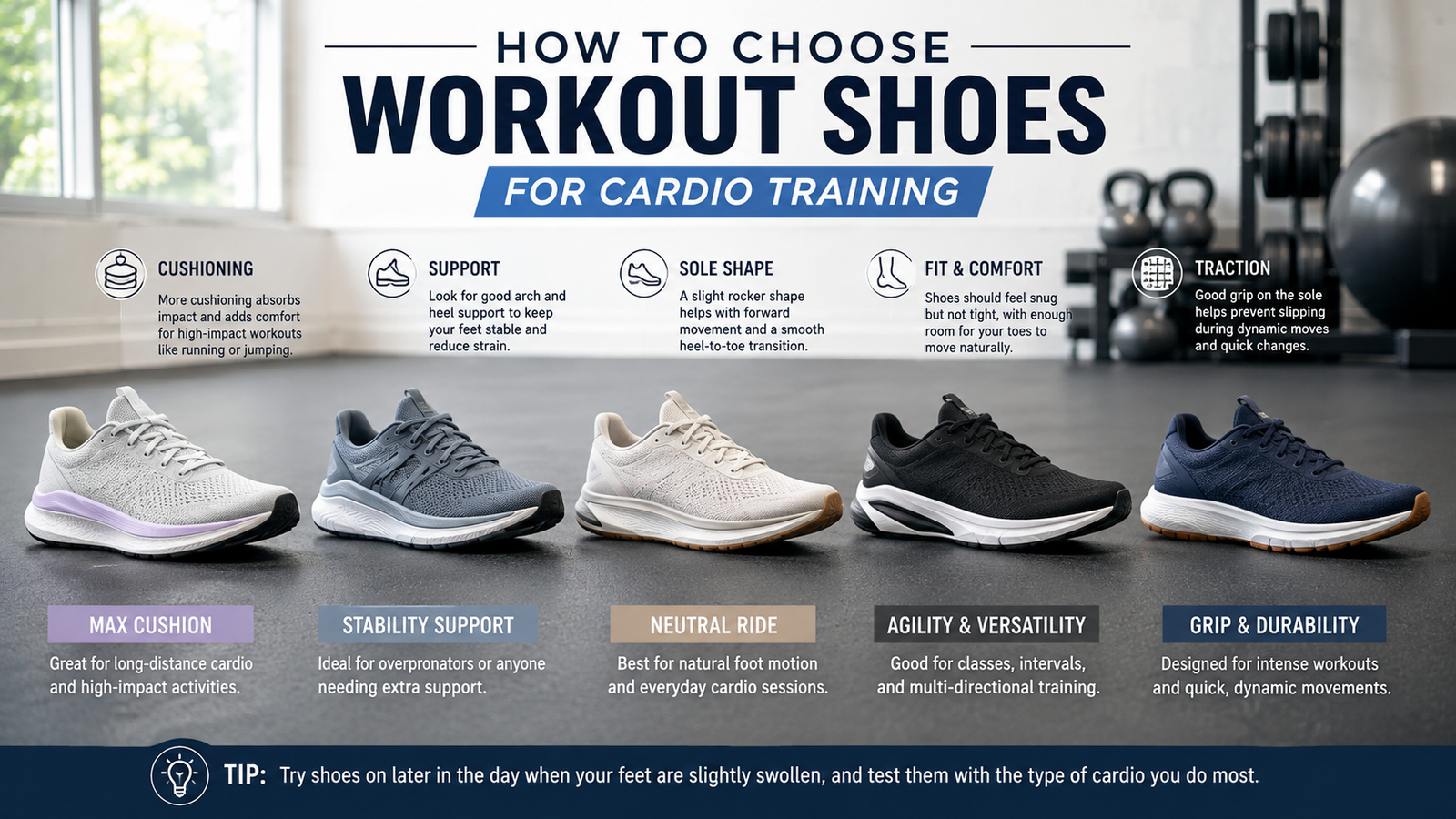
Workout shoes can influence:
- comfort;
- stability;
- traction;
- impact management;
- movement confidence;
- fatigue during training.
But choosing shoes for cardio is more complicated than simply buying something labelled:
training shoes
because different forms of cardio place very different demands on footwear.
A shoe that works well for:
- treadmill running;
may feel unstable during:
- lateral drills;
- stepper workouts;
- gym circuits.
A firm cross-training shoe that feels excellent for:
- strength training;
- short conditioning sessions;
may feel harsh during:
- long treadmill runs.
The most practical way to choose cardio footwear is:
identify your main activity → choose the correct shoe category → prioritize fit and comfort → match cushioning and stability to the movement → check traction and durability → replace the shoes when their performance meaningfully deteriorates
The right shoe is not automatically:
- the most cushioned;
- the lightest;
- the most expensive;
- the one with the thickest sole.
It is the shoe that allows you to perform your primary workout comfortably and confidently without forcing your foot into a shape or movement pattern that does not suit you.
Start With the Type of Cardio You Actually Do
Before comparing shoe technology, answer one question:
What type of exercise will I perform most often?
Treadmill Walking
You may prefer:
- walking shoes;
- comfortable running shoes.
Treadmill Running
Choose:
- running shoes.
Elliptical Training
A comfortable running or cross-training shoe can work.
Exercise Bike
Foot stability and pedal comfort matter more than running cushioning.
Rowing
A relatively stable, lower-profile shoe often works well.
Stepper or Stair Climber
Look for:
- stable platform;
- secure heel;
- good traction.
Jump Rope
Prioritize:
- stable landing;
- secure fit;
- responsive forefoot;
- controlled cushioning.
HIIT and Gym Circuits
Choose:
- cross-training shoes;
- hybrid training shoes.
Mixed Cardio and Strength Training
A cross-trainer is often the most versatile choice.
The activity should determine the shoe—not the marketing category you happen to like.
Do You Need Special Shoes for Cardio?
Not always.
If your workout consists mainly of:
- easy stationary cycling;
- gentle elliptical training;
a comfortable pair of athletic shoes may be sufficient.
Specialized footwear becomes more important when you regularly perform:
- running;
- jumping;
- fast direction changes;
- high-intensity circuits;
- long-duration cardio.
The more repetitive or demanding the movement becomes, the more shoe characteristics such as:
- cushioning;
- fit;
- stability;
start to matter.
Running Shoes vs Training Shoes
This is one of the most important distinctions.
Running Shoes
Running shoes are generally designed for repeated:
forward movement
They often prioritize:
- cushioning;
- heel-to-toe transition;
- shock management;
- running efficiency.
Cross-Training Shoes
Cross-training shoes are generally designed for more varied movement, including:
- lateral movement;
- jumping;
- strength exercises;
- short running intervals;
- circuits.
They often provide:
- wider platform;
- more lateral stability;
- firmer cushioning.
Which Should You Choose?
Mostly Running
Choose running shoes.
Mostly Gym Circuits
Choose training shoes.
Running + Strength
A hybrid training shoe may work if the running is relatively short.
Long Runs + Strength
Using separate:
- running shoes;
- training shoes;
is often more practical.
One shoe does not need to do everything.
Why Running Shoes Are Different
During running, the body repeatedly moves:
- forward;
through thousands of steps.
Running shoes are designed around this repetitive motion.
They may include:
- rocker geometry;
- thick midsoles;
- lightweight foam;
- heel cushioning.
These features can be excellent for running but may be less stable during:
- lateral exercises;
- heavy lifting.
Why Training Shoes Are Different
Training shoes often use:
- flatter soles;
- wider bases;
- firmer foam;
- stronger sidewalls.
This helps with exercises involving:
- side-to-side movement;
- jumping;
- squats;
- lunges.
But that firmness may feel less comfortable during a long treadmill run.
Shoes for Treadmill Walking
For walking workouts, prioritize:
- comfortable fit;
- flexible forefoot;
- adequate cushioning;
- secure heel.
You do not necessarily need an expensive performance running shoe.
A comfortable daily trainer can work very well.
Running Shoes for Walking
Running shoes can be excellent walking shoes.
They often provide:
- cushioning;
- lightweight construction.
If the shoe feels:
- stable;
- comfortable;
there is no requirement to buy a separate walking-specific shoe.
Walking Shoes
Dedicated walking shoes may use:
- slightly firmer soles;
- flexible forefoot;
- stable heel.
They can be useful if walking is your primary activity.
But the distinction between modern walking and running footwear is not always dramatic.
Comfort should guide the decision.
Shoes for Treadmill Running
Running shoes are the most appropriate choice.
Prioritize:
- correct fit;
- suitable cushioning;
- comfortable width;
- secure heel;
- adequate outsole grip.
The shoe does not need to be specifically labelled:
treadmill shoe
A normal running shoe works indoors.
Do You Need Less Cushioning on a Treadmill?
Not necessarily.
Treadmill decks often provide some cushioning themselves, but your shoe still affects:
- comfort;
- running mechanics.
Use whatever cushioning level feels comfortable.
You do not need to deliberately choose a minimal shoe just because the treadmill surface is softer than concrete.
Shoes for Elliptical Training
Elliptical exercise creates less impact than running.
Footwear priorities include:
- stable platform;
- secure heel;
- comfortable forefoot.
Running shoes can work.
Cross-training shoes may also work well.
Because the foot remains in contact with the pedal, excessive cushioning is usually unnecessary.
Foot Numbness on Ellipticals
Some users experience:
- forefoot pressure;
- numbness.
Shoes that are too:
- narrow;
- tight;
can worsen this.
Make sure the toe box provides adequate space.
Loosen laces slightly if necessary.
Persistent numbness deserves further assessment.
Shoes for Exercise Bikes
Stationary cycling places different demands on shoes.
For basic exercise bikes, use shoes with:
- stable sole;
- secure fit.
Very soft running shoes may compress on small pedals.
But for casual cycling, normal athletic shoes are usually adequate.
Shoes for Indoor Cycling
More performance-oriented cycling may benefit from:
- firmer soles;
- cycling-specific shoes.
Some bikes support:
- clip-in pedals.
Do You Need Cycling Shoes?
No, not for basic home cycling.
They become useful if you:
- cycle frequently;
- want a firmer connection to the pedal;
- use compatible clip-in pedals.
For beginners, standard athletic shoes are fine.
Clip-In Cycling Shoes
These attach to compatible pedals using:
- cleats.
They can improve:
- foot security;
- pedalling consistency.
But they require:
- compatible pedal system;
- some practice.
They are not necessary for general fitness.
Shoes for Rowing Machines
Rowing generally works well with:
- stable;
- relatively low-profile shoes.
Because the feet are secured into footplates, thick running cushioning is not particularly necessary.
A firm training shoe can provide:
- stable force transfer.
Can You Row in Running Shoes?
Yes.
For general home rowing, running shoes are usually fine.
However, extremely thick or soft shoes may alter:
- footplate feel.
This matters more to experienced rowers than beginners.
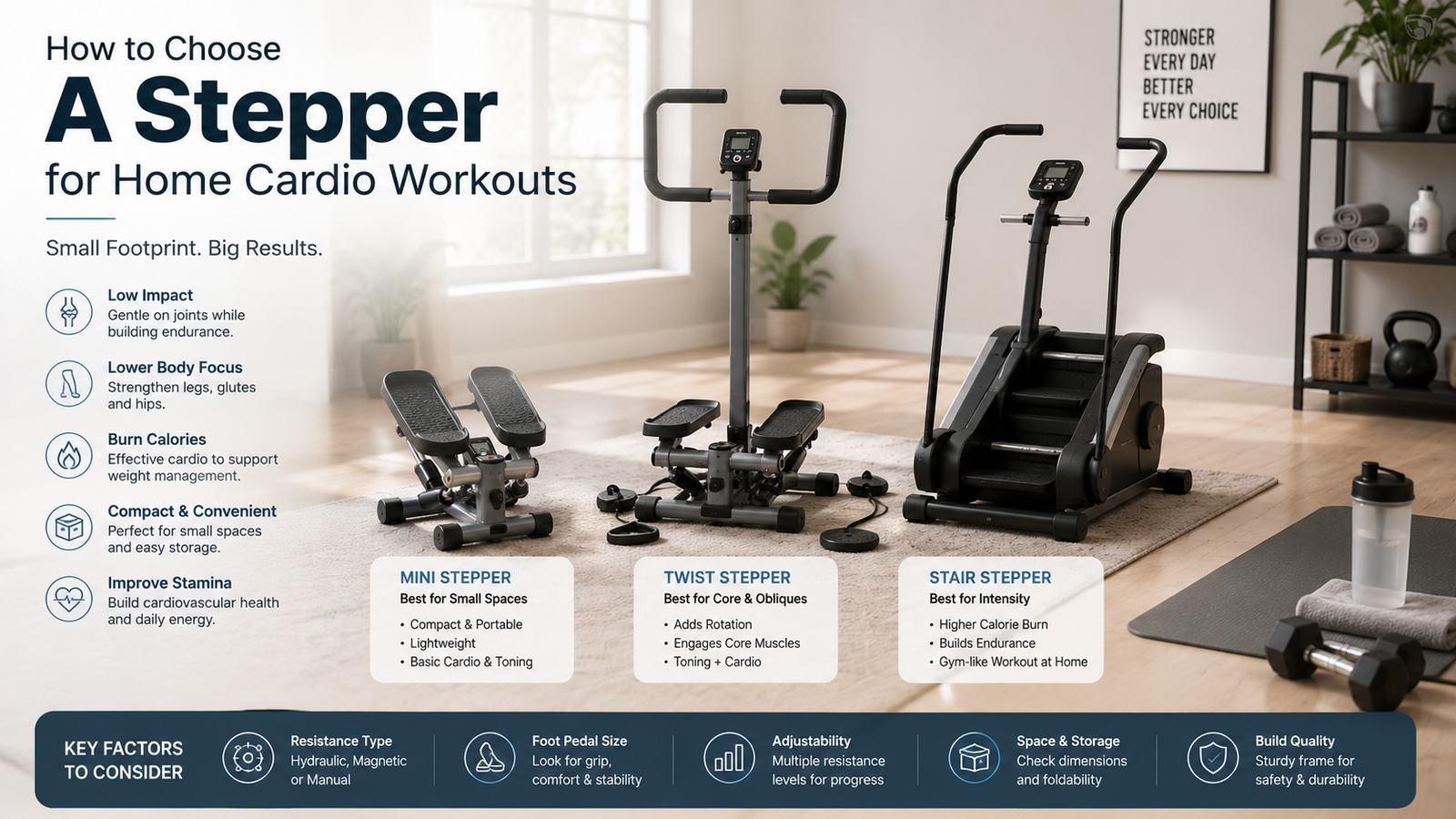
Shoes for Steppers and Stair Climbers
Prioritize:
- secure fit;
- stable heel;
- traction;
- moderate cushioning.
You want the foot to remain stable during repeated stepping.
Avoid shoes that feel:
- excessively soft;
- unstable.
Heel Security on a Stepper
A loose heel can create:
- rubbing;
- instability.
The shoe should hold your heel without excessive pressure.
Use proper lacing.
Shoes for Jump Rope
Jump-rope footwear should provide a good balance of:
- stability;
- cushioning;
- responsiveness.
Because jumping involves repeated forefoot contact, extremely soft shoes may feel unstable.
A good training shoe often works well.
Cross-Trainers for Jump Rope
Cross-training shoes can be excellent because they often provide:
- stable base;
- moderate cushioning;
- lateral support.
They work particularly well if your rope workout is combined with:
- bodyweight exercises;
- strength training.
Running Shoes for Jump Rope
They can work, especially for beginners.
But very tall, highly cushioned running shoes may feel:
- less stable;
- less responsive.
If you jump frequently, a lower-profile trainer may feel better.
Shoes for HIIT
High-intensity interval training may involve:
- jumping;
- short sprints;
- lateral movement;
- burpees;
- squats;
- lunges.
This makes cross-training shoes particularly useful.
Look for:
- stable platform;
- lateral support;
- secure upper;
- moderate cushioning.
Why Running Shoes May Be Less Ideal for HIIT
Many running shoes are designed for:
- forward motion.
A very soft or tall running shoe may feel unstable when moving:
- sideways;
- rapidly changing direction.
For running-only intervals, running shoes are fine.
For mixed HIIT, training shoes often work better.
Shoes for Cardio Classes
Classes may include:
- dance;
- aerobics;
- jumping;
- lateral movement.
Choose footwear with:
- lateral stability;
- flexible forefoot;
- controlled cushioning.
A cross-trainer is generally safer than a highly cushioned distance-running shoe for multidirectional classes.
Shoes for Dance Cardio
Dance-style workouts need enough traction to prevent slipping, but excessive grip can also make twisting feel difficult.
Look for:
- moderate outsole grip;
- flexibility;
- lateral support.
If a shoe sticks aggressively to the floor, rotational movements may feel awkward.
Shoes for Mixed Gym Training
If you perform:
- treadmill warm-up;
- strength training;
- short cardio intervals;
one cross-training shoe can be practical.
But if you run for:
- 30–60 minutes;
regularly, separate running shoes are often more comfortable.
The Most Important Feature: Fit
No cushioning technology can compensate for a shoe that does not fit.
A good shoe should feel:
- secure;
- comfortable;
- free of pressure points.
Your toes should not feel:
- crushed;
- compressed.
Your heel should not slide excessively.
Shoe Length
You need some space in front of the longest toe.
Feet can expand slightly during exercise.
A shoe that fits perfectly when sitting may feel too small during:
- running;
- long cardio sessions.
How Much Toe Space Do You Need?
A common practical guideline is roughly:
- a thumb’s width;
between your longest toe and the front of the shoe.
But this is not a strict measurement.
Foot shape and shoe design matter.
The toes should have room without the foot sliding.
Your Longest Toe May Not Be the Big Toe
Some people have a second toe that is longer than:
- big toe.
Size the shoe based on the longest toe.
Shoe Width
Width is just as important as length.
A narrow shoe may cause:
- pressure;
- numbness;
- rubbing.
If your foot spills over the side of the midsole, the shoe may be too narrow.
Wide Feet
Some brands offer:
- wide;
- extra-wide sizes.
Do not automatically size up in length to compensate for insufficient width.
A longer shoe may create:
- heel movement;
without actually fitting the forefoot correctly.
Narrow Feet
People with narrow feet may need:
- secure lacing;
- narrower lasts.
A shoe that feels loose laterally can reduce:
- stability.
Toe-Box Shape
Toe boxes can be:
- tapered;
- rounded;
- wide;
- foot-shaped.
Choose according to your natural toe shape.
Your toes should not be forced together excessively.
Heel Fit
The heel should feel:
- secure;
- comfortably held.
Some small movement may occur.
But excessive heel slipping can cause:
- blisters;
- instability.
Heel Counter
The heel counter is the structural area around the rear of the shoe.
A firmer heel counter can provide:
- rear-foot stability.
But it should not create uncomfortable:
- pressure;
- rubbing.
Heel Lock Lacing
If the shoe fits overall but the heel slips slightly, a:
- runner’s knot;
- heel-lock lacing technique;
may help.
This uses the extra top eyelets to secure the heel.
Instep Fit
People with high-volume feet may feel pressure across the top of the foot.
People with low-volume feet may struggle to tighten the shoe enough.
Lacing technique can sometimes help.
But if the upper shape fundamentally does not match your foot, choose another model.
Try Shoes Later in the Day
Feet can become slightly larger after:
- standing;
- walking;
- exercise.
Trying shoes later in the day may provide a more realistic fit for some people.
Wear Your Normal Workout Socks
Try shoes with the socks you actually plan to wear.
Sock thickness affects fit.
Do not test with:
- very thin dress socks;
if you train in thicker athletic socks.
Left and Right Feet May Differ
Many people have one foot slightly:
- longer;
- wider.
Fit the shoe to the larger foot.
Do not force the larger foot into a smaller size just because the other shoe feels perfect.
Comfort at First Wear Matters
Modern athletic shoes generally should not require a painful break-in period.
Minor adaptation can occur.
But if the shoe causes obvious:
- pressure;
- pinching;
- pain;
in the shop, do not assume it will magically become perfect later.
Cushioning
Cushioning influences:
- impact feel;
- comfort;
- stability;
- responsiveness.
Shoes can range from:
- minimal;
- moderate;
- maximum cushioning.
Is More Cushioning Better?
No.
More cushioning may feel comfortable for:
- running;
- walking.
But very soft, tall cushioning can reduce stability during:
- lateral training;
- jumping;
- strength exercises.
Choose according to activity.
Soft vs Firm Cushioning
Soft Cushioning
May feel:
- plush;
- comfortable.
Useful for:
- long walks;
- running.
Firmer Cushioning
May provide:
- greater stability;
- more direct ground feel.
Useful for:
- cross-training;
- gym circuits.
Neither is universally superior.
Responsive Cushioning
Responsiveness generally describes how much the foam appears to:
- rebound;
- return energy.
This can make running feel:
- lively.
But response is subjective.
A shoe does not need the most advanced foam to be effective.
Midsole Foam
Different brands use different:
- EVA;
- TPU;
- PEBA;
- proprietary foams.
The chemical name matters less for most users than:
- comfort;
- stability;
- durability.
Do not choose solely by foam marketing.
Stack Height
Stack height describes how much material sits between:
- foot;
- ground.
A higher stack often creates:
- more cushioning.
But it may reduce:
- ground feel;
- lateral stability.
High-Stack Shoes
Useful for:
- long-distance running;
- impact comfort.
Less ideal for some:
- gym circuits;
- rapid direction changes.
Low-Stack Shoes
Provide:
- more ground feel;
- greater stability.
They may work well for:
- training;
- jump rope;
- strength.
But they can feel harsher during:
- long runs.
Heel-to-Toe Drop
Drop describes the difference in height between:
- heel;
- forefoot.
For example:
- 10 mm heel;
- relative to forefoot difference.
It changes how the shoe feels during movement.
High-Drop Shoes
These place the heel relatively higher.
Some runners find them comfortable, particularly if they have limited:
- ankle dorsiflexion.
They may shift some loading patterns away from the calf/Achilles region.
Low-Drop Shoes
These create a flatter platform.
They may increase demand on:
- calves;
- Achilles;
- feet;
particularly during running.
Transition gradually if changing substantially.
Zero-Drop Shoes
Heel and forefoot sit at approximately the same height.
These are not automatically:
- more natural;
- healthier.
They simply change the loading pattern.
If you are accustomed to high-drop shoes, switching suddenly to zero drop can significantly increase:
- calf;
- Achilles demand.
Does Drop Matter for Cardio?
It matters most for:
- running.
For elliptical, bike or rower training, it is generally less important.
For cross-training, a moderate-to-low drop can provide a stable feel.
Stability
Stability refers to how secure the shoe feels during movement.
Important factors include:
- platform width;
- foam firmness;
- upper security;
- sole geometry.
Stability for Running
Running stability does not necessarily mean:
- stiff shoe.
Modern stable running shoes may use:
- wider platforms;
- sidewalls;
- geometry.
Stability for Training
For gym circuits, you generally want:
- wide base;
- firmer foam;
- good lateral containment.
This helps when moving:
- side to side.
Stability Shoes vs Neutral Shoes
Running shoes are sometimes classified as:
- neutral;
- stability.
Stability shoes are intended to provide additional guidance or support for some runners.
But the old idea that every person with a certain:
- arch shape;
- pronation pattern;
must use a specific stability shoe is oversimplified.
Comfort and injury history matter.
What Is Pronation?
Pronation is a normal inward rolling movement of the foot during walking and running.
Everyone pronates to some degree.
It is not automatically a problem.
Is Overpronation Always Bad?
No.
Foot motion varies naturally.
Pronation alone does not reliably predict injury.
A shoe should not be selected solely because someone tells you that your feet:
- pronate.
Do Flat Feet Need Stability Shoes?
Not automatically.
Some people with flat feet are perfectly comfortable in neutral shoes.
Others prefer more structured footwear.
Choose based on:
- comfort;
- symptoms;
- professional advice if necessary.
Do High Arches Need Cushioned Shoes?
Not automatically.
High arches do not guarantee a particular shoe requirement.
Again, comfort and activity matter more than simplistic arch rules.
Wet-Foot Tests
You may see tests where you:
- Wet your foot.
- Stand on paper.
- Infer arch type.
These can show footprint shape.
But they cannot reliably determine which shoe will:
- prevent injury;
- suit your running biomechanics.
Use them only as rough observations.
Gait Analysis
Some specialty stores offer:
- treadmill gait analysis.
This can be useful for observing:
- movement;
- shoe comfort.
But a brief pronation video should not be treated as a medical diagnosis.
The most important question remains:
Does the shoe feel comfortable during the activity you perform?
Outsole Traction
The outsole contacts:
- treadmill belt;
- gym floor;
- studio surface.
Good traction helps reduce:
- slipping.
Running-Shoe Traction
For treadmill use, extreme outdoor grip is usually unnecessary.
A normal road-running outsole is enough.
Training-Shoe Traction
For HIIT and circuits, good multidirectional grip is useful.
But extremely sticky rubber can make:
- dance;
- pivoting;
less smooth.
Match grip to activity.
Outdoor Cardio
If you train outside, outsole design matters more.
Consider:
- wet surfaces;
- pavement;
- track;
- trails.
A road running shoe is not automatically appropriate for:
- technical trails.
Trail Running Shoes
Trail shoes generally offer:
- deeper lugs;
- stronger upper protection.
They are useful for uneven outdoor surfaces.
They are usually unnecessary for:
- treadmill running;
- indoor cardio.
Outsole Rubber Coverage
Some lightweight shoes expose more midsole foam to reduce weight.
This may increase:
- outsole wear.
For regular gym use, more rubber coverage can improve durability.
Flexibility
Different activities require different flexibility.
Running Shoes
Need enough forefoot flexibility or appropriate rocker geometry for:
- forward transition.
Training Shoes
Often need flexibility for:
- lunges;
- jumping;
- dynamic movements;
while maintaining lateral stability.
Excessively Flexible Shoes
A shoe that twists easily in every direction may feel unstable during:
- strength;
- lateral movement.
Extremely Stiff Shoes
Very stiff footwear may feel uncomfortable during:
- walking;
- dynamic cardio.
Performance running shoes with plates can also feel unusual at slower speeds.
Carbon-Plated Running Shoes
Some performance running shoes use:
- carbon-fibre;
- composite plates.
They can improve running economy for certain athletes.
But they are designed primarily for:
- running performance.
They are not ideal general gym shoes.
Do You Need Carbon-Plated Shoes for the Treadmill?
No.
They may be useful for:
- racing;
- specific performance workouts.
But they are unnecessary for ordinary:
- treadmill cardio;
- walking.
They can also be expensive and less stable for multidirectional exercise.
Rocker Geometry
Some running shoes have curved soles that help promote:
- forward rolling.
This can feel smooth for running.
But aggressive rocker shapes may feel awkward during:
- squats;
- lateral drills.
Again, activity determines suitability.
Shoe Upper
The upper holds the foot onto the sole.
It may use:
- mesh;
- knit;
- synthetic overlays.
Good uppers should balance:
- breathability;
- security;
- comfort.
Breathability
Indoor cardio can generate substantial heat.
Breathable mesh can improve:
- comfort.
But extremely thin mesh may reduce:
- lateral support;
- durability.
Knit Uppers
Knit can feel:
- soft;
- sock-like.
But some knit shoes stretch more during:
- lateral movement.
For HIIT, look for enough structure.
Structured Mesh
Often provides a good balance of:
- ventilation;
- support.
This is common in running and training shoes.
Toe Protection
Not particularly important for standard indoor cardio.
Outdoor trail shoes may include stronger:
- toe bumpers.
For gym use, excessive protection adds unnecessary weight.
Lateral Sidewalls
Training shoes may include raised:
- midsole sidewalls;
- reinforcement.
These help keep the foot centred during:
- side-to-side movement.
Useful for:
- HIIT;
- agility exercises.
Heel Clip
Some training shoes use external heel structures to improve:
- rear-foot containment;
- stability.
This can be useful.
But it should not cause:
- rubbing;
- pressure.
Shoe Weight
Lighter shoes may feel faster.
But very low weight can come with trade-offs in:
- durability;
- cushioning;
- stability.
Do Lightweight Shoes Improve Cardio?
A lighter running shoe may reduce the amount of mass moved with every step.
This can matter for performance.
But for general fitness, the difference between two reasonable shoe weights is rarely the most important factor.
Fit and comfort matter more.
Heavy Training Shoes
Training shoes may weigh more because of:
- stable sole;
- durable upper;
- lateral reinforcement.
This can be worthwhile for mixed gym use.
How Important Is Shoe Weight for Jump Rope?
Moderately light shoes can feel:
- responsive.
But excessive focus on minimal weight is unnecessary.
A stable landing platform is more important.
Arch Support
The phrase arch support is often used loosely.
Shoes may provide different levels of:
- midfoot structure;
- contour.
More arch pressure is not automatically better.
The shoe should feel supportive without creating:
- painful pressure.
Insoles
Most athletic shoes include removable insoles or sockliners.
These mainly provide:
- comfort;
- minor cushioning.
They are not necessarily medical orthotics.
Do You Need Custom Orthotics?
Most people do not.
Custom orthotics may be appropriate for certain individuals with:
- specific foot problems;
- clinician recommendations.
Do not assume everyone with:
- flat feet;
- arch pain;
needs custom inserts.
Aftermarket Insoles
These can change:
- arch feel;
- cushioning;
- shoe volume.
They may help some users.
But adding a thick insole can make the shoe:
- too tight.
Fit should be reassessed.
Socks Matter Too
Athletic socks can affect:
- friction;
- moisture;
- fit.
Look for:
- comfortable fit;
- moisture management.
Cotton-heavy socks may remain wet during sweaty workouts.
Synthetic or wool-blend athletic socks may manage moisture better.
Thick vs Thin Socks
Thicker socks can:
- reduce shoe volume;
- add cushioning.
Thin socks provide:
- more room;
- direct fit.
Choose the sock and shoe together.
Blisters
Blisters usually result from:
- friction;
- moisture;
- pressure.
Potential solutions include:
- correct sizing;
- better socks;
- heel-lock lacing;
- reducing hotspots.
Do not continue training through developing skin damage.
Black Toenails
Common in running when toes repeatedly strike the front of the shoe.
Possible causes:
- shoe too short;
- foot sliding forward;
- downhill running;
- improper lacing.
Make sure there is adequate toe space.
Toenail Pressure on Treadmills
Even without downhill terrain, a short shoe can create repeated impact.
If your toes constantly contact the front:
- size;
- fit;
needs reassessment.
Numb Toes
Potential causes include:
- narrow toe box;
- tight laces;
- swelling during exercise.
Loosen the fit or try a wider shoe.
Persistent numbness deserves evaluation.
Top-of-Foot Pain
Laces may be too tight across:
- instep.
Alternative lacing patterns can reduce pressure.
But persistent pain should not be dismissed as a shoe issue without assessment.
Heel Blisters
Possible causes:
- excessive heel slip;
- poorly shaped collar;
- rough socks.
Try:
- heel-lock lacing;
- different socks;
- different shoe model.
Shoe Collar
The collar surrounds the ankle opening.
It should hold the heel without:
- digging into the Achilles;
- rubbing the ankle.
Achilles Irritation From Shoes
A high or rigid heel collar may irritate:
- Achilles region.
If this occurs repeatedly, choose a shoe with a different heel shape.
Do not assume your tendon must simply adapt to rubbing.
Heel Tabs
Some shoes have extended heel tabs.
These may reduce pressure for some users.
Others may find them annoying.
This is mainly a fit preference.
Shoe Tongue
A padded tongue may distribute lace pressure.
Thin tongues reduce:
- weight.
If you have sensitive insteps, more padding may feel better.
Gusseted Tongues
A gusset connects the tongue to the upper.
This can help:
- keep tongue centred;
- improve foot lockdown.
Useful but not essential.
Lacing Systems
Traditional laces are still highly effective.
Some shoes use:
- elastic;
- dial-based;
- quick-lace systems.
Convenience does not automatically improve performance.
The lacing system should allow even pressure without:
- hotspots.
Runner’s Knot
A runner’s knot can improve heel hold.
It is especially useful when:
- heel slips;
- forefoot fit is otherwise correct.
Do not overtighten.
Locking the Midfoot
For lateral training, the shoe should hold the midfoot securely.
If your foot slides within the shoe during:
- side lunges;
- lateral hops;
the fit may be too loose.
Shoe Size Across Brands
Do not assume the same labelled size fits identically across brands.
Sizing varies.
Even two models from the same brand may fit differently.
Try the actual shoe.
Men’s vs Women’s Shoe Sizing
Sizing systems differ.
Some shoe models also use different:
- widths;
- lasts.
Choose the model and size that fits your foot rather than assuming gender-specific marketing determines suitability.
Unisex Shoes
Unisex shoes may use sizing based on:
- men’s scale;
- universal conversions.
Check the manufacturer’s chart carefully.
Foot Shape Is More Important Than Brand Loyalty
One brand may suit:
- narrow heels;
- wide forefeet.
Another may suit a different shape.
Do not stay loyal to a brand if its current model no longer fits.
Shoe Models Change
A new version may change:
- foam;
- upper;
- width;
- heel shape.
If you liked version 8, version 9 is not guaranteed to fit identically.
Try it again.
Do Expensive Shoes Prevent Injury?
Not necessarily.
Price can reflect:
- premium foam;
- lightweight materials;
- carbon plates;
- branding.
An expensive shoe does not guarantee fewer injuries.
Comfort, appropriate training progression and suitable footwear matter more.
Is There One “Best” Shoe for Everyone?
No.
Feet differ in:
- width;
- arch shape;
- volume;
- toe shape.
Training also differs.
A shoe highly rated by another person may feel terrible on you.
Comfort Is a Strong Decision Factor
One of the most practical principles in athletic footwear is:
choose a shoe that feels comfortable during the movement you actually perform
Do not force yourself into a theoretically perfect biomechanical category if the shoe:
- hurts;
- rubs;
- feels unstable.
Minimalist Shoes
Minimalist footwear reduces:
- cushioning;
- structure;
- heel-to-toe drop.
It may strengthen certain foot muscles over time.
But it also changes loading substantially.
Transitioning to Minimalist Shoes
Do not switch from thick cushioned shoes to minimal shoes and immediately continue your normal:
- running distance;
- jump-rope volume.
The feet, calves and Achilles may need time to adapt.
Transition gradually.
Barefoot Training
Some gym users train barefoot for:
- strength;
- mobility.
But barefoot cardio has different considerations.
Running and jumping barefoot increase demands on:
- skin;
- feet;
- calves.
Gym policies may also require footwear.
For most cardio, appropriate shoes are more practical.
Barefoot Treadmill Running
This should not be treated as automatically healthier or more natural.
It can increase:
- friction;
- foot loading.
The moving belt also creates additional skin-injury concerns.
Use appropriate footwear unless you have a specific reason and experience.
Stability for Strength + Cardio Workouts
If you combine cardio with:
- squats;
- deadlifts;
- lunges;
a very soft running shoe may feel unstable.
A firmer cross-trainer often works better.
Why Soft Running Shoes Are Poor for Heavy Lifting
Soft foam compresses under load.
This can create:
- instability;
- energy loss.
For heavy strength work, you generally want:
- firm;
- stable base.
If your workout includes both long running and heavy lifting, use separate shoes.
Shoes for Circuit Training
Circuit workouts may combine:
- rowing;
- jump rope;
- burpees;
- lunges;
- weights.
A cross-training shoe is usually the best compromise.
It provides:
- enough cushioning for short cardio;
- enough stability for resistance work.
Rope Climbing and Training Shoes
Some cross-training shoes include reinforced midfoot material for:
- rope climbing.
This is useful in functional fitness.
It is irrelevant for ordinary cardio.
Do not pay for specialized durability you will never use.
Shoes for Outdoor Bootcamp Workouts
Outdoor circuits may involve:
- running;
- lateral movement;
- grass;
- pavement.
Choose a hybrid trainer with:
- durable outsole;
- good grip.
A purely indoor shoe may wear quickly outdoors.
Shoes for Gym Flooring
Indoor gym floors generally provide reliable traction.
You do not need aggressive lugs.
A flat rubber outsole is usually enough.
Shoes for Outdoor Running
Road-running shoes are designed for:
- pavement;
- smooth surfaces.
For trails, use:
- trail running shoes;
if the terrain requires additional grip and protection.
Water Resistance
For indoor cardio, waterproofing is usually unnecessary.
Waterproof membranes may reduce:
- breathability.
For outdoor wet-weather training, water resistance may be useful.
But fully waterproof shoes can feel hot.
Breathability in Hot Weather
In hot climates, prioritize:
- breathable mesh;
- moisture-wicking socks.
Indoor gyms can become hot even with air conditioning.
A heavily padded upper may feel uncomfortable during longer cardio sessions.
Workout Shoes in Indian Conditions
For hot and humid environments, practical features include:
- breathable upper;
- quick-drying materials;
- good outsole grip;
- removable sockliner.
If training outdoors during monsoon conditions, wet-surface traction becomes more important.
Do not use indoor gym shoes on slippery outdoor surfaces simply because they feel comfortable.
Shoe Odour
Sweaty shoes can develop odour.
After workouts:
- loosen laces;
- remove insoles if appropriate;
- allow shoes to dry.
Do not immediately seal wet shoes inside a gym bag.
Can You Wash Workout Shoes?
It depends on the shoe.
Many athletic shoes should not be:
- machine washed;
- tumble dried;
because heat and agitation can damage:
- adhesives;
- foams.
Follow manufacturer cleaning instructions.
Basic Shoe Cleaning
A practical method:
- Remove loose dirt.
- Use mild soap and water.
- Clean gently with a soft brush or cloth.
- Air dry.
Avoid extreme heat.
Drying Shoes
Do not place most athletic shoes directly on:
- heater;
- strong radiator;
- high-temperature dryer.
Heat can damage:
- foam;
- adhesives;
- upper materials.
Allow them to dry naturally.
Rotating Two Pairs
People who train frequently may benefit from rotating shoes.
Potential advantages:
- each pair dries fully;
- wear is distributed;
- different footwear can suit different workouts.
For example:
Pair 1
Running shoe.
Pair 2
Cross-training shoe.
This can be more useful than buying one expensive shoe for every activity.
How Long Do Workout Shoes Last?
There is no exact universal lifespan.
Wear depends on:
- body weight;
- gait;
- surface;
- shoe construction;
- workout frequency.
Running shoes are often discussed in terms of mileage.
Training shoes may be replaced according to:
- outsole wear;
- foam compression;
- upper breakdown.
Running-Shoe Mileage
A commonly discussed range is roughly:
- several hundred kilometres;
but it varies considerably.
Some shoes remain comfortable longer.
Others lose performance earlier.
Do not replace only because an arbitrary number has been reached.
Signs Running Shoes May Need Replacement
Look for:
- noticeably flattened cushioning;
- uneven outsole wear;
- recurring discomfort;
- midsole feeling dead;
- damaged upper;
- reduced traction.
Compare with how the shoe felt when newer.
Signs Training Shoes Need Replacement
Possible signs:
- outsole worn smooth;
- sidewalls breaking down;
- upper no longer holding foot securely;
- sole separating;
- cushioning permanently compressed.
Does Shoe Appearance Tell You Everything?
No.
A shoe may look fine externally but have degraded:
- midsole foam.
Conversely, superficial scuffs do not necessarily mean the shoe is finished.
Judge function.
Uneven Outsole Wear
Some asymmetrical wear is normal.
Severe unusual wear may reflect:
- movement pattern;
- training surface;
- shoe fit.
Do not attempt to diagnose gait problems from outsole wear alone.
Worn Grip
For HIIT, worn outsole rubber can reduce:
- traction.
Replace the shoe if the outsole becomes unsafe on:
- gym floors.
Midsole Compression
Foam gradually loses some ability to:
- rebound;
- cushion.
You may notice the shoe feels:
- flatter;
- harsher.
This can be a useful replacement signal.
Upper Damage
Tears near:
- toes;
- sidewalls;
can reduce foot containment.
For lateral training, this matters because the upper helps hold the foot over the sole.
Sole Separation
If the outsole or midsole begins separating:
- stop using the shoe.
Do not rely on a temporary repair for high-impact workouts if structural integrity is compromised.
Shoe Storage
Store shoes in a:
- dry;
- ventilated area.
Avoid leaving them for long periods in:
- extreme heat;
- direct sunlight.
High temperatures can accelerate material degradation.
Old Unused Shoes
Shoes can deteriorate even when not used.
Foam and adhesives age over time.
A 10-year-old unworn running shoe may not perform like a new one.
Do You Need Different Shoes for Every Workout?
No.
Most people need:
- one;
- perhaps two pairs.
A practical setup:
Mostly Running
One running shoe.
Mostly Mixed Gym
One cross-trainer.
Run + Lift Regularly
One running shoe + one training shoe.
Avoid collecting footwear without a clear use case.
Shoe Rotation for Different Cardio Modes
You might use:
Running Shoe
For:
- treadmill;
- long walks.
Cross-Trainer
For:
- jump rope;
- stepper;
- HIIT;
- gym circuits.
This covers most home-gym needs.
Shoes and Exercise Technique
Good shoes cannot compensate for:
- poor progression;
- inappropriate technique;
- excessive workout volume.
For example, Achilles pain from rapidly increasing jump-rope volume cannot necessarily be solved by buying more cushioned shoes.
Training load matters.
Shoes Do Not Prevent All Injuries
No shoe can guarantee prevention of:
- knee pain;
- shin splints;
- plantar fasciitis;
- ankle injuries.
Injury risk is influenced by:
- training volume;
- recovery;
- previous injury;
- strength;
- sleep;
- movement;
- individual physiology.
Choose appropriate footwear but keep expectations realistic.
Shoes for Knee Pain
There is no universal shoe that fixes knee pain.
Some people prefer:
- more cushioning;
- more stability.
Others do not.
Persistent knee pain should be assessed rather than repeatedly changing shoes.
Shoes for Plantar Fasciitis
Some people with plantar heel pain prefer shoes with:
- cushioning;
- stable heel;
- comfortable arch contour.
But plantar fasciitis has several contributing factors.
Footwear may help with comfort but is not always the complete solution.
Shoes for Achilles Problems
A higher heel-to-toe drop may reduce Achilles demand during some activities.
But treatment should not rely solely on shoe choice.
Persistent Achilles pain deserves proper assessment.
Shoes for Shin Splints
Changing footwear may help if current shoes are unsuitable.
But shin pain can also be driven by:
- rapid increase in training;
- hard surfaces;
- running volume.
Do not assume shoes are always the cause.
Shoes for Flat Feet
Choose what feels comfortable.
Some people prefer:
- stability shoes.
Others prefer:
- neutral shoes.
Flat feet alone do not automatically require corrective footwear.
Shoes for High Arches
Again, comfort matters more than arch categorization.
You may prefer:
- cushioning.
But do not assume a high arch automatically means one specific shoe type.
Shoes for Bunions
Look for:
- wider toe box;
- flexible upper;
- minimal pressure over the bunion.
Do not squeeze the forefoot into a narrow shape.
Shoes for Wide Forefeet
Choose models available in:
- wide sizes;
- naturally broad toe boxes.
Sizing up only in length often does not solve the problem.
Shoes for Sensitive Toes
Avoid:
- rigid toe caps;
- narrow taper.
Look for:
- softer upper;
- adequate space.
Shoe Fit During Running vs Standing
A shoe may feel fine while standing but uncomfortable during:
- running;
- jumping.
Always test the movement if possible.
How to Test Shoes in Store
If permitted:
- Walk.
- Jog.
- Perform a few small hops.
- Try a lateral movement if choosing a trainer.
Pay attention to:
- heel slip;
- forefoot pressure;
- side-to-side stability.
Test Both Shoes
Do not test only one foot.
Walk or jog in both.
Your feet may differ.
Use the Same Workout Motion
If buying for:
- treadmill running;
jog in them.
If buying for:
- HIIT;
perform controlled lateral movement.
The shoe should be tested for its intended purpose.
Buying Workout Shoes Online
Check:
- size guide;
- width options;
- return policy;
- reviews about fit.
Fit-related reviews can be helpful, particularly repeated comments such as:
- runs narrow;
- heel loose;
- toe box short.
But everyone’s foot is different.
Return Policy Is Important
Shoes often need to be tried indoors before committing.
Check whether the retailer allows returns after:
- indoor try-on.
Do not wear them outside before deciding if this would invalidate the return.
Online Reviews
Use reviews for recurring patterns.
For example:
- many users report heel slipping;
- many report narrow forefoot;
- outsole wears quickly.
Do not choose only because a product has a high average rating.
Price
Good cardio shoes exist across a wide price range.
More expensive shoes may include:
- advanced foams;
- lighter materials;
- premium uppers;
- plates.
But you do not necessarily need these for ordinary fitness.
Budget Shoes
A budget shoe can be excellent if it provides:
- good fit;
- appropriate stability;
- adequate traction.
Avoid compromising on fit merely to save money.
Mid-Range Shoes
Often provide the best value for:
- running;
- general gym use.
You can often get:
- durable foam;
- comfortable upper;
- reliable outsole.
Premium Running Shoes
Premium shoes may offer:
- high-energy foam;
- carbon plates;
- very low weight.
These features matter most for:
- performance runners;
- racing.
They are not required for home treadmill workouts.
Premium Training Shoes
More expensive training shoes may offer:
- durable sidewalls;
- advanced rubber;
- better stability.
These can be worthwhile for frequent:
- functional fitness;
- CrossFit-style training.
But a basic cardio user may not benefit enough to justify the cost.
Fashion Sneakers vs Workout Shoes
Lifestyle sneakers may look athletic but are not necessarily designed for:
- repetitive running;
- jumping;
- hard workouts.
They may lack:
- cushioning;
- support;
- traction.
Use shoes designed for exercise if you train regularly.
Basketball Shoes for Cardio
Basketball shoes provide:
- lateral support;
- traction.
But they may be:
- heavy;
- bulky;
for long treadmill workouts.
They can work for certain court-style conditioning but are not ideal general cardio shoes.
Tennis Shoes for Cardio
Tennis shoes are designed for:
- lateral court movement;
- stability.
They can work for some gym circuits.
But they may feel too firm for long running.
Casual Sneakers for Walking
Some casual shoes can handle light walking.
But for frequent brisk walking or long sessions, dedicated athletic shoes may provide better:
- comfort;
- breathability;
- durability.
Running Shoe for Everyday Use
You can use running shoes casually.
But everyday wear contributes to:
- outsole;
- foam wear.
If you are training for performance, you may prefer to reserve certain shoes for workouts.
Do Running Shoes Need “Breaking In”?
Modern shoes should generally feel comfortable quickly.
A small amount of adaptation may occur.
But shoes should not require:
- painful blistering;
- several weeks of discomfort.
What if a Shoe Feels Slightly Tight?
Remember that feet may swell during exercise.
A shoe that already feels tight before training will usually not become more comfortable during a long cardio session.
Try:
- wider;
- larger;
- different model.
Should Toes Touch the Front?
No.
Repeated toe contact can lead to:
- discomfort;
- damaged toenails.
You should have some front space.
Should Shoes Feel Tight Around the Midfoot?
Secure:
- yes.
Painfully tight:
- no.
Your foot should not slide around, but circulation should not feel restricted.
Should the Heel Move at All?
A very small amount may occur depending on design.
But noticeable repeated slipping may cause:
- blisters.
Try different:
- lacing;
- shoe model.
Shoe Fit Changes With Orthotics
If you use orthotics, bring them when trying shoes.
They can change:
- internal volume;
- heel position.
Some shoes accommodate inserts better than others.
Removable Insoles
Useful if you need:
- orthotics;
- custom inserts.
Check whether removing the stock insole creates enough space without compromising fit.
Waterproof vs Breathable Shoes
For indoor cardio:
- breathability usually matters more.
Waterproof membranes may make shoes:
- warmer.
Use waterproof footwear when the environment actually requires it.
Reflective Details
Useful for:
- outdoor running;
- walking at night.
They do not make you completely visible.
Use appropriate lighting and safety measures.
Shoes for Night Running
In addition to reflective footwear, consider:
- reflective clothing;
- lights;
- safe routes.
Do not rely on small reflective logos alone.
Shoe Colour
Colour has no meaningful effect on performance.
Choose whatever you prefer.
Do not assume lighter-coloured shoes are cooler unless construction materials differ.
Sustainable Shoe Claims
Some shoes use:
- recycled materials;
- plant-derived foams;
- lower-impact manufacturing.
These may matter environmentally.
But sustainability claims do not automatically tell you:
- comfort;
- performance;
- durability.
Evaluate both.
Vegan Shoes
Some footwear avoids animal-derived materials.
This may matter ethically.
It does not determine whether the shoe is:
- supportive;
- suitable for cardio.
Shoe Durability vs Weight
Increasing durability often requires more:
- rubber;
- reinforcement.
That adds weight.
Extremely lightweight shoes may wear more quickly.
Choose according to your priority.
Indoor-Only Shoes
If you use shoes only indoors, they may:
- stay cleaner;
- last longer.
This can be especially useful for home gyms.
Outdoor Shoes on Gym Floors
Outdoor shoes can bring:
- dirt;
- small stones;
onto equipment and floors.
If possible, use clean training footwear indoors.
Shoe Hygiene
Allow shoes to dry after workouts.
You can remove:
- insoles;
if the manufacturer permits.
Avoid repeatedly wearing damp shoes.
Antibacterial Sprays
These are optional.
Do not soak shoe foam with strong chemicals.
Drying and ventilation are usually more important for odour control.
Shoe Deodorizers
They may reduce odour temporarily.
But persistent smell usually requires:
- washing socks;
- drying shoes;
- cleaning insoles.
Fungal Foot Problems
If you have persistent:
- itching;
- scaling;
- fungal infection;
shoe hygiene matters, but appropriate medical treatment may also be needed.
Do not simply cover odour with fragrance.
Common Workout-Shoe Buying Mistakes
Buying by Appearance First
Fit and function matter more.
Choosing Running Shoes for Every Activity
They may be unstable for lateral training.
Buying Training Shoes for Long Runs
They may be too firm.
Assuming More Cushioning Is Always Better
Stability matters too.
Buying a Shoe Too Small
Feet expand during exercise.
Sizing Up to Fix Width
Choose a wider model instead.
Choosing by Arch Type Alone
Comfort is more informative.
Buying Carbon-Plated Shoes for Casual Cardio
Usually unnecessary.
Ignoring Heel Slip
It can create blisters.
Ignoring Toe-Box Pressure
Can cause numbness and toenail problems.
Buying Based on Brand Loyalty
Fit can change between models.
Keeping Shoes Long After Traction Is Gone
This can affect safety.
Common Workout-Shoe Use Mistakes
Wearing the Same Shoes for Every Training Style
Sometimes two pairs make more sense.
Wearing Running Shoes for Heavy Lifting
Soft foam may feel unstable.
Using Minimal Shoes Without Transition
Increase load gradually.
Tightening Laces Excessively
Can cause foot numbness.
Training Through Blisters
Address the friction source.
Using Worn Shoes Because They Look Fine
Check performance, not appearance alone.
Drying Shoes With High Heat
Can damage materials.
How to Choose Shoes Step by Step
Step 1 — Identify Your Primary Workout
Running, HIIT, jump rope, bike or mixed gym?
Step 2 — Choose the Correct Shoe Category
Running or cross-training?
Step 3 — Get the Fit Right
Length, width, heel and toe box.
Step 4 — Choose Cushioning Level
Match it to:
- impact;
- stability needs.
Step 5 — Check Traction
Especially for:
- HIIT;
- gym circuits.
Step 6 — Test the Actual Movement
Walk, jog, jump or move laterally.
Step 7 — Ignore Unnecessary Technology
Buy comfort and function first.
A Simple Choice by Cardio Type
Treadmill Walking
Choose:
comfortable walking or running shoe
Treadmill Running
Choose:
running shoe
Elliptical
Choose:
running shoe or cross-trainer
Exercise Bike
Choose:
stable athletic shoe; cycling shoe if using clip-in pedals
Rowing
Choose:
stable, relatively low-profile trainer
Stepper
Choose:
stable trainer with secure heel
Jump Rope
Choose:
responsive, stable cross-training shoe
HIIT
Choose:
cross-training shoe
Mixed Gym Workout
Choose:
cross-trainer
A Simple Choice by Cushioning
Long Running
Moderate-to-high cushioning may feel comfortable.
Walking
Moderate cushioning is usually enough.
Jump Rope
Moderate, stable cushioning.
HIIT
Moderate or firmer cushioning.
Strength + Cardio
Firmer cross-training sole.
Cycling/Rowing
Very thick cushioning is generally unnecessary.
A Simple Choice by Stability
Mostly Forward Running
Running shoe.
Lateral Movement
Training shoe.
Strength + Cardio
Training shoe.
High-Impact Class
Stable trainer with moderate cushioning.
A Simple Choice by Foot Width
Wide Foot
Choose:
- wide sizing;
- broad toe box.
Narrow Foot
Choose:
- secure last;
- effective lacing.
Wide Forefoot + Narrow Heel
Look for models that combine:
- roomy toe box;
- strong heel lockdown.
A Simple Choice for Beginners
If your program includes:
- walking;
- elliptical;
- bike;
- light gym circuits;
a comfortable cross-trainer may cover most needs.
If you plan to start regular running:
buy a proper running shoe.
Do not make your first shoe overly specialized.
A Two-Shoe Setup for Mixed Training
For someone who does both running and gym training:
Shoe 1 — Running Shoe
Use for:
- treadmill running;
- longer walks.
Shoe 2 — Training Shoe
Use for:
- HIIT;
- jump rope;
- strength;
- circuits.
This is often more practical than searching for one compromise shoe.
Workout-Shoe Buying Checklist
Before purchasing, ask:
1. What is my main cardio activity?
Running, cycling, rowing, jumping or mixed training?
2. Do I need a running shoe or cross-trainer?
Choose based on movement.
3. Is there enough toe room?
Your toes should not strike the front.
4. Is the shoe wide enough?
Avoid forefoot compression.
5. Does the heel stay secure?
Excessive slipping can cause blisters.
6. Is the cushioning appropriate?
Enough for comfort without unnecessary instability.
7. Is the platform stable?
Important for HIIT and lateral movement.
8. Does the outsole grip the surface appropriately?
Neither slippery nor unnecessarily sticky.
9. Does the shoe flex naturally for my activity?
Movement should not feel forced.
10. Does the upper hold my foot securely?
Especially during lateral exercise.
11. Am I choosing the shoe because it feels good or because of a trend?
Comfort should win.
12. Do I need a wide or narrow size?
Do not compromise.
13. Will I use orthotics?
Test the shoe with them.
14. Can I return the shoe if the fit is wrong?
Especially important when buying online.
15. Does it feel comfortable during the actual movement I plan to perform?
This is the most important question.
When Should You Seek Professional Advice?
Footwear alone cannot solve every exercise-related problem.
Professional assessment may be useful if you have:
- persistent foot pain;
- recurring ankle injuries;
- persistent Achilles pain;
- unexplained knee pain;
- significant numbness;
- repeated stress injuries;
- diagnosed foot deformities.
A:
- physiotherapist;
- sports medicine clinician;
- podiatrist;
may help determine whether the issue relates to:
- training;
- footwear;
- biomechanics;
- another medical condition.
The Physical Glow Takeaway
Choosing workout shoes for cardio should begin with the movement you actually perform.
A simple guide:
- treadmill running → running shoes;
- walking → comfortable walking or running shoes;
- elliptical → running shoe or stable trainer;
- cycling → stable athletic shoe, or cycling-specific footwear for clip-in systems;
- rowing → stable, relatively low-profile trainer;
- stepper → secure, stable shoe with good traction;
- jump rope → responsive cross-training shoe with controlled cushioning;
- HIIT and circuits → cross-training shoe with lateral stability.
Then prioritize:
- fit → enough length and width without sliding;
- toe box → room for natural toe position;
- heel lockdown → secure without rubbing;
- cushioning → matched to impact level;
- stability → matched to movement direction;
- traction → appropriate for your training surface;
- durability → appropriate for how often and where you train.
Do not assume:
- maximum cushioning prevents injury;
- expensive shoes are automatically better;
- flat feet always require stability shoes;
- high arches always require maximum cushioning;
- one shoe must perform every workout equally well.
The best cardio shoe is the one that allows you to:
move comfortably → remain stable → avoid pressure points → train consistently → finish the workout thinking about the exercise rather than your feet.
If you regularly combine long running with:
- strength;
- HIIT;
- jump rope;
two appropriate pairs of shoes may ultimately be more practical than one compromise pair.
Good footwear should support your training.
It should not become the main obstacle to it.