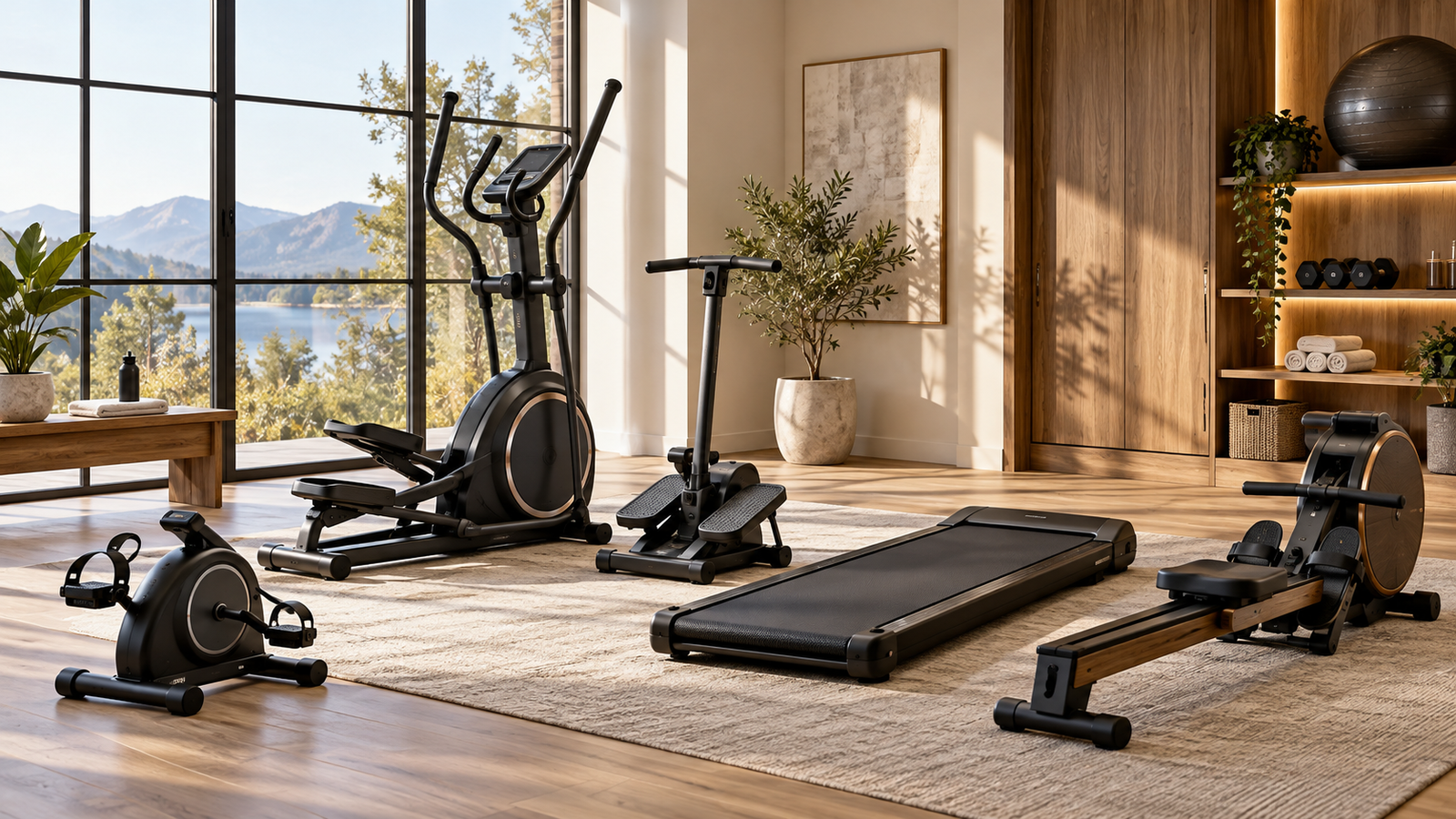
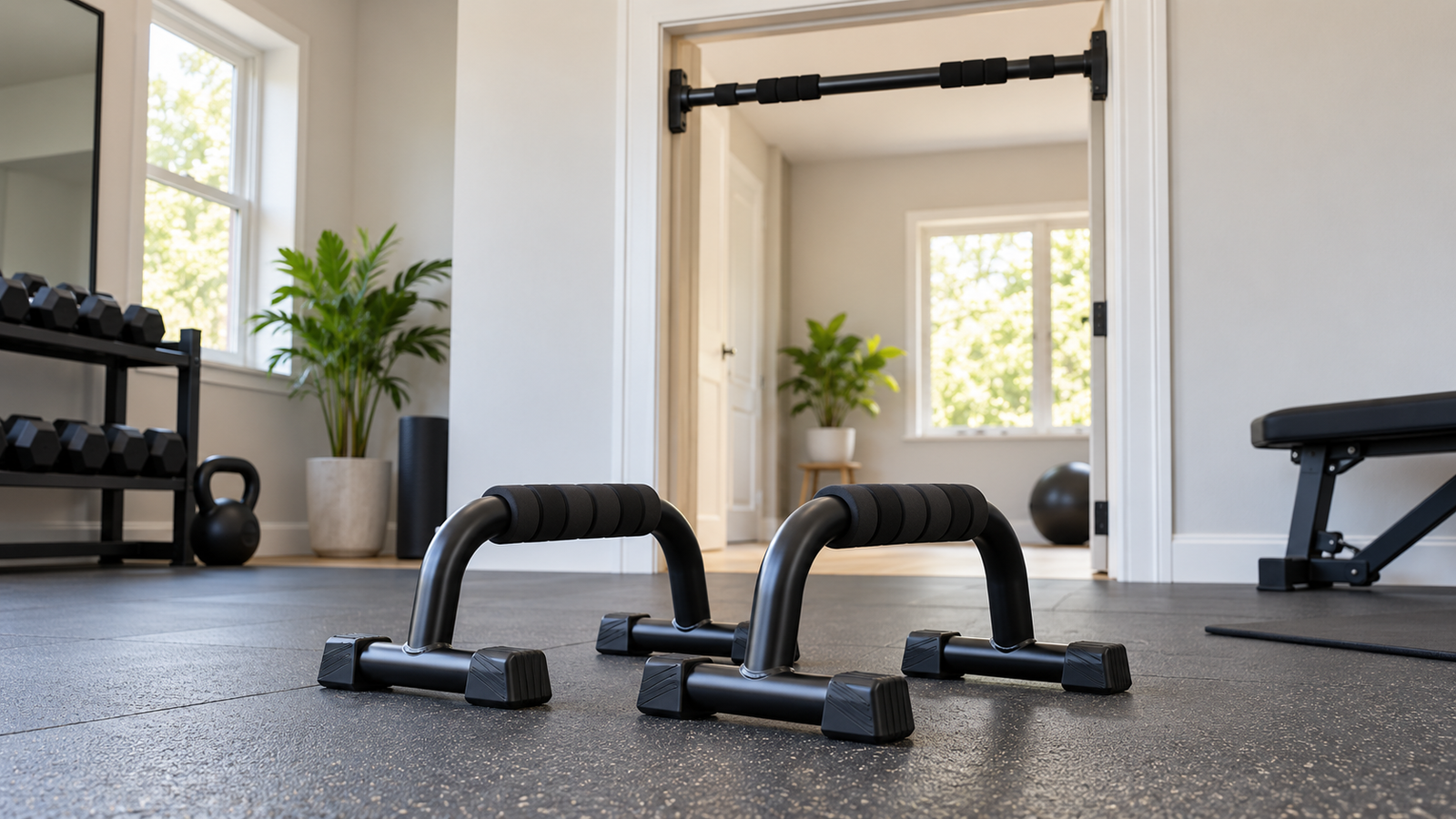
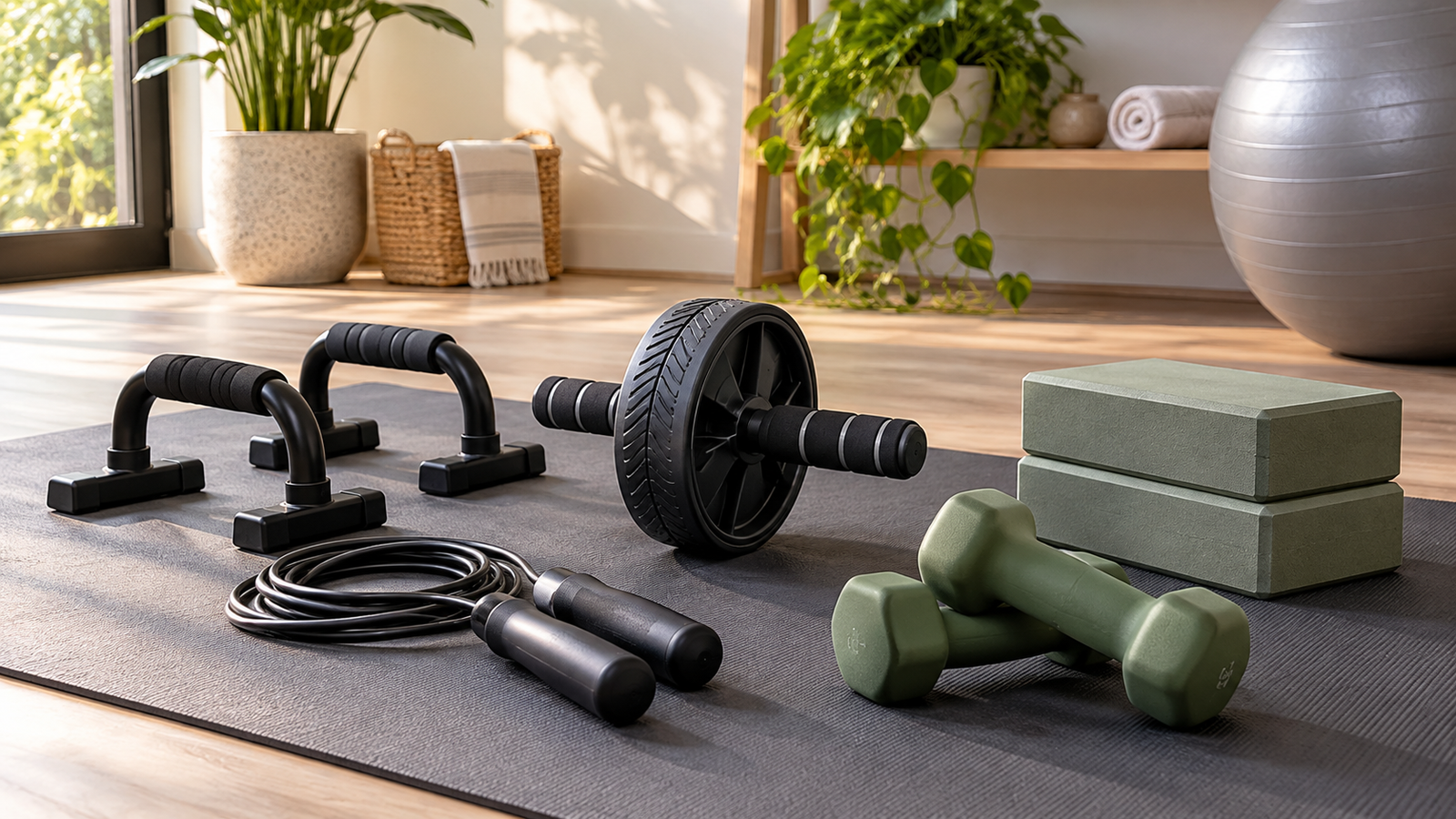
Small-Space Home Gym Layout: Clearance, Floor Load and Storage
Plan training clearance, stable flooring and equipment storage before adding benches, racks or free weights to a small room.
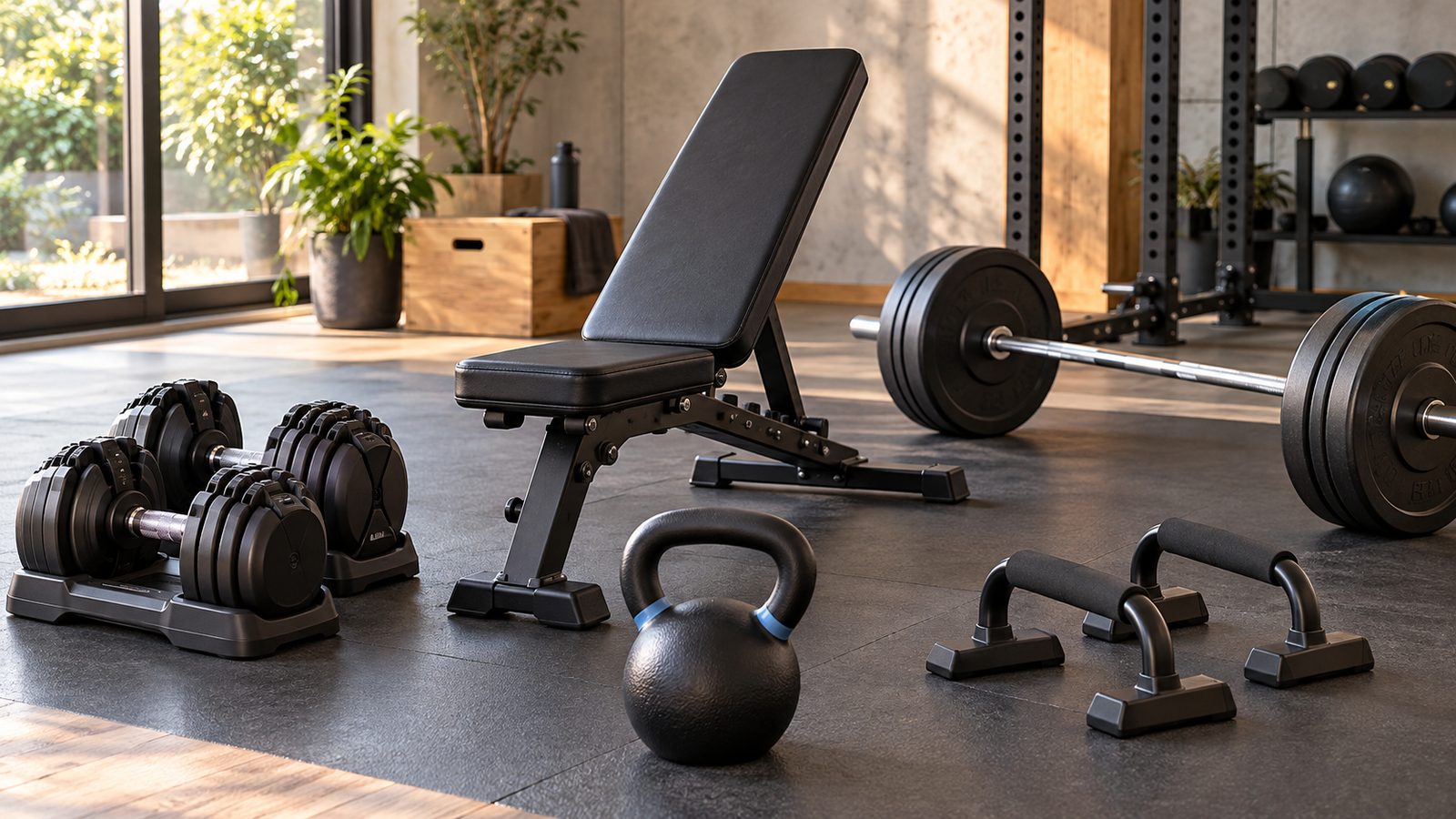
Building a home gym does not necessarily require a dedicated room, expensive machines or a large collection of equipment. A carefully planned workout area in a bedroom, apartment, spare room or covered terrace can support an effective strength-training routine.
However, buying equipment before evaluating the available space can create several problems.
An adjustable bench may fit comfortably in a corner but leave insufficient room to move dumbbells safely. A doorway pull-up bar may appear convenient but be incompatible with the doorframe. A squat stand may fit within the room’s dimensions while leaving inadequate clearance for loading a barbell or escaping a failed lift.
There is also the question of floor loading. Heavy equipment creates different demands from a yoga mat or resistance band, particularly in an upper-floor apartment.
The best small-space home gym is not the one that fits the most equipment. It is the one that allows you to perform your intended exercises safely, comfortably and consistently.
This Physical Glow guide explains how to measure workout clearance, understand floor-loading considerations, arrange equipment, plan storage and avoid expensive layout mistakes.
1. What Counts as a Small-Space Home Gym?
A small-space home gym is a workout area designed around limited floor space, shared household use or restricted equipment storage.
It may include:
- A corner of a bedroom.
- A spare room.
- An apartment living area.
- A study or home office.
- A covered balcony or terrace.
- A multipurpose room.
The defining characteristic is not a particular room size. It is that equipment must fit around other practical constraints.
For example, a 3 × 3 metre room might work well for resistance-band training, yoga and compact dumbbells, but it may be unsuitable for certain large strength machines.
Likewise, a longer but narrower room might accommodate an exercise bike while making wide lateral movements difficult.
The Three Spaces Every Home Gym Needs
A useful home gym must account for three separate areas:
- Equipment footprint: The physical space occupied by the equipment itself.
- Exercise clearance: The additional space required for movement, lifting, mounting and dismounting.
- Access and storage: The space required to enter, move through and organize the room.
Ignoring any of these can make an apparently suitable setup difficult to use.
2. Measure the Room Before Choosing Equipment
Start by measuring the actual usable area rather than relying on the room’s advertised dimensions.
Record the length, width and ceiling height.
Then identify obstacles such as doors, cupboards, windows, furniture, wall projections and electrical fittings.
What You Should Measure
| Measurement | Why it matters |
|---|---|
| Room length | Determines space for benches, mats and longer equipment |
| Room width | Affects lateral movement and barbell clearance |
| Ceiling height | Critical for overhead exercises and pull-up stations |
| Door swing | Prevents equipment from blocking access |
| Furniture clearance | Ensures household areas remain usable |
| Wall clearance | Needed around some machines and exercise movements |
| Storage dimensions | Determines where equipment goes after use |
Do not assume that an exercise machine measuring 120 cm long needs only 120 cm of usable space.
You may need additional clearance behind it, beside it or around moving parts.
Account for Equipment in Its Operating Position
A foldable exercise bench may occupy little space when stored but considerably more when opened.
Similarly, an adjustable dumbbell may have a compact storage footprint but require space for your arms to move safely during exercises.
Always measure equipment in the position in which you will actually use it.
3. Planning a 2 × 2 Metre Workout Area
A 2 × 2 metre area provides approximately four square metres of floor space.
This can support selected compact workouts, depending on equipment and exercise selection.
Example 2 × 2 m layout — conceptualIllustrative layout only, not an engineering or clearance specification. The mat and storage positions must be adjusted for real door access and exercise movement.
Suitable Activities
Depending on the individual and room configuration, this area may support:
- Bodyweight squats.
- Resistance-band exercises.
- Selected dumbbell movements.
- Floor-based core exercises.
- Stretching.
- Yoga.
- Mobility exercises.
What May Be Difficult?
Large machines and exercises involving wide arm movements can become impractical.
Overhead presses may be restricted by ceiling height, while lunges may require more clear floor length than expected.
A Better Strategy
Choose exercises first.
Then determine which compact equipment allows you to perform them.
Avoid buying a machine simply because its advertised dimensions fit inside the room.
4. Planning a 3 × 3 Metre Home Gym
A 3 × 3 metre room provides approximately nine square metres.
This may offer more flexibility for a combination of strength training and recovery work.
For example, you could plan space for:
- An adjustable bench.
- A compact dumbbell system.
- Resistance bands.
- A workout mat.
- Wall-mounted or low-profile storage.
However, fitting these items physically is different from having enough space to use them.
Example Layout Principles
Position storage against a suitable wall.
Keep the central area available for movements.
Avoid placing a bench directly against furniture that blocks arm movement.
If using dumbbells, make sure your hands and weights cannot strike nearby objects during exercises.
What About a Squat Rack?
Some compact squat stands may fit in a nine-square-metre room.
However, using them safely depends on barbell dimensions, plate-loading access, ceiling height, suitable safety equipment and floor capacity.
A standing rack footprint alone is not enough to establish suitability.
5. Exercise Clearance: Why Equipment Dimensions Are Not Enough
Clearance is the free space required around equipment during actual use.
It differs by exercise.
For example, performing a standing dumbbell lateral raise requires room to extend the arms sideways.
A bench press requires clearance for the bench, weights, entry and exit.
An exercise bike may require space for mounting, dismounting and ventilation.
Questions to Ask
Before purchasing equipment, consider:
- Can I perform the exercise through its intended range of motion?
- Can I enter and leave the equipment safely?
- Can another person walk through the room without entering the exercise area?
- Can I put weights down without striking furniture?
- Can I recover safely if I lose balance?
- Does the equipment manufacturer specify minimum clearance?
Do Not Invent a Universal Clearance Distance
There is no single clearance measurement appropriate for all gym equipment.
A treadmill, bench, squat stand and pull-up station have different requirements.
Always prioritize the manufacturer’s stated operating clearances.
For strength exercises, consider the full movement envelope, including your body and the equipment.
6. Ceiling Height: The Most Overlooked Measurement
Floor space is usually the first thing people measure.
Ceiling height is often overlooked until equipment has already been delivered.
Standing Exercises
Overhead presses require sufficient space for your height, arm extension and the raised weight.
Pull-Up Bars
Pull-ups require room for the equipment, your body and safe movement above and below the bar.
Some users need additional clearance to avoid striking the ceiling.
Power Towers
A freestanding pull-up or dip station may be much taller than a normal workout bench.
Also consider whether the equipment rocks or moves during use.
Adjustable Benches
An inclined bench can change the position of your head and weights relative to nearby shelves or fittings.
Ceiling Fans and Lights
Ceiling fans introduce particular hazards during overhead exercises.
Never perform an exercise where a raised weight, arm or body could contact a fan.
Switching the fan off does not remove the physical obstruction.
7. Floor Loading: Can Your Apartment Support Home Gym Equipment?
Floor loading is one of the most important considerations for apartment-based gyms.
A residential floor supports the combined effects of the building structure, occupants, furniture and other imposed loads.
Gym equipment introduces additional considerations because weight may be concentrated over relatively small contact areas.
Dynamic exercise can also generate forces beyond the static weight of equipment.
What Contributes to Floor Load?
Consider the combined weight of:
- The machine or rack.
- Weight plates.
- Dumbbells.
- The person exercising.
- Any additional stored equipment.
- Other furniture in the room.
For example, a multi-station strength machine with a heavy weight stack represents more than just the weight of the user.
Static vs Dynamic Loading
A stationary weight and a dropped weight create different loading conditions.
Dropping dumbbells or weight plates may produce concentrated impacts that should not be treated as ordinary static furniture loads.
Why Residential Buildings Differ
Floor capacity depends on structural design, construction quality, slab type, reinforcement, span, age and other factors.
A general online statement that all residential floors can hold a particular number of kilograms is not a safe substitute for structural assessment.
When to Consult a Structural Engineer
Professional assessment is advisable before installing particularly heavy equipment, concentrated weight storage or any setup involving substantial dynamic loads in an upper-floor residential space.
A building manager or homeowner association may also impose equipment restrictions.
Exercise mats and rubber flooring do not increase the structural load-bearing capacity of a floor.
8. How to Think About Distributed Weight vs Concentrated Weight
Two equipment setups with similar total mass may distribute their loads differently.
A wide piece of furniture may transfer load through several support points.
A heavy machine resting on narrow feet can concentrate loads into smaller areas.
Example
Imagine a large cabinet and a compact weight stack with similar total weight.
The cabinet might distribute its load across a broad base.
The weight stack may transfer weight through a smaller number of feet.
This difference matters when evaluating localized loading.
However, simply dividing total weight by floor area does not establish whether a slab is structurally safe.
What Should You Do Before Buying?
Obtain the equipment’s total weight and support-foot dimensions.
If the setup is unusually heavy or intended for an upper floor, seek professional guidance about the building’s capacity and permitted use.
Avoid relying on improvised calculations from internet forums.
9. Choosing Home Gym Flooring
Gym flooring serves several purposes.
It can protect the finished floor, improve grip, help stabilize certain equipment and reduce some vibration or noise.
However, different materials serve different functions.
| Flooring type | Advantages | Limitations |
|---|---|---|
| Rubber mats | Durable, useful beneath selected equipment | Can be heavy, expensive or emit odours |
| EVA foam tiles | Lightweight and easy to store | May compress under heavy equipment |
| Yoga mats | Portable and comfortable for floor exercises | Not suitable as structural protection for heavy weights |
| Dense equipment pads | Can protect contact areas in certain setups | Must suit the equipment and surface |
| Existing hard flooring | Stable surface for some exercises | May be noisy or vulnerable to damage |
What About Interlocking Foam Tiles?
They can be convenient for stretching and low-impact exercise.
However, some foam tiles compress or separate under heavy loads.
They should not automatically be used beneath squat racks or heavy gym machines.
Rubber Flooring for Strength Training
Dense rubber products may offer improved durability and floor protection in suitable applications.
But thickness alone does not guarantee that dropped weights will be safe for the floor or building structure.
Slip Resistance
Make sure equipment remains stable and the exercise surface does not slide.
Some mats can move when placed over smooth tile.
Check compatibility with the existing floor finish and intended activity.
10. Noise and Vibration in Apartment Gyms
A home gym can affect neighbours even when the equipment does not damage the floor.
Noise can come from several sources:
- Footsteps.
- Jumping exercises.
- Dropped weights.
- Moving exercise benches.
- Treadmill operation.
- Plate contact.
- Equipment vibration.
Impact Noise vs Airborne Noise
Impact noise occurs when movement transfers vibration through the building structure.
Airborne noise travels through the air.
The solutions differ.
Can Rubber Mats Make a Gym Silent?
No.
Floor mats may reduce some impact or vibration, but they cannot guarantee that sound will not travel to neighbouring apartments.
Practical Noise-Reduction Strategies
Prefer controlled weight placement over dropping.
Avoid unnecessary jumping exercises in noise-sensitive buildings.
Consider lower-impact cardio equipment.
Use equipment designed for stable operation.
Schedule workouts in accordance with building rules.
Exercise Bike vs Treadmill
A suitable stationary exercise bike may produce less repetitive footfall impact than running on a treadmill.
However, noise depends on the machine, installation and building.
11. Choosing Between Dumbbells, Resistance Bands and Larger Equipment
The most useful home gym equipment is determined by your training goals.
For some people, a pair of adjustable dumbbells and resistance bands provides substantial exercise variety.
Others may need specialized equipment for particular strength goals.
| Equipment | Space requirement | Main benefit | Main limitation |
|---|---|---|---|
| Resistance bands | Very compact | Portable resistance training | Resistance varies through movement |
| Fixed dumbbells | Varies with number of pairs | Simple and versatile | Multiple pairs require storage |
| Adjustable dumbbells | Compact relative to a full rack | Several resistance levels in one system | Adjustment mechanism and handling vary |
| Adjustable bench | Moderate when open | Expands exercise options | Needs operating and storage clearance |
| Pull-up bar | Small footprint, installation-dependent | Upper-body pulling exercises | Structural and installation compatibility |
| Squat stands | Larger operating area | Barbell exercises | Safety, loading and floor considerations |
| Multi-station home gym | Substantial fixed footprint | Multiple exercises at one station | Heavy, expensive and difficult to move |
What Should Beginners Buy First?
Begin with equipment that supports exercises you can perform consistently.
Resistance bands, an appropriate mat and selected dumbbells may be enough for many beginner routines.
A large machine is not required to begin strength training.
12. Storage Solutions for Compact Home Gyms
Storage influences both safety and convenience.
Equipment left scattered across the floor can create trip hazards and make the workout area difficult to use.
Wall Storage
Suitable wall hooks may hold light accessories such as resistance bands or skipping ropes.
However, wall-mounted storage must be compatible with the wall material, anchors and expected load.
Do not mount heavy equipment on unsuitable partitions.
Vertical Racks
Compact racks can organize dumbbells and other accessories.
Check the rack’s rated capacity and stability.
Under-Bed Storage
This can work well for light, compact equipment.
Consider accessibility and the risk of damaging floors or furniture while retrieving items.
Storage Baskets
Baskets may be suitable for yoga blocks, straps, towels and other lightweight accessories.
Avoid Overhead Heavy Storage
Heavy dumbbells and weight plates should not be stored where they could fall onto someone.
Keep heavier items in stable, low positions whenever practical.
13. Should You Buy Foldable Gym Equipment?
Foldable equipment can improve space efficiency, but it is important to assess both its operating and folded dimensions.
Advantages
- Easier storage.
- Greater flexibility in multipurpose rooms.
- Potentially less permanent obstruction.
- Convenient for selected apartment setups.
Limitations
- Folding mechanisms require maintenance.
- Hinges and locks need proper engagement.
- Some equipment remains heavy even when folded.
- Storage positions may require additional clearance.
- Compactness does not establish stability or quality.
What to Verify
Before purchasing, check:
- Open dimensions.
- Folded dimensions.
- Equipment weight.
- Rated user or working load.
- Locking mechanism.
- Storage instructions.
- Required safety clearances.
Do not store heavy foldable equipment vertically unless the manufacturer explicitly permits that orientation.
14. Home Gym Ventilation and Temperature
A cramped workout area can become uncomfortable if ventilation is inadequate.
Exercise generates heat, and enclosed rooms may become warm quickly.
Airflow
Provide adequate ventilation through windows or suitable mechanical systems.
Air Conditioning
Air conditioning can improve thermal comfort.
However, it does not replace fresh-air ventilation requirements.
Fans
Fans may improve perceived comfort, but their placement must not create hazards during overhead exercises.
Humidity
High humidity can make workouts uncomfortable and may affect equipment storage.
Moisture exposure can contribute to corrosion of some metal components.
Hydration
Keep drinking water accessible.
Avoid placing open containers where they could spill onto electrical equipment or create a slipping hazard.
15. Lighting, Mirrors and Electrical Safety
A functional home gym needs adequate visibility.
Poor lighting can make it harder to identify obstacles or handle equipment safely.
Lighting
Use sufficient general illumination.
Avoid harsh glare directly in the eyes during floor exercises.
Mirrors
Mirrors can help some users observe exercise technique.
However, they should be securely mounted and located away from the path of moving weights.
Electrical Equipment
If using a treadmill, exercise bike or other powered machine:
- Follow the manufacturer’s electrical requirements.
- Avoid overloading extension boards.
- Protect cables from foot traffic.
- Keep liquids away from outlets.
- Ensure safe access to the power switch.
- Follow grounding and installation instructions.
Cable Management
Loose cables can create trip hazards.
Route them away from workout paths and moving equipment.
16. How to Plan Your Home Gym Based on Exercise Goals
Different training objectives require different layouts.
Strength Training
Prioritize stable equipment, clear movement areas and suitable resistance.
Consider dumbbells, bands and a bench before purchasing larger machines.
Weight Management and General Fitness
A combination of strength training and accessible cardio may be practical.
Walking, cycling and bodyweight exercises can all contribute to overall activity.
Mobility and Stretching
A clear floor area, mat and selected mobility tools may be sufficient.
Rehabilitation
Equipment and exercise selection should reflect professional guidance when recovering from injury or managing a medical condition.
Mixed Fitness
A flexible central workout zone with compact storage may be more useful than several machines permanently occupying the room.
The layout should support the activities you will perform most often.
17. A Small-Space Home Gym Planning Calculator
Use this tool to estimate how much floor area is available and compare it with a potential equipment footprint.
It is a planning aid, not a safety or structural certification.
Floor area estimatorRoom length (metres)
3.0Room width (metres)
3.0Equipment length (metres)
1.2Equipment width (metres)
0.6
Room area
9.00 m²
Equipment footprint
0.72 m²
Area occupied
8.0%
8.28 m² remains outside the equipment footprint, before accounting for access, movement clearance and other furniture.
Floor-area percentage alone cannot establish fit or safe operation. A machine may occupy little floor space but require substantial clearance; always check dimensions, manufacturer guidance and structural loading separately.
18. Building a Home Gym on a Budget
A compact gym does not need to begin with a major investment.
Buying several expensive machines immediately may create unused equipment and reduce room flexibility.
Phase 1: Start With Basic Equipment
Depending on your fitness needs, begin with:
- An exercise mat.
- Suitable resistance bands.
- A manageable dumbbell option.
- Light accessory storage.
Phase 2: Identify Limitations
After several weeks of consistent workouts, assess what you genuinely need.
Are your available resistance levels insufficient?
Would an adjustable bench expand useful exercise choices?
Is cardio equipment necessary, or can walking and other activities meet your needs?
Phase 3: Add Specialized Equipment
Purchase larger equipment only when there is a clear purpose and sufficient safe space.
Avoid Buying for Appearance
A room filled with machines may look impressive but still provide a poor workout environment.
Training consistency and appropriate exercise selection matter more than equipment quantity.
19. Comparing Compact Strength Equipment
If you are planning a small home gym in India, different equipment categories serve different purposes.
| Equipment | Main advantage | Important consideration |
|---|---|---|
| Adjustable dumbbell | Multiple resistance levels in a compact system | Adjustment mechanism and handling |
| Adjustable bench | Expands exercise variety | Open position and movement clearance |
| Doorway pull-up bar | Compact upper-body training | Frame compatibility and installation safety |
| Squat stands | Support selected barbell exercises | Stability, load rating and safety systems |
| Multi-station home gym | Several exercises in one station | Heavy footprint, assembly and floor loading |
Physical Glow’s Best Compact Home Gym Equipment in India: Top 5 Strength Essentials buying guide compares equipment including adjustable dumbbells, workout benches, pull-up bars, squat stands and home-gym systems.
Use that comparison after determining what your room can accommodate.
This educational guide focuses on the layout, clearance and storage decisions that should come before purchasing equipment.
20. Common Small-Space Home Gym Mistakes
Mistake 1: Measuring Only the Equipment Footprint
Allow space for actual exercise movement, access and emergency exit.
Mistake 2: Ignoring Ceiling Height
Overhead exercises and pull-up equipment require additional vertical clearance.
Mistake 3: Assuming Floor Mats Increase Structural Capacity
Protective flooring does not make an overloaded slab structurally safe.
Mistake 4: Installing a Doorway Pull-Up Bar Without Checking Compatibility
Doorframes vary in construction and strength.
Follow the manufacturer’s installation requirements and do not use unsuitable supports.
Mistake 5: Storing Heavy Weights Above Shoulder Height
Falling equipment can cause serious injury.
Use stable, appropriate storage.
Mistake 6: Buying a Large Machine Before Establishing a Routine
A compact setup may already meet your needs.
Mistake 7: Blocking Doors and Walkways
Exercise equipment should not obstruct exits or essential household movement.
Mistake 8: Ignoring Neighbouring Apartments
Repeated impact and equipment vibration can travel through buildings.
Mistake 9: Using Unstable Furniture as Gym Equipment
Household chairs and tables are not automatically suitable for weight-bearing exercise.
Mistake 10: Overcrowding the Workout Area
Too much equipment can reduce the room’s usefulness and create hazards.
21. Frequently Asked Questions
How much space is needed for a home gym?
It depends on your intended exercises and equipment. A small floor area can support mat work, bands and selected dumbbell movements, but larger machines require more space.
Is a 2 × 2 metre area enough?
It may be sufficient for certain compact workouts, provided movement, access and safety clearances are adequate.
Can I build a gym in a bedroom?
Yes, if the layout permits safe exercise and the equipment does not obstruct furniture, exits or essential movement.
Can I put gym equipment on an upper floor?
Possibly, but heavy or impact-producing equipment may require structural assessment. Do not assume a floor is suitable based on equipment weight alone.
Do rubber mats protect apartment floors?
They may protect finishes and reduce some noise, but they do not increase structural capacity or guarantee protection against dropped weights.
Is a squat rack suitable for a small room?
Only if there is adequate operating clearance, floor capacity, stability and appropriate safety equipment.
Can I mount a pull-up bar on any doorframe?
No. Compatibility depends on the doorframe and the manufacturer’s requirements.
Are adjustable dumbbells good for apartments?
They can be space-efficient, but appropriate weight selection, handling and floor protection remain important.
Is foldable equipment always safer?
No. Folding mechanisms and locking systems must be used correctly, and the equipment still needs adequate operating clearance.
How can I reduce gym noise?
Use controlled movements, avoid dropping weights, choose suitable equipment and consider appropriate floor protection. No mat guarantees sound isolation.
Do I need a gym mirror?
No. Mirrors can help observe movement but are not essential for effective training.
Can I use foam tiles under heavy weights?
Some foam tiles compress excessively. Check the product’s intended use and equipment requirements.
Where should I store dumbbells?
Use stable, appropriately rated low-level storage that prevents rolling and accidental falls.
Should I buy a bench or resistance bands first?
The answer depends on your exercises and goals. Resistance bands require little storage, while a bench expands certain strength-training options.
Can I build an effective home gym without machines?
Yes. Many strength and general fitness routines can use bodyweight exercises, resistance bands and free weights.
Does a heavy gym machine need professional installation?
Some machines do. Follow the manufacturer’s assembly and installation instructions.
How important is ventilation?
Adequate ventilation and temperature control support comfort during exercise, particularly in enclosed or humid spaces.
Can a ceiling fan interfere with workouts?
Yes. Fans create collision hazards during overhead movements.
Should I buy equipment online without seeing it?
You can, but carefully review dimensions, operating clearance, weight limits, installation requirements and return conditions.
What is the biggest small-home-gym planning mistake?
Buying equipment based only on whether it physically fits rather than whether it can be used safely and conveniently.
22. Final Verdict: Prioritize Usable Space Over Equipment Quantity
A small-space home gym can support effective training without becoming crowded or expensive.
The key is to plan around actual exercise movements rather than equipment photographs or advertised footprints.
Measure the room, identify obstacles and confirm ceiling clearance before buying.
Choose equipment that supports your goals and can be stored safely.
For heavy equipment, pay particular attention to concentrated loads, dynamic impacts and the structural characteristics of the building.
Protective mats can improve practicality, but they do not replace structural assessment.
Start with a flexible setup and expand only when you identify a genuine training need.
A well-planned home gym should leave enough room to move, train and put equipment away safely—not simply accommodate the greatest number of products.
Editorial References and Further Reading
- American College of Sports Medicine — General resistance-training recommendations and exercise programming.
- National Strength and Conditioning Association — Strength-training equipment, facility planning and safety resources.
- Bureau of Indian Standards — Relevant Indian structural-design standards, including IS 875 Part 2 for imposed loads. Building-specific interpretation should be performed by a qualified structural engineer.
- Equipment manufacturer manuals — Model-specific operating clearances, installation requirements and rated loads.
Physical Glow Editorial Note: This article is intended for general fitness and equipment-planning education. Room dimensions and conceptual layouts are illustrative. Structural capacity, installation safety and equipment clearances must be verified for the actual building and products. Seek professional guidance for heavy equipment installations or uncertain floor-loading conditions.