Stability Ball vs Medicine Ball vs Wall Ball: Differences and Uses
Learn how large inflatable stability balls, compact medicine balls and stitched wall balls differ in construction, weight and intended exercises.
Stability balls, medicine balls and wall balls are all round fitness tools, but they are designed for very different types of training.
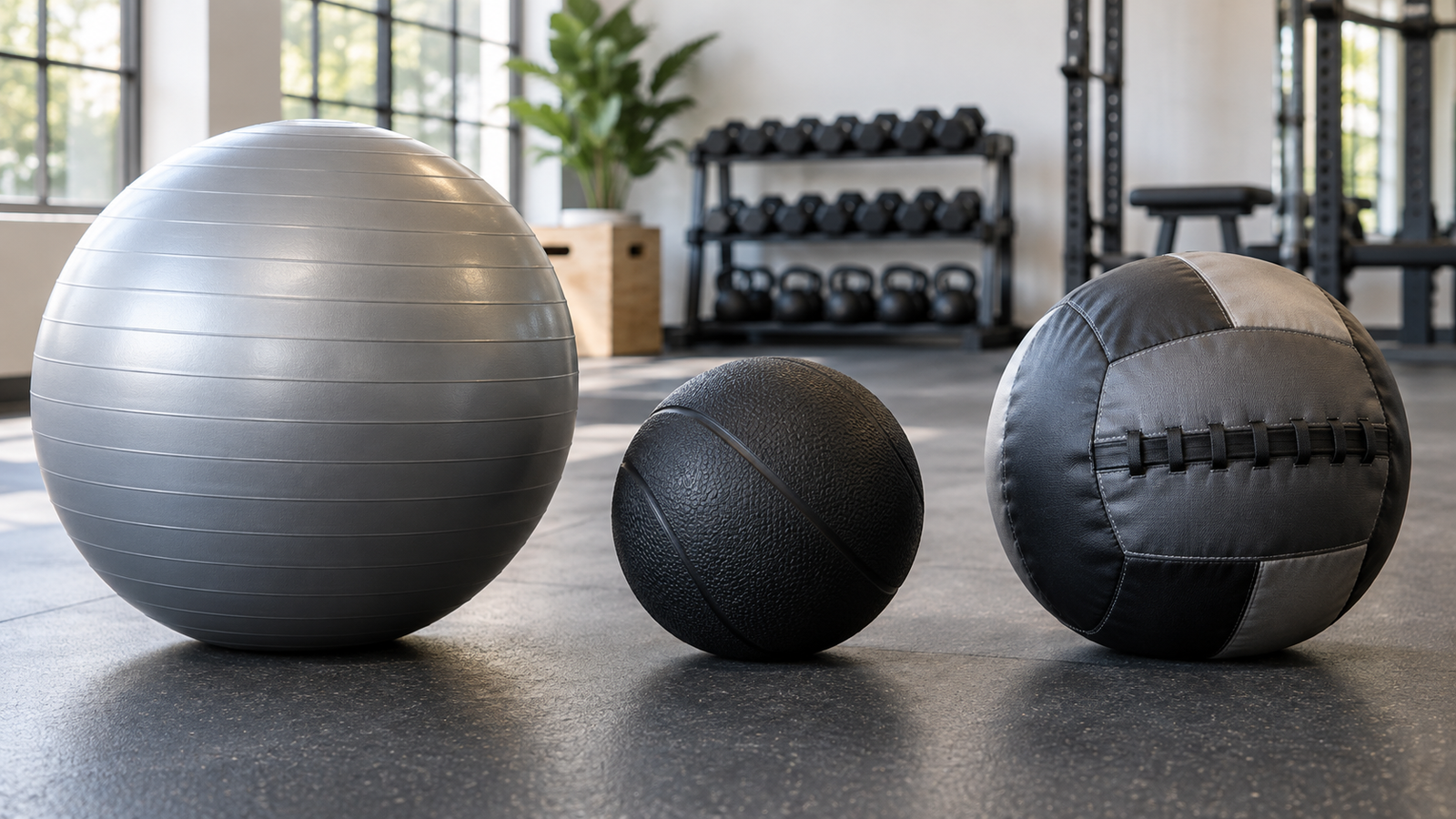
A stability ball is large, inflatable and mainly used for core control, mobility and supported exercises. A medicine ball is smaller, denser and designed for strength, power and controlled throwing drills. A wall ball is usually larger and softer than a medicine ball and is made for repeated throws against a wall or to a target.
Choosing the right one depends on whether your goal is stability, general strength, explosive power or conditioning.
What is a stability ball?
A stability ball is a large inflatable exercise ball.
It is also commonly called a:
- Gym ball.
- Swiss ball.
- Exercise ball.
- Fitness ball.
The ball is large enough to support part of the body during exercises.
Common uses include:
- Core exercises.
- Hamstring curls.
- Bridges.
- Mobility drills.
- Wall squats.
- Supported stretching.
- Balance work.
Because the ball moves in several directions, it adds an instability challenge.
What is a medicine ball?
A medicine ball is a smaller weighted ball designed for resistance training.
Medicine balls may be made from:
- Rubber.
- Synthetic leather.
- Textured plastic.
- Composite materials.
Common weights range from relatively light beginner options to much heavier training balls.
Medicine balls can be used for:
- Russian twists.
- Squats.
- Lunges.
- Rotational drills.
- Chest passes.
- Overhead throws.
- Core training.
- Partner exercises.
Some medicine balls are designed to bounce, while others are not.
What is a wall ball?
A wall ball is a weighted ball specifically designed for repeated throwing and catching.
It is usually:
- Larger than a medicine ball.
- Softer on the outside.
- Filled with material that distributes weight.
- Covered in stitched synthetic leather or fabric.
Wall balls are commonly used for:
- Wall-ball squats.
- Target throws.
- Overhead throws.
- Conditioning circuits.
- Functional fitness workouts.
They are designed to be thrown against a suitable wall or target and caught repeatedly.
Stability ball vs medicine ball vs wall ball at a glance
| Factor | Stability ball | Medicine ball | Wall ball |
|---|---|---|---|
| Main purpose | Stability, mobility and core training | Strength and power | Repeated throwing and conditioning |
| Size | Very large | Small to medium | Medium to large |
| Weight | Lightweight when inflated | Weighted | Weighted |
| Construction | Inflatable | Dense rubber or similar material | Soft outer shell with weighted filling |
| Designed for throwing | Usually no | Some models | Yes |
| Designed to bounce | No | Some models | Usually low bounce |
| Used for sitting/support | Yes | No | No |
| Best for beginners | Yes | Yes with appropriate weight | Yes with light weight and good technique |
Why these balls should not be treated as interchangeable
The differences are not cosmetic.
A stability ball is designed to deform and move under bodyweight.
A medicine ball is designed to provide resistance.
A wall ball is designed to tolerate repeated throwing and catching.
Using the wrong type for an exercise can reduce effectiveness or create unnecessary risk.
For example:
- Do not use a stability ball as a weighted throwing ball.
- Do not assume every medicine ball is safe to slam against the floor.
- Do not use a wall ball as a substitute for a large stability ball.
What does a stability ball train?
A stability ball creates an unstable surface.
This can increase the demand on muscles responsible for controlling body position.
Depending on the exercise, it may challenge:
- Abdominals.
- Obliques.
- Glutes.
- Hamstrings.
- Shoulder stabilisers.
- Back muscles.
The instability is useful for control and coordination, but it is not automatically better than stable training.
Stability ball for core exercises
Common core exercises include:
- Ball crunches.
- Plank with forearms on the ball.
- Stir-the-pot.
- Stability-ball rollouts.
- Dead-bug variations.
- Feet-on-ball planks.
The difficulty changes depending on where the ball is positioned.
For example, placing the feet on the ball during a plank usually creates a different challenge from placing the forearms on it.
Stability ball for hamstring curls
This is a common lower-body exercise.
A simple version involves:
- Lying on your back.
- Placing your heels on the ball.
- Lifting the hips.
- Bending the knees.
- Rolling the ball toward the body.
- Extending the legs again.
This trains:
- Hamstrings.
- Glutes.
- Core.
Move slowly and avoid letting the hips drop excessively.
Stability ball for wall squats
You can place the ball between your back and a wall.
As you squat, the ball rolls vertically.
This can provide a guided movement path.
However, it is not automatically safer than a normal squat.
Use a comfortable depth and maintain control.
How to choose stability ball size
Ball diameter matters.
Common sizes include:
- 55 cm.
- 65 cm.
- 75 cm.
Choose size according to:
- Your height.
- The manufacturer’s size chart.
- The exercises you plan to perform.
When sitting on the ball, your feet should be comfortably supported on the floor.
Avoid choosing the largest ball simply because it looks more stable.
Inflation changes stability
A softer, slightly under-inflated ball generally feels more stable.
A firmer ball tends to roll more easily and can feel more challenging.
Do not exceed the manufacturer’s recommended inflation level.
Over-inflation can increase stress on the material.
What does anti-burst mean?
Some stability balls are marketed as anti-burst.
This generally means the material is designed to deflate more gradually if punctured.
It does not mean the ball cannot fail.
Check regularly for:
- Cuts.
- Surface damage.
- Bulges.
- Air leakage.
- Excessive wear.
Replace a damaged ball.
What does a medicine ball train?
Medicine balls are useful for both strength and power.
They can train:
- Core rotation.
- Upper-body power.
- Lower-body strength.
- Coordination.
- Explosive movement.
The type of exercise depends on the weight and ball construction.
Medicine ball for Russian twists
Russian twists are a common rotational core exercise.
A simple version involves:
- Sitting with knees bent.
- Holding the ball in front of the body.
- Keeping the torso controlled.
- Rotating from side to side.
Do not rush.
Excessive speed can reduce control.
Choose a weight that allows you to rotate without collapsing posture.
Medicine ball squats
Holding a medicine ball can add resistance to squats.
You can hold it:
- At the chest.
- In front of the body.
- Overhead, if appropriate.
For beginners, holding the ball close to the chest is usually easier to control.
Medicine ball lunges
A medicine ball can add resistance to:
- Forward lunges.
- Reverse lunges.
- Walking lunges.
The ball can be held at chest height.
More advanced versions may include controlled rotation.
Do not add rotation if basic lunge technique is not stable.
Medicine ball chest passes
A chest pass is a power exercise.
You hold the ball at the chest and throw it forward to:
- A partner.
- A suitable wall.
Only use a medicine ball intended for this type of impact.
Make sure there is enough space.
Medicine ball overhead throws
Overhead throws can train explosive upper-body and trunk movement.
They require:
- Adequate ceiling height.
- Clear space.
- A ball designed for impact.
Do not perform overhead throws indoors unless the environment is suitable.
Bouncing medicine balls
Some rubber medicine balls are designed to bounce.
These may be useful for:
- Partner drills.
- Wall throws.
- Dynamic exercises.
A bouncing ball behaves differently from a non-bounce ball.
Check the product description before buying.
Non-bounce medicine balls
Some medicine balls are designed to absorb impact.
These may be better for:
- Controlled throws.
- Strength exercises.
- Floor drills.
Do not assume a low-bounce ball is safe for hard slams unless it is specifically designed for slamming.
Medicine ball vs slam ball
These products are often confused.
Medicine ball
Designed for general weighted exercises and, depending on construction, throwing.
Slam ball
Designed specifically for high-impact floor slams.
Slam balls usually have:
- Thick rubber shells.
- Very low bounce.
- High impact resistance.
Do not repeatedly slam a medicine ball unless the manufacturer says it is designed for that use.
What does a wall ball train?
Wall-ball exercises combine several movements.
A typical wall-ball repetition involves:
- Holding the ball at chest height.
- Performing a squat.
- Standing up explosively.
- Throwing the ball toward a wall target.
- Catching it.
- Moving directly into the next repetition.
This can train:
- Legs.
- Glutes.
- Core.
- Shoulders.
- Cardiovascular endurance.
Because many muscles work together, wall balls are common in conditioning workouts.
Why wall balls are larger
The larger size makes them easier to catch against the body.
The softer outer shell also reduces impact compared with a dense rubber medicine ball.
This is useful when performing many repetitions.
Why wall balls are usually low-bounce
A strong rebound would make repeated catching less predictable.
Wall balls are generally designed to:
- Hit the wall.
- Drop back toward the athlete.
- Be caught under control.
They should not rebound aggressively like some rubber medicine balls.
How to perform a basic wall-ball exercise
A typical setup is:
- Stand facing a suitable wall.
- Hold the ball at chest height.
- Squat under control.
- Stand up powerfully.
- Extend the arms and throw the ball toward the target.
- Catch the ball softly.
- Absorb the catch.
- Begin the next squat.
Use a light ball when learning.
Wall-ball target height
Target height affects difficulty.
A higher target increases the throwing demand.
Beginners should focus on:
- Consistent technique.
- Controlled catches.
- Comfortable target height.
Do not choose a difficult target just because it is used in competitive workouts.
Which ball is best for core training?
It depends on the type of core work.
Stability ball
Best for:
- Anti-extension exercises.
- Balance.
- Planks.
- Rollouts.
- Supported movement.
Medicine ball
Best for:
- Weighted twists.
- Rotational strength.
- Loaded sit-up variations.
- Power drills.
Wall ball
Core muscles work during wall-ball exercises, but it is not primarily a dedicated core tool.
Which is best for strength training?
A medicine ball is usually the most versatile weighted option.
It can add load to:
- Squats.
- Lunges.
- Presses.
- Rotational exercises.
However, dumbbells and barbells usually allow more precise loading for progressive strength training.
A medicine ball is especially useful when movement and coordination are part of the goal.
Which is best for power training?
Medicine balls are commonly used for explosive throws.
Examples include:
- Rotational throws.
- Chest passes.
- Overhead throws.
Wall balls also involve power, but repeated wall-ball sets usually become more conditioning-focused.
Which is best for conditioning?
Wall balls are the most directly suited to conditioning circuits.
They combine:
- Squatting.
- Throwing.
- Catching.
- Repeated full-body movement.
This can elevate heart rate quickly.
Medicine balls can also be used in circuits.
Stability balls are less commonly used for high-speed conditioning.
Which is best for mobility?
The stability ball is usually the most useful.
It can support:
- Back extension.
- Chest opening.
- Hip mobility.
- Gentle stretching.
Do not use the ball to force range.
Which takes up the most space?
A stability ball is generally the hardest to store because it is large when inflated.
A medicine ball is much smaller.
A wall ball is larger than most medicine balls but still easier to store than a full-size stability ball.
If storage space is limited, consider this before buying.
Which is easiest to transport?
Medicine balls are compact but can be heavy.
Wall balls are lighter relative to their size but bulky.
Stability balls are very light but large unless deflated.
For frequent travel, none is especially convenient compared with resistance bands or compact training tools.
Weight selection for medicine balls
Choose a weight that allows you to perform the intended exercise correctly.
For strength exercises, you may use a heavier ball.
For explosive throws, a lighter ball is often more useful because you need to move it quickly.
A ball that is too heavy can turn a power exercise into a slow strength movement.
Weight selection for wall balls
Wall-ball weight should allow repeated squatting, throwing and catching without technique breaking down.
Start lighter if:
- You are new to the exercise.
- Your shoulder endurance is limited.
- Your squat technique is still developing.
Progress gradually.
Heavier is not always better
A heavier ball does not automatically make training more effective.
If the weight causes:
- Poor posture.
- Shortened range.
- Slow throws.
- Unsafe catches.
then the load may be inappropriate.
Choose weight according to movement quality.
Surface texture matters
Medicine balls often use textured rubber.
This can improve grip during:
- Sweaty workouts.
- Fast throws.
Wall balls often use stitched synthetic outer materials.
A stability ball usually uses textured PVC or similar material.
Grip should feel secure without being excessively abrasive.
Seams and stitching on wall balls
Inspect:
- Seams.
- Stitching.
- Panels.
- Outer covering.
Repeated throwing places stress on the shell.
Loose stitching can worsen quickly.
Stop using a damaged wall ball.
Medicine ball durability
Check for:
- Cracks.
- Splits.
- Deformation.
- Surface peeling.
A damaged ball may fail during impact.
Do not continue throwing a ball with visible structural damage.
Stability ball maintenance
Keep the ball away from:
- Sharp objects.
- Extreme heat.
- Rough edges.
- Outdoor debris.
Check inflation periodically.
Clean it with a method recommended by the manufacturer.
Can a stability ball be used as a chair?
It can be used for short periods, but it should not automatically replace a supportive office chair.
Sitting on a ball requires ongoing postural effort.
This can become tiring.
A stability ball is primarily an exercise tool.
Can a medicine ball be used for wall balls?
Sometimes, but it depends on the ball.
A hard rubber medicine ball may:
- Bounce unpredictably.
- Be more difficult to catch.
- Damage some walls.
- Feel uncomfortable during high-repetition catching.
A wall ball is usually better for repeated wall-ball workouts.
Can a wall ball be used like a medicine ball?
Yes, for some exercises.
You can use a wall ball for:
- Squats.
- Lunges.
- Core exercises.
However, its larger size may make some exercises awkward.
It is also less suitable for drills that require a compact dense ball.
Can a wall ball be slammed?
Usually not unless the manufacturer specifically says so.
Wall balls are designed mainly for wall throws and catching.
Repeated floor slams can damage the stitching and internal filling.
Use a slam ball for slamming.
Can a medicine ball damage walls?
Yes.
Dense medicine balls can damage:
- Plaster.
- Drywall.
- Paint.
- Lightweight surfaces.
Only throw against a surface suitable for impact.
A dedicated reinforced training wall is preferable.
Training indoors safely
Before throwing any ball indoors, check:
- Ceiling height.
- Wall strength.
- Windows.
- Lights.
- Fans.
- Furniture.
- Other people.
Leave enough space for missed catches.
Common stability-ball mistakes
Choosing the wrong size
Use height guidance rather than guessing.
Over-inflating
Follow the manufacturer’s instructions.
Training near sharp objects
Create clear floor space.
Performing advanced movements too soon
Develop basic control first.
Using a damaged ball
Replace it.
Common medicine-ball mistakes
Choosing too much weight
Power exercises need speed.
Throwing a non-throwing ball
Check construction.
Using poor catching technique
Absorb the ball under control.
Training too close to breakable objects
Create safe space.
Confusing a medicine ball with a slam ball
They may be built differently.
Common wall-ball mistakes
Using a ball that is too heavy
This can reduce throw height and squat quality.
Standing too close to the wall
The returning ball can become difficult to catch.
Standing too far away
You may need to throw horizontally rather than upward.
Catching with straight rigid arms
Absorb the ball smoothly.
Letting the ball pull you forward
Maintain balance before starting the next squat.
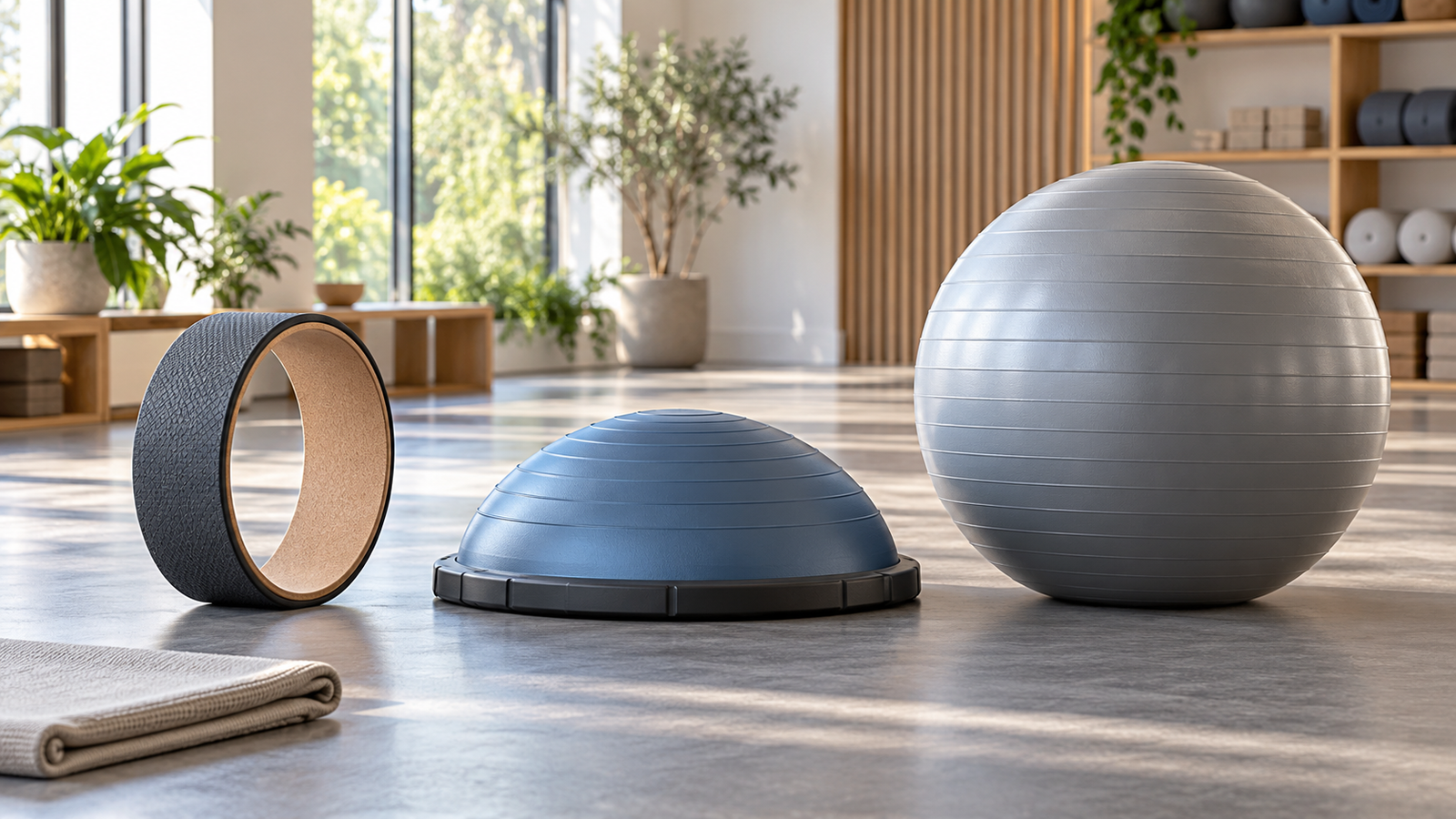
Stability ball vs balance dome
These tools are also sometimes confused.
A stability ball is a complete inflatable sphere.
A balance dome is a half-sphere attached to a rigid platform.
The balance dome is more practical for:
- Standing exercises.
- Step-ups.
- Single-leg drills.
The stability ball is better for:
- Supported floor exercises.
- Hamstring curls.
- Planks.
- Mobility.
Medicine ball vs kettlebell
Both add resistance, but they behave differently.
A kettlebell is better for:
- Swings.
- Loaded carries.
- Heavy strength exercises.
A medicine ball is better for:
- Throwing.
- Catching.
- Rotational power.
Choose according to the movement.
Medicine ball vs dumbbell
Dumbbells provide more precise resistance and are generally better for conventional strength progression.
Medicine balls offer greater freedom for:
- Throws.
- Rotational drills.
- Dynamic movement.
They complement traditional weights rather than replacing them.
How to compare these products before buying
| Factor | Stability ball | Medicine ball | Wall ball |
|---|---|---|---|
| Size to check | Diameter | Diameter and weight | Diameter and weight |
| Main construction | Inflatable | Dense weighted material | Padded stitched shell |
| Important specification | User size and load capacity | Weight and bounce behaviour | Weight, stitching and impact use |
| Storage demand | High | Low | Moderate |
| Impact use | No | Depends on model | Wall throws |
| Main buying risk | Wrong size | Wrong weight or ball type | Weak construction or excessive weight |
Which should a beginner buy?
Choose a stability ball if:
- You want general core exercises.
- Mobility is important.
- You like supported training.
- You have enough storage space.
Choose a medicine ball if:
- You want weighted core training.
- You want strength and power drills.
- You want a compact tool.
- You plan to perform controlled throws.
Choose a wall ball if:
- You specifically want wall-ball workouts.
- Conditioning is a major goal.
- You have a safe wall and enough space.
- You want repeated throwing and catching.
Do you need all three?
Usually not.
Their purposes overlap slightly, but each is most useful for a different training style.
For a general home gym, a stability ball or medicine ball may offer broader everyday use.
A wall ball makes more sense if wall-ball conditioning is already part of your programme.
Frequently asked questions
Is a stability ball the same as a medicine ball?
No.
A stability ball is large, lightweight and inflatable.
A medicine ball is smaller and weighted.
Is a medicine ball the same as a wall ball?
No.
A wall ball is generally larger and softer and designed specifically for repeated wall throws.
Can I sit on a medicine ball?
No.
It is not designed to support bodyweight like a stability ball.
Can I throw a stability ball?
You can move it during exercise, but it is not designed as a weighted throwing tool.
What weight medicine ball should I buy?
Choose a weight you can control for the intended exercise.
Power drills usually benefit from lighter loads than slow strength exercises.
What weight wall ball should beginners use?
Start light enough that you can maintain squat depth, target accuracy and controlled catches.
Which ball is best for abs?
A stability ball provides many core-stability exercises, while a medicine ball is better for weighted and rotational core work.
Which ball is best for fat loss?
No single ball directly causes fat loss.
Fat loss depends on overall energy balance and a sustainable training programme.
Which lasts the longest?
Durability depends on construction and use.
A dense medicine ball may last a long time if used appropriately.
Inflatable stability balls and stitched wall balls need more regular inspection.
Choosing the right ball for your home gym
Choose by movement, not by appearance.
A stability ball is best suited to core stability, supported movement and mobility.
A medicine ball is the most versatile option for weighted strength, rotational work and explosive throwing.
A wall ball is the most specialised choice for repeated target throws and full-body conditioning.
Before buying, check dimensions, intended use, weight, material, maximum load and whether the product is designed for the type of impact you plan to use.
Physical Glow’s Top 5 Exercise, Stability, Medicine and Wall Balls in India comparison looks at several ball formats for home training. Use that comparison alongside this guide, then verify the current diameter, weight, construction, load limits and impact-use instructions for the exact product you intend to buy.