Doorway vs Wall-Mounted Pull-Up Bars: Fit, Installation and Safety Checks
Compare doorway and wall-mounted pull-up bars by fixing method, frame suitability, available space and manufacturer installation requirements.
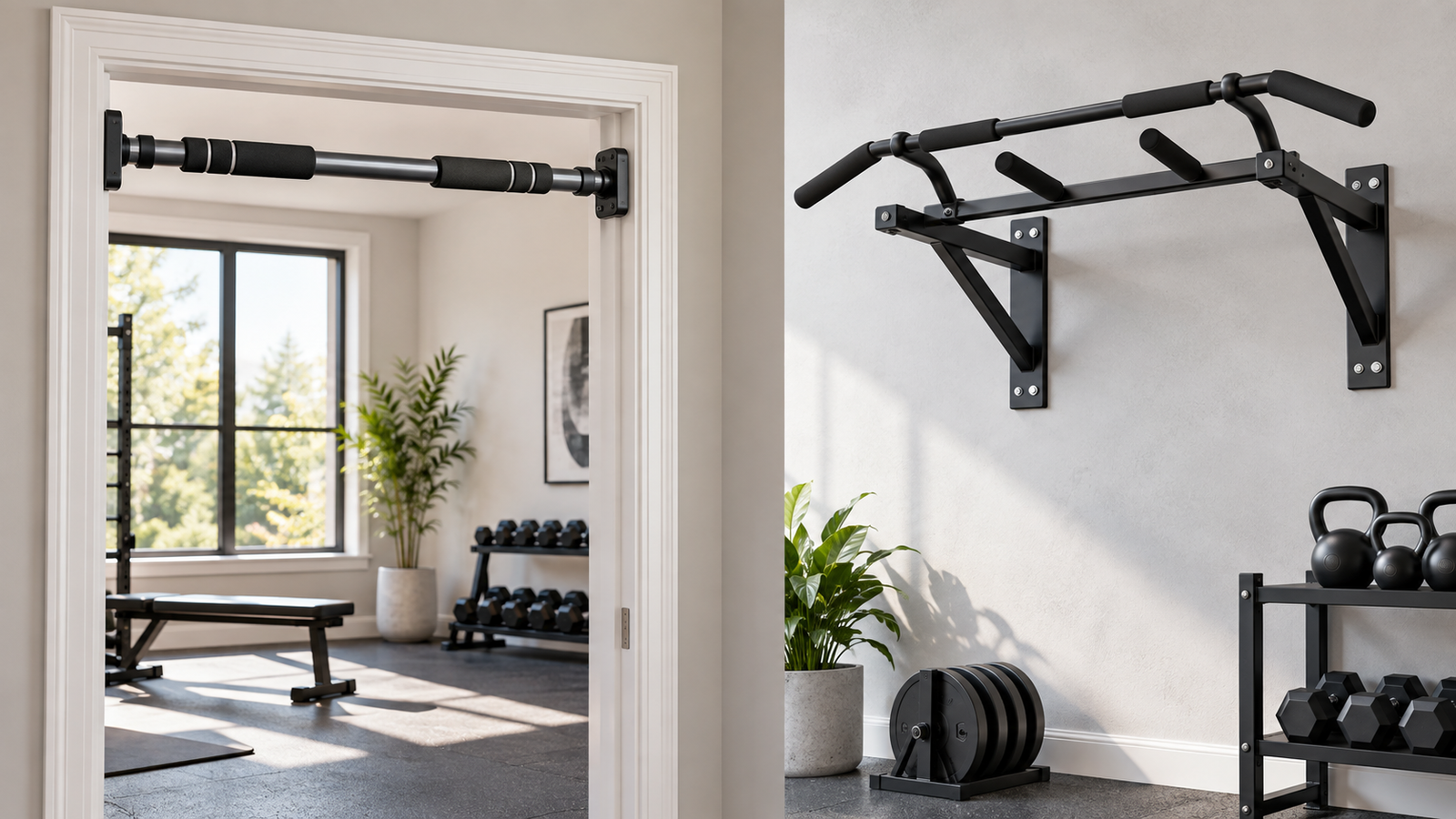
Doorway and wall-mounted pull-up bars both support upper-body bodyweight training, but they differ significantly in installation, stability, space requirements and exercise versatility.
A doorway pull-up bar is usually easier to install and remove. A wall-mounted bar generally requires drilling and a suitable structural surface, but it can provide a more permanent setup with greater exercise flexibility.
The better choice depends on your home, training goals, available space and how much installation work you are willing to do.
What is a doorway pull-up bar?
A doorway pull-up bar is designed to fit inside or around a doorframe.
Common designs include:
- Telescopic pressure-mounted bars.
- Bars with expanding end pads.
- Over-doorframe leverage bars.
- Adjustable no-drill bars.
These products are popular for home use because they take up little space and usually require less installation than wall-mounted equipment.
They can be suitable for:
- Pull-ups.
- Chin-ups.
- Hanging holds.
- Assisted pull-ups.
- Some core exercises.
However, suitability depends heavily on the bar design and the strength of the doorframe.
What is a wall-mounted pull-up bar?
A wall-mounted pull-up bar is fixed directly to a suitable wall using brackets, bolts and anchors.
These bars are generally larger and more permanent.
Many include:
- Multiple grip positions.
- Wide-grip handles.
- Neutral-grip handles.
- Straight bars.
- Angled handles.
- Additional attachment points.
A wall-mounted bar can become a dedicated upper-body training station in a home gym.
Doorway vs wall-mounted pull-up bar at a glance
| Factor | Doorway pull-up bar | Wall-mounted pull-up bar |
|---|---|---|
| Installation | Usually simpler | More involved |
| Drilling required | Often no | Usually yes |
| Portability | High | Low |
| Space required | Minimal | Requires wall area |
| Stability | Depends heavily on frame and mechanism | Usually more permanent when correctly installed |
| Grip variety | Usually limited | Often greater |
| Best for renters | Often better | Usually less practical |
| Best for dedicated gyms | Can work | Usually more suitable |
| Removal | Easy | Requires uninstallation |
| Installation skill | Basic to moderate | Moderate to advanced |
How does a doorway pull-up bar stay in place?
The mechanism depends on the design.
Telescopic pressure bars
These bars expand horizontally between the sides of a doorframe.
Pressure and friction help hold the bar in place.
Some models also use:
- Locking mechanisms.
- Anti-slip pads.
- Safety brackets.
- Mechanical expansion systems.
The bar must be installed exactly according to the manufacturer’s directions.
A bar that feels tight is not necessarily installed correctly.
Over-doorframe bars
These use leverage against the doorframe.
The bar rests around the upper frame and distributes force through contact points.
These designs can be easy to remove, but they require a compatible frame shape and enough clearance around the doorway.
How does a wall-mounted bar stay secure?
Wall-mounted bars use mechanical fasteners.
The brackets may be attached with:
- Expansion bolts.
- Concrete anchors.
- Heavy-duty screws.
- Other structural fasteners.
The exact mounting method depends on the wall material.
A suitable concrete or masonry wall may support one installation method, while hollow or lightweight walls may require something different.
The manufacturer’s mounting requirements should be followed closely.
Why installation surface matters
The strength of the bar alone does not determine safety.
The structure holding the bar is equally important.
For doorway bars, inspect:
- Doorframe condition.
- Frame width.
- Frame depth.
- Surface damage.
- Loose trim.
- Cracks.
- Whether the frame meets the bar’s dimensional requirements.
For wall-mounted bars, inspect:
- Wall construction.
- Anchor compatibility.
- Wall thickness.
- Presence of electrical or plumbing services.
- Condition of the mounting area.
If you are unsure whether a wall can safely support dynamic bodyweight exercise, professional installation is the safer option.
Which option is easier to install?
Doorway bars are usually easier.
A telescopic bar may require:
- Measuring the doorway.
- Expanding the bar.
- Positioning the end pads.
- Locking the mechanism.
- Testing the installation.
A wall-mounted bar can require:
- Measuring the wall.
- Marking drill points.
- Checking level.
- Drilling holes.
- Installing suitable anchors.
- Mounting the brackets.
- Tightening bolts.
- Rechecking stability.
For users who do not want permanent modification, a doorway bar is usually more practical.
Which is more stable?
A properly installed wall-mounted bar generally provides a more permanent platform.
However, “wall-mounted” does not automatically mean safe.
Stability still depends on:
- Wall strength.
- Anchor choice.
- Installation quality.
- Bolt tightness.
- Product design.
Doorway bars can also be stable when used within their specifications, but their security depends more visibly on frame condition and installation technique.
What about dynamic exercises?
Dynamic movement increases the forces on both the bar and the supporting structure.
Examples include:
- Kipping pull-ups.
- Swinging leg raises.
- Fast transitions.
- Explosive pull-ups.
Many compact home pull-up bars are intended primarily for controlled movements.
Do not assume that a bar suitable for standard pull-ups is also suitable for dynamic calisthenics.
Check the manufacturer’s instructions and permitted exercises.
Weight capacity: what should you check?
Product listings often advertise a maximum load.
Do not judge a bar only by this number.
Also check:
- Whether the stated capacity applies to correct installation.
- Required wall or frame type.
- Whether the rating is static or intended for exercise use.
- Manufacturer warnings.
- Included hardware.
A very high load claim does not compensate for an unsuitable doorframe or weak wall.
Which option is better for renters?
Doorway bars are usually more renter-friendly.
A no-drill design can avoid permanent holes.
This makes it easier to:
- Move the equipment.
- Store it.
- Take it to another home.
- Avoid landlord concerns.
However, pressure pads and over-frame bars can still mark paint or trim.
Inspect the mounting surfaces regularly.
Which option is better for homeowners?
A wall-mounted bar may make more sense if:
- You have a dedicated workout room.
- You want a permanent setup.
- You have a suitable structural wall.
- You want more grip options.
- You train frequently.
A homeowner can also use a doorway bar if convenience and compact storage matter more than permanence.
Doorway width matters
Adjustable doorway bars are sold for specific width ranges.
Measure the actual opening rather than assuming the doorway is standard.
Check:
- Minimum compatible width.
- Maximum compatible width.
- Depth of the frame.
- Shape of the trim.
- Clearance around the door.
A bar extended too close to its maximum range may behave differently from one used near the middle of its adjustment range.
Follow the manufacturer’s stated limits.
Wall clearance matters too
A wall-mounted bar needs enough space around it.
Consider:
- Ceiling height.
- Distance from adjacent walls.
- Space for your legs.
- Head clearance.
- Bar projection from the wall.
- Nearby furniture.
A bar installed too close to the ceiling may limit the top of the pull-up.
A bar installed too close to another wall may make wide grips uncomfortable.
Grip options on doorway bars
Most doorway bars provide one or more of the following:
- Shoulder-width overhand grip.
- Underhand chin-up grip.
- Occasionally neutral grip.
Compact bars may have limited hand-position choices.
This is usually enough for basic training.
Grip options on wall-mounted bars
Wall-mounted models often include:
- Narrow grip.
- Standard grip.
- Wide grip.
- Neutral grip.
- Angled handles.
This can be useful for users who want more exercise variation.
More handles do not automatically make the product better, but they can provide useful training options.
Pull-up vs chin-up grip
Pull-up
Typically performed with an overhand grip.
It places significant demand on the back and arm muscles.
Chin-up
Typically performed with an underhand grip.
It also trains the back while often involving the biceps strongly.
Both doorway and wall-mounted bars can usually support these movements if their design provides enough space.
Neutral-grip pull-ups
Neutral grip means the palms face each other.
Some users find this hand position comfortable.
A doorway bar may not provide dedicated neutral handles.
Wall-mounted multi-grip bars are more likely to include them.
If neutral-grip training is important to you, check handle orientation before buying.
What bar diameter should you look for?
Bar diameter affects grip feel.
A thicker bar can make gripping more demanding.
A thinner bar may feel easier for smaller hands.
Foam padding can increase the effective diameter.
There is no universally ideal thickness.
Choose something that allows you to grip securely without excessive hand discomfort.
Foam grips vs bare steel
Foam grips
Advantages:
- Softer feel.
- Reduced pressure on the palms.
- More comfortable for beginners.
Potential drawbacks:
- Can wear out.
- May absorb sweat.
- Can rotate or tear on low-quality products.
Bare or textured steel
Advantages:
- Durable.
- Easier to clean.
- Consistent grip surface.
Potential drawbacks:
- Can feel harsher.
- May become slippery with sweat.
Some users prefer training gloves or chalk where appropriate, but check whether the environment and equipment allow it.
Can a doorway bar damage the frame?
Yes, it can.
Potential issues include:
- Paint marks.
- Dents.
- Compressed trim.
- Scratches.
- Loose moulding.
Risk depends on:
- Bar design.
- Frame construction.
- Installation pressure.
- Frequency of removal.
- Protective pads.
Inspect contact points regularly.
If the frame begins to deform, stop using the bar.
Can wall-mounted bars damage walls?
Installation creates permanent holes.
Incorrect installation can cause more serious damage.
Possible problems include:
- Cracked plaster.
- Loose anchors.
- Damaged masonry.
- Misaligned brackets.
- Pulled fasteners.
Use appropriate mounting hardware for the wall material.
Do not improvise with random screws.
Ceiling height for pull-ups
You need enough room above the bar for your head to rise over it comfortably.
Very high bar placement can make access difficult.
Very low placement may prevent full hanging.
Ideally, the bar should allow:
- A comfortable dead hang.
- Full pull-up range.
- Head clearance at the top.
Your height and arm length matter.
How high should a pull-up bar be?
There is no single correct height.
The bar should be high enough for useful hanging range but reachable safely.
For some home users, a small step or platform may be necessary.
Avoid unstable chairs or furniture for access.
If you need assistance reaching the bar, use a secure step designed to support bodyweight.
Is a doorway bar suitable for tall users?
Sometimes.
Tall users may need to bend their knees during a dead hang because the doorway is not high enough.
This is not necessarily a problem for regular pull-ups.
However, it can limit:
- Hanging leg raises.
- Full-body hangs.
- Some mobility drills.
A wall-mounted bar installed higher can provide more clearance if the room allows it.
Which is better for small rooms?
A doorway bar usually uses less dedicated space.
It can be especially useful in:
- Apartments.
- Bedrooms.
- Small home offices.
- Multi-use rooms.
A wall-mounted bar occupies permanent wall space but does not take up floor area.
So both can work in small spaces depending on layout.
Which is better for a dedicated home gym?
A wall-mounted model is often more practical for a dedicated training area.
Reasons include:
- Permanent availability.
- More grip positions.
- Greater clearance.
- Less need to install and remove equipment.
If your home gym is temporary or space is shared, a doorway bar may still be the better option.
Can resistance bands be used with pull-up bars?
Resistance bands are commonly used for assisted pull-ups.
However, check whether the bar manufacturer permits attachments.
Band tension creates additional forces and movement.
Ensure:
- The bar is correctly installed.
- The band is in good condition.
- The band cannot slip off the bar.
- Your feet or knees are positioned safely.
Inspect bands for cuts or deterioration before use.
Assisted pull-ups for beginners
If you cannot perform a full pull-up yet, options include:
- Resistance-band assistance.
- Assisted machine training at a gym.
- Controlled negatives.
- Scapular pull-ups.
- Rows.
- Isometric holds.
A pull-up bar can still be useful before you can perform a complete repetition.
Focus on controlled progression rather than swinging for momentum.
Negative pull-ups
A negative pull-up focuses on the lowering phase.
A basic approach is:
- Use a stable platform to reach the top position.
- Grip the bar securely.
- Lower yourself slowly.
- Return to the platform.
- Repeat with control.
Do not jump repeatedly into an unstable doorway bar.
Make sure the setup remains secure.
Scapular pull-ups
Scapular pull-ups are a small controlled movement from a hanging position.
Without bending the elbows much, you engage the shoulder-blade muscles and slightly raise the body.
These can help build control for full pull-ups.
They still require a stable bar and appropriate shoulder comfort.
Hanging exercises
Pull-up bars can also be used for:
- Passive hangs.
- Active hangs.
- Knee raises.
- Some leg raises.
However, hanging core exercises can create more swinging than regular pull-ups.
Check the bar’s permitted usage and keep movement controlled.
Can pull-up bars be used for stretching?
Some people use them for hanging-based mobility.
A controlled hang can create a stretching sensation through the upper body.
However, hanging should not be treated as a guaranteed treatment for back or shoulder pain.
If hanging causes pain, numbness or instability, stop.
People with existing shoulder or upper-body conditions should seek appropriate professional guidance before using prolonged hangs.
How to inspect a doorway bar before every workout
Before training, check:
- The bar has not rotated.
- The lock remains engaged.
- End pads remain firmly positioned.
- Doorframe surfaces are intact.
- There is no visible bending.
- Grips are not loose.
- There is no unusual movement.
A few seconds of inspection can identify installation problems before you load the bar.
How to inspect a wall-mounted bar
Periodically check:
- Bolts.
- Brackets.
- Anchors.
- Welds.
- Handle grips.
- Wall cracks.
- Movement at mounting points.
If you hear unusual noises or notice movement, stop using the equipment until it has been inspected.
Common installation mistakes
Ignoring the doorframe material
Not every frame can support a pressure-mounted bar.
Using the wrong wall anchors
Fasteners must match the structural material.
Installing too close to the ceiling
This can reduce movement range.
Over-tightening a pressure bar
Excessive force can damage the frame.
Under-tightening
Insufficient pressure can allow slipping.
Skipping alignment
A crooked wall-mounted bar can create uneven loading.
Assuming included hardware suits every wall
It may not.
Check the manufacturer’s installation requirements.
Common training mistakes
Swinging unnecessarily
Controlled repetitions reduce unwanted movement.
Using a grip that is too wide
Extremely wide grips are not automatically more effective and may be uncomfortable.
Performing partial repetitions only
Use a comfortable controlled range appropriate to your training level.
Ignoring shoulder pain
Muscle effort is expected; sharp joint pain is not.
Testing the bar with explosive movements immediately
Start with gentle loading after installation.
How to test a newly installed bar
Before performing full pull-ups:
- Inspect the mounting.
- Grip the bar while keeping your feet partly supported.
- Apply gradually increasing downward pressure.
- Listen and watch for movement.
- Perform a controlled short hang if stable.
- Reinspect the setup.
Follow any specific testing procedure supplied by the manufacturer.
Doorway bar portability
One major advantage of doorway equipment is portability.
It can be:
- Removed after training.
- Stored in a cupboard.
- Taken while travelling by car.
- Moved between suitable doorways.
However, repeated installation means you must check the setup each time.
Do not assume it is secure simply because it worked previously.
Wall-mounted bar maintenance
A fixed bar requires little day-to-day setup but still needs maintenance.
Clean:
- Sweat from handles.
- Dust around brackets.
- Grips.
Check fasteners periodically according to the product instructions.
Humidity may also matter if exposed steel begins to corrode.
How to compare pull-up bars before buying
| Factor | What to check |
|---|---|
| Installation type | Doorway pressure, leverage or wall mount |
| Compatible dimensions | Door width or mounting spacing |
| Structural requirements | Doorframe or wall type |
| Grip options | Standard, wide or neutral |
| Bar diameter | Grip comfort |
| Padding | Foam or bare steel |
| Space | Head and leg clearance |
| Maximum load | Manufacturer rating and conditions |
| Hardware | Included anchors and bolts |
| Portability | Fixed or removable |
| Exercise compatibility | Controlled pull-ups only or additional movements |
When a doorway bar makes more sense
Choose a doorway bar if:
- You rent your home.
- You want minimal drilling.
- Space is limited.
- You want to store the equipment after use.
- Your training is mainly basic pull-ups and chin-ups.
- Your doorframe meets the product requirements.
It is usually the more convenient option.
When a wall-mounted bar makes more sense
Choose a wall-mounted bar if:
- You have a dedicated training area.
- You want a permanent setup.
- You have a structurally suitable wall.
- You want multiple grip positions.
- You need more clearance.
- You train frequently.
Installation takes more effort, but the result can be a more versatile home-gym station.
Frequently asked questions
Are doorway pull-up bars safe?
They can be safe when the product is appropriate for the doorway and installed correctly.
Inspect the bar and frame before use and follow the manufacturer’s instructions.
Can I install a wall-mounted pull-up bar myself?
Possibly, if you understand the wall structure, correct fasteners and drilling process.
If you are uncertain about the wall or installation, use a qualified installer.
Do no-drill pull-up bars really work?
Many use mechanical pressure or leverage successfully, but their suitability depends on the exact design and supporting doorframe.
“No drill” does not mean “no installation requirements.”
Can I use a pull-up bar on a wooden doorframe?
Only if the specific bar and frame construction are suitable.
Do not assume every wooden frame can safely accept the required pressure or loading.
Can a wall-mounted bar be attached to drywall?
Do not assume standard drywall alone is a suitable structural mounting surface.
Wall-mounted exercise equipment usually needs secure attachment to an appropriate structural substrate or framing system.
Follow the manufacturer’s mounting specifications or obtain professional advice.
Which bar is better for beginners?
Either can work.
For beginners in apartments or shared spaces, a doorway bar can be convenient.
For a permanent home gym, a properly installed wall-mounted bar may provide more room to progress.
Are wide-grip pull-ups better?
Not automatically.
Different grip widths change the movement and comfort.
Use a grip that allows controlled training without shoulder discomfort.
How often should I check the bar?
Check removable doorway bars before every workout.
Wall-mounted bars should also be inspected regularly for loose fasteners, wall damage or movement.
Choosing the right pull-up bar for your home
Start with the structure you have available.
A doorway bar makes sense only if your doorframe is compatible and strong enough for the installation method.
A wall-mounted bar makes sense only if you have an appropriate structural mounting surface and enough clearance around it.
After confirming installation compatibility, compare grip options, dimensions, bar diameter, available training space and the types of exercises you expect to perform.
For compact and temporary setups, doorway bars are generally the more convenient category. For dedicated home gyms, wall-mounted bars can provide a more permanent and versatile training station.
Physical Glow’s Top 5 Doorway and Wall-Mounted Pull-Up Bars in India comparison examines several adjustable and fixed training setups. Use that comparison alongside this guide, then verify the current dimensions, installation requirements, mounting hardware and load specifications for the exact bar you intend to buy.