Standard vs Olympic Barbells and Weight Plates: What Fits Your Home Gym?
Understand the practical differences between standard and Olympic barbell systems, including sleeve size, plate compatibility, bar length, progression and home-gym space.
Choosing between a standard barbell setup and an Olympic barbell setup is one of the most important decisions when building a home gym.
The difference is not just the size of the bar. It affects:
- Which weight plates you can use
- How much weight the bar can hold
- How much space you need
- Which racks and benches are compatible
- How easily you can upgrade your setup later
If you buy the wrong system at the beginning, you may eventually end up replacing both the bar and the plates.
This guide explains the practical differences between standard and Olympic barbells and weight plates so you can choose the system that fits your training goals, room size and budget.
What Is a Standard Barbell?
A standard barbell is generally a smaller-diameter bar designed for weight plates with smaller centre holes.
These bars are commonly available in lengths such as:
- 3 feet
- 4 feet
- 5 feet
- 6 feet
Some are straight bars, while others are curl bars or shorter exercise rods.
Standard bars are commonly used for:
- Biceps curls
- Bent-over rows
- Shoulder exercises
- Light pressing
- Basic home strength training
They can be a practical option if you have limited space and do not expect to lift very heavy loads.
What Is an Olympic Barbell?
An Olympic-style barbell uses larger rotating sleeves designed for Olympic weight plates.
A typical full-length Olympic bar is around 7 feet long, although different versions are available.
Olympic bars are commonly used for:
- Squats
- Bench presses
- Deadlifts
- Overhead presses
- Rows
- Olympic-style lifts
- Heavier progressive strength training
They are usually the more expandable option for people building a long-term strength-training setup.
Standard vs Olympic Barbells: The Main Difference
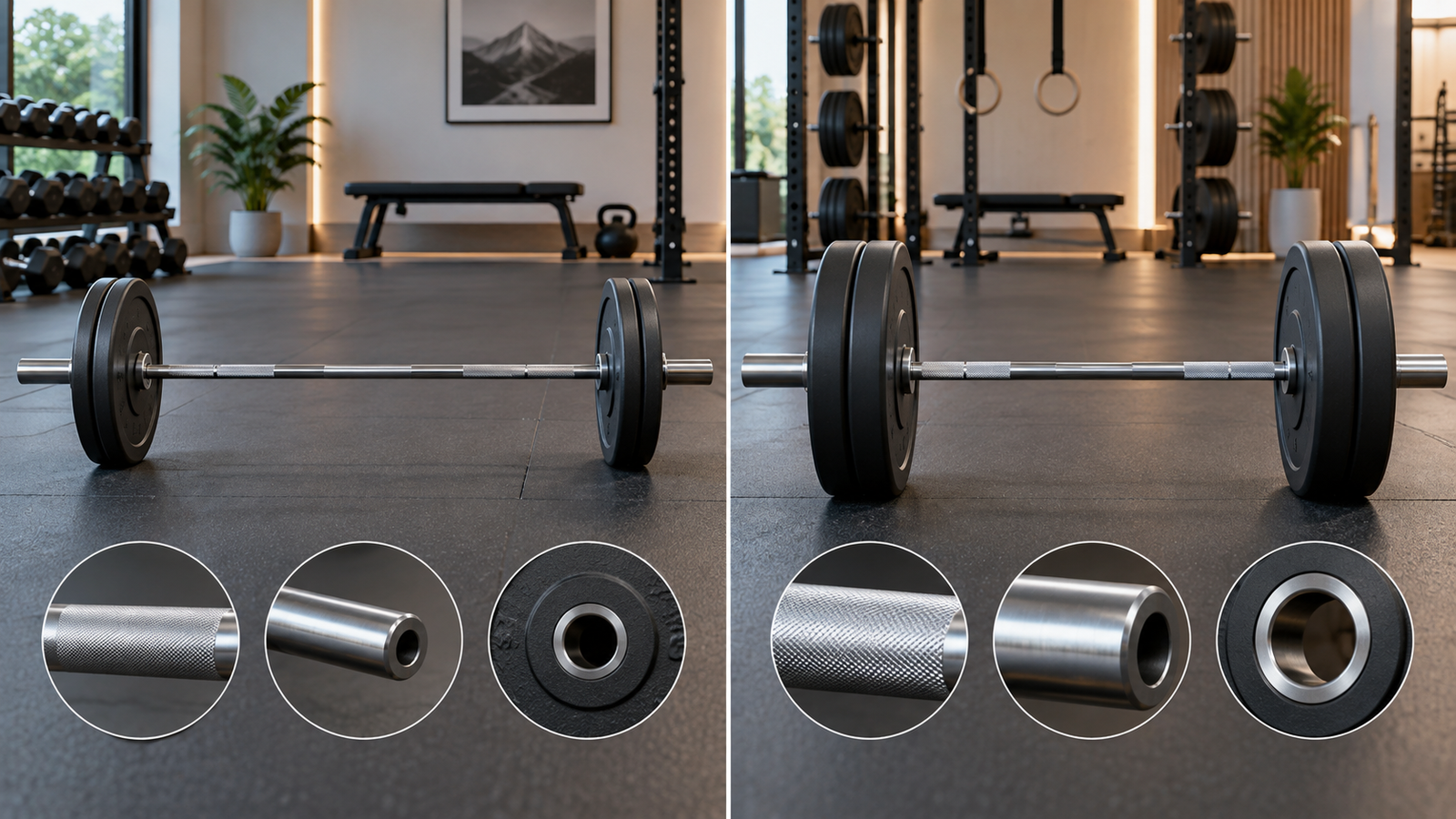
For most home-gym buyers, the most important difference is plate compatibility.
A standard plate is designed for a smaller bar sleeve.
An Olympic plate generally uses a much larger centre hole, commonly around 50 mm.
That means you cannot simply assume that any weight plate will fit any bar.
Before buying either component, check:
- Bar sleeve diameter
- Plate centre-hole diameter
- Collar compatibility
- Total sleeve length
- Manufacturer specifications
Compatibility should always come before colour, coating or appearance.
Why Plate Compatibility Matters So Much
Weight plates can represent a large part of the total cost of a strength-training setup.
Once you own several pairs of plates, changing bar systems becomes expensive.
For example, if you build a complete standard setup and later decide to move to an Olympic bar, your existing plates may no longer fit.
That is why it is useful to decide early whether you want:
- A compact basic system
or
- A more expandable Olympic-style system
The right choice depends on how serious you expect your strength training to become.
Standard Barbell Advantages
A standard barbell setup can make sense for many home users.
Lower Initial Cost
Standard bars and smaller plates are often available at lower entry prices.
This can make them suitable for:
- Beginners
- Casual users
- Light strength routines
- Compact home gyms
Smaller Size
Shorter standard bars can fit more easily into small rooms.
A 3-foot or 6-foot bar is easier to store than a full 7-foot Olympic bar.
Suitable for Basic Exercises
If your training consists mainly of curls, rows, shoulder work and lighter strength exercises, a standard system may provide everything you need.
Easier Storage
Short bars and smaller plate collections generally take less space.
This matters if you are training in:
- A bedroom
- Apartment
- Small home gym
- Multi-purpose room
Standard Barbell Limitations
The main disadvantage is long-term expandability.
Lower Potential Load Capacity
Many basic standard bars are not designed for very heavy lifting.
Always check the manufacturer’s stated capacity.
Smaller Equipment Ecosystem
There may be fewer compatible options for:
- Power racks
- Heavy-duty benches
- Specialty plates
- Bumper plates
- Advanced lifting accessories
Shorter Loading Sleeves
Some compact bars have limited space for adding plates.
This may become restrictive as your training progresses.
Olympic Barbell Advantages
Olympic-style systems are popular because they offer more room for progression.
Greater Long-Term Flexibility
An Olympic system makes it easier to build around:
- Squats
- Deadlifts
- Bench presses
- Heavy rows
- Overhead pressing
It is generally a better foundation for progressive strength training.
Wider Plate Selection
Olympic plates are available in many formats, including:
- Cast iron
- Rubber-coated
- Bumper plates
- Grip plates
- Competition-style plates
Rotating Sleeves
Many Olympic bars use rotating sleeves.
This allows the plates to rotate more independently from the shaft during certain lifts.
For normal home strength training, this may not be essential, but it is part of the design of higher-quality Olympic bars.
Better Rack Compatibility
Full-size Olympic bars are commonly designed for use with:
- Squat racks
- Power racks
- Bench press stations
This makes the system easier to expand over time.
Olympic Barbell Limitations
Olympic equipment is not automatically the best choice for every home.
Requires More Space
A full-size 7-foot bar needs considerable room.
You need enough width not only for the bar itself, but also for:
- Loading plates
- Moving around the bar
- Entering and exiting a rack safely
Higher Initial Cost
The total setup can become expensive when you add:
- Olympic bar
- Plates
- Collars
- Rack
- Bench
- Plate storage
Heavier Equipment
The bar itself can be significantly heavier than many standard bars.
This may not be ideal for someone who only wants light resistance training.
Bar Length: 3 Feet vs 6 Feet vs 7 Feet
Bar length matters almost as much as plate compatibility.
3-Foot Bars
A short 3-foot bar may work well for:
- Curls
- Triceps exercises
- Shoulder exercises
- Compact home workouts
It is not usually the right choice for rack-based squats or wide-grip bench pressing.
Its biggest advantage is storage.
6-Foot Bars
A 6-foot bar can provide a useful balance between:
- Exercise variety
- Manageable storage
- Moderate loading capacity
However, not every 6-foot bar fits every rack.
Check the distance between the sleeves before assuming compatibility.
7-Foot Bars
A full-length 7-foot bar is the typical choice for:
- Squats
- Bench presses
- Deadlifts
- General barbell strength training
It provides more loading space and tends to integrate better with standard-sized racks.
The drawback is the amount of room it occupies.
How Much Space Do You Need for a Barbell?
Measure your room before buying.
A 7-foot bar is already over two metres long.
You also need extra clearance to:
- Load and unload plates
- Move around the bar
- Use a rack
- Maintain safe distance from walls or furniture
A good barbell setup requires more space than the bar length alone.
Do not place a long bar into a narrow room where the sleeves nearly touch the walls.
Standard vs Olympic Weight Plates
The plates themselves also differ.
The most important factor is the centre-hole diameter.
Standard Plates
These are designed for smaller-diameter standard bars.
They are commonly sold in:
- Cast iron
- Plastic-coated formats
- Basic rubber-coated formats
They are often suitable for smaller home setups.
Olympic Plates
Olympic plates are designed for larger sleeves.
They commonly come in:
- Cast iron
- Rubber-coated plates
- Bumper plates
- Grip plates
They are generally easier to integrate into larger strength-training systems.
Rubber-Coated vs Cast-Iron Weight Plates
Once compatibility is confirmed, you can consider plate material.
Rubber-Coated Plates
Rubber-coated plates may offer several practical advantages.
They can:
- Reduce noise
- Reduce metal-on-metal contact
- Be more comfortable to handle
- Help protect flooring
However, they can also be thicker than bare cast-iron plates.
This matters because thicker plates occupy more sleeve space.
Cast-Iron Plates
Cast-iron plates are simple and durable.
They are often:
- Thinner
- Easy to store
- Straightforward
- Suitable for basic home strength training
The trade-off is more noise and less floor protection.
If you train on tile or delicate flooring, rubber gym flooring is worth considering.
What Are 50 mm Olympic Plates?
A plate labelled 50 mm refers to the approximate size of its centre hole.
These plates are designed for compatible Olympic-style sleeves.
If you see:
- 50 mm plates
- Olympic plates
- Olympic barbell
they are generally part of the same style of system.
Still, check the exact manufacturer’s specifications rather than assuming compatibility purely from marketing terms.
Can You Mix Weight Plates From Different Brands?
Often, yes.
If the dimensions are compatible, plates from different brands may work on the same bar.
The important factors are:
- Centre-hole size
- Bar sleeve size
- Plate thickness
- Available sleeve space
Brand does not matter as much as physical compatibility.
However, mixing different plate designs may make total loading less convenient.
How Much Weight Should You Buy?
This depends entirely on your current and expected strength levels.
A beginner does not necessarily need a 100 kg or 120 kg plate set immediately.
A practical setup might start with several smaller increments so weight can be increased gradually.
For example, having multiple plate sizes allows more controlled progression than owning only very heavy pairs.
Think about:
- Your strongest planned exercise
- Your current training level
- How quickly you expect to progress
- The bar’s rated capacity
- The rack or bench capacity
Do not buy more total load than your equipment is designed to support.
Full Weight Set vs Individual Pairs
Both approaches can make sense.
Buying a Full Set
A complete weight set is useful if you are building a gym from scratch.
Advantages include:
- Matching plate design
- Wide training range
- Easier progression
- One-time setup
The main disadvantage is cost.
Buying Individual Pairs
Buying plates gradually can be more economical.
This is useful if:
- You already own some plates
- You are progressing slowly
- You want specific weight increments
It also prevents buying plates you may never use.
What About Plate Thickness?
Plate thickness matters because the bar has limited sleeve length.
Two plates of the same weight can have very different thicknesses depending on material and design.
Very thick plates reduce the total number you can load on the bar.
This becomes particularly relevant for heavier lifters.
For beginners, it is usually less important than compatibility and total available weight.
Do You Need Barbell Collars?
In most barbell setups, collars are useful for helping keep plates in position.
They are especially important when:
- The bar moves through different angles
- You perform compound exercises
- The plates may shift during a set
Use collars designed for your specific bar sleeve.
A standard-bar collar and an Olympic-bar collar are not necessarily interchangeable.
Choosing Between 28 mm and 30 mm Grip Diameters
Some Olympic bars may list a grip or shaft diameter such as:
- 28 mm
- 29 mm
- 30 mm
This refers to the shaft area you hold.
A thinner grip may feel easier for some pulling movements.
A thicker shaft may feel more substantial but can be harder to grip for people with smaller hands.
For most recreational home lifters, small differences in shaft diameter are less important than:
- Construction
- Knurling
- Load capacity
- Sleeve design
- Bar length
What Is Knurling?
Knurling is the textured pattern cut into the barbell shaft.
It helps improve grip.
Aggressive knurling can provide stronger grip but may feel rough on the hands.
Milder knurling may be more comfortable for general training.
Some bars also have centre knurling, while others do not.
This can matter for certain lifts, but is not usually the first buying consideration for a beginner.
How to Choose a Barbell for a Home Gym
Use the following sequence.
Step 1: Decide Your Main Exercises
If your plan includes:
- Squats
- Deadlifts
- Bench presses
- Heavy rows
an Olympic-style system is usually the more expandable option.
If you mainly want:
- Curls
- Shoulder exercises
- Light rows
- Compact workouts
a standard bar may be sufficient.
Step 2: Measure Your Room
Check:
- Room width
- Ceiling height
- Rack area
- Plate-loading clearance
- Storage area
Do this before ordering.
Step 3: Choose One Plate System
Avoid mixing incompatible standard and Olympic equipment.
Plan the bar and plates together.
Step 4: Check Load Capacity
Verify the rated capacity of:
- Barbell
- Rack
- Bench
- Flooring setup
The system is only as strong as its weakest component.
Step 5: Plan for Future Progression
Think beyond your current strength.
A slightly more expandable system can make sense if you expect to train consistently for years.
Common Barbell Buying Mistakes
Buying Plates Before Checking the Bar
The plates may not fit.
Always verify dimensions first.
Buying a Long Bar for a Small Room
A 7-foot bar may become frustrating or unsafe if the room is too narrow.
Choosing Only by Total Weight
A 100 kg set is not automatically better than a 50 kg set.
Compatibility, increments and training needs matter more.
Ignoring Rack Compatibility
A bar may technically work for lifting from the floor but may not fit properly across your rack hooks.
Assuming Every “Olympic” Product Is Identical
Dimensions, capacity and build quality vary between manufacturers.
Check specifications carefully.
Buying Too Many Heavy Plates
Smaller increments are useful for progressive overload.
A useful setup should allow gradual changes in load.
Which Setup Is Better for Beginners?
There is no universal answer.
A standard setup can be a sensible beginner choice if:
- Space is limited
- Budget is limited
- Training loads will remain moderate
- You mainly perform basic accessory exercises
An Olympic setup can be better if:
- You want to build a serious home gym
- You plan to squat, bench and deadlift regularly
- You expect your strength to increase significantly
- You want easier future upgrades
The Olympic system usually offers more long-term flexibility.
Which Setup Is Better for Small Apartments?
Usually a compact standard bar is easier to manage.
A short bar and limited number of plates can be stored more easily.
However, if you still want Olympic compatibility, shorter Olympic-style bars are available in some markets.
Check whether the reduced bar length still works with your intended rack.
Which Setup Is Better for Heavy Strength Training?
A properly rated Olympic barbell system is generally the more appropriate direction for heavier progressive lifting.
That does not mean every Olympic bar is automatically suitable for very heavy loads.
Always check the manufacturer’s stated capacity and intended use.
How Should Weight Plates Be Stored?
Plates should not be left where they can roll, tip or become trip hazards.
Useful storage options include:
- Plate trees
- Wall-mounted storage
- Rack-mounted plate pegs
- Horizontal plate holders
Heavy plates should be stored securely and in a way that is easy to access without awkward lifting.
When Should You Replace a Barbell or Plate?
Inspect equipment regularly.
Stop using equipment if you notice:
- Cracks
- Severe bending
- Loose sleeves
- Damaged collars
- Significant corrosion affecting structural areas
- Cracked rubber around plate hubs
Strength equipment should be treated as load-bearing hardware, not simply decorative gym equipment.
Standard vs Olympic: Quick Decision Guide
Choose a standard barbell system if you want:
- Lower initial cost
- Compact equipment
- Light to moderate lifting
- Simple home workouts
- Easier storage
Choose an Olympic barbell system if you want:
- Better long-term progression
- Rack-based strength training
- Higher loading potential
- Wider equipment choice
- A more complete home gym
Neither system is automatically better.
The correct one is the system that fits your room, training plan and future goals.
Frequently Asked Questions
Can Standard Weight Plates Fit an Olympic Bar?
Generally not if the plate’s centre hole is smaller than the Olympic sleeve.
Use plates designed for the bar you own.
Can Olympic Plates Fit a Standard Bar?
The hole may be too large to sit correctly on a smaller standard bar, making the setup unsuitable.
Use properly matched equipment rather than improvised adapters unless they are specifically designed and approved for that use.
Are Olympic Barbells Only for Advanced Lifters?
No.
“Olympic” describes the equipment format, not the user’s skill level.
Beginners can use Olympic equipment if it fits their goals and they learn appropriate lifting technique.
Do I Need a 20 kg Olympic Bar?
Not necessarily.
Different bars are available at different weights.
Choose a bar appropriate for your training level, exercise selection and equipment setup.
Are Rubber Plates Better for Home Gyms?
They can be useful because they reduce noise and protect surfaces, but they may cost more and occupy more sleeve space.
Should I Buy a Barbell Before Weight Plates?
The order is not important as long as you plan both together.
Compatibility should be confirmed before purchasing either.
Final Takeaway
The choice between standard and Olympic barbells is ultimately a choice between a compact basic system and a more expandable strength-training system.
A standard barbell can be perfectly adequate for light to moderate home training, especially where space and budget are limited.
An Olympic system makes more sense when you plan to build your home gym around exercises such as squats, bench presses and deadlifts and want room for long-term progression.
Before buying anything, confirm:
- Bar diameter
- Plate-hole size
- Bar length
- Rack compatibility
- Load capacity
- Available room
- Storage space
The most important rule is simple: choose the bar and weight plates as one compatible system rather than purchasing them separately and hoping they fit.