Foam vs Silicone Earplugs: Fit, Reuse and Safe Everyday Use
Compare disposable foam, corded foam and reusable silicone earplugs by fit, hygiene, comfort and manufacturer-stated noise reduction.
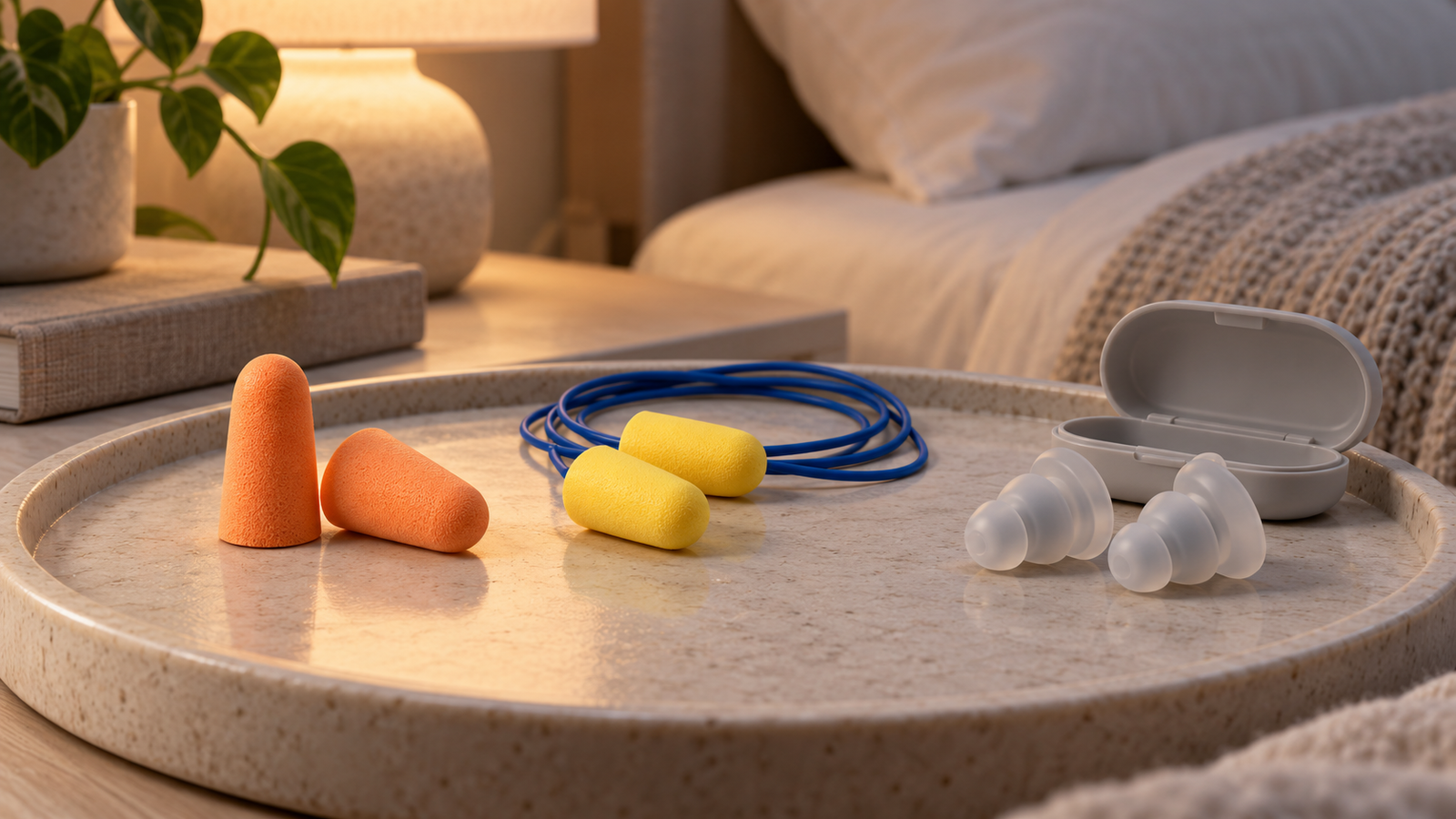
Foam and silicone earplugs are both used to reduce unwanted sound, but they differ substantially in fit, comfort, reuse and maintenance.
Foam earplugs are usually compressed and inserted into the ear canal, where they expand to create a seal. Silicone earplugs may either sit at the entrance of the ear canal as mouldable putty or use reusable flanged designs that fit partly inside the canal.
Neither material is automatically better.
The right choice depends on where you plan to use the earplugs, how sensitive your ears are, whether you want disposable or reusable protection and how reliably you can achieve a proper seal.
What are foam earplugs?
Foam earplugs are typically made from soft slow-recovery foam.
Before insertion, the plug is rolled into a narrow cylinder. It is then placed into the ear canal, where it gradually expands.
This expansion helps create a seal against surrounding sound.
Foam earplugs are widely used for:
- Sleeping.
- Studying.
- Travel.
- Workplace noise.
- Events.
- General noise reduction.
Many models are inexpensive enough to be treated as disposable products.
What are silicone earplugs?
“Silicone earplug” can describe more than one design.
Two common versions are:
Mouldable silicone earplugs
These are soft putty-like plugs that are shaped over the opening of the ear rather than pushed deeply into the canal.
They are often used for:
- Sleeping.
- Swimming.
- Travel.
- Users who dislike deep insertion.
Reusable flanged silicone earplugs
These use one or more flexible silicone flanges that sit inside the ear canal.
They may be attached to:
- A stem.
- A small handle.
- A cord.
These are usually washable and intended for repeated use.
Foam vs silicone earplugs at a glance
| Factor | Foam earplugs | Silicone earplugs |
|---|---|---|
| Typical fit | Expands inside ear canal | Moulds over opening or uses flanges |
| Reuse | Usually limited | Often reusable |
| Initial cost | Usually lower | Usually higher |
| Maintenance | Minimal | Requires regular cleaning |
| Fit consistency | Depends strongly on insertion | Depends on shape/design |
| Sleep comfort | Often good | Often good, especially low-profile types |
| Deep insertion | Usually yes | Varies |
| Water use | Not usually ideal | Some types are designed for swimming |
| Portability | Excellent | Excellent |
| Best for | Disposable everyday noise reduction | Reuse, shallow fit or specific activities |
The most important factor is fit
Earplugs only work well when they create an effective seal.
A highly rated product can perform poorly if it does not fit your ear properly.
Common reasons for poor performance include:
- Incorrect insertion.
- Plug too large or too small.
- Ear canal shape.
- Insufficient expansion.
- Loose silicone seal.
- Movement during sleep.
This is why practical comfort and fit can matter as much as the advertised noise-reduction number.
How foam earplugs create a seal
Foam plugs depend on compression and expansion.
A typical insertion technique involves:
- Rolling the foam plug between clean fingers until it becomes narrow.
- Reaching over the head with the opposite hand.
- Gently pulling the outer ear upward and backward.
- Inserting the compressed plug.
- Holding it in place while the foam expands.
If the plug expands before it is inserted far enough, it may sit too loosely.
If inserted too aggressively, it may become uncomfortable.
Why foam earplugs sometimes seem ineffective
A common problem is simply pushing an uncompressed foam plug into the ear.
This usually produces a shallow fit and weak seal.
Another mistake is rolling only the tip instead of compressing the entire plug.
A properly inserted foam earplug should generally feel secure without causing pain.
If much of the plug remains outside the ear, the insertion may be too shallow, though exact fit varies by product and ear anatomy.
How mouldable silicone earplugs work
Mouldable silicone plugs usually create a seal over the entrance of the ear canal.
They are softened between the fingers and gently shaped to cover the opening.
They should not normally be pushed deeply into the canal.
This surface-sealing design can appeal to people who dislike the feeling of an expanding plug inside the ear.
How reusable silicone flange plugs work
Flanged plugs are inserted into the canal.
The flexible flanges bend slightly and create seals at different points.
Unlike foam, they do not expand after insertion.
This means the plug shape and size must already match the ear reasonably well.
Some products offer:
- Small.
- Medium.
- Large.
Others use a universal multi-flange design.
Which material blocks more sound?
Material alone does not determine performance.
Noise reduction depends on:
- Product design.
- Fit.
- Seal.
- Ear anatomy.
- Frequency of the sound.
Some foam earplugs offer very high advertised noise-reduction ratings.
Some reusable silicone models offer lower attenuation but may be easier for a particular user to fit consistently.
A product that seals correctly is usually more useful than one with a higher specification that repeatedly fits poorly.
What is a noise reduction rating?
Earplugs may display a laboratory-derived noise-reduction value.
Depending on the country and testing standard, you may see terms such as:
- NRR.
- SNR.
These ratings are useful for comparing products tested under the relevant standard, but they do not mean you will experience exactly that reduction in real life.
Actual performance is often lower because of:
- Imperfect fit.
- Movement.
- Incorrect insertion.
- Differences between ears.
Treat the rating as comparative information rather than a guarantee.
Do earplugs make a room completely silent?
No.
Earplugs reduce sound; they do not eliminate all sound.
You may still hear:
- Alarms.
- Voices.
- Traffic.
- Vibrations.
- Low-frequency noise.
Some sound also reaches the inner ear through vibration conducted through the head and body.
If a product claims to create complete silence, that should be treated cautiously.
Foam earplugs for sleep
Foam plugs are popular for sleeping because they are:
- Soft.
- Lightweight.
- Inexpensive.
- Available in low-profile shapes.
However, side sleepers may find some large plugs uncomfortable if they protrude from the ear.
Smaller or softer foam designs can be more comfortable.
Silicone earplugs for sleep
Silicone can also work well for sleep.
Mouldable designs are often attractive to side sleepers because they can sit relatively flat against the outer ear.
Reusable flange models may protrude more.
For sleep, consider:
- How much of the plug sticks out.
- Whether it presses against the pillow.
- Whether it stays sealed when you move.
Comfort for eight hours matters more than a minor difference in specifications.
Side-sleeper comfort
For side sleepers, the ear is pressed toward the pillow.
A bulky earplug can create pressure.
Look for:
- Low-profile foam.
- Mouldable silicone.
- Short-stem reusable designs.
If you wake with ear soreness, the product may be too large, too rigid or inserted too deeply.
Earplug size matters
Ear canals vary significantly.
A plug that fits one person perfectly may be uncomfortable for another.
Signs a plug may be too large include:
- Pressure.
- Pain.
- Difficulty inserting.
- Persistent soreness.
Signs it may be too small include:
- Falling out.
- Weak sound reduction.
- Loose seal.
Products offering multiple sizes can be useful if standard plugs do not fit well.
Foam density and comfort
Foam products differ in softness and recovery speed.
Softer foam
May feel more comfortable for extended use.
It can be particularly useful for sleeping.
Firmer foam
May feel easier to insert but can create more pressure as it expands.
Slow-recovery foam
Gives you more time to position the plug before it expands.
For beginners, slow-recovery foam can be easier to use.
Tapered vs cylindrical foam plugs
Tapered foam
The narrower tip can make insertion easier.
It may suit users with smaller ear canals.
Cylindrical foam
Provides a consistent shape and may create a firm seal.
However, some users find it bulkier.
There is no universally superior shape.
Corded foam earplugs
Some foam plugs are connected by a cord.
These can be useful when:
- Removing plugs frequently.
- Working in noisy environments.
- You are concerned about losing them.
For sleeping, a cord may be inconvenient because it can become tangled or press against the skin.
Reusable silicone earplugs
Reusable models can be more economical over time.
Their useful life depends on:
- Product quality.
- Cleaning.
- Frequency of use.
- Storage.
Replace them when the material becomes:
- Hard.
- Torn.
- Sticky.
- Deformed.
- Difficult to clean.
Can foam earplugs be reused?
Some users reuse foam plugs, but disposable foam products are generally not intended for indefinite use.
Foam gradually becomes:
- Dirty.
- Less compressible.
- Less able to expand properly.
Follow the manufacturer’s instructions.
If a disposable plug looks dirty or no longer returns to shape correctly, replace it.
How to clean reusable silicone plugs
Follow the product instructions.
For washable reusable plugs, cleaning may involve:
- Removing visible debris.
- Washing with mild soap and water.
- Rinsing thoroughly.
- Allowing them to dry completely.
- Storing them in a clean case.
Avoid harsh chemicals unless the manufacturer specifically approves them.
Can mouldable silicone plugs be washed?
Not all mouldable silicone products are intended for washing.
Some become less effective once contaminated with:
- Hair.
- Dust.
- Skin oils.
Check the manufacturer’s guidance.
Replace mouldable plugs when they stop holding a clean seal.
Why storage matters
Reusable earplugs should be stored in a clean case.
Leaving them loose in:
- Pockets.
- Handbags.
- Gym bags.
can expose them to dirt and debris.
A small ventilated or clean storage case makes repeated use more hygienic.
Earplugs for travel
Both foam and silicone models work well for travel.
Foam is convenient because:
- It weighs almost nothing.
- You can carry several spare pairs.
- No cleaning is necessary during short trips.
Reusable silicone is useful if you prefer one familiar fit and do not want to carry disposable pairs.
Earplugs on flights
Earplugs can reduce cabin noise, but ordinary noise-reduction plugs do not necessarily address changes in air pressure during ascent and descent.
Some specialised filtered travel plugs are designed differently.
If pressure-related ear discomfort is your main concern, standard sleeping plugs and pressure-regulating travel plugs should not be treated as identical products.
Earplugs for studying
For studying, comfort and moderate noise reduction may be more important than maximum isolation.
You may still want to hear:
- Doorbells.
- Family members.
- Important announcements.
Reusable silicone designs can be convenient if used daily.
Foam plugs may provide stronger isolation in noisier environments.
Earplugs for office use
Earplugs can reduce distracting background sound.
However, strong noise reduction may also make communication difficult.
For offices, filtered or lower-attenuation plugs may sometimes be more practical than maximum-blocking foam.
Earplugs for concerts
Concert ear protection is a separate use case.
Standard foam plugs can reduce overall sound levels but may alter the balance of music frequencies.
Musician-style filtered earplugs are designed to reduce sound more evenly.
If music quality matters, consider a filtered product rather than simply selecting the highest-rated sleeping plug.
Earplugs for very loud workplaces
Industrial noise exposure is different from ordinary household noise.
Use hearing protection that meets the relevant workplace safety requirements.
The correct type depends on:
- Noise level.
- Duration.
- Work environment.
In very high noise, earplugs may need to be combined with earmuffs.
Workplace hearing protection should follow the employer’s safety programme rather than relying solely on consumer product reviews.
Earplugs for swimming
Some silicone earplugs are designed to help reduce water entry.
Foam earplugs are generally not ideal for swimming because foam can absorb water and lose its intended properties.
Use a product specifically labelled for swimming.
Noise-blocking earplugs and swimming earplugs are not necessarily interchangeable.
Earplugs for children
Children have smaller ear canals.
Adult plugs may not fit safely or comfortably.
Use age-appropriate products and follow the manufacturer’s guidance.
Young children should use ear protection under adult supervision.
For very loud environments, correctly fitted earmuffs may sometimes be easier to manage.
Can earplugs get stuck?
Improper insertion can make removal difficult.
Do not push earplugs deeper than directed.
To remove an inserted plug:
- Grip it gently.
- Twist slightly if needed.
- Pull out slowly.
Rapid removal of a tightly sealed plug can feel uncomfortable because of the pressure change.
If an earplug becomes lodged and cannot be removed safely, seek medical assistance rather than using sharp objects.
Never use tools inside the ear
Do not use:
- Tweezers.
- Pins.
- Cotton swabs.
- Hair clips.
to retrieve a deeply lodged plug.
These can push the object farther inside or injure the ear canal or eardrum.
Can earplugs cause earwax buildup?
Frequent earplug use may interfere with the natural movement of earwax in some people.
Signs of significant wax buildup can include:
- Blocked sensation.
- Reduced hearing.
- Ear fullness.
- Ringing.
Do not repeatedly insert objects to remove earwax.
Professional assessment is appropriate if symptoms persist.
Earplugs and ear infections
Earplugs do not automatically cause infections, but hygiene matters.
Risk may increase when plugs are:
- Dirty.
- Shared.
- Inserted with unclean hands.
- Used in already irritated ears.
Do not share personal earplugs.
Stop using them if the ear canal becomes painful, swollen or develops discharge.
Can you wear earplugs every night?
Many people use earplugs regularly for sleep.
Regular use requires attention to:
- Cleanliness.
- Fit.
- Ear comfort.
- Earwax.
Persistent discomfort or recurrent ear problems should be assessed rather than simply switching brands repeatedly.
What if earplugs hurt?
Pain is a sign that the fit is not right.
Possible reasons include:
- Plug too large.
- Insertion too deep.
- Excessive foam expansion.
- Rigid silicone.
- Existing ear irritation.
Remove the plug and try a different size or design.
Do not try to “get used to” persistent pain.
What if one ear fits differently?
This is common.
Your two ear canals do not have to be identical.
You may even need:
- Different plug sizes.
- Slightly different insertion depth.
Multi-size reusable sets can be helpful in this situation.
Earplugs and tinnitus
Earplugs reduce external sound, which can make internal sounds such as tinnitus seem more noticeable in a quiet environment.
Earplugs are not a treatment for tinnitus.
If ringing is new, persistent or associated with hearing changes, professional assessment is appropriate.
Can earplugs block alarms?
They can reduce the volume of an alarm.
How much depends on:
- Plug attenuation.
- Alarm frequency.
- Alarm volume.
- Distance.
If you rely on an alarm for safety or waking, test your setup before sleeping with strong noise-reduction earplugs.
Vibrating alarms or smartwatches may provide an additional wake-up method.
Comfort vs maximum noise reduction
A common mistake is choosing the plug with the largest rating even if it is uncomfortable.
A plug you remove after one hour is not useful for an eight-hour night.
For regular use, balance:
- Noise reduction.
- Fit.
- Pressure.
- Heat.
- Ease of removal.
Foam vs silicone for sensitive ears
Some people prefer silicone because it can avoid the expanding pressure created by foam.
Others find soft foam more comfortable than silicone flanges.
There is no universal answer.
If your ear canals are sensitive, a shallow mouldable silicone design may be worth considering.
Material sensitivity
Although uncommon, some users can develop irritation from particular materials or surface coatings.
Stop using a product if you develop:
- Persistent itching.
- Rash.
- Swelling.
- Burning.
Do not keep inserting an earplug into inflamed skin.
How to test fit at home
After inserting the earplug correctly:
- Listen to normal room sounds.
- Cup your hands over your ears.
- Remove your hands.
- Compare the difference.
If cupping your hands creates a dramatic additional reduction, the plugs may not be sealing effectively.
This is only a simple practical check, not a substitute for formal fit testing in occupational environments.
Common foam earplug mistakes
Typical mistakes include not compressing the plug fully, letting it expand before insertion, failing to straighten the ear canal during fitting, inserting it too shallowly and reusing visibly dirty disposable plugs.
A good fit should feel secure without creating pain.
Common silicone earplug mistakes
Typical problems include pushing mouldable silicone deep into the ear canal, using dirty reusable plugs, selecting the wrong flange size and failing to create a complete seal.
Follow the design-specific instructions.
Mouldable plugs and flanged plugs are inserted differently.
How to compare earplugs before buying
| Factor | What to check |
|---|---|
| Material | Foam or silicone |
| Design | Inserted, mouldable or flanged |
| Noise rating | NRR, SNR or applicable standard |
| Size | Universal or multiple sizes |
| Reusability | Disposable or washable |
| Sleep profile | How far does the plug protrude? |
| Cleaning | Easy to wash and dry? |
| Storage | Case included? |
| Activity | Sleep, travel, swimming or workplace use |
| Quantity | Cost per pair and expected lifespan |
Cost comparison
Foam earplugs usually have the lower initial cost.
However, regular users may go through many pairs.
Reusable silicone costs more upfront but may cost less over time if:
- The plugs fit well.
- They are cleaned properly.
- Replacement is not frequent.
Calculate value based on how often you use them rather than the price of one pair.
Which is better for occasional use?
Foam is usually convenient for occasional use.
You can keep several pairs in:
- Travel bags.
- Bedside drawers.
- Work bags.
They require little maintenance.
Which is better for daily use?
Reusable silicone can be practical for daily use if you are comfortable cleaning and storing it properly.
However, some daily sleepers still prefer disposable foam because of its softness and consistent fresh fit.
Which is better for side sleepers?
Low-profile mouldable silicone or soft short foam plugs are often the most comfortable options.
Avoid long stems that press against the pillow.
Individual ear shape remains important.
Which is better for maximum noise reduction?
Well-fitted foam earplugs often provide high levels of attenuation.
But actual effectiveness depends on insertion.
A correctly fitted silicone plug can outperform a poorly inserted foam plug in real-world use.
Which is easier to use?
Mouldable silicone can be easier for users who dislike canal insertion.
Reusable flanged silicone is quick once the correct size is found.
Foam requires a little more technique because it must be compressed and held while expanding.
Frequently asked questions
Are foam earplugs better than silicone earplugs?
Neither is universally better.
Foam is inexpensive and often provides strong noise reduction, while silicone offers reusable and shallow-fit options.
Which is better for sleeping?
Both can work.
Choose the model that remains comfortable when lying on your side and stays sealed through the night.
Can foam earplugs be reused?
Some may tolerate limited reuse, but many are intended to be disposable. Follow the manufacturer’s instructions and replace dirty or damaged plugs.
How long do reusable silicone earplugs last?
There is no universal lifespan. Replace them when they become damaged, hardened, deformed or difficult to clean.
Can silicone earplugs go inside the ear canal?
Reusable flanged silicone plugs are designed for insertion. Mouldable putty-style silicone plugs are usually intended to cover the canal entrance rather than being pushed deeply inside.
Which is better for swimming?
Use silicone earplugs specifically designed for swimming.
Why can I still hear while wearing earplugs?
Earplugs reduce sound rather than eliminating it completely. Fit and sound frequency also affect how much you hear.
Why does my voice sound different with earplugs?
Blocking the ear canal can make internally conducted sounds such as your own voice sound louder or deeper. This is known as the occlusion effect.
Can I share reusable earplugs?
It is better not to. Earplugs are personal items that come into direct contact with the ear canal or surrounding skin.
Should I wear earplugs if my ear already hurts?
Avoid inserting an earplug into a painful or inflamed ear until the cause has been assessed.
Choosing between foam and silicone earplugs
Start with the activity.
For inexpensive, strong everyday noise reduction, foam is often the simplest choice.
For repeated use, easier cleaning or a shallower fit, silicone may be more practical.
For sleeping, focus heavily on pressure and how far the plug protrudes. For swimming, choose a product specifically designed to limit water entry. For occupational noise, choose certified hearing protection suitable for the actual exposure level and ensure it fits correctly.
The highest advertised rating does not help if you cannot wear the product comfortably or achieve a reliable seal.
Physical Glow’s Top 5 Earplugs and Sleep Masks for Bedroom Comfort in India comparison looks at disposable foam, reusable silicone and other sleep-focused formats. Use that comparison alongside this guide, then verify the current noise-reduction rating, sizing, reuse instructions, cleaning method and intended activity for the exact earplugs you plan to buy.